


Science Show Demonstrations
- Air vortices – Shooting compressed air rings over the class – discussion on pressure
- Bernoulli balls – Float balls in mid-air, relating curved surfaces to wing design
- Coloured shadows – Colour addition vs colour subtraction
- Fire ball – Learn about the fire triangle in this highly visual demonstration
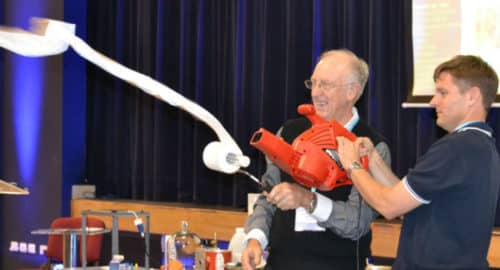
- Flying toilet paper – Demonstration on how the Coanda effect helps planes to fly
- Giant gyroscope – A student uses a giant gyroscope to spin on a rotating platform
- Gigantic bubbles – Have a look at surface tension in a different way
- Laser sights – How are lasers used in atmospheric research?
- Liquid Nitrogen Demos – Flying glove, popping tins, nitrogen sprinkler, bubble column, fog and more
- Mega hoberman sphere – An expanding sphere (1ft to 4ft). Gravity, forces, friction & big bang.
- Nail chair – How can you sit on a nail chair and be OK? Dispelling magic myths…
- Newton colour wheel – Colour addition experiment for the entire audience.
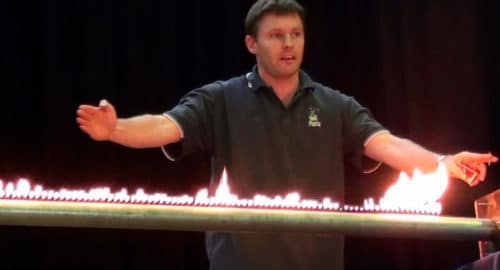
- Rubens Tube – A ‘flame equalizer’, how does it work?
- Slinky Shake – A visual representation of sound waves
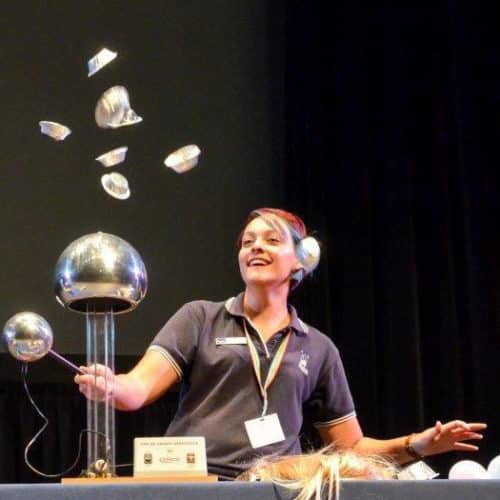
- Van de Graf hair rise – Opposite charges attract, like charges repel… related to a ‘Fun fly stick’ toy
- Flying foil plates – Another version of liker charges repel
- Glowing fluorescent tube – How does an electromagnetic field do this?
What Students Experience
The Ultimate Science Journey
Big Science Big Fun is designed to demonstrate the sheer breadth of the physical and chemical world. By bridging multiple disciplines in one high-impact session, we provide students with a panoramic view of how science explains everything from the air we breathe to the energy that powers our lives.
1. Forces, Flight & Motion
We explore the physics of movement. From levitating beach balls and the Bernoulli principle to giant gyroscopes and the mechanics of flight, students see how forces shape our world.
2. Exploring Energy
Students see the hair-raising power of static electricity and energy transfer. Using the Van de Graaff generator, we make abstract energy concepts visible and memorable.
3. Light, Sound & Chemistry
The journey rounds out with optics and acoustics. Students explore coloured shadows, flame equalisers, and energetic fireballs, connecting light and sound energy to chemical reactions.
Science in Action
Our Commitment to Quality Science Education
A Trusted School Partner for hundreds of Australian schools.
Supporting teachers and students since 2004 with reliable, syllabus-aligned visits.
Since 2004, we have provided stable, high-quality STEM support.
Our programs are refined through constant dialogue with teachers.
Led by science specialists who understand classroom dynamics.

Australian Curriculum Mapping
Australian National Curriculum Mapping for all our science incursions
Australian ACARA Content Outcomes:
Science F-10 Version 9.0
Year 7
- investigate and represent balanced and unbalanced forces, including gravitational force, acting on objects, and relate changes in an object’s motion to its mass and the magnitude and direction of forces acting on it AC9S7U04
- use particle theory to describe the arrangement of particles in a substance, including the motion of and attraction between particles, and relate this to the properties of the substance AC9S7U05
Year 8
- compare physical and chemical changes and identify indicators of energy change in chemical reactions AC9S8U07
Year 7 & 8
- explain how new evidence or different perspectives can lead to changes in scientific knowledge AC9S7H01 AC9S8H01
- examine how proposed scientific responses to contemporary issues may impact on society and explore ethical, environmental, social and economic considerations AC9S7H03 AC9S8H03
- develop investigable questions, reasoned predictions and hypotheses to explore scientific models, identify patterns and test relationships AC9S7I01 AC9S8I01
- analyse data and information to describe patterns, trends and relationships and identify anomalies AC9S7I05 AC9S8I05
- construct evidence-based arguments to support conclusions or evaluate claims and consider any ethical issues and cultural protocols associated with using or citing secondary data or information AC9S7I07 AC9S8I07
Year 9
- use wave and particle models to describe energy transfer through different mediums and examine the usefulness of each model for explaining phenomena AC9S9U04
Year 9 & 10
- explain how scientific knowledge is validated and refined, including the role of publication and peer review AC9S9H01 AC9S10H01
- Investigate how advances in technologies enable advances in science, and how science has contributed to developments in technologies and engineering AC9S9H02 AC9S10H02
- develop investigable questions, reasoned predictions and hypotheses to test relationships and develop explanatory models AC9S9I01 AC9S10I01
- analyse and connect a variety of data and information to identify and explain patterns, trends, relationships and anomalies AC9S9I05 AC9S10I05
- construct arguments based on analysis of a variety of evidence to support conclusions or evaluate claims, and consider any ethical issues and cultural protocols associated with accessing, using or citing secondary data or information AC9S9I07 AC9S10I07
Australian National Curriculum Mapping for all our science workshops & shows

NSW K-10 Science Syllabus Mapping
NSW Science 7–10 Syllabus (2023)
Stage 4
A student:
- identifies questions and makes predictions to guide scientific investigations SC4-WS-02
– Identify questions and problems that can be investigated scientifically
– Make predictions based on scientific knowledge and observations - explains how the properties of substances enable separation in a range of techniques SC4-SOL-01
– Compare the properties of dilute, concentrated, saturated and supersaturated solutions - explains how uses of elements and compounds are influenced by scientific understanding and discoveries relating to their properties SC4-PRT-01
– Identify some common elements in everyday objects
– Conduct a series of investigations to identify and compare the physical properties of metals, non-metals and metal - explains how energy causes geological and chemical change SC4-CHG-01
– Undertake experiments to identify the indicators of physical and chemical changes
– Describe the initial and final changes that are observed in a chemical reaction, including writing a word equation to represent a chemical reaction. - describes the effects of forces in everyday contexts SC4-FOR-01
– Explain forces as either direct (contact) or indirect (non-contact)
– Conduct a practical investigation on the effects of a range of direct and indirect forces
– Investigate examples of forces and magnetism in familiar contexts
Stage 5
- asks questions or makes predictions using observations SCLS-WS-02
– Ask questions about familiar objects and events based on observations
– Make predictions based on observations - explains the factors that affect the rate of chemical reactions SC5-RXN-02
– Investigate and explain how concentration, surface area, temperature and catalysts affect the rate of reactions - describes the features and applications of different forms of waves SC5-WAM-01
– Use the wave model to explain how energy is transferred without the net transfer of particles
– Use models to compare and describe the features of transverse and longitudinal waves
– Compare the different wave regions of the electromagnetic spectrum
– Investigate the features of waves, including amplitude, frequency, speed and wavelength by exploring a range of wave types
– Investigate applications of absorption, reflection and refraction in everyday life
NSW K – 10 Science Syllabus mapping for all our NSW incursions

VIC Science Syllabus Content
VIC Curriculum F–10 Version 2.0
For explanatory points & implementation advice for each dot point, please visit the VIC Curriculum F-10 site.
Levels 7 and 8
- the particle and kinetic theories of matter can be used to describe the arrangement and motion of particles in a substance, including the attraction between particles, and to explain the properties and behaviour of substances, including melting point, boiling point, density, compressibility, gas pressure, viscosity, diffusion, sublimation, and expansion and contraction. VC2S8U05
- physical changes can be distinguished from chemical changes; a chemical change can be identified by a colour change, a temperature change, the production of a gas (including laboratory preparation and testing of oxygen, carbon dioxide and hydrogen gases) or the formation of a precipitate. VC2S8U08
- balanced and unbalanced forces acting on objects, including gravitational force, may be investigated and represented using force diagrams; changes in an object’s motion can be related to its mass and the magnitude and direction of the forces acting on it. VC2S8U14
- energy exists in different forms, including thermal, chemical, gravitational and elastic, and may be classified as kinetic or potential; energy transfers (conduction, convection and radiation) and transformations occur in simple systems and can be analysed in terms of energy efficiency. VC2S8U15
- investigable questions, reasoned predictions and hypotheses can be developed in guiding investigations to identify patterns, test relationships and analyse and evaluate scientific models. VC2S8I01
- scientific methods, conclusions and claims can be analysed to identify assumptions, possible sources of error, conflicting evidence and unanswered questions. VC2S8I06
- evidence-based arguments can be constructed to support conclusions or evaluate claims, including consideration of ethical issues and protocols associated with using or citing secondary data or information. VC2S8I07
Levels 9 & 10
- wave and particle models can be used to describe energy transfer (conduction, convection and radiation) through different media; waves (electromagnetic and mechanical) have different properties, features (including amplitude, wavelength, frequency and speed) and applications. VC2S10U14
- chemical reactions are described by the Law of Conservation of Mass and involve the rearrangement of atoms; they can be modelled using a range of representations, including word and simple balanced chemical equations. VC2S10U08
- chemical reactions include synthesis, decomposition and displacement reactions and can be classified as exothermic or endothermic; reaction rates are affected by factors including temperature, concentration, surface area of solid reactants, and catalysts. VC2S10U09
- investigable questions, reasoned predictions and hypotheses can be used in guiding investigations to test and develop explanatory models and relationships. VC2S10I01
- the validity and reproducibility of investigation methods and the validity of conclusions and claims can be evaluated, including by identifying assumptions, conflicting evidence, biases that may influence observations and conclusions, sources of error and areas of uncertainty. VC2S10I06
- arguments based on a variety of evidence can be constructed to support conclusions or evaluate claims, including consideration of any ethical issues and cultural protocols associated with accessing, using or citing secondary data or information. VC2S10I07






