


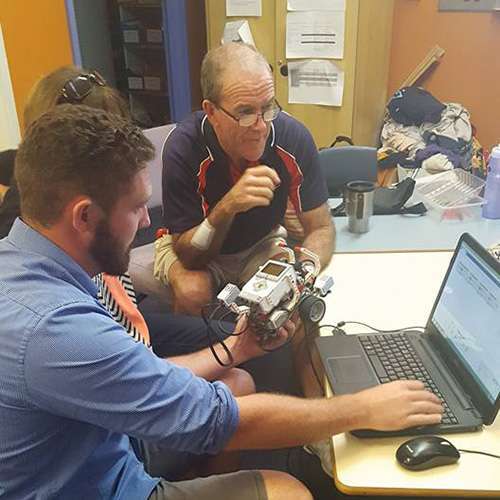

Lego Robotics TPL Rapid Upskill!
Designed from real classroom experiences, this day is designed to help you deliver effective Lego robotics lessons that teach your students how to code and apply this computational thinking to a variety of STEM challenges.
- Suitable for all Primary Teachers and available Australia-wide.
- Meets the Australian Professional Standards for Teachers
- Designed to build digital literacy & STEM capacity in your school
- Highly interactive & hands-on… you will be programming EV3 Lego Mindstorm Robots throughout the day!
- Embedded curriculum planning
- Skills-based and applicable to challenges found in the Robocup Junior and First Lego League competitions
Get the most out of your Lego Robots in your school!
What do participants do?
How to teach the basics
- Introducing computational thinking to students
- Use motors to accelerate, brake, reverse in the correct sequence
- Vary motor power to perform a point and curve turn
- Use loop-based programming to drive the robot in a square
- Clear a table of light obstacles using a basic programming sequence.
Using the Sensors
- Program the robot to stop on the sound of a loud hand clap.
- Use a light sensor to detect light levels in the room.
- Use logic-based programming to make the robot follow a black line.
- Use a touch sensor or ultrasonic sensor to detect a solid wall
- Program the robot to react to differing light levels in the room.
- Sensor calibration
Going deeper into coding
- Data flow between sensors using wires
- Send information between robots
Preparing students for STEM Challenges
- Lego robot bowling
- Negotiate a maze of solid objects
- introduction to RoboCup Junior & First Lego League competitions
- Suggestions for in-school competitions we’ve seen
- Ideation on possible uses of your Lego Robots
OPTIONAL: Include your students!
Not a requirement, however, we’ve found that this day can be highly effective if your teachers work together with students from their classes. The benefits of this are that you can
- see first-hand how selected students from different grades respond to the challenges
- discover which activities are more interesting to your students
- create student leaders for coding who later can help you troubleshoot other student’s work
AITSL Standards
- 2.1 Demonstrate knowledge and understanding of the concepts, substance and structure of the content and teaching strategies of the teaching area.
- 2.2 Organise content into an effective learning and teaching sequence.
- 3.2 Plan lesson sequences using knowledge of student learning, content and effective teaching strategies.
- 3.3 Include a range of teaching strategies.
Supporting the National STEM School Strategy 2016 – 2026
In 2015, all Australian education ministers agreed to the National STEM School Education Strategy 2016–2026, which focuses on foundation skills, developing mathematical, scientific and digital literacy, and promoting problem-solving, critical analysis and creative thinking skills. The strategy aims to coordinate current activities and improve STEM education. Fizzics Education has created this Teacher Professional Learning opportunity to help address the five action areas highlights by the Strategy;
- Increasing student STEM ability, engagement, participation and aspiration.
- Increasing teacher capacity and STEM teaching quality.
- Supporting STEM education opportunities within school systems
- Facilitating effective partnerships with tertiary education providers, business and industry
- Building a strong evidence base
By addressing these five action areas teachers will be able to contribute to addressing two overall goals of the strategy;
Goal 1
- Ensure all students finish school with strong foundational knowledge in STEM and related skills
Goal 2
- Ensure that students are inspired to take on more challenging STEM subjects.
ACARA
Designed to support Digital Technologies in the Australian Curriculum
Requirements
- Appropriate for up to 30 teachers – why not invite other schools to form a mini-PLN?
- Table and chairs for each teacher.
- We provide all the necessary materials
- Access to a whiteboard and electrical power.
- Set up time 45 minutes and pack up time 45 minutes.
Go Further!
Complete Units of Work to Support Your Teaching
Support your classroom with 270+ syllabus-linked lessons, high-quality videos, and marking rubrics.






