Transcript
[00:00:00] Announcer: You’re listening to the Fizzics Ed Podcast. For hundreds of ideas, free experiments and more, go to fizzicseducation.com.au. And now, here’s your host, Ben Newsome.
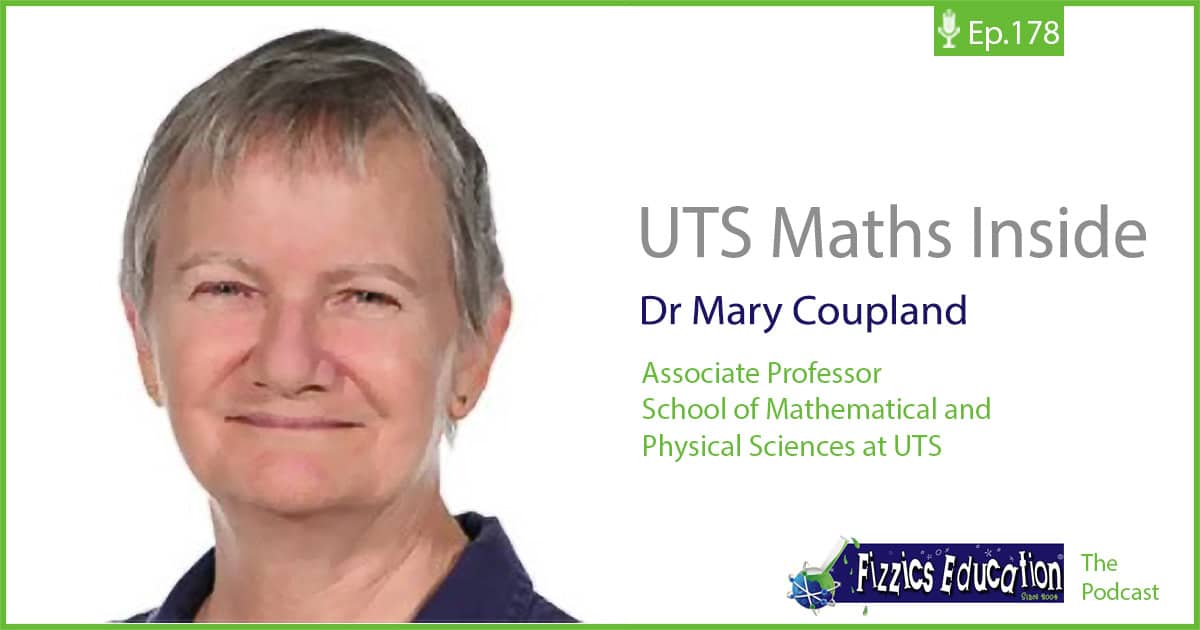
[00:00:19] Ben Newsome: Welcome again for another Fizzics Ed Podcast, glad to have you again for another chat around STEM. Today, we are very much looking at the M in STEM. We’re hanging out with my good friend Associate Professor Dr Mary Coupland, who is at the School of Mathematical and Physical Sciences at the University of Technology Sydney. She loves mathematics so much she very much gets involved with many different undergraduate subjects and getting people involved in mathematics in general. She loves her work in this, and this is the thing, you can love mathematics and teaching about it too.
[00:00:55] Ben Newsome: Today is very much a chat about different ideas around how mathematics might fit within your teaching and some of the ideas that she has when it comes to the ethos and understanding of mathematics in general. She has a lot of awards, believe me, you can very much check that out in her bio. In the meantime, let’s get into the chat and learn a bit more about her ideas for mathematics in STEM.
[00:01:23] Announcer: This is the Fizzics Ed Podcast.
[00:01:29] Dr Mary Coupland: Well, Ben, I like making mathematics more interesting, more valued by students. I like making mathematics classrooms more fun, more relevant to real-world issues. I think I would really like to break down that barrier that says, “Oh, I’m not quite understanding this so I’ll drop down to an easier level in mathematics.”
[00:01:55] Dr Mary Coupland: I think if we can encourage kids, motivate them to stick at maths, I think they can achieve all kinds of things, things that they didn’t even know that they needed to know. Mathematics is everywhere in the world around us and I guess that’s probably my mission.
[00:02:17] Ben Newsome: Well, you sound a little like me when I think about how I think about science. I think science is everywhere around the world and very much is the case, and mathematics underpins frankly how the universe works, from the very large to the very small and everything in between. But also, ignoring all that esoteric thinking, it’s just a way of thinking. It’s logical.
[00:02:30] Dr Mary Coupland: It’s logical, and I like the description I heard a very revered mathematician give one day, which is that pure mathematics and applied mathematics are two sides of a coin. You can’t have one without the other.
[00:02:45] Dr Mary Coupland: When we think of pure mathematics as being abstract, as being super intelligent, and applied mathematics as being everything from everyday commerce and dollars and cents right through to engineering perhaps, they have to go together. If you get that balance wrong, I think you can turn kids off too soon. Probably the same in science, is it? You’ve got some heavy theoretical science, but you’ve got so much practical science.
[00:03:15] Ben Newsome: Oh, you see this a lot. You’re at a barbecue and people just want to know how a particular thing might happen, and it doesn’t matter what industry they work in, their background, people are just curious people because that’s what people are, they’re curious. Get rid of the fancy terms and just talk about the ideas. That’s what it can be, and I was actually just thinking as you were talking about the two sides of a coin, I think there’s three, there’s the edge. Maybe the edge is actually where the two come together.
[00:03:42] Dr Mary Coupland: That’s a very nice thought, I hadn’t got that into my head yet. The edge, I like that, and of course it’s growing all the time. That’s another thing, people sometimes think that maths and science is finished, it’s all in the textbooks, but it’s not, of course, it still goes on.
[00:03:56] Ben Newsome: Oh, you just reminded me of, I wish I could remember who said it, there was some proclamation, you know those old-style 19th-century type proclamations, “We’ve learned everything to do with the world,” and then this person who changed everything with relativity changed everything. So it’s just, yeah, we don’t know everything, nor will we ever.
[00:04:22] Dr Mary Coupland: No, no, we won’t. And that’s the fun part, that’s the exciting bit.
[00:04:28] Ben Newsome: So right, so in your world you would cross both sides of pure through the applied and everything else. So what interesting projects do you see happen through the faculty?
[00:04:38] Dr Mary Coupland: Well, at UTS, we were very lucky to be part of the Australian Maths and Science Partnership Programme. Now this was a big initiative of the Federal Government back in 2013, they said, “Tell us about projects that will bring maths and science together.” UTS along with CSIRO and the Australian Association of Mathematics Teachers, we put together a bid and we were successful in winning some money for a project which we called Maths Inside.
[00:05:13] Dr Mary Coupland: And what we did with that money is make classroom materials that bring mathematics that’s inside science and inside objects, we brought that, or we tried to bring that into the classroom. So the project made videos of scientists talking about where they use science, and along the way of course we helped them with their script and we suggested ways they might talk about mathematics, and of course we didn’t have to do that artificially, they use maths, of course, being scientists.
[00:05:49] Ben Newsome: Oh, absolutely. I’m biology trained so very much went down the statistical route, but it is everywhere. I actually had a really good chat and I know a friend of yours, Professor Asha Rao down in Victoria, talks about this too, she has this pure love of just how the numbers all seem to flow through.
[00:06:08] Dr Mary Coupland: The flow of numbers, yes, and the flow of ideas and the fact that you can get started on something and you don’t know where it will end. But I think also what’s really nice about the videos we made, and I must say CSIRO did a wonderful job with these videos, they asked the scientist to talk a little bit at the beginning about what got them interested in science. Very often it was things like looking up at the stars at night, questioning their parents about things that they saw happening in the world around them, nature, that kind of thing.
[00:06:15] Dr Mary Coupland: And I think that’s really interesting to hear these scientists who are very steeped in their research but talking about how they grew up and the questions they asked when they were young kids and how that led them into various different research paths. So we have Robert Slat, who’s a…
[00:06:23] Ben Newsome: That sounds fantastic. By the way, Professor Lisa Harvey-Smith is also the Women in STEM Ambassador, I believe, too.
[00:06:33] Dr Mary Coupland: Exactly. Yes, yes. And we do have male and female scientists of course in the videos. And something that our feedback told us quite early on, because of course you don’t just do a big project, you have to check along the way that it’s reaching your target audience, which in our case was high school kids, years 8 to 12. So we did some research into their reactions to the videos and the classroom materials. And one thing that a couple of the kids said early on was that it would be nice to see groups of scientists, not just one person.
[00:07:18] Ben Newsome: Oh, that’s a good point.
[00:07:20] Dr Mary Coupland: And so some of the videos, yes, became enlarged and they show teams of scientists. The nutrition one, for example, shows how teams work together. You’d have a nutritionist, you’d have clinical dietitians, and you’d have statisticians all working together to solve problems, to talk to people about their diets and so on.
[00:07:54] Ben Newsome: Which is fantastic. I’m actually looking at it right now. So that’s the one with the type 2 diabetes size of things and it was a large coordinated team and there’s not just videos, you look down the bottom, there’s a number of activities that students can do and designed for different grade levels, which really does make sense. It’s really handy.
[00:08:15] Dr Mary Coupland: Yes. Well the AAMT, the Australian Association of Mathematics Teachers, helped us with the classroom materials, so they are clearly set out in terms of what year group, what topics, and relate, we know that they relate to things in the syllabus. And the other thing is they’re all in Word or Excel so that teachers can download them and adapt them easily to what they need in their classroom.
[00:08:43] Ben Newsome: That’s key, the adapt part because I was in a chat last week around bushfires in schools and the very first thing, in fact, it’s even just sitting behind my computer, I know it’s an audio thing so no one else can see, but I’ve got it in my hand and there’s a lovely document and it said “How can we pull it apart?”, which is a classic example of someone who wants to take ownership of what’s happening with their lessons.
[00:09:18] Ben Newsome: And it’s very cool and actually just looking at the scenarios, it’s all over the place. Bees with backpacks, that’s really interesting from a colony collapse disorder side of things through to hospitals, wow, there’s heaps of stuff.
[00:09:53] Dr Mary Coupland: Yes, look, I really love the bees with backpacks because Paulo de Souza, who’s the scientist, is so keen and it comes through the video very clearly. We need to know more about bees so that we’re prepared for situations where their numbers are dwindling. And what he does is attach these tiny microchips or radio, what is it, RFID, you probably know the term.
[00:10:19] Ben Newsome: Yeah, yeah.
[00:10:20] Dr Mary Coupland: To the back of bees, and they’re very light, they don’t harm the bee. And then each time the bee enters or leaves the hive, a little signal is sent and so they know, for instance, that bees don’t just live in one hive. They go off to other hives, he called it pyjama parties, and they might stay in another hive for a couple of days and then come back to their home hive.
[00:10:48] Dr Mary Coupland: The other thing is of course that bees forage in the environment and then they come back and they communicate to other bees the direction to go in to find food. And all of that is fascinating, and you can use that as an example of networks, of best path through a maze, those kinds of mathematical things can be launched into by starting with looking at the natural world.
[00:11:22] Ben Newsome: Gosh, I was just thinking about the thousands of bees moving in and out. That’s an extraordinary amount of data.
[00:11:29] Dr Mary Coupland: It is, and of course then you have to get into sampling then because you don’t need to put backpacks on every bee. So how many bees is enough? And so all of that statistical technology and machinery and knowledge has to come into the project so that you know you’re metering enough bees to get a good sample.
[00:11:51] Ben Newsome: So, such thinking about bit further away from, and Maths Inside is a fantastic project, but there’d be people around the world who may not even have heard of it and obviously they can go onto the site and find out about it. But every teacher listening into this will have a syllabus they’ve got to follow and for some it’s absolutely meaningful, they go, “Yes, I know exactly how to teach it.” And others, it’s sort of, “Okay, how do we make this so it’s hands-on?”
[00:12:21] Ben Newsome: How do you, when you look at any particular mathematical idea, equation, etc., how do you approach it from your mind thinking “How can I get a student to learn a particular concept well?” Is it best to start off with exploring real-world ideas with their hands, or is it better to work with abstractions with numerals on a board and learning how they interrelate? How do you think, I guess is what I’m asking.
[00:12:45] Dr Mary Coupland: Okay, that’s a nice question. Look, personally, I’m always interested in mathematics as a human invention. I know people say mathematics is in the world around us, but we don’t know that until we invent codes and algebra to describe the world around us. And in that sense, I sometimes think it’s a good idea to begin with the history actually.
[00:13:13] Dr Mary Coupland: If you’re teaching calculus, why was calculus invented? Who invented it? What problems were they trying to solve at the time? And I think I must get a plug in here for materials by a great mentor of mine, Mary Barnes. Now she wrote a wonderful series of books for the Curriculum Corporation, which are still available, called, oh, of course now the name’s just gone straight out of my head.
[00:13:44] Dr Mary Coupland: But if people Google “Mary Barnes and Introduction to Calculus” they’ll find, I think it was Investigating Change, that’s what it was. And she takes that approach. Why are people interested in rates of change, that kind of thing? But then another approach is to build on what students already know. And so if they already know positive numbers, well with a few questions you can nudge them towards looking at negative numbers.
[00:14:17] Dr Mary Coupland: So I think a good teacher has all of these tools at their fingertips and they choose the right approach to suit their class, because not every class will be motivated by the same approach.
[00:14:28] Ben Newsome: That makes a lot of sense. I remember doing outreach years and years ago, not on behalf of the current [Organization] I’m with, and they said, “Well, there’s no point talking about city concepts or ocean concepts, the kids out there have never seen the sea.” So making it embedded in their lives kind of makes sense, right?
[00:14:53] Dr Mary Coupland: Yes, yes, that’s right. Or giving them some options. Science is all around us, but if you’re in the middle of Australia, what do you want to know about coral? Well, you might want to know, you might want to be able to visit the coast one day and find the coral. Yes, it’s a tricky one, isn’t it? Because you don’t want to be, it’s a balance, isn’t it, between using what students know but also opening windows and doors for them so that they can move beyond.
[00:15:30] Ben Newsome: Oh, for sure. A good friend of mine was on this podcast, Steve Sherman, hi if you’re listening in mate. Steve runs a great organisation out of South Africa called Living Maths and he was describing this programme, he was running this session with his kids and inevitably there’s sometimes a kid who’s not engaged and the kid’s looking out the window a lot. And went, just said to the kid, “What are you looking at?”, just curious.
[00:15:57] Ben Newsome: And the kid had been watching the cable car going up and down to the mountain and back. And so he was able to fold this student back into the lesson through actually, “Hey guys, let’s work out mechanically how this is working and the mathematics of this particular object.” And now the kid was engaged without realising that they were going to be the star of said lesson.
[00:16:21] Ben Newsome: It’s just a really good example of, okay, not always can we do this because sometimes the child might just need to pay attention, but in this case he was able to use what the kid was actually interested in because the kid just wanted to be outside and on the cable car, was able to get the kid engaged again just by talking about what the kid was interested in.
[00:16:43] Dr Mary Coupland: Yes, look, I think there’s a lot to be said for that and Dan Meyer, M-E-Y-E-R, he has some wonderful videos and materials about that very thing, you know, shooting hoops in basketball and how do you analyse that with mathematics and things like that, and ways that teachers can bring students in. Sometimes group work is a good idea, get kids into a group, sometimes it’s not, you know, you have to just weigh it up.
[00:17:11] Ben Newsome: It’s Ben here. I hope you’re enjoying this particular chat and guess what? There’s so much more you can do with your science teaching. Head on over to fizzicseducation.com.au, there are complete and comprehensive teaching units that you can get your hands on. If you click on the top, you will find there are a whole bunch of scope and sequences, cross-curricular teaching ideas, hundreds of printable experiments and activities, videos, risk assessments, marking rubrics, you name it, it’s all there and it’s all linked to the curriculum and it’s something that you can implement right now. Head on over to fizzicseducation.com.au and check out what’s on offer.
[00:17:48] Ben Newsome: Well, I remember you and I hanging out at an event and we were talking about applied mathematics and helping kids understand how everything works. And I remember sort of talking about some stories where students are very good at plugging things into an algorithm and believing the answer is correct because the mathematics is right.
[00:18:06] Ben Newsome: And the actual example I was using was, I think it was mark and recapture with little toy koalas. And they would happily tell you with their hand on their heart that there’s something like 10,000 koalas in this box that there is no way it could hold more than 200, okay? But the mathematics was totally correct. And it’s just interesting how blindly we can believe what’s in front of us when our calculators work.
[00:18:31] Dr Mary Coupland: Yes, yes, that’s right. It would be nice to always be able to check the calculator, wouldn’t it?
[00:18:38] Ben Newsome: Well, that’d be true. But yeah, it was just an interesting way. As I think about how we might teach, whether it’s simple geometry. For me, I like teaching circles with an anemometer because an anemometer measures wind speed and you’ve got these little cups moving around and there’s a certain distance they travel in a certain amount of time.
[00:19:01] Ben Newsome: And now we can measure wind speed as an actual, we need to learn how to do the maths to be able to do the wind speed, rather than being it unto itself, but I guess it comes down to imagination. What could you do with the triangle? Are you going to measure the height of a building? Whatever it is that you want to do, there’s a lot of different ways to apply the maths. I think I’m on the applied side as I think about it, Mary.
[00:19:27] Dr Mary Coupland: Oh, I thought you might be since you’re interested in science. And by the way, Ben, congratulations on your award too, your two awards from the UTS alumni the other night. That was really great to see.
[00:19:40] Ben Newsome: Oh, thank you so much. That was the event where we actually did catch up. But, yeah, thank you so much. That was quite a night at UTS and, yes, very fortunate to be named amongst those people. But, yeah, well done, great.
[00:19:55] Dr Mary Coupland: Thank you.
[00:19:57] Ben Newsome: So what do you think Maths Inside, it was conceived in 2013, 2014, rolled through to about 2018, but the information’s still there. But as we know, the world moves on, there’s more science being created, there’s more mathematics and how it’s being applied. Is there opportunity for people to update it and all that sort of thing?
[00:20:17] Dr Mary Coupland: I hope so. I’m hoping that if we manage to get the project going again, what we have agreed is that we must do two things. One is, without going too far from the science, go a bit more into the trades, because there’s maths inside trades, of course. And a second thing would be to look at Indigenous mathematics as well. And there are people who are experts in that area and so interviewing those folks would be really interesting to do.
[00:20:55] Dr Mary Coupland: So those are two directions if we do manage to continue the project in terms of creation. But as you say, the materials are there. I want to give a shout out, if I may, to Anne Prescott, who was the co-leader of the project, and Sandy Schuck and Marco Angelini, who were collaborators. And a part of the project which is quite separate from the videos and the scientists was done by someone called Jason Stanley at UTS.
[00:21:28] Dr Mary Coupland: And he is a remarkable mathematics teacher and he wrote a section for the website where students can assess their own mathematical knowledge at that junction between high school and uni. So it’s not a “teach me something”, it’s a “what do I really know about quadratics and functions and trig? Am I ready for university mathematics?” We call it Pathways to Uni Maths and it’s all there on the Maths Inside site.
[00:22:05] Ben Newsome: Oh, that’s really handy. I actually remember when I first came into first-year university, I thought I understood mathematics, but there was an entire area where I hadn’t even seen the symbols before, let alone know what to do with them. No, very much so. I had never seen a sum of sign, would you believe?
[00:22:26] Dr Mary Coupland: That’s interesting, yes. Well, that kind of thing can throw you a bit.
[00:22:30] Ben Newsome: I had to learn an entire language because it is, it’s a language.
[00:22:32] Dr Mary Coupland: It is, it is a language, yes.
[00:22:34] Ben Newsome: Speaking of language, you’re very much involved in a congress coming up next year. What’s that all about?
[00:22:38] Dr Mary Coupland: Well, the congress is the 15th International Congress on Mathematical Education. It’s in Sydney, 2024, at the International Convention Centre. And the dates are 7 to 14 of July. We expect thousands of mathematics teachers and educators from all around the world to be in Sydney next July. So we hope that people will come and meet all these overseas visitors.
[00:23:09] Dr Mary Coupland: It’s a wonderful opportunity for teachers of maths and science, I would suggest, to experience the latest research in mathematics education and to hear about projects that are being rolled out across the globe.
[00:23:25] Ben Newsome: That would be an extraordinary opportunity because you’re right, it’s an international congress, so it’s the 15th time and now it’s come to Sydney, so it sounds like a real opportunity. Is this open just to high school that could turn up or primary teachers would be able to turn up? Would students be able to turn up?
[00:23:39] Dr Mary Coupland: Anybody can enrol. It will be most interesting, I think, to teachers and to people training to become teachers. I went to my first ICME in Adelaide in 1984 as a new high school teacher and I just loved it. There was so much to find out. You know, there were people in the Netherlands teaching fractions in a way which I’d never thought of before. You know, there were gurus of mathematics education to talk to, and it was very inspirational.
[00:24:18] Dr Mary Coupland: I do think that anybody who can get there, it’s in the school holidays, so hopefully people might be interested in coming to Sydney, go to the conference, bring your family, do things on the non-conference days, but I think it’ll be great. It only happens every four years, Ben, and you have to bid for it, a little bit like the Olympic Games. Cities bid for the chance to run this conference.
[00:24:47] Dr Mary Coupland: And once you’re in the conference, you can choose a stream. So the streams might include teaching geometry, they might include teaching early childhood maths, they might include research into the history and pedagogy of statistics. I mean, there’s all kinds of streams within the conference.
[00:25:11] Ben Newsome: That would be an extraordinary time. It actually feels like something that could make an inflection. I really can see that because the number of times I’ve been lucky enough to be go to international conferences before and you just realise just how far ahead others can be and how much you can miss out because you’re just not exposed to it.
[00:25:33] Dr Mary Coupland: That’s true, that’s true. This is a chance to hear all those people from the countries that do really well in those international tests that have been in the news recently, so Singaporeans will be there. But as well as that, it’s an opportunity to meet with other Australians because it’s not often that Australian maths teachers and maths educators get together.
[00:25:57] Ben Newsome: No, this is fantastic, and I love that the throwaway line is “come and be counted”.
[00:26:01] Dr Mary Coupland: Yes, yes. Yes, that’s right. If I could get a plug in here, we’re hoping to have a poster competition for schoolkids. To make a poster, and the theme will be “Everyone Counts” because as you say the conference theme is “Come and be Counted”, so everyone counts. How do you count? What do you count? How do you keep track of things? How do you estimate when you’re counting a large number of things?
[00:26:30] Dr Mary Coupland: So the possibilities for the poster are quite big there, and there’ll be some prizes. We have some sponsors, so it’ll be an interesting event.
[00:26:41] Ben Newsome: Oh, fantastic. So if you’re wondering, just go check out icme15.com, so that is I-C-M-E-1-5 dot com, to check that out. And definitely if you just find your favourite search engine, type in “Maths Inside” and “UTS”, you will find that. And I will get both those links in the show notes as usual, absolutely.
[00:26:58] Ben Newsome: So just curious, if you had a bunch of students who are going to go out into the big wide world to teach mathematics in high school, let’s just say, and you were going to give them some parting words of advice, what would it be? And that could be quite broad.
[00:27:18] Dr Mary Coupland: Oh, they would be broad. I think keep learning. Keep learning yourself. Don’t think that maths is finished and it’s in the textbooks, maths keeps going. And I think our teachers can always learn more about teaching, about their own students, about ways to make maths exciting. And go and talk to people in other staffrooms, don’t just sit in the maths staffroom.
[00:27:43] Dr Mary Coupland: Go and talk to the science teachers and find ways to work together on things. I think that’s happening more with the impact of STEM projects, you know, science, technology, engineering and maths.
[00:27:56] Ben Newsome: Oh, for sure, and there’s opportunity to bring it into, well, it’s everywhere. You can find it in art, in whatever you’d like to do, absolutely.
[00:28:03] Dr Mary Coupland: That’s right, that’s right.
[00:28:05] Ben Newsome: Mary, it’s been fantastic having a chat with you and I hope you have a decent break as I timestamp this particular discussion. I am sure that that congress will go very well. And please, if you’re listening in, go check out Maths Inside, it is very much a deep programme and you can implement it, well, frankly now, in your classroom, absolutely. And do get in touch if you have any questions.
[00:28:26] Ben Newsome: Oh, speaking of which, how do we get in touch?
[00:28:28] Dr Mary Coupland: Well, [email protected].
[00:28:34] Ben Newsome: Easy, and I’ll put that in the notes as well. Look, Mary, this has been a pleasure.
[00:28:38] Dr Mary Coupland: Ben, it’s great to talk to you and all the best with physics and science education. You do great stuff and maybe we can put some more maths in there somewhere, who knows?
[00:28:49] Ben Newsome: Oh, look, any chance to be able to get kids to learn more, I’m up for that.
[00:28:53] Dr Mary Coupland: Good, good. Great stuff.
[00:28:55] Ben Newsome: Awesome. Thank you so much.
[00:28:56] Dr Mary Coupland: Thank you very much for the opportunity.
[00:29:01] Announcer: We hope you’ve been enjoying the Fizzics Ed Podcast. We love making science make sense. Why don’t you book us for a science show or workshop in your school? If you’re outside of Australia, you can connect with us via a virtual excursion. See our website for more.
[00:29:16] Ben Newsome: So, I hope you enjoyed that chat with Associate Professor Dr Mary Coupland. I certainly did, and I love the passion for mathematics and making it tangible and real for students. That is exactly our job. And I’m sure that if you listen on in, you might have picked up a few ideas as well. Now, if you want to go find out a bit more, the links are in the show notes as usual, or you could look up Mary Coupland at UTS and you’ll be able to find a bio and some of the work that she’s very much doing.
[00:29:41] Ben Newsome: So, look, I hope you enjoyed this. I certainly did. My name is Ben Newsome from Fizzics Education. This is the Fizzics Ed Podcast, and I hope to catch you another time.
[00:29:51] Announcer: You’ve been listening to another Fizzics Ed Podcast. We’re excited about science. Subscribe to us on iTunes to download the next episode as soon as it’s released. And don’t forget, for hundreds of ideas, free experiments, our new Be Amazing book and more, go to fizzicseducation.com.au. That’s physics spelled F I Z Z I C S.
[00:30:16] Announcer: This podcast is part of the Australian Educators Online Network. aeon.net.au.
Frequently Asked Questions
What was the primary goal of the Maths Inside project?
The Maths Inside project was designed to make mathematics more interesting and valued by students by showing its real-world relevance. It created classroom materials, including videos of CSIRO scientists, to demonstrate how mathematics is used within scientific research, such as tracking bee populations or managing type 2 diabetes.
How can teachers use the Maths Inside resources in their classrooms?
Resources from the project are available on the Maths Inside website. They include videos and classroom activities provided in Word and Excel formats. This allows teachers to easily download and customise the materials to suit their specific class needs and syllabus requirements across years 8 to 12.
What is the Pathways to Uni Maths resource?
Developed by Jason Stanley at UTS, Pathways to Uni Maths is a section of the Maths Inside website that allows students to self-assess their mathematical knowledge. It helps those transitioning from high school to university to identify their understanding of quadratics, functions, and trigonometry.
What is the significance of the International Congress on Mathematical Education (ICME)?
The ICME is a global event held every four years that brings together thousands of mathematics educators and researchers. It provides a platform to share the latest research, pedagogy, and projects from around the world. Sydney hosted the 15th congress (ICME-15) in July 2024, offering Australian teachers access to international perspectives on teaching topics like geometry and statistics.
How does Dr Mary Coupland suggest engaging students who are struggling with mathematics?
Dr Coupland suggests that teachers should focus on the human invention aspect of mathematics by exploring its history and why certain concepts, like calculus, were invented. She also emphasises the importance of building on what students already know and using applied mathematics to connect abstract concepts to tangible examples, such as the mechanics of a cable car or sampling in environmental science.
Extra thought ideas to consider
Mathematics as a Human Invention
Instead of viewing mathematics as a finished set of rules in a textbook, consider teaching it as a series of codes and algebra invented by people to describe the world. Exploring the historical problems that led to the development of calculus or trigonometry can provide students with a clearer ‘why’ behind the formulas they learn.
Breaking the Silos through Interdisciplinary Collaboration
Teachers can optimise student engagement by collaborating across departments. When mathematics teachers talk to science, art, or trade teachers, they can find shared projects—like networks in biology or geometry in construction—that make STEM concepts feel cohesive rather than isolated subjects.
Discussion points summarised by AI from the FizzicsEd Podcast, verified and edited by Ben Newsome CF