Transcript
[00:00:00] Announcer: You’re listening to the Fizzics Ed Podcast. For hundreds of ideas, free experiments and more, go to fizzicseducation.com.au. And now, here’s your host, Ben Newsome.
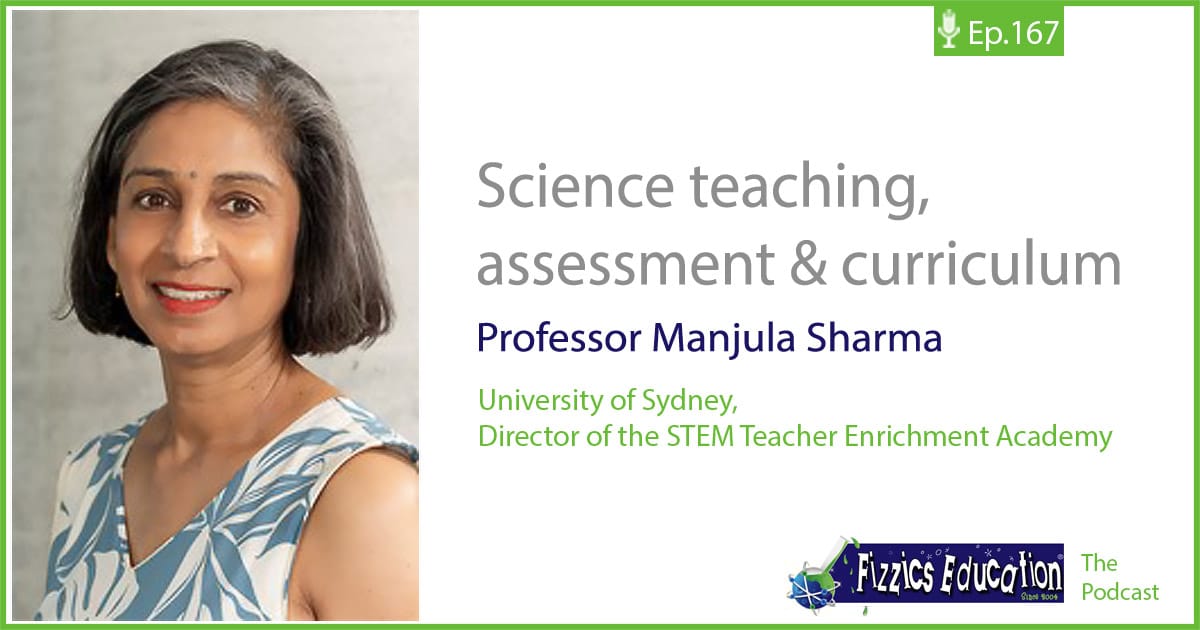
[00:00:18] Ben Newsome: Welcome to another Fizzics Ed Podcast. Glad to have you again for another chat around STEM. It is coming into Science Week, and what better person to hang out with than Professor Manjula Sharma, who is an amazing person when it comes to science education. She is Professor of Science Education at the University of Sydney. She is the Director of the STEM Teacher Enrichment Academy there, and prior to this, she’s been heavily involved in many different areas of Fizzics Education research. You can find all about that in her bio. But today, we are talking about educational assessment, just what it takes to be able to pull together different areas of the curriculum to make science sing in your classroom, and we talk about STEM project ideas and so much more. Let’s get into this as we celebrate National Science Week.
[00:01:15] Ben Newsome: Welcome to the Fizzics Ed Podcast.
[00:01:18] Prof Manjula Sharma: Thank you, Ben. It’s wonderful to be here. It’s a cloudy morning, but looking forward to it getting better and better.
[00:01:26] Ben Newsome: It is getting better and better. As we record this, we’re coming right into Science Week, which for people like us is full on, but it’s good fun.
[00:01:40] Prof Manjula Sharma: It’s full on. It’s amazing how much gets done and how much participation there is. It’s mind-blowing.
[00:01:50] Ben Newsome: If you look at National Science Week’s website, there are over a thousand public events across Australia, let alone all of the work done in schools and libraries. It’s really a celebration week.
[00:02:10] Prof Manjula Sharma: It’s fantastic. Year on year, it’s gaining more momentum, exposure, and participation, which is good for science and STEM.
[00:02:22] Ben Newsome: For sure. Speaking of being good for science and STEM, you’ve been involved for quite a while. Please let people know what you get up to.
[00:02:35] Prof Manjula Sharma: I’ve had years of experience. I ran a Fizzics Education Research Group at the University of Sydney in the School of Physics, doing education research. My most famous PhD student is Derek Muller, and he runs the Veritasium website. The research group had the approach that students come in with their ideas, what they want to look at, and we would follow that and create a research project around it.
[00:03:13] Prof Manjula Sharma: Like we advocate for teaching, I was the facilitator. I didn’t know much of what they were going to investigate, but I helped them create the project—getting the research question aligned, the interpretation, and the analysis organised, the same as in any project. The kinds of things they did included motivation, emotions, multimedia, online learning, and lab work.
[00:03:42] Ben Newsome: I must say, the work you’ve done with some of the students is amazing. I’ve worked with people like Dr. Simon Crook and Peter Lebedev, who have been on this podcast. There’s a lot to be discovered when it comes to education with physics. It isn’t just pushing a cardboard box around and looking at forces.
[00:04:08] Ben Newsome: What are your particular areas of interest? I’m guessing it’s fairly wide.
[00:04:18] Prof Manjula Sharma: It’s very wide. I follow the interests of the people who come in to work with me, and their interests motivate me to learn more. I’m a jack of all trades, partly a master of one, but my students become masters of that particular area. I’m basically interested in education and supporting others.
[00:04:45] Ben Newsome: When you go out to schools, what are the lessons that grab your attention and make you think, “This is working so well”?
[00:05:04] Prof Manjula Sharma: There was one last week in regional Australia. There is this school with Kindergarten students, and the person mentoring the school as part of our STEM Teacher Enrichment Academy decided to do paper chains with bright coloured paper. It involved their kinaesthetic skills in cutting the paper, whether lengthwise or the other way.
[00:05:48] Prof Manjula Sharma: They weren’t given strict instructions; they were just told to make paper chains. They all got busy and started looking at one another, asking, “How are you doing that?” At the end, they asked, “Which one is the longest?” We didn’t want to set it up as a competition. They ended up doing maths because they were measuring in various ways, such as holding it against different people to see if it was three-quarters or half the height of a person.
[00:06:40] Prof Manjula Sharma: They then discussed what the chain could be used for and what it represented. It really used their social skills, kinaesthetic skills, and cognitive skills. At the end, one boy said, “My chain is not the longest, but it has the maximum number of links.” The teacher took me aside and said, “That’s the clever kid in the class. He sets his own rules.”
[00:07:17] Ben Newsome: When people define their own rules and try to exceed them, that’s awesome. I saw a lesson that worked really well where kids were handed an A4 piece of paper and asked, “Can you fit through it?” Then you make the next piece of paper an A5, then eventually a business card. The kids have to cut it in a continuous loop. You’d be amazed how much circumference you can get around yourself if you cut it like a series of S’s.
[00:08:03] Prof Manjula Sharma: A lot of these activities are low cost or source materials from the community. With the STEM Academy, schools run their own projects. There’s a bigger project in that school because the children get breakfast, and the price of eggs is going up. The whole school is designing and building a chook house.
[00:08:46] Prof Manjula Sharma: They’ve linked in with the community. Community engagement is a big part of our programme. We don’t give all the resources; they’ve got to source them from the community for it to be sustainable. They’ve got Bunnings involved and people willing to help offload junk materials.
[00:09:09] Ben Newsome: STEM, by definition, should be project-based. It’s really neat when schools link it to their own community. What do you see as some of the best aspects within a STEM scope and sequence to produce students who understand how STEM works?
[00:09:39] Prof Manjula Sharma: The focus in the STEM Academy is having the school come up with their own problem or something that interests their community. The teachers spend a couple of days with us framing that. We spend time doing inter-curricular activities, and they have some planning time.
[00:10:17] Prof Manjula Sharma: They come up with an idea, take it back to the school, discuss it with other teachers and their students, and refine it. Sometimes that project becomes mini-projects that continue for three or four years. By the time that project fades away, the school has built the capacity to self-create another STEM project.
[00:10:48] Prof Manjula Sharma: Some of these STEM projects can be quite elaborate, so it’s about how to break them down into smaller components, requiring community engagement. Some go to their P&C, or email parents asking, “We’ve got this, what’s happening?” A parent might reply, “I’m an engineer” or “I know somebody who can help.” It just cascades wonderfully.
[00:11:32] Prof Manjula Sharma: In the meantime, while doing this, the teachers backward map onto the curriculum. It’s not a forward mapping exercise. If a chicken coop project comes up, they ask where measurement fits into that. It’s taking the curriculum as a living document, transforming it from a static list so your project is the skeleton around which the curriculum fits.
[00:12:30] Ben Newsome: I’ve often thought of the curriculum this way. We could see it as prescriptive, but in the real world, it doesn’t work that way. As a scientist, we test an experimental question, get results, and then research literature to find why our results are happening. Why can’t we do this with our curriculum?
[00:13:10] Prof Manjula Sharma: I like analogies. You’ve just described an experiment, but when the final report is written, it’s linear. It doesn’t include all the detours taken. That final report is then used by someone else to test reliability. The curriculum is like the final report.
[00:13:48] Prof Manjula Sharma: It is up to the teacher to take that curriculum and map it how they want to deliver it. If it’s a curriculum where you just plug things in all the way through, it becomes really complicated to unplug it and fit it into projects.
[00:14:11] Ben Newsome: It makes for robust discussions in a group of teachers asking, “How do we deal with dot point three or five?” Every school addresses the curriculum differently.
[00:14:28] Prof Manjula Sharma: I would switch it around: look at a project that interests your community, and then see where that dot point plugs in. If it doesn’t plug in, you’ve got to think about how important that dot point is. Every learner has different needs, yet those needs can be grouped so it doesn’t become totally chaotic.
[00:15:16] Prof Manjula Sharma: So, from that point of view, you’ve got to ask if spending hours on a single dot point is worth it. Could you just do a little activity on the side while doing the maths for the chicken coop? Do we get more value by exciting and engaging the students?
[00:15:40] Ben Newsome: That should hopefully be the outcome. What sparked your outstanding career through science education and STEM research?
[00:15:56] Prof Manjula Sharma: I’ve always been interested in education. I started my career as a lecturer at the University of the South Pacific in Fiji, working with island governments on physics for fisheries and agriculture. You have to integrate mechanics and see how it fits into those areas to still be called physics.
[00:16:49] Prof Manjula Sharma: When I started at the University of Sydney, I was involved in the lab programme for dentistry, medicine, and vet science. I did my PhD in physical optics. I had an ARC grant that was successful, but applied for a teaching grant in parallel. When my supervisor went off to Singapore and Italy, I decided to focus entirely on education, and the school was fantastic in supporting me.
[00:17:34] Ben Newsome: How have you seen shifts and changes in perceptions of how science should be taught over the years?
[00:17:52] Prof Manjula Sharma: The most significant change, which I think takes away from the core ethos of teaching and learning, is the extreme focus on assessment. Any conversation jumps straight to learning outcomes and assessment. The way I look at teaching is to say: here’s the curriculum, here’s your teaching task, here’s your student learning task. What is a task that will tie those together to bring your assessment in?
[00:18:56] Prof Manjula Sharma: If you start off with, “Here’s the curriculum, how do I assess this?” and design your learning task for the assessment, it switches everything around. Assessment puts pressure on students, whereas creating a learning task means having a bit of fun. We’ve been driven by the idea that “assessment drives student learning,” but when I ask my classes face to face, that’s not how it works for them.
[00:19:35] Prof Manjula Sharma: For example, in the university, in the first lecture class, they come in and it’s “Here’s the course, here’s the test, here’s your assessment.” Instead, I prefer coming in to say, “Here’s a demonstration, here’s what physics is about. Let’s discuss these questions, and I’ll see you next week.” By the end, you get to, “Assessment one is coming up, and here’s what it will be like.”
[00:20:11] Ben Newsome: It’s that tension around how much summative assessment you want to do. Yet, if you speak with any teacher on the ground, it’s always about formative assessment—how the kids are going and if they understand.
[00:20:26] Prof Manjula Sharma: Yes. It’s the formative assessment that actually ties in with the teaching and student learning exercise, not the summative. Summative will come.
[00:20:34] Ben Newsome: G’day, it’s Ben here. I hope you’re enjoying this particular chat, and guess what? There’s so much more you can do with your science teaching. Head on over to fizzicseducation.com.au. There are complete and comprehensive teaching units that you can get your hands on. If you click on the top, you will find there are a whole bunch of scope and sequences, cross-curricular teaching ideas, hundreds of printable experiments and activities, videos, risk assessments, marking rubrics—you name it, it’s all there, and it’s all linked to the curriculum and it’s something that you can implement right now. Head on over to fizzicseducation.com.au and check out what’s on offer.
[00:21:15] Ben Newsome: The problem with summative is within the word itself: it’s a summation. You’re stuck once you’ve done the assessment. If the kid didn’t quite make the grade, it doesn’t help you much then. Working out ways to help the child prior to that summative assessment might help a bit.
[00:21:42] Prof Manjula Sharma: One of my early mentors, Sheila Tobias—a political scientist, historian, and STEM analyst—said something simple that influenced me a lot. She asked, “What is assessment for?” It provides an indicator to external people who will hire the person, showing where they sit in the field. It’s feedback to parents so they can provide support.
[00:22:30] Prof Manjula Sharma: It’s feedback to the school in terms of how the school’s tracking. If the assessment of all students is increasing or decreasing, it guides where they spend resources. It’s feedback to the teacher to see how their class is going. It’s an overall tracking mechanism, not just about what a single grade means right now. Assessment is stakeholder feedback; making it too high-stakes for the students just stresses them out.
[00:23:30] Ben Newsome: It should be a soft touch on the student; they shouldn’t be aware that it’s high stakes. I think about art students who produce a portfolio of work over the years, giving you an idea of where they’re coming from.
[00:24:00] Ben Newsome: And you think about STEM projects—they are a solution to a problem. Those projects are effectively the portfolio students could show. It would be nice to say, “Here’s my portfolio of work solving problems using science,” which would be handy to employers. When I chat with people entering our company, I always want to know what they’ve done and achieved; I’ve never asked what grade they got in a subject.
[00:24:51] Prof Manjula Sharma: That’s one of the strengths of STEM; you can provide that portfolio. The design process and science experiment go part and parcel within STEM. When they design the chook house, they’ll investigate strength and height by doing mini-science experiments and maths along the way. Portfolios become a genuine possibility instead of just lining up all their reports in a big chunky folder.
[00:25:56] Ben Newsome: If you’ve got the time to see the iterative process of them working through the problem, including the failures and what they did about it, that’s incredibly valuable.
[00:26:14] Prof Manjula Sharma: Some schools start a project in year seven and continue it into year eight. It becomes a longitudinal thing for students. If they choose design technology in year nine, the iteration continues.
[00:26:50] Prof Manjula Sharma: And then at the same time, within year seven, a new component of the chook house comes in. How do you feed the chickens? Design better bowls for the food, or cut tyres for them to use outside, or build incubators. It just grows. In this particular school, year six students are also doing the finances to see if they can sell the eggs for a profit.
[00:27:26] Ben Newsome: It makes sense. The beauty of STEM projects is they have real-world limitations like resources and cash. That produces a resourcefulness because the limitations are where they actually produce their best results.
[00:27:58] Prof Manjula Sharma: Yes, optimising.
[00:28:04] Ben Newsome: What are some of the great experiments that you’ve seen in physics that just sing and work incredibly well?
[00:28:42] Prof Manjula Sharma: One that’s been around for a long time is the bungee jumping egg drop.
[00:28:53] Ben Newsome: Oh, good fun.
[00:28:54] Prof Manjula Sharma: It’s an experiment where the complexity of the science and the explanation grows as you do it. There’s something to be said for repeating the same experiment and pointing to deeper issues you can measure. Students might say they’ve done it before, but when you ask deeper questions, they get right into it.
[00:29:29] Prof Manjula Sharma: Practice is really important. In physics at university, we’re really into uncertainties and error analysis because you have to estimate how reliable your measurement is. There are equations for that, and they get complicated quickly.
[00:30:10] Prof Manjula Sharma: At the end, you have to do a bit of estimation together with those calculations because it has to be an intuitive, experiential guess based on how off the measurements could be.
[00:30:43] Prof Manjula Sharma: With the bungee jumping, my PhD student designed a technique where groups take measurements of springs, put them on a shared spreadsheet, and calculate the K-value. We set up an egg to be dropped with a spring at the front. The whole class has to agree on their estimation based on those measurements.
[00:31:30] Prof Manjula Sharma: They make their guess based on the measurements because groups will get different K-values, sometimes twice as much. They can’t go back and repeat it, so they have to handle the outliers. It gets quite intricate before the egg drops.
[00:32:13] Prof Manjula Sharma: Then they have a couple of repeats changing the springs to figure it out. Afterwards, there’s an intense discussion about when engineers make structures, what safety factors they take into account. It teaches them why uncertainty is important. After that first class, they’re completely into uncertainties.
[00:32:56] Ben Newsome: It’s a bit like when you get into an elevator and it says you can have eight people, but you’ve got nine. You have to consider variables like chicken eggs being different sizes, or what happens when a spring has been stretched multiple times.
[00:33:30] Prof Manjula Sharma: Or is there a child in with you, right? The ninth person is a child.
[00:33:36] Ben Newsome: Yes. We expect the mathematics to work perfectly until we finally test it and discover variables we haven’t allowed for.
[00:34:02] Prof Manjula Sharma: Yes. That’s one that’s really been a hit with us because it changes the mood. It brings the community together as they step into the world of labs and experimentation. Education is a social activity couched within the politics of our context.
[00:35:02] Ben Newsome: If you had a bunch of teachers listening, what advice would you give them about how to best construct effective science lessons, irrespective of content?
[00:35:29] Prof Manjula Sharma: Know your students. Understand your school context and the external drivers, like parental expectations, which affect what you can do without putting students in a difficult situation.
[00:36:21] Prof Manjula Sharma: Look at the links between the different areas in the curriculum. Sometimes something in electricity ties in with mechanics, creating a nice story where you revisit and reinforce concepts, effectively collapsing the curriculum into manageable chunks.
[00:37:05] Prof Manjula Sharma: That reorganising of the curriculum can be adjusted depending on the school’s context. Practice is really important in physics, so finding a context that turns up in both mechanics and electricity lets you repeat problems in different ways.
[00:37:40] Prof Manjula Sharma: So, to me, looking at the curriculum as something which you can massage and mix in different ways while focusing on what interests you as a teacher—like medical contexts—can be incredibly effective.
[00:38:12] Ben Newsome: No, that makes sense. We’re not teaching in a vacuum; students have cultural context, and so does a community. We have a mandate to cover the curriculum, but we can cover it in different ways.
[00:38:32] Prof Manjula Sharma: Yes. It is important for the teacher to identify that who they are is part and parcel of this. Reorganising the curriculum means you are a part of what the students are learning, so each child walks away with a bit of the teacher.
[00:39:12] Ben Newsome: And the teacher learns alongside, which can be really handy, too.
[00:39:18] Prof Manjula Sharma: Yes, empowering for the teacher is what I am giving, and the legacy. So long as you cover that curriculum and you can do it in a different way, you’ll know when you’re with the students; you know their faces and so on, you’ll know.
[00:39:26] Ben Newsome: Professor Manjula Sharma, thank you so much for dropping into the podcast and sharing your insights today.
[00:39:30] Prof Manjula Sharma: Thank you, Ben. It’s been an absolute pleasure.
[00:39:33] Ben Newsome: Catch you next week, everyone. Keep making science sing in your classrooms!
[00:39:37] Announcer: You’ve been listening to the Fizzics Ed Podcast. For more, go to fizzicseducation.com.au.
Frequently Asked Questions
What is the STEM Teacher Enrichment Academy’s approach to school projects?
The Academy encourages schools to identify their own unique problems or interests relevant to their specific community. Rather than providing a pre-set curriculum, they help teachers frame a project that is sustainable, resource-efficient, and engaging for their particular learners, ensuring the projects have long-term viability.
How can teachers effectively integrate the curriculum into a large STEM project?
Professor Sharma suggests “backward mapping” the curriculum. Instead of starting with a linear list of syllabus dot points, teachers start with an engaging real-world project—such as a chicken coop—and identify where outcomes like measurement, mechanics, or biology naturally fit within that project’s lifecycle.
What should be the primary purpose of assessment in science education?
Assessment should be viewed as stakeholder feedback for employers, schools, and parents. Professor Sharma warns that when summative assessment becomes the sole driver of classroom activity, it can increase student pressure and stifle the fun of scientific enquiry. Prioritising formative assessment helps guide the learning process more effectively.
Why is community engagement vital for sustainable STEM education?
Engaging the local community, including parents and local businesses, helps schools source resources and expertise without requiring massive external funding. This creates a sustainable model where the project belongs to the community, allowing students to see the direct impact of their work in their local area.
How does the ‘bungee jumping egg drop’ experiment teach complex physics concepts?
This experiment is an excellent tool for teaching uncertainty and error analysis. Students must measure spring constants and work collectively to estimate the probability of the egg surviving the drop. It shifts student thinking from “perfect” mathematical results to understanding margins of safety and real-world engineering limitations.
Extra thought ideas to consider
Moving Towards a STEM Portfolio
Similar to how art students produce a body of work, STEM projects allow students to build a portfolio of solutions. This demonstrates how they apply scientific skills to solve problems, offering potential employers a much clearer picture of their capabilities and interests than a single test score ever could.
The Social Nature of Scientific Enquiry
Learning is a social activity couched within a community context. By using collaborative experiments that require class-wide discussion and consensus, educators can model the social construct of science, helping students develop essential communication and teamwork skills alongside technical knowledge.
Discussion points summarised from the FizzicsEd Podcast, verified and edited by Ben Newsome CF