Transcript
[00:00:00] Announcer: You’re listening to the Fizzics Ed Podcast. For hundreds of ideas, free experiments and more, go to fizzicseducation.com.au. And now, here’s your host, Ben Newsome.
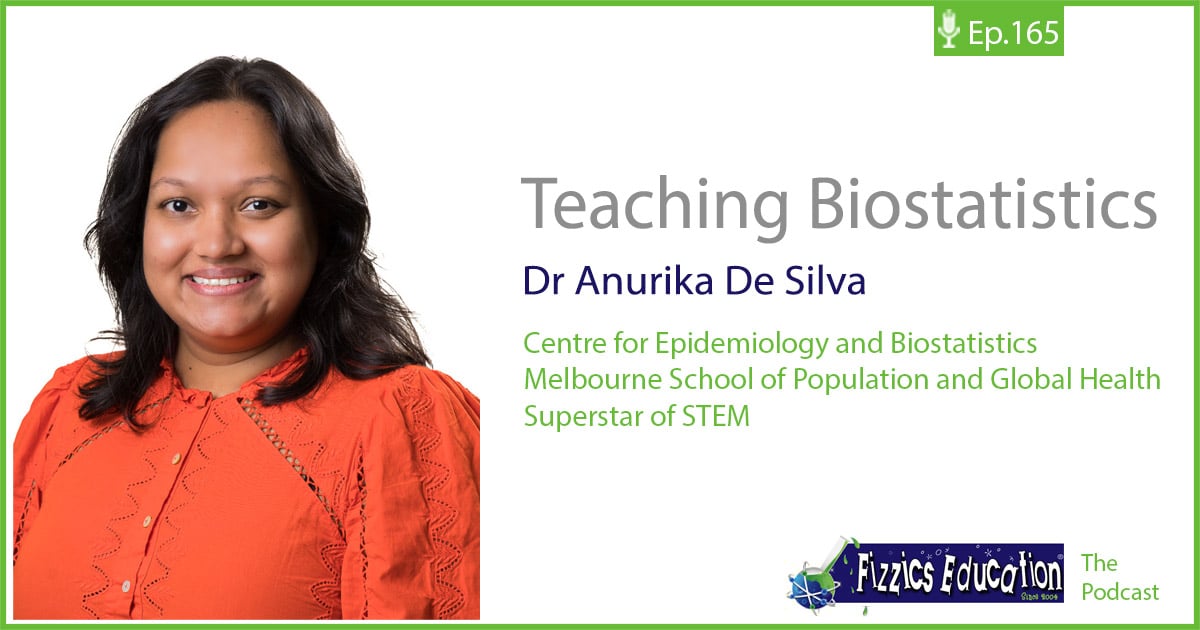
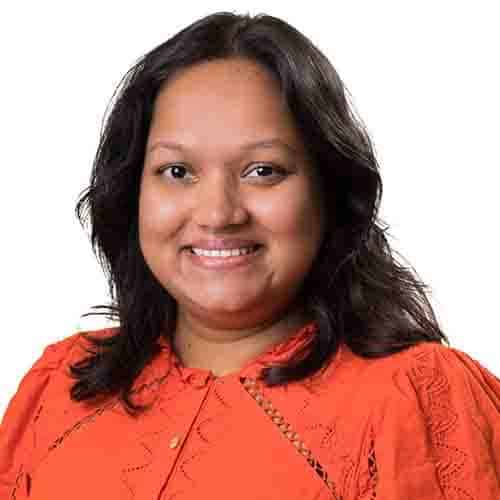
[00:00:19] Ben Newsome: Welcome again for another FizzicsEd Podcast. Glad to have you no matter where you are around this world of ours. We are talking STEM, and today we are focusing on the M in STEM. We’re hanging out with Dr Anurika De Silva, who is from the Centre for Epidemiology and Biostatistics from the University of Melbourne. She is a Superstar of STEM from Science and Technology Australia, and she is incredibly passionate about getting the next generation into STEM study and careers and, hugely, an advocate for gender diversity in this as well.
[00:00:55] Ben Newsome: She helps doctors find best treatments for patients. That’s what she does. And she’s led strong clinical and statistical collaborations in a whole bunch of teams from national and international institutes all over the place. She’s all about statistical methods that help health practitioners, and this idea of mathematics making stuff happen is so important for our students to understand. So, let’s head into this chat.
[00:01:31] Dr Anurika De Silva: Thanks, Ben, and thank you so much for inviting me. I’m very excited to be here and share my story with you today.
[00:01:52] Ben Newsome: I am excited as well because behind this all, I did do a biology degree a long time ago, which does involve a bucketload of statistics, turns out. And this is something that you very much do in lots of different ways. So, I have to ask, how did you fall into mathematics as a whole? Why is this your thing?
[00:02:11] Dr Anurika De Silva: I’ll go back a few years. I was fascinated with numbers since I was a little girl, and maths was definitely my favourite subject in school. I’m thrilled that so many years later, I still get to do what I love every single day. There were many reasons why I got into maths, and mainly I feel like the beauty of mathematics is that it has applications everywhere. I love that I get to use maths and stats to help doctors discover the best treatments for patients. It gives me a sense of purpose and it feels like I’m contributing to make society better.
[00:02:45] Ben Newsome: Oh, I mean, if you’re dealing with medical things, absolutely you are. I often wonder what students think a mathematician does on a daily basis. What does a day in the life of a mathematician look like? Do they conjure images of you just sitting in front of a whiteboard pondering quietly out to the sunset, or do you work with datasets? What does it look like on an average day when you’re working with the medicos to be able to help patients get better outcomes?
[00:03:14] Dr Anurika De Silva: Right now I would call myself a clinical biostatistician. I work at the Methods and Implementation Support for Clinical and Health Research Hub, or in short, MISCH Research Hub, at the University of Melbourne. We work across different hospital partners, the Royal Melbourne Hospital, Austin Health, for example, and we work with some brilliant clinicians and provide statistical support to their studies. It can be a clinical trial, it can be an observational study, and there’s this common misconception that as statisticians, we get involved just to analyse the data.
[00:03:55] Dr Anurika De Silva: You might have heard this term “crunching data” as well, but what we do is much more than that. We get involved right from the beginning of the study. For example, a clinician might come to us with a vague idea about what they want to do, and we would get involved in the study design and then we would get involved in the entire study process with them. So that’s what my life looks like right now. I get involved in all these very exciting studies.
[00:04:36] Ben Newsome: That’s so critical because a lot of us have questions that we want answered, but if we go about—gosh, I can imagine spending six or seven years of a PhD to only realise that your experiment was flawed from the very start and you have to start again.
[00:04:57] Dr Anurika De Silva: Yes, this is a really good point, Ben, because as statisticians, we are very passionate about making sure that these studies are designed and analysed rigorously to make sure that we get robust results. There’s a lot of investment going into these studies, and mainly these studies contribute a significant amount of evidence to clinical guidelines and to routine patient care.
[00:05:25] Dr Anurika De Silva: It’s very important that five years down the line, we don’t realise, “Oh, we’ve designed this study incorrectly,” or we haven’t conducted this study accurately. That’s where we come in, and it’s been amazing to have these strong collaborations with our clinicians.
[00:05:45] Ben Newsome: Which is good fun. That’s what you’re doing on a daily basis for work. But I know you’re doing a lot of education in the teaching side of it as well. How do you go about getting someone to go from a complete beginner—or at least, I guess you’re not really seeing complete beginners, you’ve got people who have a bit of a mathematics background—but getting to the point where they are career-ready to be able to help the world?
[00:06:05] Dr Anurika De Silva: As a part of my job, I provide training on these statistical methods to our clinical researchers who are now conducting these studies, but also to our future clinical researchers. That’s where my teaching comes in. I currently teach biostatistics for our Master of Public Health students at the University of Melbourne. This is actually one of the largest core subjects for the Master of Public Health. This semester, I have around 350 students, and I’ve been involved with this subject for the past eight years—first as a teaching associate and now as the subject coordinator.
[00:06:40] Dr Anurika De Silva: I’ve taught students from all walks of life, from different academic pathways and a large cohort of international students. Something that has been common and really struck me is this aversion to learning maths and stats because not all of them, as you said, come from a strong maths and stats background. A majority of these students haven’t really chosen a career in maths and stats. Because they’re Master of Public Health students, they mainly have chosen a career, maybe in epidemiology or in clinical research. So, we do have our work cut out for us.
[00:07:15] Dr Anurika De Silva: I unfortunately have felt this with my students—they speak with some amused self-deprecation saying that they’re not good at maths. I’m sure you may have heard this not just amongst students, but among adults as well, that people are very quick to say that they’re not good at maths, even though it’s such an important life skill. Students usually tell me that maths and stats is boring, it’s dry, it doesn’t have a human component to it. I believe them because when we first learn this subject, we don’t get to see real-world applications.
[00:07:50] Dr Anurika De Silva: Going back, even thinking about how I learned maths and stats, it was not really until my undergraduate year that I was really exposed to the real-world applications. I did my undergraduate studies at the University of Colombo in Sri Lanka. It’s a small country, a beautiful country in the Indian Ocean. It was actually in my undergraduate research year I was involved with a team which developed a 3D vessel traffic monitoring system for the Colombo South Harbour. As the statistician, I was given the responsibility of getting the minimum number of features needed to distinctly identify different types of vessels.
[00:08:15] Dr Anurika De Silva: Then I gave it to our computer scientists who really nicely mapped it in the 3D system. But this was the first time I got to see maths and stats being used to solve a real-world problem, and it really opened my eyes into the vast applications of mathematics. For me, there was no looking back after this point, and that’s when I seriously considered having a career in applied maths and stats. It also showed me how important it was to see the real-world applications of something. This is something that I also follow with my students as well.
[00:08:35] Dr Anurika De Silva: Because I understand, when they learn this for the first time in school, not many people get to see the real-world applications of this subject. This is why perhaps as kids, we are fascinated about maybe marine biologists or palaeontologists, but maybe not so much about statisticians, even though statistics is needed to solve many real-world problems. At least for me personally, I have a very hard time convincing my little nephew that I do a very cool job. He doesn’t believe it.
[00:09:04] Ben Newsome: Oh, it’s applicable across and beyond biology too. It’s eventually handling large sets of data with question marks around it that seem to move and it’s a little bit fuzzy in some ways. I’m actually thinking from my end, even in my undergraduate years, my very first subject I did was a statistics 101 type subject and I got through it, didn’t really do spectacularly well.
[00:09:45] Ben Newsome: But the follow-on subject, suddenly the penny dropped. I went from a pass/credit student to a high distinction in this statistics area because I suddenly understood how this would work in biology. I actually got it thoroughly. It’s funny how when I look back at the introductory subject and then the following one, there was a common thread there, but I was missing it very clearly.
[00:10:25] Dr Anurika De Silva: I agree with you, Ben, and this is the connection we try to make with our students as well because my subject is a mandatory subject. Many of my students, especially during the first few weeks, tell me that they only do my subject because it’s mandatory. Even though I know later in their careers, even if they have chosen a career in epidemiology or clinical research, statistics is going to be a crucial part in their careers.
[00:10:35] Dr Anurika De Silva: I know it’s going to be a real value addition, but especially in those first few weeks, they only do it because it’s mandatory. But what we try to do is we try to bring those real-world examples into the classroom. Our teaching team, many of us are involved across a lot of clinical studies, so whenever we teach, we bring our own examples into the classroom and the students really love to listen to these examples because they can place whatever they learn, the theoretical concepts, and they can see how it’s used in practice.
[00:11:15] Dr Anurika De Silva: Another thing we like to do is we like to use published examples, especially from high impact factor journals like the New England Journal of Medicine or The Lancet, and also examples being used in the media so that they can see, “Oh, yes, I’m learning an introductory biostatistics subject, but I can use these concepts to now read a journal article which is published and get some information out of this.” This has served us really well and the students are now very excited about the subject.
[00:11:51] Dr Anurika De Silva: For example, especially during the pandemic, we tried to incorporate examples about COVID-19 studies into our modules. The students found it extremely interesting to see how something that they’re learning now, even though it might be very introductory, very basic, they can still use these concepts to interpret something that’s very timely, very relevant to what’s been happening in society or in public health.
[00:12:26] Ben Newsome: And fast moving in that case.
[00:12:29] Dr Anurika De Silva: Exactly! There was a huge interest in public health, and we also saw a massive increase in student numbers in our Master of Public Health during pandemic times. It was really good to see that students are really interested in improving public health. It’s important to get them excited about biostatistics as well.
[00:12:56] Ben Newsome: One of the things that you’re doing is helping people get excited about STEM in general because I know that you’re involved in the Superstars of STEM programme. I know it’s only the start of the programme for now, but what’s it been like?
[00:13:06] Dr Anurika De Silva: This is a terrific programme, Ben, and I need to mention my supervisor, Associate Professor Karen Lamb, who was the one who encouraged me to apply for this. It has been a terrific programme so far. As you said, I just started it in January. It’s a terrific initiative by Science and Technology Australia, and it’s there to smash gender assumptions on who can work in STEM.
[00:13:42] Dr Anurika De Silva: Growing up, I was constantly told that mathematics is not for women. That was one thing that really motivated me into getting into maths, and I’m very lucky to have very encouraging parents, true. I found maths to be a very empowering tool. I find this programme quite empowering and quite useful, and it has taught me in this very short period to share my story and also make my science accessible.
[00:14:14] Dr Anurika De Silva: As STEM professionals, on a daily basis, we work a lot with our own colleagues, with clinicians, but we need to think about making science accessible to a broader community as well. That’s a message the Superstars of STEM is trying to spread and also make people, especially young people, excited about STEM and STEM careers.
[00:14:38] Dr Anurika De Silva: I’ve had the privilege of having very strong role models in life since a young age, but that established the importance of having visible role models to me. That’s something the Superstars of STEM is trying to do, have those visible role models for the young generation growing up. It has been an amazing experience so far.
[00:15:04] Dr Anurika De Silva: I got to meet some of the brilliant group of Superstars of STEM last week because I attended Science Meets Parliament. Having migrated to Australia just eight years ago, just going into Parliament House was such a surreal feeling. It was amazing to meet everyone from across Australia just doing amazing science.
[00:15:27] Dr Anurika De Silva: Just listening to Dr Cathy Foley, Australia’s Chief Scientist, and I also had the privilege of meeting Honourable Dr Andrew Leigh, Assistant Minister, and just talk about the importance of statistical communication in the broader community. All in all, it has been an amazing experience so far, and I’m just looking forward to the other activities. I have a few school visits planned and even this podcast, Ben, was an opportunity that was facilitated through Superstars of STEM. So, I’m very grateful to be a part of the programme.
[00:16:11] Ben Newsome: For sure. I’m actually curious, you’ve got some visits coming up with some schools. Schools are an interesting beast because the students, you don’t know where they’re coming from until they’re in front of you when you come and do visits. As an outreach person, I very much know this. What are your plans? What age group are you working with? What grade?
[00:16:29] Dr Anurika De Silva: At the moment we are planning for secondary schools, but it can be varied based on the school that we are working with. Sometimes teachers might have requests to aim for grades 9 to 10 or 7 to 8. It depends, some schools might have specific events aimed at different grades.
[00:16:51] Dr Anurika De Silva: I’m just excited to be a part of these school visits because, as I said, I’m originally from Sri Lanka, so I haven’t gone through this school system. I’m very excited to see and be a part of this programme just to see how the school system looks like and to get some school kids excited about STEM and being in STEM.
[00:17:19] Ben Newsome: For sure. If you’re listening as a teacher about getting kids excited about mathematics, a lot of you actually work deeply in this, numeracy is a thing. I think about some of the fun observance days, for example, International Pi Day is one that comes to mind straight away, or seeing especially as I’m speaking with a statistician, maybe Pi Approximation Day because it flicks around the other way, but these are fun days to at least get kids involved in.
[00:17:42] Ben Newsome: I was just thinking about what you mentioned a little while ago about this thing, and I see my kids do it, I see my friends do it: “I’m not good at maths.” It’s such an easy throwaway line. I kind of think about, what if we flipped that and imagine that you were talking with your friends or with your kids or your relatives and they didn’t say “I’m not good at maths,” they said “I’m not good at reading” or “I’m not good at art.” You don’t hear that so much. For some people, there might even be a stigma against saying “I can’t read.” Obviously, it’s very debilitating for a person who can’t read.
[00:18:20] Ben Newsome: And yet, if they’re having trouble with numbers, no one’s got any trouble saying that. In fact, it’s almost as a camaraderie thing and we all shake hands, we put our hand out, “Yeah, absolutely. I don’t understand maths either,” and we all have a bit of a laugh and we move on. Yet, it’s a fundamental part of our lives. This is a real hard thing to get past.
[00:18:41] Dr Anurika De Silva: Yes, I agree, Ben, and this is the main issue because we wouldn’t say that I’m bad at reading. But we hear this phrase, “I’m bad at maths,” and even sometimes we hear speakers who come to school use it as a phrase to bond with kids. “You know, I was bad at maths when I was in school, I’m still bad at maths.” But that doesn’t give out a good message because it normalises it.
[00:19:14] Ben Newsome: Makes it okay.
[00:19:15] Dr Anurika De Silva: Yes, exactly. Because as I said before, maths is such an important life skill to have. I’m not saying you need to do a PhD in mathematics. Working with my students, what I’ve realised is that their attitude, it’s just the tip of the iceberg. It’s made me realise that there is a much broader issue in the community, a real antipathy towards maths and stats which affects people’s interaction with evidence-based research and related public policies.
[00:19:54] Dr Anurika De Silva: A good example was the pandemic years. We saw that a significant amount of people really struggled to actively and accurately engage with pandemic-related data. I’m not just talking about vaccinations or lockdowns or masks. I’m also talking about the people’s lack of willingness to understand the pandemic itself, even to the point that there were too many people for comfort who believed that the pandemic was a hoax.
[00:20:31] Dr Anurika De Silva: This misinterpretation or the misunderstanding of data led to a lot of resentment, hostility, and it created a lot of division, especially when social unity was quite important. It’s very important that people have the ability to make informed decisions, and not just during the pandemic. It applies to other issues which have a lot of social, community, and global impact. It can be policies on climate change, migration, or other cultural changes.
[00:21:10] Dr Anurika De Silva: To make these informed decisions, it’s important that people understand evidence. One of the biggest frameworks of understanding evidence is to understand and engage with data. But the more you dislike it, the more you have a fear towards it, the less likely you’re going to accurately engage with data.
[00:21:35] Ben Newsome: Even understanding—during the COVID years, we suddenly understood that there was this thing called this R0. What is this number? And now we suddenly really understand it. I think about this term, statistically relevant, and it means something to a STEM professional because we’re exposed to this world, but the average punter isn’t.
[00:21:56] Ben Newsome: It can be an issue when we’re making decisions or making life choices around particular sets of data. “Oh, so-and-so said this,” and they’ve been reading studies. If you actually look at the study, it could only be like five people were checked, and that’s not a great cohort for a dataset. People make these solid groundings based on flawed assumptions. It’s difficult.
[00:22:30] Dr Anurika De Silva: Yes, I agree, and this is the important part where we need to bring more awareness about understanding data, understanding evidence-based research. We see this sometimes in the media as well, using one study and sensationalising just one finding and that can be misinterpreted. We have a broader message that we need to spread and definitely I understand the best place to raise awareness is school.
[00:23:07] Dr Anurika De Silva: I appreciate that there are some fantastic initiatives at the moment, some government-led initiatives focusing on STEM education, such as Curious Minds, STEM Professionals in Schools, and Science by Doing. But there are some other fantastic initiatives as well, university-led initiatives, industry-led initiatives. I know many of the universities in Australia do a lot of outreach with schools.
[00:23:44] Dr Anurika De Silva: We also need to take this message to the broader community. We see in other countries, for example, the BBC, they have a resident statistician. What they’re trying to do is make statistics part of people’s lives. Having statisticians in media makes statistics part of people’s lives. They are trying to make people more aware about thinking with data. That’s how we can raise awareness about this.
[00:24:19] Dr Anurika De Silva: I often feel that raising awareness about a disease, such as heart disease or cancer, is relatively easy because people can relate to it, because you might know someone who’s going through the disease, or you might be going through it. People are more keen to learn about this, and funding organisations are more keen to fund awareness programmes based on these diseases.
[00:24:51] Dr Anurika De Silva: But raising awareness about understanding data or evidence-based research might sound a bit irrelevant or it might be a bit difficult. We still need to spread this message. That’s where programmes like the Superstars of STEM are quite important.
[00:25:14] Ben Newsome: 100%. I was actually thinking about ways of normalising mathematics. There’s a bloke who’s been going around for many, many years, Simon Pampena, who does this maths comedy. Seriously, this is a thing. He does stand-up comedy using mathematics. I remember going through—he did a piece on why Australia really wins the Olympics—sorry, anyone overseas—but according to numbers, Australia really wins the Olympics if you really play with the numbers in different ways.
[00:25:52] Ben Newsome: You can mess with numbers and you can actually make it funny. Now, I’m not doing a great job of it because I’m not Simon Pampena who does this work very well and I’m thinking off the fly. But you can play with maths and make it normal. If you can do a stand-up comedy routine to a general audience using mathematics, it shows that people can connect with data. It’s just the way you do it.
[00:26:15] Dr Anurika De Silva: Yes, exactly. Ben, you’re selling yourself short here because this podcast is quite useful to people as well. There are some other amazing podcasts as well, like the Random Sample podcast or the Stats + Stories podcast. There are also other blog posts and stories.
[00:26:40] Dr Anurika De Silva: For example, Sir David Spiegelhalter has been doing a series of stories on understanding risk, aimed at the general community. These are ways we can really connect with the general community who might have this aversion towards maths and stats and get them really excited about these concepts. Definitely this is one of the podcasts that is doing a really good job, Ben.
[00:27:06] Ben Newsome: Oh, thank you. Thank you. I feel like I should get the cheque in the mail or something. But thank you very much. We try to do what we can to get people to know that there are lots of initiatives out there, and that actually brings up the point. You are involved in initiatives, not just Superstars of STEM. You do the work with your 350 Master’s students and you’re going out to schools.
[00:27:35] Ben Newsome: The question is, as you go out to the schools, if you get a moment to actually speak with the teachers directly, just say you had all the teachers in the room for a moment and you were going to get a message out or at least some advice out to those teachers to increase numeracy interest, not just levels and abilities to pass a grade, but frankly, interest. What would be some advice that you give them?
[00:27:54] Dr Anurika De Silva: I would definitely—I mean, the teachers know their students best and whenever I go to these schools, I first ask the teachers for their advice as well, what they think would be best and most appropriate for the students. It’s a working collaboration with the teachers. One of my recommendations or suggestions would be to bring in real-world applications or examples to the classroom.
[00:28:34] Dr Anurika De Silva: This is why something like a collaboration with another STEM professional outside of school is quite helpful because they can give you these real-world applications or real-world examples. I’m seeing how excited students become when they see these real-world applications.
[00:28:55] Dr Anurika De Silva: As a statistician, it’s very hard to get students excited about statistics. For example, if I go to a school with my colleagues who do something like climate change or who are involved in brain cancer or something like, as I said, a marine biologist.
[00:29:26] Dr Anurika De Silva: Even though statistics is used in all of these areas, in all of these real-world applications, it’s a little bit hard to get students excited about maths and stats. The important part is to show that maths and stats is being used in all of these areas. To get those STEM professionals in your classroom, it’s quite important because then the students can see, “Oh, I can have a career in this area.”
[00:30:00] Dr Anurika De Silva: That’s something that the students have told me: “I never saw myself having a career in maths. I never saw myself becoming a statistician because I never had role models growing up who were mathematicians or statisticians.” So it’s really important to get those visible role models in your classroom and get those real-world examples into your classroom.
[00:30:35] Ben Newsome: For sure. As you introduce these STEM professionals into your classroom, get them to talk about how they’re using their mathematics in different ways. I challenge you, absolutely challenge you, to find a STEM professional who does not use mathematics. I don’t care who you’re listening to. I was listening to an ABC Radio thing only yesterday afternoon with Jodi Rowley, who does the FrogID app, which is this great citizen science app where they’re about to crack their one millionth frog sound that’s been submitted by citizens.
[00:31:15] Ben Newsome: Someone’s got to crunch one million data points. Someone’s got to do it, and they’ve got to work out what’s bad and what’s good. It’s always mathematics somewhere. So it’s actually important to not just talk about, “Hey, I’m a marine biologist and I get to dive on the reef and look at various different damselfish,” but guess what, the data has to be put in as well because otherwise you don’t get to submit into those journals like The Lancet and other things that you’ve talked about. It’s just how it is. And it backs up what your evidence—it’s your evidence base.
[00:31:50] Dr Anurika De Silva: Yes, I agree. This is what the students need to see, that for everything that you want to do, all these exciting careers, you need maths and stats. You need to be able to break that barrier because I often feel that students develop this fear in school towards maths, and they carry that over to university, then they carry that over to their adulthood as well.
[00:32:15] Dr Anurika De Silva: We need to break that stigma while they’re in school. Bringing those STEM professionals into school, bringing those real-world examples into school is a really good strategy.
[00:32:36] Ben Newsome: That’s right. So, we’ll use the term, “let’s normalise this discussion around this stuff.” Dr Anurika, maths pun towards the end. Look, hey, thank you very much for coming on in. There’ll be people who’d love to know where to go to learn more about the work that you’re doing. Where would they need to head off to?
[00:32:55] Dr Anurika De Silva: A few different mediums. I’m on Twitter, my handle is @anurikadesilva. Also, as I said, I’m from MISCH Research Hub, so we have our website. If they just search for MISCH UniMelb, they can look at all the amazing work that we are doing with our clinicians there. Also, if they want to get my contact details, if they just search for Anurika De Silva at UniMelb, my email address is there, and I’m on LinkedIn as Anurika De Silva as well, they can contact me there.
[00:33:38] Ben Newsome: Thank you so so much, Anurika, for joining me for this bit of a chat. And well done, also, getting into the Superstars of STEM programme and undoubtedly that’s a fantastic another launchpad—it’s not like you’re involved in one, you’re involved in several—another way to get out your love of mathematics that you grew so long ago.
[00:34:06] Dr Anurika De Silva: Thank you so much, Ben. This has been lovely. It was a great experience for me as well. I think I’ve told you this before—this was my first podcast. I hope I did well.
[00:34:13] Ben Newsome: You did well! And it’s funny how—and that’s actually important—and people listening in too, your first can always be the start of many as well.
[00:34:29] Dr Anurika De Silva: I hope that’s true. And yes, if anyone takes away one message from this, I hope it would be never to say that “I’m bad at maths” again.
[00:34:35] Ben Newsome: Yes, that’s a no-no. Exactly right. Thank you so much, Anurika. Have a fantastic morning.
Frequently Asked Questions
What is a clinical biostatistician and what do they do?
A clinical biostatistician, like Dr Anurika De Silva, applies mathematical and statistical methods to biological and medical research. Rather than just ‘crunching numbers’ at the end of a study, they are involved from the very beginning to help design experiments, clinical trials, and observational studies. Their work ensures that the data collected is robust and provides reliable evidence for best-practice medical treatments.
Why is it important for statisticians to be involved in the design phase of a research study?
Involving a statistician early prevents fundamental flaws in the study design that could render years of research invalid. By ensuring the methodology is rigorously strict from the start, researchers can produce results that are accurate enough to be used in clinical guidelines and routine patient care, saving time, money, and potentially lives.
How can educators help students overcome a fear of mathematics and statistics?
The most effective way to engage students is to showcase real-world applications. When students see how maths and stats solve tangible problems—such as identifying vessels in a harbour or determining the effectiveness of a new vaccine—the subject moves from being dry and theoretical to being purposeful and exciting. Bringing STEM professionals into the classroom as visible role models also helps break the stigma that maths is ‘too hard’ or ‘not for everyone’.
Why is the phrase ‘I’m not good at maths’ considered problematic?
Saying ‘I’m not good at maths’ has become a socially acceptable throwaway line that normalises innumeracy. Unlike literacy, where there is a stigma attached to not being able to read, being ‘bad at maths’ is often used as a bonding tool. This attitude can lead to a broader antipathy towards data, making it difficult for adults to accurately engage with evidence-based research and public policies, as seen during the pandemic.
What is the Superstars of STEM programme?
Superstars of STEM is an initiative by Science and Technology Australia designed to smash gender assumptions about who works in STEM fields. It equips women and non-binary experts with communication and media skills so they can become visible role models. By increasing the presence of diverse scientists in the media and schools, the programme aims to inspire the next generation to pursue careers in science, technology, engineering, and mathematics.
Extra thought ideas to consider
The impact of data literacy on social unity
During global crises like a pandemic, the ability to interpret data becomes a vital life skill. Misunderstanding or misinterpreting statistical evidence can lead to resentment, hostility, and social division. Improving general numeracy and data literacy helps people make informed decisions about their health and community, fostering greater social cohesion.
Normalising statistics in mainstream media
One way to improve public engagement with data is to make statistics a regular part of everyday life. Some international broadcasters employ resident statisticians to help the public understand risk and evidence in the news. By integrating statistical thinking into general media, society can move away from sensationalised headlines and towards a more nuanced understanding of complex global issues like climate change or public health.
Discussion points summarised from the FizzicsEd Podcast, verified and edited by Ben Newsome CF