Transcript
[00:00:00] Announcer: You’re listening to the Fizzics Ed Podcast. For hundreds of ideas, free experiments and more, go to fizzicseducation.com.au. And now, here’s your host, Ben Newsome.
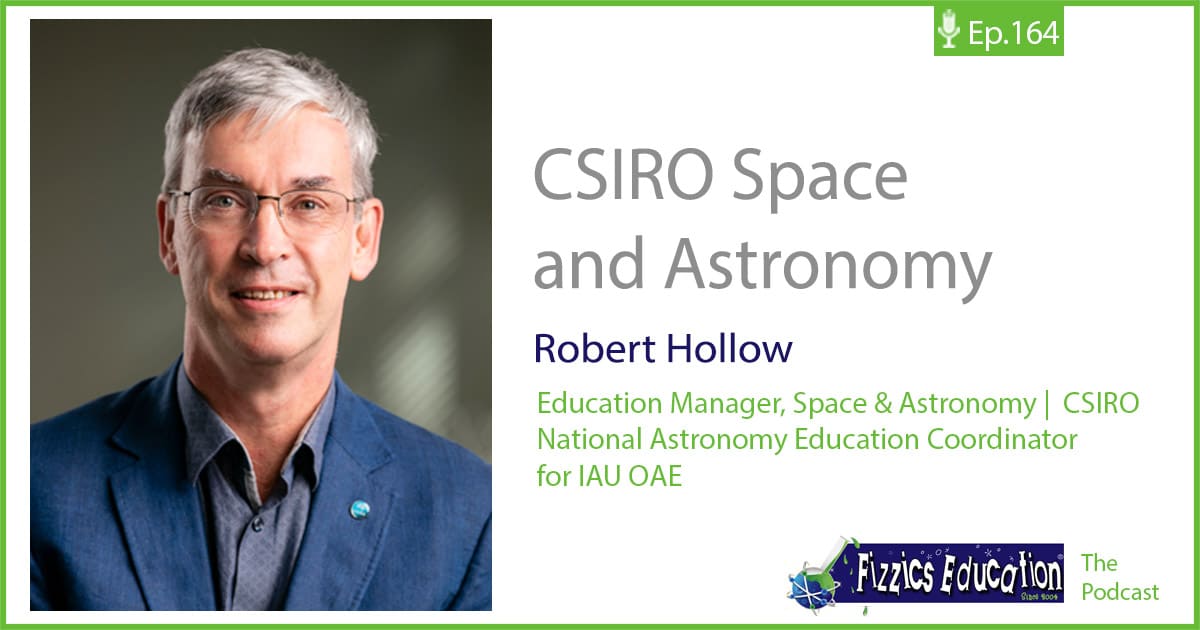
[00:00:18] Ben Newsome: Welcome again for another Fizzics Ed Podcast. Glad to have you back for another chat around STEM, and today we’re hanging out with Robert Hollow, who is the Education Outreach Manager for CSIRO’s Astronomy and Space Science group, CASS. He is incredibly passionate about science outreach, and he develops educational programmes and materials to support students, teachers, and the public, and has been doing this for a very long time. Today we’re going to hang out with him and learn just why he loves what he does, and about the PULSE@Parkes project and so much more. Let’s get into it.
[00:00:50] Announcer: This is the Fizzics Ed Podcast, for all about science, EdTech and more. To see 100 fun free experiments you can do with your class, go to fizzicseducation.com.au. That’s physics spelled F I Z Z I C S and click 100 free experiments.
[00:01:08] Ben Newsome: I’m really excited to have a chat with you because a little while ago we ran into each other in Adelaide at the space forum. Winding it forward, I got to teach just after New Year’s at the dish out at Parkes, which is frankly a lot of fun. But you get to do this every day. I’d love to know a bit more about what you do.
[00:01:27] Robert Hollow: My title role is Education Manager here at CSIRO Space and Astronomy. I’m actually based in Sydney, not at the telescope out at Parkes, or Murriyang, the Wiradjuri name for our telescope there. I do a whole range of things. I run teacher workshops; in fact, I’ve just come back from a session for Tasmanian teachers in Hobart at their annual conference on the weekend, which was really good.
[00:02:01] Robert Hollow: I coordinate our postgraduate and undergraduate students. We’ve got about 35 PhD students scattered across Australia, and we have about 15 third-year undergrads come and work with us on a really interesting range of research projects every summer. That keeps me busy. I also coordinate and run our programme called PULSE@Parkes. It is a free programme for high school students where they can use the iconic 64-metre Parkes radio telescope, Murriyang, live remotely in real-time to observe these amazing astrophysical objects called pulsars.
[00:02:44] Ben Newsome: That’s a bit on your plate. It takes you around a little bit.
[00:02:50] Robert Hollow: I also do a lot of stuff in Western Australia in support of all our activities there with the head of the SKA going in there, and ASKAP and the like. I get to visit the remote community schools and work with teachers and students across the Midwest primarily in Western Australia, which is also a lot of fun.
[00:03:13] Ben Newsome: Fantastic. I’m curious, when you did a teacher session down in Tasmania, was that to high school teachers or primary teachers?
[00:03:22] Robert Hollow: It was a mix. It was their annual conference and they asked me to go down and run a session on how they can use real astronomical data in the classroom with their students. That’s a real passion of mine, using authentic data.
[00:03:37] Ben Newsome: I was going to ask that. Whether you’re a Grade 12 teacher or you’re teaching Grade 6, the data’s there. The question is, where do you access it? How do you interpret it? And how do you go about doing this?
[00:03:52] Robert Hollow: That’s the point. The one thing we don’t lack in astronomy in general, and radio astronomy in particular, is data. We have lots of data and most of it’s freely available. The question is how the non-professional can engage with the data. From an education point of view, part of my work is bringing that data to teachers initially, because you get a multiplier effect there, so they feel comfortable introducing it with their students.
[00:04:30] Robert Hollow: There’s actually a diverse range of programmes around the world. Teachers don’t need to reinvent the wheel. There are a lot of great programmes out there and they can work at different levels. We help mentor students doing the Year 12 extension science independent research project, but we’ve also used our data with much younger students. We’ve got a web-based activity with PULSE@Parkes, and there are lots of other astronomy programmes out there that utilise data at different levels. Plus, there’s a huge range of citizen science projects now, many of which use astronomical data.
[00:05:07] Ben Newsome: That’s what I was curious about, because as a student going through various science classes, you get presented these things and you get involved because you’re effectively being told to. I always had in the back of my head, “Is this real? Is it going to be used?” But the beauty about citizen science is it 100% can be used.
[00:05:28] Robert Hollow: That’s right. I was involved in a project a few years ago called Radio Galaxy Zoo, and that used data from our Australia Telescope Compact Array up in Narrabri, New South Wales. Radio Galaxy Zoo was really one of the first citizen science projects to see how the public can interact with radio astronomy data and make a meaningful contribution.
[00:05:57] Robert Hollow: Those citizen science projects in the Zooniverse system all have principal investigators. They’re real science projects, papers get published from it. It’s just that the public are involved in helping analyse that data and classify what we were looking for.
[00:06:17] Ben Newsome: Which means we’ve got to teach the students what they’re looking for, right? Otherwise, it’s a myriad of numbers with perhaps some coherence, but not to the naked eye if you haven’t been trained.
[00:06:31] Robert Hollow: That was personally where I was coming from with Radio Galaxy Zoo. I was more interested in how non-experts interact with a radio astronomy image. Obviously, my astronomer colleagues were interested in galaxy evolution and galaxy morphology, but I was more interested from an educator perspective. Is it valid to take radio astronomy to the public? I preempt myself by saying yes because we’ve been doing it for 15 years with PULSE@Parkes, and we’ve seen that high school students can interact with our data and ask really meaningful questions.
[00:07:15] Ben Newsome: That data is freely available from Australian sites. Is there capacity for students to work with data from overseas?
[00:07:24] Robert Hollow: Yes. A huge amount of astronomy data is sitting in publicly available databases. There are some very good programmes that have developed really effective interfaces. For instance, the Sloan Digital Sky Survey developed a server called SkyServer that’s designed for educators and students, but it interrogates the professional database. Students have made discoveries and really interesting findings using that site.
[00:08:01] Ben Newsome: That’s amazing. The thing about these sites is that they’re somewhat isolated. We don’t always get to go out to—for those listening in, you may not know where Narrabri is. It is a bit of a trip away from Sydney, as is Parkes.
[00:08:16] Robert Hollow: It’s an eight or nine-hour drive. Parkes is about a five-hour drive from Sydney. Parkes is relatively accessible and it’s just off the Newell Highway, the main highway between Melbourne and Brisbane. We get over 100,000 people a year to our fantastic visitor centre out there, which is pretty phenomenal even by global standards. You come across people who always remember their visit out to Parkes. We try to provide it, and obviously, we had your team out there doing some activities over the school holidays, and we’re looking forward to doing more things specifically during holiday times.
[00:08:59] Ben Newsome: That was a lot of fun. Nothing like presenting science in front of an iconic icon, as well as having a whole bunch of Elvises in front of you during the Elvis Festival in Parkes. It was amusing, especially when you get an Elvis up to help present a thing with you.
[00:09:15] Robert Hollow: I think all science demos need their Elvis.
[00:09:19] Ben Newsome: I actually think that—because I am going to be visiting Narrabri a little bit further down—but if I go back to Parkes again, I think I’m going to need some lab glasses with rhinestones or something.
[00:09:32] Robert Hollow: That’ll create an even greater impression.
[00:09:36] Ben Newsome: For sure. I remember when we spoke at the space forum last year, you described how you got to go overseas a bit to learn from others doing this. Where have you been able to go and what have you learned?
[00:09:51] Robert Hollow: Personally, one of the things I really enjoy about astronomy and astronomy education is it is a global pursuit, a global community. I’ve been doing it professionally now with CSIRO for just on 20 years. At the time my position was created, there were very few full-time astronomy education people outside of the science museums and planetaria. That community has certainly grown significantly in Australia now, so I’ve got a lot of colleagues here.
[00:10:28] Robert Hollow: There’s so much we can learn from programmes overseas and people doing exciting stuff overseas, and vice versa. Part of what we do is share what we do and hopefully inspire others to look at, “We’ve done this, why don’t you give something similar a try or use your facilities to come up with something similar?” It’s a two-way thing, and it’s always stimulating to catch up with colleagues and share ideas. That’s how quite a few good new projects have come about.
[00:11:00] Ben Newsome: The fun thing about this is that it can be about the far edge of some galaxy somewhere, or it can be looking at spacecraft that are operating if we buy that time to look at it. Especially as the Artemis missions are coming up, are you guys going to be involved in some way about helping confirm landing, etc.?
[00:11:21] Robert Hollow: CSIRO will be heavily involved in Artemis. The crewed missions—the ones that are going to send humans back to the moon—because it’s beyond Earth orbit, all fall under the remit of the NASA Deep Space Network. We operate the NASA Deep Space Network station down at Tidbinbilla just outside of Canberra, the Canberra Deep Space Communication Complex. It will be absolutely vital in maintaining telemetry and communication with the crewed missions carrying humans to the moon.
[00:11:54] Robert Hollow: But Artemis is even bigger than that. This time we’re not just going to the moon, staying there for a day or two, and coming back. The aim is to have people living on the moon. To that end, you’re going to need to send resources there ahead of time. Starting this year, there will be uncrewed automated spacecraft landing on the moon, taking cargo and building up a supply base.
[00:12:25] Robert Hollow: Those ones, because they’re not carrying humans, NASA doesn’t want the Deep Space Network tied up with those. They have to access other facilities. One company, Intuitive Machines, has signed a contract with us to use Murriyang, the Parkes radio telescope, for telemetry. They’re due to start sometime this year.
[00:12:47] Ben Newsome: What’s fantastic to learn—I remember having a chat with one of the radio physicists when I was out there—you alluded to the sheer amount of data that’s being produced, that sometimes they may not even get a chance to look at that data for a year or two years after the fact. We were doing some science demonstrations at the time and we were understandably concerned about whether doing X experiment is going to put a blip in the data two years after the fact.
[00:13:20] Ben Newsome: When people visit these sites, do you see a lot of issues with background emissions of mobile phones and that sort of thing? Or is there a way of scrubbing that data using AI? How is that dealt with? Looking at it two years after the fact, it can be a bit challenging to work out what happened on that day.
[00:13:38] Robert Hollow: What you’re referring to, we’re great in astronomy with acronyms. You’re talking about RFI, which stands for Radio Frequency Interference. Just as you can have light pollution around optical telescopes, for radio telescopes, we’re always concerned about RFI. It is a perennial and growing issue.
[00:14:00] Robert Hollow: For instance, at a site like Parkes, you’ve got a town relatively nearby, an airport there, and people driving up the highway. These days you’ve got mobile phones, digital TV, Bluetooth, you name it. It’s an ongoing issue. This is one reason why our newer facilities are in remote outback Western Australia in a protected radio quiet zone, well away from large population centres.
[00:14:30] Robert Hollow: In answer to the second part of your question, yes, we have people whose full-time job is to try and figure out how to flag, identify, deal with, and remove RFI. We have a whole range of strategies going on. You can flag a thing saying, “There was this burst for this 10 seconds here, let’s take that 10 seconds out of our data.” But there are other measures too.
[00:15:00] Robert Hollow: You try to restrict the interference around the site. You would have known when you drove up to Parkes there are signs asking you to turn your mobile phone off. But when you’re getting 100,000 people visiting a year, I’m not sure all 100,000 of them have turned their phones off. We do notice, for instance, at nighttime, it’s generally a quieter radio environment out there.
[00:15:25] Ben Newsome: I suppose, when we’ve got students in front of us, there are lots of different pathways they can take. You have some kids who 100% want to do pure astronomy down the line. And yet this thing called data just won’t go away in lots of ways. Are you finding that some of the mathematics classes are getting involved?
[00:15:47] Robert Hollow: I can’t answer specifically as to what the maths classes are doing, but we can certainly say that whilst we have a need for people that have gone through traditional astrophysics pathways through university, more and more we need specialists and expertise in a broad range of areas. We’re increasingly recruiting people to work on projects in artificial intelligence and machine learning.
[00:16:21] Robert Hollow: We’ve got some new post-docs in our space and astronomy group working with the pulsar team, and they’re not astronomers by background. They haven’t done astronomy at university. They’re coming in with their skillsets to help work as part of a team to figure out how you can interrogate these large datasets. With PULSE@Parkes we’re looking at pulsars, right? We’ve got petabytes of pulsar data publicly available taken on Murriyang. How can you look through all that?
[00:16:51] Robert Hollow: The example is once you know what you’re looking for, it’s much easier to find it. Now we have software pipelines that have been developed and refined so that if you’re doing a search for new pulsars, you can find them. The real challenge in any pipeline, and when you’re designing new telescopes and instruments, is you can design it to help you more readily find what you know about.
[00:17:23] Robert Hollow: But at the same time, the really exciting science is often the totally unexpected things. You don’t want to have a system that is so locked down that it only finds and keeps looking for the known stuff. The really interesting stuff is coming up with ways of finding unknown stuff.
[00:17:42] Ben Newsome: It almost reminds me of mining in some ways. You’ll have a new technique designed and suddenly an area that was abandoned because it wasn’t producing enough particular mineral ore, now it’s really abundant because the new technique is bringing out a whole bunch more ore.
[00:18:07] Ben Newsome: Every now and then I’ll see a science alert post saying, “We’ve now mined the old Voyager 2 data and discovered this thing we didn’t know before.” You just said petabytes, that wasn’t terabytes. That’s a lot of bytes. Which means you’re dealing with a sheer number of zeros just there. Does that mean that there’s a real opportunity to keep on poring over this data year after year in different ways?
[00:18:31] Robert Hollow: Absolutely. The classic example is we’ve had pulsar surveys looking for pulsars. About 15 years ago, an American astronomer, Duncan Lorimer, was going back through archive data from Parkes and he found this rather unusual thing. It looked like a really intense burst of radio energy, but it was incredibly short, milliseconds in length. The first one of these was called the Lorimer Burst after him.
[00:19:05] Robert Hollow: Then they looked through more data and started finding more of these. Eventually, the first one was observed using Murriyang. For a while, it was only with Murriyang or Parkes that they were being found, which is great, but it’s also concerning because if you’re only finding it with one instrument, is it real? What is it? Fortunately, other telescopes started finding these things.
[00:19:33] Robert Hollow: This has been one of the huge growth areas in radio astronomy in the last decade, things called Fast Radio Bursts. There have been lots of conferences, large groups working on this, telescopes optimised, and new ones designed specifically to look at these. Now we’re finding hundreds, probably thousands by now, of these objects.
[00:19:55] Ben Newsome: This is the interesting thing when it comes to new discoveries; sometimes it’s after the fact people go, “Oh, we should have realised that.” I think about the work that got done with the cosmic microwave background radiation, the CMB, that, “Oh, it looks like the universe might be inflating because there’s evidence for this thing.” I believe it’s like 1% of your background—mind you, we don’t have analogue TV anymore—but that buzz that was on your TV. I even remember the stories where they first found this thing they were looking for like, is it bird poo on the antenna? What’s going on?
[00:20:32] Robert Hollow: White dielectric material was the scientific name in the paper. Because it was a horn antenna, the pigeons would go in and nest in there, so they had to clean that out to make sure that wasn’t the source.
[00:20:46] Ben Newsome: Such a quaint word, dielectric material. Well done. I do like the way that’s actually really part of a good story for students to say, “Well, eventually the null hypothesis is that’s not the case. It’s something wrong with our instrument first.” I can understand why there would have been concerns that, at Murriyang we’ve got these bursts happening, but nowhere else. Maybe it’s just pointing at the right place at the right time with the right receiver.
[00:21:18] Robert Hollow: To be blunt, astronomers or the scientists I work with, are inherently skeptical people. You find something, you don’t immediately publish and proclaim it. You want to make absolutely sure that you rule out as much as you can. This takes time. It can take a year or more to work through, and then you try and run tests, talk with people, and get independent confirmation. It’s an iterative process, it’s a collaborative process, but you’ve got to be very careful and methodical working through the data. Particularly if you’re going to make some bold new claims.
[00:21:56] Ben Newsome: Extraordinary claims need extraordinary evidence, that’s just what it is, and repeatable would be rather lovely. Excellent. So you’ve just had the conference in Tasmania and no doubt you’ll get pulled to different conferences all around. You are effectively the education spearhead for the CSIRO. If you had a bunch of teachers in front of you from a variety of different areas, what would be some advice you’d give them to get kids inspired to join the work that you do?
[00:22:33] Robert Hollow: I think there are lots of different programmes or pathways they can take. These days good teachers realise they don’t have to be the expert on everything. In many ways they’re the facilitator. They need to be able to support the students, ideally point them to some effective starting places, reliable programmes, authentic programmes, and the like.
[00:23:07] Robert Hollow: There’s no way the teacher’s going to be an expert on everything, and they’ve got to be honest too in saying what they don’t know. But there’s a lot of support out there for them. I’ve got my programme, we’ve got colleagues at other institutions running some great programmes that teachers can get involved with. Going more broadly, CSIRO Education has a diverse range of programmes that we run across the nation. Go and have a look at the CSIRO Education site and you can get contact people for more details on those.
[00:23:38] Robert Hollow: Don’t be afraid to give it a go, I think is the advice to teachers, because there’s a lot of good stuff out there. It is challenging for teachers. They are an incredibly time-poor group of people. They have so many demands on their time.
[00:24:00] Robert Hollow: When I’m running a workshop or working with teachers, I always like to have a few ideas so that they could take one thing from the time they spent with me and literally go and use it in the classroom tomorrow, pretty much grab and use. But I also like to introduce them to things that they can go and play with or take time to work through, wrap their heads around, and start thinking about some more exciting ideas and opportunities they can share with their students.
[00:24:28] Ben Newsome: For sure. Actually in that vein, getting kids to understand that there is this thing called the electromagnetic spectrum and it’s got a wave, and it can be stretched or squished. If you’re listening in, find yourself a simple metal slinky and get two students to stretch out the slinky. Have one student wiggle it and you’ll create a wave. Now get the students to walk together or further apart, and they can visually show that you can have waves that are short and waves that are long. That simplistic discussion can begin the discussion of what a radio wave is compared to another form of wave, for example, visible light.
[00:25:15] Robert Hollow: The radio waves are the long wavelength, low frequency, and low energy part of the electromagnetic spectrum. The advantage is that for most frequencies, radio waves can penetrate the atmosphere so we can pick them up at ground level. We don’t need to put our telescopes into space, because as soon as you start doing that, it gets incredibly expensive. Australia was one of the pioneering nations and is still a world leader in radio astronomy. It’s one of our strengths. We’ve been doing it a long time, we do it really well.
[00:25:51] Robert Hollow: One of the demonstrations I use often—and it’s something probably a lot of students don’t know these days—is a little pocket transistor radio. Who uses those? Everyone’s probably getting everything over Wi-Fi. But a good old AM/FM radio, it’s got an antenna and circuitry that can convert a radio wave into an output, in this particular case sound. If you take a cheap one, $10 from an electrical store…
[00:26:24] Robert Hollow: Tune it on the AM band—the average student won’t know what the AM band is these days—but tune it between stations and then go and hold it up to the computer screen. You’ll get a really obvious example of radio frequency interference because you’ll get that big static burst. You can actually use it to map out where the wiring is in the classroom, where a data projector is, any source of interference. That’s one of the things that I like to use as a really simple personal introduction to the fact that there are these radio waves around us.
[00:26:58] Ben Newsome: It’s fascinating. It really is. Considering that when you start talking with kids about where these radio waves were a source, eventually we start talking about deep time.
[00:27:09] Robert Hollow: We can talk about the radio waves that we pick up; some of them have been travelling across the universe for a long time.
[00:27:20] Ben Newsome: Very much so. It’s wild that this is the case. Thanks very much for popping on here. I really appreciate having a chat. We need to go visit the CSIRO Education website. Type in CSIRO Education, you’ll find it. Perhaps look up Murriyang or the Parkes Observatory. But you also mentioned the pulse programme. What was that?
[00:27:38] Robert Hollow: PULSE@Parkes. So it’s research.csiro.au/pulseatparkes, all one word. Put it into a search engine and you’ll find it too.
[00:27:58] Ben Newsome: And as normal we put these into the show notes too, by the way.
[00:28:02] Robert Hollow: At the moment we just opened a whole new bunch of slots that schools can apply for from April through to September. We only accept applications from teachers, not from individual students unfortunately. If it’s a student listening, go and talk to your teacher. If it’s a teacher listening, jump on, have a look, and put an application in. We offer these online, so any school in Australia can apply for a session.
[00:28:31] Ben Newsome: Good, I was going to ask that because I know a few people listen to this from overseas, outside of Australia. Do they sadly miss out?
[00:28:38] Robert Hollow: We have done sessions occasionally. We’ve had funding and done tours to Japan, New Zealand, South Africa, China, and the like. So we have done sessions overseas, but they’re always limited in number, or in conjunction if we’re at a conference somewhere, we’ll sometimes do a demonstration session. But for Australian schools, it’s free to apply and we certainly like to see lots of new schools sign up.
[00:29:04] Ben Newsome: Reserve your spot quickly because April will come across fast because by my clock that’s next week. It’s not far away. And if you’re listening to this a year or two from now, I’m sure that those slots will be open for sure.
[00:29:20] Robert Hollow: We open them every six months. Because we’re bound by telescope semesters, which are totally out of sync with school years of course. So we have an October to March and then we have an April to September semester.
[00:29:36] Ben Newsome: Like anything, book your seats, the bus is leaving so to speak. Thanks very much for joining us. I really appreciate having a chat and hopefully we get to chat again in person at another space forum or something similar.
[00:29:48] Robert Hollow: That would be great. And in the meantime, enjoy Narrabri and getting back to Parkes.
[00:29:53] Ben Newsome: I really can’t wait. It’s really good fun getting out there. Catch you soon. Thanks a lot.
[00:30:00] Announcer: We hope you’ve been enjoying the Fizzics Ed Podcast. We love making science make sense. Why don’t you book us for a science show or workshop in your school? If you’re outside of Australia, you can connect with us via a virtual excursion. See our website for more.
[00:30:16] Ben Newsome: So I hope you enjoyed that chat with Robert Hollow. I certainly did, especially speaking with someone who really knows their science outreach and has helped so many students and teachers right across this country and beyond to understand how radio astronomy works. Gosh, love it. As usual, we have more people like Robert coming up on the Fizzics Ed Podcast. I hope you’re enjoying this series. Go back through the back catalogue. At this point in time there are over 160 of them, and they keep on growing. It’s been fascinating to have these chats and I love bringing them to you. You’ve been listening to me, Ben Newsome from Fizzics Education. This is the Fizzics Ed Podcast and I hope to catch you another time.
[00:30:52] Announcer: You’ve been listening to another Fizzics Ed Podcast. We’re excited about science. Subscribe to us on iTunes to download the next episode as soon as it’s released. And don’t forget, for hundreds of ideas, free experiments, our new Be Amazing book and more, go to fizzicseducation.com.au. That’s physics spelled F I Z Z I C S.
[00:31:21] Announcer: This podcast is part of the Australian Educators Online Network. AEON.net.au.
Frequently Asked Questions
What is the PULSE@Parkes programme?
PULSE@Parkes is a free educational initiative for high school students that allows them to remotely control the iconic 64-metre Parkes radio telescope (Murriyang) in real-time. Students use the telescope to observe pulsars—highly magnetised, rotating neutron stars—and contribute to authentic scientific research.
How can students and teachers access radio astronomy data?
A significant amount of astronomy data is stored in publicly available databases. Robert Hollow highlights that programmes like the Sloan Digital Sky Survey’s SkyServer and CSIRO’s own archives allow non-professionals to interrogate professional data for classroom projects and independent research.
What is Radio Frequency Interference (RFI)?
RFI is the radio wave equivalent of light pollution. It includes signals from mobile phones, digital TV, Bluetooth, and aircraft that can interfere with the sensitive equipment on radio telescopes. CSIRO manages this by establishing radio quiet zones and using sophisticated software to flag and remove interference from the data.
How is the Parkes telescope involved in the Artemis moon missions?
While the Canberra Deep Space Communication Complex handles crewed telemetry, the Parkes radio telescope (Murriyang) has been contracted by companies like Intuitive Machines to provide telemetry and communication support for uncrewed lunar landers carrying cargo and supplies to the moon.
Do you need to be an astrophysicist to work in astronomy?
Not necessarily. Robert notes that modern astronomy increasingly requires specialists in artificial intelligence, machine learning, and data science. Many researchers working on pulsar data pipelines come from non-astronomy backgrounds but bring essential skillsets to manage the petabytes of data produced.
Extra thought ideas to consider
The Challenge of the Unknown
When designing software pipelines to find astronomical objects, there is a risk of confirmation bias where we only find what we are looking for. The real breakthrough in science often comes from “serendipitous discovery”—finding data that doesn’t fit the known models, such as the Lorimer Burst which led to the discovery of Fast Radio Bursts (FRBs).
Data Mining Legacy Archives
With petabytes of data being archived, there is a growing opportunity to re-examine old observations using new techniques. Just as researchers found new insights in decades-old Voyager 2 data, current students may one day discover new astrophysical phenomena hidden within the data being recorded today.
Discussion points summarised from the FizzicsEd Podcast, verified and edited by Ben Newsome CF