Transcript
[00:00:00] Narrator: You’re listening to the Fizzics Ed Podcast. For hundreds of ideas, free experiments and more, go to fizzicseducation.com.au. And now, here’s your host, Ben Newsome.
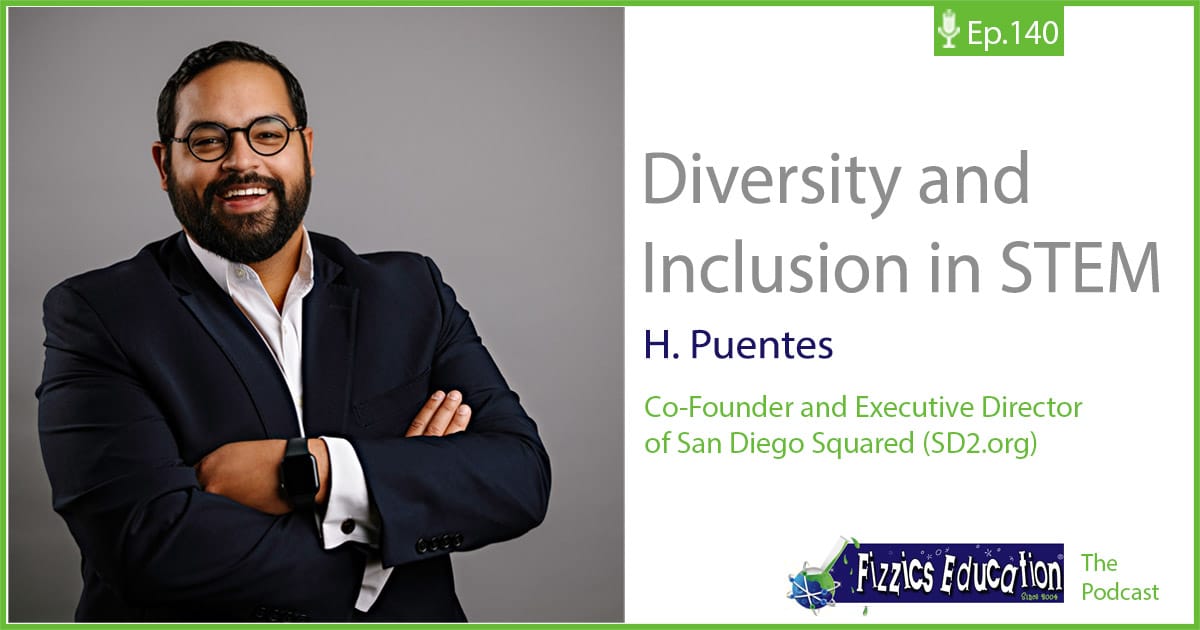
[00:00:17] Ben Newsome: Welcome again for another Fizzics Ed Podcast. Glad to have you again for another chat around STEM, and in this particular case, we are diving right into diversity and inclusion. You see, H. Puentes does an amazing job through a group called San Diego Squared, a non-profit focused on increasing diversity in STEM-driven companies through partnerships, programmes, and financial support for high school students, college students, and their educators. He’s the co-founder and he’s the executive director of SD2, and prior to that, he served on the leadership team at Connect, where he founded Connect All at the Jacobs Center, which is the region’s first diversity-focused startup accelerator and business resource centre. Today, H. has raised over $6 million to increase diversity in tech and the life sciences, and you can really tell he is really walking the walk. And you’ll know what I mean when we get into this chat. So, let’s head right on in.
[00:01:10] H. Puentes: Hey, thanks for having me. Really, really appreciate it, Ben.
[00:01:12] Ben Newsome: Oh mate, I’m really happy for you to be involved because I hadn’t come across what SD2 does, but once I sort of looked underneath the covers a bit, you do a bit. You really do.
[00:01:24] H. Puentes: Yeah, we try to be thoughtful about how you approach increasing diversity in STEM, at least over here in the US, which has a lot of history to it. People have done a lot of work in this space, but we can’t seem to move the needle in any meaningful way. So we really wanted to think about how we could have a unique approach that really added value, that didn’t reinvent the wheel. And when we reflected, we found some really good opportunities to really sort of humanise this work a bit and really connect with communities in a way that perhaps isn’t normally done.
[00:02:04] Ben Newsome: Yeah, that’s fantastic. And let’s be honest, every country has these problems in different shapes and forms, but you’re doing something about it, which I love. It’s just kind of neat. So when did this all come about? I mean, this is not a sort of a quick endeavour. I mean, this takes time.
[00:02:21] H. Puentes: No, and it’s interesting. I feel like my lived experience has sort of driven me here. My parents are immigrants from Colombia. They were both born in Cali. I was born in New York, I grew up in Texas, a country town. My family met some real difficult financial circumstances. I was very fortunate to get to university, but my mother laughs that I pulled up to university with a can opener and a towel. I had no sheets. I had no pillowcases. The first day I’ve ever visited the university was the first day of classes.
[00:03:00] H. Puentes: And so with some real hard work and support and mentorship, I graduated, landed in London for grad school, and then worked in management consulting. So I was travelling like crazy, for-profit, ended up at a venture-backed startup out of the Bay. So I really got that kind of innovation, entrepreneurship, venture capital kind of bug. And then about a decade ago, I transitioned to non-profit work and really found something that just spoke to me and spoke to my heart.
[00:03:30] H. Puentes: I’m really fortunate that my wife is what I call a boss. She’s a PharmD, a pharmacist. She’s also a PhD in oncology cancer research and speaks multiple different languages and does very well. And what that does is it allows her to hold down the house and lets me do these kind of more community work projects.
[00:03:55] H. Puentes: And I think that’s really important, especially when you talk about diversity and inclusion, because it allows me the freedom to really have the difficult conversations that I think that we’re not having. For example, if you enter a company and you see that there’s 12 board members that all look the same, if you’re a newly-minted diversity officer, it might be difficult to have that conversation with your CEO and the board members for fear of some sort of retribution.
[00:04:24] H. Puentes: And so what you do is you then focus on unconscious bias training and your hiring practices, when the sort of elephant’s sitting in there in the room and you don’t feel confident enough to have that conversation because you’re worried you might have families, you might have kids, and you need the job, frankly. And so I feel very, very fortunate to be in a position where I can really keep it 100, as we say in the US. I can be my authentic self and I can ask questions that I think are really important.
[00:04:55] H. Puentes: So before starting SD2, I was at an organisation called Connect in town in San Diego. Connect is an accelerator for high-tech and life science companies. It’s been around for almost 40 years. I ran external affairs there, and at Connect, I started a programme that I think is pretty cool called Connect All. And that was really our diversity and inclusion initiative focused on increasing diversity amongst founders, executives, and boards of directors.
[00:05:35] H. Puentes: We took that programme from concept to about $4 million in funding in two and a half years to build the region’s first diversity-focused startup accelerator, and we brought it into a community that was notoriously underrepresented. And so that’s really where I got my chops in this space and really learned about how do you bridge the gap between some of the conversations that are happening in the more affluent areas or industry-heavy areas, and how do you bridge that gap with some of the conversations and what’s going on deep in the communities that we’re trying to connect with.
[00:06:14] H. Puentes: Really proud of that work. It’s still rocking to this day. 60 companies have gone through the accelerator, almost 400 companies have gone through the resource centre. And like I said, that’s really where I got my focus and my scars to prove it. And then a few summers ago, I was connected with a real just an iconic biotech executive in San Diego named Bill Rastetter, who after the George Floyd murder was pretty activated and just asking around, what can I do?
[00:06:50] H. Puentes: Bill Rastetter created a drug, a cancer therapeutic back in the late ’90s called Rituximab. That cancer therapeutic is used in almost 5 million patients. It’s done 100 billion in sales since he created it, and then he went on to start and sell and start and grow a number of different companies. And so you can kind of see the matchmaking happening. Here you have someone like Bill who has real deep roots and access to an industry that’s very difficult to access, and you marry that with somebody who has taken these innovative ideas around diversity and inclusion and actually operationalised them, which is very difficult to do when you move from theory to practice.
[00:07:10] H. Puentes: And so together we founded San Diego Squared. And you know, it’s kind of like all of those steps in my life, from struggling to university to being involved in for-profit and venture to understanding the industry side, to having the freedom to work in non-profit work and really experience how to lead a team, how to lead a big project, establish that project for longevity, and then it has prepared me I think for this new role at San Diego Squared to try to make impact in a different way, but still addressing diversity in innovation.
[00:07:44] Ben Newsome: I just love how what you’re talking about is true lived experience. When you really think about it, I mean the number of times that you’ll see someone sort of helicoptered in to deal with a role as opposed to actually going in and walking it and talking it and living it and breathing it and hurting through it and all the rest. But now you’re really flying. So how are you bridging? I mean looking through what SD2 does, I mean there’s a few things going on. You’ve got scholarships, you’ve got all sorts of stuff going on. So I mean what is there to discover if people just jump on the site?
[00:08:16] H. Puentes: Yeah, I think we kind of boil down our areas of focus to four. So we’ve got four primary areas that we focus on. Backing up, our mission is to increase diversity in STEM-driven companies. I always like to say that I come from kind of the realist view of diversity and inclusion. And what I mean by that is that ultimately I want to see our economy, particularly the innovation economy, reflect the communities in which they operate in.
[00:08:58] H. Puentes: I am not here to tell people how to spend their money; I am here to try to get diverse communities paid, because I really think that if we can get them into industries that have great career trajectory, that have great pay, then you’ll start to address the income inequality gap. And if you start to address the income inequality gap, then you can bring the power back into the communities and let them kind of do for it. So we don’t teach values and morality or anything like that. This is really strictly about how do we get this industry that’s created more jobs, more capital than any other in human history, frankly, to be more reflective of the communities in which they serve.
[00:09:25] H. Puentes: And so we’ve got four areas that we focus on. The first is around community activation. We learned pretty early on that there’s some really incredible organisations doing some great work on the ground already, whether it’s at universities, at high schools, secondary, primary, whatever you would call it, but also in the community orgs. There’s a lot of community organisations doing great STEM work and they’re really working at scale with curriculum and training. But what we found was that their links to industry were often not very strong.
[00:10:00] H. Puentes: The prime example of a teacher, a teacher that’s probably underpaid, that maybe is teaching a science class, has 30 students, 40 students, is dealing with the post-COVID virtual in-person. And she might have or he might have 10 students that are interested in 10 different companies and 10 different careers. And that poor teacher might reach out, but they don’t have the bandwidth to reach out to 10 different companies. And even if they did, they’d reach into and maybe they get a manager at that company, and maybe the manager might really want to connect, but they don’t really have the juice within that company to really get the company going.
[00:10:35] H. Puentes: This industry, as I said, is very difficult to access. But when Bill and our board that he’s assembled reach out to these companies, it hits differently. Bill has frankly made a lot of people very, very successful. Our board is responsible for a lot of people being very, very successful. And so when we reach out to a company, we’re able to connect directly to the C-suite level and we’re able to activate a company in a way that just an educator wouldn’t be able to. And so what we found is that we have a real good role in this community activation where we connect the industry to different teachers or different community orgs or programmes where they can be utilised.
[00:11:15] H. Puentes: So an example, Deloitte recently reached out to us saying, “Hey, we’ve got our big volunteer day, and we’ve got hundreds of Deloitte employees here in San Diego that we want them to do something on their volunteer day. Can you help us?” And so we immediately started to reach out to local community orgs and saying, “Hey, they’ve got hundreds of volunteers ready to go. Could you use them?” And one down in Logan Heights like, “Of course, we run a summer camp. It would be great to have them come and teach financial or accounting or mathematics.”
[00:11:58] H. Puentes: And then another community org that’s a college access programme’s like, “Oh, we would love to be able to talk about financial management and how do you deal with loans and that.” So they’re putting together an academy for one group and they’re going to speak for the summer course for another. And so obviously Deloitte’s extremely thrilled because they don’t have the bandwidth to go out and know all the community orgs that could utilise their human capital. And then of course, the community orgs, the teachers, the educators are extremely thrilled because now they can just connect with us and we’ve got deep relationships that we can help deploy. So that’s one area of focus that we do.
[00:12:26] H. Puentes: The second is our Squared Fellows programme, which is a high school programme, so students before they enter the university. We essentially go around the community to identify sort of the best and brightest diverse underrepresented high school students. And when we say best and brightest, that doesn’t mean GPA. That doesn’t mean you gotta be the valedictorian. It could be that a teacher really sees something special in you.
[00:12:51] H. Puentes: It could be that you’ve got grit because you’ve had to struggle and work since you were 15, but you’ve really demonstrated an interest in science and you want to pursue that. It could be that you’ve excelled in sports and you’ve excelled in your community by being a community leader, a church leader or something like that. So we really try to redefine what it means to be the best and brightest, identify those students early, we bring them into a rotation-based programme where each rotation they visit a different type of STEM company.
[00:13:20] H. Puentes: And then what we do, which is signature to SD2 programmes, is we fortify each of these students with a year-long mentor that meets with them once a month for an entire year. So for you to be a mentor at SD2, you have to commit for over a year. We really think it’s that mentoring consistently over time that’s going to help students really build their confidence, build their nuanced understanding of the industry, and really, really help to build their social capital, which is really critical, especially if you don’t have an aunt or an uncle or somebody in your family that’s been able to pursue a career in STEM.
[00:13:52] H. Puentes: And then the second two, we’ve got our Squared Interns programme where we connect paid internship opportunities at STEM companies with college students, underrepresented college students. This has been really massive and sort of successful even though we haven’t fully launched it. What essentially we do is we act as an internal referral for these companies. So companies will post an opportunity. They’ll say, “Hey, I need a CSR intern that has an MBA candidate.”
[00:14:32] H. Puentes: And then what we do is we’re able to build a hyper-local scouting network at the different universities. And we’re able to maintain that in ways that one company just can’t do that. And what I mean by hyper-local means instead of just going to the career centre or just deploying on an app an opportunity, or going to the historically black universities in the US, we’re able to meet with the dean of the STEM school. We’re able to know who the fraternity and sorority chapter presidents are, who the professor of chemistry is at a particular university. And so we’ve got about 20 to 30 scouts in our network across different campuses in San Diego.
[00:15:00] H. Puentes: So when a company needs that MBA candidate, we know who the MBA programme directors are at the different campuses. We immediately send the opportunity to them, and then they start to send us diverse candidates. And then what we do, which is sort of the secret of it, is we then send an email over to the company champion and say, “Hey, these five candidates have applied through our network.”
[00:15:21] H. Puentes: And then what they do, which is the sort of the secret of it, is they then pull that student out of the queue. They send that resume over with an email directly to the hiring manager that says something to the effect of: “Company X is committed to seeing diversity and inclusion in its employment. In that spirit, we’ve partnered with organisations like San Diego Squared to help us identify diverse talent. This candidate comes from that relationship. We ask that you give them a serious consideration.”
[00:15:50] H. Puentes: And this is massive when you think that, for example, at just Illumina alone, 7,000 students apply for 80 internship slots. So the algorithm’s going to cut you out. And so not only now are we able to pull that student out of being one of 7,000, but now they’re going to be one of maybe a few hundred, probably less, and they’re going to be highlighted directly to the hiring manager, which has proven to be just a massive value-add and one that we’re solving a big problem for the company because the company doesn’t have the bandwidth to build all those relationships on any given campus, much less seven of them.
[00:16:27] H. Puentes: But we can do that because we’re taking five internships for one company, five internships for another, three here, and for us, the economies of scale work. And then we’re also helping the universities because they possibly can’t have 10 different relationships with 10 different companies. And so now that chemistry professor is loving it because now we send it and they know it’s real, they know they’re looking for diverse candidates, and because that chemistry professor is right at the watering hole where all the students are, they’re able to help us become that scout.
[00:16:58] H. Puentes: Similar to like the Premier League or the baseball farm system, where they go into these communities and they see the students playing early, they’re able to identify them directly through a scouting network and then send them directly to the teams where they then are supported financially through education, through training to make sure that they have the best chance of success. So we essentially replicate that model, but for diverse talent in STEM. And then I think the kicker once again is each of those students is assigned a year-long mentor so that as they’re going through this internship, they’re also being supported through somebody that looks like them, shares that lived experience, and is actually a practising professional in STEM.
[00:17:42] H. Puentes: And then the last thing we do is we’ve got our Squared STEM Scholars, which is our funding arm. So we give out scholarships. Last year we gave over 120,000. This year we’re giving almost 200,000 in scholarships. And the key thing there is scholarships aren’t new. People have been giving scholarships to underrepresented folks for a long time.
[00:18:06] H. Puentes: When we give a scholarship, we see ourselves as a strategic investor in that student. And so every scholarship, once again, you get a year-long mentor. And the idea is to ensure that we are supporting you. It’s not just about the financial capital for us. It’s important—you can’t take away the financial need from underrepresented communities—but it’s when you pair that financial need with real human connection and inspiration that you’re going to start to really move the needle.
[00:18:30] H. Puentes: So we’ve got our community activation, we’ve got our fellows programme for high school students, our Squared Interns, which is our scouting network for college students, and then we’ve got our Squared Scholars, which are college scholarships that come with year-long mentorship. And that’s essentially SD2 trying to underpin that pipeline from getting people excited about STEM, connecting them through activation, moving to your fellows that are high school students, they hopefully get scholarships that help support them as they’re going through college with mentorship, and then they land that paid internship opportunity, which oftentimes then, if they excel there because they’re being supported, becomes that gateway to full-time employment into a STEM company. And that is the sort of suite of SD2.
[00:19:07] Ben Newsome: And what I love about this is that you’re actually producing a future network of alumni who are going to know exactly what SD2 does and then accelerate it further and further and faster. Actually, the whole time when you were describing that, I was looking over your top left-hand shoulder at that logo going SD2 and I was going, well, that could change to CA2, California Squared, or it could change to NY2, or frankly any other version that you could shove in that black box there because it’s such a great concept. It’s a great model. And I guess a question for me right now is this is clearly going to grow. So where’s this going?
[00:19:47] H. Puentes: Yeah, I think look, I think Bill, as you can imagine, Bill has built iconic companies and I’ve always been a firm believer that scaled problems require scaled solutions. As you mentioned, countries across the world are facing this issue. This is not new. This is not just unique to the US, unique to San Diego, or unique to California. So I think what we’re doing right now, we’re about a year and a half in, we’re really trying to refine this model, make sure it works, make sure we understand it works, refine it, make it better, and then we’ve definitely got our vision to scale. You can imagine LA Squared, Boston Squared, New York Squared, Research Triangle Park in North Carolina Squared, Houston Squared.
[00:20:38] H. Puentes: And so we, the unique position we’re in is that I think with our board, with Bill, we’ve got a network that’s ready to scale. I think we just want to make sure that we’re doing this in the right way. And so you can definitely see the hope and the vision is that if we’re able to get this model right here, then can we move to LA Squared and Boston and the Bay Squared? Can we scale it out to a national organisation that then is now you’re connecting people from different cities? Because you can imagine a paid internship knows no barriers. And so if we’re able to start to connect the dots, there’s a real nice scalability piece.
[00:21:20] H. Puentes: And then also, I think if you’re able to place a paid intern, then maybe you’re able to place a junior engineer. Maybe then you’re placed a senior engineer. Then what about an executive or a board member? And so I think ultimately, if you kind of water down what the big vision is, we want San Diego Squared or the future Squared Foundation to really sort of be the community where diverse talent is, where people are connecting with each other, supporting one another, and really helping each other move along that career path into a really sustainable, wealth-generating, intergenerational wealth-creating opportunity for underrepresented people that just hasn’t been there historically.
[00:22:03] Ben Newsome: Totally. I mean, part of this too is you mentioned a few times relationships, hyperlocality. Having those connections matter and them not being superficial. So of course that’s going to take up time, but you’ve got a prototype.
[00:22:20] H. Puentes: We do. We do. And I think what you’re talking about there is that this is human work. And I think a lot of people forget that it’s hand to hand, that it’s not glamorous. We spend a lot of human—we’re not creating anything new. And the interesting piece is we’ve already connected several students that we’ve changed trajectory.
[00:22:38] H. Puentes: I’ll give an example, we placed a young Black man, a chemistry major out of CSU San Marcos, a local university here in town. We placed him in a biotech called Tracon Pharmaceuticals, which has been super supportive of our work.
[00:22:56] H. Puentes: He had the internship. Now he is their latest full-time employee. And he was so excited last month when we were speaking because he was getting his first bonus. And so to just think about the trajectory that was changed. He was excellent before SD2. We aren’t doing anything other than providing an opportunity for these students to be seen.
[00:23:14] H. Puentes: There’s greatness out there in all these communities, but oftentimes that greatness goes without being seen. And so the beauty of this work is that we get to just highlight what’s already there. We’re not doing anything special, we’re doing the human work to really connect these students with these opportunities so that they aren’t just another number in some sort of algorithm and application pool, but they’re actually a student that’s excelled, that’s overcome a lot of adversity to be where they are and can really, really add value.
[00:23:46] H. Puentes: Diversity, there’s an economic case for it. It’s not a charity. We’re not a charity thing, even though we’re a non-profit, we’re adding value to these companies. And I think these companies understand that. And I think that’s where the real problem is being solved on the company side and the community side, which is super exciting.
[00:24:06] Ben Newsome: Seriously, as we record this particular chat, I was listening to the radio on the way into work just prior to landing here. And they were talking about there’s a genuine, and we know about this, genuine skills shortage right now. So unemployment is at record lows right now in Australia. And we got inflation going up, etc., etc.
[00:24:35] Ben Newsome: So you got companies really needing to fill those skills, like now. Yesterday would be nice. And effectively what you’re really doing is, yeah, increasing diversity, but that talent pool is constrained based on their networks, based on how much money they’re going to throw into marketing, etc., etc. But going at a grassroots level and tapping into this really deep group of people who know a lot of stuff but maybe, like you’re saying, be caught up in the algorithms, this skips that and accelerates them along. I like it.
[00:24:55] H. Puentes: Yeah, it’s just trying to bring that humanity, ground this work in humanity and get away from—I think all the data’s out there. All of the panels have been panelled. All the podcast episodes are out there. It’s like, what does it look like to just reach out into these communities, identify incredible talent, and then connect them with real opportunities? And you’re sort of at the tip of the spear. When students are making that jump from high school into university, who’s holding their hand through that? Who’s supporting them, who’s helping them with their letter of recommendation, social capital, identifying what roles?
[00:25:35] H. Puentes: And then once they’re through academia, who’s helping them make that jump from academia into industry? And what I’ve found is that oftentimes it’s not the smartest student, it’s not the degree or what you studied, it’s really that social capital. It’s that confidence and believing that you belong in STEM. It’s that nuanced understanding of what space you want to work in, and those are the things that SD2’s really focused on. It’s like bringing that humanity to this work and knowing that we didn’t get here overnight. And so I think we’re not going to do it tomorrow.
[00:26:10] H. Puentes: SD2’s not going to in the next five years, 10 years, just completely change. We’re going to start one student at a time and change that student’s trajectory and then go to the next student. And if we can do that with 50, 100 students in one city every year, then we go to four cities, and then that’s 400 students every year. And really just having that long-term lens, I think is really important and critical to this work.
[00:26:35] Ben Newsome: Totally. I mean, that’s actually something I talked to our students, that we see many, many students, and a lot of people want something more now or hopefully next week or next year. Dude, you gotta take the time. You gotta put in the effort. But actually that brings up the point. So we’ve got people all over the world listening to this particular chat, and not all just in schools. It’s quite interesting and heartwarming to know who listens to this, which means undoubtedly there’ll be people who are involved in diversity and inclusion in some way, shape, or form.
[00:27:05] Ben Newsome: And some of them might be running non-profits or wanting to form a non-profit to impact their local community, their local town, their country, or beyond. And so I guess I wonder, if you had to give them some advice—just hey, you had some sort of like a mini-accelerator for like tops of two minutes—where you had to go, you know what? Here’s what I’ve learned and here’s what you need to know to start taking steps towards truly making this happen. What would you say to these future leaders?
[00:27:38] H. Puentes: Yeah, I think if you’re starting a non-profit, I think you need to find a sustainable business model. And you need to move that model away from a charity normative perspective. Meaning, if you’re getting your money from the head of the foundation of a company or foundations from an organisation, that sustainability is really, really difficult if you’re just starting out. I think if you can increasingly move and arm the heads of HR or executive teams to really have a true business case that when they are in the boardroom and they ask, “Well, why do we give San Diego Squared in this case $100,000 a year?”
[00:28:18] H. Puentes: Well, what we’re doing is we’re arming them by saying, “Hey, let me tell you why. Because we’re able to find you two interns a year. And at two interns a year, and let’s just say they make $100,000 a year or two employees make 100,000, you’re going to need to hire a headhunter to find those two talented individuals. And you would normally pay a recruiting firm 20% to 30% of first-year salary. So at 100 grand, we’re bringing you 60 grand of value by helping you to identify diverse talent. But not only that, are you able to identify talent through our work, but you’re also investing in the future pipeline and the sustainability of your ecosystem.”
[00:28:55] H. Puentes: And so oftentimes I find people well-intentioned move into the space of non-profits, but they don’t really think clearly about what is the sustainable business model here. Because once the, you know, we’re two years after George Floyd, once things subside, what’s going to ensure that you have the wherewithal and the financial longevity to keep your work going?
[00:29:21] H. Puentes: Because it is such generational work, you’re going to need batteries for the generational work. And so really thinking that through, I think is one of the things that I would really recommend. And the more it can be a true economic case for your work, the stronger your organisation’s going to be. And that’s probably for people starting, that’s going to be the single most important thing that you can do is really think about the long-term sustainability of your organisation.
[00:29:45] Ben Newsome: Oh, it makes so much sense. And actually I do see a lot of outreach organisations that rely heavily on funding models alone from government, and they pop in and out based on politicians’ whims. They just do.
[00:29:57] H. Puentes: It’s so difficult to do that, and in that, it undermines the work in and of itself. And so you create organisations that are short-sighted, there’s a feast or famine on funding, and then you have these sort of battles, and people aren’t connected, and it sort of disincentivises precisely the work you need to actually move the needle forward.
[00:30:21] Ben Newsome: Perfect. Now let’s just go with your words, the hyperfocused sort of hyper-local thinking. If I was listening in San Diego now and I needed to get in touch based on those four pillars that you work on, how do we do that?
[00:30:35] H. Puentes: Yeah, you can go to our website sd2.org, that’s SD2, the numeral two. You can see there on my corner there. You can email us at [email protected] or email me directly, [email protected]. I’m happy to connect with anybody. I always am an open book. I give all of my experiences out freely because I just think that that’s important and the right thing to do. So sd2.org, you can email me [email protected]. I’d be happy to connect with anybody that was listening in San Diego or beyond, because there’s things that I can learn too.
[00:31:15] Ben Newsome: H, and that’s the thing. It is quite a journey. I mean, especially for yourself, Colombia to Texas to San Diego, UK and more all over the place. It’s really, really cool listening in what you’ve been doing. And look, I really want to see this grow. I think it’s fantastic and really happy to support what you’re doing in our own tiny little way down in this corner of this world. I appreciate it.
[00:31:37] H. Puentes: I appreciate it, Ben, and thank you for what you do. Thank you for providing the voice for so many people to be able to share and learn and grow. I really think this idea of building a community, which you are doing, is super undervalued but super critical to the work that we’re doing. So thank you so much for doing this and for the opportunity to come and speak on your podcast.
[00:31:58] Ben Newsome: Mate, much appreciated. Have a fantastic evening. I’m going to enjoy my morning.
[00:32:02] H. Puentes: There you go. Enjoy. I will do the same. Take care.
[00:32:05] Ben Newsome: Take it easy, man. All right, bye.
[00:32:07] Announcer: We hope you’ve been enjoying the Fizzics Ed Podcast. We love making science make sense. Why don’t you book us for a science show or a workshop in your school? If you’re outside of Australia, you can connect with us via a virtual excursion. See our website for more.
[00:32:25] Ben Newsome: Well, there we go. We just hung out with H. Puentes, who is an amazing person at San Diego Squared. So, head on over to their website sd2.org. You will find out all about those four pillars that he discussed and, more importantly, how to get involved. So, look, I hope you enjoyed this particular chat. I always love these particular chats. And as usual, we’ve got more of these coming up. You have been listening to the Fizzics Ed Podcast. You’ve been hanging out with me, Ben Newsome, from Fizzics Education, and I’ll catch you another time.
[00:32:53] Announcer: You’ve been listening to another Fizzics Ed Podcast. We’re excited about science. Subscribe to us on iTunes to download the next episode as soon as it’s released. And don’t forget, for hundreds of ideas, free experiments, our new “Be Amazing” book and more, go to fizzicseducation.com.au. That’s physics spelled F-I-Z-Z-I-C-S.
[00:33:19] Narrator: This podcast is part of the Australian Educators Online Network, aeon.net.au. A, E, O, N, dot net, dot au.
Frequently Asked Questions
What is the core mission of San Diego Squared (SD2)?
San Diego Squared is a non-profit organisation focused on increasing diversity in STEM-driven companies. They achieve this by partnering with industry leaders to provide programmes, financial support, and long-term mentorship to underrepresented high school and university students, as well as their educators.
How does the “scouting model” for internships work?
SD2 acts as a hyper-local scouting network, similar to a professional sports farm system. They build deep relationships with university deans, professors, and student leaders to identify talented diverse candidates. By referring these students directly to hiring managers at partner companies, they help them bypass automated HR algorithms that often filter out qualified diverse talent.
Why is year-long mentorship a requirement for SD2 programmes?
H. Puentes emphasises that mentorship is critical for building social capital and confidence. Short-term interactions are rarely enough to change a student’s career trajectory. A full year of consistent guidance helps students navigate the nuances of the STEM industry, build professional networks, and truly feel they belong in high-level innovation roles.
What advice does H. Puentes offer for starting a sustainable non-profit?
He suggests moving away from a “charity” mindset and instead building a true economic business case for your work. By showing companies the tangible value you provide—such as saving them recruitment costs or providing high-quality talent—you create a more stable funding model that doesn’t rely solely on the whims of foundation grants or political cycles.
What are the four pillars of SD2’s approach?
The organisation focuses on four key areas: Community Activation (connecting industry to local educators), Squared Fellows (a high school rotation programme), Squared Interns (college scouting and placement), and Squared STEM Scholars (scholarships paired with mandatory mentorship).
Extra thought ideas to consider
The Elephant in the Room: Boardroom Diversity
H. discusses the difficulty diversity officers face when addressing lack of representation at the executive and board levels. Consider how the freedom of being an external non-profit partner allows for more honest, “keep it 100” conversations with CEOs about structural changes compared to internal roles that may fear retribution.
Reframing Diversity as Talent Optimisation
Rather than viewing diversity initiatives through a lens of morality or values alone, SD2 treats them as an economic necessity. By tapping into “unseen greatness” in underrepresented communities, companies are not performing an act of charity but are instead ensuring they have access to the best possible talent pool to drive innovation.
Addressing the Income Inequality Gap via STEM
STEM careers offer some of the highest trajectories for pay and professional growth. By focusing on getting diverse talent paid in these high-growth sectors, organisations can help create intergenerational wealth and return power to underrepresented communities to drive their own development.
Discussion points summarised from the FizzicsEd Podcast, verified and edited by Ben Newsome CF