Transcript
[00:00:00] Announcer: You’re listening to the Fizzics Ed Podcast. For hundreds of ideas, free experiments, and more, go to fizzicseducation.com.au. And now here’s your host, Ben Newsome.
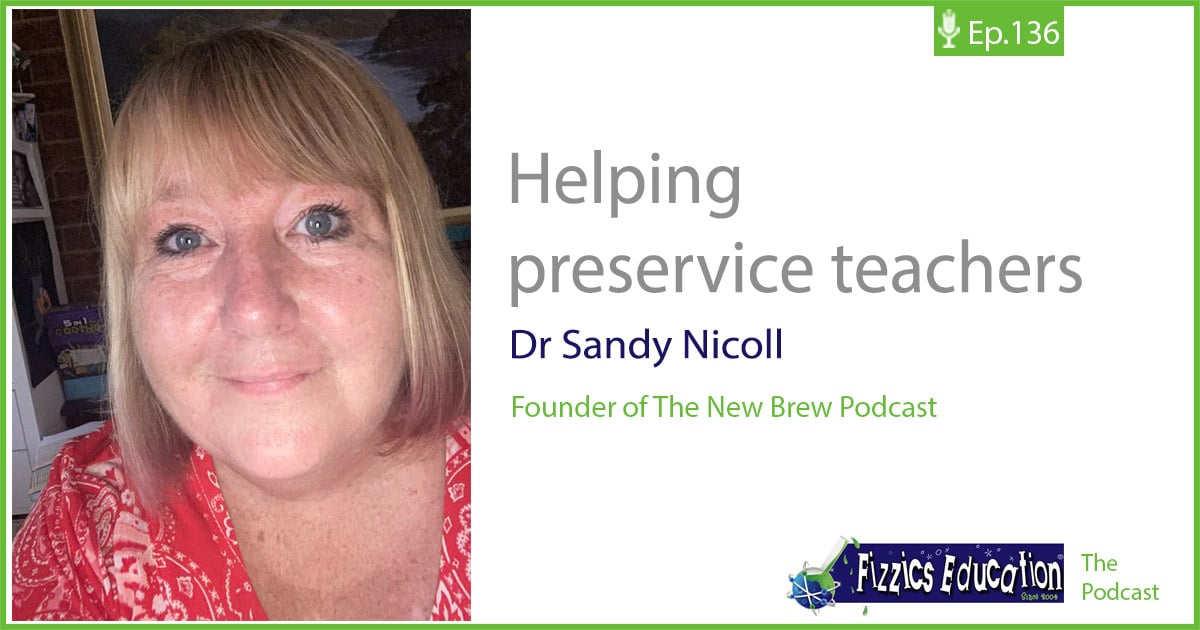
[00:00:20] Ben Newsome: Yes, welcome again for another Fizzics Ed Podcast. I hope you’re having a fantastic day, evening, night, wherever you are, and this particular chat is with a very good friend of mine, Dr. Sandy Nicoll, who has been doing an amazing job empowering pre-service teachers to really shine and really take ownership of what they’re getting up to. She’s been involved in helping pre-service teachers for many, many years, and she reckons as a classroom teacher over the past three decades, she pretty much estimates she’s worked alongside 15,000 pre-service teachers, having been a tutor and a lecturer when it comes to pre-service teachers.
[00:00:54] Ben Newsome: She does the New Brew Podcast, which is all about empowering pre-service teachers to support their desire to be influencers for good. And my gosh, doesn’t she achieve that? She does it alongside the curators Hema, Jace, Jared, Kyle, Rowan, and Tash, and they are doing an amazing job. It’s actually worth checking out the New Brew Podcast, but we are chatting about how this relates to STEM education and honestly, education in general. So let’s find out how we can support our pre-service teachers.
[00:01:23] Announcer: This is the Fizzics Ed Podcast. For all about science, ed-tech, and more. To see 100 fun free experiments you can do with your class, go to fizzicseducation.com.au. That’s Fizzics spelled F-I-double-Z-I-C-S, and click 100 free experiments.
[00:01:42] Dr. Sandy Nicoll: Thank you for inviting me, Ben. I’m really enjoying speaking to you normally on a Friday morning at Clubhouse, so let’s get that conversation going.
[00:01:52] Ben Newsome: We have been hanging out early Friday morning. It’s currently late Friday afternoon. We’ve been doing a bit of work the last 12 hours, a little bit bleary-eyed, but just good fun hanging out. Sandy, look, you and I know each other, we do, but I know some people haven’t had the pleasure of meeting you yet. So, Sandy, what do you get up to?
[00:02:13] Dr. Sandy Nicoll: Alrighty, so I think I’ll go back to the beginning of my life. I was born a long time ago. I did nursing before I did teaching, and my most predominant role as a nurse was to help people die. So in my 20s, it really shaped my whole way of living and thinking, and I’ve always been someone that embraces living today, because that’s all we’ve got. All we’ve got is today.
[00:02:41] Dr. Sandy Nicoll: Long story short, I became a primary school teacher and I absolutely loved teaching. I was fortunate to be targeted when I graduated, so I got a job straight away. Lucky me, and I still think that was such a gift to get. I taught in Mount Druitt for eight years. It was not easy, not easy at all, but I loved it.
[00:03:04] Dr. Sandy Nicoll: So my love for the reluctant learner, the child that doesn’t want to be at school, that doesn’t want to be engaged, became my passion. After eight years and my two kids, I was too tired to travel so far, so I moved to the Ryde district and taught there for another seven years. Even still today, I teach in schools casually.
[00:03:22] Dr. Sandy Nicoll: Where I live on the Central Coast of New South Wales, near the beach now, I still have been teaching in schools because I always want my foot in schools, but I actually technically lecture at university. Kind of hard to believe, but I do. I have a PhD, and my topic was how do primary pre-service teachers learn to engage in the classroom?
[00:03:41] Dr. Sandy Nicoll: Really, if you look at it, it’s how do they learn to teach? What helped them to get kids wanting to learn? I met with these amazing pre-service teachers for two years and listened to what we call their stories. I didn’t have some big agenda, I actually just wanted to know how do they learn. That was the basis of my PhD.
[00:04:04] Dr. Sandy Nicoll: Through my PhD, I made a lot of recommendations, and one is we actually let them down. I think as a profession of teachers, who I love, I’m so proud to be a teacher, I’m so proud to be a friend with so many teachers, but we don’t look after our New Brew. I don’t blame us for not looking after our New Brew because we’re so busy in our classrooms trying to follow all these rules and regulations.
[00:04:31] Dr. Sandy Nicoll: My Master’s research was on why teachers burn out. I saw teachers burn out and I researched that, and I’ve got no surprises why we burn out. So me being me, I wanted to do something positive that moves us forward to help us to move forward. My PhD became about how can we help essentially pre-service teachers get ready for the classroom.
[00:04:51] Dr. Sandy Nicoll: I will tell you this now, I’ve just written a chapter on it, unis let pre-service teachers down terribly. I’m sorry if you’re a university lecturer, but we do. So the New Brew Podcast, which is what I’m talking about today, it’s my way of hopefully showing other people—it’s a recommendation from my PhD—there is a different way of helping them to get ready for the classroom.
[00:05:16] Dr. Sandy Nicoll: We know through different organisations, if you want to look at the Teachers Federation or AITSL or whoever, generally we say four out of ten leave within five years. I find that unacceptable. These kids have come to uni, often the first in their family to study. They want to be teachers, they love the idea of being a teacher.
[00:05:41] Dr. Sandy Nicoll: For four years they live and breathe that desire, that passion to be a teacher, but within five years of graduating, they leave. I don’t like that. So the New Brew Podcast is about that. One of the big things from my PhD is recommendations, and one is the idea of having regular practice at things.
[00:06:06] Dr. Sandy Nicoll: We know theorists talk about it anyway, but the whole idea of that mastery of practice where you keep on having a go, but the key is having a mentor. Having someone that believes in you, who’s not going to judge you because we stuff up. Because quite frankly, Ben, I stuff up still today and I think I always will.
[00:06:40] Ben Newsome: So you’re saying you’re human?
[00:06:44] Dr. Sandy Nicoll: Yes. Just to tell you how human I am, my first lesson where I had to be accredited, I burnt the school down pretty much. As you do. So Sandy. I was doing a science lesson and it was to be accredited a long time ago.
[00:07:03] Dr. Sandy Nicoll: What I did was, it was a hot day, it was like 40 degrees, and at the window sitting next to each other were batteries, cotton wool, and wire.
[00:07:21] Ben Newsome: Okay. How long?
[00:07:24] Dr. Sandy Nicoll: Exactly. So that was the quickest way to learn. Okay, I think I’ve just made a closed circuit.
[00:07:31] Ben Newsome: You did, successfully.
[00:07:34] Dr. Sandy Nicoll: Very successfully. Now me being me, they were cotton buds, and I tell people this story all the time because I think it’s really funny. I then, me being me, that was on one side of the room and it was hot in Mount Druitt. I ran across the room to put the cotton buds in the water sink area. Of course you do, because that’s me.
[00:07:58] Dr. Sandy Nicoll: But did I not realise that I dropped the cotton buds as I ran? So as I ran, I made spot fires all through my classroom. So I had to turn around and use my feet to put them out. I tell you what, that was such a good lesson.
[00:08:16] Ben Newsome: Fire brigade came.
[00:08:18] Dr. Sandy Nicoll: They did, and my principal and they were all laughing. Anyway, long story short, it was all sorted. The fire brigade said you’re fine. And my principal said, “Okay, Sandy, I want to see your lesson now to pass you.”
[00:08:33] Ben Newsome: Take a breath.
[00:08:35] Dr. Sandy Nicoll: “You want to see me teach now?” So me being me, I went, “Okay,” and I did. My career’s been a comedy of errors. The point is I reflect on my errors constantly and I go, “Okay, maybe I won’t put those things together closely next time.” I have a science degree, by the way. So I did that before I did nursing.
[00:08:55] Dr. Sandy Nicoll: I know, the science! I can’t believe I did it, but that’s just me. I live and laugh at myself constantly because I live a life, a comedy of errors. But I think that’s the point. If you look at people like Brené Brown and so on, transparency and honesty is what gets us through.
[00:09:18] Dr. Sandy Nicoll: That’s one of the key things with the New Brew Podcast, which I want to talk about today. We’re not perfect. I’ve asked people to join for very different reasons. There’s no one leader, I’m not the principal. We are a group, a cooperation, we’re a community, an online community.
[00:09:50] Dr. Sandy Nicoll: When I approached the pre-service teachers, I said to them, “What area do you want to focus on? What do you want to be the focus for your page, your section?” So the ones that said yes—we’ve got a few brews going. If you understand brew, first of all, I’m a maker.
[00:10:10] Dr. Sandy Nicoll: That might work out really well for those who like makerspace and STEM and STEAM, but I’m the maker, so I help them put things together. And then they’re the curators. So Jace curates the gender page, Kyle and Natasha curate the Indigenous and rural page, Hema curates the parents and language page, Jared does the technology page, and Rowan does the creativity page.
[00:10:33] Dr. Sandy Nicoll: They run their own pages because I truly do believe in transformational leadership. My job is to be the person that supports them, cheers them on, and says, “You tell me what idea you have and I’ll help you bring it to fruition.” Now if we look at my PhD and my research record, you’ll see I research this with a lot of different teams.
[00:10:52] Dr. Sandy Nicoll: Not being mentored, not being supported as a pre-service teacher and in your first year of teaching is a sure career ender. So, how can we do it? The New Brew Podcast is pretty much—what I’m trying to do is I’m essentially the backbone for these pre-service teachers, but I call on other backbones or ribs, whatever you want to call it.
[00:11:18] Dr. Sandy Nicoll: And you’re a rib! You’ve come on and they’re still talking about your learning circle with us. The whole idea is we want to help them from behind so that they can succeed. Because seriously, that generation, they want to be influencers for good.
[00:11:36] Dr. Sandy Nicoll: If you have a look at Gen Z, for example, and millennials—I’m predominantly teaching Gen Z now—they are going, “Well, we know the UN is telling us that there’s all these global goals that are a problem. We know the world’s telling us it’s a problem, but no one has answers.”
[00:11:57] Dr. Sandy Nicoll: Now if you go into a primary school classroom to Kindy and you set up how to solve a world problem, you get so many answers it’s not funny. Those kids just don’t have the agency or the chance to talk about it. Same as pre-service teachers. They’ve got answers, they’ve got ideas, but they get squashed.
[00:12:18] Dr. Sandy Nicoll: So many teachers are fantastic on prac because they don’t squash them. If you’re listening as a teacher, thank you, because the biggest thing that I know through my PhD is that the biggest factor that actually influences pre-service teachers is not their coursework, it’s the classroom teachers.
[00:12:37] Ben Newsome: Absolutely. You’re sending me down a bit of a reminisce in my head. I had a really good friend of mine, and he was a friend. Yes, master teacher was the title, but he was a friend. So Bruce, on my very first day, sent me on a scavenger hunt. That was my only job for that day.
[00:13:02] Ben Newsome: All the teachers knew it, because this is what he does to his new pre-service teachers when they arrive. So I had to go find the drawer and look underneath a thing and go find the number and that would then tell me to go to another thing. After four hours of running around the whole school, he said, “So what did you think about that? Did you fill it all out?”
[00:13:24] Ben Newsome: I said, “Yes, I did, I filled out all the things and found all the weird things. I had to ask the maths teacher a weird question about cactuses.” He says, “So what do you think the point of that was?” I said, “It was so I could meet everyone straight away.” He goes, “Yes. That was the point.” He said the issue with high schools is that they are siloed, massively. And I went, “He’s right. Genius. What a simple way to start.”
[00:13:47] Dr. Sandy Nicoll: Yeah, I’ve got three themes in my PhD. One was back to research and talking about the theory, because we all know this, when you go on prac what they teach you at uni doesn’t always work. Of course it doesn’t always work, because that’s your classroom and your context. We can’t cut and paste stuff.
[00:14:11] Dr. Sandy Nicoll: The next one is what you were talking about, it’s relationships. Relationships are key. I always say to people, as a leader, that’s what I focus on first. It’s relationships. Getting to know each other, understanding each other. Understanding that someone might have a mental health issue or a disability or whatever.
[00:14:30] Dr. Sandy Nicoll: It doesn’t matter though, Ben, because we all do. If we’re honest, we all have a problem. We all need support from each other. The next two themes that came through were reflection—a key thing is to reflect on your practice—and the last one is your own identity.
[00:14:50] Dr. Sandy Nicoll: The whole idea is finding yourself, finding what you want to do, where you want to teach, and what’s your passion. Hence, when I said to the pre-service teachers, “What is your passion?” And they said, for example, Jace said gender, and Rowan said creativity. I said, “Great, do you want to make that your page?” “I would love to.”
[00:15:13] Dr. Sandy Nicoll: Now those pre-service teachers are writing their stuff, working out lesson plans, working out whatever on those topics because that’s their passion. Guess what? If your passion is gender, for example, you want to then know, how do I teach mathematics? What do I have to think about that might be unique?
[00:15:30] Dr. Sandy Nicoll: Or Indigenous. Natasha and Kyle have realised, “Oh wait a minute, my passion is First Nations, Indigenous students. Okay, we know through research that boys are not as well engaged, boys won’t come to school as much, boys leave by the age of 14. What can I do with mathematics?”
[00:15:46] Dr. Sandy Nicoll: Can you see my reasoning? When you start with heart, you’ll actually care more and you’ll look after them. And identity also is about looking after ourselves. Because if they don’t form a community, they leave. Of course they leave, because you’ve got no one supporting you.
[00:16:05] Ben Newsome: What you’re doing is you are creating community. Not only the New Brew Podcast is awesome, and thank you for inviting me on for a little window of what goes on. But they’re getting to know their ecosystem of education before they even enter the practice formally. Which is fantastic. I mean, isn’t that the point? Aren’t we meant to be collegiate and professional and share ideas and resources? When you enter that big wide world as a brand new first-year teacher, it’s a little bit daunting.
[00:16:38] Dr. Sandy Nicoll: Bloody oath, Ben. And then when we look at most starting off as casual teachers…
[00:16:43] Ben Newsome: Which is worse! Because you go over there, you put the 50 cents in the coffee jar so you can have a coffee and here’s what you do. Please just don’t burn down the classroom.
[00:16:53] Dr. Sandy Nicoll: Yeah, and you’ve got lunch time duty and you’ve got this. Seriously, I’m not criticising schools at all. They’ve got no choice, because that’s the way our system is. But seriously, if we really think long term, if four out of ten are leaving within the first five years…
[00:17:11] Dr. Sandy Nicoll: Fair enough, some might find out that they don’t like teaching. But they probably should have known that when they were studying. What does it mean for our career, our profession long term? The new generation, which I love working with them by the way, they don’t take crap. They really don’t.
[00:17:31] Dr. Sandy Nicoll: Okay, they might photograph everything. So what? If they’re photographing everything, doesn’t that actually show that our schools are working? One of our general capabilities is to be technologically savvy, so of course they’re going to be that way oriented, because that’s how our schools were geared up.
[00:17:49] Dr. Sandy Nicoll: We live in a world where everyone wants to be an influencer. So everyone wants to make an impact. Well, why not embrace being an influencer and call them an influencer for good? The New Brew Podcast is about being influencers for good. Each one wants to influence their area of choice for good.
[00:18:16] Dr. Sandy Nicoll: I just wanted to try and offer unis an alternative. These could be tutorial groups that we set up from day one where they actually come together. I get it that personalities may not get on. Okay, well that’s teaching, so you might have to address getting on with a different personality, or we can modify them and not set you in stone with a certain group.
[00:18:41] Dr. Sandy Nicoll: One of the things is we say that they’re not good at technology. Yes, they’re digital natives and they’re good at selfies and Insta, but they’re not good at the deeper stuff. Alright, so I set up a website. We’ve got a website and an art gallery now which you’re on, you’ve got a wall. That’s what I mean, all of this is organic.
[00:19:03] Ben Newsome: I was going to say that word! I was going to say it’s so organic. I’ve watched you just create this rather rapidly.
[00:19:10] Dr. Sandy Nicoll: Well, sort of. It looks like it’s rapid, but it’s not because I’ve been thinking about it since 2011. But yeah, because now that we’ve hit the ground running, it looks really rapid, but for me, most of this stuff I’ve been thinking about for a good 10 or 12 years.
[00:19:24] Ben Newsome: It’s really fantastic. And yet, despite thinking about it since 2011, you’re not holding onto the reins that hard.
[00:19:33] Dr. Sandy Nicoll: No, I don’t believe in that. I like the idea—there’s a theory of transformational leadership by Burns. His ideas were in the 1980s, so it’s a long time ago. People like Asha Rao, who I love from RMIT, she follows his model as well.
[00:19:56] Ben Newsome: Ash is fantastic. Some people who have been listening to this podcast might remember Ash. Go through the past reel, Ash and I talk about mathematics in the real world. She very much knows her way through mathematics and really makes it happen.
[00:20:10] Dr. Sandy Nicoll: She does. I actually watched that episode, I loved it. That was actually one of the reasons why—last year because of COVID and where I live is quite low socio-economic, I knew that families didn’t have options to help their kids as much as they would like.
[00:20:28] Dr. Sandy Nicoll: So I started a Facebook page called Kids At Home with Dr. Sandy, and we were Team STEM. We were females, because to be honest, I believe in just giving anyone the job who has the skill set, but we’ve got to rebalance gender for girls in particular. We set up this STEM team and we would go around the world helping world leaders.
[00:20:52] Dr. Sandy Nicoll: We helped Russia, you name it. We had problems and we helped them solve a problem as engineers. Saint Basil’s had a problem with a duck that couldn’t be found and we had to work out how to save the duck. Yeah, I know. Interesting. We did coding. We did all this on Kids At Home with Dr. Sandy on Facebook. It’s a closed group now.
[00:21:18] Dr. Sandy Nicoll: That was for me my trial, my practice for the New Brew Podcast. Long story short, I met Asha on Twitter via that because I kept on posting it on it and she noticed. As she would because she’s so amazing. She started talking to me, so she became a guest.
[00:21:35] Dr. Sandy Nicoll: Not only has she helped on Kids At Home, she’s helped where I teach at uni and she’s helped with the New Brew Podcast. Because that’s what an amazing person she is, that she will freely share her knowledge and her ideas. And you’re right. I’m really thankful to have met someone like her, and you, to be honest.
[00:21:56] Ben Newsome: Aw, this is the feel-good episode.
[00:21:58] Dr. Sandy Nicoll: I know, I know.
[00:22:00] Ben Newsome: Oh dear. But here’s the thing though, you are now in a position where you can influence a lot of pre-service teachers in the way that they practice their STEM in a way that actually matters. That must be exciting, and that’s kicking off very soon.
[00:22:15] Dr. Sandy Nicoll: Yes. Okay, so technically we’re not working with pre-service teachers yet. My new role is Lecturer of Master of Research in STEM. The job actually is to help people who want to move into—like teachers, for example, or people from industry who want to do a Master’s in STEM so that they can help education.
[00:22:38] Dr. Sandy Nicoll: I was blown away when the job came up and I applied for it. The students, we start next Monday, the 15th of November, and that will be our first semester. I’m using basically all my teaching to help them to learn to research.
[00:22:56] Dr. Sandy Nicoll: I’m showcasing to them, e.g., Fizzics Education. Do you know who runs Fizzics Education? Hence my art gallery. If you go onto Artsteps you’ll see the art gallery I’ve set up under the New Brew Podcast, like a spatial 3D. What I want to do is make that strong connection now that exists in the Fourth Industrial Revolution between education, industry, and research.
[00:23:25] Dr. Sandy Nicoll: That’s our future. If we want to really address the 17 goals for the UN when we think of sustainable development, people like Michael Harvey, he’s supporting me as well. Heaps of people on Twitter I’ve met are helping me because they can see that if we can equip pre-service teachers—my job at the moment is helping teachers or people in industry who do a Master’s on research in STEM—we can help everyone.
[00:23:58] Dr. Sandy Nicoll: At the moment, it’s a win-win. Eventually, because I am talking to the college, I want to bring my STEM course in for the pre-service teachers in early childhood, primary, or secondary, because it’s the future. Employment-wise, it’s the future.
[00:24:16] Ben Newsome: Can I ask something I’ve been wondering for a while, and I don’t think anyone’s got an answer for this. STEM’s been around for a bloody long time. The terminology hasn’t, but we didn’t start with a bloody label. And yet we do like a label and we like dissecting what a label is.
[00:24:34] Ben Newsome: I’ve still yet to not hear that we always need to find out what is your interpretation of STEM, etc. Gosh, I don’t know how many different ways we can cut this thing up. Are we focusing on trying to label too much?
[00:24:55] Dr. Sandy Nicoll: I agree. I really don’t like the word STEM. I really don’t like the word STEAM. What I do understand is when we look at the Fourth Industrial Revolution, that is about technology, that is about breaking down barriers like geography. We don’t need to think, “I live in Norway, I can’t talk to someone in Australia anymore.”
[00:25:20] Dr. Sandy Nicoll: I think the nature of policymakers, the nature of governments, is they have to label things to give funding. It’s encapsulated, it’s a nice easy thing. It shoves it all together and people have got a vague idea what it is. But we’ve still got our da Vincis out there.
[00:25:39] Dr. Sandy Nicoll: We’ve still got our Émilie du Châtelets out there, who is the person who wrote mathematics and philosophy of mathematics in France. We’ve still got our Fibonaccis out there. The key is to be able to help them to use their knowledge and—because mathematics is my thing—to multiply it.
[00:26:02] Dr. Sandy Nicoll: I’ve been fortunate. When I was looking at the students that applied for Excelsia, I had to look at their expressions of interest. Part of that was saying what they want to research, what interests them. I looked at that and I thought, “Can we help you achieve your goal, your dream, and get more research in that area?”
[00:26:26] Dr. Sandy Nicoll: Yes, we can. I’ve been saying yes to all of them, and they’re fantastic. They’re from engineering predominantly, which is really interesting, and technology at this stage. It’ll change, but they’re there. The policy of STEM gives us a way of giving funding and saying we can have that funding for these people so they can make a difference. But they were always there, Ben. They were always there. I just think of kids in schools, they’re there.
[00:26:59] Ben Newsome: Well, actually, there’s a group, I have to reach out to Aravinth again. There’s a group called DreamSpace Academy out of Sri Lanka. What they do is they find those da Vincis in areas where they’re never going to be found.
[00:27:14] Dr. Sandy Nicoll: They won’t be found. You’re right.
[00:27:16] Ben Newsome: In any way, shape, or form. They pretty much put a rocket up them, for want of a better term. They absolutely go, “You know what, what if we place them with a really good way to actually get them going? But not just do STEM for the sake of it, actually linking it with entrepreneurial thinking.”
[00:27:31] Ben Newsome: And making real stuff and teaching them how to lead teams, because turns out you’re going to need to lead a team if you’re going to do something at scale. They do an amazing job. There are da Vincis around the place, they just get stuck.
[00:27:43] Dr. Sandy Nicoll: Can I put it to you that you might be a da Vinci?
[00:27:45] Ben Newsome: Oh gosh, I don’t know about that.
[00:27:48] Dr. Sandy Nicoll: Let’s break it down into a nutshell. Who was and what was da Vinci? He was a polymath. I look at people like Kylie and Glenn Burrett from 3D SPLAT as well. Kylie tells me Glenn is the thinker, the creative type. I think Kylie might be as well, but she doesn’t quite admit it.
[00:28:09] Dr. Sandy Nicoll: In actual fact, people who are da Vincis in the 21st century have new ideas, they want to move things forward. They’re polymaths, they can look at different things in a different way. Ben, I hate to break this to you, but you’re a polymath, alright?
[00:28:26] Dr. Sandy Nicoll: So we should be embracing polymaths, because polymaths are our future. I don’t know who is a polymath in my courses that I’m teaching, but I will help them become the most successful person that they can, because they will make a difference wherever they go.
[00:28:42] Dr. Sandy Nicoll: One of my mottos is—and I say this all the time at the end of my podcasts—if you engage others to empower them, as in to give them the skill set so they can succeed wherever they want to succeed, they will create, and then they will elevate.
[00:29:05] Dr. Sandy Nicoll: The way I function, because I’m classed as a generalist in education, I think of all subjects. I want to empower and engage you in what interests you, Ben. For you it’s science.
[00:29:21] Ben Newsome: Just how it all works. Exactly.
[00:29:26] Dr. Sandy Nicoll: Exactly, that’s right. It’s only science. It’s nothing else.
[00:29:32] Ben Newsome: Superposition! The waves on top of themselves, they double. It actually reminds me of wakeboarding, you’d always get a bigger wave when the two wakes come together, when you do the right angles and the waves go up and you get this big pop up in the air.
[00:29:48] Dr. Sandy Nicoll: I’m a surfer too, so I get it. It totally happens. When those 90 degree waves come together, they really go. I know, in my day I had—yes, I have a Malibu and I have a shortboard. I learned to surf when I was age 15 in the days of Puberty Blues where girls were booed off the waves.
[00:30:13] Dr. Sandy Nicoll: I was booed off the waves, but me being me, I didn’t let them boo me off the waves, I kept going. I need to get back into it, because my PhD meant I basically sat for five years at a desk and just worked. I didn’t have exercise like I would like. I want to get back into it because it’s so much fun.
[00:30:35] Ben Newsome: It is good fun. Just thinking about this, it actually does frame the context of this discussion, is that we don’t want our pre-service teachers booed off the waves of our classrooms in any way. That’s really what you’re doing. I’m just curious.
[00:30:52] Ben Newsome: If you had a bunch of teachers who have been teaching for 20 years and they’re about to have a brand new New Brew pre-service teacher coming into their classroom for that placement, what would be your advice for someone who’s got someone arriving to do their placement?
[00:31:11] Dr. Sandy Nicoll: I’m going to go left of field. You’re not the expert. You might be an expert in certain areas, but you’re not the expert in everything. Learn from them. I learn from the New Brew all the time. I realised a long time ago when I was in tutorials, “Oh wait a minute, I’m learning from you.”
[00:31:34] Dr. Sandy Nicoll: Yes, you’ve got a skill set and you can teach them pedagogy, you can teach them student management. You have an amazing skill set, but you will learn from them. I call it getting back. It’s one of my hashtags. It’s in a paper I’m writing about one of them called Anna.
[00:31:54] Dr. Sandy Nicoll: Anna met—and she’s still in the same school now, she graduated in 2013, so she’s actually an assistant principal now—but her teacher was in charge of technology at her school. Her teacher was amazing at technology. Then she met Anna, and she went off the Richter scale with even more stuff because she learnt from Anna.
[00:32:19] Dr. Sandy Nicoll: As much as yes, we like the idea of “I’m the expert,” you are in some areas, but not everything. No one’s an expert in everything. They come with stuff. Listen to them. Ask them, what are your passions? What are you good at?
[00:32:36] Dr. Sandy Nicoll: Follow my model from New Brew, ask them what they’re good at, and then learn from them. You’d be surprised when someone is thinking that they’re teaching you, they change their whole interest, their whole passion. They want to be more responsible, they’re more committed, they work so much harder because they’re chasing their passion and they’re helping others.
[00:32:59] Dr. Sandy Nicoll: If we understand MRIs—remember I told you I did nursing—if we understand MRIs, one of the best things for anyone’s mental health is to help others. You can read books on it, like How to Rewire Your Brain. One of the biggest factors globally is anxiety and depression.
[00:33:23] Dr. Sandy Nicoll: If we really wanted to listen to research and science, we would do what they’re telling us, which is help others first. What it does is it helps our happy hormones in our brain. Our happy hormones make us happy, and we help the world better. I guess my answer is quite left of field: listen to them.
[00:33:43] Ben Newsome: I don’t see that as left of field at all. I reckon it’s fantastic. That brings up the point that if they’re going to find out about the New Brew Podcast and what you’ve been getting up to, where would they go? How could they find that and also get in touch with you?
[00:34:03] Dr. Sandy Nicoll: Of course, I love that. Our website is called thenewbrewpc.com. The focus on the website is to do lesson plans under certain areas. Please join our email list. You can email [email protected] or [email protected].
[00:34:25] Dr. Sandy Nicoll: There’s two ways of joining. One can be just to be a member on the email list, or subscribe. The subscribe part is what the pre-service teachers want to do because they do like the idea of being entrepreneurs. You can support by being a subscriber. I’m not pushing that hugely.
[00:34:44] Dr. Sandy Nicoll: The other thing is go onto our podcast. We’re on Spotify, SoundCloud. Find the New Brew Podcast. We’re on Twitter, we’re on Instagram. We do Insta Live when we’re going to release something new. I’ve just written a book called The Inquiry Adventures of Sarah and AJ.
[00:35:07] Dr. Sandy Nicoll: I haven’t actually asked you yet, Ben, but I’m sure you’ll say yes. I’m doing a lesson plan with Ben.
[00:35:13] Ben Newsome: Oh yeah, that’s cool. There you go. Let’s do it.
[00:35:16] Dr. Sandy Nicoll: I haven’t asked you yet, but I’m sure you’ll say yes. But yeah, so they’re probably the main ones.
[00:35:20] Ben Newsome: You got me on recording, right?
[00:35:22] Dr. Sandy Nicoll: Exactly. We’ve just opened an art gallery through Artspaces. It’s just started, it’s not finished by any means, but that’s the whole point because we are a work in progress. If you go onto Artspaces and again look up the New Brew Podcast, you’ll see walls that we’ve created and there happens to be a physics page wall. So you might recognise the dude.
[00:35:46] Ben Newsome: Awesome, thank you, Sandy. Here’s the thing, I don’t normally say this as we finish up these particular chats, but seriously, if you’re listening in and you know of a pre-service teacher, please share this particular episode with them. They may not realise just how valued they are to the education system. They honestly are.
[00:36:05] Ben Newsome: And also too, if you know someone who is mentoring a pre-service teacher, especially even if you just share that couple minutes excerpt from Sandy about what to do before they walk in their classroom, it is very powerful. People really do react to their environment, and let’s make it as positive and as welcoming as possible.
[00:38:28] Dr. Sandy Nicoll: Thank you for having me, Ben today. I really enjoyed talking to you.
[00:38:32] Ben Newsome: Sandy, thanks very much. What a great way to end the week.
[00:38:36] Dr. Sandy Nicoll: Yes. By the way, I’m recording two more podcasts tonight.
[00:38:39] Ben Newsome: Oh there you go. Well hopefully—I know that actually, I’ve got to upload another programme and upload a video. This is what happens when you get lost in what you do.
[00:38:52] Dr. Sandy Nicoll: Yeah, it’s not a job.
[00:38:54] Ben Newsome: Exactly, it’s not a job. Well, Sandy, thank you so much for hanging out on this, and if anyone needs to find those, we always put those links in the show notes. Enjoy, and Sandy, all the best. I know you will smash it out of the park on November 15th.
[00:39:09] Dr. Sandy Nicoll: Thank you.
[00:39:11] Announcer: You’re listening to the Fizzics Ed Podcast. Why don’t you book us for a science show or workshop in your school? We love seeing students get excited about science, and you will too. Go to fizzicseducation.com.au and click on schools for more info.
[00:39:28] Ben Newsome: It was so great to hang out with Dr. Sandy Nicoll and really talk about her passion when it comes to supporting pre-service teachers. Even her PhD, “How do primary pre-service teachers learn to engage students in learning during professional experience?” You really see it shines right through everything that she really talks about and will do so for a very long time.
[00:39:51] Ben Newsome: So if you want to find out more, head on over to her website thenewbrewpc.com. You’ll find not only the podcast, but there’s a whole bunch of resources that are building up that will support not just pre-service teachers, but any educator.
[00:40:05] Ben Newsome: She does have a bit of a passion for STEM and you can ask her about it. Shoot her a quick DM, I’m sure she’ll get in touch with you without a doubt. That is enough of this particular podcast. As usual, we have more guests coming up. I hope you’re having a fantastic day, evening, or night wherever you are. You’ve been listening to me, Ben Newsome at Fizzics Education. This is the Fizzics Ed Podcast and I’ll catch you another time.
[00:40:26] Announcer: You’ve been listening to another Fizzics Ed Podcast. We’re excited about science. Subscribe to us on iTunes to download the next episode as soon as it’s released. And don’t forget, for hundreds of ideas, free experiments, our new Be Amazing book, and more, go to fizzicseducation.com.au. That’s Fizzics spelled F-I-double-Z-I-C-S and click 100 free experiments.
[00:40:55] Announcer: This podcast is part of the Australian Educators Online Network, aeon.net.au.
Frequently Asked Questions
Why do so many new teachers leave the profession within the first five years?
Dr Sandy Nicoll highlights that approximately four out of ten teachers leave the profession early in their careers. This is often attributed to a lack of adequate mentorship, the disconnect between university theory and classroom reality, and the high rates of burnout amongst educators who feel unsupported in their first few years.
What is “The New Brew Podcast” and who is it for?
The New Brew Podcast is an online community and platform designed to empower pre-service teachers. It aims to support their transition into the workforce by providing a space where they can lead, share resources, and find the mentorship necessary to become “influencers for good” in the education sector.
How can experienced teachers better support pre-service teachers during placement?
Sandy suggests that experienced mentors should adopt a “learner” mindset. Instead of acting as the sole expert, mentors should listen to pre-service teachers, identify their unique passions—such as technology, indigenous education, or creativity—and allow them to lead in those areas, fostering a sense of professional identity and responsibility.
What are the key pillars of supporting new teachers identified in Sandy’s PhD?
Her research identifies four critical themes for success: building strong professional relationships, bridging the gap between research theory and classroom practice, engaging in deep reflection, and helping the individual develop a clear professional identity based on their passions.
What does Sandy mean by the term “polymath” in a STEM context?
Sandy refers to “polymaths” as individuals, like Leonardo da Vinci, who think across multiple disciplines. In modern education, she encourages moving beyond labels like STEM to focus on polymath thinking—allowing students and teachers to solve complex world problems by integrating science, mathematics, technology, and creativity.
Extra thought ideas to consider
The Fourth Industrial Revolution and Geography
With the rise of the Fourth Industrial Revolution, technology has removed geographical barriers. Educators should consider how they can collaborate globally, as Sandy did through her “Kids At Home” initiatives, to solve problems regardless of where they are physically located.
Service as a Tool for Teacher Well-being
There is a biological link between helping others and mental health. By fostering a culture of mentorship where teachers support one another, schools can potentially reduce rates of anxiety and depression, as the act of giving triggers positive neurological responses.
Discussion points summarised from the FizzicsEd Podcast, verified and edited by Ben Newsome CF