Transcript
[00:00:00] Ben Newsome: You’re listening to the Fizzics Ed podcast. For hundreds of ideas, free experiments, and more, go to fizzicseducation.com.au. And now, here’s your host, Ben Newsome.
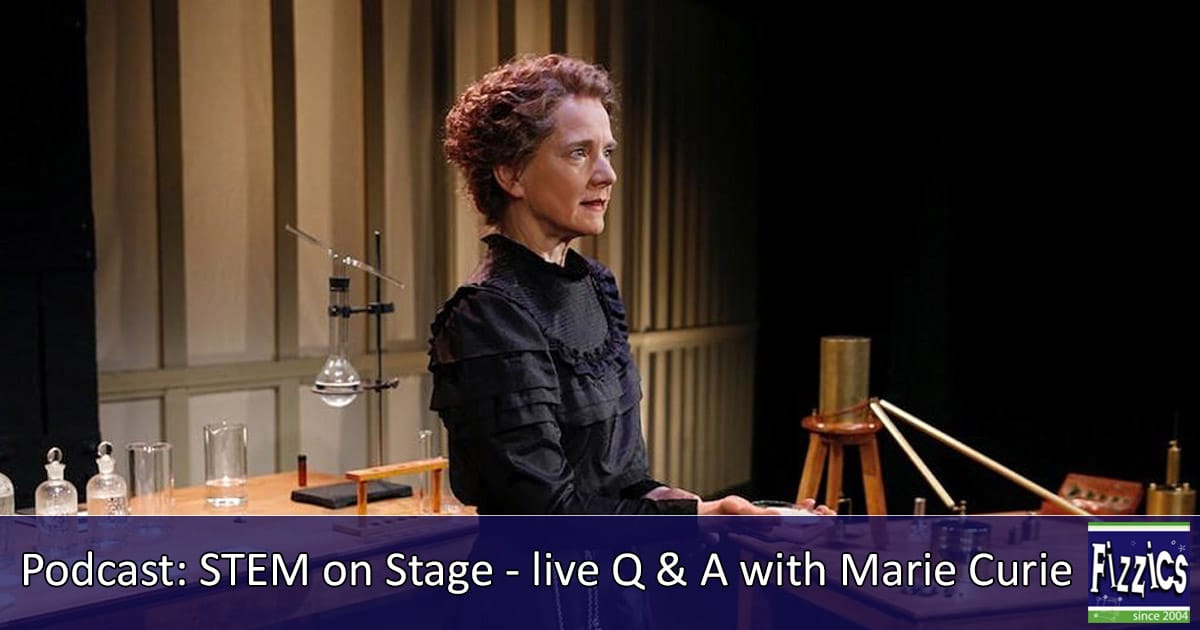
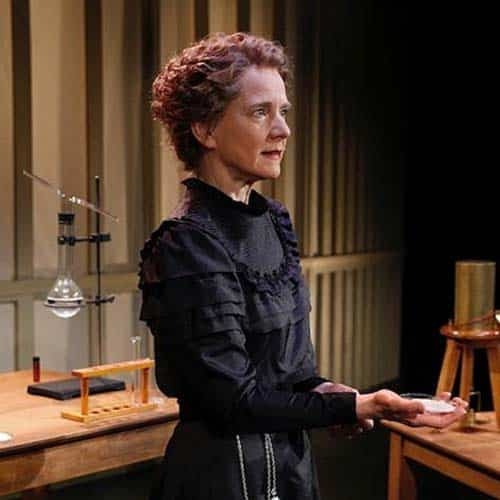
[00:00:19] Ben Newsome: It’s popping in for another Fizzics Ed podcast. I’m glad to have you here and I must say this is going to be a real journey into how you can do humanities, arts, and STEM on stage and take kids on a trip back into time. Seriously, that’s exactly what STEM on Stage does. And we’re hanging out with Jen Myronuk and Susan Marie Frontczak who are very much involved in bringing Marie Curie—yes, that Marie Curie—to life. It’s such an amazing performance they do, where they do Humanity Needs Dreamers: A Visit with Marie Curie, which is an amazing film, plus there’s a live Q&A when they do their special stage performances and online performances. Imagine being able to hear and see Marie Curie go about her business as she created some of the amazing research and eventually was able to get two Nobel Prizes. And imagine being able to speak with Marie Curie in the flesh, very much so. It’s a very interesting experience and certainly a very educational one to boot. So we’re going to head right in as you listen to Jen and Susan Marie.
[00:01:29] Ben Newsome: This is the Fizzics Ed podcast. For all about science, EdTech and more. To see 100 fun free experiments you can do with your class, go to fizzicseducation.com.au. That’s Fizzics spelled F-I-double Z-I-C-S and click 100 free experiments.
[00:01:45] Ben Newsome: Jen, Susan Marie, welcome to the Fizzics Ed podcast.
[00:01:51] Susan Marie Frontczak: Thank you, glad to be here Ben.
[00:01:53] Jen Myronuk: Thanks, wonderful.
[00:01:54] Ben Newsome: I am so excited to have a chat with you. It’s the end of the week here and honestly, I was like, “I get to chat with you too!” It’s going to be really cool. So yeah, there’s a little fan moment. But hey, I know what you get up to, however, not everyone has had a chance to meet. So I suppose just quickly for now, Jen, who are you and what do you do?
[00:02:11] Jen Myronuk: Hi, thanks Ben. I’m Jen Myronuk and I am originally from Silicon Valley and worked in technology and advocacy and then about 10 years ago, I made the switch to humanities and I am the co-founder of STEM on Stage and we produce narrative science. We produce science on stage through theater and we invite the audience to join us. Our current production is Humanity Needs Dreamers: A Visit with Marie Curie, and outside of that, I’m also on the board of directors for Design with Us and we look at disabilities in STEM. So pretty much I’m a technologist who jumped over into working in science education.
[00:02:59] Ben Newsome: Wow. That’s cool and there’s lots to dig into there for sure as well. But before we do so though, I just want to welcome the person that really does bring Marie Curie to life. Hi, Susan Marie, how are you doing?
[00:03:00] Susan Marie Frontczak: I’m doing well, and my goodness, I’ve got a hybrid background just like Jen does. I majored in engineering in college. I worked for Hewlett-Packard company for about 14 years. Meanwhile, I was developing a love of theater on the side. I started being a solo storyteller when theater wasn’t accessible to me and that so took over my life that I left the engineering behind to become a full-time storyteller and I missed the science. I really missed the science. So I ended up putting all those different parts of me together to create—it’s not exactly storytelling and it’s not exactly theater, it certainly is science and history as well—but where Marie Curie gets to tell her own story. Marie Curie gets to speak directly to the audience like a storyteller will speak to the audience. There’s no fourth wall; you’re not looking in on some other world as traditional theater has you do. You get to meet her, you travel in time back to her and you get to hear her tell her story. And it feels like it pulls all the different parts of me together. Now there have been a number of plays about Marie Curie, and I guess something I was deeply committed to with this is that you don’t lose the science. You don’t just use fancy jargon to let someone know someone’s a scientist. I wanted to make the audience feel like they were right in the laboratory with her. So that’s how I came to portray Marie Curie.
[00:04:51] Ben Newsome: I tell you what, gee you do quite a job. I was lucky enough to experience exactly that earlier this year. And it really does feel—I love the ruminations, by the way, that you have as you go about all the work that she did. How on earth did this come about? Because this is a really cool program.
[00:05:11] Susan Marie Frontczak: Well, I began my science plus performance career with Marie Curie as a live show. In fact, first I wrote a two-hour full-length play, two acts with intermission. And then I found out about this format where you could present in character and then take questions in character, so the audience is even more involved. They get to inquire of Marie Curie about her life and her science. So I still perform the two-hour show in some places, but I love this format that’s referred to as Chautauqua where I answer questions first in character and then out of character as the scholar who knows about Marie Curie. That sandwich of those three parts, I realized at one point that there are just so many schools I can get to in my lifetime and I wondered if it would be possible to capture this in a way that could inspire a wider audience. And about this same time I met Jen and she can tell her side of the story, but I recognized in Jen that she had the vision to help figure out how to translate to this new medium because the key is filming in a way that a viewing audience feels like Marie Curie is talking to them. Now this hasn’t been done before. You go to a movie, it’s like traditional theater; you’re looking in on a different world and those people you’re watching do not know that you’re there. But with this living history capture, it is to get that feeling that the audience knows that Marie Curie is speaking to them.
[00:07:22] Ben Newsome: It’s really, really hard to actually kind of keep yourself in the present because she really does transport us back in time, 100%. Like, it’s an amazing job that you do.
[00:07:29] Ben Newsome: And Jen, for you, how on earth did this, STEM on Stage, how did this come about for you?
[00:08:18] Jen Myronuk: So 10 years ago, I was living in Boulder, Colorado. I had taken a short break from my time in California and was working with a history company and I met Susan Marie and learned about Chautauqua and when she invited me to help her translate this for video, I took it very seriously because I met Marie Curie in the same way that you would meet her even with watching this film, but live. And the same questions were like, “This is so amazing, I feel like I’m in the presence of the person.” It’s not someone portraying Marie Curie; it’s as if the scholar is the storyteller, which is the field of Chautauqua, and it was brand new to me. I’d never heard of it before. So I went on pretty much a producer’s scavenger hunt. Where could we get this produced? What could we do? So we ended up deciding on Boston and I moved to Boston in 2015 and I met Jonathan Carr, who is at American Repertory Theater and does Storycode Boston, and he immediately saw the potential and came on board as our cinematographer and we went to Boston Center for the Arts and we took Susan Marie’s one-act living history play and put it inside a storyworld that could be immersive where, as she mentioned, we could break the fourth wall. So we actually shot the film over five days. It does look like one seamless take; it’s not, it’s many, many takes. And then we did something unique, which most people were not aware of. We did eight versions of this film. I would take it to the Cambridge Science Festival or to a school or to a physics lab and with that feedback, I would adjust the film and make it even more personal. So we ended up with a wonderful version that we would project on a screen and people would get a sense of living history theater digitally, but the idea was it would still feel as intimate as if it was a live show. And so this has been a collaborative process the whole way through and so STEM on Stage was born here in Boston and the goal was how do we capture this and make it also available for everyone as a form of humanities. And so that’s the process we’re in now and we have a partnership with the Princeton Center for Complex Materials and Daniel Steinberg and we are looking at taking this nationally and internationally as a public humanities program. But I have to say, most of all, I think because of my background in technology and Susan Marie’s background in engineering, the idea that we could iterate and collaborate and create together is really the power of this entire production.
[00:10:39] Ben Newsome: It really is amazing and this is the thing; it’s not just a static piece of—and I will say it straight up—art. It’s art and STEM all put together. It’s what STEAM truly is meant to be. It’s not just static, it’s still performed live and people interact. In fact, that really—actually maybe because I’ve experienced it, but I’d actually rather in some ways, I kind of wonder towards the end of these productions that you do, Susan Marie, those questions that come from the audience. I mean, they must be incredibly varied. I mean, you’re talking about a two-time Nobel Prize winner and your job as a scholar is really to be able to pull out this information but make it accessible to the audience. How do you deal with that?
[00:11:02] Susan Marie Frontczak: Ah, well, you sort of have a double question. Half of it is how do you handle it on the fly when they’re asking questions, but there was also a lot in crafting the piece itself to make sure it would be accessible to people who were not physicists or chemists. For example, I know that the Curies began with 100 grams of pitchblende. And now you have the advantage over us being there in Australia, because here in the United States, many of my audience members—almost all of them—are still using ounces and pounds and have no idea what 100 grams is. So I had to pick something that would make sense, that I could say this small potato weighs about 100 grams. I had to find something that would have existed back in 1915 and still exists today that people could relate to. So there were a number of those sorts of decisions to make. How do you describe a tenth of a gram? Well, a straight pin is something like that. How do I show the scientific method of making a theory and then trying to test it and it not working and it not working and it not working and then finally finding something that works? How do you do exhaustive testing of a finite set, going through all of the elements and seeing if any of them emit rays? So there were many little pieces built into the program to try to make the science accessible. But then, you’re right, during the Q&A, people get to ask whatever they want. Kids can ask about, “Did you have any pets?” You know, people ask all kinds of things. And then I will also have the PhD scientists in the audience who will ask a question. I always try to answer in a way that never excludes people from the audience because I guess Marie Curie herself was a lifelong teacher. She began teaching as a teenager, illegally, in what is now Poland and had been taken over by Russia. She taught people in secret; she could have been arrested for it. I mean, she was a teacher her whole life long and wanted to make information not just accessible, but fun. So I figure if I’m really going to portray her, I have to be able to do that for the audience as well.
[00:13:42] Ben Newsome: That makes total sense and it’s actually a real challenge for any science communicator and that’s exactly what you’re doing; you’re communicating science in a period piece. It’s so cool. So Jen, you were going to say something?
[00:13:49] Jen Myronuk: I was going to say one of the things that I have most enjoyed being both a producer and then I directed the film, although the stage portion is directed by Susan Marie—so again, we’re really collaborative. But one thing that I’ve learned is that although Marie Curie has a very famous name, most people don’t know that much about her. That we don’t teach really the history of science; we teach the history of the Nobel Prize award winners, like who won, but we don’t know why they won. And so what I really enjoy about this collaboration with Susan Marie is that her work is really about inviting the audience to join in the quest of pioneering radioactivity and what did that mean at that time, but also the idea that we can bring it to a modern conversation today. And one thing about Marie Curie and others who are like her across all fields is that she was not inevitable. There was no guarantee that any of this was going to work and she wasn’t famous from the time she was born. And that’s one thing we have to do is we have to go back to the moment of discovery and be with the person before they knew anything was possible, we can join them in that experiment. And I think that’s what’s missing from the history of science, is that we need to be in process and not just simply look at the end result. So what I love about this is, if an engineer could write a play, I believe that this is the play and this is the play that was written. And so the goal here is how do we communicate not just discoveries, but the context of what was discovered and how it is applied today. So STEM on Stage and this work is really about trying to find that balance. And I have a question for Ben: did you learn in watching this 40-minute presentation, did you learn things that you had not been aware of before about Marie Curie?
[00:15:46] Ben Newsome: You know what I really enjoyed was it wasn’t just the factoids, the facts that allowed all this sort of pull together; I actually enjoyed the materials. Looking at the materials on the desk and Susan Marie, you interacting with them and going, “That’s what it looked like!” if you know what I mean. Like, it’s one thing to sort of read about it on a book or on a website or anything like that, but actually seeing the materials themselves and actually being able to really go, “Okay, so right, I kind of get it now.” It’s, I don’t know, that to me was actually one of the takings away. Now unfortunately I had to leave two-thirds way through, I missed the question session which I know is really, really a lot of fun. I mean, actually even just selecting those pieces that are on the desk that you’re working through, I mean, they look very, very historically accurate, right?
[00:15:49] Susan Marie Frontczak: Yes, I feel so fortunate to have some very special friends who were willing to help me recreate her electrometer. The electrometer kind of comes in three parts: there’s the quadrant electrometer that I guess a Hungarian came up with this concept and Pierre built on that and his discovery of piezoelectricity and how to use that combined with a chamber that would hold your sample that’s emitting the rays. I had several people involved in making that come to life, really. And it was key to her science, it also was very important to their romance. I mean, I think it’s a nice little pun that it was magnetism that brought them together in the first place because she was studying magnetism and he was an expert in it. But then that his genius, really, of creating laboratory instrumentation—and he had quite a reputation, even Lord Kelvin would correspond with him about laboratory instrumentation—that that provided her with the ability to measure the rays. And in order to make scientific advancement, you have to be able to measure things, not just make qualitative observations, but quantitative measurements. So it was key to her discovery.
[00:17:15] Ben Newsome: That to me, like that’s what I really remember is looking at, “Right!” I mean imagine a Year 9 student, a 14, 15-year-old sitting there who’s lived in a digital age watching discoveries effectively being played out in front of them using analog equipment, but highly sensitive stuff. I mean that to me is just as much of the learning as the actual theoretical stuff of what came out of the research. That is just as cool and actually, I mean mind-blowing for students at this stage. I mean I kind of wonder, what is the most popular grade level? I mean I know this is really available for all walks of life and all different ages and backgrounds, but from a school’s point of view, what is the popular grade level that really, really this works for?
[00:18:09] Jen Myronuk: I would say we have two answers: we have one for the film and one for the live show, which they both are all ages. But what we found is that with the film version and families watching it home together, even younger kids, like as young as seven and eight, are following along. But I would say that middle school all the way up to, you know, 110. I basically, I find that each person finds their own connection to this, but I would say for Susan Marie, what you’ve discovered or what have you discovered in your live performances?
[00:19:37] Susan Marie Frontczak: Well, I think there is a real sweet spot with middle school, 11, 12, 13-year-olds. There’s just, both the boys and the girls. This isn’t something that only inspires the girls; they both get really into it that there’s the, as you say, as you observe Ben, the equipment is tangible. It’s something you can put your hands on. I’ll have kids come up afterwards and I’ll point out details of how it really works and that it does not plug into the wall for electricity, it’s all standalone. And that you have to cover six different orders of magnitude of measurement from something that was three times as radioactive to something that was a million times as radioactive. And so those middle school students really can get into that. I think that there is another sweet spot, sort of fourth and fifth grade, nine and 10-year-olds, but it’s they just come in at a different level.
[00:19:40] Ben Newsome: Yeah, absolutely. Actually even just thinking about the analog stuff. Same idea: typewriters. Showing a student a typewriter, like an actual typewriter, how it mechanically works. We use it in a forensics program and we’ve doctored one of the letters, we twisted one of the keys, which by the way is really hard because it’s hardened steel. But anyway, kids just physically looking at something that’s completely removed from their world is so fascinating.
[00:20:11] Jen Myronuk: Yes. And one other aspect that’s really intriguing is that Marie Curie began her scientific career as a materials scientist. And this was something that was pointed out to us early on with Daniel Steinberg and he’s the director of education outreach at this NSF or National Science Foundation funded project looking at material science and research with engineering and these centers that look at materials. So the study of the magnetic properties of steel, and the fact that there’s this inquiry and that you might start in a field and you might start with an experiment or a program and by following your deepest curiosity and the scientific method, you might end up discovering something entirely different. And so this idea of being interdisciplinary and really speaking to that.
[00:21:09] Jen Myronuk: But a lot of people don’t know about the origins and less about factoids and more about process. What was the process that Marie Curie followed? And to one other point to add on what Susan Marie said, I’ve traveled around the country pre-pandemic. I went to probably 60 of the 100 events that we had in 20 states in the US and one thing that I got consistently across the country here in the US, middle school boys would come up to me and say, “I want to be Marie Curie when I grow up.”
[00:21:32] Ben Newsome: That’s cool.
[00:21:33] Jen Myronuk: And the girls are equally inspired. And what I think is missing again and what we can really provide is that it’s the process. It’s the approach and it’s the context. So less about facts, more about context using evidence and source material, but the main thing is the joy of discovery. And I think Susan Marie, what she brings to the table, which I’ve really come to appreciate, is how much joy science can be, even if it’s dangerous. It can be incredibly joyous.
[00:22:06] Ben Newsome: Absolutely. I’m actually thinking here, I mean, done a lot of touring with this program, especially through COVID, I know you had to do some online things too, and a lot of people have had to. Wouldn’t this be awesome to tour Poland?
[00:22:19] Susan Marie Frontczak: Oh yes. I did in fact get a chance to present in Poland at a couple of international schools and at the University of Lodz where I have a second cousin who is a mathematics professor there. So that was just unbelievably awesome to have a chance to do that. Of course, I presented in English. Unfortunately, I am not fluent in Polish, but it was to an audience that could understand what I was saying. But yes, yes, it would be very fun.
[00:22:57] Susan Marie Frontczak: I would love for this film not just to reach other schools in my own country, but around the world and our vision is that it would be accompanied by a scientist who could then give a few words about what inspired them to go into their field of science so that there can be—so that it’s curated if you will. The film goes with a scientist that can talk live about their work that’s today, not 100 years ago, and that the bridge can be made to “and you too can get excited about this stuff.” That person, of course, would speak in the local language and probably we would have subtitles or dubbing or something like that to make the film widely accessible.
[00:23:42] Ben Newsome: This is incredibly powerful. Years ago, gosh, six years ago maybe, seven, we did a National Science Week—so every August National Science Week happens down in Australia—and we did a similar thing. We were doing science presentations prior to IMAX movies in the middle of a large cinema. And so we had the camera coming down and it’s kind of like think of it, suppose people now would do online programs now when we’ve got cameras on us and we then project it up onto the screen. Exactly what we’re doing is only going onto a large IMAX screen so that the people at the very back of the cinema could then see the demonstrations happening live and then the IMAX performance presentation would happen. I think what you’re describing would totally work and I love doing it in the local language, which means it is incredibly accessible and it’d be something to really pursue.
[00:25:27] Jen Myronuk: And one thing about this program, which is different than video on demand, is that we don’t actually have it available; you can’t just watch it when you want. We actually set it up as an actual start time and end time so that you watch it as if it’s happening in real time. And I think that’s also the difference between digital theater and just simply streaming content. Attention is important and when you watch a story or a living history presentation, it’s not that it’s just the science or just her life events; both of them go so well together and it creates almost like a memory and you feel like you really have met the person.
[00:26:48] Jen Myronuk: And one thing that we also wanted to emulate was Marie Curie did get a chance to tour and speak and share her science in the US and also internationally, and we love the idea that audiences in the 21st century can continue with that tradition. And so we have not yet brought the film and this project to Australia, so we’re hoping to do that and we’ll think about a time that we can set that up. But the bigger question is how do we want to tell the story of science so that the people today may be sparked to think, “I could make a contribution.” And that’s really the message behind this whole project, is the continuum that discoveries happen and they continue to happen and that’s what’s wonderful about science, is the unknown and that we can discover things together.
[00:27:38] Ben Newsome: Absolutely. And I think about there’s a very important week coming up in science very, very soon. Only challenge at this point, considering who Marie Curie was, there is a little bit less representation this year, by the look of it. But hey, hopefully these sort of things will change that. This is what this is actually all about. This is really awesome. So righto. So if you had a group of teachers in front of you and they were looking to then take what you’ve done and then build more deep rich learning around it, what would be your suggestions around what would be the first steps?
[00:28:21] Susan Marie Frontczak: Ha! I actually have an outline of what could be done. I call it the Science Within, the Science Within the show, where there’s sort of a tree of possibilities and the teacher can jump in with her kids at a level that their kids are at. For example, with very young kids, you can talk about symmetry. And Pierre being very interested in crystals and symmetry, I have a whole lesson plan for recognizing symmetry in the world around you and talking about axes of symmetry. This can be at a almost a preschool level, I mean, four or five-year-olds can do this. But you can also then, if you want to challenge your high school students, you can talk about symmetry in more than three dimensions. It can be as complex as you want it to be. So a teacher could take that idea of symmetry that’s in the show and build on it with their students at this whole continuum between the very simple to the very complex.
[00:29:27] Susan Marie Frontczak: But I have a dozen different topics. I’ll tell you how this came about. I was thinking naively at the beginning, “Oh, I should just write a little article about what is radioactivity to accompany this as part of a curriculum guide.” And then I realized, “Oh, well yes, okay, to understand radioactivity, first you really kind of need to know what elements are, and you need to know a little bit about this basic simplified model of an atom with electrons and neutrons and protons and you need to know about…” and I kind of kept going back and back and back, and then I worked my way forward again from very simple concepts. The simplest are symmetry and the other one is measuring things. What are all different kinds of things you can measure?
[00:30:19] Susan Marie Frontczak: And again, you can work with very young kids at that level and they’ll come up with length, their height, their weight, how fast they can go. And then with more advanced students, you can talk about, “Well, if you have a magnet, how would you measure how strong the magnet is?” and challenge them to come up with ways to measure things because that’s what made it possible to nail that radioactivity is an atomic property. So I have topics all the way up to finally my article on what is radioactivity that builds on the others. So I really—this is not completely developed and I would love to get it so I can just hand it off, so it’s a resource online for teachers just to tap into whenever they show the film.
[00:31:15] Jen Myronuk: And we also say this, and I especially brought this up at all the past screenings because this is highly collaborative: we’re public humanities. Our goal here is to create something that really is shared and essentially is everyone’s resource. We’re kind of a new model and we’re still working and experimenting, but the ultimate goal here is that we—and we’re working to finalize our sponsorship and our grants—but ultimately, this is something that everyone has access to and can build upon. So along with Susan Marie’s The Science Within and other resources, we love the idea of what would you imagine that you could do with this? If you had access to Marie Curie as a master teacher from 1915 teaching the scientific method, what can we build on with this model?
[00:32:33] Jen Myronuk: And we also have plans for an upcoming pilot workshop that we’ll be announcing for the spring and we have some other projects in the pipeline and future productions. But ultimately, we do want to ask the science teachers and those in different disciplines: how do we collaborate together to create really compelling shared resources? And this is originating from the US, but certainly Marie Curie’s story and her work is global. And so we will be excited to hear and get suggestions, and especially as we move into 2022, we will have screenings now at the end of 2021 with Princeton on December 8th, but you can always visit stemonstage.org to sign up for any type of future announcements. But the main goal here, and to quote the late great Stephen Sondheim, who was an amazing inspiration to me, that the audience is truly the final collaborator. And so we really want to invite participation in the work that we’re doing.
[00:33:36] Ben Newsome: It’s fantastic and actually that as of listening in 2021, that date’s not far away at all. So I really do highly encourage you going to that website, finding it, and getting involved. And actually, you know what? If you’re listening in 2023, ’24, whenever you’re actually listening to this thing, this is going to keep on growing. And I feel that this is a really cool opportunity to get your students involved and honestly your families. It’s really cool. Hey, have you presented this to retirement centers? Just out of pure interest.
[00:34:02] Susan Marie Frontczak: Oh yes. Oh yes. I have done all kinds of audiences, including retirement centers. I love a senior audience because they—oh, well, I’ve been doing this show for 20 years, so if you go back to 2001 and you put an 80-year-old in there, they could have been a teenager when Marie Curie was still around.
[00:34:26] Ben Newsome: That’s what I was wondering.
[00:34:27] Susan Marie Frontczak: So you get some really interesting people coming up. It’s awesome to have an octogenarian or septuagenarian come up or older to come up and say, “I majored in chemistry because of Marie Curie, and I taught for 30 years.” Or, “I majored in physics and I worked on this and this and this at such and such a laboratory.” Or having someone come up and say, “I never had a chance to study science, but I kind of get it. It sounds like it was fun.” To get that breadth is, I tell you, very rewarding.
[00:35:32] Jen Myronuk: And I do think that the intergenerational conversations really are key to promoting a world that is based in science and discovery and optimism for what we can create together. And I love the fact that we have a production with how Susan Marie’s crafted this in her 20 years of work that the parents and the students and the grandparents and the science teachers, everyone can come and find themselves reflected in the story and have a conversation.
[00:36:09] Jen Myronuk: And so we hope that that really is what leads in the 21st century is both being interdisciplinary, intergenerational, and highly curious about what’s possible and that’s what we’re hoping to promote with the film. And so the film again, it’s Humanity Needs Dreamers: A Visit with Marie Curie and it’s based on her quote that we borrowed from. And the 40-minute digital theater presentation, we have it accompanied by a live virtual Q&A for our public history program, but as Susan Marie mentioned, a lot of time the 40-minute film can then be hosted by a local scientist who can lead the conversation.
[00:37:01] Jen Myronuk: So we really want to see humanities take the lead along with STEM and STEAM because it’s really what we create together and that’s the world that we become together.
[00:37:21] Susan Marie Frontczak: In fact, talk about being surprised by our audiences sometimes, something that hadn’t occurred to me until one of these audiences—Jen told me about this and she can probably give more detail—that it’s in some ways an immigrant’s story. To realize that Marie Curie studied in a different country that was not her first language, that she felt way out of her depth speaking French and listening to lectures in French and capturing it all and processing it all in her brain and still came out first in her class. That she did this in a country and a culture that was new to her and she adopted it and she never gave up her roots, but still had a lot to learn along the way. I think along with it being a story of science and humanity for young and old, it’s also very much an international story. We found people being inspired in what they were facing in their own lives whether or not they ever wanted to make a major discovery in science, but that her story helped them grapple with what they were dealing with on a day-to-day basis and making their own contributions.
[00:38:41] Jen Myronuk: And I know that one example was this young seventh grader from Jordan who’d moved to Bangor, Maine with his family and he asked very incredible questions during the Q&A. We had a film screening and we had the Maine Science Festival and it was a wonderful presentation. But at the end he said, “What I love most about watching this is Marie Curie’s love of her homeland because I love my homeland too.” And this idea that science is everywhere, it is international, and to that point, that it really is about sometimes you have to leave your home country and that Marie also named the first element after Poland, Polonium, and this idea that we really need to be mindful of what it takes to discover and those who take the big risks.
[00:39:29] Jen Myronuk: And science especially is very international in that regard and so to really tell that story as well. So we’ve definitely experienced that and it’s been a delight. I really miss being in person with everyone, but the virtual opportunities open up a lot as well and I am excited to basically be Marie Curie’s tour manager. That’s how I feel in the 21st century. And I can’t imagine doing anything else and also I’m so grateful that I got a chance all those years ago to meet Susan Marie Frontczak and have this incredible collaboration. So we are excited to continue with this journey and we are curious to see where it leads, but we hope at the end of the day that everyone will get a chance to not only meet Marie Curie, but to really meet a part of themselves and their connection to the world and who we could become.
[00:40:12] Ben Newsome: Absolutely. So look, again, if you’re listening in, really do encourage you to go there. I’ll put the links as usual into the show notes so you’ll definitely be able to click on that. But hey, this is a thing that might come to a town, city near you despite us being in Australia. We’ve got people all over the world listening to this thing and who knows, this might tour all over the place. It’d be very, very cool. Thank you so much for hanging out with me, Susan Marie and Jen.
[00:40:38] Susan Marie Frontczak: My pleasure. Thank you, Ben.
[00:40:41] Jen Myronuk: Thank you, Ben. This has been wonderful.
[00:40:43] Ben Newsome: You’ve been listening to another Fizzics Ed podcast. We’re excited about science. Subscribe to us on iTunes to download the next episode as soon as it’s released. And don’t forget, for hundreds of ideas, free experiments, our new B-Amazing book and more, go to fizzicseducation.com.au. That’s Fizzics spelled F-I-double Z-I-C-S and click 100 free experiments.
[00:41:08] Ben Newsome: Well there we go, we just heard from Susan Marie Frontczak and Jen Myronuk, both amazing people and I must say awesome STEM educators wrapped together with the humanities mix which I honestly think is going to help kids really understand their own capacities, their own capabilities through watching a genius on the stage and on the screen. Really, really cool. So if you want to know a bit more, go down over to stemonstage.org or head on over to storysmith.org. Both will give you lots of information and is well worth checking this out. So that’s enough of this particular podcast and as usual, there are more episodes coming up on this Fizzics Ed podcast. You’ve been listening to me, Ben Newsome, this is the Fizzics Ed podcast, yes, and I hope you have a fantastic evening, morning, night, whatever you’re doing, and I’ll catch you another time.
Frequently Asked Questions
What is "Humanity Needs Dreamers" and how does it differ from a standard documentary?
"Humanity Needs Dreamers" is a 40-minute "digital theatre" presentation. Unlike a standard documentary, it features living history scholar Susan Marie Frontczak performing as Marie Curie, breaking the "fourth wall" to speak directly to the audience. This format is designed to make viewers feel as though they are present in the laboratory during the moments of discovery, bridging the gap between history and a live performance.
What is the "Chautauqua" format used in these performances?
Chautauqua is a unique format of living history. The performer first presents a monologue in character, then answers questions from the audience while still in character. Finally, the performer "breaks character" to answer questions as a scholar who has extensively researched the historical figure's life and work. This triple-layered approach allows for deep inquiry into both the science and the person.
Why does the production focus heavily on the scientific process rather than just biographical facts?
The creators, Jen Myronuk and Susan Marie Frontczak, both have backgrounds in technology and engineering. They aim to show that scientific discovery is not "inevitable" or just a list of dates. By showing the physical labour—such as the processing of pitchblende and the use of the electrometer—they help students understand the grit, measurement, and persistence required for scientific breakthroughs.
Is the content suitable for primary school students?
While the "sweet spot" for engagement is often middle school (ages 11–13), the production is highly accessible for younger audiences. Children as young as seven have followed the narrative successfully. The tangible nature of the analog equipment and the human story of Marie Curie's journey make it engaging for ages 7 to 110.
How does Marie Curie's story relate to modern students beyond her scientific discoveries?
Beyond physics and chemistry, the production explores Marie Curie as an immigrant who had to master a new language and culture while pursuing her education. This "immigrant story" resonates with many international students and highlights the global nature of scientific collaboration and the personal sacrifices often made for discovery.
Extra thought ideas to consider
The Importance of Quantitative Measurement
Consider how the development of specific laboratory instrumentation—like the electrometer created by Pierre and Marie Curie—changed radioactivity from a qualitative observation to a quantitative science. Without the ability to measure precisely, the discovery that radioactivity is an atomic property might never have been proven.
The Role of Narrative in STEM (STEAM)
How does presenting science through theatre (the arts) change our emotional connection to the subject? By humanising the "genius," students may find it easier to see themselves reflected in the work, moving science from a static textbook subject to a living, breathing career path.
Discussion points summarised from the FizzicsEd Podcast, verified and edited by Ben Newsome CF