Transcript
[00:00:00] Voiceover: You’re listening to the Fizzics Ed Podcast. For hundreds of ideas, free experiments and more, go to fizzicseducation.com.au. And now, here’s your host, Ben Newsome.
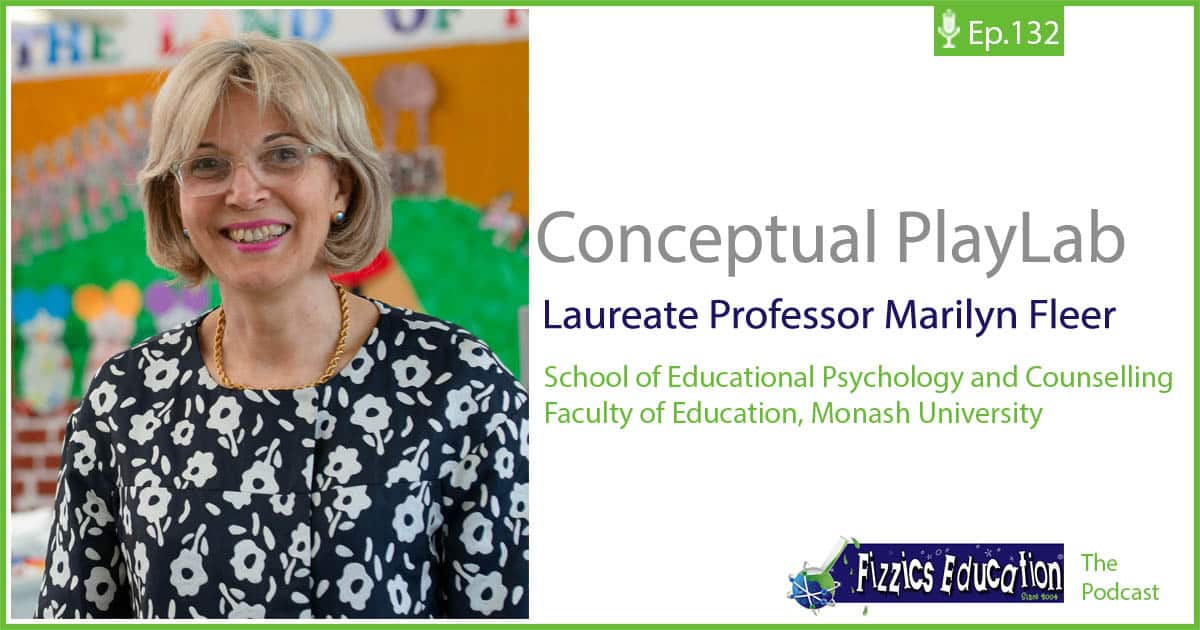
[00:00:19] Ben Newsome: Yes, we’re back again for another Fizzics Ed Podcast. Glad to have you, and I must say, this is a really interesting chat if you love your early childhood education and STEM education, mashing it together. And I must say, Laureate Professor Marilyn Fleer, who’s joining us, really knows this. She’s done a lot of research when it comes to STEM education, STEM concepts, and young children, educators, and families. She’s coming from Monash University and she’s been working on a Conceptual PlayWorld, which is an imaginary scenario created by an educator where young children are invited to go on an imaginary journey and meet and solve challenges, and in the process, learn STEM concepts. Really, really cool and highly playful, and I must say, really rewarding for educators as well as the kids. So I really looking forward to this chat. I really hope you enjoy this chat with Marilyn because she’s really got a great background and a great take when it comes to education in the early years. Let’s head on in.
[00:01:13] Voiceover: This is the Fizzics Ed Podcast. We’re all about science, ed-tech and more. To see 100 fun, free experiments you can do with your class, go to fizzicseducation.com.au. That’s physics spelled F-I-double-Z-I-C-S, and click 100 free experiments.
[00:01:32] Ben Newsome: Marilyn, welcome to Fizzics Ed Podcast.
[00:01:33] Prof. Marilyn Fleer: Oh, thanks so much for inviting me to come along today to chat with you.
[00:01:40] Ben Newsome: Look, I’ve been really looking forward to this because we’ve been hanging out for quite a while now, but on Twitter. And so I actually get to meet you in person.
[00:01:53] Prof. Marilyn Fleer: It’s amazing how you can make these fantastic connections through Twitter and all sorts of social platforms. So it’s wonderful to meet you, Ben, and this is great to have this chance to chat.
[00:02:11] Ben Newsome: Absolutely. It’s a Friday afternoon, let’s just hang out for a little while, hey? Talk STEM, why not? We talk STEM whenever we can, but definitely so. So I know you, but other people don’t know you. So tell us, who are you? What do you do?
[00:02:24] Prof. Marilyn Fleer: I’d love to tell you that. So, I’m Marilyn and I’m in Melbourne, in Australia, and I run what’s called a Conceptual PlayLab. And that’s at Monash University in the Faculty of Ed. And it’s a big research program that we have that’s designed to support early childhood educators and early years educators in schools to really engage in STEM: science, technology, engineering, and not so much on the M, but some of my colleagues are, but mostly science, technology, engineering. Because there’s just too little work out there. And I guess that’s who I am. I come to this area from a background of working with young children and have had many years, I won’t tell you when I started, many years of teaching and then being in higher education, and then now in a research role in this Conceptual PlayLab, which is funded by the Australian Research Council.
[00:03:27] Ben Newsome: Fantastic. So when did that get started?
[00:03:32] Prof. Marilyn Fleer: Well, the actual PlayLab, we launched in 2019 and it’s for five years. And the Australian Research Council funded it through a really interesting process because your university puts in an application because they like this particular funding because it’s a Laureate Fellowship funding, so it’s quite special. And there’s only been, like, I’m the second one in education, so it doesn’t normally go to education. So we’re so excited. But we’re even more excited because it’s gone to an area, the birth to eight years of age, it’s gone to the educators and the teachers who work in that space essentially to support and grow STEM. So we haven’t been going for long, but I think we’ve been kicking a few goals, which is great.
[00:04:26] Ben Newsome: Well, that’s fantastic. I’d love to know, I mean, there’s lots of playgrounds, but yours is conceptual. So what makes it conceptual?
[00:04:32] Prof. Marilyn Fleer: All right, that’s a great question. Well, what we have is because we know that the research tells us that sometimes there are groups of teachers who might feel a little uncomfortable in STEM, and might think that they’re not competent and therefore don’t feel confident to teach STEM. And so I was curious about this because I’ve been seeing this kind of message out in the literature for a really long time, 20 years and more, and nothing’s changed. And so I thought, well, what is the problem? And I thought, it’s actually not the teachers. The problem is actually we don’t have the right teaching models to support the early childhood educators and teachers who work in play-based settings. So it’s a little different to more formal settings. And so we didn’t have the right tools. So we did, over about 10 years, I did a series of research projects. And what came out of that was this Conceptual PlayWorld. And a Conceptual PlayWorld builds on teacher strengths because early childhood educators are fantastic observers of children. They know how to design really amazing play-based programs. And usually they really like literature, you know, they’re really good storytellers and story readers and can do these great and exciting things with books. But the area of STEM can sometimes take second fiddle. And so we thought, well, let’s, this research showed that when we actually think about a story such as the story of Robin Hood, and we create a STEM PlayWorld of Robin Hood where STEM concepts serve the children’s play, that children get excited and really get a buzz out of it, because we know of course that children really get excited by STEM anyway, but the educators, the teachers get really excited as well because it fits with their strength. So it’s a credit-based model of teaching. And so that’s kind of like, I can tell you the characteristics, if you like.
[00:06:56] Ben Newsome: Yeah, please.
[00:07:00] Prof. Marilyn Fleer: Oh, okay, great. So the model itself has five characteristics and educators use those characteristics to plan a Conceptual PlayWorld. And so I’ll tell you the five characteristics and then I’ll illustrate one, I’ll go with the Robin Hood one. So there’s five characteristics. One is choosing a really great story, and one that’s not a book that’s about facts, but a really nice book that’s got a great story in it, there’s some excitement in it, there’s some drama in it. And so that’s the first characteristic is really thinking about the story that can lend itself to go on adventures day after day after day. And then the second characteristic is to design a really beautiful imaginary situation. And in that imaginary situation, it’s like jumping into the story. So you jump into the story and you be part of the story, but you create this imaginary situation. So, the playground outside can become Robin Hood’s forest, the castle can be there and the Sheriff can be around. So you can create this imaginary world. So that’s the second characteristic. And the third characteristic that the teachers plan for is thinking about how do you go into the imaginary place situation together as a whole group of 25, 30 children, and how do you exit it? So having some sort of technique. So in the example of Robin Hood, the fort became the time machine. And everybody jumped into the time machine and went 5, 4, 3, 2, 1, vroom! and off they went back in time to the time of Sherwood Forest and Robin Hood. And of course when they had to leave, when it was time to leave, they went of course back into the time machine and then they were back in their classroom or their center. So that’s another part of it. But then you’re probably thinking, well, what about the STEM concepts? Well, the next characteristic, the fourth one, is planning what might be the STEM concept that’s going to make the play more exciting. So in other words, creating more drama. And we know that in the story of Robin Hood, there is the drama of the poor villagers starving to death because they’ve been taxed so heavily and the wicked old Sheriff has got all the treasure in the castle. So, setting up the problem of how do we get the treasure out of the castle? So what kind of machine might we have to design? And what kind of escape plan might we have to create so that we can go into the castle, retrieve the treasure and escape and then give the gold back to the villagers? So that’s kind of an example of a problem that could arise and which would need engineering principles to actually look at the kind of science to understand a bit more about force, to work with pulleys, because castles have got all sorts of things that are interesting for engineers to explore. And then the last characteristic, the fifth one, is planning the educator role. So for instance, in early childhood settings where there’s often more than one staff member with a group of children, then having the two educators, the two teachers, or it could be in the school with a parent who comes in regularly to help, planning what role they’re going to take. So are they going to dress up as the castle engineer one week and the children all go into the time machine, go back in time and they meet the castle engineer and they learn how to get around or how to use the pulley system in order to get into the castle and then how to jump back out of it and go back into real time and develop a plan that you take back to the castle engineer next time you visit that imaginary PlayWorld? So it’s kind of thinking through what the role will be. And so they’re the five characteristics. But the key point is that the drama of the story is what engages the children, but the STEM concepts is what deepens their play. Because as they learn more STEM knowledge, they learn more engineering principles, they and you know, bring in or look at plan views and cross sections and so on that we often see in books, but actually how to design and build little mini prototypes of castles or some sort of machine to go into the castle. Then there’s all this rich learning that’s going on. But in the children’s mind, they’re exploring those concepts to service their play. So for very young children, they just get so excited. And when they get that excited, the educators and the teachers just love it because it really engages them. So that’s our model, our Conceptual PlayWorld model. And our research is showing that it’s working really well.
[00:07:18] Ben Newsome: Oh, why wouldn’t it? I’ve just got to say, listening to it, it’s captivating. But kids love stories. Let’s be honest. And they love immersing, and more importantly, they love creating the story. And I’m just thinking about the challenge is children’s science. Children have a lot of different interesting conceptions of how the world is and very little scaffold. So I guess the challenge is, from a pure STEM approach, trying to work out when do we help and when do we stand back when we’re doing those types of things? How do we do that when we’re dealing with really young ones?
[00:07:58] Prof. Marilyn Fleer: Yeah, it’s a really fantastic question, Ben, because the role of the educator, the teacher, is so important in this because you’re quite right: it’s getting this balance between when to be the teacher and when to be the person that learns alongside the children, and when to be the follower. Because sometimes—and that’s part of the planning of the fifth characteristic, planning the role of the educator—because sometimes it’s really good, especially if you’ve got two teachers in the same room with a group of children, it’s really nice when one can be with the children and modeling question-asking.
[00:08:43] Prof. Marilyn Fleer: So they can say, “Oh, but I don’t understand how that pulley works. What are those funny things there? What are they called? Oh, they’re cogs,” you know? And so you can have this interplay between adults, but you can also have then your modeling to the children how to notice and how to ask questions. So one—and we’ve got this special name that we call these different positions that the educators take. And so our research is showing this is really important as well. So to answer your question as succinctly as I can, we have this where the teachers are in the equal position with the children.
[00:09:28] Prof. Marilyn Fleer: So they say things like, “Oh, can we solve this problem together? How can we do this together?” And so that’s kind of the equal position. And the children can say, “Well, yes, let’s try and do this together,” and so they’ll roleplay going out into the imaginary situation and exploring something that’s been set up. And then there is this other position, which is the under-position, which is where the teacher will say, “I wasn’t here yesterday when you did all of that beautiful modeling. How did you do it? I can see that you’ve made a castle and I can see that there’s a little drawbridge here and you’ve got a bit of a string here, but how did you work this out?”
[00:10:13] Prof. Marilyn Fleer: And so then the children go into the above-position and they share what they know. But even in the roleplay, this can happen as well because they can be out in the actual Sherwood Forest and meet the castle engineer under stealth, and the castle engineer is secretly telling them the story of what the floor plans are like. Therefore, the engineer is in the above-position because that’s the teacher. And so with very young children, we often hear things like—especially if they’ve dressed up to look like a stereotypical engineer—the children will say, “Is that really so-and-so?” or they start to think, “Is it the teacher or is it really the engineer?”
[00:10:58] Prof. Marilyn Fleer: They get to a point where they forget and they really embrace the story so much and believe it so much. And so these are the different roles. I’ll give you a really nice example: one time when we were doing this research with this particular example, I’ll stay to script with the Robin Hood. One of the teachers was sitting in the classroom with the children at group time, and they were sort of recapping on the day and saying they were going to visit Sherwood Forest, and the children were all getting excited. And just before they started, they said, “Oh, where’s our other teacher, Olivia? Olivia, our other teacher, she’s not here.”
[00:11:43] Prof. Marilyn Fleer: And she wasn’t. She came running in through the door with a hat on, pretending to be Friar Tuck. And she said, “Oh, I’ve got a message for you.” So she was in role in the classroom. She wasn’t back in time; she’d come to visit. And she said, “Oh, I’ve got a message for you from the dragon,” because at that stage the children had created a few more characters, as you do when you’ve revisited the story over time and especially because they were discussing plan view and being dragons flying over castles—in addition to doing the usual Google Earth and checking out actual real castles.
[00:12:28] Prof. Marilyn Fleer: So you had these things happening concurrently. But anyway, back in the classroom, Friar Tuck, Olivia, comes in and says, “I’ve got this letter.” So she had a piece of paper and around the edges of the paper she’d obviously put a little bit of a flame into it so it looked old, and then she’d scripted a message saying from the dragon, saying that the dragon was upset, was getting hungry and was really worried and couldn’t get out, “Can please come and help me.” So it set up a little drama within the story. And so that’s a really nice example of teachers taking on all these different kinds of roles in the roleplay.
[00:13:13] Prof. Marilyn Fleer: And of course the children then immediately wanted to help, and we know for sure that these social issues of helping are really important, particularly as the world is at the moment. And so the children were really excited to want to help the dragon to get the dragon out, and so they had to do a whole lot of additional STEM work. So you can see how the educators might take on all these different kinds of roles where they’re above as the normal teacher in the above-position, or they’re being the castle engineer in the above-position giving instructions or whatever it might be. They can be in the under-position where they’re asking the children for help and they can be in the equal position.
[00:13:31] Ben Newsome: Well, it strikes me as something that—I love the fact that you’ve called it Conceptual PlayWorld, because it’s completely about concept rather than materials. Of course, you can have materials, that would help augment what you’re doing, but you don’t need it. It’s a mental construct. Which means as long as you’re authentic in the selling of the story, they’re in. Which I’m guessing that that’s probably the double-edged sword: if you want to do this type of thing, you’d better be in role or it’s not going to fly.
[00:14:02] Prof. Marilyn Fleer: Oh, and that’s so true, because I think in the early days, our research showed us that teachers—that was the bit that you’re spot on—some of the teachers got into it really quickly because they were just that kind of teacher that loved drama and didn’t mind being a character in the story, playing along with the children. Instead of having the traditional, “This is our one hour of science teaching,” this was about creating this PlayWorld that you visited and they were just in role, enjoying this experience.
[00:14:47] Prof. Marilyn Fleer: In fact, sometimes the children positioned the teachers in the normal everyday activities of a classroom, they would position the teachers in character. They’d make them. For example, one of the routines for entering into the time machine was to go to the door and line up, but they did this “beep, beep, beep” noise, and then they’d go off into the time machine and off they’d go. But what was really interesting was that the children loved this so much that they’d be in the middle of something completely different and one child would go “beep, beep, beep,” and they’d all rush off and go into the imaginary PlayWorld and the teachers would have to follow and try and bring them back.
[00:15:32] Prof. Marilyn Fleer: But they did that beautifully because as they gained more experience of the drama of it, they would then go into character and they’d say things like—they’d signal that they were the dragon flying ahead of the children and saying, “Stop! I’m going to use my superpowers here to bring you all back because we still have this other activity we have to finish before we can visit the PlayWorld.” So they can take on the character and work with the children that way. But you’re so right: you have to feel comfortable to do that kind of dramatization. And you’re also right: you don’t need any materials, because this is all premised on a particular view of play that comes from the work of Lev Vygotsky.
[00:16:12] Ben Newsome: 100%. I can totally say, you’re actually sending me back to my childhood. I was just reminiscing in my brain thinking about there was this pile of trees that had been knocked over by a bulldozer on my grandfather’s property and they had to clear that area safely, correctly, all the rest. But the whole point was that I remember as kids, and I think it was right up to 10, 11 years old or something like that, that was actually the pirate ship. And the whole thing was that we’d always go back to the grandfather’s place and we’re going to go play on the pirate ship. Over time, this thing rotted over years and years until eventually we finally grew up. It’s a bit sad when you think about that we grew up in some ways, but it happens.
[00:16:47] Prof. Marilyn Fleer: Absolutely, it so does. And you know what’s also really beautiful about the stick is that I often use that example when I’m talking to people who are a bit dubious about how this imagination in play connects to imagination in STEM. I say that when a child can look at something and imagine it to be something else and have new actions, that’s exactly what they do when they’re engaged in STEM.
[00:17:03]
Prof. Marilyn Fleer: Because if we use the M for mathematics, if we take the stick and we call it a ruler, we have to imagine standard units. And this is a big idea in mathematics. And, you know, that’s exactly the same as taking the stick and it being a hobbyhorse. So children who develop the capacity to imagine a stick being whatever you want it to be, or a spoon being a digging stick and you’re an archaeologist, or it becomes pretend handles, or it’s reflecting some light in a pretend experiment, or whatever it might be, then that changing of the meaning of that object is so important.
[00:17:50]
Prof. Marilyn Fleer: And we know from the research in this very young period that imagination in play is the critical foundation for imagination in STEM. So our research in the Conceptual PlayLab is all about imagination in STEM and imagination in play. And I guess in many respects, the teachers play with the ideas, the children experience it, we as researchers have a really good time doing it all. But it is very, very powerful. And you’re quite right, the stick can be anything you want it to be, and what you bring from your cultural background to it will come alive in the imaginary situation.
[00:18:46]
Ben Newsome: So you’ve got this PlayLab, it’s clearly humming. Like, it’s clearly working. And at some point funding stops and things go on. How could people pick this up and take it and go with it? I mean, how do they interact with you and the researchers in some way? Because you often see these really great initiatives and they’re boxed up sometimes and people don’t even know they even exist, let alone can interact. So how on earth would they find out, do all that sort of thing? Where would they go?
[00:19:22]
Prof. Marilyn Fleer: Oh, that’s great, Ben, thank you for asking that question, because we have this amazing website and that will go beyond the life of the funding because it’s embedded within the Faculty of Education at Monash, so it will always be there. And on that website are all these fantastic—you can download an app, free apps on your phone regardless of what platform, and it has video clips of children and teachers working together on those five characteristics so that you can use it as a planning tool back in the school, back in the center.
[00:20:05]
Prof. Marilyn Fleer: So that’s just one part of it. We also have as part of the website, we have documents that people can download, which are little examples of what we call a Pop-Up PlayWorld, where you can do this just in a morning. So if you’re wanting to put your foot into this little spot, a little baby step in, we have lovely examples of things you can do with planning sheets that people can just download for free. Everything we do is for free because it’s funded by the Australian Research Council, and we want that material out there and being used.
[00:20:51]
Prof. Marilyn Fleer: But we also, as part of what we’re doing, we have this self-paced professional development fully online. So if anybody’s interested, and we’d love to have you involved, it’s important in two ways. One, it’s professional development that takes you through how to design and set up your own PlayWorld in your classroom or your center, and then you jump back on again and you do reflections. But there’s also a private Facebook so that as you’re doing this, you can ask a question or post an image or post something that you want some help with.
[00:21:35]
Prof. Marilyn Fleer: And there’s over a thousand people on this who are contributing and helping each other, but I always jump on and so do my colleagues from the PlayLab team. So if you jumped on tomorrow and you said, “How do I do X?” well, there’d be somebody who’ll help you. So we’ve got that as well. But you know, in this time of a pandemic and particularly in different communities where people are stuck at home and wondering what to do with their children in the learning from home at the moment, we’re also working on two things.
[00:22:19]
Prof. Marilyn Fleer: One of our fantastic PhD students, Sharon McCormack, has got these wonderful online self-paced activities that she posts every week now for parents who want to do some STEM with their children, a Conceptual PlayWorld at home with their children. But we also have projects in Sydney and other places where we have people who are working with families to do PlayWorlds in their home. And if anybody’s a family day care educator, we’re going to be offering what we call our VIP professional development, where people might want to join us.
[00:23:02]
Prof. Marilyn Fleer: And we have a digital storyteller who tunes into people’s homes and does the PlayWorld over a week with family day care educators. So they bring their children to the screen, and the storyteller tells the story and sets up the problem, and then the next day they have a chat about what they created, and then the next day another problem arises and so on and so forth. So we’ve got all those things to support families as well. So there’s heaps and heaps of materials there. So just jump onto our website and learn more and join our group, our Twitter, everything.
[00:23:42]
Ben Newsome: Absolutely. And as usual, you always put those links in the show notes. But if you’re just going, “What was that thing?” and you’re walking around, just type in “Conceptual PlayLab Monash” and you’ll find said links and in you go. That’s the easiest way. Actually, I was just thinking, so this is up to eight years old, right? So the problem is I suppose that eventually this breaks down for some kids, some not, some whatever. But if you think about the roleplaying importance—I mean, I know, I’m a high school teacher, I know we do roleplaying in the upper years but it’s done in a slightly different way.
[00:24:25]
Ben Newsome: But you were talking about above-position, below-position and all the rest. These positions, I think, is what’s really fundamental to what this is about in some ways. There’s the concept and we’re going to work with this indirect idea that this stick, so to speak, is now a different thing, but it seems to me as the way that the educator works with the student eventually and then you wrap the STEM around it. So is there a point where, you know what, this age group needs a completely different way to deal with it? I know the research is very much for the younger ones, but kind of like, just even just going off gut feel.
[00:25:08]
Prof. Marilyn Fleer: Yeah, well, I think when you think about the senior years, what’s meaningful for them? Of course, is personal relationships and they want to be with their friends and do things. And there are fantastic stories for older students, secondary students. There are fantastic stories that they would enjoy. And if you were to even just begin a science lesson just capturing the essence of a story, then I would think you could really—and I’m just remembering, there was a paper I did read where somebody used roleplay with secondary students and they said it was really, really captivating, particularly for the students whose first language wasn’t English.
[00:26:03]
Prof. Marilyn Fleer: And they said it was really, really helpful for them, but all of them got really excited and motivated because they were roleplaying a story that they all liked, but they brought in their home experiences and they enriched the story. And when they were doing whatever the experiment was—I can’t remember what it was now, it was a chemistry lesson—the story was what drove and made meaning of the science experience. It was something as simple as pretending you were working with potions or something like that. I wish, if I’d known you were going to ask me this question, I would have found the paper.
[00:26:52]
Ben Newsome: But it was actually reminding me there was a past guest, gosh, it was a while ago now, Jillian Kingcargill, I think she’s at Northern Illinois University. She does this project, STEM-reads, and they look at things like Jurassic Park and they really go, “Well, what’s correct? What’s not so correct?” and kids then construct meaning out of these texts. And I suppose if you wrap around roleplay into that as well, you’ve then got yourself quite a spicy mix for learning STEM.
[00:27:20]
Prof. Marilyn Fleer: Yeah, I love the sound of that. You tell Jillian to take the next step.
[00:27:26]
Ben Newsome: Awesome. Look, Marilyn, thank you so much for popping on the podcast. Now you did actually mention Twitter, so I am actually going to pick on you on this. What is your Twitter handle so people can find you directly?
[00:27:37]
Prof. Marilyn Fleer: Sure, it’s just MarilynFleer, F-L-double-E-R. Very simple.
[00:27:43]
Ben Newsome: Very easy. And yes, put that in the show notes and you always can find that. Look, thank you so much and thank you for hanging out with me on a Friday afternoon. It is almost the end of the week, but let’s be honest as educators, is there an end of the week? No, that’s a concept that’s indirect. Oh dear, oh dear. Well, thank you so much. Have a fantastic afternoon.
[00:28:15]
Prof. Marilyn Fleer: Thanks so much, Ben.
[00:28:17]
Voiceover: We hope you’ve been enjoying the Fizzics Ed Podcast. We love making science make sense. Why don’t you book us for a science show or workshop in your school? If you’re outside of Australia, you can connect with us via a virtual excursion. See our website for more.
[00:28:33]
Ben Newsome: It is really worth checking out the Conceptual PlayWorld, so head on over to the website. That is monash.edu/conceptual-playworld. And as usual, we put those links in the show notes. And by the way, when you’re looking in the show notes, take out the PlayLab Podcast which brings together snapshots of research findings into early childhood education, STEM learning, and play as it’s happening. So, very well worth checking that out. So, I hope you enjoyed this chat, and I really love diving into early education because this is really important. This is where the journey begins when it comes to STEM and understanding about our world. So, that’s enough of this particular episode, but thank you very much for listening in, and you’ve been listening to me, Ben Newsome from Fizzics Education. This is the Fizzics Ed Podcast, and I hope to catch you another time.
[00:29:21]
Voiceover: You’ve been listening to another Fizzics Ed Podcast. We’re excited about science. Subscribe to us on iTunes to download the next episode as soon as it’s released. And don’t forget, for hundreds of ideas, free experiments, our new “Be Amazing” book and more, go to fizzicseducation.com.au. That’s physics spelled F-I-double-Z-I-C-S and click 100 free experiments.
[00:29:49]
Voiceover: This podcast is part of the Australian Educators Online Network. AEON.net.au.
Frequently Asked Questions
What is a Conceptual PlayWorld?
A Conceptual PlayWorld is an evidence-based model for teaching STEM in early childhood. It involves creating an imaginary scenario based on a story where children and educators go on a journey together, encounter challenges, and use scientific, technological, or engineering concepts to solve those problems within the narrative.
What are the five characteristics used to plan a PlayWorld?
Educators plan a Conceptual PlayWorld by 1) selecting a compelling story with drama; 2) designing a physical and imaginary situation; 3) creating a specific technique to enter and exit the imaginary world (like a time machine); 4) identifying a STEM problem that deepens the play; and 5) planning the various roles the educators will play alongside the children.
Do I need special materials to implement this in my classroom?
No, the model relies primarily on imagination and the collective agreement of the participants. As Professor Fleer notes, a simple stick can become a ruler or a hobbyhorse. While some props can help, the most important element is the mental construct and the educator’s willingness to stay in character to sustain the play.
How does the educator’s role change during the play?
Educators shift between three positions: the ‘above-position’ (the expert or instructor), the ‘equal-position’ (a collaborator solving problems with the children), and the ‘under-position’ (where the teacher asks the children for help or explanation). This allows children to take the lead and demonstrate their own STEM understanding.
Is this approach only suitable for schools and centres?
Not at all. The Conceptual PlayLab has developed resources specifically for families and family day care educators. This includes online storytelling sessions and ‘Pop-Up PlayWorlds’ designed to be easily implemented at home using everyday household items and situations.
Extra thought ideas to consider
The Link Between Play and Scientific Imagination
The research suggests that the ability to imagine a stick as something else (substitution) is the cognitive foundation for STEM. For example, imagining a stick as a ruler requires a child to understand the concept of standard units—an abstract idea that mirrors the way scientists and engineers use models to represent reality.
Narrative as a Hook for EAL/D Learners
While researched heavily in the birth-to-eight age bracket, storytelling and roleplay can be highly effective for older students, particularly those for whom English is an additional language. By embedding abstract chemistry or physics concepts within a relatable drama, the story provides the necessary context and meaning that a standalone experiment might lack.
Discussion points summarised from the FizzicsEd Podcast, verified and edited by Ben Newsome CF