Transcript
[00:00:00] Ben Newsome: You’re listening to the Fizzics Ed Podcast. For hundreds of ideas, free experiments, and more, go to fizzicseducation.com.au. And now, here’s your host, Ben Newsome.
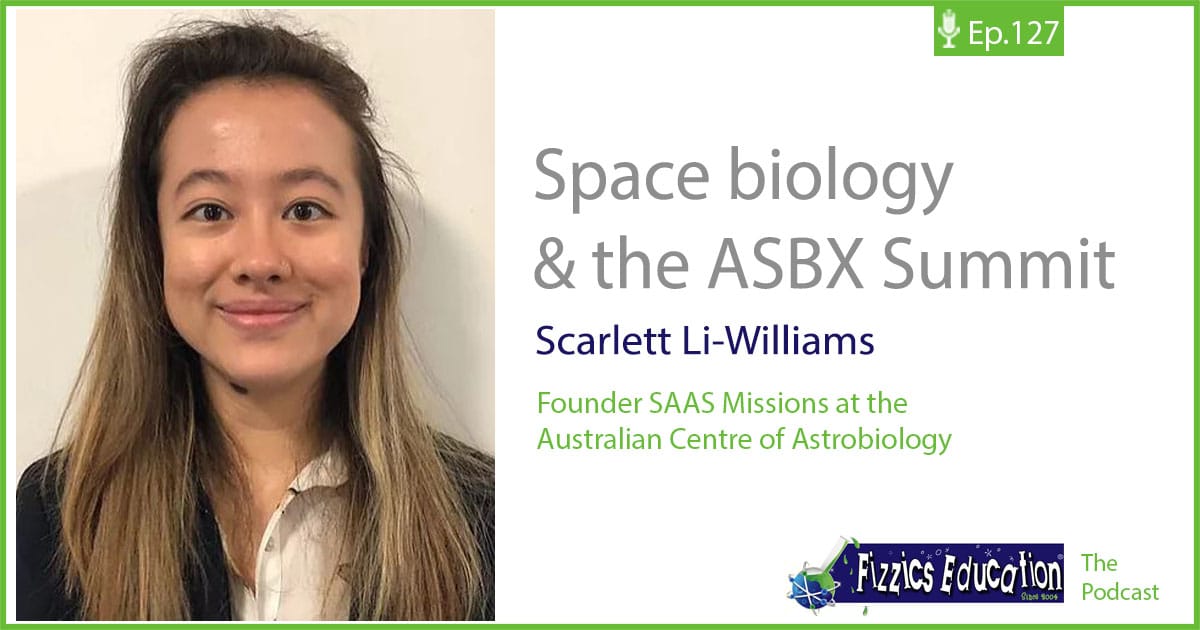
[00:00:18] Ben Newsome: You’re back in for the Fizzics Ed Podcast. Hey, glad to have you again for another chat around science and STEM, and I must say, Scarlett Li-Williams’ journey into STEM has been, honestly, inspiring. She is a current postgraduate research student at the School of Biological, Earth and Environmental Sciences at the University of New South Wales, but she’s had some sliding door moments, which has brought her all the way at the end of 2021 to be involved on the organizing committee for the Australian Space Biology and Health Summit. How cool is that? You see, Scarlett has been very passionate about science for a very, very long time. She’s been involved in the Young Scientists Journal and the British Science Association, and she really loves spending time, well, communicating science. And I must say, this is a really good discussion when it comes to, well, what can you do with a science degree? This is all about, well, thinking about your horizons, and that is exactly, well, funnily enough, space is all about. So let’s head on right in.
[00:01:31] Scarlett Li-Williams: Well, currently I’m a Master’s student actually. That’s what I kind of do in my day job, you could say. I specialize in molecular ecology, which in itself is not a very well-known field, but I have a molecular biology background. So I work a lot with genomics and genetics, and actually, you can do a lot with the environment and helping the environment and looking into how invasive species impact Australia, look into biodiversity and how we can help it and save it, just from genetics that you collect from the environment. So it’s a very interesting area. It was an area I’d never heard of when I was actually studying. I came across it because I met a researcher out of nowhere, and that’s how I got into that research.
[00:02:22] Ben Newsome: You’ve got to love the chance encounters, because that’s exactly what I was going to ask. How on earth do you find out about that thing? So there you go.
[00:02:26] Scarlett Li-Williams: Yeah, exactly. It was completely by chance. I just got referred to him. I was sitting in my zoology lecture, and I said, “I’m really interested in animals,” because I started off being very interested in animals. It’s why I came to Australia to start with. Marine biology, you’ve got the Great Barrier Reef and all of the unique wildlife that can only be found in Australia. I think it’s around 75%. I’m not 100% sure about that, and I don’t like saying things unless I’m 100% sure, but it’s a very high percentage of animals found in Australia only found here. So it’s one of the reasons I came. And yeah, I was sitting in my lecture, and then my professor was just like, “Oh yeah, have you heard of this research and what he’s doing?” And I said, “No.” So I sat down for a meeting with him. It’s very mathematics-based, which scared me at first because I’m notoriously terrified of maths. But it was so interesting, a completely interdisciplinary field. So that’s how I got into it.
[00:03:20] Ben Newsome: Absolutely. I mean, island biogeography is a thing, and Australia is somewhat of an island—that’s debatable, are we an island, are we a continent, what are we? But what we are is an isolated spot where our plants and animals have developed differently. It’s interesting that you get into the genomics of that because I suppose that’s really the cutting edge of today’s science, right? We currently got connected because we’re involved in an ExoLab project with Magnitude, with the International Space Station, and doing some research about what will actually happen to red clover and its symbiosis with Rhizobia in microgravity versus on the ground, and then some genomics that comes out of this. And I’m guessing that might be how did you get involved potentially with this? How did Ted get in touch with you?
[00:04:09] Scarlett Li-Williams: Right. So I really, when I came to university, I wanted to try everything. I had no idea what my particular interests were. I know I just loved biology and animals. So I got into the space scene. I just remember there was this guy, he came to one of my first lectures, and he had this crazy, frizzy hair, and he was a physicist. And he goes, “We’re actually recruiting students to help with these biology projects. We want to send plants to space.” And I was like, “Yeah, that sounds amazing. I’m going to go along and see what that’s all about.” And that’s how it kind of all started, and that was a few years ago. Since then, it’s just snowballed and it’s become something I love so much. What happened was I was presenting at a conference actually, and it was a virtual one last year, and that’s how I got in touch with Ted. Because I was doing my presentation on legumes in space and growing legumes in space, and then I saw that that’s what his bio said. So I quickly messaged him on the Slack channel they were using for that conference, and there we go, just kind of went from there.
[00:05:11] Ben Newsome: Actually, you know what? That’s really cool because a lot of people who are listening to this particular podcast, they live in education in some way, shape, or form usually, and we go to conferences. We do. But there really are just chance encounters, aren’t they? It’s a chance encounter yet again, and suddenly you’re hanging out with Ted who is heavily involved with the US National Lab and the ISS, growing legumes, which happens to be what you do. It’s really important to get, I suppose, the learning out of that straight away is get your bio right so people can find you.
[00:05:41] Scarlett Li-Williams: Yeah, and it’s great when they respond positively. Unfortunately, a lot of the time with science is, you hit up somebody and you’re just like, “Oh, I’m doing this same area as you. This is fantastic, let’s collaborate.” And unfortunately, a lot of the time in science, they actually see that as a bad thing and they’ll go, “Oh no, someone else is doing the same thing as me,” and they go into this competitive mode where they don’t want anything to do with you and they feel they have to actually do better than you. So it was great meeting Ted because what he’s doing, I think predominantly is in education, and I think education is a fantastic space to be in because there’s a lot of collaboration. People generally are very willing to try and just share the knowledge and create engagement, which is why I really like being in education as well.
[00:06:22] Ben Newsome: That’s awesome. So you’re involved in research, you’ve got this really side project, because I know it’s this genomics and invasive species and whatnot. I’m very curious about that. All right, so if you had to be in front of a bunch of high school students to describe what on earth is this thing that you’re researching, how would you describe that in simplistic form?
[00:06:45] Scarlett Li-Williams: As in what just encompasses everything that I do?
[00:06:49] Ben Newsome: Yeah, sort of the actual research. How does genomics work from an invasive—why would we even care? Why would this matter from an invasive species point of view?
[00:07:01] Scarlett Li-Williams: Oh, that’s a good question. I guess it provides really core answers. That’s the thing with genomics. So a lot of times in biology, I was that kid that was asking, “But why?” You know, it’s kind of like when we’re talking about anything to do with plants, like the peppered moth is a massive thing that’s taught within the UK. And I just, they were talking about how the industrial revolution happened and how there were these mechanisms of evolution where one moth would survive more than the other because of survival of the fittest. And I was just like, “Yeah, but why? Why does it have that coloration? Why, why, why?” And so it just gets to the point where it always comes down to the genes. That is why. That’s what actually creates the color of a moth, and that’s actually what creates a disease, is actually just mutations a lot of the time in the genetics. So that’s kind of why I’m really interested in genetics. It’s kind of the cause of it all when it comes to life.
[00:07:54] Ben Newsome: Well, it’s interesting. I mean, I used to work in not so much the gene expression, I was dealing with the actual outcome of those genes, which was the invasive things actually hanging around in the first place. I used to do bushland regeneration and restoration projects in Sydney long before I got into education. But certainly, you could see the impact of highly competitive species in an environment they’re not really meant to be in. So let’s be honest, they’re really good at what they do. That’s why they’re invasive. They’re quite successful, really.
[00:08:24] Scarlett Li-Williams: Yeah, they adapt very, very quickly. That’s what makes a lot of invasive species very successful. And when you’re studying genomics, for instance, if you just look at even, let’s say you take a load of samples from the top of Australia, let’s say in the Queensland area, and you actually take samples of an invasive species such as deer or cane toads, and you work your way down the coast, you can see a genuine change in genetics. And sometimes you can even see a pattern where you can see how they’ve migrated and where they’re going, and it can help predict where they’re going to end up as well, because you can actually trace all the different changes in the genetics.
[00:08:58] Ben Newsome: It’s funny, though, that you say that, is that effectively what’s been happening watching the various variants of this particular virus that we’re all reasonably familiar with nowadays. You really can watch really a timeline, I suppose, of how things go, and it’s really this tree that splits out in lots of different ways and produces interesting things. How, right, okay, so the kids have to, so they get that. They understand how molecular biology works, really. So right, how on earth do you get into something like that? The reason why I ask that is you’ve had a very interesting path. You’re working from zoology and you have this chance encounter, and now you’re working in genomics, and then you have another chance encounter, now you’re working on this side project with the space station. I mean, that’s a bit of an arc.
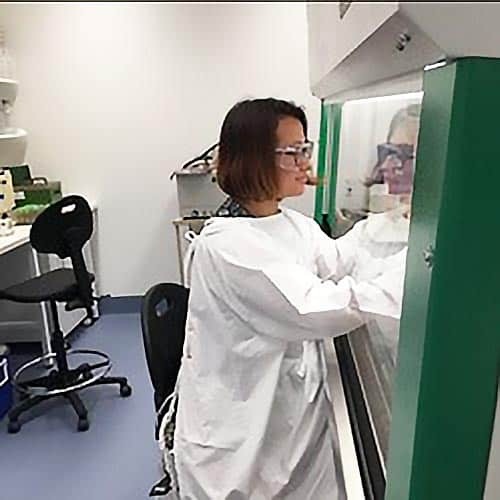
[00:09:44] Scarlett Li-Williams: It really is, and I personally think the best thing to do is just keep your mind wide open to any opportunities and what you want to do. I’ve had work experience in cancer labs, cardiovascular disease labs, because they were just opportunities that just came up. And then there was a marine biology lab opening. There were all these things, and I just wanted to try it all. And then over time, you kind of narrow down what it is that you really find interesting, not just based on something that catches your eye, but because you realize what you don’t want, if that makes sense. So for instance, when it comes to very intense lab work, I enjoy being outside a lot of the time. So I didn’t want something that was going to be solely just lab-based, so I got rid of those options. So I think it’s, I think people don’t need to worry too much about trying to find that one thing that they love and then just pursuing it. I think it’s totally okay to just be completely open to any possibilities, and then you’ll find yourself in spaces that just are really bizarre and there isn’t really much of a community for them yet, but then you can be part of that forefront. And that’s what sort of space biology is. I feel like I’m in such a great space at the moment because I tried so many different things and you just never know what will be useful later on. So now I use a lot of my lab skills that I learned, for example, in a cancer lab, when I’m actually looking at bacteria in roots.
[00:11:06]
Ben Newsome: Yeah, I mean, I was just thinking right now, so if you’re future-thinking, and especially with that particular project with space biology, we will get to the moon at some point, hopefully soon with the Artemis missions. It’s going to be very cool. And then again, we’re going to take another step out to Mars, etc., etc. And at some point, we just might be hanging out and potentially living on these places. I’m kind of wondering from an invasive point of view, finding the gene expressions of successful organisms, what makes them successful is really handy because as much as the invasive thing is a problem on Earth in certain areas, I mean, going to something that’s off-Earth, we kind of actually need those very characteristics that make them a pest in the first place, because they need to be successful, right?
[00:11:49]
Scarlett Li-Williams: That’s a very, very good point, yeah.
[00:11:51]
Ben Newsome: I was just thinking that, it’s a thing. I guess for now, I mean, you’re involved in a variety of different things and you’ve got a symposium coming up later this year around space biology. Tell us a bit about that.
[00:12:05]
Scarlett Li-Williams: Yeah, so that’s going to be happening in November. It’s going to be hybrid, hopefully we’ll still have the in-person aspect for it as well as it being online. We’re really trying to get a big international crowd. Everyone’s welcome and it’s going to be free, which is absolutely fantastic. It’s going to be supported by a few agencies, space agencies, as well as New South Wales government. They’ve been really great with this. And we’re actually trying to promote a lot of STEM outreach for this because we’ve noticed that with a lot of these official formal conferences, there’s just not enough outreach to students. So we are trying to encourage students to actually submit to a competition. It was decided literally yesterday in a meeting that we’re opening up a competition because with our conference, we’re going to have little subheadings, like subcategories. We’ll have space economics and we’ll also have space biology, space health. We’re going to post some questions for students and they can submit their answers in the form of a video, and then we’ll just let, you know, upload those videos to the site and they can just be watched by people all around the world, which will be great, as well as doing presentations and posters too.
[00:13:10]
Ben Newsome: That is so cool. And actually, I mean, this is one of the things I wanted to have a chat to you about because, I mean, that is an opportunity, quite the opportunity for students to engage in. And so there’s a lot of verticals in that. There’s a lot of different ways they can get involved. So, righto, firstly, how can they get involved?
[00:13:30]
Scarlett Li-Williams: We haven’t actually put any of this on the website yet, so this is like first-hand news, you’re the first person I’ve told about this.
[00:13:36]
Ben Newsome: Oh, you heard it here first! Wow, there you go!
[00:13:39]
Scarlett Li-Williams: So the plan is to have some form of website in some way, shape, or form.
[00:13:45]
Scarlett Li-Williams: Yeah, so we have a website for the conference and we’ll be posting advertisements there about it. The actual name of the symposium is the Australian Space Biology and Health Symposium, and I’ll send you a link to the website so you can spread it on your socials. Yeah, it’s going to be the ASBX. And we’re going to have speakers from all over the world. We’ve got speakers from NASA, JAXA, which is the Japanese space agency, the Canadian Space Agency will be there too. So it’s a great way for students to get really involved and they can ask whatever questions they like to these people. We’re going to have an astronaut there as well.
[00:14:21]
Ben Newsome: Absolutely. Now here’s a challenge for people listening in. If you’ve Googled this particular symposium or you’ve gone to the link because, yes, we always post those things in the show notes, and you’re wanting to get involved and you’ve got students there. I’m thinking about coming full circle to the start of this conversation that turning up with some information about your projects and actually giving a bit of a bio about even your school and what your projects have been doing or what you’ve been doing at university could be quite powerful because I believe that the nature of space, people are really open to try some interesting ideas. And these conferences and symposiums tend to be really pollination events, cross-pollination events of different ideas. And so please, if you are considering going there, think about that’s not the end, it’s the start.
[00:15:05]
Scarlett Li-Williams: Exactly, that’s a great way to put it. And the thing is when you’re in the space sector is it’s one of those areas that the crazier the idea, the better, the more encouraged it is. A lot of the time, people just they want something that’s just going to work. I find that a lot with science and a lot of engineers and scientists that I work with actually who are very in their fields, complete experts, absolutely fantastic at what they do. And you come to them with a bit of a weird, broad idea, “I want to go plant plants in space,” and they just think you’re a little bit mad. But when you come to the space scene and you say something like that, they’re all just like, “Yes, let’s do it! Let’s do this thing!”
[00:15:41]
Ben Newsome: The thing is there is a commonality amongst growing, funnily enough, food, and it produces a multidisciplinary approach because, I mean, even just the simple containers they’re growing in, some of those materials can be off-gassing in an environment they shouldn’t be off-gassing in the first place because it’s meant to be quite a safe place for astronauts to live. But also, like, soil scientists being involved because I mean we go to Mars, I mean, there are perchlorates in the soil. That’s kind of bad for growth, it’s kind of toxic, actually. And all these different things really will matter because eventually, once all the boffins have got their heads together and making a thing happen that works, there’s going to be people who aren’t boffins someday. Don’t know when, could be a thousand years from now, I don’t know. But at some point, the non-boffins in us will have to be using the technology that set them up in the first place to be there. And this is the start of it, and it’s good fun.
[00:16:37]
Scarlett Li-Williams: Yeah, exactly. You said soil scientists and that reminded me of a really funny story that I have actually. A couple of years ago we were going to do a rocket launch and we wanted to grow some *Rhizobium* bacteria, basically, and just see what the effects of G-forces and acceleration would have on their growth. And I was reaching out to just soil companies in Australia trying to get some soil from them. And I just remember, I didn’t even, in my mind, I just had my timeline, I had to get on with it because the rocket launch was coming up. And I was sending out these emails saying, “Hey, I’m Scarlett, I work with space and rockets and I would like some soil.” I gave them a brief email about what I was doing, what I was hoping to achieve, and was hoping that they would like to either donate or give me some discounts on soil to grow these things. So these are agricultural soil companies. Did not realize that I’d sent them out on April Fool’s. And there was just one company that USyd use, University of Sydney, and I was, you know, they were like the main company that I really wanted to get involved because I really like their ethos and I thought they’d be a great company to use. And they never got back to me. And so a week later I was like, “I’ll chase them up, you know, I’ll see what the issue is.” And the woman on the phone went, “That was real? Oh my god, we had a board meeting. We all discussed it and we just thought that’s got to be a joke. There’s no way we’re a tiny little company based out in the rural New South Wales, why would someone just out of many be asking us for soil for a rocket experiment that’s happening? No, this can’t be real.” And then in the end, they donated. They donated a lot of free soil once they realized that it was actually a legitimate thing.
[00:18:24]
Ben Newsome: That’s awesome. And actually, the thing is there are different soil types. There really are. I mean, I’m going back to undergraduate days at this point. There’s a bucketload of different soils and actually kids not realizing that is actually a concern because they might try and plant their plants at their home and the things don’t grow because there’s far too much clay or whatever it is. And it’s not just the texture, it’s the things that are in the soil. And it really does make a difference. And actually, I’m actually, when I talk to students and show them a map of the Sydney soil region—so I’m in Sydney—it is quite diverse. I mean, we’ve got shale and we’ve got sand-transition, shale-sandstone transition areas, we’ve got Cooks River clay areas and we’ve got all this different stuff going on. And to a botanist, not a soil person, to a botanist, if you look above, like with aerial photography or if you even look at—a botanist with a plant list can pretty much guess the soil based on the plants growing on it because it’s an indicator of something else. And I suppose when we look at, like, the work that you do, I mean, the phenotypes, the expression of the things that are growing from the genotypes, it’s really—it’s a related concept, so it’s all about looking deeper, right?
[00:19:35]
Scarlett Li-Williams: Exactly, yeah, and just finding those patterns.
[00:19:39]
Ben Newsome: Yeah, that’s cool. Hey look, love what you’re doing. And I’m just kind of wondering, so if you were in front of a bunch of, I don’t know, kids who really want to do science in some way, they’re going, “You know what? This is the thing, I want to do this.” And they’re wondering about, righto, what are the next steps? What are potential opportunities? How do I get involved in cool projects as opposed to being told, “Here’s my class 1A, now I do class 1B, and 1C, D, E, F” until I finally graduate with a degree and then I do the next degree and then I’m sort of stuck in degree-land? How do they get involved in actual projects that do things? What are the first steps?
[00:20:19]
Scarlett Li-Williams: I think just—I think for me it probably all started with just Google. I remember being 15 and I had no idea what I wanted to do, and in fact, I didn’t enjoy science in school. I really didn’t. It was very exams-based and I was not a good exam taker. But I found biology incredibly interesting. I found zoology very interesting. And I just ended up Googling different organizations. In the UK, there’s this organization, British Science Association, and they do this thing called the Big Bang Fair. And there’s also projects like the CREST Awards. I think there’s something similar here too.
[00:20:57]
Ben Newsome: We do have the CREST Awards.
[00:20:58]
Scarlett Li-Williams: Yeah, and that’s the opportunity to do your own research experiment. So that’s exactly what I did. I remember my first ever research experiment that I did independently was when I was 15 and it was on looking at lichens and their, like, where they grow based on pollution levels. Because actually it turns out they prefer high levels of pollution, some species, because they like the nitrogen. So it was a very interesting project. And then I started to realize, well, the company that actually do this project, they do a lot of other stuff too. And then it just kind of went from there, went to their website, went to other websites because they link their websites to websites. And you can find a lot online. I started to attend meetings online and in person, talking to people that go, “Oh, have you heard of this opportunity?” or “Have you heard of this group of people?” And just over time, that’s how I really got into it. And then I decided, “Okay, I’ll do a science degree. I’ll just, you know, grit my teeth, I’ll pass these exams, I’ll go to university and I’ll do science.” And that’s how I got involved in it.
[00:21:56]
Ben Newsome: I feel like the degree is a ticket to something else, but it doesn’t have to be. It doesn’t have to be. I mean, there are plenty of people who work in science who honestly don’t have a degree at all.
[00:22:06]
Scarlett Li-Williams: Exactly, exactly. You’ve just got to have that interest, that curiosity, and I honestly think that’s enough to make you a scientist.
[00:22:13]
Ben Newsome: Yeah, absolutely. So I suppose in summary, open mind, yeah?
[00:22:17]
Scarlett Li-Williams: Pretty much, exactly, yes.
[00:22:19]
Ben Newsome: Scarlett, look, thank you so much for popping on this podcast. And if you’re listening in, seriously, Google that symposium. And we’ll put that link out there, it’d be definitely worth checking out because that, whilst that’s a thing that’s coming up later this year, this is 2021 and the nature of a podcast being that you might be listening to this several years from now, look up other space biology symposiums that might be happening in a country near you or in your country, because you just never quite know.
[00:22:46]
Scarlett Li-Williams: Exactly. Great. Well, thank you so much for having me. It’s been great chatting.
[00:22:49]
Ben Newsome: Awesome. Thanks so much, Scarlett. Have a great afternoon.
[00:22:52]
Scarlett Li-Williams: You too.
[00:22:54]
Enjoying the Podcast Segment: We hope you’ve been enjoying the Fizzics Ed Podcast. We love making science make sense. Why don’t you book us for a science show or workshop in your school? If you’re outside of Australia, you can connect with us via a virtual excursion. See our website for more.
[00:23:12]
Ben Newsome: Well, there we go, we just heard from Scarlett Li-Williams, who not only is highly passionate about science, she really loves communicating it, which means you can get in touch with her to find out more. Now, I do recommend go check out ASBX. That is the Australian Space Biology and Health Summit. It is at the end of 2021. Go to the website—so asbx.com.au—and there’s going to be a bunch of information going up about all the different talks and all the different things that’s going on. And yes, the ExoLab that I’m involved in with Magnitude will be involved as well. I’m really, really looking forward to this. It’s going to be amazing. So definitely reach out to Scarlett as well, worth getting in touch. And also, maybe think about: is this worth sharing to your students? Because you know what? Sometimes it’s just good to hear about how other people have come across, you know, just those little moments where suddenly your career takes a twist and it accelerates very, very quickly. And I’ve got a funny feeling that Scarlett is going to get very, very involved in space science as the years progress. Look, I hope you’ve enjoyed this particular podcast. I loved hanging out with Scarlett and I hope you enjoyed listening in. So as usual, we do have more episodes coming out on the Fizzics Ed Podcast. You’ve been listening to me, Ben Newsome. I’m from Fizzics Education and I’ll catch you another time.
[00:24:25]
Fizzics Ed Podcast Outro: You’ve been listening to another Fizzics Ed Podcast. We’re excited about science. Subscribe to us on iTunes to download the next episode as soon as it’s released. And don’t forget, for hundreds of ideas, free experiments, our new “Be Amazing” book and more, go to fizzicseducation.com.au. That’s physics spelled F-I-Z-Z-I-C-S, and click “100 Free Experiments”.
[00:24:54]
Australian Educators Online Network: This podcast is part of the Australian Educators Online Network. AEON.net.au.
Frequently Asked Questions
What is molecular ecology?
Molecular ecology is an interdisciplinary field that applies genetic and genomic tools to address ecological questions. Scarlett specialises in using these techniques to study how invasive species impact biodiversity and to trace the migration patterns of animals across the Australian landscape.
How can genetics help manage invasive species in Australia?
By analysing the DNA of invasive species, researchers can identify genetic changes that occur as populations migrate. This data allows scientists to trace where a species originated, how it is spreading, and predict which areas are most at risk, helping to create more effective management strategies.
What is the ASBX Summit?
The Australian Space Biology and Health Summit (ASBX) is a major international event that brings together experts from agencies like NASA, JAXA, and the Canadian Space Agency. It focuses on the challenges of biological systems in space and provides a platform for researchers, students, and educators to collaborate.
How can students get involved in space biology research?
Students can participate by entering competitions, such as the ASBX video submission challenge, or by starting independent research projects through programmes like the CREST Awards. Scarlett encourages students to attend symposiums and reach out to researchers directly to find collaborative opportunities.
Why is it important to study plants like clover in microgravity?
Studying the symbiosis between plants like red clover and nitrogen-fixing bacteria (Rhizobia) in space is crucial for future long-term missions. Understanding how these biological systems function in microgravity helps scientists develop sustainable food sources for astronauts on the Moon or Mars.
Extra thought ideas to consider
The Importance of “Sliding Door” Moments
Scarlett’s career path was shaped by chance encounters in lectures and at conferences. Consider how staying curious and networking outside of your immediate field can open up unexpected career pathways in STEM.
The Versatility of a Science Degree
A science degree is often a “ticket” to diverse opportunities rather than a rigid path. Think about how skills learned in one area—such as a cancer research lab—can be surprisingly applicable to niche fields like space agriculture or environmental genomics.
Discussion points summarised from the FizzicsEd Podcast podcast, verified and edited by Ben Newsome CF