Transcript
[00:00:00] Ben Newsome: You’re listening to the Fizzics Ed Podcast. For hundreds of ideas, free experiments, and more, go to fizzicseducation.com.au. And now, here’s your host, Ben Newsome.
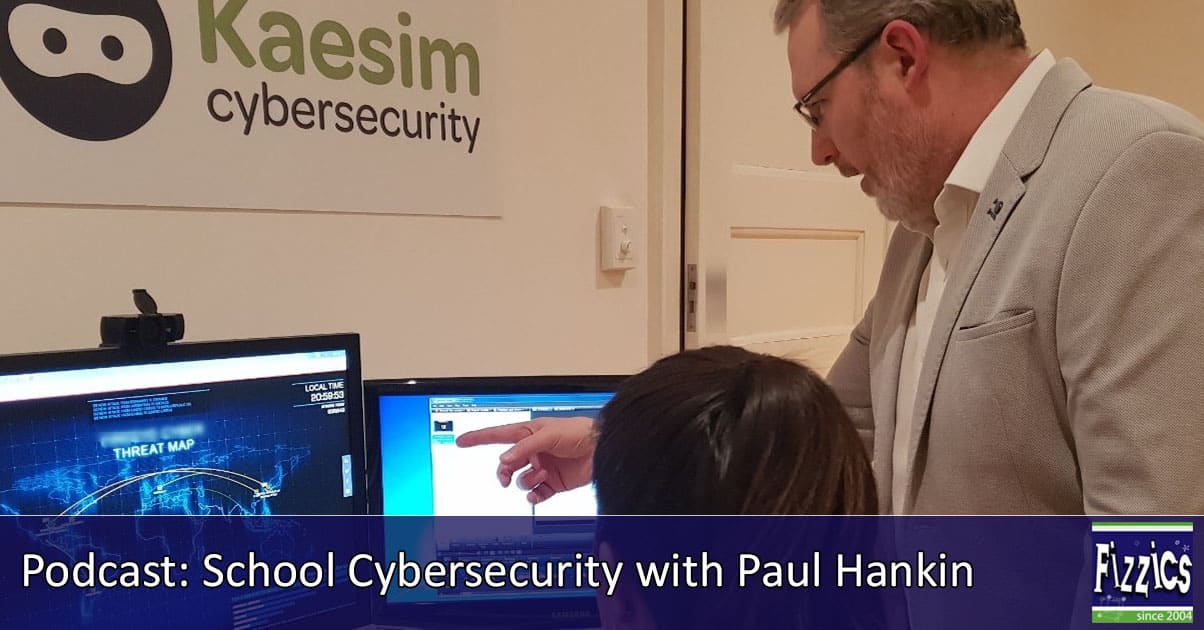
[00:00:19] Ben Newsome: You’ve spoken again for another Fizzics Ed Podcast. I hope you’re having a fantastic day, evening, or night. I must say, this is a little bit different when it comes to a STEM podcast. Normally we talk about education of kids in regard to all the sort of lessons that you expect with STEM education. This time we’re heavily involved, we’re talking about the T in STEM. We’re talking about cyber security and importantly, we’re hanging out with someone who has a bucketload of experience. Paul Hankin has been dealing with cyber security for many, many years. He’s from a place called Kaesim, K-A-E-S-I-M, which is a global team of cyber security experts that’s been protecting over 6,500 client assets right across the US, UK, and Australia since 2015. Importantly, we’ve been hanging out and chatting about what does this mean for education and looking after our students. We get into a number of different chats, and this particular one will actually have some genuine take-home tips—actually five of them—that will actually help reduce 85% of your cyber attacks. That’s not a bad outcome for a simple little podcast, so definitely well worth hanging around and listening in for that. Also, finding out what are some real tangible steps you can take when you’re thinking about the students of all the different ages that you teach. I really hope you enjoy this chat. I loved having a chat about something a little bit different in this podcast, but I must say, this is well worth your time. Let’s get into it.
[00:01:41] Ben Newsome: This is the Fizzics Ed Podcast. For all about science, edtech, and more, to see 100 fun free experiments you can do with your class, go to fizzicseducation.com.au. That’s Fizzics spelled F-I-double Z-I-C-S, and click 100 free experiments.
[00:01:54] Paul Hankin: Thanks Ben, thanks for having me.
[00:01:57] Ben Newsome: Mate, I’m really happy to have you. I must say, this is a little bit different from what we normally talk about on the Fizzics Ed Podcast because normally it’s about STEM and all different ways that we can teach students science, technology, engineering, and maths. I thought, you know what? Tech is a thing, it’s not going away, and you work in tech very much so, and more importantly help protect it. I thought this could really help with people listening in. Paul, you’ve been doing this for a while, right?
[00:02:18] Paul Hankin: I actually have. I’ve been doing this since 1982, age 13, when I got my first computer. I’ve been in STEM before it was called STEM. I was actually smiling when you said that you’re involved in a Microbee computer now. I actually remember as a kid playing with a Microbee. My dad got it for me, and that’s where I did my first computing too. That would have been about 1984, ’85, I reckon. Showing our age. Actually, I started my hacking back then because the speed of the Microbee was eight megahertz—eight megahertz—and I found a little hack installing a switch and I got it up 50% to 12 megahertz.
[00:02:54] Ben Newsome: Oh wow! I remember my dad having to type out the programs. This was back before we even had the tapes. Exactly, that’s right. We’d buy a magazine at the newsagents, you’d come home and you’d type the program out of the magazine. And if they got a backslash instead of a forward slash or something like that, it’d be game over. You’d be typing for days and it wouldn’t work. Oh gosh, I’d forgotten all about that. Oh dear.
[00:03:18] Paul Hankin: So I started quite early. Background on me, I started early, I was installing alarm systems in my local school and also in my local computer shop. That first alarm system in the computer room was covering a punch-card computer. That’s how old the computer was. That’s what the alarm system was protecting. The alarm system was made of Dick Smith parts and it was housed in a chipboard, a wooden box in the ceiling. So, very, very old school since then.
[00:03:49] Ben Newsome: It’s funny you know, you’re describing that because we are going to talk about cyber security and how it can help schools in the modern age. But I must say, if you had a security system involved in punch cards, that’s going to be pretty hard to hack. No, but anyway, this is something you’re highly passionate about. I must say, we here at Fizzics want to protect ourselves as best we can, and of course there’s always more and more steps we’ve got to do. The thing is, as educators, we’re working with families in lots of different ways and they’ve all got varying degrees of protection. That sort of means what for us as a school educator? What an ecosystem. What have you seen out in the world?
[00:04:39] Paul Hankin: Look, education systems are very interesting because there’s such constant change with students changing their devices, they install different apps, students come and go, teachers come and go. It’s a very dynamic environment. When you combine that with schools traditionally being underfunded, they don’t have the best budgets for cyber security because they’re trying to get their budget to cover other things. They’re actually a prime target for hackers. They’re quite easy to hack. That’s why, and because they have a lot of sensitive data too, data on students. You could almost say a school is a critical infrastructure like electricity or banks or telecommunications because if the school is shut down, all hell breaks loose.
[00:05:15] Ben Newsome: Well, we’ve seen that with COVID-19. Let’s be honest, when the schools did shut down, yes, all things broke loose because it was kind of hard. I suppose nowadays with the digital infrastructure, a number of schools, as people listening in know full well, are heavily networked together. It could easily be one school, therefore other schools are affected.
[00:05:39] Paul Hankin: Yeah, and in fact, there’s been a hack every month in Australia and our friends in the US as well. In Australia, it was RMIT in February this year, then in April it was Newcombe Secondary College in Victoria, and then in May it was the University of New South Wales. It’s basically every month an educational institution gets hacked. Same with the US, they’ve had much larger ones, but in the US last year there was something like 408 public schools were hacked, successfully hacked. The FBI have said it’s one of the most hacked industries at the moment. Like you said, COVID, the amount of cybercrime has increased by 300 or 400% since COVID began. Exactly right in terms of things being different. It’s the new normal in more ways than one, not just with pandemics but with the way we live and technology, and therefore that changes the risks and changes what we have to do.
[00:06:29] Ben Newsome: I guess just thinking now, currently it’s mid-year 2021, in case you’re listening to this podcast a couple of years from now because these things tend to be the case. But at this point, we’ve got some schools that are completely face-to-face, there are other schools that are hybrid, and there are other schools globally that are still off-site using all sorts of different ways. Even once this whole COVID thing starts to settle down in some way, shape, or form, this hybrid learning won’t go away completely. So I kind of think about the average school—300, 400 students—all with some form of device or at least shared devices or something. That’s a lot of stuff to control. How do you even start the first steps with something like that?
[00:07:12] Paul Hankin: The first step with all things, I mean, the best way to think of it is a bit like your physical security at home or your factory or office. You need to sort of do a risk assessment and say where are our security gaps and what are the—and then prioritize them, like what’s the biggest gap at the moment? Again, given you’ve got schools with tight budgets and probably one IT guy or half an IT guy, or maybe even the administrator is the IT guy, you’ve got to spread your time and money really well. It’s not just enough to identify what the risks are, it’s to prioritize them. Because like my to-do list and probably yours, the to-do list never ends in life. It’s not about finishing your to-do list, it’s about prioritizing it properly so the most important things are at the top and the least important things are down the bottom. If those things down the bottom become important, you push them up the top. So, yeah, number one is just doing a risk assessment to find out where your gaps are.
[00:08:02] Ben Newsome: I guess it would be fair to say that one of the major risks—tell me if I’m wrong, by the way—would it be fair to say that one of the risks to the school would be the environment of which people are connecting to the school networks in different ways that are outside the Wi-Fi infrastructure of the school itself? So they’re accessing it from home or from a public library, something like that. Would that be the biggest risk or is there something else that I’m missing?
[00:08:29] Paul Hankin: Ben, you are not wrong in that assessment. Yeah, so essentially because people are always trying to get around IT departments in offices as well as schools, but particularly in schools. Like I said, there are so many different devices connecting because every kid’s got a different device and people are working from home, so they’re using their home networks. So that’s one of the issues. In the old days with cyber security, you’d try and control the connection points where people are logging in to, all that sort of stuff. But now because there are so many people with different devices and ways of connecting, it’s much better to sort of like put—it’s like putting bubble wrap around each device that has value. You wouldn’t put much around your printer, your Wi-Fi printer, it’s not very valuable. But around your phone and your laptop, you put a little firewall around that, a little bit of bubble wrap. That way it doesn’t matter what that phone connects to, it’s always going to be protected no matter where it goes. If it’s connecting to a Starbucks free Wi-Fi or at the airport, or if you go to a friend’s house. I might have great cyber security at my house, I go to your house, Ben, and you’ve got terrible cyber security, your Wi-Fi is awful. I connect to your Wi-Fi and I get all the junk that’s on your Wi-Fi because your router could be wide open to the world. And by the way, that’s not—as much as this goes out to the world—that’s not an invitation to see if you can hack my firewall. No, it’s not.
[00:09:44] Ben Newsome: But I must say, okay, I get it, managed devices. This is the problem with one size fits all because it does not work in education land. Because there are some schools that 100% have managed devices and there are others that absolutely cannot and will not at any foreseeable time in the future. So how does the school deal with this if it hasn’t got the budget, but it’s got a lot of kids and they’re on different devices? These are personal devices, this is their stuff, not the school’s.
[00:10:09] Paul Hankin: I think really you could hack the problem, pardon the pun. In terms of I think the more you can get people interested in cyber security—because let’s face it, as I think we’ve discussed before, educators love kids but they don’t love IT. A lot of people find IT boring and cyber security is just an extension of that. I think one thing you can do if budgets are an issue is let’s try and get people interested in cyber security. Just as you run STEM projects to build a little robot and do something using electronics or robotics, maybe an idea would be, “Hey, let’s build some sort of network and try and hack it and understand cyber security from a science project point of view.” Then once you get that uptake from students and teachers that way where it’s a regular class, then you get the regular learning about it and that awareness rises. Then kids might be wanting to do cool projects at their home to secure their home from a cyber security point of view. You could have a competition to see who has got the best cyber-secured house at their home. In a sense, it’s the parents funding that, I guess, and it’s not that expensive anyway. It’s not the school, and then everyone’s awareness is raised and everyone is having fun too and they’re learning more. So that idea I just made up then.
[00:11:19] Ben Newsome: I was just thinking, it’s kind of novel too because I suppose there are various versions of ethics around that. But I like the network side though of creating—I hadn’t thought of this—creating a network to test your assumptions, which I hadn’t even thought. Is that crazy difficult to do?
[00:11:38] Paul Hankin: No, not really. I mean just like you can build little—you know you can get those Raspberry Pis computers and make lots of things like that. It’s the same with cyber security. You can get a little box and install Linux and do a few fun things with it. That’s definitely a way to go because then it becomes a lesson or a class or an activity, so it can be put into the curriculum. It can be something that happens regularly. Then the kids can take that home and work on their own sort of cyber security for themselves at home, teach their mom and dad that sort of stuff as well. The greater the cyber awareness of a person, the more secure they are in general.
[00:12:13] Ben Newsome: Wow. I mean that’s a really interesting thing. I can see how that would work well in secondary and the middle school years. It might be challenging with the really young kids, but certainly with the older kids that could easily work. It’s food for thought, isn’t it? I mean the thing is, traditionally, if you were speaking to a group that were a bunch of adults and they have phones and they can do this two-factor authentication, the problem is that some of these kids just aren’t—they can’t do two-factor because it’s not allowed to put it on their phone. How do they do it? It’s a bit messy, isn’t it?
[00:12:45] Paul Hankin: Yeah, look, I think kids are messy and also I think too is kids are curious and they love clicking on everything as well. So they’re a more risky behavior than an adult who is more risk-averse because they’re just older. So I think it’s going to be an area that’s always going to be a little bit messy and it’s like all things, it’s just about reducing the risk, managing the risk, just trying to increase people’s awareness so that they’re not the low-hanging fruit.
[00:13:13] Paul Hankin: One of the myths we talk about is that everyone thinks that the hackers are so good because they’re hacking into systems and people have spent millions of dollars. What you find in practice is the hackers are not so good, it’s that the cyber security is so bad. So most situations of people being hacked, it’s because their computer wasn’t patched or they didn’t have 2FA installed or the IT department don’t have qualifications in cyber security. So you don’t really have to lift the bar very much to not be that low-hanging fruit. It’s good to be the middle-hanging fruit. You don’t need to be the high-hanging fruit like a superannuation fund or CBA Bank who spends 90 million dollars a year on cyber security. Just be the middle-hanging fruit, not the low-hanging fruit. And then, you know, it’s sort of like leaving your car unlocked at the shopping mall. What will a car thief do? He’ll walk along 20 cars and he’ll just try the handle on all 20 cars, and the handle that opens is the one he’ll rob. He won’t bother with the ones that are locked. So the one that’s unlocked is the low-hanging fruit, that’s the one that’ll get stolen. So I think it’s really risk management, awareness. But as you know in education, you’ve got to make it fun, you’ve got to make it interesting.
[00:14:19] Paul Hankin: One other point to add to that was that there’s a cyber security skills shortage. There’s an absolute shortage of people trained in cyber security to be employed in businesses and it’s a massive growth area for the next five years, a bit like STEM and AI and machine learning. So again, if it was brought in as an activity to stimulate the interest in it, then students could pick that up as a subject, maybe in a university level or private courses. So there’s another sort of bonus to bringing it in as part of your curriculum. Because I think it’s one of those things that’s like work health and safety or any other issue that’s compliance-based that’s boring. I mean, people aren’t stupid, they know it’s boring, you’ve got to try and force it on them, it doesn’t really work. But if you make it integral or part of the curriculum, then you’ve got half a chance of those who might be interested getting involved and it self-propels and probably doesn’t need much budget at all.
[00:15:13] Ben Newsome: You probably heard me chuckling. I had this visual of an old joke where you don’t have to be faster than the bear, you just have to be faster than the person running away from the bear next to you. Exactly right. And it sounds terrible, just like saying, “Well, let’s sacrifice other people by being the middle-hanging fruit and leaving other people as the low-hanging fruit.”
[00:15:37] Paul Hankin: But essentially, basically cyber security is an industry now. Like I say, cyber criminals make 1.5 trillion dollars in income per year from cybercrime. 1.5 trillion. The damage it does is about 6.5 trillion with a T. So if that was a company, it would be the third largest company in the world after the US and China. And therefore, it’s such a lucrative business because so many people’s computers are just poorly set up and they’re not protected. It’s so easy. You can even—they even have, you’ve probably heard of ransomware—they have ransomware as a service. So if I’m wanting—I don’t have to know how to hack computers, I can just hire someone to do the hacking for me and it’s so automated these days for a few hundred dollars. So that’s the problem now, hacking has become industrialized. Maybe 20 years ago you and I remember we’d have antivirus software, but what was it for? Just to block annoying pop-ups, maybe we’d lose a bit of data and then probably it would slow our computer down. Now things have changed because 20 years ago that was all that viruses did to your computer. Nowadays they shut down hospitals, they shut down schools, they shut down oil pipelines in the US, which causes major, major problems. So I think it’s now a part of society that we have to bring into school where it’s just like you’ve got your civil engineer and you’ve got your mechanical engineer and computer engineer, well now you’ve also got cyber engineers and it’s a real thing. Just like cyber warfare is a real thing, it’s we’ve gone from land, air, sea, now we have space and now we have an area called cyber. So yeah, I think it’s a real area that we need to move into.
[00:16:49] Ben Newsome: One thing that was crossing my mind, if you’re an educator, it doesn’t matter where you are in the globe and you’re looking at trying to get something implemented in your system, the International Society for Technology in Education (ISTE) has a series of standards which is about being digitally aware as a teacher but also as a learner and as an administrator. So if you’re needing to get this through the various powers that be, you can show those standards. Just look up ISTE standards and you can show these. This is very much a global movement towards helping kids understand, not just the child protection stuff, which by the way is incredibly important, but the cyber side of things is something that needs to be dealt with. And I just love how you mention it’s quite simple really—updating your browser. I mean, we’re in a chat right now, probably shouldn’t do it or I’d break our chat, but we could, after this chat, I could quickly just check and click update and what’s done in a minute, right?
[00:18:02] Paul Hankin: Look, a lot of the things are very simple, but like doing your taxes and going to the dentist, it’s not very fun and you don’t want to do it and you leave it to the last minute. So we need to use a bit of behavioral economics and understand how people work and try and fix that problem, hack the problem. And that’s why I think an idea of making it part of the curriculum is really good because then you can—you’re the expert at making things fun in science-wise and stuff like that. You know, that’s the sort of thing that educators are great at, they take something which is—they make things interesting and they make things exciting and fun to learn.
[00:18:46] Paul Hankin: What I love that you mentioned about this really does open up a potential career for kids, especially as they start to think about this as they head towards the end of school. I mean, are these courses for this type of work expensive or are they fairly achievable for kids? No, so you can do things like I said, a Certificate IV in Cyber Security. I think in Australia they were offering them with scholarships for anyone who applied. I think normally it’s $9,000 but you can get it for a scholarship when I checked it a year ago. So pretty much there is such a shortage of people in the industry, they’re desperate for people to be trained in cyber security. So the government is pretty much funding I think 23 or 24 TAFE campuses to run these Certificate IV in Cyber Security. Then you can move up a level and get your diploma and stuff. You can also do private courses as well. But honestly, if you were a university graduate or even not, in fact not, if you were just over 18, you could get trained up in a reasonable amount of time, say six months. You could get a certification in six months and you could have a job at the end of that six months because there’s such a shortage of people that the government is trying to hire and private industry as well. In fact, I think private industry is hiring everyone because they pay better, which is leaving a shortage for government. So yeah, there’s a real shortage of people in the workforce.
[00:19:53] Ben Newsome: Yeah, so it’s a sad reality. It’s a growth industry, but it shouldn’t be, but it’s a growth industry. It’s what it is, so you just accept the landscape for what it is. I suppose that’s a silver lining. I mean, there are opportunities for our kids if they want to go down this line. But also there’s opportunities for us for doing something about this problem. I guess if people were listening to this in the car, walking the dog or whatever they’re doing, and they had to walk away with three simple tangible steps to at least take those steps towards having a more secure environment, especially with such a vast variety of kids using their networks and apps and all these things that we use every day, what are some of the three simple things they could do to walk away and go, “You know what, I could start the process”?
[00:20:38] Paul Hankin: Sure. Well, I’m going to break the rules here and go five. Give me five! Why not? I’ve got five tips that can reduce 85% of cyber attacks. So five tips reduce 85% of cyber attacks, and these come from the Australian Signals Directorate, which is the Australian spy agency, after they spent years going through thousands of cyber attacks and analyzing and responding to all these companies that went to them for help. They found if you do these five things, you’ll reduce the risk of cyber attack by 85%, which is pretty good. So the first one is, yes, two-factor authentication. You’ve got to switch it on absolutely everything. A lot of email fraud that occurs these days, it’s because people don’t have 2FA set up and it’s easy for them to be hacked. And with that as well, use a password manager because people just use the same password everywhere and it’s no good. So get a password manager. Number two, backups. Do an online daily, make it automated, and offline weekly as well if you can. Number three, update your software. Set it on automated update so you don’t have to think about it. Number four is don’t install rubbish on your computers or your phones and no pirated software because usually that is full of holes as well. Don’t make everyone an admin user on your computers because it’s not a good idea. And that was, I think that was five, wasn’t it? Yeah, that was number five.
[00:22:08] Ben Newsome: Well, feel free to keep on going, like give us 15! Those five are really handy. If this was a test, I wonder how well you did. But the beauty about this is that some of these are crazy simple to start implementing like this evening.
[00:22:44] Ben Newsome: Absolutely. And the fact that we’ll cut down 85% of your risk, which is a big thing to cut down for only five little things to do. I think the big problem with cyber security and IT in general is people feel overwhelmed with how much they have to do, they can’t keep up, and they feel like, well no matter what I do anyway, I’ll still get hacked. But it’s not the case. Those five tips will take you from being low-hanging fruit to middle-hanging fruit, and then it’s the other guy who gets eaten by the bear, not you.
[00:22:52] Paul Hankin: I love it. We’re generally thinking about don’t go near bears anyway. look, hey, thank you so much, Paul, for popping on this podcast. Undoubtedly, there might be some people that’d love to get in touch with you. So how would they do that? Best way is just to go to our website which is Kaesim.com.au, so K-A-E-S-I-M.com.au, and just hit the book a call button and you can have a chat with me or one of the team members here. Happy to help people with anything at all. Yeah, absolutely.
[00:23:12] Ben Newsome: Easy as. And as you know, we put these links in the show notes. Click away, go through to us. And that’s the thing, that’s a good takeaway—don’t click on the things you shouldn’t click on. But in this case, that link would be useful. Definitely go. Absolutely. Look, Paul, thank you so much. I’m very glad we could have this chat. And thank you for those people listening in because I know this is not a normal agenda, so to speak, with this particular podcast. But I must say, it’s so important and when we keep on talking about STEM, there’s a T, there’s technology, and this is part of technology. Simple as that. Absolutely. Look, much appreciate it. Have a fantastic afternoon. Thanks Ben.
[00:23:46] Ben Newsome: We hope you’ve been enjoying the Fizzics Ed Podcast. We love making science make sense. Why don’t you book us for a science show or workshop in your school? If you’re outside of Australia, you can connect with us via a virtual excursion. See our website for more. Go to fizzicseducation.com.au. That’s Fizzics spelled F-I-double Z-I-C-S.
[00:24:04] Ben Newsome: Well there you go, team. I hope you enjoyed that chat with Paul Hankin and I must say, how important is cyber security in this day and age? And considering that those five simple steps could really help your students and the families who attend your school, it’s well worth considering passing on that message. I really, really think it’s worthwhile. So again, if you want to check out Kaesim, go to their website, Kaesim.com.au, and reach out to Paul. Say g’day for me and see what you might be able to do to be able to help out. Having some confidence around cyber security—and I love the fact of getting into potential careers in cyber security—this is an important skill and really should be considered when we’re thinking about STEM in its broader context. We’ve got to be careful with our technology, no doubts about it. Look, I hope you enjoyed this podcast. I certainly loved putting this together for you. I hope you’re having a fantastic time teaching science, education, technology, and all these different ways. We’ll catch you another time. This is me, Ben Newsome from Fizzics Education, and this is the Fizzics Ed Podcast. I’ll catch you again soon.
[00:25:11] Ben Newsome: You’ve been listening to another Fizzics Ed Podcast. We’re excited about science. Subscribe to us on iTunes to download the next episode as soon as it’s released. And don’t forget, for hundreds of ideas, free experiments, our new “Be Amazing” book and more, go to fizzicseducation.com.au. That’s Fizzics spelled F-I-double Z-I-C-S. This podcast is part of the Australian Educators Online Network. AEON.net.au.
Frequently Asked Questions
What are the first steps a small organisation should take to improve its cybersecurity?
The best starting point is to implement the ‘Essential Eight’ strategies recommended by the Australian Signals Directorate (ASD). These focus on practical measures like multi-factor authentication (MFA), regular backups, and patching applications to mitigate the majority of common cyber threats.
How does a background in policing influence an approach to IT security?
For Paul, cybersecurity is a continuation of his family’s six-generation legacy in the police force. This perspective shifts the focus from purely technical solutions to a mission of service and protection, treating data security as a vital part of community safety and business integrity.
What was the significance of the MicroBee computer in Australian tech history?
The MicroBee was an Australian-made microcomputer that played a pivotal role in the 1980s. It provided a platform for early ‘geeks’ to learn programming and hardware configuration, seeding the technical skills that would eventually lead to the development of Australia’s modern IT and cybersecurity sectors.
What is GRC, and why is it important for cybersecurity compliance?
GRC stands for Governance, Risk, and Compliance. It is a framework that ensures an organisation’s security activities are aligned with its business goals, that risks are effectively managed, and that all legal and regulatory requirements are met, such as those set by the ACSC or NIST.
Why is real-time threat intelligence sharing critical for modern businesses?
Platforms like Cyber Threat Intelligence Sharing (CTIS) allow security providers to recognise and respond to emerging threats as they happen. By sharing data across government and private sectors, organisations can block new ransomware or malware before it reaches their network, rather than reacting after a breach.
Extra thought ideas to consider
The evolution of security from physical to digital
Paul’s early work with physical alarm systems highlights how security principles remain constant even as the medium changes. Whether it is a physical lock on a door or an encryption key on a server, the goal is to protect assets from unauthorised access through a combination of hardware, software, and vigilance.
The human element in digital transformation
As businesses undergo digital transformation (DX), the technology often moves faster than the people using it. Effective cybersecurity must account for human behaviour, ensuring that security protocols are intuitive enough for staff to follow while being robust enough to withstand social engineering attacks.
Discussion points summarised from the FizzicsEd Podcast podcast, verified and edited by Ben Newsome CF