Transcript
[00:00:00] Announcer: You’re listening to the Fizzics Ed Podcast. For hundreds of ideas, free experiments and more, go to fizzicseducation.com.au. And now, here’s your host, Ben Newsome.
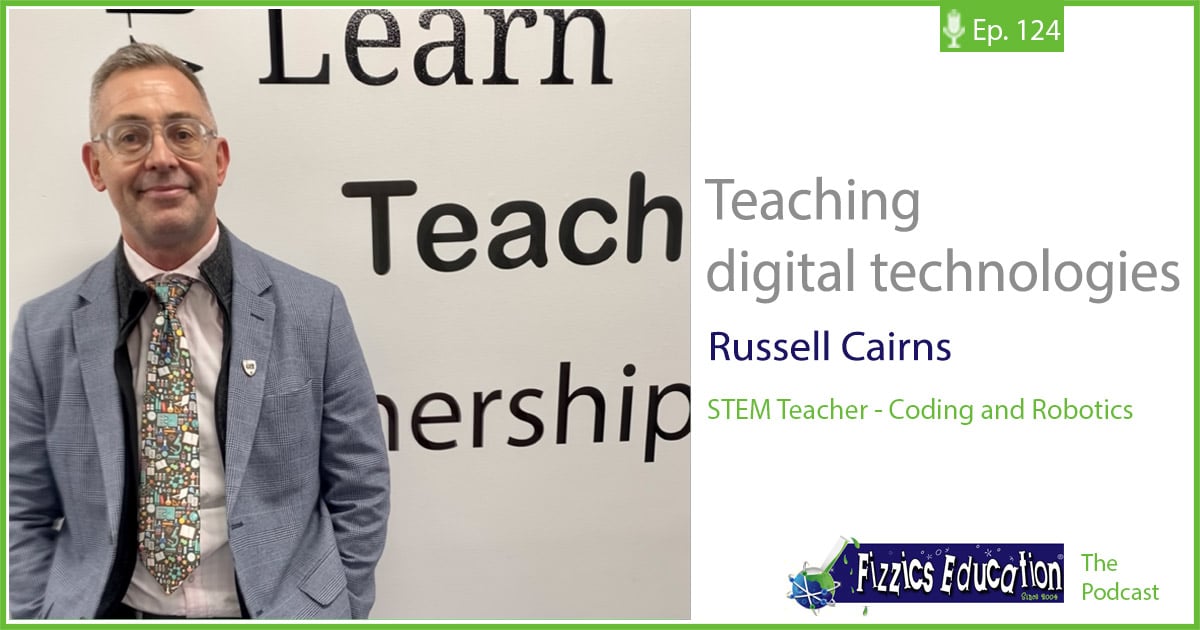
[00:00:19] Ben Newsome: Yes, welcome back to another FizzEd Podcast. Hey, glad to have you again for another chat around science and STEM and all that sort of thing. And I must say, we are hanging out with a very good educator when it comes to the T in STEM. We’re hanging out with Russell Cairns, who some people might know as Rusty. Rusty is an amazing specialist STEAM coach who teaches the subject Digital Technology, coding, and robotics to over 900 K-6 students every week. He also runs a lunchtime Minecraft, robotics, 3D printing, digital arts, and he supports STEAM clubs. And just on the side, he’s also a Wonder Workshop Robotics Coach, Sphero Lead Educator, a MakerBot 3D Learning Ambassador, and he is also New South Wales ICT Educator Leader of the Year and a Microsoft Innovative Educator Expert as well. Seriously, he really knows his thing when it comes to tech in schools and especially in the primary sector. He loves this stuff and he’s got a bit of an idea about how to get these things out into the world far beyond formal schooling. So let’s get right into it. This is the Fizzics Ed Podcast for all about science, edtech, and more. To see 100 fun free experiments you can do with your class, go to fizzicseducation.com.au, that’s Fizzics spelled F-I-double-Z-I-C-S, and click 100 Free Experiments.
[00:01:37] Russell Cairns: Hi, Ben. It’s great to touch base with you. And we’ve been catching up on Clubhouse under Rusty Robot. So it’s just great to be able to bounce ideas off you and know that I’ve always got someone to sound out and give me good advice.
[00:01:58] Ben Newsome: Mate, I’m really stoked that you could join us on this chat because you’ve been doing a lot of really cool stuff in education for a long time. And I’ve been stoked to get you on this podcast because I know you could share a bucketload of value when it comes to well, edtech. Let’s be honest. I mean, that’s why even your Clubhouse handle is Rusty the Robot, right?
[00:02:18] Russell Cairns: Yeah, so I’m really like a project-based learning teacher and I teach 900 kids a week. So I’m just feeding them the diet of edtech and giving them that endorphin hit that they need. So we start our lessons off with a computer science principle, and we introduce the principle and then we try and get them onto the devices as quickly as possible. And then we wrap up with some hands-on learning if we can. And then they go off, I get the next 30 kids for another 30 minutes. So ultimately it’s like a floodgate of kids coming through. It is. So over 900 kids a week, and I’m really lucky. Anything that looks really cool that I want to pilot, then I’ve got kids coming in for 30 minutes that I can pilot something with one or two classes. So what I can do is if I’ve got eight Stage 2 classes, I can pilot something new with two of those classes and then get back to the vendor and say this is the result, this is what I found out, this is what works and this is what doesn’t work.
[00:05:14] Ben Newsome: Well, here’s what I love about what you’ve been doing because that’s exactly what you’ve been doing. You’ve been truly alpha testing, I was going to say beta testing. I love the fact that you’re reaching out directly to the vendors and saying, “Hey, can I borrow some stuff and make stuff happen?”
[00:05:41] Russell Cairns: Yeah, so we call it feeding the beast. When you’ve got 38 classes a week, some of those are co-teaching. When you’ve got 38 classes, you need to feed that beast. And we have been surviving off a diet of STEM T4L boxes. So STEM T4L once a semester sent me 10 boxes of a particular robot and 10 of this and 10 of that. And then I have to try and work out how can I take this 10 robots and then feed it into a class of 32, so that’s one robot between three, which is not ideal. And then how can I take the big boys’ robots and teach them to the little kids because I’m teaching K-6. So how can I take that big robot and make it valuable for the little kids? And then the other issue is next year when I’m teaching those classes again, they’ll say, “Oh, you know, we learned that robot with you, Mr. Cairns, last year. We want a new robot.” And that’s kind of the way kids are. Kids feel if they’ve dipped their toe into something then they’re experts on it and they’re not. And so you have to relate it back to the guiding principles of project-based learning, teamwork, grit and challenge, problem thinking and design, and design thinking. And then you’ve also got to teach like a scope and sequence, so computational thinking, but make it different but build on what you taught last year.
[00:09:18] Ben Newsome: I love that. I mean, actually I was just thinking there when you’re describing the kid who walks in who’s jaded and goes, “I’ve seen this robot,” and you know what? That happens in science all the time. I’m a science educator. You happen to have vinegar on your table, instantly they think you’re going to do a volcano. It’s like, no, I’m actually going to do an acid-base titration, I want to show you what’s actually going on. It’s funny how that works. I mean, one of the things that’s crossed my mind, what in reaching out to vendors, I mean, that could be potentially daunting for some. I mean, how do you go about that? How do you bridge those relationships to be able to even get those loaner kits in the first place?
[00:09:40] Russell Cairns: Well, it takes a lot of negotiating and you have to realise I’m really skirting on the boundaries of conflicts of interest. So I have to be really careful how I’m saying, “I’m going to try something of yours and you’re going to give me 10 of it or 12 of it, preferably, and then I’m going to give it back to you at the end of 15 weeks. And I may not buy it, and you may not be able to sell it again. But I’m going to report honestly what my findings are without identifying the school or the students and respecting students’ rights to privacy for what they say.” So things are complicated and it’s a dance. It’s a dance that I play. And the other thing is one year I may be talking to Mr. LEGO and saying, “Hey, Mr. LEGO, I love what you’re doing with Spike Prime. I want to be everything Spike Prime.” And next year I might be saying, “Hey, Mr. VEX, I love what you’re doing with VEX.” And that might be because I’ve identified that it fills a gap in the market or that might be I’ve identified that it teaches something cool that I don’t think is being taught. And one of those things may be engineering in STEM. So I’ve just had a little sit-down with a fantastic academic who is very passionate about putting the E into STEM or STEAM and putting it into primary schools. And we always talk about this interdisciplinary learning, how you can’t just teach things in isolation, it has to be weaved into the other subjects. But it’s tricky for a classroom teacher to do that. It’s much easier for me with my space that I built and my chairs and my tables and my benches and my floor space that I can put floor robots on. It’s much easier for me to do that efficiently than giving a kit to a primary teacher and saying, “Here’s a kit, get upskilled on how to use it and you’ve got two weeks.” They may only get two 40-minute periods in the whole week to teach that. And then they’ve got to fit it in with all that other stuff. And on the weekend they’ve got to go home and watch a whole lot of videos from LEGO on how they’re going to integrate that STEM kit into their science unit or history unit or geography unit. Rather than just saying, “Hey, here’s something that’s really cool that we can play with and we can learn about playing.” And we can learn about STEM concepts at the same time, but ultimately I just want to see you work in a team. So that’s my current thinking about upskilling students rather than teachers, upskilling a whole student base so that over a two or three-year period you upskill them in devices and then you upskill them in STEM thinking and pedagogy and then you upskill them in computational thinking. Once everybody has had their toes dipped in the water and they’ve learned this language, then you can bring in clubs. And I think clubs are without a doubt the most untapped potential in schools. We already have drama clubs, we’ve got singing clubs, dance clubs, speaking clubs, chess clubs, but I’m not seeing so many STEM clubs.
[00:11:08] Ben Newsome: Yeah, I mean, what I’ve got to say there is that what you’re doing is incredibly entrepreneurial. I mean, you really are, and like you say, you are pushing the boundaries. But hey, those boundaries are there for a reason, we can push them as long as we don’t break them. But that is amazingly cool and I love the idea of partnering directly with students in their own learning and really, they can then be the teachers back to the teachers effectively.
[00:11:23] Russell Cairns: So I do have a systems thinking and marketing and advertising background. And I look at something and I go, what is the problem with this, you know, introducing this new concept or introducing this new product? How do I need to break it down? And years ago, I did that with coffee making skills. So I went to Seattle and I studied the way that they were making coffee in Starbucks. And then I went to Italy and I studied how they were making their espresso in the different parts of different regions of Italy. And then I broke that down into, you know, systems-based thinking and I trained baristas on how to in those really busy cafes, you know, just pump shots and someone else just to make milk and someone else just to concentrate on the pouring of the latte. And then I made sure that the person that pumped the shots was rotated around and got to learn how to pour the latte and the person that was, you know, frothing the milk learned how to pump the shots. And it’s kind of like that training model of training young adults, especially new arrivals to Australia, that really inspired me and made me want to go back to university and get my Dip Ed. If I hadn’t got my Dip Ed, I wouldn’t be teaching in a primary school, I’d probably be teaching in a high school. But that’s the nature of the beast. And then as soon as I got into a primary classroom, once again I used my systems thinking to say, how do I want to teach? And what I was inspired by was people like yourself and people like John Stevens who says Maker Mondays, that every school day should start off with a maker day. Monday morning should be a maker day. Monday morning at the moment, we call the rolls, you sit on the floor, we do phonics for 20 minutes, then we do maths problem of the day for 20 minutes, and then we do writing for 20 minutes and then the bell goes and then they go out and play and then they come back and then they do some English for 20 minutes and then they do some more maths for 20 minutes. And then somewhere in that five hours that we get in front of them, we have to fit in collaborative practice, how to be critical and creative thinkers, problem-based learning, geography, history, science. And unfortunately, because everything’s siloed in the main diet for a classroom teacher is literacy and numeracy skills, it’s really hard to upskill yourself and upskill your classroom in those skills. And those kids will go away on holidays, spend five or six weeks with an iPad in their hands, playing on an iPad every day for four hours a day, and they’ll come back into your classroom at the beginning of the year and they won’t know how to use a computer that you taught them last November. And you have to go through that whole process of retraining them again. Anyway.
[00:12:43] Ben Newsome: Yeah, and so the cycle continues, right?
[00:12:46] Russell Cairns: So I think whatever you do it’s got to be gradual and also the pedagogy’s got to drive you. I mean, you’ve got to find your passion. You’ve got to find what you’re good at. If you’re an arts teacher, then become a STEM arts teacher. If you’re a geography and history teacher, become—we call them HAMSTERS, you know, like Humanities, Arts, Maths, Science, Technology, Engineering and I forgot what the R is.
[00:13:08] Ben Newsome: I’ve got this visualisation of the hamsters trying to get through this school maze of life.
[00:13:13] Russell Cairns: Well, this is the thing. I mean, we have these big ideological debates and I sit in these curriculum reviews and I’ll sit in the curriculum review for the arts team and the arts team will be saying, “Well, there’s not enough dancing in here.” Or and then the visual arts people will say, “Well, there’s not a visual arts in there.” And the music person will say, “Well, there’s no music in here.” And I’m on the thing saying, “Where’s the technology?”
[00:13:38] Ben Newsome: Yeah, well, there’s the thing. It reminds me of the patient going to a group of doctors saying, “I feel this,” and then you’ve got the cardiac surgeon and the various surgeons and they’ll all say based on their specialty what needs to happen, right?
[00:13:49] Russell Cairns: Well, not only that, but how soon can I book you in so I can cut that out? So it’s true.
[00:13:54] Ben Newsome: Which presents—I mean, this is why it’s such a fun and dynamic world that we live in, this education world that we live in. And I mean, I must say though, I mean, being able to get outside of the nine to three to actually, you know, bring in that upskilling capacity is something you’ve been really busy with. I mean, I was able to catch up with Carl Easton earlier this year, late last year, I don’t know, but it was really good just having a chat about what he’s been getting up to. And you’ve been working with Carl a little bit over the years and that sort of thing.
[00:14:22] Russell Cairns: Yeah, so I like to find dynamic teachers that are in their school struggling away and I like to, you know, shine a light on them. And Carl’s amazing. Carl’s someone that I’ve always called on and said, “Hey buddy, we’re doing this.” And he goes, “Really?” And I go, “Yeah, don’t worry, it’ll be fine.” And I’m a bit like *Wayne’s World*, you know, you build it and they will come. And so I grabbed Carl because he had expertise in robotics. And I don’t—you know, I’m teaching robotics, but I don’t necessarily know about robotics, I just know how to teach. So he’s got this great concept about teaching through robotics, using robotics to teach concepts and stuff. And I’ve got this great idea about project-based learning and inquiry-based learning and having children, you know, work with challenges. So I was able to grab Carl by the hand and we made the Dynamic Duo and we ran teachmeets for a good two years. And each teachmeet, I would then review the teachmeet while the teachmeet was happening and saying, “Wow, next time I’m going to do this,” or “next time I’m going to do this.” And I’m very grandiose sometimes in my plans. And I’ve come to the conclusion I’ve got to stop doing teachmeets. I’ve got to start doing STEM outreach. I need to start activating the students to then go back into the classroom and demand that change that I’m looking for. I need to empower the students to show the students the skills, the hard skills and the soft skills. And I need them to be a voice so they go in and say, “Hey, give me the keys to the IT cabinet. I’ll take out those EV3s that have been sitting in there for the last nine months not being used. I’ll sort them out and you open up your classroom and I’ll run a lunchtime club.” And my little Year 6 person is going to teach my little Year 4 person on the fundamentals of coding. And it’s that kind of like getting the older to teach the younger, you know, with that—what’s it called—zone of proximal development? It kind of makes sense. Keep it cool, let the kids take the charge. And failure’s good, celebrate failure. You know, taking on a massive project and not completing it is great.
[00:16:41] Ben Newsome: What I love about this bit with the club is that the student isn’t going to have the hang-ups of trying to worry about the curriculum and all that blah blah blah blah blah. They just want to play.
[00:16:49] Russell Cairns: Yeah, well, not only that, but they need to complete the challenges. You need to give them a deadline. They need to have a mat. They need to have a defined—so if we were flying drones, for instance, then they need to be able to go and make this drone, you know, on a landing zone and develop a hook so that the drone can pick something up and then carry it. And then, of course, there’s a thousand ways you can relate that to science or history or geography, but they just want the drone. But you have to make it hard for them by saying, “All right, you can fly the drone, but you need to learn how to complete the challenge.” So if you don’t have a challenge, then you don’t have project learning or problem-based learning. If you don’t have a deadline, then teachers are not going to get behind it. It’s that horrible thing that in Term 3 or Term 4, Week 8 or Week 6, you’ll need to submit. I mean, my pressure is at the moment, I’ve got 18 schools coming into my school for a tournament. I have no idea how I’m going to organise that. I mean, I know how to organise a tournament, but I don’t know how I’m going to get my kids to compete in the team. And my kids just want to win the tournament. And my principal says, “Make sure those kids can, you know, rate really well in the tournament and get through to the state finals.” But me, I’m more interested in running the tournament and that’s why I’ve made the decision to focus all my energy on outreach. And my latest project is outreach for girls in STEM, low SES in Western Sydney, and taking the workshops directly to them on the weekends and just like my teachmeets, free, volunteer-only, no charge. How I’m going to do it? I mean, I’ve got the venues. How I’m going to get the teachers? How I’m going to get the equipment? How I’m going to get the computers? I don’t know. But I know that I’m going to make a difference and I know that’s why I wanted to become a teacher.
[00:18:52] Ben Newsome: This is why I love about what you get up to. I mean, you were talking before about the zone of proximal development, you push that on yourself as well, which is awesome.
[00:18:59] Russell Cairns: Yeah, I was in a Clubhouse with Ben Newsome and Kylie recently and I said, “I’m really feeling uncomfortable here. I’m really worried.” And you said, “Well, that’s good because, you know, you can’t have growth without some pain.” You know, so—you can’t have growth with comfort. They don’t go together. So we need to push ourselves. And unfortunately, as a classroom teacher, you’re winding down in Term 4. You’re not thinking about your code, you’re not thinking about all of the fantastic things that now that the reports are done that you can do with your kids and you could end your year with a celebration. You’re thinking, “How can I take all the posters off the wall? How can I make sure there’s no staples in the noticeboards? How can I make sure my room is clean and tidy so that in Week 9 when I’m told, ‘Oh, you’re no longer on Year 3, you’re on Year 2,’ how am I going to pack up all my stuff and relocate to my new room?” And that’s the cycle. You know, we’ve stopped thinking in school years, we’ve started thinking in terms. We’ve stopped thinking in terms and now we’re thinking in five-week cycles. All of my teachers are on five-week cycles. They’ve got—they need data, they need reports at the end of five weeks. They need to report back on how their kids are doing in literacy and numeracy and what’s the target growth for them? And that’s incredible pressure because if you have a day off sick, you’ve got to work twice as hard the next day to catch up. So I don’t know. I suppose I’m lucky because I’ve got—I’ve got my own programme, I’ve got my own space, I’ve got all these kids that I can work with. But it’s still never enough, Ben. You know, I still feel—always—you know, I go to bed at night feeling like, you know, what am I doing to make change? And, you know, like I look—you know, I go along to these amazing, you know, robotics spaces at the elite school, and I love the elite schools, don’t get me wrong, you know, I come from an elite school background. But I look at all the opportunities that they’ve got and I look at, you know, what a kid in some elite school is doing in Year 2 that my Year 5s don’t know how to do. And it worries me. It worries me that, you know, our education system and our digital divide is so—so broad. And it’s not from lack of devices and it’s not from lack of experience, it’s just lack of time. So I don’t know, we just have to try and do our bit to reclaim that time.
[00:21:40] Ben Newsome: Well, it’s the thing I actually want to—I’d love to know a bit more about, you know, this programme that you’ve got coming up, this free programme, girls coding day. And I know you want to take this out to the remote areas if I remember, too.
[00:21:50] Russell Cairns: Absolutely. So, you know, anyone that’s listening out there that wants to sponsor a crazy events guy, I want to do education events making an impact and I want to give kids a taster. I want to give them a taster on whether it’s VR, robotics, 3D printing. The beauty about robotics is that we can set up a design thinking challenge for them and we can make them make the robot do something or create the robot. And there’s different categories of robots. You’ve got the pre-made robot, which is the easy one to teach with, and then you’ve got the robot that requires assembly. And then you’ve got different categories of challenges. So, one challenge might be get it to follow a particular line or get it to do a certain thing or get it to get up this ramp at a certain speed. And then other challenges like the RoboCup dance challenge. I mean, that’s, you know, dress up a robot and make it dance. How cool’s that?
[00:22:47] Ben Newsome: It’s a lot of fun. I used to be a judge on that. The kids get right into it. I wasn’t judging the dancing, I was judging the code. You know what’s interesting about that is that you have some kids and you could clearly tell who knew what they were talking about and the others who had been coached to say the things, because then when you ask the questions that weren’t about what they were coached about, you could tell they actually hadn’t made the code.
[00:23:06] Russell Cairns: Yeah, and it’s that kind of, you know, everyone brings something. Robotics is a great leveller. If you don’t know what you’re doing, and this includes teachers as well, you’re going to be showing up in front of the kids. There’s nowhere to hide, the robot’s going the wrong way. And the other thing is if you don’t do the work, then you’re not going to finish your project. And I’m running a 3D printing programme at the moment and I’ve got now been told instead of having eight weeks, now I’ve got seven weeks because Monday’s a public holiday. And I’ve been told that all of the STEM in the box and that crafty sort of stuff that goes with the 3D printing, the physical stuff, I have to create that. So I’ve had to go out and buy 35 or 50 copies of something or a box or whatever. And now, instead of teaching the programme and the 3D printing side, I’ve got to get the craft stuff done as well. And that’s just because the teachers are just so time-poor. And then I’ve got to find how am I going to store all that stuff for students? Because at the end of the 30 minutes, I’m going to ring the bell and say, “Quick, quick, pick up all your little bits and pieces, put them in your box, and don’t worry about it, we’ll do it next week.” And then next week they’re not going to have time.
[00:24:24] Ben Newsome: Well, it big begs actually the question with the timetable itself, actually. Because, I mean, in reality, I mean, a double RFF teacher like you, 30 minutes. The reality is that let’s assume they’ve arrived on time and let’s assume they’re going to settle within 30 seconds of them walking the door. Ha, good luck. But assume they have, you really have to compress a lot in that time because, I mean, they often talk about—and this is going outside of education for now—but, I mean, think about, I don’t know, you’re working on an assignment or whatever it is that you’re doing. And then the phone rings. And your brain has to—”Okay, I’m talking to this person, I’ve done the thing for a bit, now I’ve got to go back to the assignment. Where was I up to?” And it takes a couple of minutes to resettle yourself and off you go again. It’s challenging, right?
[00:25:02] Russell Cairns: And the biggest issue today with kids is focus, without a doubt. And COVID, the remote learning, has entrenched bad screen behaviours from home. And so I’m a guy that teaches the tech. So, therefore, it’s like I’m the drug dealer, they’re coming into the cookie store. And I have to say to them, “I know you want to do all these really cool things with tech, but you have to slow down and do what I want you to do.” So, the 40-minute class or the 30-minute class in its reality is just unsustainable on a long-term basis. However, on an RFF where you’re going to rotate the kids around over a two-hour period and give them 40 minutes in the library and 40 minutes on PDH, for instance, and 40 minutes on technology, then you will be ticking those boxes. And in your report comments, you will have three sets of comments that slide in. Do we have a checklist? No, we don’t have a checklist. Do we have a scope and sequence that’s going to be maintained? No. If the kids are away during that RFF, are they given an opportunity to catch up? Well, I always try and make my lessons online, but it’s up to them to catch up. Is there a cross-country carnival on? Well, if there is, Year 2 are not going to get their technology lesson this year that week. So I don’t know what to do. All I know is just try and just give them the best I can.
[00:26:31] Ben Newsome: Well, you’re certainly doing that. I mean, one thing I’m definitely crossing my mind is the—I think you’re outsourcing the resources, which are honestly just a whole bunch of brains. You’ve got 900 brains coming through your classrooms every week, which, by the way, is a spectacular number for primary school, by the way. But that’s another story. But for now, you have 900 brains of different capabilities, etc., etc., which you’re effectively outsourcing, especially with those clubs that you’re looking to set up with the older students and the younger students. So yes, they’ve only got a certain window of time with you. And I think the idea to be able to get kids learning from other kids at least can accelerate them because you can’t always be with them. You can’t always be on top of them going, “Did you watch the Flipgrid thing?” or whatever it is that whatever asynchronous learning platform we’ve got to use now or into the future, whatever. There’s only so much time we can do with each kid. And so actually outsourcing that teaching for students who are actively engaged and understand those concepts, especially if it’s challenge-based and there’s rubrics to follow, etc., etc., it is going to help, but it’s certainly not a silver bullet either. It’s challenging.
[00:27:33] Russell Cairns: No. And you know the other thing is we built some really amazing platforms and we built into it conceptual lessons on computational thinking, computer science, and practice-based lessons. And through those practice-based lessons, when they’re actually on the devices, they’re logged into an account and I’m tracking all their data and I’m seeing how long that they stay on this activity, what their success rate is, what their completion rate is, and I’m seeing how quickly they’re performing and how quickly they’re sitting down. And I’m teaching basic skills of keyboarding and mice and all that sort of stuff to very young kids. But I’m making it fun within other concepts. But I’m collecting that data and I’m constantly watching that data. My job is almost sustained or proven by how effective they are. And to miss a lesson, that affects my success rate. But by having that data, then all of a sudden, it just exposes some really interesting possibilities of some kids that I had a 45-second interaction with and had unfortunately labelled them as not necessarily understanding the concept. And they do. They just are not overtly giving the signs. It’s like the kid that keeps fiddling. You know, the kid that keeps fiddling, you have to say, “I’m trying to introduce my lesson, can you stop fiddling please because you’re not listening to me?” But how do you know whether they are or not?
[00:28:58] Ben Newsome: Well, that’s exactly right. Actually, as we talk, I’m fiddling with something. And I am very much listening to you. Everyone’s got different learning styles and what actually helps you settle. I mean, I always fiddle with stuff, I just can’t help myself. But it, you know, I suppose eventually it’s on the output of the student eventually at the end of the day, isn’t it?
[00:29:15] Russell Cairns: Well, it’s just really good, I mean, like if you’re bringing in any digital platform, whether it’s Scratch or whatever you’re doing, try and monitor it. Try and set up a teacher account. Do not let them just go in randomly and play Minecraft. Always monitor it and try and get them to sign in, because that’s an additional skill and an additional hurdle that they’ve got to get over. Typing their first name, last name at education.nsw.gov.au is very hard for a six-year-old. And we’ve got ways to help them to do that. But they need to learn it. And they need to learn it before they get into Year 6, otherwise, we’ve got lots and lots of kids that can’t sign into a computer and can’t be creators. So, but track the data, see what they’re doing and monitor it. Because kids are just so amazing how they have this incredible ability to say “I’m finished,” but they’re not. And then if you look at the data and say, “Well, you’re not. You skipped these seven questions and you just clicked on these buttons and your accuracy and success rate is rubbish. I’m sorry, but you’re going to have to go back and finish those activities. You’re going to have to get the work done.”
[00:30:27] Ben Newsome: Kids are great at bluffing. Until the data shows eventually that—no.
[00:30:35] Russell Cairns: And also, there’s lots of third-party platforms that just aren’t safe. So, if you’re going to introduce something, do it with great caution, because you know the kids are going to be going and downloading that and they’re going to be getting on communities and chat rooms and who knows what they’re talking to. And that’s another lesson within itself. But we all want to keep our jobs and we want child safety as paramount.
[00:30:57] Ben Newsome: Yeah, that’s a whole another thing. In fact, actually, I’m meeting with a cyber security expert tomorrow around some things around even what Fizzics does and some bits and pieces out. And I’m just thinking, you know what? That would actually be a great chat to go into. I’ll have to do that at some point for sure.
[00:31:13] Russell Cairns: So, the third-party apps are going to unlock education. Third-party apps are going to drive innovation and get us away from the platforms that we’re stuck to. And I was in a Microsoft webinar today and it was just incredible the new things that were being rolled out. I mean, like I was just blown away at the new developments on PowerPoint online. And I’m thinking, wow, I didn’t know that and I haven’t taught any of that. And if I wanted to give the robots a rest next term or particularly in Term 4, when things are very uncertain with camps and stuff like that, I could just teach ICT skills, so when those Year 6s go into Year 7 and the teacher goes, “Okay, we’re going to go on to Teams now,” you know that they’ll be on right on that platform.
[00:33:03] Ben Newsome: And that’s essential regardless of what you’re going to actually teach. They’ve got to be smart.
[00:33:08] Russell Cairns: Ben, we could talk for hours and I’m weary that the time’s ticked away for you and for the people listening.
[00:33:14] Ben Newsome: Well I tell you what, I mean, firstly thank you so much for joining. There’s undoubtedly some people listening and going, “You know what? I’ve been given a bit of a green light to start setting up a makerspace.”
[00:33:26] Russell Cairns: Teach boldly.
[00:33:28] Ben Newsome: Teach boldly, that’s the advice.
[00:33:31] Russell Cairns: And raid the furniture cupboard. You know, get underneath the school, find out what sort of tables—it doesn’t matter what you use. I just set up a 35-seat outdoor space in what was an old gardening space. And I’m running out of that for the next couple of days and the kids don’t really like it because it’s a bit chilly. But I’m learning. I’m saying, “Well, I won’t be using those tables next time, or I won’t be giving kids cushions to sit on because they pick up the cushions and hit each other in the head.”
[00:34:02] Ben Newsome: Yeah, that’s bad. But okay, teach boldly and I guess as always, like all things, take the first step.
[00:34:11] Russell Cairns: Yes. Yeah.
[00:34:13] Ben Newsome: And actually circling back on what you were talking about right at the very start… I wonder if there’s a catalyst mate to a whole bunch of inquiries to the various suppliers, but I’m thinking that if—
[00:34:23] Russell Cairns: Okay, with the suppliers don’t expect to get anything for free. So, you know, and they’ve all told me that, do not go on Ben’s show and say, “Well, you can just go and get 10 loan robots,” because that’s not the case. You know, if you’re going to do that then, you know, have the decency to raise some money, you know, have a fundraiser, you know, put some pressure on the principal, I don’t know, cut your casuals budget, that’d be a good idea. Cut your casuals budget and invest it in some robots. And seriously, for $1500, you’ll get a really good starter if you want some robots.
[00:34:57] Ben Newsome: Well I don’t think of them as robots, I think of them as learning platforms.
[00:35:00] Russell Cairns: Yes.
[00:35:01] Ben Newsome: And I mean, if you can get one that can work with multiple grades and it’s going to have some longevity, go for it.
[00:35:09] Russell Cairns: And not only that, but I mean the whole reason why Carl and I started this was, you know, we were going to people’s classrooms and we were visiting, we were saying, “Can you show me your tech cupboard?” And there was literally tens, sometimes hundreds of thousands of dollars worth of stuff just locked away that hadn’t been used for two or three years. And I said, “Well, what’s wrong with this?” and they go, “Well, some parts are missing from the kit,” and I said, “Well you’ve got 14 kits. I’ve only got seven myself.”
[00:35:33] Ben Newsome: Well actually, you know what? I must say, we’ve been actually engaged in a lot of ways to re—so a school has several times actually, has actually discovered kits left behind by a teacher that’s left and they go, “We don’t know how to use these things, but you guys I can see on your website you actually, you know, we do LEGO robotics and a few other things. Can you come in and show the kids how to do the thing so then we can go on from there?” And that’s actually, that’s a wise decision because we can actually work with the students, get them up to speed real fast, and then the kids can then learn and off they go.
[00:36:05] Russell Cairns: Yeah. And that’s what using outside providers, whether they’re coding clubs or whether they’re skills-based providers and that—that’ll get you going. And if you’re going to book an incursion or an excursion, you know, have some pre and post activities and build that change. So if Ben comes to visit my school, then something needs to happen. That chemistry cupboard needs to be sorted out, that vinegar, those vinegar volcanoes… they need some more stuff. And I want to see change. And what’s upset me, Ben, is they say, “Oh, it’s Term 4 and we’re doing chemistry.” So I go, “What are you doing for chemistry?” and they go, “Oh, you know, we’re doing solids or liquids or something like that,” and I go, “Well so what are you doing?” And then I find out that Year 1 is doing slime, Year 2 is doing slime, Year 3 is doing slime, Year 4 is doing slime. It’s slime! You know, it’s not that hard. And of course kids are all getting that now.
[00:37:06] Ben Newsome: No, look mate, love chatting with you as always. I know we’re going to chat on Clubhouse and other ways.
[00:37:14] Russell Cairns: We need to make a part two. Lessons I… things I tried and failed.
[00:37:21] Ben Newsome: Well that to me honest is the best place to, you know, to think anyway. But I mean, I know we’re going to chat on Clubhouse more, but I really do want to hear about—you know, let’s revisit this in a few months’ time whereby you’ve run some of those girls’ coding days. I’d love to hear about what’s been going on with that and actually literally what worked and what didn’t.
[00:37:42] Russell Cairns: Yeah, totally, you know, and you know like I remember I gave a presentation to Microsoft Innovative Experts about “I tried a Minecraft club and I failed.” And they were going, “Oh my goodness, you can’t do that!” And I’m going, “No, I want to say why it failed and what I would do next time.” So, you know, begrudgingly they let me do it. It wasn’t my best presentation, you know, lying there with all my faults about why it failed.
[00:38:07] Ben Newsome: Oh it would be good. “Here’s how I stuffed up.” I mean, 30 minutes of stuffing up. And it’s not stuffing up, you’re actually pushing boundaries. That’s the whole point of it, isn’t it? Isn’t that what we teach our students?
[00:38:18] Russell Cairns: Well, when we were in Clubhouse the other day, “Here’s how I blew up the school pool.”
[00:38:23] Ben Newsome: That wasn’t me, that was someone else. I know who that was. I won’t drop his name for now. I’ll say Michael for now. Michael, if you’re listening, I know—I know Michael, I know exactly how you did that. But you knew not to do it next time.
[00:38:36] Russell Cairns: All right Ben. And please anyone reach out to me @RussellCairns1. I have a few other Twitters but that’s probably the best one to get me on because that’s the one I remember today. Come and visit me on Clubhouse, so go into Clubhouse and go to Edu8, E-D-U-C-8. And every Friday morning at 7 a.m. it’s Rusty’s digital tips and tricks. So come in and share a digital tip or trick for your classroom.
[00:39:07] Ben Newsome: It’s really good. I’ve been in that chat before and sometimes I can’t make it but I know you drop a lot of value in that particular chat. It definitely seriously if you—
[00:39:13] Russell Cairns: I come straight off—I come straight off Ben’s, you know, “How to be an Edupreneur,” because we’re all edupreneurs in our own way. Some of us just don’t make money. And Kylie said the other day, “You’re an intrapreneur.” So I had to go and look it up. And it made me really excited because it changed my kind of like mood from being down and frustrated and saying, you know, “Why am I doing this?” to saying, “Well, I am actually doing… yeah, I am actually making a difference.”
[00:39:45] Ben Newsome: Intrapreneur is 100%—it’s a real thing. And Kylie—and if anyone’s listening in, that’s Kylie Burrett. Actually Kylie was on the podcast gosh, a year or two ago. Absolutely she’s totally right, you are an intrapreneur, you are making stuff happen. And considering that you’re also setting up your own things on the side to be able to really help with a social impact point of view, you are an edupreneur straight up.
[00:40:09] Russell Cairns: Oh thanks Ben.
[00:40:12] Ben Newsome: Look mate, much appreciated. I know we could chat for long time, but we won’t, but we will revisit this another time because I do want to find out what happened with your metropolitan delivery and your remote delivery, that will be interesting too.
[00:40:23] Russell Cairns: Yes, yes. All right, thanks Ben. And keep STEMming everybody out there.
[00:40:28] Ben Newsome: Steam ahead. Thanks so much mate.
[00:40:31] Announcer: We hope you’ve been enjoying the Fizzics Ed Podcast. We love making science make sense. Why don’t you book us for a science show or workshop in your school? If you’re outside of Australia, you can connect with us via a virtual excursion. See our website for more.
[00:40:48] Ben Newsome: Well there we go. Just spoke with Russell Cairns, who you can really tell loves his tech education. And importantly, any way to get education out to kids is what he’s going to be involved in. I love the idea that he’s going into community-based STEM opportunities. And I must say, learning through play and really creating hybrid delivery of programmes with LEGO and VEX and Dash and Micro:bit, he is going to be amazingly good. And by the way, it’s not just those platforms. He really has a background in a lot of different things. So if you really want to know more about AR or Ed Prototyping, Osmo, and all those sort of things, Coder-Bot, the lot—he will be able to help you out. Tinker… the—I feel like it’s one of those lists you just keep on going and going and going. But really, I highly recommend you reaching out to Rusty. So definitely head out to Rusty’s Twitter, he’s definitely where he hangs out. And look, as usual, have all those links in the show notes that you’ll be able to go through and learn a little bit more about what he’s been doing and importantly, how you can connect. So look, I hope you enjoyed this particular chat. As usual, we have more education chats on the way, especially around STEM. And I look forward to hanging out with you another time. Until then, have a fantastic evening, morning, or night. You’ve been listening to me, Ben Newsome of Fizzics Education. And this is the FizzEd Podcast. I’ll catch you another time.
[00:41:30] Announcer: You’ve been listening to the Fizzics Ed Podcast. For hundreds of ideas, free experiments, and more, go to fizzicseducation.com.au.
Frequently Asked Questions
How can a school start a Makerspace on a limited budget?
Russell suggests starting small by focusing on community-building and simple ‘making’ materials. Utilising tools like Micro:bit or recycling materials for construction can create a low-cost entry point. The key is to foster a culture of creativity and problem-solving rather than focusing solely on expensive hardware.
What are the ‘6 Cs’ mentioned in Rusty’s teaching philosophy?
The 6 Cs represent the essential skills for 21st-century learners: Critical thinking, Collaboration, Communication, Creativity, Citizenship, and Character. Russell integrates these into his STEAM programmes to ensure students are developing more than just technical coding skills.
How does hybrid robotics help bridge the gap for regional schools?
By using remote teacher training, digital engineering journals, and free demo kits, Russell’s hybrid model allows regional students to participate in high-level competitions. This approach ensures that geography isn’t a barrier to accessing industry-leading tools like Sphero or VEX robotics.
Why is student voice so important in a STEAM classroom?
Empowering student voice and agency ensures that learning remains authentic and centred around their interests. When students have a say in their projects, they are more engaged and take ownership of their learning journey, transitioning from passive consumers of technology to active creators.
What is ‘STEAMing in the Hills’?
This is a collaborative initiative co-created by Russell to foster local educator networks. It provides a platform for teachers to share ideas, participate in ‘TeachMeets’, and build a community of practice that drives systemic change across multiple schools.
Extra thought ideas to consider
The ‘Low Floor, High Ceiling’ Approach
When selecting EdTech tools, it is vital to choose platforms that are easy for beginners to start with (low floor) but have the capacity for complex, sophisticated projects as students progress (high ceiling). This ensures inclusivity while still challenging high-ability learners.
Teachers as Lead Learners
The shift from ‘sage on the stage’ to ‘guide on the side’ is crucial in STEAM education. Educators do not need to be experts in every coding language; instead, they should model a growth mindset, learning alongside their students and demonstrating how to troubleshoot and iterate when things go wrong.
Discussion points summarised from the FizzicsEd Podcast podcast, verified and edited by Ben Newsome CF