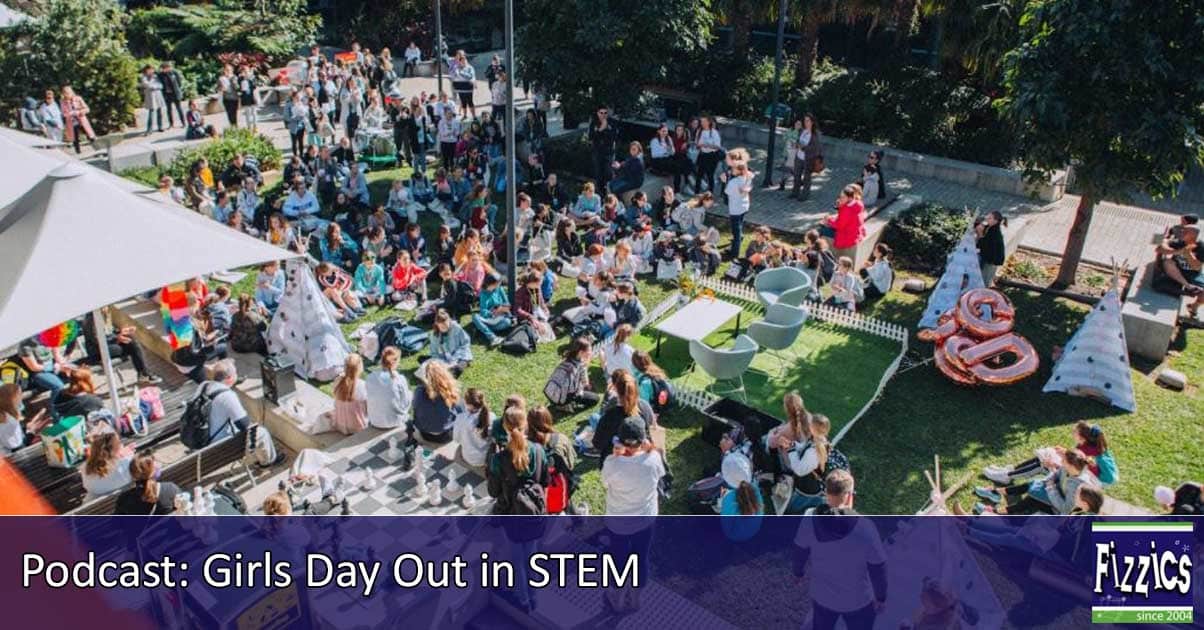
Podcast: Girls Day Out in STEM with Petriea Skitek
Find out more about Girls Day Out in STEM, an Australian program that empowers and inspires girls aged 10-14 years towards a career in STEM. Meet the founder Petriea Skitek!
Petriea Skitek is a highly accomplished educator and event strategist with a diverse academic background. She earned her Arts degree at Griffith University, with a specialised focus on economics and women in politics, before completing her education studies at the University of New England. This unique combination of political insight and pedagogical training has defined her career, which spans decades of high-level event management for industry and government across Australia, Asia, and New Zealand.
Petriea has extensively applied her educational expertise to curriculum development and programme delivery on an international scale. Notably, she managed staff and educational outcomes across several schools in Greater Tokyo for the Universal Language Institute. Today, she continues her advocacy for gender equity as a member of the Women in Technology Committee for her regional branch of Zonta International—a global organisation of professionals dedicated to empowering women through service and systemic advocacy.
About Girls Day Out in STEM
Girls Day Out in STEM (GDOS) is a dynamic initiative designed to empower and inspire girls aged 10–14 years to pursue careers in Science, Technology, Engineering, and Maths. By providing a fun, safe, and highly engaging environment, GDOS breaks down the barriers that often discourage young women from entering technical fields.
During these events, participants have the invaluable opportunity to hear directly from professional women in STEM, learn about the groundbreaking contributions already made by young female trailblazers, and discover the vast opportunities a future in science and technology can provide. By boosting awareness of diverse career paths and providing direct access to visible role models, GDOS provides a vital experience that complements and extends the traditional school curriculum.
[00:00:18]Ben Newsome: Welcome again for another Fizzics Ed Podcast. Glad to have you back for another chat around science, STEM, and all that sort of thing. This week is an interesting week. We’re all talking about the Girls Day Out in STEM programme, which for a couple of years now has been empowering and inspiring girls from age 10 to 14 towards a career in science, technology, engineering, and maths. It’s really, really cool.
[00:00:37]Ben Newsome: Now, here’s the thing. Petriea Skitek is the person who’s been involved in this. She has decades of experience in event management, and she’s a teacher. She actually trained in education at the University of New England and she has really been building genuine momentum towards helping kids right across the country really see what they can be. It’s really, really cool.
[00:01:00]Ben Newsome: By the way, we’ve been talking about this sort of thing on that new Clubhouse app, which I know a few people might have already jumped on in. Definitely, if you get a chance to get on that, it is well worth your time. There’s a lot of education chats there, and I’ve been hanging out with a lot of interesting people doing all sorts of chats around science education, ed-tech discussions, even entrepreneur discussions. Even this weekend, I’m hanging out with some people doing some AI, which is really, really cool.
[00:01:30]Ben Newsome: So, just a little heads-up that we’re definitely on Clubhouse and doing lots of things. But without further ado, here’s Petriea, and she can let us know all about Girls Day Out in STEM.
[00:01:38]Announcer: This is the Fizzics Ed Podcast. We’re all about science, ed tech and more. To see 100 fun free experiments you can do with your class, go to fizzicseducation.com.au. That’s physics spelled F I Z Z I C S and click 100 free experiments.
[00:01:56]Ben Newsome: And Petriea, welcome to the Fizzics Ed Podcast.
[00:01:59]Petriea Skitek: Thanks, Ben. Thanks for having me.
[00:02:02]Ben Newsome: Oh yeah, I’m really happy to have you on this. We’ve been hanging out for a little while with a great meet-up that happens every month, the STEM Lightning Lunches. But I really thought you’d want to jump on this and just let people know what you get up to. So, Petriea, what do you get up to?
[00:02:18]Petriea Skitek: Sure. Well, yes, it’s true. I love your Lightning Lunches. They’re really quick, effective, and efficient. But that’s sort of what we try to be too, but we have a niche and our niche is for girls. And we’re sort of not apologetic about that. I know it might be a bit political, but we actually help girls to understand and boost their awareness in STEM.
[00:02:48]Petriea Skitek: So, we try to help them along their journey, actually. And we do this by having a Girls Day Out in STEM event. And it happened live, in person, in actually a little regional town in New South Wales, in Australia. And then of course, like everybody else, last year we had to pivot to go online, and that had its own challenges but also its advantages.
[00:03:15]Petriea Skitek: And then this year, we’re actually going down the East Coast of Australia. So, in March, on March 7th, we’ll be celebrating International Women’s Day, the UN’s day. And then we’ll do the same National Science Week in August, and that’s a really funky topic this year. It’s Food: Different by Design. And that actually will use some of the UN’s sustainability aims and goals.
[00:03:52]Petriea Skitek: And then we lighten it up with a bit of a finale at the end of the year. We’ll be down in Melbourne, Victoria, and we’re going to celebrate Ada Lovelace Day. And yeah, so we go from food through to coding.
[00:04:06]Ben Newsome: Fantastic. So you’re going from food through to coding.
[00:04:10]Petriea Skitek: Yes, and that’s the whole thing about what we do. So Girls Day Out in STEM actually is very girl-centric first. We found that—and I’ll explain why if I’ve got the time later—but we found that if we’re girl-centric first, then we add the STEM into that, we find that we capture more girls who wouldn’t have that propensity naturally to go to STEM. And this is one of the real leaks in the pipeline for girls in STEM.
[00:04:43]Ben Newsome: Oh, it’s a massive thing. Just straight up. I mean, I’m just thinking about that UN Day has only just passed as we record this particular chat. But the reality is that a singular day doesn’t help the other 364 other days. It seems to be kind of the point that we need to do something about it. I mean, I’m just trying to get a picture of what these Girls Day Out in STEM look like. So they arrive at a site and they’re about to do STEM stuff, but how does that timetable sort of look from the outset? What’s the rough plan?
[00:05:16]Petriea Skitek: Yeah, sure. So basically, if you can imagine an event day, a programme for an event day, and that’s how we run it. So we ran it live like that. And actually, when we put it online, it also worked really well. So if you can imagine in the morning, we start off—it is a dedicated, secured website because, of course, we want to be child safe.
[00:05:40]Petriea Skitek: We start off with an acknowledgement to country to recognise—which is most important—to recognise the First Nation people of Australia. And we try to make that bilingual. In past events we’ve had that bilingual so that again we just acknowledge the languages of the indigenous community and where we’re coming from.
[00:06:07]Petriea Skitek: Then we go to a welcome address, and that’s something to get the girls into the mood of, you know, that people have gone before you and it’s okay, we’re in a safe place. We’re here with girls. The girls like to have that security to know that, “Oh, I’m with friends.” And then we have our STEM masterclasses. Up until now we’ve had 20 STEM masterclasses.
[00:06:32]Petriea Skitek: And I know STEM is integrated, so don’t get me wrong. But just for girls, as I said, who don’t have a propensity to do this, we actually just divvy it up into science, technology, engineering and maths. But as we all know, you can’t do one without the other. It’s just to give sort of a sign-up feel to it.
[00:06:54]Petriea Skitek: And then we have a Hall of Fame. So we celebrate girls their age—our target audience is girls 10 to 14 years old. And so we have this Hall of Fame where we celebrate the power of girls in STEM, what they’re already achieving. There’s amazing things out there that girls are already achieving. And just trying to again say, “They’ve done it, you can do it.”
[00:07:18]Petriea Skitek: We then actually, this year, we’ve got a fundraiser with the Royal Flying Doctor Service. And then we have an entertainment set piece. And that’s sort of like sideshow alley, but for example, this year we’re going to do a prize wheel and we’re going to talk about the maths behind the power of numbers like chance and probability and things like that.
[00:07:38]Petriea Skitek: Then we have in the afternoon session, a meet and greet session which is actually the only live part for our online event. They get to meet four wonderful women who are the experts in their field. And then we have what we call a hangout area. And that’s all about knowing what you can do, what further information if you wanted to go into competitions like the Cyber Challenge or robotics or whatever. And we tell them also other activities that are coming up during the year.
[00:08:17]Petriea Skitek: We have book signings from their favourite STEM authors. Then we have a section on again, something similar but a little bit older, the Women in STEM career information. Something to aim for. And then we have—all girls want to dance—so we have a confetti and song playlist at the end to dance to and celebrate and see you next time.
[00:08:41]Ben Newsome: That’s awesome. What age group is this again?
[00:08:44]Petriea Skitek: Yeah, so 10 to 14. So in Australia, that is girls in years five and six and then seven and eight in high school.
[00:08:52]Ben Newsome: So very much the middle school years. That’s really, really cool. How many kids have gone through this?
[00:08:57]Petriea Skitek: Well, we first started, it was regional, so it had a small footprint and we were just trialling it, and 250 girls actually ended up coming that time. They actually came from a radius of 150 kilometres outside of this little town where we held it. Then last year we had 800 register. And I don’t know where we’re going to go this year, but it’s been very popular. We’ve had every state in Australia, but we’ve also had people coming on from North America, Japan, UK, New Zealand, and I think there was some in Europe too. Yeah.
[00:09:38]Ben Newsome: It’s funny how I’ve got this funny feeling that’s organic. Like, there’s probably obviously a marketing side to it as well, but just how, I mean, I suppose if you keep that rate up, doubling and doubling and doubling, you’ve got yourself a bit of a thing on your hands there.
[00:09:55]Petriea Skitek: We can talk to them about compounding.
[00:09:57]Ben Newsome: Yes, we could. We totally could. You can almost say it’s always growing like, sadly, the virus did. Growing really fast.
[00:10:04]Petriea Skitek: Exactly. And just on the pandemic, I mean, as we know, this is not going away anytime fast, especially for our friends in the Northern Hemisphere. But this has actually been a bit of a lifesaver for a lot of girls, a lot of parents, and a lot of schools because last year for National Science Week, which you know about very much, Ben, some schools actually used Girls Day Out in STEM as their National Science Week project.
[00:10:38]Petriea Skitek: Yes, so we were really impressed. We were very humbled.
[00:10:42]Ben Newsome: Yeah, absolutely. And if anyone listening in doesn’t know about Australia’s National Science Week, it is actually a genuinely national programme. And so there’s gosh, we’re not talking like 10, 20 or 100 events, there are thousands. There’s stuff happening everywhere. It’s kind of like, it’s funny how it’s science week honestly, but just because the time and dates end up being allowing for weekends either side, it’s ten days and then some. We’ve always called it science month. There’s so much going on and libraries light up with things happening, preschools are doing cool stuff. It is so amazing.
[00:11:37]Ben Newsome: Actually, if you’re listening in and you’re in a totally different country that doesn’t do it and you have the opportunity to get in front of a government official, trust me, it is well worth saying, hey, check out what the guys are doing down in Australia. It really helps. And there’s a return on investment because it actually brings people interested in STEM. The industry gets to talk about what they do and it becomes quite an interesting thing. It’s had a roll-on and it’s been going on for many, many years. I was just kind of thinking, Petriea, those kids who have just been through, they effectively would be advocates, I’d imagine, for this particular programme. Do you get to link those graduates, so to speak, back to those kids?
[00:11:53]Petriea Skitek: Totally. We’re hoping to do that. That’s our aim because we want to be sustainable. So again, for people outside of Australia, the Australian government actually had a decadal plan, a women in STEM decadal plan. And it’s all about being sustainable. It’s just not having these pop-up, like you were saying, these unsustainable programmes that just pop up and whatever. We really want to shift the needle. We really want to make this sustainable. And exactly how what you just described, we want these girls then to become the buddies of future girls.
[00:12:35]Petriea Skitek: So just even when we did our exit survey last year, at the beginning, I think it was about 68% of the girls when we asked the question, ‘Is STEM for you?’ And then when they finished Girls Day Out in STEM, when we asked the same question again, it was at 98.8% that yes, STEM is now for me.
[00:12:58]Ben Newsome: Hey! Well done. I mean, okay, so I feel like one day we’ll have soundtracks on this podcast. I feel like there should be some sort of plug-in applause at that point.
[00:13:08]Petriea Skitek: That’s okay. All good.
[00:13:11]Ben Newsome: No, that’s alright. That’s brilliant. And that’s irrespective of where they come, because you mentioned that yes, you did it in Australia, you had people in Japan, and the US and whatnot. That’s really, really cool. So it crosses cultures, and it always was going to.
[00:13:24]Petriea Skitek: Well, that’s right. I mean, that is our mission and purpose, is that regardless of girls’ backgrounds, we want them to see, to discover, and to decide that this is—to experience STEM as a world of imagination and possibility. And in the case of women, a lot of healing. And that’s why we try to do this by sharing our stories with older women, with role models. Because it’s authentic, it’s genuine, and everybody knows when they see something that is not genuine and not authentic.
[00:14:00]Petriea Skitek: So, you know, life is not a straight line. And this is what is really good when we interviewed and we got messaging for the girls, to say it takes more than just the knowledge of your STEM skills. There’s much more to it for girls. There’s resiliency, there’s things like sexist stereotypes, family cultural expectations, lack of role models and maybe what they particularly want to do, or even understanding the options. So that’s what we want to achieve. We want to shrink those barriers and we want them to have that sense of efficacy and empowerment.
[00:14:48]Ben Newsome: Yeah, absolutely. Speaking to what you were talking about before with the warts and all. I mean, we were talking about what this podcast is like, and honestly, we just chat. We really just do. And the thing is, with this discussion around careers in STEM and how you get to this really cool role that you’re in, I don’t know a single person who’s been put in a position to talk to kids about their journey through life and their careers who doesn’t describe challenges, problems, missteps, and failures. Because that’s what makes you and what grows you. If you don’t have that failure, either you’re not pushing yourself enough, or, actually, I don’t think there’s a single person on this planet who’s not had a problem.
[00:15:30]Petriea Skitek: Well, totally. I mean, look at Newton. He says we stand on the shoulders of those who’ve previously done things, or in science it’s linking, right? So we’re only as good as the last link. And a lot of things have been by missteps or, ‘Oops, we left that Petri dish out too long and oh, wow, we discovered something different.’ So this creativity, this problem-solving resiliency, I think it’s well-researched that girls won’t do something unless they think that they’re absolutely qualified, they tick every single box.
[00:16:10]Petriea Skitek: We want exactly that, to show them that it’s not a straight line. It has ups and downs and curves and different routes to go. So don’t give in. Don’t think you have to be this perfect person. And we never know what life’s going to bring you.
[00:16:30]Ben Newsome: Totally so. And what you’re describing is so very, very important. I kind of think about what you did: an event when COVID didn’t exist, and then you did an event during the COVID thing. The future, 2021, 22, 23, 24, are you sort of thinking your events will be hybrid, sort of online and face-to-face? How is that going to work?
[00:16:56]Petriea Skitek: So what we plan, we’ve always actually had this because as I described before, it first started out in regional Australia. So there’s a lot of regional kids, especially girls, and especially regional with a lot of low socioeconomic families and backgrounds and what have you. We always wanted to be inclusive. So we always thought to videotape when we are live and send that out to a live feed, or to have it recorded and then send out later so that they could have it on demand.
[00:17:30]Petriea Skitek: So that was always part of the plan. It’s just that COVID sped that up. And so that’s how we will go forward. So we will have some recorded, which fits into—we have a lot of volunteers, so that actually fits into a lot of people’s busy schedules. So it can be pre-recorded, it can be live and we record it, and we can live stream or we can actually then send it later. And where we can afford to, we will send a kit out to the girls so that they can participate in various, say for example, experiments or whatever the masterclass might be about, or whatever a guest speaker might want to share with them.
[00:18:17]Petriea Skitek: And like all the prizes that we’ve got wonderful prizes. Like we have book signings by Professor Lisa Harvey-Smith, as you know in Australia, she’s our government’s Women in STEM Ambassador. And she’s got a beautiful series of books, three books that are out. She signs them and we send them out to the girls. We’ve had girls receiving those in outback Queensland and they receive them and they’re so happy.
[00:18:46]Petriea Skitek: We send out, Google is one of our great sponsors, so we send out goodies from Google, just even AirPods. It’s just to know that they feel that they’re part of us, they feel part of the group. So yes, we send out prizes, we mail that out. As I said, future planning, we will send kits out for the ones that we will be live streaming and we’ll give them a time and access point and they can just join in with their little kits. And then we will have in-person live, yes, when COVID’s safe.
[00:19:26]Ben Newsome: Yeah, that’s going to be really interesting. Obviously, having the ability to do synchronous learning and asynchronous learning is a thing. I mean, not everyone can learn at the same time as you, especially when you’re crossing nation’s boundaries. I mean, that is very much the case. And actually, that brings up a question: invariably, when we run programmes—and Fizzics has been doing this stuff for quite a few years into other nations—the question about curriculum comes up. The outcomes, the syllabus linkages. And they are important. So how do you navigate that into Japan, into North America, and all the rest?
[00:20:00]Petriea Skitek: Okay, I’ll give a little insight for me. I spent 20 years in Japan. So when I first of all, I spent a year as a foreign exchange student in 1984 to 85. I actually was a high school student in a regular high school in Japan, in Tokyo. So I’m sort of familiar with what goes on. And not only that, I spent 20 years actually in the education section—Monbusho, we were connected with that department in another life ago. So I’m sort of familiar with that.
[00:20:47]Petriea Skitek: But to be quite honest, this is why we run Girls Day Out in STEM on a Sunday. We actually complement the mainstream schooling. So this is also what inspired me to put a Girls Day Out in STEM, because we know how crowded every curriculum is in any country in the world. It doesn’t matter where you are, it’s crowded. There’s so much demand on teachers to wear every hat. It’s incredible. Actually, that’s why I did my postgraduate studies in education.
[00:21:27]Petriea Skitek: And every unit that I did, I thought, “Right, you expect me to do that, and then on the last unit in English you expected me to do that, and then now you want me to do this.” And I seriously thought, there’s not enough hours in the day to do this at school. Not only with all the other expectations of teacher-parent nights, or interviews, the whole gamut of what we’ve got to do.
[00:21:58]Petriea Skitek: So this was actually to complement what’s going on at schools and to actually give a little bit of a lift for a lot of teachers, so that they’re not always at the coalface expected to produce stuff.
[00:22:14]Ben Newsome: So Petriea, I was just wondering. I mean, we just went past that UN celebration day, and the observance days are so important with the UN because they get the focus in on what’s important for the world stage. I got into quite an interesting discussion with teachers, education leaders, some of them at quite a high level, over the discussion of what steps we need to do to help women and girls get into STEM roles, get rid of this glass ceiling, and sort of the timelines and which way it’s going to go.
[00:22:47]Ben Newsome: I mean, where I’m going with this question is, I was kind of wondering about, it’s these small efforts repeated over and over and over again all over the globe that’s going to help make a difference. We can’t expect this stuff to happen overnight. It’s going to take… sadly, realistically though, a while. Quite a while possibly. But at the same point, we all have the ability to make that change. So I mean, if you were chatting with someone, I don’t know, just say they’re in Ontario. They’re in Ontario, and they want to make a Girls Day Out in STEM event start to happen. What sort of first steps would you suggest would be worthwhile?
[00:23:25]Petriea Skitek: I would suggest this is how we did it. Because we were just doing STEM workshops, and we noticed and observed that the kids rocking up to the workshops were along the gender lines. Biology, if we did that in the rainforest, mostly girls coming. And all the engineering and physics and whatever, were the boys. So we actually thought, well let’s make it girl-centric first.
[00:23:58]Petriea Skitek: So I think you have to have a passion for what you’re doing, number one. I think in life anyway, you’ve got to have a passion. And we decided that we would have these workshops and just tweak them. And we had this Mad Hatters tea party—well it was pH, pH party. And what it is, of course, is grinding all different fruits and vegetables at 4 o’clock in the morning and putting them in vials so that they could see the whole acidic right through.
[00:24:35]Petriea Skitek: And lo and behold, because we made it girl-centric, it completely changed to then 90-10, we had girls rocking up. And I think this is where, if you’re in any country, if you’re in Ontario—I love Toronto, all our friends out there in Ontario—I think the passion to know that girls really need a helping hand, and we started by just rocking up to a university and saying, “Look, as a community event, could you give us a few rooms?” And then from that, we went to taking over the whole campus.
[00:25:14]Petriea Skitek: And it’s just having that passion and just linking all the dots together. Like, okay, what would girls like to see in this space? Okay, we’re trying to get them to be chemists, let’s do a Hairdressing 101 and teach them about the science behind material science. But do it with an approach of Hairdressing 101, but we had Dr. Kylie Press there doing the chemistry. And it was standing room only because we advertised it as Hairdressing 101. It was all chemistry. And these girls just rocked it, and they just couldn’t get enough of it.
[00:25:59]Petriea Skitek: And then we had many examples like that. So I would totally say, if you’ve got the passion and the drive, your ideas, your creativity, it just takes that little seed and then just going and driving it. Just go for it. Just drive it. Don’t care about all the naysayers, don’t care about people, there’s enough people to put you down. Just have the passion, the drive, if that’s what you want to do, you’ll find a way you can do this.
[00:26:34]Ben Newsome: Love it. I was just thinking the same when you were talking about the naysayers. I can’t remember which group it was, which entrepreneur it was, but someone said if you get enough naysayers, it tells you you’re onto a good thing, which is a little bit counter-intuitive. It also means you’ve got to work out, you really have to have belief that you genuinely have a good thing, because maybe the other naysayers are actually right. But in most cases, no matter what you do, someone will always find a problem.
[00:27:00]Ben Newsome: People are very good at saying what won’t work, what people are less good about doing is starting something themselves. And it’s just the reality of getting going and expecting, not just thinking it might happen, expecting things to go wrong.
[00:27:17]Petriea Skitek: Totally. And that’s what we as teachers do, don’t we? We inspire. We’re constantly saying, “Put yourself in the arena,” because the classroom is the arena. You will always have critics on the sideline pointing out all your flaws, all your shortcomings, but that’s what we teach our students, don’t we? To get above that and to know that that’s what’s going to happen in life anyway. So as educators, that’s what we’re about, aren’t we? Self-efficacy, self-belief.
[00:27:47]Ben Newsome: 100%. I mean, there’s no point just telling it to the students if we don’t live that life ourselves. 100%. Love it. Love it. Hey, Petriea, how can people reach out to you should they need to, or want to, or in between? I think they really should. I think what you’ve been doing is really, really cool.
[00:28:03]Ben Newsome: And I love how you’ve involved a variety of different people in these events. It’s not just the kids and the teachers, or the kids and an industry leader. It’s getting a bunch of different government types in, signing books, I mean that’s just kind of cool. How do they get in touch?
[00:28:26]Petriea Skitek: Sure. Okay, so we currently, as I said, we’re going to have our Girls Day Out in STEM coming up. So it’s very easy. It’s https://www.gdostem.com.au. That’s our event page. But just, you can send us an email: [email protected]. So you can just shoot off an email to us, and I’m more than happy to help anybody.
[00:29:04]Petriea Skitek: This is all what the future I think is going to bring, is collaboration. It’s sharing. It’s basically how I met you, Ben, through Lightning Lunches and through Inspiring Australia when we all were scrambling to get online. That genuine wish to share with others is so precious, so valuable. I wouldn’t have even been here today if I didn’t have all of those amazing people who just said yes to me. And like I learned so much from your experience, and going onto those webinars, learning from you, Karen, everybody else. One thing I hope the pandemic has shown us is that sharing and caring is really important. We’re more than happy to share with anybody.
[00:30:00]Ben Newsome: I totally agree. I mean, collaboration, that’s always been a very strong thing for me. I’ve always been a big fan of it. I know that it accelerates things to happen. For example, we’re science communicators, we’re STEM outreach people, but we are not publishers. We are not, there’s all sorts of things we’re not. We’re not engineers who can build certain things that we want to make happen. That’s why you engage people or enrol people in getting that stuff done.
[00:30:29]Ben Newsome: And I kind of think about when we go out to it might be a grant thing, or it might be a particular programme for a corporate or whatever it is, going in by yourself means you’re pretty much saying, “I am a human Swiss Army knife, I can do everything.” And in reality is that you can’t just do everything. Not perfectly anyway. So having just a Phillips screwdriver… you know. It’s kind of… it really does matter.
[00:31:06]Ben Newsome: Having people who really know a particular set of skills and a certain expertise means that as a whole your project is far better, far richer, because you bring a deeper meaning to the delivery and people then can have a better way to publish that thing, or maybe they’re really good at marketing the thing, whatever it is. Bringing on those diverse range of skills is important, which actually harkens back to the whole topic of this discussion, which is getting girls into STEM. The whole point of this is diversity in the first place, getting different points of view into things and actually shaping new inventions and new experiments and leading discovery. I think it’s so important.
[00:31:47]Petriea Skitek: Totally, totally. That’s how our future is going to grow. With diversity and inclusivity. If we got everybody involved, like you just said, it is a depth that we could never have if it’s just very singular-minded or a singular delivery. That’s very shallow. But when you’ve got diversity, and a diversity of minds and diversity of requirements even, it drives innovation. And even what we’re doing now in the space of robotics, for even people who can’t stand or have other disabilities or cannot function fully in their bodies, but now they can. It’s absolutely amazing. And why not include those people? They’ve got wonderful minds, wonderful creativity, wonderful insight.
[00:32:42]Ben Newsome: Exactly. I love it. Love it, love it. Petriea, thank you so much for joining me. Albeit it’s always a bit of a brief chat, but I know we’re going to be hanging out more on the STEM Lightning Lunches and probably other events here and there, you never know what’s coming up in the world. But look, I love what you’re doing, and definitely, if you’re listening on in, I will, as usual, put this information in the show notes. They’re always there. And really reach out, I think it’d be really cool. And I really encourage people overseas who do not have this thing happening in your local neighbourhood or beyond, give it a go. What have you got to lose? Nothing really, apart from a little bit of time. And then suddenly though, that investment in your time will produce a lot of returns. Hey, Petriea, thank you so much for joining us.
[00:33:30]Petriea Skitek: Thank you for having me, Ben. I really appreciate it. Thank you.
[00:33:51]Ben Newsome: Well, there we go. We just heard from Petriea Skitek. You can really tell she loves her Girls Day Out in STEM programme. And what an amazing programme. And I know that it is going to keep getting bigger and bigger and bigger. By the way, do you know that Petriea is also a member of the Women in Technology Committee for her regional branch of Zonta International, which is an organisation of professionals who are empowering women through service and advocacy, which is really awesome to do. And I must say, I love that with her background in events in Australia, Asia, New Zealand, combining her educational training towards curriculum development and programme delivery, it is really, really powerful that she’s really focused heavily on Girls Day Out in STEM, and I know that it’s just going to be awesome to do.
[00:34:31]Ben Newsome: So seriously, it is well worth going to her website. So again, her website is gdostem.com.au. So again, gdostem.com.au. And she actually said that if you have got any inquiries at all, feel free to email her at [email protected].
[00:34:49]Ben Newsome: So anyway, I hope you have a fantastic day, evening, morning, night, whatever it is, wherever you are. I hope you’re having an amazing time and you’re making your learners have a real chance to engage with the real world and I hope you’re having a bit of fun with it. So anyway, you’ve been listening to me, Ben Newsome from Fizzics Education, and I hope to catch you on the podcast or even on Clubhouse. And again, we’ll catch you another time. All the best.
[00:35:38]Announcer: This podcast is part of the Australian Educators Online Network. aeon.net.au.
Frequently Asked Questions
What is the primary goal of the Girls Day Out in STEM (GDOS) initiative?
The primary goal is to empower and inspire girls aged 10–14 to consider careers in Science, Technology, Engineering, and Maths. By creating a fun, safe, and engaging environment, the programme aims to break down barriers and stereotypes that might otherwise discourage young women from entering these fields.
Why does GDOS specifically target the 10–14 age bracket?
Research indicates that this age group is a critical turning point where many girls begin to lose interest in STEM subjects. By engaging them during these formative years, GDOS helps maintain their curiosity and demonstrates how their schoolwork translates into exciting real-world career opportunities before they make final subject selections in high school.
How does the GDOS programme differ from traditional school science lessons?
While schools focus on the curriculum, GDOS focuses on the “human” side of STEM. It provides direct access to professional women working in the industry, allowing girls to hear personal stories, see diverse role models, and understand the day-to-day reality of various careers, making the path to a STEM future feel achievable and relatable.
How has the programme adapted to reach more participants?
While GDOS began as a series of physical events, it has successfully transitioned into a digital experience. This shift allows girls from across Australia and beyond to participate in challenges, listen to keynote speakers, and engage with STEM content regardless of their geographical location.
What can participants expect from a GDOS event?
Participants can expect a mix of inspirational talks from female trailblazers, hands-on challenges, and interactive sessions. The events are designed to be high-energy and collaborative, often involving “mystery” elements or digital quests that encourage problem-solving and critical thinking in a supportive community.
Discussion points summarised from the Girls Day Out in STEM with Petriea Skitek with AI assistance, verified and edited by Ben Newsome CF
Extra thought ideas to consider
The Importance of Visible Mentorship
Consider how the phrase “you cannot be what you cannot see” applies to the gender gap in technology. How can more industries create platforms for female professionals to share their journeys with the next generation to normalise the presence of women in technical leadership roles?
Bridging the Gap Between Interest and Career
Reflect on the transition from enjoying a science experiment in the classroom to pursuing a long-term career in engineering or data science. What role do community initiatives play in sustaining this interest when the academic workload becomes more challenging in senior secondary school?
Digital Equity in STEM Education
As programmes move online to reach remote or regional students, what strategies can be used to ensure that the “hands-on” and collaborative magic of a physical event is preserved in a virtual environment?
Recognised by
22 years, award-winning work, 1 purpose
Recognition from business, education and industry bodies across Australia.
Australian Small Business Champion
Multiple years
CILC Pinnacle Award and Hall of Fame inductee
Center for Interactive Learning and Collaboration
Western Sydney Awards for Business Excellence
Winner
Top 100 Coolest Company
Listed
Local Business Awards
Winner
We value your privacy
We use cookies to improve your experience. Essential cookies are always active. You can choose which optional cookies to allow.We use cookies. Optional ones stay off unless you allow them.Privacy policy