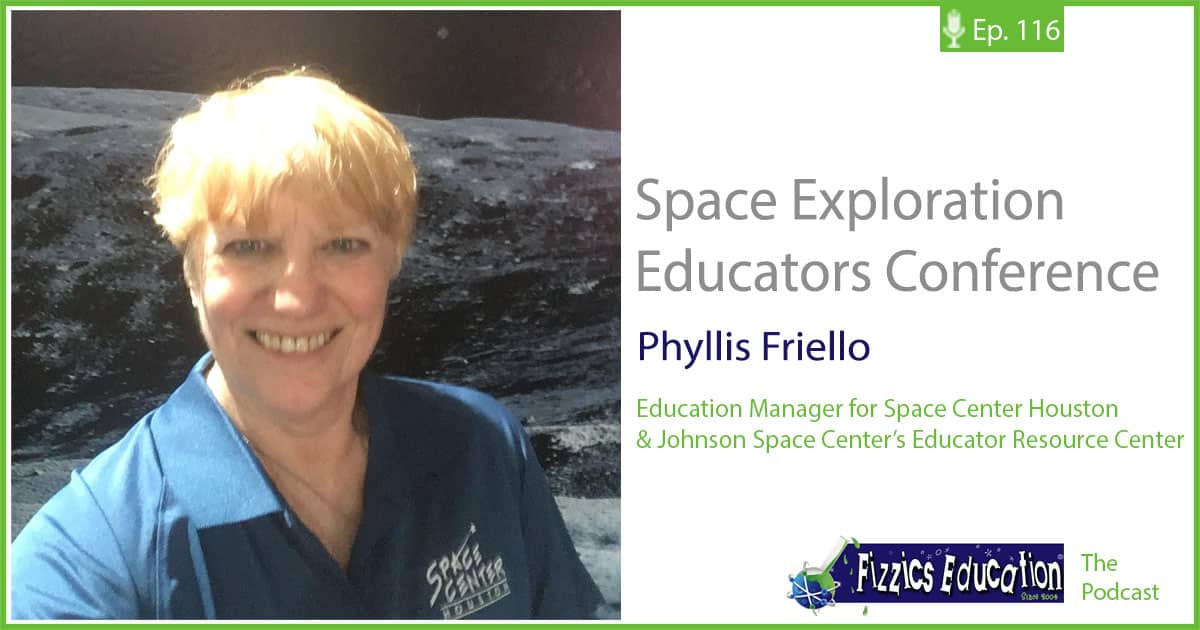
Podcast: Space Exploration Educators Conference with Phyllis Friello
We chat with Phyllis Friello, Education Manager for professional development at Space Center Houston and the Johnson Space Center’s Educator Resource Center to find out more about the Space Exploration Educators Conference. So much on offer, and this year you can connect virtually!
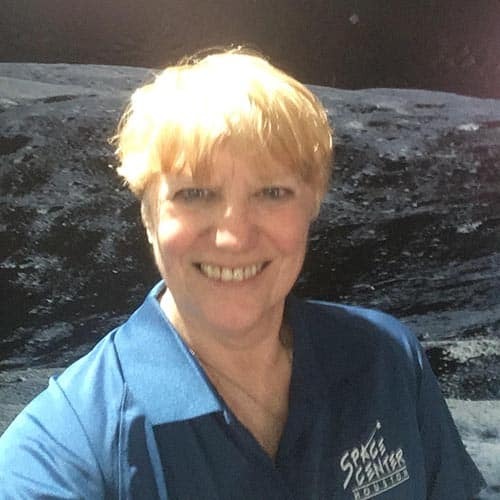
Phyllis Friello is the Education Manager for professional development at Space Center Houston and leads the Johnson Space Center’s Educator Resource Center (ERC). With a B.S. from George Washington University and an M.S. from Old Dominion University, Phyllis brings a formidable scientific pedigree to the world of space education.
The majority of her distinguished career was spent as a research scientist and manager at world-renowned institutions, including the Johns Hopkins and Harvard Schools of Medicine and the National Institutes of Health (NIH). Her work primarily focused on groundbreaking ophthalmology and neuroimaging research, providing her with a deep understanding of the intersection between human biology and advanced technology.
Transitioning her expertise to the classroom, Phyllis became a physics educator for Baltimore City Schools, teaching at the prestigious Baltimore School for the Arts. Her academic journey has been marked by numerous fellowships and competitive NASA programmes. Today, she serves as a NASA Master Educator and an Education Ambassador for the American Institute of Physics. Notably, in 2015, her contributions to science education were recognised at the highest level when she was a guest of President Obama for Astronomy Night at the White House.
[00:00:20] Ben Newsome: You’re back again for another Fizzics Ed Podcast. I’m glad to have you again for another chat around science, STEM, and all that sort of thing. I can tell you what, this is a big chat. This time we’re hanging out with Phyllis Friello, who is the education manager for professional development at the Space Centre Houston and the Johnson Space Centre’s Education Resource Centre. It is so awesome to hang out with Phyllis in this particular session because we get to hear about the Space Exploration Educators Conference, which is coming up in early February. You’ll hear all about that very soon, and it’s something that you can really connect with no matter where you are in the world.
[00:00:54] Ben Newsome: Now, Phyllis has had an amazing career when it comes to science and in education. The majority of her professional career was as a research scientist and manager at the Johns Hopkins and Harvard schools of medicine and National Institutes of Health, focusing on ophthalmology and neuroimaging research. Following this, she became a teacher at Baltimore City Schools, where she was teaching physics at the Baltimore School of the Arts. She really describes that she actually had a lot of fun with this. She’s done a lot of really cool things. She is a Master of Education and Education Ambassador for NASA and the American Institute for Physics.
[00:01:24] Ben Newsome: In 2015, she was a guest of President Obama at the Astronomy Night at the White House. So seriously, Phyllis really loves her space exploration education and education in general. So look, I hope you enjoy this chat with Phyllis. I certainly did. I really want you to consider going to the Space Exploration Educators Conference, which is just around the corner in early February. So let’s listen on in.
[00:01:52] Announcer: This is the Fizzics Ed Podcast. We’re all about science, ed tech and more. To see 100 fun free experiments you can do with your class, go to fizzicseducation.com.au. That’s physics spelled F I Z Z I C S and click 100 free experiments.
[00:02:10] Ben Newsome: Phyllis, welcome to the Fizzics Ed Podcast.
[00:02:12] Phyllis Friello: Thank you so much. It’s such a pleasure to be joining you today.
[00:02:15] Ben Newsome: Look, I am really, honestly, I’m going to be straight up. I’ve really been looking forward to this chat because like every other child who’s finally grown up, I haven’t quite grown up yet, and you work for somewhere really cool. So Phyllis, tell us about what you do.
[00:02:30] Phyllis Friello: Yes, I am the education manager for Space Centre Houston in Houston, Texas. And among things that I get to do, I get to work with educators from all around the world and bring them the excitement of space exploration so they can in turn bring it to their students. So it really is exciting.
[00:02:48] Ben Newsome: Oh, it’s so cool and actually I really want to have a chat a bit later on about how you honestly landed doing this. I mean, it’s not every day that you get to be the education manager for a place like that. Actually, I might just ask straight out. Where have you come from? Did you start off as a teacher or what is that path that gets you there?
[00:03:07] Phyllis Friello: Mine was a bit of a circuitous path, so I started as a research scientist for many years. I was doing a lot of biomedical research, research toxicology, environmental science and that sort of thing.
[00:03:20] Phyllis Friello: And then I took a break from that in between a couple of studies, protocols, and I taught school. I thought, “Oh, this would be kind of cool,” and they needed STEM teachers and I really enjoyed it. I loved being with the kids and sharing everything that I did with the kids. And then unfortunately my school system was laying off quite a few teachers and I heard about the position available at Space Centre, and it combined my passion for STEM and STEM education, and I thought, “Give it a shot!” And so I ended up here in Houston from the East Coast.
[00:03:57] Ben Newsome: It’s amazing what happens when you give it a shot. I feel like I should put a really bad term like a moonshot perhaps. But no, I like the idea of what you’re doing there. It’s such a cool thing to come from a research background and then really get to teach the next generation because some of those kids in front of you will be those researchers doing really cool things, whether they’re engineers or scientists or whatever, it’s awesome. Hey, one thing I wanted to dive into really right at the start, you do really have this really interesting conference coming up and I want to make sure that people listening in hear about it before they go on their merry way. So Phyllis, tell us about that, I’d love to hear a bit more.
[00:04:36] Phyllis Friello: Sure, so we have our annual Space Exploration Educators Conference coming up. This is our annual conference and it is an international conference every February. And we host teachers from around the world. And this is for informal educators, formal educators, homeschool, whoever has an interest in STEM and particularly in space science and they want to share that with their students.
[00:05:00] Phyllis Friello: So this year is going to be a little bit different of course, like everything else that we’re experiencing, but it’s going to be February 4th to 6th.
[00:05:11] Ben Newsome: Awesome. So international, so 4th to 6th, does that mean you’re getting up late at night to deal with this?
[00:05:18] Phyllis Friello: No, this isn’t bad at all. This is just late afternoon, so I’m happy to do it.
[00:05:24] Ben Newsome: So I mean, this is quite an interesting conference. How long has this been going for?
[00:05:28] Phyllis Friello: This is the 27th year.
[00:05:31] Phyllis Friello: And it is phenomenal. The conference has grown and we’ve increased our breadth of the educators. For a while it was a lot of middle school educators, teachers, but now it covers K to 12 plus. We’re even getting a lot of college students and professors coming to join us.
[00:05:51] Phyllis Friello: And we’re also really excited to include a lot of pre-service teachers, teachers who are starting their career out in education, and this way they get to come and right away get an incredible network of fellow educators who share their passion.
[00:06:06] Ben Newsome: I’ve got to ask, I mean these sort of things, they’ve always got so many things happening. I feel like when I go to a conference like this that you never quite get to see everything. But then again, this is being done in a different way with all these webcams and whatnot, so I believe we might be able to see some of that content if you can’t quite make it for everything.
[00:06:27] Phyllis Friello: Yes, and that is a problem when we host folks here in Houston, there’s so many incredible presentations and sometimes they’re opposite each other and you have to decide what you want to go to, which can be kind of a pickle. But this year, we are recording everything so our participants will have access to the content for a year.
[00:06:51] Phyllis Friello: So that way you don’t have to worry about missing another presentation or, as we’re finding out, a lot of our teachers just can’t get the time off. The situations with the various school districts is making it a little bit more difficult for them to attend live sessions.
[00:07:09] Phyllis Friello: And we understand that and we want them to get the full benefit of this conference. So the content including the sessions, the tours, our incredible keynote speakers, everything is going to be available for a year for them. So they can access it when it’s more convenient and particularly in their time zone.
[00:07:26] Ben Newsome: Right, you’ve kind of thrown out a breadcrumb there. I’d love to know about the keynote speakers and the sessions themselves. If you’re able to rock up live, if you’re able to actually rock up in early February, what can you experience? What do you get to do? Who do you get to hear from? What’s happening?
[00:07:42] Phyllis Friello: The sessions are incredible and most of them are given by your fellow educators. So they’re really very good and they’re designed so you can go to the session and then take something home right away to implement in your classroom. And the lessons will be available online so they can download those and they’re just ready-to-implement lessons.
[00:08:05] Phyllis Friello: And these could be anything from rocketry to how to integrate art into teaching about space science, maths… we have an incredible one that’s also given by one of our incredible engineers here, Chris Maddie at Johnson Space Centre. He’s giving one on the maths and the mysteries of black holes and relativity.
[00:08:30] Phyllis Friello: So we’ve got everything on both ends of the scale. We also have a really cool programme that I started a couple of years ago because there’s so much incredible research going on at NASA and all around NASA with their partners, and it was taking a little bit to get to the teachers.
[00:08:48] Phyllis Friello: But there’s no reason why our teachers shouldn’t have the latest and greatest. So what we did is I’m pairing up our experts with educators. Sometimes the experts aren’t the ones who would be giving the information to the educators, so we pair them up so we’ve got somebody who can make sure it’s in a format that can be accessible by everyone.
[00:09:11] Phyllis Friello: So we have our expert educator pairs. So you could walk into a session or listen to a session where you’d have the person designing space suits for Orion and an educator to help you implement that in the classroom. Or the former chief of the human research programme giving a presentation on the twin study and the human health factors, and an educator again with a lesson ready for you to take it into the classroom.
[00:09:38] Ben Newsome: Oh, that’s so very cool. I feel like it’s almost like an iceberg of a conference. You see the top layer and then you keep on going down, “Oh, it’s really deep!” And the same thing is it’s actually almost like going through the NASA sites too, I mean there is so much you can teach kids STEM in every context, whether it’s food, getting up there in the first place, probably surviving radiation’s somewhat important. All those things, there’s so much to talk about.
[00:10:02] Ben Newsome: I’ve got to ask, I mean this is almost putting you on the spot. You’ve taught a lot of this type of science for a while. If you had some kids purely off the cuff, walking in, just say they’re in middle school years, and you go, “You know what, I’ve got about 10 minutes with them before they go to their next thing.” And you wanted to explain some particular concept that you love talking about, or some quick activity, what would be a go-to that you know always sings, always works no matter what? Just out of interest, because I’d love people listening in to emulate it, to try it.
[00:10:42] Phyllis Friello: I think my favourite thing that I taught when I was in school was actually gravity and black holes and relativity. That’s why I was so excited to have Chris join us. And so what I like teaching them is how we’ve described gravity in the past, either through Newton or Einstein, and then taking a look at black holes, particularly in light of our recent first photo of the event horizon.
[00:11:15] Phyllis Friello: And so one of my favourite lessons is talking about gravity and how we perceive that and how Einstein thought it was pretty much a warping of space-time and how that works. And when I was teaching school I taught at a pre-professional arts school. So it was so much fun because the kids would go off and make models.
[00:11:39] Phyllis Friello: Because there’s so much in physics, as you know, that you can’t just simply show. A lot of it is so conceptual, but they could use their amazing creativity and imagination to depict gravity. And then we would get into black holes and trying to talk about… well, a lot of what we know about black holes now you get from TV or film or the arts.
[00:12:08] Ben Newsome: That reminds me, I mean Interstellar, there was the Gargantua I believe, and there were actual research papers that came out of that artistic depiction of a black hole. I agree, gravity is a thing that kids always kind of want to get their head around.
[00:12:23] Ben Newsome: I mean there’s that old grab a book and grab a piece of paper and if I drop it which one will hit the ground first? And if I put the paper on top of the book, they drop together, which is odd for some kids. And then you go what if I screw up the paper and put the book next to it and drop again? They drop at the same speed, which means maybe it’s not the mass, maybe something else is going on. There are so many simple things you can do in the classroom. It’s a lot of fun and kids always want to know about black holes, let’s be honest.
[00:12:47] Phyllis Friello: Yes, and they’re just cool. And also I like teaching it because you can use it across all classes. So you can take a look at the literature on the black hole, you can take a look at film and you can use it and space science pretty much for cross-curricular lessons, which is really cool. Because there’s something for everyone, and so many of our astronauts and our scientists are first inspired by the arts, by what they see. Comic books for the Apollo.
[00:13:23] Ben Newsome: I just want to throw it out here, I’d love to know if I’m wrong by the way, feel free to go “Nah dude, you’re doing it the wrong way.” But I noticed a couple of years ago I had a wine glass — you know how the wine glass has that stem and it sort of goes outwards a little bit? And I put it down on my kitchen counter. My kitchen counter has these little dots all over it, just does.
[00:13:41] Ben Newsome: And I was sliding it along, I don’t know why, I was just looking at the base of this glass and I noticed the warping of the light that was happening around the base of the stem of the glass. I went, “Oh wow, this reminds me of gravitational lensing.” And we actually put that onto our site because it honestly looked like it. Trying to make, let’s be honest, warping space-time is wild for your brain at the best of times. But at least seeing something so simple like a wine glass… I mean one of these days I might have to bring a wine glass into schools to show, why not? But it’s amazing how sometimes something so simple can explain something so big.
[00:14:18] Phyllis Friello: Right, and just how you get a different perspective of things. And that’s also important, particularly with the young kids because they really like to ask a lot of the “how far, how high, how much does it weigh” questions, and then when you tell them it doesn’t mean a thing. So you’ve got to put it in perspective and give them a different way to look at it and think about it.
[00:14:39] Phyllis Friello: Because when you’re talking about space and the vastness of space, it’s hard to comprehend for people who are working in it, let alone when you’re speaking to the students. So that’s always kind of a fun thing to try and get across as well and talk about light years and just travel, how long it’s going to take us to get to Mars and back.
[00:15:04] Ben Newsome: Oh, it’s amazing. Actually the thing is, once this whole COVID thing starts to settle down — at some point it’ll happen, hopefully reasonably soon — I mean you’ll have visitors again coming to the centre. I’m curious because I haven’t been to the Houston one. I’ve been to Cape Canaveral, never been to the Houston one. I’d love to get an idea of if I had my class with me — so Australian teachers if you happen to be able to hook up some funding and zip on over at some point it’d be really cool — what could you experience as a student coming to the site? I’ve never been there, I’d love to know a bit about it.
[00:15:35] Phyllis Friello: We would love to have you. And actually the centre is open now. So yes, we are having visitors now. And when we reopened — we were closed for a few months — we had a whole reopening plan just to make sure everyone was absolutely safe. So we have a lot of different protocols in place to ensure the safety of our guests and of course our crew members. And so when you come in, what you can expect to see are different facets of the space programme, of the human space programme, because that’s what Johnson Space Centre is focused on.
[00:16:08] Phyllis Friello: So we’re here, the official visitor centre of NASA Johnson Space Centre, so we focus primarily on their work and that is getting humans in space. The robots are great, but the objective: we’re going to get people on Mars! So they can take a look at first the history of the human and the crewed space programme, and then kind of the current. So take a look at what we’re doing on station right now and all the research that’s being conducted on station. We have a shuttle that they can actually go into and take a look at. And of course the shuttle was vital in the construction of the station.
[00:16:29] Phyllis Friello: And then take a look at the… we have a Falcon 9 first stage rocket that they can go outside, a used rocket, take a look at that and again look at the vastness, the Saturn V rocket. And then we have a really cool exhibit, Mission Mars, so they can look at the future and where we’re going. So through everything, they can get a real picture of what’s going on and what has gone on with the space programme.
[00:17:03] Phyllis Friello: And then of course, it’s the portal to JSC, to Johnson Space Centre, where they can go on site and Building 9, the training facility, watch the astronauts and look at the station modules on the floor where they’re working and the future modules, which is really cool. And then a really amazing thing is to go into mission control and see what’s going on because it’s right here right across the street and there’s always people there on console flying the station. So that’s pretty amazing to see. And if you can’t get to the centre now, we have a lot of programmes where you can access it virtually, including things for students and teachers and all kinds of guests.
[00:17:58] Ben Newsome: So you’ve described like there’s nothing really to do at all. No, this is so cool. I must say it’s an actual true bucket list. At some point I’ll get across there. I got close a couple of years ago with an ISTE conference, we were down in San Antonio. So we were in the sort of area, but let’s be honest it’s a large state. I didn’t quite get up there, but at some point it’ll happen, I really want to get up there. It would be so cool, especially checking out those modules.
[00:18:26] Phyllis Friello: Yes, and come for SEEC next year! So we hope to host everyone in person next year at SEEC 2022. So come for SEEC, we do get teachers from Australia coming over and we’ve got teachers from all around the world. And that’s one of the really cool things about the conference is you get to meet up with teachers who have different perspectives on their teaching and they bring news of their space programme.
[00:18:54] Phyllis Friello: We have teachers representing JAXA coming over and they’re always just so much fun to be with and you just get a really good perspective and share ideas and make some friends. And most of our teachers communicate with each other throughout the year, which is really great.
[00:19:12] Ben Newsome: Sounds like a really vibrant community. And that’s what’s kind of cool about this because you get to hook up with people you’ve never met before who are doing really cool things in their places where they’re teaching and kind of learn off them. It’s a great melting pot of ideas, so much fun. I would love to go, it would be awesome. Hey, there’d be people listening in going “Right, how do I get involved?” Where would they need to head off to?
[00:19:42] Phyllis Friello: So you can take a look at the Space Centre Houston website and go to spacecenter.org and look under our education programmes and look up the Space Exploration Educators Conference or seec.org and take a look at that. We also do have some scholarships available. Registration is very low this year, I think $99.95 for everything this year. But we also have some scholarships because we understand this has been a difficult year for everyone and part of what we do at SEEC and throughout the year is we really want to support teachers anyway we can. So apply for a scholarship, we would love to have you.
[00:20:19] Ben Newsome: That’s so awesome. So as usual, listening in, I always put these links in the show notes, so please click ahead and go find it for sure. Hey, before you run away, it’s always nice to know — you were talking about pre-service teachers before. Imagine you had a bunch of pre-service teachers in front of you, they’re really keen to teach about space exploration, the Artemis mission, something like that. What would be some advice to these teachers about to start doing this for real?
[00:20:45] Phyllis Friello: I would advise them to start looking for your network now. Start looking for your community. Particularly now, teachers need the support from each other. They’re going through a very difficult time, some of them are teaching in person, some online, some both, and it is such a fluid situation right now.
[00:21:07] Phyllis Friello: So make friends, make connections. Because you could end up in a school where I was, where I was the physics department. And I had other colleagues in the other sciences, but it was great for me to make connections with people who shared my passion and we could share ideas and talk things out amongst each other.
[00:21:30] Phyllis Friello: The other thing to do is to join our Facebook page, our SEEC Facebook page. Because if you run into a situation where “I need a lesson next week to talk about literature and astronomy,” somebody’s going to have one where they’ll say “Hey, use Sea Fever and I’ll show you how to make a sextant for your kids.” It’s a really helpful community. So I would advise for new teachers just to start off taking in as much as you can and making some friends.
[00:22:06] Ben Newsome: I agree, and actually you’re right about those Facebook groups especially, because you can go down rabbit holes. A lot of conversations, a lot of comments, a lot of different ideas, and they are really handy. I want to add to that too, if you’re listening on in, grab yourself a free account for Trello.com. I mean there’s lots of different project management tools, but I use Trello or you can use Pinterest and start collecting all those ideas into a visual display that you can rearrange and move around. I use Trello because it’s free and you can move around just because there are thousands of ideas and eventually your brain just can’t keep it all in.
[00:22:44] Ben Newsome: Absolutely. Hey look, Phyllis, thank you so much for joining the Fizzics Ed Podcast. This conference is undoubtedly going to come off extremely well. And I love that these things will be available for a year for people who sign up. Again, if you’re listening in, why not apply for a scholarship? It might be good, you can try that and if you can’t get a scholarship, that’s okay. At $99 hopefully someone can get you into it, it is well worth your time. And for those people in the Southern Hemisphere down in Australia, it might be worth just hanging out into the evening a bit because you then get to talk with the people who are presenting.
[00:23:20] Phyllis Friello: Yes, you can talk with them. We’re going to have a virtual banquet, which will be different for us, and then you’ll be able to break out into some rooms and just network and have some fun.
[00:23:28] Ben Newsome: And that’s exactly how these things should be.
[00:23:31] Phyllis Friello: Yes, definitely. Thank you so much.
[00:23:33] Ben Newsome: Thank you so much. Have a great afternoon.
[00:23:35] Phyllis Friello: You too. Thank you.
[00:23:37] Announcer: This is the Fizzics Ed Podcast. We’re excited about science. Grab a copy of our new book, Be Amazing: How to Teach Science the Way Primary Kids Love from our website. Just search Be Amazing book. It’s available in hard copy and ebook. Go to fizzicseducation.com.au. That’s physics spelled F I Z Z I C S.
[00:24:00] Ben Newsome: Well, there we go. We just got to chat with Phyllis Friello, who you can really tell loves her STEM education and importantly space exploration and making it really meaningful and a real connection to kids all over the place. What a really cool job in Houston. It’d be so awesome to visit one day. But here’s the thing. In early February, just like she was saying, there is a conference that you can connect with a bunch of educators in Houston and all around the world that you can totally get involved with.
[00:24:25] Ben Newsome: So, look up SEEC, S-E-E-C, or the Space Exploration Educators Conference. Look it up on Google or go to spacecenter.org/seec, and you’ll be able to hear about all the virtual conference goings on, the workshops, the seminars, the keynotes and more that are happening through February 4th to 6th of this year. And as she said, this has been going on for many years, and it’s well worth your time.
[00:24:48] Ben Newsome: And even if you think you’re not doing teaching of space much this year, there just might be some lessons that you can apply in a few different areas, whether it’s plant science, human body or whatever it is that you’re teaching. Usually space exploration does have some science that can be applied in all different ways. It’s really worth your time. So look, I hope you enjoyed that chat with Phyllis Friello. I hope you might be able to join the SEEC conference. I certainly will be connecting in. So anyway, you’ve been listening to me, Ben Newsome for Fizzics Education. You’ve been listening to the Fizzics Ed Podcast. I hope you’ve enjoyed this and I’ll catch you another time.
[00:25:50] Announcer: This podcast is part of the Australian Educators Online Network. aeon.net.au.
Frequently Asked Questions
What is the Space Exploration Educators Conference (SEEC)?
The Space Exploration Educators Conference (SEEC) is an annual event held at Space Center Houston, designed specifically for teachers. It provides educators with hands-on workshops, networking opportunities with NASA scientists and engineers, and ready-to-use curriculum materials to inspire students through the excitement of space exploration.
Who can attend the SEEC conference?
While it is based at Space Center Houston, the conference is open to educators from all over the world. It caters to teachers across all grade levels and subject areas, not just science or physics, demonstrating how space themes can be integrated into diverse curricula including history, art, and mathematics.
How does Space Center Houston support teachers through the Educator Resource Center (ERC)?
The Educator Resource Center provides teachers with access to NASA-themed materials, lesson plans, and professional development sessions. It serves as a bridge between the complex science of NASA and the practical needs of the classroom, helping teachers stay updated on current missions and scientific discoveries.
What role do NASA Master Educators play in professional development?
NASA Master Educators, like Phyllis Friello, are experienced teachers who help lead professional development initiatives. They work to translate high-level NASA research into digestible and engaging educational content, ensuring that teachers are well-equipped to inspire the next generation of explorers.
How does Phyllis Friello’s background in medical research influence her approach to space education?
With an extensive background in ophthalmology and neuroimaging at institutions like Johns Hopkins and Harvard, Phyllis brings a unique biological perspective to space science. This allows her to highlight the human side of space exploration, such as how the body adapts to microgravity, making the science more relatable for many students.
Discussion points summarised from the Space Exploration Educators Conference with Phyllis Friello with AI assistance, verified and edited by Ben Newsome CF
Extra thought ideas to consider
The Interdisciplinary Nature of Space Exploration
Space science is often pigeonholed into physics, yet it encompasses biology, chemistry, engineering, and even the humanities. Consider how you can use space as a central theme to connect disparate parts of your school’s curriculum, making learning more cohesive and exciting for students who might not naturally gravitate towards pure physics.
Bridging the Gap Between Research and Classroom
The transition from a high-level research scientist to a classroom educator is a powerful model for STEM education. Think about how professional development programmes like SEEC can empower teachers to feel like part of the scientific community, allowing them to bring an authentic sense of discovery into their daily teaching practice.
Recognised by
22 years, award-winning work, 1 purpose
Recognition from business, education and industry bodies across Australia.
Australian Small Business Champion
Multiple years
CILC Pinnacle Award and Hall of Fame inductee
Center for Interactive Learning and Collaboration
Western Sydney Awards for Business Excellence
Winner
Top 100 Coolest Company
Listed
Local Business Awards
Winner
We value your privacy
We use cookies to improve your experience. Essential cookies are always active. You can choose which optional cookies to allow.We use cookies. Optional ones stay off unless you allow them.Privacy policy