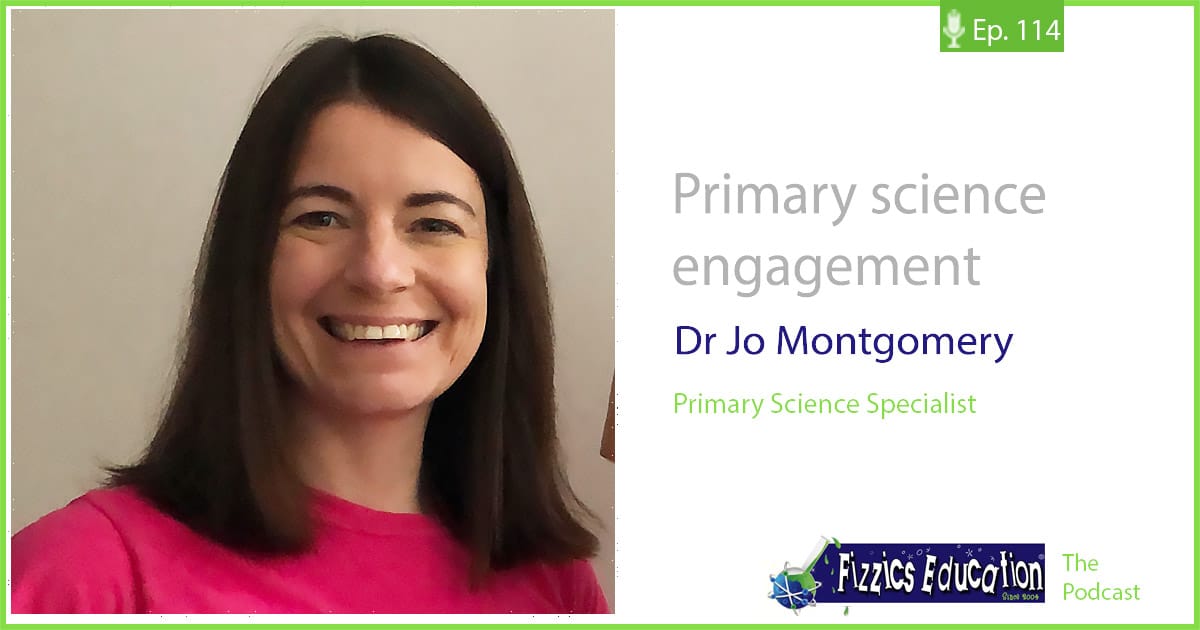
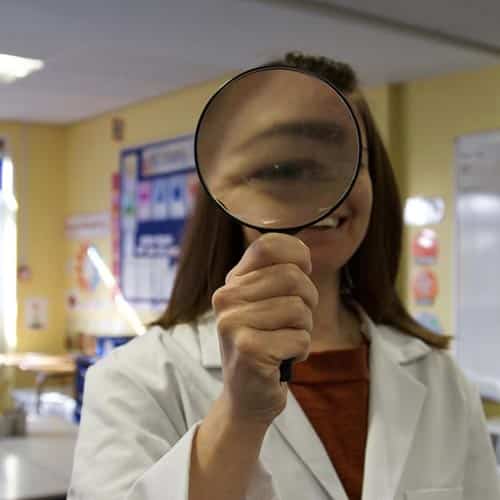
We hang out with Dr Jo Montgomery (aka Dr Jo Science), a primary science specialist who works with students across the UK to help them get excited & inspired in STEM!
Combining a robust academic background in research science with extensive classroom experience, Dr Jo Montgomery has dedicated over 20 years to supporting science education. Her career spans the entire educational spectrum, from the Early Years through to university level, where she focuses on bridging the gap between scientific theory and practical application.
Jo is a dedicated primary science specialist with a profound passion for nurturing innate curiosity and fostering a spirit of investigation in young learners. She is renowned for delivering vibrant, curriculum-relevant workshops and hands-on STEM clubs that bring science to life for both schools and community groups. Her approach ensures that children don’t just learn about science, but actively participate in the process of discovery.
Beyond her work with students, Jo is a leading figure in professional development for educators. She serves as a STEM Learning Associate Facilitator and a Primary Science Quality Mark (PSQM) hub leader, guiding schools toward excellence in science leadership. As a Regional Champion for the Great Science Share for Schools and an established independent consultant in the UK, Jo continues to influence how science is taught and celebrated on a global scale.
Connect with Dr Jo Science
Dr Jo Science Solutions – Explore her full range of workshops, resources, and consultancy services.
Elevating Science Leadership: Implementing structured programmes like the Primary Science Quality Mark (PSQM) provides a clear roadmap for improving science teaching across an entire school community.
The Power of Child-Led Inquiry: Encouraging students to ask their own questions and design investigations fosters deep engagement and mirrors how real-world scientists work.
Building Teacher Confidence: Professional development and peer-to-peer collaboration are essential tools to help primary educators overcome anxiety and deliver high-impact STEM lessons.
[00:00:19]Ben Newsome: Yes, welcome again for another Fizzics Ed Podcast. Glad to have you again for another chat around science and STEM and all that sort of thing. We are definitely talking with a primary science specialist today. It’s Dr Jo Montgomery, who’s a qualified teacher in the UK and a former research scientist with over 20 years of experience in teaching kids science in the primary setting. She loves making science exciting and accessible and, more importantly, to help them develop positive attitudes when it comes to STEM. So much so, she’s an Explorify champion and a Great Science Share for Schools regional champion too. That’s what this chat is all about. It’s all about making science interesting and fun for kids no matter where they are sitting. Let’s get right into it.
[00:00:58]Announcer: This is the Fizzics Ed Podcast. We’re all about science, ed tech and more. To see 100 fun free experiments you can do with your class, go to fizzicseducation.com.au. That’s physics spelled F I Z Z I C S and click 100 free experiments.
[00:01:21]Dr Jo Montgomery: I’ve been really lucky to have a really varied career in science education. I’m a scientist and a teacher by background, and right now I deliver fun and engaging curriculum-linked hands-on science workshops for schools and community groups. I also support teacher professional development with a range of organisations in the UK, but also as an independent consultant too. I spend most of my time working directly with groups of children.
[00:02:09]Ben Newsome: So you’re not busy at all, just quiet, nothing happening. That sounds awesome. You used to work as a research scientist. What made you make the jump across?
[00:02:14]Dr Jo Montgomery: That’s a really good question, and I don’t think I’ve ever had a career plan mapped out of where I wanted to be and where I wanted to go. I’ve just followed the things that interested me. My parents were teachers, which is probably why I didn’t go straight into teaching. Although instead, I went into academic research which is equally poorly paid and has terrible work hours, and not even the school holidays. I’ve worked in a variety of roles. I’ve worked in neuroscience and animal behaviour, I’ve worked in clinical trials and development, and then even from being a student, I’ve been involved in public engagement and science communication. It was a natural step for me to start to move more towards the education side.
[00:03:31]Ben Newsome: Oh, excellent. Do you miss doing the research?
[00:03:35]Dr Jo Montgomery: I would like to say yes, and that certainly was my answer for many years. I did really miss being at the lab bench, cutting-edge science and having those really high-level conversations with people. But I certainly don’t miss it now. I absolutely love what I do, and I love the variety as well.
[00:03:54]Ben Newsome: I was on your website briefly having a look through what you get up to. Talk about some variety! It’s not the sort of thing that you suddenly come up with overnight. Obviously, you’ve built that up over a long time. You mainly do primary years?
[00:04:11]Dr Jo Montgomery: Yes, that’s right. Focus on the primary years. Although in the past I have worked from age 3 to 103, but certainly to the university level education.
[00:04:23]Ben Newsome: Yeah, it’s a lot of fun. We’ve done some work into the retirement homes as well. What’s really good fun is doing the grandparents and grandkids day. They have an absolute blast. Lately not been able to do that, especially with the year just gone past and possibly this year as well, not allowed in anymore. But it’s certainly a lot of fun with the primary kids.
[00:04:52]Ben Newsome: Out of curiosity, walk us through what a typical workshop or show tends to look like.
[00:04:58]Dr Jo Montgomery: As I said earlier, there’s a huge variety. I cover all sorts of different topics in biology, chemistry or physics, so no two workshops are the same, but typically it’s very much focused on the hands-on. Whilst there is some instructive teaching of new things, it’s very much about getting the children to have a go, to get hands-on and to investigate and discover things for themselves. Lots of opportunities for really relevant and meaningful science enquiry in my workshops. But also introducing them to new skills, new ideas, new ways of working and new knowledge as well.
[00:05:51]Ben Newsome: The thing about all these sorts of things, there’s so many different activities, experiments that you could choose from. It doesn’t always have to be so all whiz-bang either, it often can be very simple activities.
[00:06:05]Ben Newsome: I’m going to throw you a little bit on the spot, thinking about all the different activities that you run. If you had a bunch of 10-year-old kids about to walk into your door in the next five minutes and you had to quickly come up with something, what sort of experiments do you like doing that are really quick off-the-cuff things that anyone can do if they’ve just got something random hanging around the room? Even just what’s in your room right now? What would you do that you know is going to work?
[00:06:33]Dr Jo Montgomery: I think we all as educators have a bunch of those things up our sleeves that we can pull out if you absolutely need something. I’m just reaching forward here because you said things that you’ve got hanging around your room, so I’ve got a balloon here. There’s an awful lot of science you can do with a balloon. Lots of things to do with static electricity, you can fill them with water, fill them with air, you could even fill them up with carbon dioxide from an acid-base reaction adding vinegar and sodium bicarbonate and look at the differences in weights.
[00:07:12]Dr Jo Montgomery: We can get between those, but definitely one that really captures imagination. And it’s interesting that you mentioned earlier, it doesn’t have to all be whizzy. I find that if you do something that’s really powerfully “wow”, that’s all the children remember. They don’t remember the science that happened behind it. If you can get them to look at something more simple and really use their observation skills, you can start to tease out the science in things and they’re focusing on the correct thing then.
[00:07:44]Dr Jo Montgomery: One go-to that I would have that immediately sprung to mind when you said, “What would you do if they walked through the door?”, and I mentioned the sodium bicarbonate and vinegar experiment earlier. I think you can take that in so many different directions. The classic volcano of adding an acid and an alkali together to produce those bubbles of CO2, but not just doing that. Okay, you get that “wow” in a cup or a test tube of the fizzing happening.
[00:08:24]Dr Jo Montgomery: But then really get them to slow down and observe and say, “So what are the bubbles doing?”, and then we can really observe that they’re going up, and we could even use that then to look at that further. Maybe pop a couple of raisins in and see what happens to those. The bubbles you can see gathering around the outside of the raisin, so those nucleation points where they seed the bubbles and then the bubbles start to rise, they get to the top, they pop, the raisin sinks back down again. You can talk about all sorts of things to do with densities and floating and sinking and the properties of gases and liquids. I guess that would be one of the things that I definitely would be a go-to where you can really tease out the science through something really simple.
[00:09:14]Ben Newsome: Absolutely. For those people listening to this podcast, Jo just happened to be able to reach up behind the desk and suddenly had a green balloon ready to go. That was totally unplanned, but that was kind of cool. But you’re right, I totally agree about it’s a problem if you’re only just doing the whiz-bang stuff. We often come across this a lot. I’ve had a good chat with some students after the fact saying, “What did you remember? What did you learn?” and it’s often like, “Wow, what was it? They did this thing!” “What did you learn?” and they say, “I don’t know, not sure.” Settling it down to a very simple level is important, and I really like diving deep. Like when you were talking about the vinegar and bicarb reaction, there are so many variables that you can do because often kids will just happily pour the two things together, watch it fizz and that’s it.
[00:09:47]Ben Newsome: But you could change the concentration of the vinegar, you could change the temperature of the vinegar. You could try different versions of things that look like bicarbonate powder, bicarbonate soda, maybe throw cream of tartar in there instead and see, not much happens because it’s just two acids being thrown together and nothing goes on. But the idea that kids actually have the chance to change one thing and see the effect is actually true science. That’s a thing that can be a bit of a trouble with these experiments, they often feel almost like a recipe, like building the chocolate cake. The chocolate cake comes out and we eat it, as opposed to doing real science which is two different chocolate cakes and one has extra chocolate, one has less chocolate, which one would you prefer to eat? Odd analogy came off the top of my head, it is early in the morning for me, but for me, that’s where the real science and the real learning is. I imagine that’s a lot of the work that you do when you mentioned that you do professional development programmes into schools. Helping teachers understand about what is out there to teach and how can you turn it into a true science is really a bit of fun and also quite rewarding, I’d imagine.
[00:10:24]Dr Jo Montgomery: Yeah, absolutely. Obviously, the joy and enthusiasm really does come from working with children, but you know that you’re helping to develop teachers who are going to go on and have that impact with even greater numbers of children as well. We’re all children at heart, actually. We all like a little bit of tinkering and experimenting and having a go at stuff. I try to make my professional development with teachers really hands-on as well because I think it’s really important for teachers to have the opportunity to explore and discover and investigate and think about the things that their children might ask if they were doing the same thing and to have a bit more confidence at what happens when you do those experiments and what happens if you change that thing and you put more chocolate in your chocolate cake.
[00:11:09]Dr Jo Montgomery: You know how things work like that. It’s extremely rewarding as a job, both working with children and with teachers as well. In the UK, something like 40% of primary school teachers are not confident in teaching science, although that figure is improving, people are getting more confident, there’s more professional development out there. Traditionally primary school teachers don’t necessarily come with that science background. Being able to give people the confidence that science isn’t actually that difficult, it is just about being curious and finding things out is really a great thing to do.
[00:11:52]Ben Newsome: Absolutely. By the way, I am an advocate for adding more chocolate into the chocolate cake, just as a little side note there. My kids gave me some chilli chocolate cake the other day, it actually really works and I like it, it’s quite interesting. Anyway, going on a little tangent. How did you go with this online thing? Everyone’s had to do this online thing throughout this last year, but some people have been doing it for much longer, others had to pick it up. How did you go with that?
[00:12:15]Dr Jo Montgomery: It was a little bit of jumping straight in with two feet. At the start of lockdown we were suddenly thrown into school closures, workplace closures, all sorts of things and everything just went online in the UK. Whilst secondary schools were really good at that remote delivery, primary schools took a little while to catch up with that here. Therefore, I was fortunate for that because it was suddenly really popular because I had the setup, the skills to be able to do that just with my laptop. I could stream into schools where there were small groups of children still being taught, and it could also be streamed to children at home. I think just being really adaptable and flexible and ready to go with that online thing really worked in my favour.
[00:13:01]Ben Newsome: It’s one of those things where the online can sometimes actually be better depending on what you’re doing. You think about some of the experiments you do. We’ll go back to the vinegar and bicarb thing. That’s fine in a small workshop environment, but imagine you wanted to show that same experiment when you’ve got 300 kids in a school hall and this tiny little thing set up. Unless you’ve got a document camera and you’re being put onto a data projector so it looks nice and big, no one can really see what you’re doing. If you’re 15 metres back, it doesn’t really help much when you’re looking at these tiny little things.
[00:13:37]Ben Newsome: Having the ability to have that extra camera to zoom in on that particular experiment that you’re doing makes all the difference. Sometimes something that’s really small, I think of when we do liquid nitrogen and when we’re dealing with high school kids, superconductors are awesome. They’re very cool and they get to see the Meissner effect with a magnet floating above a superconductor, but there’s no way I’d normally show that in a big show environment unless I’ve got a camera there because no one’s going to see it. The thing’s only floating five millimetres above the magnet. It’s so much better to be able to zoom on in.
[00:14:15]Ben Newsome: When you were connecting with schools, I imagine you’ve still got unfortunately the lockdown going on now for yourselves right now. Was it much hassle trying to be able to get everyone online or is it finding it quite easy these days?
[00:14:29]Dr Jo Montgomery: It kind of depends actually. I think you’re right, that point about there are definite benefits to online, you can see things more close up and show things that you can’t necessarily show when you’re together. In terms of connectivity, there are really big differences in the UK over people who have access to internet-enabled devices and people who don’t. I would say that particularly in my area the majority of schools and people have access to some, but not necessarily all of it. There might be two or three children at home, there might be one computer or one tablet device and everybody’s trying to access it for home learning. That can be challenging absolutely and there’s definitely juggles to be done in terms of managing that.
[00:15:16]Dr Jo Montgomery: But there are also unfortunately some households that don’t have any access to this. In the first lockdown certainly, I went out on my bike and was delivering little mini science kits to people who didn’t have any access to anything else so they’d have activity cards and a mini science kit to be doing some stuff. There were definitely ways round.
[00:15:38]Ben Newsome: Absolutely, there is a genuine discrepancy between the haves and the have-nots with that particular thing. We definitely know about some school districts where they had to drive a bus out which had Wi-Fi. The thing is, it only works if they’ve got devices. If they haven’t got a device either, the Wi-Fi is irrelevant at this point. It was certainly very challenging. Thinking of those little activities, certainly at Fizzics, we’ve got a bunch on our site too, they are so really handy. One of the things I notice from your site is that you’re involved with Children’s University. Now, I actually haven’t come across that before, which says how much I don’t know about what’s going on out in the world, but that looks really cool. Tell us a bit more about that.
[00:16:16]Dr Jo Montgomery: The Children’s University is an initiative to encourage extracurricular learning and activities. Not just the school stuff, but to discover more widely all sorts of things. Now, some of them are embedded in schools, so schools might subscribe to the Children’s University and then they’ll have one day a month or an afternoon a week dedicated to their Children’s University activities. Schools will typically organise it so that they have other people come in and help, they might be parents, they might be people from the local community.
[00:16:58]Dr Jo Montgomery: You can have smaller groups than a normal class size doing all sorts of different things, and they generally set it up so that you’ve got a passport and you get little stamps for the different things that you do. There might be science activities, there could be creative writing, it might be learning to knit or to cook or to whittle wood to give children a really wide variety of experiences. Now, it doesn’t have to be done through a school setting, the Children’s University you can do in your own time, as an after-school club, all sorts of things. Obviously, these days there’s access online to a whole variety of different things, so you can get a digital passport to get little stamps for the activities that you do. Throughout childhood you get all these activities that you build up for your Children’s University and you get to have a little mini graduation at the end of it.
[00:18:22]Ben Newsome: That’s so cool. I think of my kids, my kids love collecting those stamps when they go out to a fete or whatever, it’s just the thing, they want to run around doing that. That’s actually really good, I actually like that idea of that being a driver for them to want to do more rather than the parents just saying on high “you’re going to do this thing”. Though that’s possibly potentially happening slightly in the background, at least the kid might go “hey I can collect the next stamp”. That’s kind of cool. That’s neat. Projecting forward, at some point this whole lockdown thing will eventually settle down. You’re based in the UK, do you have much of a chance to go across to Europe or do you find yourself mainly in the UK itself?
[00:19:02]Dr Jo Montgomery: I’m definitely mainly working in the UK, absolutely. Moving out into Europe is now slightly more tricky for us having left the European Union unfortunately at the beginning of this month. But I have certainly through this year, because everything has moved online, had much more opportunity to work in different places. I was teaching in Saudi Arabia a couple of weeks ago, which was quite exciting, obviously remotely. I think it has opened up opportunities as well as obviously it being a really very difficult and challenging time for lots of people. People have said, “We have never been able to get visitors”. Even if we’re suggesting rural Scotland or, and obviously in Australia you’ve got places that are miles away from anywhere. Being able to do things online means that you can get that virtual visitor in your school. I’ve been able to reach groups of people that I wouldn’t have had the opportunity to do before. I would like to carry some of that through once this whole situation has settled down as you say and we’re back to being able to travel about and see people in person, I think I will still hold on to an aspect of online teaching as well.
[00:20:27]Ben Newsome: Yeah, what’s really cool about reaching out to places that are very remote and often in a different time zone is people thinking things can be very different. We can have different climates, you’re in the Northern Hemisphere, I’m not right now. That’s a talking point, but often there’s also the actually we do sort of the same things. It’s interesting just chatting, we’ve done connections where we’ll have two sets of students, one in Alaska, one in Australia. The kids in outback Australia say, “what are you doing after school?” “I’m going to go hunting with my dad.” “Cool, that’s great. What are you guys doing?” in Alaska and they actually say that they’re going to do the same thing. We’re just going for different animals. It’s interesting hearing about even just the slight variances and differences between the schooling systems themselves. School is not the same anywhere, even within the same district they can be different. That can be a really good chatting point. I’ve always enjoyed it, it’s always a lot of fun. So with all these science experiments and whatnot, if you had a bunch of brand new teachers about to enter into the schooling world and you had to give a little bit of advice about how to engage kids further in STEM related activities, what would be some suggestions that you might give for them?
[00:21:50]Dr Jo Montgomery: I think my first piece of advice to them would be don’t be scared of practical work. I think people are often concerned that behaviour management might go awry if you’re doing hands-on practical, but actually the opposite is true. It’s a bit like being a bit scared to take children out of the classroom and into the outside area, whilst there can be some behavioural issues by leaving the confines of your very structured environment, what you generally find is that behaviour is better because they are engaged and motivated and enthusiastic. So definitely don’t be scared of practical work, that would be the first thing I would say. And the second thing is don’t get bogged down in your school’s curriculum and way of doing things, definitely look around you and see what opportunities there are and different ways of teaching practical science.
[00:22:51]Ben Newsome: Agreed absolutely. And from a behaviour point of view, that makes total sense. I was one of those kids that needed those activities where there’s actually a useful thing to be involved in. Thinking of those science activities, I understand the fear that can happen in classrooms, “don’t mess the classroom up please” or maybe things might go wrong. Actually, it’s where the things going wrong is where the learning can be.
[00:23:13]Dr Jo Montgomery: Absolutely. And science is like that, things go wrong and you often learn more from what doesn’t work than from what does work.
[00:23:22]Ben Newsome: That begs the question. Out of all the different lessons, you’ve done a lot of them. What are the ones that you look back and go, “You know what, I just remember this going completely pear-shaped”? It just didn’t work, and off the top of your head, are there any situations where you can think of where that’s happened and what were the silver linings in that?
[00:23:47]Dr Jo Montgomery: I can’t think of anything that’s gone so catastrophically wrong. Obviously, which is really useful. You must make sure that everything is risk assessed and it’s safe, and we’re not trying to remove risk, we just need to minimise it and be aware of it as well. But actually I think the key thing is that as educators we need to be flexible and adaptable and without even thinking about it really as teachers we respond and change things that are happening minute by minute. I think you can judge the temperature of a room, “this isn’t working, okay I need to stop and flex and do something different here”. There certainly have been occasions where I’ve gone, “No, actually do you know what, stop, this isn’t working. Put the electricity stuff back away, we’re going to do something completely different.” Because sometimes there’s a strange wind or something blowing through the trees and it just makes the children a little bit different from normal and you just change what you do. Those skills of flexibility and being adaptable are really important in a classroom, but reading the room and making sure that the children are safe as well is really important.
[00:24:01]Ben Newsome: Absolutely. I’ve got to attest, and I’d love to know what other people think about this. I tell you what, wind and kids! What is it with wind? You just get the wind going and it’s a dry day, it’s like the kids just lose their mind, especially if it’s a Friday afternoon. There’s some experiment in there I’m sure.
[00:24:18]Dr Jo Montgomery: I think dogs are the same too.
[00:24:20]Ben Newsome: Yeah, they are. Absolutely. Actually, I’m happy to talk about my mess-ups, mistakes and failures. It’s sometimes really good. I remember a student asking, “Hey, I’d love to do this particular activity.” It was the classic concentrations of sugar and layering them with different colours. Simple as that. Looks great on Pinterest. Doing it in real life, getting those layers, it’s not quite the same as what they expect. We did actually achieve the different layers, but getting the kids to understand that it is just as much your technique as the science that matters. Because they’re all water soluble, you end up with a blend of colours as opposed to perfect layers, which you actually need to have the right chemicals to make that happen. It’s good for the kids to see that just because you see it on the internet portrayed in a certain way in beautiful light with a nice photographer, doesn’t mean it’s going to turn up in real life. It’s a good thing for them to see.
[00:25:17]Ben Newsome: Yeah, absolutely. So Jo, thank you very much for jumping on this podcast. We’re going to be hanging out really soon on a panel later on today. It’s a very busy day. But in the meantime, is there anywhere where people can find out more about what you get up to?
[00:25:35]Dr Jo Montgomery: Yeah, sure. You can follow me on social media, I’m at Dr Jo Science, and my website is drjosciencesolutions.co.uk.
[00:25:44]Ben Newsome: Easy, and as usual we put those links in the show notes on the Fizzics website and please click on through, check out what Jo’s been getting up to. Thank you very much for joining me this evening or this morning because we are on the opposite side of the planet. But hey, go and grab a coffee, we’re going to be hanging out in another panel with the Toddle team fairly soon. Looking forward to it. In the meantime, have a great short time. Catch you very soon.
[00:26:12]Dr Jo Montgomery: Thanks very much Ben, great talking.
[00:26:31]Ben Newsome: Well, there we go. You just heard from Dr Jo Montgomery, who you can really tell loves her science in the primary setting. And if you’re wondering what that panel was all about that we mentioned right at the end there, that is in the lead-up to the Learning Jam. Yes, the Learning Jam is a 24-hour global learning event in STEAM. It’s happening between January 23 and 24 of 2021. So if you want to check that out, it’s on toddleapp.com/learningjam. Toddle is presenting this. It’s all about getting people in a variety of schools right around the planet right into STEAM as we head into 2021. So definitely check that out.
[00:27:09]Ben Newsome: Anyway, that is enough of this particular episode. I hope you’re having a fantastic time with teaching your science, no matter what setting you are in. Make sure it’s exciting and engaging, and it’s all about getting positive attitudes for kids in science. Definitely important. Look, you’ve been listening to me, Ben Newsome from Fizzics Education, and you’ve been listening to the Fizzics Ed Podcast, and I’ll catch you another time.
[00:27:56]Announcer: This podcast is part of the Australian Educators Online Network. AEON.net.au.
Frequently Asked Questions
What is the Primary Science Quality Mark (PSQM)?
The Primary Science Quality Mark (PSQM) is a school improvement programme based in the UK that aims to raise the profile of science in primary schools. It provides a framework for science leads to evaluate their school’s current practice, develop an action plan, and demonstrate the impact of their leadership on the quality of science teaching and learning across the whole school.
How can teachers effectively manage child-led inquiry in a busy classroom?
Dr Jo suggests that child-led inquiry doesn’t have to be chaotic. By providing a structured environment where students are encouraged to ask their own questions and then facilitating the resources to test those ideas, teachers can foster independence. Starting small with “I wonder” prompts and gradually allowing students more autonomy in their investigations helps build their scientific reasoning skills.
What is the significance of the Great Science Share for Schools?
The Great Science Share for Schools is an annual campaign that encourages young people to share their scientific questions and investigations with new audiences. Unlike traditional science fairs which might focus on competition, this initiative focuses on the process of inquiry and the communication of findings, allowing children to see themselves as part of a global scientific community.
How can primary teachers without a science background feel more confident?
Confidence often comes from professional development and peer support. Dr Jo emphasises the importance of hands-on workshops and mentoring. By engaging with organisations like STEM Learning or participating in local science hubs, teachers can learn that they don’t need to have all the answers; rather, they can be co-investigators alongside their students.
Why is it important to start science education in the Early Years?
Children are born with an innate curiosity about the world around them. Introducing science early—through play, exploration, and sensory experiences—helps develop critical thinking and problem-solving skills. By nurturing this natural inquisitive nature before any negative stereotypes about science can form, educators set a strong foundation for lifelong scientific literacy.
Discussion points summarised from the Primary Science with Dr Jo Montgomery with AI assistance, verified and edited by Ben Newsome CF
Extra thought ideas to consider
The Role of Mentorship in Science Leadership
Developing a strong science culture in a school often relies on a single passionate coordinator. How can we move from individual enthusiasts to a sustainable model of distributed leadership where multiple staff members feel empowered to lead STEM initiatives?
Breaking the ‘Mad Scientist’ Stereotype
Despite progress, many children still envision a scientist as an older man in a lab coat. How can primary educators intentionally use diverse role models and real-world contexts to show that science is a collaborative, inclusive, and everyday activity accessible to everyone?
Evaluating Impact Beyond Standardised Testing
Science in primary school is often about wonder and discovery, which can be hard to measure through traditional tests. What are some innovative ways schools can document and celebrate student progress in scientific inquiry and curiosity without dampening their enthusiasm?
Recognised by
22 years, award-winning work, 1 purpose
Recognition from business, education and industry bodies across Australia.
Australian Small Business Champion
Multiple years
CILC Pinnacle Award and Hall of Fame inductee
Center for Interactive Learning and Collaboration
Western Sydney Awards for Business Excellence
Winner
Top 100 Coolest Company
Listed
Local Business Awards
Winner
We value your privacy
We use cookies to improve your experience. Essential cookies are always active. You can choose which optional cookies to allow.We use cookies. Optional ones stay off unless you allow them.Privacy policy