
Recently there has been a massive push for more technological literacy among our students, and given the global trend towards digital workspaces, this is not surprising. But there is an aspect of digital literacy that is often overlooked, and this is photography. Its underuse in the classroom surprises me, particular because it lends itself so easily to many different subjects and talking points.
In a previous post, titled “Insects and the Food Web,” I discussed the idea of keeping caterpillars as classroom pets, allowing your students to see their metamorphosis into a butterfly. Well, this process is slow- taking about a month to complete. However, with a dedicated camera, you and your students can record the process and view it as a time-lapse in about ten seconds. There are two methods to do this. The one that will yield the best result makes use of a single dedicated camera that is left untouched for the month. Simply set up the camera and get it to take a photo every hour or two. You can easily find several free apps that will do this for you from the app store. However, if you cannot leave a camera untouched for this long, simply take a photo of the chrysalis twice a day. Once your photos are taken simply stitch the photos together in chronological order using a time-lapse app, this too is reliably available in the app store. The first method uses more photos than the second and will yield the best result. This experiment let your students’ view each photo individually, giving them the opportunity to see the structure in more detail. Detail that may be overlooked in a video. But, if keeping insects isn’t your thing, you can try this same setup with sugar crystals. To find out how to make your crystals simply click here.
You can also easily get your student to create their own claymation film. Much like the experiment above a Claymation film is a video that is made up of many photos, but the difference is that your students get to create and direct the film itself. Simple give your students some clay, or a toy, and tell them to move it ever so slightly and take a photo. Repeat this step again and again until the photos, as a sequence, portray a moving image. This is how ‘Wallace and Grommet’ is made. Encourage your students to play with the framerate* of their final video to slow down and speed up time. This is a very interesting and fun way to explore physical phenomena that is often unseen to the human eye, such as bouncing a ball. To make this look realistic the students will need to critically think about, and model, the ball being warped and compressed as it collides with an object and then reforms to its original shape, this is a fun physics and film lesion here.
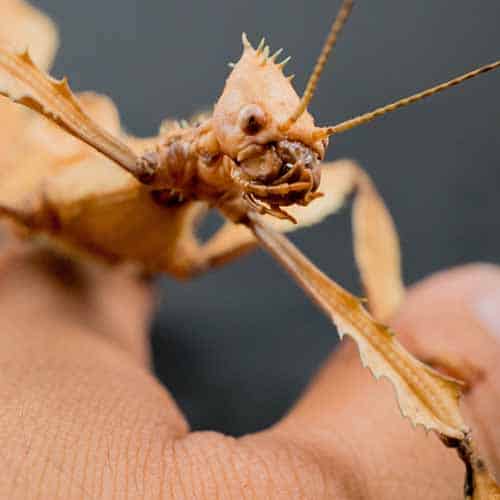
You may also like to make use of some macro photography in the classroom. Macro photography is characterised by having an extreme levels detail despite the subject being very small. This type of photography can be used to encourage your students to look more closely at the structures of miniature things, such as plants and insects, from a very unique perspectives. One that is invisible to the human eye. However, most tablets, phones and laptops do not come with a dedicated macro feature, so you may need to purchase an attachment. Also, I would only do with the older students as some patience and fine motor skills is needed to produce clear images. This is due to the shallow depth* of field that accompanies macro photography and macro lenses. Below is an example of macro photography of one of our company phasmids, stick insects.




