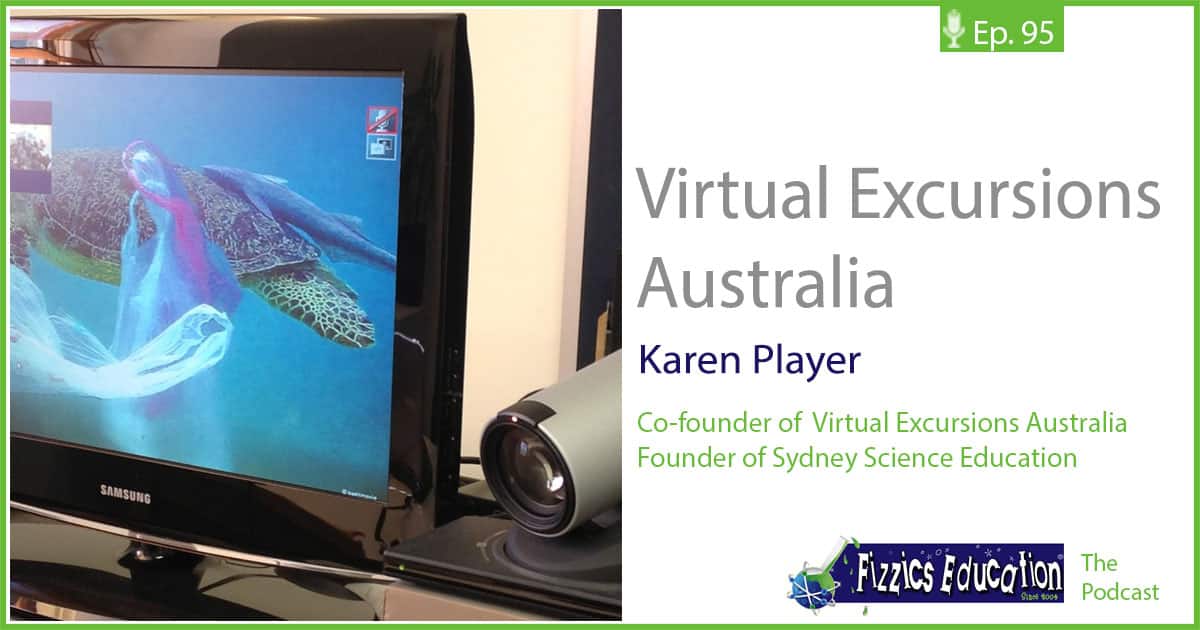
Sadly distance education is now the new normal for at least the next few months. We chat with Karen Player, co-founder of Virtual Excursions Australia and founder of Sydney Science Education, to find out just what is available for schools, libraries, community groups and more in terms of live interactive classes that are educational, linked with curriculum and presented in alignment with global best practice.
How do we bring the world’s best museums, labs, and galleries into a classroom in the middle of the outback? In this episode, we explore the origins and impact of Virtual Excursions Australia (VEA). We discuss how this collaborative network is bridging the digital divide, ensuring that every student—regardless of their postcode—has a front-row seat to high-quality, interactive educational content.
About Virtual Excursions Australia
Karen Player
Virtual Excursions Australia (VEA) is a national collaborative network of content providers, including arts, science, and education organisations. Co-founded in 2012 by Karen Player, Stephen Bancroft, and Ben Newsome CF, VEA serves as a professional platform for distance education specialists to share best practices. By connecting hardware and software vendors with booking hubs, VEA enables learners across Australia to access innovative, high-quality interactive programs that were once limited by geography.
VEA isn’t just a directory; it’s a movement to standardise and elevate the quality of online interactive learning. It brings together the “best of the best” to ensure that Digital Literacy and Curriculum Engagement are accessible to all.
Key Pillars of the Network:
Best Practice Sharing: VEA provides a space for educators and content creators to discuss the latest in video conferencing pedagogy and engagement strategies.
Equity of Access: By facilitating “Virtual Incursions,” the network ensures that remote and regional schools have the same opportunities as metropolitan schools to engage with experts.
Innovation Hub: VEA works closely with hardware and software vendors to ensure the technology used in classrooms is robust, user-friendly, and effective for two-way interaction.
Diverse Content: From live physics shows and marine biology dissections to interactive art gallery tours and historical storytelling.
The Evolution of Distance Ed:
We discuss how virtual excursions have moved from passive “broadcasts” to truly interactive experiences. Students can now ask questions in real-time to a diver underwater or a curator at the Australian Museum.
The Power of Collaboration:
VEA proves that when organisations work together rather than in silos, they can reach more students. The “Booking Hub” model simplifies the process for busy teachers to find and schedule world-class content.
Pedagogy Over Technology:
A core takeaway is that the screen is just a tool. The success of a virtual excursion depends on Inquiry-Based Learning—ensuring students are active participants in the scientific or creative process.
Education Tip: Preparing for a Virtual Event.
Follow VEA’s best practices by treating a virtual excursion like a real trip. Have your students prepare three specific questions for the expert before the call starts. Check your audio and lighting 10 minutes prior to ensure the connection works. As the founders of VEA believe, the most impactful learning happens when the technology disappears and the human connection takes over.
[00:00:18]Ben Newsome: Yes, welcome again to another Fizzics Ed Podcast. Glad to have you here yet again. Unfortunately, it’s not a great time, is it? It’s been such a messed-up time globally. I really hope that you have not been affected, that your colleagues, your friends, your family have been somehow safe from this thing that’s been travelling around the world. I hope that the world really does get back to normal.
[00:00:45]Ben Newsome: Here’s the thing: we can help you along the way. Virtual Excursions Australia has been around since 2012. This time we chat with Karen Player, who along with myself and Stephen Bancroff set up Virtual Excursions Australia in 2012 to help people out with virtual excursions, distance learning, EdTech, and all that sort of thing. Karen’s going to share some of her ideas about what’s coming up in the future around Virtual Excursions Australia and how you can get involved. So, hopefully, this is a useful chat considering how messed up it has been globally. Even after this is all over, the content that you hear now will certainly be useful for many years to come. I hope you’re doing well. Let’s jump straight into the chat because we’ve got a bit to share.
[00:01:20]Announcer: This is the Fizzics Ed Podcast. We’re all about science, ed tech and more. To see 100 fun free experiments you can do with your class, go to fizzicseducation.com.au. That’s physics spelled F I Z Z I C S and click 100 free experiments.
[00:01:40]Ben Newsome: Karen, welcome again to the Fizzics Ed Podcast.
[00:01:43]Karen Player: Great to be here again, Ben.
[00:01:46]Ben Newsome: You’re now our very first serial visitor to the podcast.
[00:01:52]Karen Player: I’m not sure I quite like the sound of that, but I certainly always love having a chat with you about what’s going on in science education and the digital realms.
[00:02:00]Ben Newsome: I just realised how much that sounded like Dexter. No, it’s great to have you back. Long-time listeners know that Karen Player was heavily involved with the Australian Museum for many years and was on the podcast a while ago now. But you’ve branched out and are doing cool things. Karen, tell us what you’re getting up to.
[00:02:18]Karen Player: I left the museum in 2019 to have a chance to actually do a little bit more face-to-face education with schools and started Sydney Science Education. It’s been lots of fun writing blogs and going out visiting schools. Of course, everything that’s been happening at the moment has really got us rethinking about what we do when we can’t visit schools.
[00:02:48]Karen Player: One of the things that I’ve been involved in for the last decade was actually virtual excursions. It’s been really nice to put that digital hat back on and rethink how we can deliver programmes remotely for groups that are either homeschooling or during school holidays, and how we can have that digital engagement. Ben and I know that you can still have really great hands-on, interactive learning experiences with students through virtual excursions and digital programmes. That’s probably a bit of a shift from where I thought I was going to be six months ago, but it’s been nice to step back in those digital shoes.
[00:03:26]Ben Newsome: It’s been a wild ride. There are so many different versions of clichés and hackneyed responses to this, but it’s been nuts for everyone. The focus of this entire chat—by the way, well done with Sydney Science Education and moving out of the museum into the big wide yonder, you’re doing an amazing job—is that Virtual Excursions Australia has been around for a very long time, doing a whole bunch of different collaborative events. It really is like getting the band back together.
[00:04:00]Karen Player: I completely agree. It was the 2012 Questnet Conference up in Cairns where you, me, and Steve Bancroff from AVR Media were having a beer after one of those great sessions. We were like, “What can we do? What can we do differently? How can we help people not make the same mistakes we’ve made? How can we share that information?” I think that’s where VEA was born.
[00:04:29]Karen Player: I also have to do a shout-out to Vanessa Barrett because I think it was during one of the New South Wales Inspiring Australia network meetings that the whole idea—that there are lots of people moving into the virtual world at the same time and maybe we should all start having meetings and get together—really took off.
[00:04:48]Ben Newsome: Absolutely right. In fact, it was before Inspiring Australia even existed. I believe Vanessa Barrett was working with the Office of Science and Medical Research at the time and was grabbing us virtual excursion types all together into a room. There were only six of us. We were just trying to do cool stuff. We were up at Questnet at that conference in Cairns, and I do remember the bar at the time, to be honest.
[00:05:14]Karen Player: I can visualise it. I can visualise where we were sitting and the three of us having this conversation. We were just so excited about the opportunity to just share ideas. I think that’s really where the strength of Virtual Excursions Australia was, is that a lot of the politics wasn’t there and that was why it worked.
[00:05:36]Karen Player: We were able—it didn’t matter if you were a private company, a government organisation, federal, state, regional, or metro—everyone was there to learn from each other. I’ve never been involved in a network quite like that before or since that time. So Virtual Excursions Australia was really groundbreaking with what it was doing and it was just really putting people together either with best practice on how to present digital programmes or, luckily we had some nice tech advice from Steve as well. So he was able to sort of go, “You know what? You need audio.” That was probably the thing that I’ve taken away from him most: it doesn’t matter how great your video is, if you don’t have great audio, there’s no point. I think he was probably the one that really made us all think that audio is just as important, if not more important, than video.
[00:06:30]Ben Newsome: What’s cool about that group is, you could list nearly 40 organisations of all different types and not just science, by the way, it was every type you could think of. But it wasn’t just them. We had people who supplied the data, literally through the internet cabling. You had people who did the hardware or the web conferencing software drop on in for best practice chats which we would have monthly, years on end. I think around the peak around about 2015, 2016, we were doing events every month to thousands of kids and it was so much fun.
[00:07:01]Karen Player: Yeah, I would love to know from all of our figures, from all of the members of Virtual Excursions Australia, how many students we reached.
[00:07:12]Ben Newsome: I definitely can jump in on that. I know that at one event alone, and it was organised by the Field of Mars Environmental Education Centre, they had like 15,000 kids in like two days. And we would do, whether it was Pirate Day or Slime Day or whatever day it was—I mean Dinosaur Day I believe was always quite popular—but these events would just attract kids from everywhere. It was so much fun.
[00:07:38]Karen Player: Yeah, absolutely. And it’s not just about what our members were providing but what else was just out there. So one of the posts I put up recently in response to a lot of the great ones that were coming out of the US with live streams and free virtual museum tours and things like that was to actually do an Australian version.
[00:13:31]Karen Player: So we collated information that we’d seen coming through and made it a one-stop shop. And I have to say I’ve been adding stuff as more organisations are going, “Oh, that’s right, we’ve got this already. Let’s promote that.” And it gives us an opportunity to actually have an Australian focus on those amazing virtual tours and other digital programmes and live streams from zoos and aquariums that are out there. So everyone can find them as well.
[00:14:00]Ben Newsome: Totally. So now I do obviously know that a lot of people around the world listen to this podcast, which is wild in itself. So if you happen to be within a reasonable time zone, just because we’re in Australia doesn’t mean we won’t play nice. We do, which means these content providers, not just Fizzics and Sydney Science Education, but lots of these places will 100% run programmes for you regardless of where you are. In fact, I’ve actually run programmes into South Korea and a few other places where I’ve had to have a translator. And you can do it, you just have to, in my case, very much slow down with my words. But it does work, and it all comes down to time zones and that sort of thing.
[00:19:01]Ben Newsome: This is the thing. Do you remember it was last year? I think it was last year it went viral where this bloke was doing a cross for the news and his toddler came in through the back door in his bedroom? It was just so cool because he kept his cool. He did such a good job.
[00:19:15]Karen Player: And I think that’s exactly what we wrote in that post as well is there’s a lot about being flexible. Things will go wrong, and if you get flustered by that or are not prepared, then it’s always much harder. So if you know 100% stuff will go wrong in your virtual excursions and it’s just a matter of being able to have enough flexibility to roll with that. You know, dropping your video, “Oh, we’ve only got audio for a little while,” give an activity. “Why don’t you guys go off and collect five things to do so and so and I’ll get that sorted.” And just being able to have those moments of going, “You know what? It will definitely at some point something will go wrong and how do we work with that and how do we fix it to still maintain that sort of continuity and professionalism that you want to have during your session.”
[00:20:08]Ben Newsome: Oh totally. I actually remember doing a connection once and the plan was to throw it to an offsite presenter who was, I think where they were doing dinosaur stuff, right? And the concern was that the picture quality was going to be terrible because at the time they were uploading via satellite. And it was, it was terrible. And so the worries were, “Should we even do this? We’re somehow going to ruin the content.” I said, “No way! It’s like you’re the foreign correspondent, you’re coming from a crazy place. People are going to accept that your content is not going to be so good. In fact, it actually makes it more real.”
[00:20:41]Ben Newsome: In fact, the more you stuff up and the less scripted you actually have, the more real you sound and the more likely you’ll actually talk to someone like you’re actually in the room with them. And it does work. Now of course it comes with some people liking a script because there’s a certain safety in scripts and we do want great production value. But eventually you need to connect with that audience and if you’re not connecting because you’re too busy worrying about the script and the pretty pictures, you’ve missed them anyway.
[00:21:09]Karen Player: Where I completely agree with both of those points. I think that authenticity and owning it… “Yeah, we’re going to do this live crossover. It’s not going to be great quality because this person is in the middle of nowhere or really far away, but isn’t it exciting that we can actually connect with them at all?” I think there’s a lot of value in that. And moving away from scripts, I think is absolutely important as well because it means that when you’re interacting with your students, their questions lead you in directions that you never expected.
[00:21:44]Karen Player: That’s right. I mean, I think that is always amazing. And one of the things that I’ve learned over the years: it’s okay to say “I don’t know the answer to that.” You know, sometimes I get questions from the kids and I’m like, “Wow, that is such a good question. And you know what? I don’t know the answer to that. But we can find it out together.” So I either do a follow-up email that might have the answers to that, or I give them the skills and ability to then research those answers themselves.
[00:22:15]Karen Player: So I think that some people are really afraid of like, “If I move off script, they’ll ask me something and what if I don’t know it?” And they’re the best moments, when you don’t know the answer. And sometimes I’ve had other participants have known the answer if it’s a really particular group and a very, very detailed research. Some of these kids will know more about a particular topic than I will. I’ll know the bigger picture information and can do all of the framing for them. But one student might know exactly that answer because it’s something that they’ve really drilled down into before. So I love the kids being able to have the opportunity to answer that question for the rest of the group as well. Those opportunities for that student to then become the teacher, that’s so valuable and they’ll remember that for a lifetime.
[00:22:55]Ben Newsome: Absolutely. And I know that the vast majority of people listening in are teachers and, seriously, how often do you walk into a Grade 3 classroom with a script? It’s just not going to happen. And you also know that there’s lots of tools that can help with that asynchronous learning. I mean, sometime last year I spoke with a very good friend of mine, Sean Forde, who is a global ambassador for Flipgrid. And he is a big fan of using Flipgrid as a way of connecting with people via video but asynchronously in such a way that they can just get back to them video another time. You’ll check it out and you’ll answer them, no big deal. So there are lots of tools around it. I think the bottom line is, hey, we’re all in this together and there are tools around and share the ideas around and that’s really the heart of what VEA was all about.
[00:23:42]Karen Player: Yeah, I completely agree. Every time one of us finds something that we really like and really works, it’s sharing that information across. So the value of VEA since 2012 has been exactly that. And I’m really excited that we’ve got the opportunity to share that information again. Lots of new people coming on board that probably never expected to be here, never expected to be delivering online learning from their home. We can certainly help everyone with that, whether it’s just directing them to the Facebook page or directing them to the website where a lot of these things have been answered, or what you’ve been doing as well, doing webinars and Zoom meetings to help people with that information.
[00:24:29]Karen Player: So I think Virtual Excursions Australia will really become a place that we’ll be training people, we’ll be helping people find the answers to those questions that they’ve got both in not detailed technology but sort of basic technology levels, but also best practice in delivery. What works and what doesn’t, and giving people the confidence to give it a go.
[00:24:49]Ben Newsome: Absolutely. So, where do we go? What’s the name of this website and what do we do from there?
[00:24:55]Karen Player: So it’s virtualexcursionsaustralia.com.au. And then the Facebook page is Virtual Excursions Australia as well. And the Twitter is… I think it’s… VCE excursions or something like that.
[00:25:08]Ben Newsome: VCE excursions. I struggled, but we’ll put that in the show notes, right? They’ll always be there. You’ll be able to find it and I mean, I’ve been certainly tweeting out through the last couple of weeks because this community of practice has always been there. It’s just always been in a lot of ways hidden because it’s not been something that everyone’s needed.
[00:25:32]Karen Player: And I think you’ve got the professional learning group on LinkedIn as well that’s got a lot of the video conferencing networking too, so that’s always really useful to promote as well.
[00:25:44]Ben Newsome: Good point. And I’ll also put a link to the Churchill Fellowship I did where I went overseas to learn a lot from North American providers, and there’s a heap more content around from North American providers as well. So there’s a heap of stuff out there and VEA certainly is grabbing as much detail as possible, and the person who’s doing it is Karen. So thank you very much for your efforts.
[00:26:02]Karen Player: You are welcome, Ben. It’s certainly great putting the Virtual Excursions Australia hat back on. But it has been really busy just making sure that the content’s there and accessible for people. And the website has been hammered in the last month or so, and yeah, it’s coming up really well in a lot of the searches and getting lots of clicks. So it’s really great that people are using it for the purpose that it’s there to provide that best practice and information for people to have the confidence to get going in the digital world.
[00:26:37]Ben Newsome: Absolutely. Look, Karen, thank you very much for peeling yourself away from that site just for a moment just to have a bit of a chat about it. And anyone listening in, please, jump on the site. Seriously, it is worth your time. By the time you jump on it, I guarantee there’s going to be more stuff since we spoke on this podcast now. It’s just going to keep building and building and building, and maybe share your ideas. Because that is the idea—it’s a sharing space, it’s not a hiding space. So look, thank you very much again, Karen, and have a fantastic afternoon.
[00:27:06]Karen Player: Excellent. Thanks, Ben. Any time.
[00:27:26]Ben Newsome: Well, there we go. We just heard from Karen Player, who you can really tell is a massive fan of distance education and she’s been doing it for so many years. And the thing is, a lot of the people on Virtual Excursions Australia have been doing the same thing. So seriously, I encourage you to definitely head over to the Virtual Excursions Australia website. That’s virtualexcursionsaustralia.com.au. There you’ll find all sorts of stuff: tech talk, various content providers, the booking hubs, about where this all came from and where we are going, all the events and all that sort of stuff that you can get involved in.
[00:28:11]Ben Newsome: And if you want to find out a little bit more about some of that background knowledge that exists within Virtual Excursions Australia, just reach out to Karen and the team there and they’ll be able to head you straight off to where you need to find things out. That’s what it’s all about. So again, you’re always welcome to head up well, Karen and the team, but you’re also welcome to get in touch with myself. I’ve been doing a lot of this as well for many, many years and have quite a few things I could share out to you very, very quickly that can get you on your way. So, I hope you got a lot out of this chat. This has certainly almost been a trip down memory lane for me, but it’s certainly worth your time to check out that website.
[00:28:35]Ben Newsome: So all the best, I hope you’re doing okay considering how messed up this current situation is globally. And I know that there will be people listening in who have been directly affected by this crisis. It’s a mess, but we’re all here to look after each other. So that’s what this podcast really is all about. I hope you’re doing well and I will catch you another time.
[00:29:26]Announcer: This podcast is part of the Australian Educators Online Network. AEON.net.au.
Frequently Asked Questions
What exactly is Virtual Excursions Australia (VEA)?
Virtual Excursions Australia is a national collaborative network that brings together content providers, such as museums, science centres, and galleries, with schools and learners. It acts as a professional platform for sharing best practices in distance education and video conferencing, ensuring that high-quality, interactive educational experiences are accessible to everyone regardless of their location.
How do virtual excursions differ from watching a standard video or a documentary?
The key difference is interactivity. Unlike passive video content, a virtual excursion is a live, two-way experience. Students can ask questions in real-time, interact with experts,
Recognised by
22 years, award-winning work, 1 purpose
Recognition from business, education and industry bodies across Australia.
Australian Small Business Champion
Multiple years
CILC Pinnacle Award and Hall of Fame inductee
Center for Interactive Learning and Collaboration
Western Sydney Awards for Business Excellence
Winner
Top 100 Coolest Company
Listed
Local Business Awards
Winner
We value your privacy
We use cookies to improve your experience. Essential cookies are always active. You can choose which optional cookies to allow.We use cookies. Optional ones stay off unless you allow them.Privacy policy