
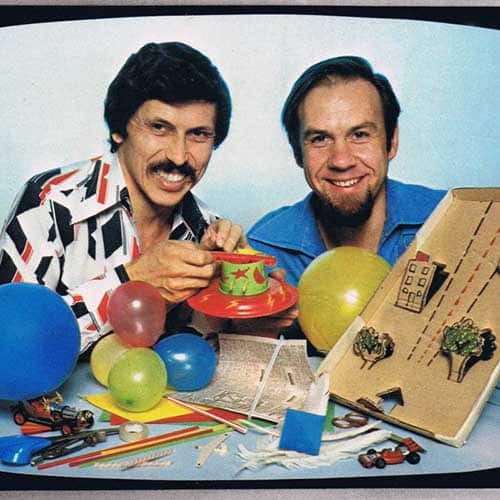
Speak with anyone who grew up in Australia during the 1970’s and 1980’s and they’ll remember the Curiosity Show! From 1972 to 1990, Deanne Hutton and Rob Morrison astounded audiences across Australia with explanations of strange phenomena and curious science with memorable demonstrations using household items. There were plenty of times when I would be begging my parents to get materials together after watching a segment of the show!
The brilliance came from the show’s simplicity, where there was no need for special effects or high energy presentations. Both Deanne and Rob brought authenticity to their presentations, where a measured rhythm and an inquisitive tone combined with top-notch experiments was all that was needed to engage kids of all ages. Let’s be honest, adults loved the Curiosity Show too!
I’m absolutely certain that the show inspired me to be involved in teaching science. More importantly, it helped me always to remember to include simple experiments in every school workshop or show, not just the whizz-bang ones. Additionally, creating a sense of wonder whilst being clear in communication was something that the presenters on the show were masters of. They didn’t cause additional confusion and were able to explain concepts simply and effectively.
On reflecting on the impact of the Curiosity Show, I suspect that there are thousands of teachers across the country who were at least indirectly influenced by the content let alone directly. In Australia, we often remember the great Julius Sumner Miller or still listen in awe to Dr Karl Kruszelnicki AM on ABC radio. Considering how influential the Curiosity Show was, I believe that the team that pulled together the show for nearly two decades also have their special place in Australian science communication.
So, what does this mean for us as teachers? Emulate the greats!
- Think about how your lesson structure helps the learner understand the concept.
- Can you use simple materials to help students connect with the content?
- Does your lesson overly rely on theatrics? Often you can let science do the work for you!
- Include variable testing in your demonstrations.
If we can keep these ideas in mind as educators, our work in inspiring the new generation of students will have that much more impact.
Brilliant work!





