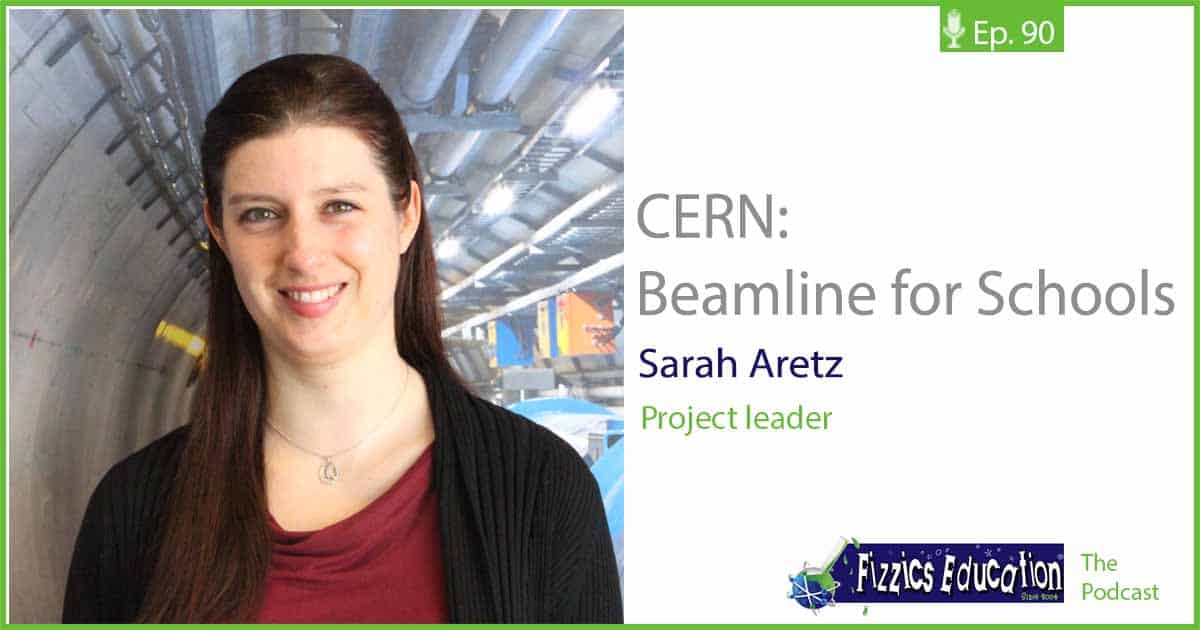
Learn more about an international science competition for high school students, where they can propose an experiment, which can be performed using a real particle accelerator. Winners are invited each year to visit CERN or DESY for two weeks with all costs covered to perform their proposed experiments together with professional scientists at a world-class particle physics laboratory.
How do high school students get the chance to walk the halls of the world’s largest particle physics laboratory? In this episode, we explore the CERN Beamline for Schools (BL4S) competition. We chat with Sarah Aretz about how teams of students from around the globe can propose their own scientific experiments, with the winners travelling to CERN, DESY, or the University of Bonn to bring their research to life at a professional beamline.
About Sarah Aretz
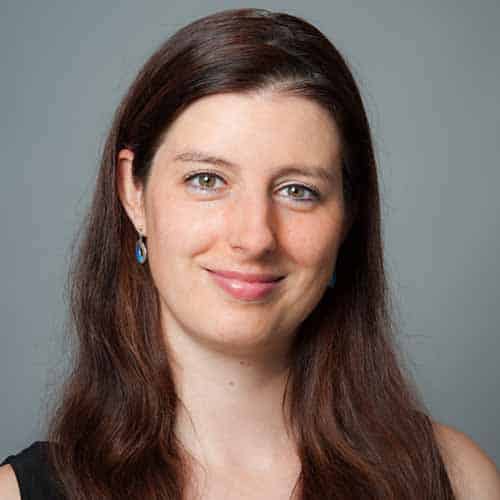
Sarah AretzDBDuncan Bell
Sarah Aretz is the Project Leader of the Beamline for Schools competition at CERN (the European Organisation for Nuclear Research) in Geneva. Sarah leads a diverse international team and has successfully implemented this competition across nearly 90 countries. In addition to managing this massive global contest, she is deeply involved in physics education research, ensuring that the competition effectively bridges the gap between high school classrooms and the cutting edge of modern particle physics.
Expertise: Particle Physics Education, International STEM Competitions, and Scientific Outreach.
The Beamline for Schools (BL4S) Competition
BL4S is a once-in-a-lifetime opportunity for secondary students to experience the life of a research scientist. Unlike standard science fairs, this competition provides winners with access to a fully-equipped particle accelerator beamline.
What You Need to Know for the 2026 Edition:
Global Reach: Open to high school students worldwide. In 2026, a record 712 proposals were submitted from 89 different countries.
The Prize: Winning teams (usually 5 per year) are invited to CERN (Switzerland), DESY (Germany), or ELSA (University of Bonn) for two weeks of hands-on experimentation, with all travel and accommodation costs covered.
Collaboration: Teams must consist of at least 5 students and be supported by at least one adult coach.
Beyond the Lab: The competition also awards prizes for the best video proposals and outstanding science outreach in local communities.
Defining a “Beamline”:
Sarah demystifies what a beamline actually is—a stream of subatomic particles moving at high speeds. Students learn to use these beams to test detectors, study antimatter, or even investigate medical science applications.
The Scientific Process:
Success in BL4S isn’t about knowing all the answers; it’s about asking a feasible and interesting question. Sarah explains how teams spend dozens of hours researching particle detectors to craft their proposals.
Building Global Networks:
We discuss how the competition creates a “mini-CERN” environment, where students from different cultures and languages collaborate on a shared scientific goal, fostering long-term professional networks.
Education Tip: The “Invisible Particle” Challenge.
You don’t need a billion-dollar accelerator to start thinking like a CERN scientist. Follow Sarah’s lead by building a DIY Cloud Chamber in your classroom. Using dry ice, isopropyl alcohol, and a dark container, students can actually “see” the tracks of cosmic rays passing through the air. As Sarah demonstrates, once students realise that invisible subatomic particles are everywhere, their curiosity about how to measure and manipulate them becomes the perfect fuel for a BL4S proposal!
[00:00:18]Ben Newsome: Yes, welcome again to another Fizzics Ed Podcast. Glad to have you yet again for another chat around STEM education. And by the way, if it’s your first time, you’re in a hangout space. On this podcast, we get to talk with lots of different educators from all over the planet and hear about what they’ve been doing to get kids right into science and technology and all that sort of thing. Really, really fun. Every now and then, we get to come across some really interesting chats, and this one is one of those days. CERN, you know, the big ring, the Large Hadron Collider, that particle accelerator under Europe, that 27-kilometre ring, they run a fantastic competition called the Beamline For Schools competition where kids all over the planet in teams compete to be able to come visit the ring and actually use real particle accelerators to do real science, to do real experiments, and it’s very, very, very cool. So, Sarah Aretz from CERN, on this chat, is going to describe all about what it is about and how you can get involved. So, I’m very excited to present this. It’s another episode of the Fizzics Ed Podcast. There’s plenty of them in the back catalogue that you can check out as well. But today, we’re talking particle physics and how you can get involved.
[00:01:42]Announcer: This is the Fizzics Ed Podcast. We’re all about science, ed tech and more. To see 100 fun free experiments you can do with your class, go to fizzicseducation.com.au. That’s physics spelled F I Z Z I C S and click 100 free experiments.
[00:01:54]Sarah Aretz: This competition called Beamline For Schools offers actually high school students from all around the world the chance to perform a real experiment at a real research laboratory, and this is therefore quite unique. So there is no fee to pay, so really everyone can take part.
[00:02:11]Sarah Aretz: And then we invite teams of at least five students and one adult team coach to propose a scientific experiment that they would like to perform at a particle accelerator. And of course, we know that this might be a big challenge in the beginning, as particle physics is usually not taught in school. However, the students are not alone. We do provide a lot of help. So our Beamline For Schools team and national contact persons in about 30 countries are answering students’ questions, also partially in their native language even, and helping them while they are developing their proposals. Furthermore, we provide also many useful resources on our website. First of all, of course, technical information about the beam conditions and also the available detectors which the students can use for their experiments they come up with. But second, we also provide a list of possible example experiments which the students can work out themselves in more detail in case they do not come up with their own idea, maybe.
[00:02:58]Sarah Aretz: And we also provide all previous winning proposals for the students to get an idea how such a proposal can look like and what has been done in the past. And very important then, in order to take part in this competition, each team has to submit a written proposal up to 1,000 words and a one-minute video until the deadline, a very important date which is always 31st of March, midnight CET, so Geneva time for CERN.
[00:03:34]Sarah Aretz: And then after an evaluation of all received proposals, which takes about two months actually, we then announce the winning teams and up to 30 shortlisted teams in June. And the winning teams are then invited in autumn with up to nine students and two team coaches per winning team for about two weeks with full cost covered really to perform their experiments themselves together with professional scientists. But there is also more, so the shortlisted teams receive, for example, extra prizes such as Beamline For Schools t-shirts and also a particle detector for the school in recent years, and every participant, shortlisted or not, receives a certificate of participation. So it’s really cool to take part.
[00:04:13]Ben Newsome: So what you’re saying is you’ve got a very small project, there’s not many people involved whatsoever. No, no, this is crazy! You’re really, really busy. So, I mean, I can see on your website you’ve got 49 countries were involved in 2019. I mean, with 178 teams, that is not a small undertaking at all, and considering the languages, let alone what you’re doing. Well done. Where did this all come from? I mean, obviously particle physics is a growing area for science flat out, simple as that. But I mean, to organise schools around the planet, I mean, someone decided to bite off a bit. Where did it come from?
[00:04:53]Sarah Aretz: That’s a very good question. So actually this competition is organised by CERN. So those of you who don’t know anything about CERN, this is an international research laboratory close to Geneva in Switzerland, Europe, and is accommodating the largest particle accelerator in the world with a circumference of 27 kilometres. And the Beamline For Schools competition was actually founded in 2014 at the time of CERN‘s 60th birthday.
[00:05:27]Sarah Aretz: And since then, it inspires and trains high school students in science. So the basic idea of this competition is really to get high school students in the age range of about 16 to 19 deeply engaged with particle physics by offering this unique chance to carry out their own experiments on a beamline, well actually under the same conditions as professional scientists. So yeah, this is how it came up. So it’s running since six years and we are looking forward to hopefully many more successful years.
[00:05:52]Ben Newsome: Oh, absolutely. I mean, the Large Hadron Collider is not a small machine. And I mean, mind you, okay, there’d be lots of people listening in, they’re science teachers, they know exactly what you’re talking about, there’d be lots of teachers in museum people who have come across this as well, but if you’re listening in and wondering, I’ve heard of it sort of, this is where that Higgs boson thing came about. This is where a lot of theoretical physics as well as the real analytical stuff happens to look at what happens right at the very start of time and what could happen in the future. It’s a really cool place. I mean, I must say, speaking with some of our team, they were saying, “You’re speaking with someone from CERN?” and they kind of wanted to jump on it as well. It’s very cool. So, right, I just heard when you were describing it at the start, that in recent years you helped some schools have a particle detector. Is that sort of done with dry ice or liquid nitrogen just to see muons and bits and pieces? What’s what is that?
[00:06:53]Sarah Aretz: Yes, so we have a team here at CERN and they are very keen to develop low-cost particle detector to detect muons, a very elementary particle which is going through us every second and you can measure it actually. And this low-cost detector, they are building here really from scratch, developing it, and it’s open source. And in recent years, we have given the shortlisted teams, each team one of these detectors, fully assembled and tested and shipped to wherever these shortlisted teams are, so that they can use it in their classrooms for many, many years and help support particle physics in the classroom and see what you can do with it and get the students engaged really actively in particle physics, which is usually not a topic which is taught very often in school, of course.
[00:07:46]Ben Newsome: That’s so very cool. Well done. Obviously, I can imagine some school districts just never having a chance at all, and that being part of a prize is just that’s awesome. It’s really, really cool. So I guess I would love to know, I mean, just in last year in March 31, you would have had all these proposals come in from all around the world and eventually you had to whittle it down to who gets to go. So I guess what the winning team of last year, what was their experiment? What did they want to know about?
[00:08:18]Sarah Aretz: So one of the winning teams of last year actually looked at fundamental differences between matter and antimatter. So we first have to say that actually since last year, we are collaborating with another research laboratory, which is DESY in Hamburg in Germany, because CERN‘s accelerators are currently switched off for maintenance and upgrade until next year. So this is why we are collaborating with them and the winning teams last year have been invited to DESY together with our team to perform their experiments there. And there, they were looking at electrons and positrons actually, and these particles at high energies, when they collide with a target, such as a piece of tungsten for example, some of their energy gets transferred into photons.
[00:09:08]Sarah Aretz: And these photons can, in turn, transform into other particles, and eventually a shower of particles at lower energies will develop. And the team has proposed to compare the properties of the particle showers originating from electrons with those created from positrons, which is the antimatter partner of the electron. So and they are still analysing their data and even going to a conference now end of January to present their results. So this has been very cool.
[00:09:37]Ben Newsome: Very cool. I mean, actually just knowing, having worked with students for many years, some of these kids, when they hear antimatter, they think it’s some sort of made-up stuff, science fiction type material, and yet they will get scans potentially in hospitals that take advantage of this physics that’s been around for years that we can do, and that really puts up the point that this work that gets done at CERN and other particle accelerators around the world is very useful for the public. It’s a thing that you’ve got done.
[00:10:05]Ben Newsome: Yeah, it’s really, really cool. So I mean, I imagine you’re going to have way more schools involved this year again. I mean, you started in 2014 and this is just growing and growing. I mean, how many people do you think might be involved this year in submitting?
[00:10:21]Sarah Aretz: Oh, that is a very good question. I’m very, very curious to see all the proposals end of March finally. So, I mean, so far in the last six years, we had about 10,000 students from 84 countries being involved in this competition. And each year on average we had plus minus 200 teams. Well, let’s say between 150 and 200 teams. So I really hope that this year we will also have about 200 teams maybe competing again in this competition. We will see. We never know because actually, as it is with most of the competitions, I guess, most of the proposals are actually submitted on the last few days, end of March, so we can never really say how many we will get.
[00:11:08]Ben Newsome: Oh, absolutely. I’ve been involved in a few different committees over the years and please, if you’re listening in and you’re thinking about submitting, don’t do it on the last day then your computer doesn’t work. Just don’t be that person. Usually, if you have enough people, someone’s going to send out a help me email. “Help me, help me, your page won’t work.” Do it a week prior if you can. And by the way, I mean, a lot of our people listening in, I mean, they are global, but we do have a lot of people in Australia. Don’t worry that it’s a month away. If you’ve missed the 2020 submission, that’s cool because you’ve got all year to work out what you might want to do for 2021 because I’ve got this funny feeling that this competition is not going to go away anytime soon.
[00:11:49]Sarah Aretz: Well, hopefully not. So currently ongoing the 2020 edition, the two winning teams will again be invited to DESY this year as we are still in shutdown. And the future of Beamline For Schools beyond 2020 is actually currently under discussion. So a decision is pending in which form the competition will be run after 2020, whereas several models are under discussion including also the collaboration with further research laboratories, because even more laboratories have said that they are interested in hosting this competition so we could even maybe franchise this competition and invite more than two winning teams each year.
[00:12:30]Sarah Aretz: So hosting the winning experiments at DESY last year has shown that the competition is not bound to one particular lab as long as the hosting lab is able to provide a particle beam, workforce for the organisation and also technical support and the necessary infrastructure, of course. So yeah, we don’t know what will come next year. Maybe we have more than one research lab and more than two winning teams, so there are even higher chances to win and to propose more different experiments because of course the beam conditions at different research laboratories are different, so there are even more experiments which can be proposed. So I would say stay tuned for edition 2021 of Beamline For Schools.
[00:13:10]Ben Newsome: Absolutely. And by the way though, I mean, so it’s late January 2020 right now. Schools are about to go back in a week or so, and there’s a usual scramble for a week or so while people get their classes together and everything else. But Year 11 and 12 Physics won’t go away, which means if you’re a physics teacher listening in, this might be, I mean, this is really time-stamping this conversation right now, but a big thing, Sarah, in Australia right now, or New South Wales where I’m chatting with you right now, is the depth studies, which is this idea that students have to propose and conduct a real research project for genuine marks towards their certificate for high school. And this is a really potentially cool idea that if they were able to be a group that got selected to come to CERN to actually carry out their experiment as part of their depth studies, that’s over the top and such a huge thing to win. So I’m just encouraged, Australian teachers, if you want to do something really cool this year, this is your opportunity.
[00:14:09]Sarah Aretz: Yes, exactly. Actually the one of the winning teams I talked about previously, they also had projects in school actually in the Netherlands. And they had the choice to do either another thing or to work on a Beamline For Schools experimental proposal, and they chose the latter because it was actually included in the school curriculum to do something of that sort, and then they won and got invited. And now they are quite famous in their surrounding and the mayor of their city has been invited to the event and everything. So they were interviewed with newspapers, radio and so on, so they are quite famous now.
[00:14:50]Ben Newsome: So I’ve got to ask, Sarah, how did you get involved with CERN? I mean, it’s an interesting, it’s always good for people to hear like they often wonder how does someone become a particular person that does a certain thing? And in this case you happen to be involved with Beamline For Schools. What’s your background? What did you do before getting involved with CERN?
[00:15:10]Sarah Aretz: Yeah, also very good question. Actually I studied astrophysics. I was always very, very curious about STEM, especially physics and astrophysics. But I was also always curious to work with people and to support the future scientists of tomorrow, let’s say. So I was also teaching in school for a few years, maths and physics and grammar school. And then I did a professional teacher training at CERN, which you also can do here, and while doing that for a week I kind of got stuck here, I was fascinated by this environment, and I started working in our education, communication and outreach team here at CERN and did a PhD here in physics education research because we have a small team here at CERN doing physics education research as well, which no one knows almost.
[00:16:04]Sarah Aretz: And during this time, many student programmes started here, not so we don’t have only programmes for teachers, national and international ones, but also a few programmes for students now which came up in recent years. And they offered me to take over one of them, and this is the Beamline For Schools competition. And I directly jumped on it because I find it very fascinating and a very cool concept for high school students, and I wish it already had existed during my time as a student because I for sure would have taken part.
[00:16:32]Ben Newsome: Absolutely. And I’ve for years followed with fascination just the discoveries around really subatomic physics. Sometimes it gets over the top. I mean, it reminds me of that quote, and I don’t know whether it was Fermi or Einstein or whoever it was, but that quote of “if I could remember the names of these particles, I would have been a botanist” or something like that. But I mean, there’s so many. It’s weird to know that really what you’re investigating is the fundamentals of matter itself. And it’s just, it’s cool. And I love that high school students can start that journey at a seriously cool research facility.
[00:17:15]Sarah Aretz: Oh yeah, it’s very cool. And I also want to emphasise that because many are overwhelmed in the beginning and don’t know what they should propose and it’s so much to learn, that they really don’t have to submit an experimental proposal developed fully in detail, really with everything. So we will still work together with them on it once they have won the competition. And there are so many different cool ideas. A few I have still in mind from the recent years, just to give you a few examples from what I still remember, are experiments about shielding of spacecraft to protect astronauts from the dangers of cosmic radiation, or the analysis of the atmosphere with respect to greenhouse gases, exploration of natural resources, or also creation of artificial Aurora Borealis, and even the artistic translation of signals of elementary particles into sights or sounds. So it’s really, really cool what they come up with, and there are really almost no boundaries in what they can propose, except we cannot put anything with DNA or anything radioactive in the beam, but apart from that, they are really free what they want to propose.
[00:18:23]Ben Newsome: Which means, I mean, I’m just going to ask the simple question just to clarify for some people listening in, they’re doing real research. Not just making a little side thing, they’re actually doing a real thing that could be used for people.
[00:18:35]Sarah Aretz: Yes, exactly. So they are doing real research and three of our previous winning teams already even published peer-reviewed scientific articles in a journal about their research and their experience they had during this competition. So and you see even one team is invited now to a conference to show their results actually. And it’s really, really cool what they are doing. They are really doing actual science and see how physics works. They get an insight into the life as a physicist and how science works. And last year a few of the winning students actually said, and that I found very fascinating, “Well, in school there’s always one answer we have to find and there’s one right answer and we only have to find this, there’s no creativity.” And when they were at DESY two weeks conducting their experiments, they were really amazed that they were included in all decisions, that they could do hands-on stuff themselves and they basically did the data analysis in the end themselves, and that there is not one right answer. Sometimes you have to discuss what you do, and this is real science and that’s what’s always unfortunately lacking in school.
[00:19:47]Ben Newsome: Well, it’s certainly you’re doing certainly something about that around the particle side for sure, there’s no way to describe it. And I imagine over time that you’ll build up an alumni of winning schools and people who are highly connected with this project. That means that over time, these students can meet with, chat with each other or whatever it is as you go through the years. These kids, you’re kind of forming a community, I guess is what I’m saying.
[00:20:17]Sarah Aretz: Exactly. Exactly. So we have an alumni group of all previous winning teams. They are also in contact with each other. One even put up a Facebook group where they are chatting with each other. We also officially from Beamline For Schools put up a Facebook group where we have more than 500 members already where students can find each other across countries and form teams across countries. So students don’t have to be from one school in order to take part in this competition. And in previous years when we always invited two winning teams, they were always sad when they had to leave and get back home. But some of the students visited each other in the different countries afterwards. So it’s really, really cool when you see them developing and forming friendships.
[00:21:02]Ben Newsome: Absolutely. And just a bit of a thumbs up to the supporters for the programme because these things don’t just go, just don’t turn up out of nowhere. I mean, they need funding and a lot of resources and backing to make it happen. And we know that you’ve had a number of foundations involved to be able to keep it going. So if you’re listening in and you’re from a foundation, maybe get in touch! That might help out CERN with what they’re trying to do to expand further. Hey Sarah, thanks so much for jumping on the podcast. Undoubtedly there’ll be some people who’d love to get in touch probably very soon, I suspect. So if they were going to get in touch, how would they go about it?
[00:21:42]Sarah Aretz: Yes, that’s very good. So online on our website which is cern.ch/bl4s, 4 really as a number for Beamline For Schools. We have a contact form which you can fill out and which directly comes to us. And online we also have our direct email address from our team which you can write to, and this is [email protected]. So just Google Beamline For Schools otherwise, find our website. There is all information on it and you can contact us in different ways even, and we are happy to help and answer all your questions, doesn’t matter if it’s organisational or technical, we will definitely help you.
[00:22:24]Ben Newsome: Absolutely. And by the way, when you jump on the website there is a good resource section there too. So go through previous documents and videos and all the bits and pieces that you might want to do as you put together your submission. So jump on board. And if you’re not a high school physics teacher, let a high school physics teacher know. Or a chemistry teacher, because it fits with both ways. Actually, I’ve got to ask that, Sarah. Do you find mainly physics classes getting involved or do chemistry teachers get involved sometimes too?
[00:22:51]Sarah Aretz: It seems that it’s mostly physics classes, but not only. So we had even students in winning teams who did not take physics, but they met for example in another, for example, robotics group or another group they had at the school working on some kind of project. And they got to know each other from different classes. And even though they might have not had physics, they jumped into that project. And we had many students interested more in biology or IT stuff, programming and so on, or medicine. But you know you can do so many things with these experimental proposals. You don’t have to be a nerd in physics. You can be interested in other things as well and a good combination of different students is always the best for a team.
[00:23:38]Ben Newsome: Absolutely. It’s highly creative and very interesting as you go along. No, very good. Well, thank you, Sarah, very much. I know you’re starting your day. I’m finishing my day. Considering we’re I think we’re directly opposite on the planet more or less.
[00:23:54]Sarah Aretz: Almost, yes. More or less, yes.
[00:23:56]Ben Newsome: Pretty pretty close to it. But look, much appreciated and good luck with the 2020 competition. No doubt it’ll be yet another success, that’s for sure. And hopefully people listening in, jump on board. It’d be great if a couple of you do get on board. And if you do, just give us a shout out and let us know how you went. I’d love to know what project you came up with. But in the meantime, if you don’t do it this year, 2021 will have another permutation of this competition, I’m sure. Keep it on your radar and enjoy. Sarah, have a fantastic day and I hope to catch you soon.
[00:24:31]Sarah Aretz: Yes, thank you very much for this opportunity. And greetings to Australia.
[00:24:54]Ben Newsome: Well there we go, you just heard from Sarah Aretz, who you can really tell has a fantastically interesting job there at CERN, hearing from all these projects and getting to see them actually happen in the flesh. That would be so awesome. And tell you what would be more awesome? Your class, your students getting to head over to CERN to do real research. How amazing! And something to be said about actually seeing the real materials being used by kids. It does so much more for their actual understanding of not only how science works, but seeing that it’s a real thing done by real people. And here are the machines that they’ve been learning about and now they get to use it. That is so, so cool.
[00:25:32]Ben Newsome: And by the way, Australia actually has its own nuclear science technology organisation and it’s called ANSTO. Australia’s Nuclear Science and Technology Organisation, that’s who they are. And recently, Duncan Bell – Duncan works at Fizzics Education as an educator as well, and he actually heads up the Fizzics Twist podcast – and he popped on down to ANSTO, which is just south of Sydney at a place called Lucas Heights. And got to speak with Bridget Murphy and hear about what ANSTO does in terms of research around particle physics and all that sort of thing. And he got to design his own little particle detector and let’s see how he went.
[00:26:06]Duncan Bell: So I just saw this trail of vapour appear in the chamber. That was cool. I have no idea what type it was though. Oh, there’s another one! So that one looks too long to be an alpha particle, too straight to be a beta particle. I think we’re going to need to do some more research.
[00:26:29]Ben Newsome: There you go. He actually found a muon and that particular particle you can actually find if you make your own particle detector. And if you head on to the Fizzics Twist podcast, so F-I-Z-Z-I-C-S and then the word Twist, T-W-I-S-T, Fizzics Twist, you’ll be able to hear how he made it and it’s not that hard to actually make. You just need to get something really cold like nitrogen, liquid nitrogen or dry ice or something like that, and set up the right temperature gradients and the right materials which you can get around the house and you can see those particles for yourself, which is very, very cool.
[00:27:03]Ben Newsome: But the chat with Bridget from ANSTO was also interesting because you get to hear all about isotope production and research that’s done in Australia around nuclear science and its impact. Very, very cool. So that’s just about it for this particular episode, but we do have far more planned throughout the year. Trust me! And check out the back catalogue if you haven’t had a chance. There’s heaps of different science organisations doing some wickedly cool stuff with education. It’s well worth checking out. But that’s enough for today. I hope you have a fantastic evening, morning, wherever you are, whatever you’re doing. You’ve been listening to me, Ben Newsome from Fizzics Education. And I hope you have a fantastic time. We’ll catch you another time.
[00:28:07]Announcer: This podcast is part of the Australian Educators Online Network. aeon.net.au.
Recognised by
22 years, award-winning work, 1 purpose
Recognition from business, education and industry bodies across Australia.
Australian Small Business Champion
Multiple years
CILC Pinnacle Award and Hall of Fame inductee
Center for Interactive Learning and Collaboration
Western Sydney Awards for Business Excellence
Winner
Top 100 Coolest Company
Listed
Local Business Awards
Winner
We value your privacy
We use cookies to improve your experience. Essential cookies are always active. You can choose which optional cookies to allow.We use cookies. Optional ones stay off unless you allow them.Privacy policy