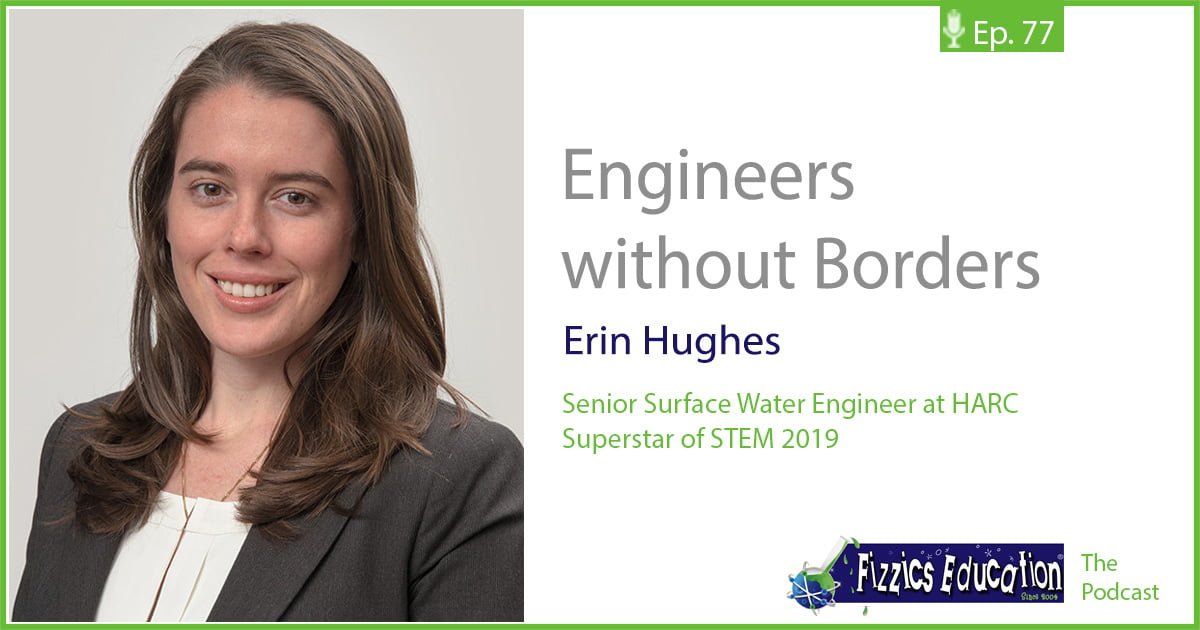
Meet Erin Hughes, a highly passionate Senior Surface Water Engineer who also is involved in delivering engineering outreach to remote schools in the Torres Straits in collaboration with Engineers Without Borders. As a 2019 Superstar of STEM, Erin clearly shows a huge interest in inspiring the next generation of engineers!
With water being fundamental to life, it is no wonder that water management is being heralded as the next global crisis. In this episode, we talk with Erin Hughes about her journey from the Torres Strait to becoming a leading surface water engineer. We explore how Engineers Without Borders Australia is using sustainable, humanitarian engineering projects to inspire the next generation in remote Indigenous communities through the sharing of knowledge and culture.
About Erin Hughes
Originally from the Torres Strait, Erin grew up in a fishing family and was educated via School of the Air over the VHF radio. This unique background shaped her career as a surface water engineer at Hydrology and Risk Consulting, where she specialises in hydraulic modelling. Erin is a 2019-2020 Superstar of STEM and has spent the last four years leading outreach programmes that deliver hands-on engineering projects to remote schools in collaboration with Engineers Without Borders.
Erin is passionate about improving STEM engagement for Aboriginal and Torres Strait Islander people. Her work focuses on creating long-term community partnerships and providing visible role models to show that engineering is a powerful tool for community development.
Engineers Without Borders Australia is a member-based organisation that creates social value through engineering. EWB believes that engineering and technical professions have a significant role to play in solving global challenges, from humanitarian aid to sustainable infrastructure.
Inspiring the Next Generation:
School Outreach: EWB has developed specialised workshops designed to inspire young people from prep to high school to use engineering to solve real-world problems.
Humanitarian Engineering: The organisation focuses on human-centred design, ensuring that technical solutions such as water filters and prosthetic limbs are appropriate for the social context.
Indigenous Partnership: By establishing long-term relationships with remote schools, EWB helps students recognise STEM as a career path they can use to benefit their own communities.
Top Episode Learnings: Engineering for Impact
Engineering as a Humanitarian Tool:
Erin explains how projects like water filters and emergency beacons show students that engineering is about solving human needs and improving quality of life, not just technical construction.
Scenario-Based Learning:
We discuss how the “bridge building” challenge teaches students about the triple bottom line by requiring them to balance structural needs with community values and strict budgets.
The Importance of Visibility:
Erin shares how programmes like Superstars of STEM are essential for uncovering the diverse range of STEM careers that are often invisible even to those working within the industry.
Education Tip: The Stakeholder Consultation Challenge.
When running a classroom engineering challenge, follow Erin’s lead by introducing “Community Chiefs” or stakeholders with specific values. Instead of just building a bridge to hold weight, require students to present their design to a stakeholder and justify their budget and material choices. This shift from a simple science experiment to a human-centred engineering task helps students see the direct community impact of their work.
[00:00:19]Ben Newsome: Yes, welcome again to another Fizzics Ed Podcast. It’s an interesting week this week. We’re speaking with Erin Hughes, who is a senior surface water engineer and is very passionate about STEM education. You see, Erin grew up in the Torres Strait and she was surrounded by water and she really knew first-hand the impact that engineering could have on local communities.
[00:00:42]Ben Newsome: Fast forward to 2019, she’s now a Superstar of STEM and over the last four years, she’s been working on outreach programmes which deliver engineering projects to remote schools across the Torres Strait in collaboration with Engineers Without Borders. Interesting life, I must say. Today we get to speak with Erin and find out just why she’s doing this, why she’s so passionate about this type of work, and her impact when it comes to education in the Torres Strait and potentially further beyond as the Engineers Without Borders programme keeps on expanding. So, an interesting chat. Very, very happy to have Erin Hughes on board and I hope you enjoy.
[00:02:16]Ben Newsome: So, you’ve been a bit busy this year?
[00:02:19]Erin Hughes: Yes, it’s been pretty flat out here and it’s still going. We’ve still got a good half of the year left to get through a few exciting things.
[00:02:30]Ben Newsome: And that actually brings up the point. What have you been getting up to? What is it that you do?
[00:02:38]Erin Hughes: Well, to give you a bit of background about myself, I’m a surface water engineer and I work for an engineering consultancy in Victoria at the moment called Hydrology and Risk Consulting. But as well as my day job, I’m very passionate about working with Aboriginal and Torres Strait Islander communities in STEM education.
[00:03:01]Erin Hughes: On the side, I do a lot of volunteering for organisations such as Engineers Without Borders, running a lot of their educational programmes and some of their Aboriginal and Torres Strait Islander programmes. I’m really excited to be one of the sixty recipients of the Superstars of STEM programme for 2019 and 2020. That’s a programme that looks at increasing the visibility of women in STEM as a way of breaking down unconscious biases and stereotypes around women in the STEM industry.
[00:03:34]Ben Newsome: And they’re doing a seriously decent effort on that. So, listeners, seriously, just type in Superstars of STEM and you’ll find this plethora of information about it on the Science & Technology Australia website. It’s really a serious effort and not flippantly; there’s so much stuff out there that just needs to be more visible, and that’s what that’s all about, which is awesome. But you’re clearly busy doing outreach and I definitely want to get into all that. Engineers Without Borders sounds awesome. But just thinking way back at the start, why choose the science thing in the first place? What made you go, “You know what, I want to become a hydrologist, I want to do this sort of work?”
[00:04:18]Erin Hughes: A lot of my decision to follow this type of career path really linked back to my childhood and where I grew up. I’m originally from the Torres Strait and that in itself was quite remote, but I was even more remote, I guess. I grew up in a fishing family and for a number of months at a time we were out on fishing vessels.
[00:04:39]Erin Hughes: When I wasn’t in access to communities that had schools, I had to do distance education, or School of the Air basically. I did my classroom lessons over the VHF radio back in the day. That was fantastic for me; it really gave me the opportunity to explore my interests and my passions and actually link them into my life and how I responded to the world around me.
[00:05:11]Erin Hughes: There was that component that I got excited about STEM because of that ability to explore. Also, I probably didn’t realise at the time, but certainly later on in life, the impact that engineering had on the world around me and my access to services and how it affected the community. That was a big driver for what actually led me down the path of studying engineering and becoming an engineer.
[00:05:43]Ben Newsome: That’s awesome. What a great story. Just as a little side note, I do so much work with distance education with a variety of schools, a lot of work with Distance Rural Technologies in New South Wales. I just connected with a group through Moreton School of Distance Education out of Queensland. They had kids all over different stations around Queensland. I do have a passion for that. So that’s the little side note. Oh cool, you do that? I know exactly what you’re talking about.
[00:06:13]Erin Hughes: Most people don’t. They go, “Oh, you did home school?” It’s a little bit different to that, but yes!
[00:06:20]Ben Newsome: It’s incredibly modern and really, if anything, I’m just going to go on a tangent here, jeez you learn some collaborative skills at an early age.
[00:06:33]Erin Hughes: You definitely do and I think that’s one of the things I originally talk about, I guess, in school workshops that I do is I tell kids I certainly wasn’t incredibly smart at science and maths, but something that my schooling taught me was how to learn and to have the discipline to teach myself. And that’s just, that’s my superpower, and that’s sort of what’s got me to where I am today and in my career.
[00:07:00]Ben Newsome: That’s awesome. So there, wind it forward, you are an engineer, you are doing awesome work in the industry truly, but you’re also doing a lot of work in this outreach and especially for indigenous communities. Let’s hear a bit more about what you’ve been doing with that, I’d love to know more.
[00:07:20]Erin Hughes: Yeah, so I guess the main programme that I’ve been focusing on for the last four years is the work that I’m actually doing back up in the Torres Strait. About four years ago we received a grant from Google which enabled me to go up with a group of volunteers who were both student engineers and professional engineers to run a series of workshops in some of the remote communities up there.
[00:07:40]Erin Hughes: And as a result of the success of that initial programme, I’ve actually been able to secure funding and run that for the last four years. And I’m really looking at establishing long-term community partnerships as a way to improve engagement with STEM, particularly for females and Aboriginal and Torres Strait Islander people.
[00:07:53]Erin Hughes: So, yeah, it’s been really exciting, a fantastic programme and, yeah, it’s allowed me to get back home and hopefully share an amazing part of Australia with a group of people.
[00:08:10]Ben Newsome: That’s so cool. And yeah, you’ve got to love an outreach thing that takes you home, by the way.
[00:08:16]Erin Hughes: You do. You do. My mum always jokes that I somehow try and link all my work to come home all the time.
[00:08:24]Ben Newsome: Nothing wrong with that. That’s fine. But if I wasn’t linked with your home and I’m in a community where I know you’re going to come visit, what would I get to see and do?
[00:08:33]Erin Hughes: We generally link up with the schools within the region. Originally, our programmes were actually developed mainly for high schools, but we’ve redesigned them and tailored them so that we can not only deliver them in high schools, but we deliver them in primary schools right through to our preps and our pre-preps.
[00:08:52]Erin Hughes: So if you are happy for us to come out to your school and run a workshop, we generally provide an offering of different types of workshops and they generally have a humanitarian engineering focus. We give students real-world problems that they actually have to solve through hands-on learning.
[00:09:20]Erin Hughes: Our projects range, so we do things such as clean water filters, emergency beacon design, prosthetic limbs, we do floating house workshops and things such as bridge design. To give you an example of the slight difference or the spin on some of our workshops, I guess the classic engineering “build a bridge” example. Yes, we do teach the kids about structural engineering and they do have to make a bridge that can hold a certain weight.
[00:10:00]Erin Hughes: But we also teach kids about the triple bottom line and design approaches that you have to go to when designing and implementing a bridge. So they get a scenario where they actually have to build a bridge between two island communities, except for the chiefs of each island have very different values and very different visions for what they need this bridge for.
[00:10:23]Erin Hughes: So the students have to actually do community consultation to be able to develop a bridge which would be suitable for the needs of both communities. And on top of that, they get a nice limited budget so they have to think about the importance of sustainability and the type of materials that they’re also going to be making their bridges from.
[00:10:56]Ben Newsome: Yeah, that’s realistic because we visit schools all the time and sometimes you’ll hear these awesome projects but the kids will just get given more resources, more resources. It’s almost like this never-ending pit of wooden sticks and glue sticks and whatever. But in reality, in the real world, you’ve got a budget and you’ve got a timeline.
[00:11:23]Erin Hughes: Exactly. And it’s not only the design that’s critical. You could come up with the best design in the world with a budget that you have, but if it isn’t fit for what the community wants, no one’s going to use it. So they actually get judged through three different components.
[00:11:38]Erin Hughes: From the chiefs in the community, whoever they are, they will judge it based on have they met their needs. They get judged on the cost perspective, have they made it within budget, but then also an actual structural perspective; it has to hold a certain weight to be effective.
[00:11:56]Ben Newsome: Which is good because I think of the community projects that happen around the place and I love the fact that you’re actually embedding it with the community itself because so often things get put upon on high that may actually not work in any way. I’m actually thinking right now of a particular rollout of school halls and there were some of the halls that were considered that might have been built around the Snowy Mountains area that didn’t allow for snow!
[00:12:22]Ben Newsome: So there were some issues and some consultation work that further happened. New South Wales teachers and others will be very aware of how long that process goes. But the roof design had to be collaboratively changed outside of what was being required as a cookie-cutter thing because it wasn’t going to fit the environment that it was going to be built for.
[00:12:41]Erin Hughes: Exactly. No, exactly.
[00:12:42]Ben Newsome: That’s it. So this thing though, you’re doing water filters and all sorts of stuff, it actually reminded me there was a project done by Joan Rory. She did this programme called Ripples Make Waves whereby she was taking students to Central and South America, mainly Central America I think it was in Guatemala, whereby these students would then work with local communities to improve clean drinking water, for real.
[00:13:06]Ben Newsome: And then she would do these 24-hour Skype calls all around the world where students would then call in from all over the globe to describe what they’ve been doing to improve clean water and whatnot. Certainly what you’re doing with the Engineers Without Borders is great, you’re going out to these schools and doing this stuff. I imagine these students now would have the capacity now to teach others.
[00:13:28]Erin Hughes: Yeah, I certainly hope so. For me anyway, it’s not about making everyone want to have a career in STEM. It’s very much about providing role models for these students if that is a space that they are interested in following as a career, but also giving them the understanding of the impact that STEM has on the world around them.
[00:13:53]Erin Hughes: Like you said, even with clean drinking water, that’s an essential human requirement, and to have that understanding and linkage to the importance of STEM in providing you that service is really important too, I think.
[00:14:06]Ben Newsome: So how often do you get to go out in the wide blue yonder and speak with communities? I mean, you’ve got also a day job, you’ve got work to do. How often do you get to go out and do that?
[00:14:16]Erin Hughes: Yeah, so for our Torres Strait programme that is once a year and it’s a four-week trip that we do take leave, and we try to link it outside of university time so our students can also come along and participate.
[00:14:35]Erin Hughes: And then on top of that, where available, I do link into other organisations such as Scienceworks and run workshops with them when they have events on the weekend. And occasionally as well, we have a very flexible work environment where I work, so I do sometimes have the opportunity to go out during work hours as well and go to schools that are closer that I can drive to and give presentations.
[00:15:02]Ben Newsome: Oh awesome. And now I’d like to actually just talk a bit more about the Superstars of STEM programme itself because I know there’s people listening in who might just be well considering potentially applying for the next round. So I think you’d have intimate knowledge of this. So tell us a bit more about it.
[00:15:18]Erin Hughes: Yeah, it’s I guess the reason why I applied was it’s a programme that certainly supports you in becoming more visible and it provides you the skills to do that effectively. So for me, I very much like to be in the backdrops and not as forward-facing. And it slightly scared me looking at what you would have to do as part of this programme. And I went, “Well, this is fantastic. I should be doing this and I need to be doing this because there is some amazing voices out there that in a way aren’t being heard, especially because they might be a minority within a field.”
[00:16:08]Erin Hughes: So yeah, I did it and I applied for it because it slightly scared me. But it’s been a fantastic programme so far in terms of the amazing support, the training that you get, and also the wonderful cohort of women. And I’ve gone away from nearly every session going, “Oh my god, I didn’t even know that was a career you could have in STEM.” There’s some fantastic things you do learn.
[00:16:33]Ben Newsome: Which is it too, because it’s a celebration of everyone’s work, but also it’s literally uncovering what some people even do. I mean, it’s funny how even as scientists or engineers or technologists or whoever we are, that we’re often blinkered to not realise just how much is actually out there. And we’re the ones who are engaged, right?
[00:16:51]Erin Hughes: Yeah, exactly. So to come to that realisation pretty quickly in yourself when you’re within this field, you sort of go, “Yep, we definitely need to be getting people’s voices out there about what they’re doing and some of the amazing work that’s going on in Australia.”
[00:17:07]Ben Newsome: Yeah. So it’s May in 2019 right now, so you’ve got a bit more to go with this programme. I mean, what is coming up through this series?
[00:17:17]Erin Hughes: Yeah, so for the first year in particular, a lot of that’s around personal development and they link you in with some fantastic workshops. So we have four workshops over the full year. And then this second year of the programme is very much about you following your passions and how to use the skills that you’ve gained to explore certain areas. And for myself, that’s very much within the STEM education programmes and expanding that and tying my work very much into that.
[00:17:53]Erin Hughes: The second part of the year of this programme as well does require you to do a certain amount of engagement with schools. So that’s a compulsory commitment on behalf of everyone who accepts this programme as well.
[00:18:05]Ben Newsome: Sounds to me like you would have no trouble with that bit because you’re already doing it.
[00:18:10]Erin Hughes: Yes, I was very lucky in terms of that, as the area and the passion that I have is pretty much linked into a compulsory part of the programme.
[00:18:18]Ben Newsome: That’s an extra win just there. I guess I’m kind of wondering, obviously you’ve got your formal work that you do day to day, and that’s clearly what you’re on about as well, but there’s also this side thing. It must be difficult juggling as to what you want to do over the years.
[00:18:37]Erin Hughes: Yeah, I think I’ve been really lucky in terms of, one, I love my job and I’ve always linked, I guess, my side passions into my career and tied them in a way into what I do. So that’s been very helpful. And it’s also been very helpful that I’ve been in fantastic work organisations which do support that social responsibility perspective and supporting their employees.
[00:19:20]Ben Newsome: We really need to give a shout-out to where you work because it’s great that they let you out and doing this. So who do you work with again?
[00:19:28]Erin Hughes: I work for a small consultancy called Hydrology and Risk Consulting. We’re really tiny, 25 people in total, and specialised in hydrology, risk management, and hydraulic modelling.
[00:19:41]Ben Newsome: Good on them because obviously some of this is done on your spare time too, but you’re occasionally taking phone calls to organise stuff as you have to do when those phone calls come in. The support of an organisation makes a huge difference for these types of things, which is just awesome. It’s good that you’re doing this. So when are you next heading up to the Torres Strait, or have you got plans to go to any other areas in Australia?
[00:20:03]Erin Hughes: This year we’re heading back up in November. I’ve very excitingly received an additional grant, so we’re looking at expanding the trip and hopefully going to a few extra communities around the area to run these workshops as part of that grant.
[00:20:25]Erin Hughes: Within that as well, I’m doing some research into educational impacts to kind of hopefully try and provide some evidence around my theory of the importance of continued relationships with STEM education as a way to improve STEM engagement for women and minority groups such as Aboriginal and Torres Strait Islander people.
[00:20:54]Erin Hughes: As part of that, I’m hoping it’ll provide me a platform to actually expand this programme and start more long-term relationships into strategic remote parts of Australia.
[00:21:03]Ben Newsome: That’s awesome. There’s so much work going around with this. We only just recently interviewed Corey Tutt, who out of the University of Sydney as part of the Veterinary School, if I remember off the top of my head, and Science Faculty, is organising off his own bat getting books sent out to indigenous communities, working with elders, and it is just genuinely cool.
[00:21:25]Ben Newsome: I think it’s really good that there’s so much you can do with people who have a genuine thirst for this type of outreach. It’s just a matter of having someone to hook onto, and clearly you are one of those people they could hook onto. So knowing that, if people wanted to get in touch with you, how would they do that?
[00:21:42]Erin Hughes: I’m definitely on LinkedIn if you search for Erin Hughes, or as well, you can go through an organisation such as Engineers Without Borders to link into some of the programmes that I manage if you’re interested in getting involved as well.
[00:21:59]Ben Newsome: Awesome. So what we’ll do is we’ll put all those links in the show notes so you can definitely go check all that out and hunt Erin down. But much appreciate it, Erin, especially just joining us in the afternoon. And no, it’s not Friday, it’s earlier on in the week. My brain’s… it’s Thursday! It’s not quite there yet. But thank you very much for joining us here and well done with what you’ve got up to so far. Being involved with Superstars of STEM is fantastic, but the reality is that you’d still be knocking stuff down and making stuff happen regardless. So it’s very cool and we’re happy to see what you’re doing further on down the track.
[00:22:39]Erin Hughes: No, thank you so much for having me. It’s been fantastic to have a chat.
[00:22:42]Ben Newsome: Well, there we go. We just heard from Erin Hughes, who you can really tell is a highly passionate person when it comes to STEM education and improving the quality of life in remote indigenous communities. And you can really tell this passion is ongoing and will keep on going as she keeps on doing this work with Engineers Without Borders Australia. And this is something that you can get involved in. Why not reach out to them? Their website again is ewb.org.au.
[00:23:15]Ben Newsome: Just check out what they get up to and this is something that you could possibly get involved in in your holidays or if you know a scientist or engineer who just might want to get involved, hey, flick them the link. Let them know that they can be involved as well. So I hope you got a bit out of this. I certainly did. It was great hearing what Erin Hughes has been up to and I know that her work in amongst the Superstars of STEM and in her own work with Engineers Without Borders Australia is making a significant difference. So that’s about it for this particular episode. We’ll be coming up with more education-based stuff in the next couple of weeks again. I hope you have a fantastic week and I’ll catch you another time.
What are the key components of the Engineers Without Borders school workshops?
The workshops use a humanitarian engineering focus to solve real-world problems. Students engage in hands-on learning tasks such as designing clean water filters, prosthetic limbs, emergency beacons, and floating houses, moving beyond simple construction to understanding social impact.
What is the significance of the “Superstars of STEM” programme mentioned in the episode?
The programme aims to increase the visibility of women in STEM to break down unconscious biases and stereotypes. For Erin, it provides the skills to be a more visible role model and highlights the diverse, often unexpected career paths available within the STEM industry.
How does the “bridge building” workshop teach more than just structural engineering?
In this scenario, students must consult with community chiefs who have conflicting values. The task requires them to balance technical structural requirements with a limited budget, sustainability, and community consultation to ensure the final design is actually fit for purpose.
Why does Erin emphasise “learning how to learn” over being naturally gifted at maths?
Erin shares that she wasn’t initially “incredibly smart” at science or maths. However, her distance education background gave her the self-discipline to teach herself complex concepts, proving that persistence and learning strategies are often more important for an engineering career than innate talent.
Discussion points summarised from the Engineers without borders with AI assistance, verified and edited by Ben Newsome CF
Extra thought ideas to consider
Community Consultation as a Design Constraint
In many school projects, students build for an abstract goal. Incorporating “community chiefs” or stakeholders with conflicting needs, as seen in the Torres Strait programme, teaches students that engineering success is defined by human and cultural factors as much as technical ones.
The “Superpower” of Distance Education
Erin’s experience suggests that the self-directed nature of distance education can foster unique meta-cognitive skills. Educators could explore how to integrate more self-teaching and independent research opportunities into standard STEM curricula to build student resilience.
Long-term Relationships vs. One-off Outreach
Erin highlights the importance of continued relationships in remote communities rather than isolated visits. This raises the question of how educational organisations can move towards more sustainable, multi-year partnerships to create a lasting impact on STEM engagement for minority groups.
Recognised by
22 years, award-winning work, 1 purpose
Recognition from business, education and industry bodies across Australia.
Australian Small Business Champion
Multiple years
CILC Pinnacle Award and Hall of Fame inductee
Center for Interactive Learning and Collaboration
Western Sydney Awards for Business Excellence
Winner
Top 100 Coolest Company
Listed
Local Business Awards
Winner
We value your privacy
We use cookies to improve your experience. Essential cookies are always active. You can choose which optional cookies to allow.We use cookies. Optional ones stay off unless you allow them.Privacy policy