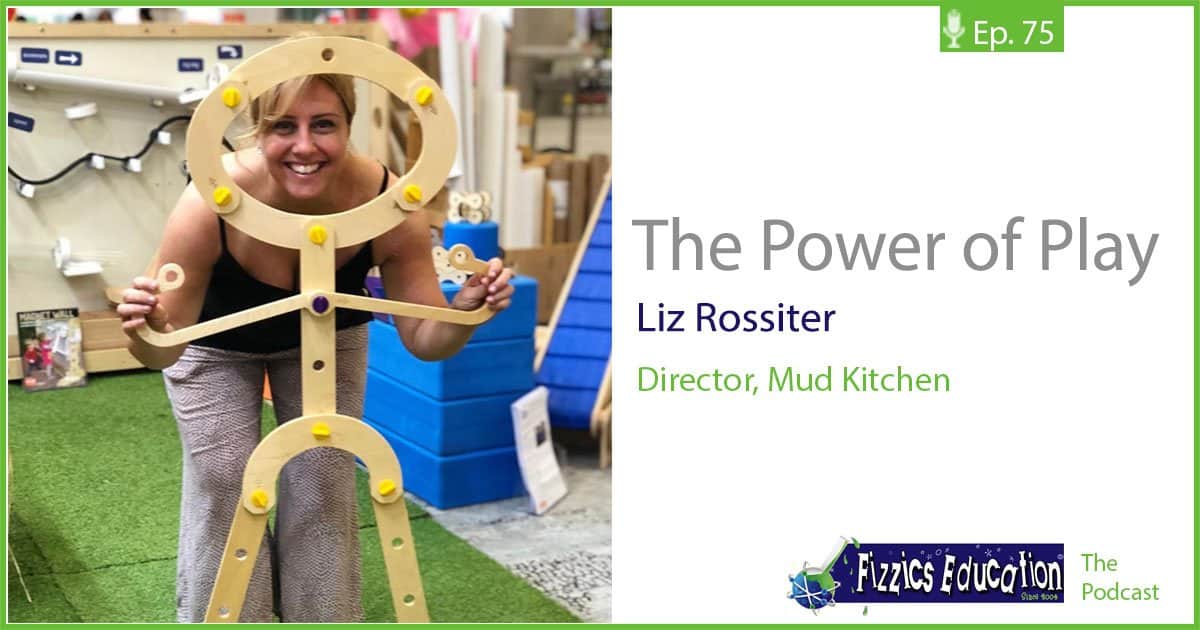
Creating opportunities for children for play opens up a world of STEM learning opportunities for students young and old. We chat with Liz Rossiter from Mud Kitchen who through her Unplug & Play Pop Up STEM playgrounds is helping kids across the country explore science & engineering through hands-on activities traditionally found in children’s museums. From programs in schools and preschools through to libraries, shopping centres and festivals, you can tell Liz has been having a blast!
In a world of screens and digital-heavy classrooms, how do we get back to the “wonder-filled” roots of discovery? In this episode, we talk with Liz Rossiter about the power of Unplugged STEM. We explore her journey from visiting American children’s museums to receiving a Women in STEM grant to bring mobile “Unplug and Play” STEM playgrounds to communities across Australia.
About Liz Rossiter
Growing up in the US, Liz Rossiter was inspired by the experiential nature of children’s museums like the Ann Arbor Hands-On Museum. This sparked an enduring passion for play spaces defined by investigation, discovery, and imaginative learning. Today, Liz is a leading advocate for play-based STEM learning as an essential balance to digital environments. Through her company, Mud Kitchen, she curates innovative educational resources for schools, preschools, and libraries. Liz also facilitates ‘Unplug and Play’ Pop Up STEM Playgrounds and was awarded a Women in STEM grant from the federal government to bring these playful learning spaces to communities all over Australia.
Expertise: Play-based Learning, Unplugged STEM, Early Childhood Education, and Community Engagement.
Mud Kitchen & Unplug and Playground
Liz’s work centres on the idea that the most profound learning often happens when children are given the space to tinker, collaborate, and imagine without a screen in sight.
Key Pillars of Unplugged Learning:
Tactile Problem Solving: Liz emphasises the “visceral” nature of physical play, where children learn cause and effect through “if this, then that” scenarios in real time.
Unplug and Play Pop Ups: These mobile STEM playgrounds bring hands-on discovery directly to the community. Supported by the Australian Government, these spaces allow children to explore physics and engineering through large-scale, open-ended equipment like wind tunnels and giant marble runs.
Universal Communication: Liz advocates for STEM learning that acts as a universal language, bridging gaps for those with different linguistic backgrounds or sensory needs through shared physical challenges.
Top Episode Learnings: The Magic of Playful STEM
The “Old School” Advantage:
Liz discusses how returning to tactile materials like paper towel rolls, cushions, and sticks fosters critical thinking and creativity that digital-only coding can rarely replicate.
Intergenerational Connections:
We explore how physical construction projects allow grandparents and children to meet in the middle, sharing perspectives on momentum, trajectory, and building techniques.
STEM as a Social Initiative:
Liz highlights that her playgrounds are about more than just science; they are about placemaking and building community by engaging families in public spaces like shopping centres and festivals.
Education Tip: Don’t Overcomplicate It.
Follow Liz’s lead by looking at the world around you as a potential play space. You don’t need expensive kits to teach science; simple items like couch cushions for elevation, planks of wood for ramps, or sticks and leaves can demonstrate force, motion, and gravity. As Liz demonstrates, when you Unplug the lesson and provide these resources, students engage in natural investigation and discovery.
[00:00:17]Ben Newsome: Yes, welcome again to another Fizzics Ed Podcast. It is another big week this week. We are speaking with Liz Rossiter, who is a big proponent of doing hands-on stuff with kids, actually getting kids to get away from the screen and getting things into their hands to unplug and play. In fact, she currently runs these pop-up STEM playgrounds called Unplug and Play through her company, Mud Kitchen.
[00:00:38]Ben Newsome: Now, for a couple of years, she’s been doing some truly innovative stuff when it comes to getting kids to really get into this maker movement, putting stuff together and seeing what happens using marble runs and magnets and all these sorts of things for the really young kids, from three years old right through to the older kids. They’ve been having a blast at schools and preschools, libraries, community groups, and shopping centres. It’s all about a playful philosophy. So, I hope you enjoy this chat. I certainly loved hanging out with Liz, and enjoy!
[00:01:07]Announcer: This is the Fizzics Ed Podcast. We’re all about science, ed tech and more. To see 100 fun free experiments you can do with your class, go to fizzicseducation.com.au. That’s physics spelled F I Z Z I C S and click 100 free experiments.
[00:01:26]Ben Newsome: Welcome to the Fizzics Ed Podcast!
[00:01:28]Liz Rossiter: Thank you, thank you for having me.
[00:01:30]Ben Newsome: Now, Liz, you do a whole bunch of stuff. Some people may not have got around to meeting you yet, so tell us a bit about what you get up to.
[00:01:41]Liz Rossiter: Well, I am very, very busy. I’ve got my hands in lots of different pots. I guess I’ve got ideas going all the time, primarily around just giving opportunities for playful learning to kids of all ages and parents as well. I’m really quite passionate about the idea that we get a lot of screens in our lives, and it’s really fun to kind of go old school and play with things that are a bit open-ended.
[00:02:14]Ben Newsome: Now, as a person who is a parent—you’ve got kids in high school, right?
[00:02:19]Liz Rossiter: Yes, God help me!
[00:02:22]Ben Newsome: I know, but for people to say that is one thing, but you totally jumped in full-scale. How did this happen?
[00:02:31]Liz Rossiter: I guess it all kind of stems from the time when I was a kid. I grew up in the US and I had parents who were academic, so we had summers off. We used to go on these epic road trips and a way to break up the monotony of the Midwest is to stop at children’s museums or various museums, whatever it happened to be along the way. Often those were places where we could run around, touch things, play with things, eat weird foods, and talk to people in their accents. It was just very experiential.
[00:02:59]Ben Newsome: Those things are amazing. If you’re listening and wondering what a children’s museum is, I can tell you now, children’s museums are nothing like what you see in Australia in many ways. A good friend of ours at the Ann Arbor Hands-On Museum in Michigan—I think we had an episode with Corinne Stracka a little while ago about what they get up to—but they are enormously cool. Could you describe what they’re like?
[00:03:21]Liz Rossiter: It’s almost like a wonderland really, that’s how I’ve described it to many people. It’s like just the opportunity to get in and touch things and play with things and move things and potentially break things, but it’s all the idea that everything in there is for investigation and discovery and imaginative learning. So you’ve got giant cogs and wheels and pendulums and all kinds of things that you’d find in daily life, but never get the chance to really explore deeply.
[00:03:51]Ben Newsome: Yeah, they’re really cool because they’re not just like, “here press a button and watch the interactive do the thing”.
[00:03:57]Liz Rossiter: No, it’s like “here’s a bunch of stuff, what can we do?”. And I guess it’s controlled chaos in that sense as well. It’s guided into play that becomes learning but not in a, you know, beat you over the head with this learning. It’s not book learning, it’s very much hands-on learning. And one of the things I remember so distinctly from my childhood is a giant old switchboard from early telephones and basically a whole wall was covered in switches for this switchboard.
[00:04:25]Liz Rossiter: And then you could talk to your friends around the other side or down there through the little, you know, it was just like an old operator kind of system and it was fantastic.
[00:04:35]Ben Newsome: That’d be unreal. I mean it actually reminds me—gosh, it’s funny how these discussions always go down memory lane. I’ve got this vague memory of living up in Townsville and one of our next door neighbours, they had like these chopped up cars of all things, and we’d actually sit in the tow truck or in the Mini. And by the way, there were redback spiders and everything in there! It was totally dangerous!
[00:04:54]Liz Rossiter: Oh yeah, super! So you survived.
[00:04:56]Ben Newsome: We survived! But I know my dad made up these—he got some old seatbelts from the tip, back when you could go to the rubbish tip and actually take stuff out and not get in trouble. Don’t do that children. But they made these like space suits out of these clips and I would run around the backyard literally with seatbelts around me. It was just nuts.
[00:05:18]Liz Rossiter: Absolutely, it’s that kind of stuff. It’s great. I had a friend who I grew up with and she—well, family friend and we saw them once every year or so—and we used to always take over their family basement and create museums. And it was exactly that. We replicated what we’d grab, her mum’s old caftans—you know, she’s a bit of a hippie—we’d do a caftan display and we’d do… yeah, it was just a spice display. So we had all these, we’d raid the kitchen for whatever we could and you’d have to taste each spice and we did little labels for each one. So this goes back a while for me.
[00:05:55]Ben Newsome: Sounds like—and the thing is, I guess winding it forward, you now 100% all hands in, all feet in on an entire venture. What are you up to?
[00:06:01]Liz Rossiter: Yeah, so we do a couple of different things. I’ve managed to get quite a few suppliers from around the world to allow me to bring in their beautiful products into Australia to supply to schools and preschools and museums, libraries and things here through our business Mud Kitchen, which is essentially—the mandate for that business, I guess the underpinning of it, is to provide playful learning experiences for people. So it’s really high quality things that are kind of large in scale often and provide these opportunities to play and learn in ways that aren’t necessarily always available with traditional toys.
[00:06:44]Ben Newsome: The thing is, I’ve seen these things in action and they are—by the way, just as a heads up, this is not like a straight up product advertisement—these things are actually amazingly cool. And I’ve seen them set up in shopping centres as well as like major science events, festivals. I mean, it’s really hard to peel the kids away from it.
[00:06:56]Liz Rossiter: Yeah, absolutely. And the adults as well. It’s just phenomenal to see people playing together. So what we’ve—going down that path, what we’ve done is then branched off into presenting and sort of curating all of our best ideas and presenting them in what we’re calling Unplug and Play pop-up STEM playgrounds. So the idea is that we are offering opportunities for kids and families all across Australia to really unplug, get away from screens and look at STEM and STEAM—I guess, you know, there’s a lot of creativity and imagination—in a completely different way, kind of an old school way.
[00:07:35]Ben Newsome: Yeah, what was really fun, and one of the interactives which I know you do is around the marble runs. Whereby, yeah, you can create a marble run, like we’ve all seen marble runs, but you can totally embed this into a primary curriculum looking at potential energy through to moving through to kinetic energy. You could do timing through gates, the whole lot. There’s actually a fair bit you can measure and do.
[00:07:51]Liz Rossiter: Yeah, absolutely. And you can also extend it into things like even literacy, where you have to do, you know, almost a procedural writing. We’ve created this thing and here’s how we did it and here’s the things that, you know, here’s what we found and step one, step two, step three, the result. Let’s try it again. What, you know, lots of different ways to approach it from all different kinds of learning aspects. Older kids can be given a whole heap of materials and be told, “Here’s the end effect we want to—here’s the result we want to achieve. Let’s theorise about what we could do here” and do some drawings and designs and then put it into action.
[00:08:33]Ben Newsome: And the thing about this is that there’s this big push of maker spaces and STEM—and let’s be honest, the acronym that will be around for a while—but this making and creating is a real thing. And having the ability for kids to have actually unstructured as well as structured play is so important.
[00:08:51]Liz Rossiter: Yes. And I think for me, you know, I often use the example of coding. When you’re coding something and you see a result, a digital result, you’re digitally coding digital result. It’s one thing, but when you actually see something and an “if, then”, “if this then that” result in real life using, you know, something as simple as a paper towel roll and a marble—if I tip it this way it’s going to do that, if I do this it’s going to do that—I’m finding failure points, I’m readjusting, I’m looking, stepping back. It’s all critical thinking, it’s creativity, but it’s tactile.
[00:09:28]Ben Newsome: Absolutely. I mean, I actually think of some of the fun things I’ve seen around the place is where they create either a piece of paper or something they can float on air for a little while and having a fan under it and the whole thing goes up. And I believe, if I remember correctly, you do something like that.
[00:09:42]Liz Rossiter: Yeah, we’ve got a wind tunnel. Yeah, it’s exactly that. It’s as simple as a giant Perspex tube and a fan that’s positioned properly underneath it. And the number of things that you can put in that tube and see the effects, and then chart them, graph them, talk about why this happens, that happens—does it matter what angle it’s tipped at?
[00:10:04]Ben Newsome: You could actually have fun with that because, I mean, usually when I see those as an interactive in a museum, it tends to be the child puts the thing directly above the fan and up it goes and they just time how fast it goes up. I’d like to flip it. It’d be kind of fun to actually go, “Can you make it get to the bottom without scrunching it into a total ball?”
[00:10:18]Liz Rossiter: Yeah, absolutely! It’s those things are just so simple like that, and wind as a concept is probably one of the hardest things to demonstrate because it’s invisible and air and all that. But those kinds of things are perfect for that investigation. So it just gives me goosebumps to think about all the things that kids, when given the right sort of open-ended materials, can create things that are just phenomenal and learn at the same time they’re having fun.
[00:10:50]Ben Newsome: So what are some of the best things that you’ve seen happen either in a preschool, early learning centre, a primary school where you go, “You know what?”—and it doesn’t have to be around the stuff that you provide—but you’re going, “You know what, the learning is 100% visceral, it’s real, it’s hands-on.” What are some of the lessons that you’ve seen sort of happen around the place?
[00:11:08]Liz Rossiter: I think one of the most rewarding and gratifying things for me is the way that experiences like that can bring people together and form sort of a community around and collaboration and communication among people who might not speak to each other otherwise, or kids who might not speak to each other otherwise. We see a lot of really interesting pairings. So, intergenerational—sometimes we’ll have grandparents come with kids to events, and often the grandparents feel a bit reluctant to join in on something that’s digital, but they’re all about building and creating and construction, especially granddads.
[00:11:35]Liz Rossiter: It’s just phenomenal to see those connections, especially if they’re an ex-builder, ex-engineer. And they’ll say ‘Look at this, can you see? It’s building momentum’ or ‘Why did that, you know, the trajectory of that, you know?’ It’s so interesting.
[00:12:03]Ben Newsome: Have you had actually interest from retirement centres just out of interest? Because that—because like you wouldn’t think of that as a pairing, but at the same point we’ve done work where we’ve been in front—we’ve done like Grandparents’ Day where rather than going, “Here let’s do a show”, we suggested, well, why don’t we do something where the grandparents can teach the kids about the thing, whatever the thing might be. That would be a lot of fun.
[00:12:24]Liz Rossiter: Yeah, yeah. I like that idea. I guess along similar lines as well, you often see boys and girls playing together of different ages. So sometimes there’ll be a young boy, four or five, who’s working with a 12-year-old girl to build something that they both have a vested interest in making sure that this ball goes down the path that they both want to create. And they add very different perspectives to that project.
[00:12:49]Liz Rossiter: The other thing I’ve seen, and it’s just to me being… I love to see sometimes we get groups that’ll come in who might be English as a second language children and parents as well.
[00:13:15]Liz Rossiter: And being able to play is such a beautiful universal thing and the communication that happens between the parents and the children, but also then the parents feel comfortable talking to potentially another parent who’s also helping to build something. And those lovely little relationships can form, and children who don’t necessarily speak a lot of English or sometimes even children who might have some issues with communication or sensory issues can feel more at home when they’re playing because it kind of takes away a verbal—it can be non-verbal, it can be quite real.
[00:13:44]Ben Newsome: I think we were just out in a shopping mall or something. They had some interactives out just next to the food court, and there were kids and our kids playing where 100% there was no language. It was straight up, they just showed them the block, whatever it was, and they were totally working perfectly fine.
[00:14:13]Liz Rossiter: It’s a universal language really. I mean, I know that sounds a bit cliché, but truly, given the opportunity, everybody loves to play and it doesn’t have to be fancy, it doesn’t have to be complicated. And I do think honestly that the deepest learning comes from opportunities where you get the chance to play freely and not feel constricted by what’s proper and what’s prescribed and what the outcome must be dictated by this particular set of structures. It has to just… the only requisite is that you get in and try.
[00:14:51]Ben Newsome: Well, this is one of the fun things about this is that it doesn’t necessarily have to be an older to younger paradigm. I mean, what I really like watching is when a year one student, year two student teaches the year six student on how to use the thing.
[00:15:06]Liz Rossiter: Yes! I love that.
[00:15:07]Ben Newsome: Which is actually a good exercise in humility, let’s be honest.
[00:15:10]Liz Rossiter: Yes, absolutely. Well, there’s also that lovely sharing of perspectives. The little kid sees the stuff down below and the big kid sees the stuff up above and they meet in the middle. We’ve seen some of the most stunning ball runs, giant ball runs, talking several metres long with some of the equipment that we have where the stuff at the top is so complicated and interesting and they’ve done lots of twists and turns and bends. And the kids at the bottom end, the toddlers, have done almost exactly the same thing down at their level, but they’re mimicking or collaborating in a way that’s really beautiful.
[00:15:44]Ben Newsome: That’s really cool. And to be honest, that sort of stuff lends itself directly to Rube Goldberg machines.
[00:15:50]Liz Rossiter: Yeah, absolutely. Simple machines and contraptions. And it is that idea that we see a lot of things just happen. So you flip a light switch and the light comes on, but what’s actually happening between the light switch and the light? And that’s I think at—Rube Goldberg tends to complicate things, but that’s the idea is that you start at this one place and you want an effect to happen at the other. And all those little bits and pieces that happen in between are where the fun is.
[00:16:17]Ben Newsome: Well that’s it. I mean like you look at any curriculum, I mean we’ve usually got our theory dot points that we’ve got to get through, and that’s a good thing. But they’ve also got this other side which is the working scientifically side. The idea to actually go, what are the actual skills?
[00:16:30]Liz Rossiter: Design processes, design thinking, all of that sort of stuff is just absolutely fundamental, I think, to knowing how to relate to cause and effect. And this is happening and why is it happening? And maybe I don’t know why it’s happening, and that’s okay too. And along the way, I’m going to find something else.
[00:16:51]Ben Newsome: Well, that’s exactly right. And it’s just, I mean, let’s be honest, there’s nothing wrong with just having a little bit of fun sometimes too.
[00:16:58]Liz Rossiter: No, absolutely! And play for play’s sake is… and as I said, I’m not a zealot about screen-free time. I can definitely attest that there are many times when that’s just the best solution to keep everybody happy for a little while, and I do think that there’s a lot to be said for being able to teach kids about technology and digital applications to all kinds of things because it is the future.
[00:17:26]Ben Newsome: And you can mesh it too. Like it totally depends on horses for courses, what is the lesson you’re trying to achieve.
[00:17:33]Liz Rossiter: Yeah, yeah. And I just think there it’s really important for a balance to be struck. And lots of kids, mine included sometimes, don’t get that balance.
[00:17:40]Ben Newsome: Now, you are… well, it’s not quite now, it’s more middle of the year, but recently you were at the World Science Festival and just a little bit popular.
[00:17:48]Liz Rossiter: Oh, it was so fantastic! We were the featured daytime activity at the Festival Lab, which was the biggest sort of structure in the space, and the weekend I think they had 50,000 people come through on the weekend and we were a ticketed event so we had limited numbers, but we sold out in three hours. It was fantastic. So many sessions and just exactly what I was talking about, those beautiful combinations of intergenerational, boys and girls, all kinds of different people coming from different backgrounds to play. Lots of giggling, lots of fun.
[00:18:25]Ben Newsome: Kind of hearing about this I’m trying to work out, is this work for you?
[00:18:30]Liz Rossiter: Yeah, well, I’d love to say no, but occasionally it does feel like it. Well, a lot of events equals the work. It’s a lot of play, and sometimes you have to keep the fun in that. But yeah, we’re pretty keen to show the world our Unplug and Play pop-up STEM playgrounds.
[00:18:49]Ben Newsome: Well that’s it, they’re really coming ahead in a great way. What’s coming up?
[00:18:52]Liz Rossiter: So we got some funding thanks to funding from the Women in STEM programmes through the federal government. We’ve got some support from them to bring these to communities all over Australia. So essentially it’ll be a couple multi-day events where we just bring our equipment and set up a really beautiful play space.
[00:19:20]Ben Newsome: That’ll be so cool because that programme is going to be amazingly cool, not just obviously… we’re talking here on an education podcast so often people will think it’s all about the schools, but in reality it doesn’t have to be around formal education at all. I mean this is for public spaces where anyone can get involved.
[00:19:35]Liz Rossiter: Yep, public space. It’s a wonderful actually placemaking kind of initiative. So we’re… I’m quite passionate as well about defining community as more than just infrastructure and all of that, but also about creating creative spaces. And there’s so many venues and parks and playgrounds and things like that that are just perfect for giant festivals of play basically, which is what we’re trying to bring to all kinds of communities.
[00:20:06]Ben Newsome: Which means, if you’re listening on in and you know people who do work in that community area and whatnot, I’m guessing you might want to get in touch with Liz.
[00:20:13]Liz Rossiter: Yes, happy to talk to just about anybody about it. But ideally it’s people who are looking for ways to engage the community, whether they’ve got already a large community festival planned and want to supplement it, or are just looking for kind of a showcase event. Maybe it’s something that in the depths of winter you need something colourful and bright, we’re happy to bring our playgrounds to fill those spaces.
[00:20:43]Liz Rossiter: But it is really one of those things where it’s a unique, quite innovative way to get people together and really, you know, to… we wouldn’t say STEM is a trend necessarily, it’s definitely an emerging thing that people are quite… it’s now visible. It’s quite a visible trend and we are just presenting kind of a, I guess one arm of that, but a playful one.
[00:21:07]Ben Newsome: Which is going to be a lot of fun. Now no doubt there’s a place to go find out more info, yes? Whereabouts?
[00:21:12]Liz Rossiter: Well, we have a website, it’s called unplugandplayground.com.au. See what I did there?
[00:21:20]Liz Rossiter: unplugandplayground.com.au. There’s a bit of information that we can send you, there’s a form on there to fill out. You can just put your details in and I’ll send over our presentation and we can have a chat.
[00:21:32]Ben Newsome: That’d be fantastic. And now, something before you run away, because I know you’ve totally got to run away. Something we always ask, and I really do value this, is I always love for people to just give us a bit of advice about… you know, it’s always just handy. So imagine if you had, I don’t know, a bunch of people who happen to look after a bunch of young kids in front of them irrespective of their background. What would you suggest to help them unplug and play?
[00:21:54]Liz Rossiter: That’s a really good question. I think ultimately what it comes back down to for me is don’t overcomplicate it. There are so many things just between couch cushions and paper towel rolls and leaves and sticks and things like that that can be created into a bit of an imaginative play space that also can demonstrate all kinds of things—force and motion and gravity and all those kinds of things. But just setting up a cushion on the floor that provides a bit of elevation and a simple tunnel or even just a plank of wood can provide all kinds of entertainment if you’re rolling different things down it. So don’t stress too much.
[00:22:42]Ben Newsome: It’s all about the imagination and unleashing it really.
[00:22:45]Liz Rossiter: Absolutely. And just being aware, I guess, of how much really around our world is potentially playful.
[00:22:52]Ben Newsome: True. And I should leave you be because you’ve got to go play elsewhere, I’m guessing.
[00:22:57]Liz Rossiter: Yeah, well, it’s about that time.
[00:22:59]Ben Newsome: It is that time. Well, thank you very much for dropping by the Fizzics Ed offices.
[00:23:02]Liz Rossiter: Thank you, it was lovely.
[00:23:04]Ben Newsome: And love your work with what you’ve been doing and have a fantastic afternoon.
[00:23:07]Liz Rossiter: Thanks, I appreciate that. Thanks.
[00:23:09]Announcer: Not all TPL for teachers is as awesome as it could be. I feel like there’s a lot of PowerPoint presentations, a lot of sitting and listening to someone talk. Well, if you want a break from that, Fizzics TPL sessions are fully hands-on, fully integrated with the curriculum and full of amazing science ideas that you can put in your classroom right now.
[00:23:31]Ben Newsome: Well, there we go, we just heard from Liz Rossiter, who is an incredibly passionate person when it comes to play. You can really tell! And I bet her high school kids when they were younger had an absolute blast, and now with her programme with these STEM pop-ups all over the place, are making a genuine impact for people everywhere.
[00:23:48]Ben Newsome: Now, here’s the thing: you could totally be making impact with your own kids. If you’ve got young kids, you have early learners in front of you, if you have primary students, you totally can get kids into exploring their world using simple materials. Simply creating marble runs down ramps and getting them to time them or, as I talked about before, potential and kinetic energy. Yes, you can get into that, but just generally getting kids to learn about cause and effect is so important.
[00:24:12]Ben Newsome: Even looking at magnets—what does it stick to, what don’t they stick to? You could be looking at the science of sound. You could be looking at what makes a low sound, what makes a high sound, just by looking at different objects that are hanging around wherever you might be teaching or even at home. Even with young kids, the idea of looking at rough versus smooth from a tactile sense is incredibly important for young kids as they develop their ways of exploring their world.
[00:24:34]Ben Newsome: It’s so important to do. I mean you can look at light and colour, there’s heaps of things you can do, and it doesn’t have to cost the Earth. So look, I hope you had a bit of fun listening to this podcast and really do reach out to Mud Kitchen, find out what they can do for your place wherever you might be, I reckon your learners will have fun.
[00:24:52]Ben Newsome: So anyway, we have more podcasts coming up, we always do, and I hope you’re enjoying this as we’ve been going along. You’ve been listening to me, Ben Newsome from Fizzics Education, and you’ve been listening to the Fizzics Ed Podcast. I will catch you next week.
[00:25:32]Announcer: This podcast is part of the Australian Educators Online Network. AEON.net.au.
Frequently Asked Questions
What is the core philosophy behind the “Unplug and Play” playgrounds? The philosophy is centred on getting children away from screens and providing opportunities for “old school,” open-ended play. It focuses on investigation, discovery, and imaginative learning using tactile materials that allow for investigation without the constraints of prescribed outcomes.
How can simple activities like marble runs be integrated into a formal school curriculum? Marble runs can be used to teach physics concepts such as potential and kinetic energy, or mathematics through timing gates. Furthermore, they can support literacy by having students engage in procedural writing, documenting their design steps, findings, and results.
In what way does play act as a “universal language”? Play allows for non-verbal communication and collaboration. Liz has observed children with English as a second language or those with sensory issues engaging deeply with peers and parents through shared building projects, proving that common goals in play transcend language barriers.
Why is tactile learning considered different from digital coding in this context? While digital coding produces a digital result, tactile learning provides a visceral “if this, then that” experience. Using physical objects like paper towel rolls or planks of wood allows children to find failure points and readjust their critical thinking in the real world.
What is the purpose of the Women in STEM grant mentioned by Liz? The funding from the federal government’s Women in STEM programme is being used to bring mobile STEM playgrounds to communities across Australia. These events are designed as a placemaking initiative to engage the public in creative, colourful, and innovative play spaces.
Discussion points summarised from the The Power of Play with Liz Rossiter with AI assistance, verified and edited by Ben Newsome CF
Extra thought ideas to consider
The Value of Intergenerational Play
Consider how involving grandparents or retired professionals (like ex-builders or engineers) in STEM play can enrich the experience. As Liz noted, these mentors often naturally introduce advanced concepts like momentum and trajectory while collaborating on simple construction tasks.
Failure as a Learning Tool
In a physical play environment, “failure points” are immediate and obvious. Discuss how allowing children to struggle with a marble run or a wind tunnel design helps build the resilience and critical thinking skills necessary for scientific investigation.
Redefining Community Spaces
Think about how “placemaking” through play can transform infrastructure into creative hubs. By bringing STEM resources into parks and shopping centres, we can engage families who might not otherwise participate in formal science education programmes.
Recognised by
22 years, award-winning work, 1 purpose
Recognition from business, education and industry bodies across Australia.
Australian Small Business Champion
Multiple years
CILC Pinnacle Award and Hall of Fame inductee
Center for Interactive Learning and Collaboration
Western Sydney Awards for Business Excellence
Winner
Top 100 Coolest Company
Listed
Local Business Awards
Winner
We value your privacy
We use cookies to improve your experience. Essential cookies are always active. You can choose which optional cookies to allow.We use cookies. Optional ones stay off unless you allow them.Privacy policy