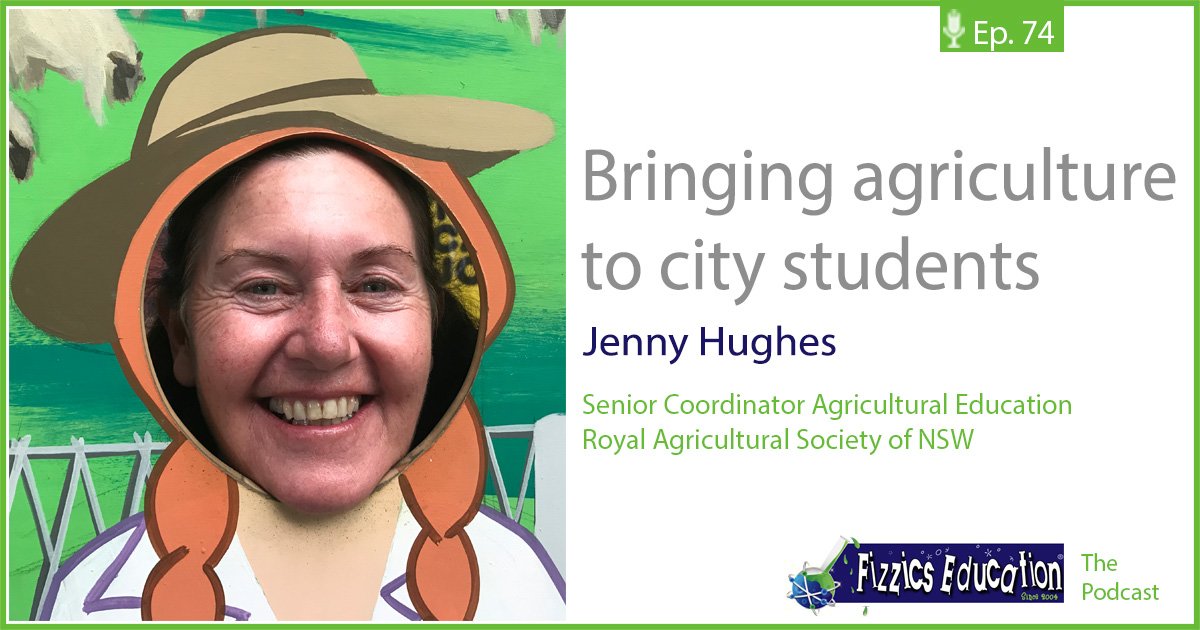
We discover just what the students can learn at the Primary Preview Day at the Sydney Royal Easter Show! Education coordinator Jenny Hughes from the Royal Agricultural Society of NSW takes us through a variety of exhibits and discusses the work RASNSW is doing to link agricultural science to learning in metropolitan areas.
How do we connect city-dwelling students with the primary industries that feed and clothe them? Recorded live at the Sydney Royal Easter Show Food Farm, this episode features Jenny Hughes from the Royal Agricultural Society of NSW. We explore why agricultural science is the ultimate “real-world” STEM application and how Jenny is using her background as a primary teacher to lift the profile of farming through the Primary Preview Day programme.
About Jenny Hughes
Jenny Hughes has a deep-rooted passion for agricultural science, having grown up on a wheat and sheep farm near Mendooran in the Central West of NSW. A trained primary teacher, Jenny is leveraging her pedagogical expertise and personal links to the bush to inspire young people about the future of farming. As the Education Coordinator for the Royal Agricultural Society of NSW (RAS), she develops programmes that highlight the sophisticated technology, biology, and chemistry behind modern Australian agriculture, including the renowned Archibull Prize.
Expertise:Education, Agricultural Science, and Rural Advocacy.
The Royal Agricultural Society of NSW (RAS) Education
The RAS is dedicated to ensuring that the bridge between “the city and the country” remains strong. Through events like the Primary Preview Day, Jenny and her team turn the showgrounds into a massive outdoor classroom focused on the Science and Technology curriculum.
Key Educational Initiatives:
Hands-on Dairy Technology: Students explore the mechanics of centrifugal motion in milk separators and learn about homogenisation and pasteurisation in a fully operational working dairy.
Sustainability and Food Waste: Programmes like the OzHarvest “Journey of the Wonky Carrot” teach students about nutritional value and reducing waste in the food supply chain.
Archibull Prize and Mentorship: Schools engage with Young Farming Champions to create artistic and technical installations (like robotic cows) that tell the story of Australian agriculture.
The Science of Food Preparation:
Jenny explains how hands-on activities like cooking with Australian Eggs allow students to witness chemical processes such as protein denaturation in real-time.
Soil and Hydrology Management:
We discuss the vital role of soil science and hydrology in farming. Modern farmers are “architects of their own future,” using friable soil knowledge and natural weed management to maintain their livelihood for generations.
Overcoming Geographical Barriers:
With the Great Dividing Range acting as a physical divider in Australia, Jenny highlights technology like Dial-a-Farmer and Arduino soil sensors as essential tools to connect city kids with regional agriculture.
Education Tip: Fair Testing in the Classroom.
Follow Jenny’s advice and grow wheatgrass with your students to explore plant structure. It is an easy way to conduct fair testing by varying light, dark, or soil conditions—noting that wheatgrass doesn’t even need soil to grow! For more advanced tech integration, use Arduino to monitor soil moisture and prevent overwatering.
[00:00:17] Ben Newsome: Yes, welcome again to another Fizzics Ed Podcast. It is another big week this week. We are speaking with Jenny Hughes, who is the Education Coordinator for the Royal Agricultural Society of New South Wales (RASNSW) agricultural programme. I can tell you, Jenny has a true passion for farming and education, really so. She was trained as a primary school teacher and she grew up on a farm near Mundoran in the central west of New South Wales, and she loves her work teaching kids about the agricultural world and how it relates to city kids.
[00:00:43] Ben Newsome: Tell you what, it is just a little bit different because this time we are in the heart of a live event. We have got all these kids around us, there’s education stuff happening everywhere, and we have got animals as well, which means it is a little bit noisy. But Jenny certainly takes us through why this Primary Preview Day is so important for kids and how it relates to city kids and regional areas as well. I hope you enjoy it; I certainly did.
[00:01:04] Announcer: This is the Fizzics Ed Podcast. We’re all about science, ed tech and more. To see 100 fun free experiments you can do with your class, go to fizzicseducation.com.au. That’s physics spelled F I Z Z I C S and click 100 free experiments.
[00:01:11] Ben Newsome: All right, hi Jenny. This is good fun.
[00:01:14] Jenny Hughes: It is really good fun. We’re here today at the Primary School Preview Day for the Sydney Royal Easter Show. It is our third annual time that we’ve done it, and it just goes from strength to strength, Ben. It is great.
[00:01:26] Ben Newsome: Yes, tell me about it. We’ve got a whole bunch of kids here coming past me with red uniforms, we’ve got blue uniforms, we’ve got white uniforms behind me. There’s hundreds and hundreds of kids here.
[00:01:35] Jenny Hughes: Yes, so just under a thousand kids here, and it is mainly Stage 2 and Stage 3 in primary school. We really focus on the Science and Technology part of the curriculum and make sure that they’re really doing some hands-on learning activities through the day.
[00:01:53] Ben Newsome: Well, this is a huge deal because the reality is everyone hears “paddock to plate” and all the rest, but fundamentally, this actually directly relates to my family. Most of my family come from the rural areas; they run farms in different ways, as graziers and all sorts of people. I love that you’re putting science and tech in it because it is really not just going, “Hey, we got a sheep, now we’ll go sell it.” There’s a lot more to it than that.
[00:02:13] Jenny Hughes: Yes, 100%. I’m a country farm girl, and it really is that experience of me growing up on a farm that I’ve tried to have happen in the Food Farm. So, everything from climbing on a cattle crush to picking up sacks of grain to helping out in the shearing shed, milking the cow of a morning—they’re all the experiences I grew up with, and I know a lot of city kids just don’t get that here. So, it is great to be able to show them this sort of stuff.
[00:02:38] Ben Newsome: And some really deep science when it comes to how soil science works, the hydrology of the area and everything else. People do full degrees for a good reason for this.
[00:02:48] Jenny Hughes: That is true, that is true. And look, we’re really lucky here because we get experts in from all over the place. From University of New England through to Fizzics Education, who certainly do a lot of stuff with science. We’ve got our sheep shearers from Billginnie Farm, we’ve got our dairy farmers from Camden in here, we’ve got just amazing people. But the real key is we’ve got a lot of Young Farming Champions from the Archibull programme, and that is really good because it is closer to the peer age, and kids learn so well from someone close to them in age.
[00:03:25] Ben Newsome: And the people who’ve been to Sydney Royal Easter Show before know full well what the Archibull is like. But we know we’ve got people listening all over the globe about this. What is this Archibull and what’s that all about?
[00:03:33] Jenny Hughes: That’s a really good—so, yes, they’re painted cows, pretty much. They’re life-size painted cows, and a woman named Lyn Strong started this programme probably nearly 10 years ago and she’s been developing it. And look, she gets schools involved in the programme. They get a blank canvas cow with nothing on it, but they pair that cow up with an industry and a Young Farming Champion. That Young Farming Champion goes into the school, mentors the kids, and then is available on email the whole time through the programme. And then all their learnings they then show on the cow. But it’s not actually just the cow, it’s a bigger programme than that. They’ve also got blogs and YouTubes and so there’s a whole heap of learning right across the curriculum for that programme.
[00:04:33] Ben Newsome: And it’s yes, it’s definitely an artistic installation they can use at their school and bring to here. But also, I mean, the tech 100% there. I’ve seen some robotic influences and all sorts of things. I mean, it’s not just painting; they 100% steam it up properly.
[00:04:45] Jenny Hughes: Oh, 100%. And you know, like, it’s the schools that really get involved with it across the curriculum are the ones that are really benefiting because, as you say, like sure, you know, you can paint a cow, but to make it robotic is another world altogether. You haven’t seen yet a couple in there; there’s the Lego cow this year.
[00:05:05] Ben Newsome: Haven’t seen that one. Not yet.
[00:05:07] Jenny Hughes: You know, like and there’s, you know, the big craze on the resurgence of Lego. You know, so there’s always, you know, something very topical in amongst them as well, so it’s real fun to see the new ones every year.
[00:05:15] Ben Newsome: So this started three years ago with the Primary Preview Day. I mean, what sparked that?
[00:05:20] Jenny Hughes: It sparked—we have incredible attendance with schools coming to the Easter Show. We’ve had a very long history with the schools programme. But I suppose I’m primary school trained and we had under 10% of the audience that were coming in were primary school. And look, I wouldn’t have brought them myself to be true. Like, you know, you would have had “Miss, where’s the showbag? Why can’t we have a showbag? Why can’t we go on a ride?”
[00:05:47] Jenny Hughes: So what we did was we actually created a space that’s safe, secure, without any of that. So today doesn’t have any rides. It doesn’t have the showbags. It doesn’t have the food stalls. The kids come like a normal excursion with their backpack, their food, and just experience the education that the Royal Agricultural Society can offer.
[00:06:07] Ben Newsome: It is, and you actually look at the hall. I mean, it’s in the Big Wool’s Food Farm there. It’s filled with stuff to do. What are the sort of things they get to do inside? I mean, it’s not just looking at a brochure. There’s lots of stuff to do.
[00:06:15] Jenny Hughes: Well, I think we probably should take a walk through, Ben.
[00:06:17] Ben Newsome: Yes, why not? We’ll just go for a walk. Actually, insert walking music. I don’t know what walking music’s like.
[00:06:24] Jenny Hughes: So outside we start off the day; we did have the sheep shearing across the back behind us. You can’t quite obviously see it, but we have had a pig, so in the pig pavilion. But walking now into the Food Farm.
[00:06:36] Ben Newsome: And it’s going to be loud because of it.
[00:06:38] Jenny Hughes: It is. We have Australian Eggs sponsors the Get Kids Cooking programme. So they actually get to cook with eggs, they learn how to crack eggs properly, and that happens right through show. Up to 3,000 kids get to do a free cooking session through show.
[00:06:55] Jenny Hughes: Today they probably do, I don’t know, seven sessions or no, ten sessions I think it is. You know, 30 kids a session. Just amazing.
[00:07:04] Ben Newsome: That’s really cool because they’ve got document cameras hanging straight over the top of their kitchen and they’ve got fully-fledged setup on white tables with kids to actually do it themselves. Actually, there’s a fair bit of science about protein denaturation and all that sort of thing to be able to cook an egg properly.
[00:07:18] Jenny Hughes: 100%. And they really do—it’s not just a fun thing, their narrative as they’re cooking actually brings all that out.
[00:07:26] Ben Newsome: Actually, I’m staring at a couple of primary students there. They’re almost tapping away at the fence; he’s really keen to get in there.
[00:07:33] Jenny Hughes: It’s like, “Bring it on, bring it on!” So what else have we got in here? As we move around, there’s OzHarvest in here with us. They are doing the “Journey of the Wonky Carrot”.
[00:07:45] Jenny Hughes: Well, there’s a lot—and supermarkets are becoming quite aware of it—about food waste, that we’re selecting food that is always top quality and not realising that the wonky carrot has just the same amount of vitamins, proteins, and minerals as everything else. It has had all the care and love from the farmer; it’s just a bit crooked.
[00:08:10] Ben Newsome: And you’re going to dice it anyway and throw it in the soup or whatever it is you’re going to do.
[00:08:13] Jenny Hughes: Correct. So we’ve got to really look at our food waste and see how we can curb that by actually using all our fruit and vegetables.
[00:08:24] Ben Newsome: Well, absolutely. When we look at food and fibre, there’s 100% a sustainability thing going right through it, whether they’re really young kids all the way to the older ones, absolutely.
[00:08:32] Jenny Hughes: Yes, 100%.
[00:08:34] Ben Newsome: Love it. What else we got here?
[00:08:35] Jenny Hughes: So we also have an activity we’ve created called “Shop to Table“. And that really is—I mean, today we’ve got it a lot more educational and a bit of a challenge for the older kids, but through Show it’s more for the younger kids to actually just experience and learn through that fun and play. So they get to go to the market and choose their not-so-real fruit and vegetables.
[00:08:56] Jenny Hughes: They’ve got little cash registers, some play money, some play little cooktops, so they can go right from choosing at the market, shopping it with their little proper shopping bags, cooking it on their little toy ovens, and then the parents can be sitting down relaxing and they can serve it to them.
[00:09:13] Ben Newsome: And the thing is, these are primary students, and there’s mathematics outcomes all over the place here for sure.
[00:09:22] Jenny Hughes: Oh, 100%. And this is as I say through Show really designed for the tiny tots. But we do this kind of activity year-round, and that’s where we do bring in the weights and the value of the food. We will give them a budget, we’ll give them play money and a recipe and a challenge, like you’ve got to create a three-course meal for a family of four. And they go to it, and it’s amazing the creations they come up with.
[00:09:51] Ben Newsome: Absolutely. And if you can’t make your way down to the Show here, I bet you could easily emulate this in your own classroom by getting some bits and pieces from the local reject store or whatever you’ve got. And maybe you could challenge the kids to go, “Let’s create a nutrition programme for an elite athlete,” for example, and then they’ve got to totally shop differently.
[00:10:06] Jenny Hughes: 100%. 100%. And look, I know there are programmes and kits out there, ‘Create Your Own Party’. That really does excite them because they’re all going to have a party at some stage throughout the year, so it makes it very real for them, which is really important whenever you’re doing something.
[00:10:21] Ben Newsome: Now, as an Australian, I can’t help myself, I really have always loved the pie making spot, where the kids can actually see how pies actually get baked for real, and then you get to eat them.
[00:10:32] Jenny Hughes: So let me tell you what Ben is actually smelling here.
[00:10:35] Ben Newsome: Yes, I haven’t had my lunch by the way. It’s—what is it currently? Yes, I should have had it.
[00:10:41] Jenny Hughes: So we actually get—there’s a Perspex window into a fully operational bakery. We get to see them make the dough, roll it out, scoop the filling into the pie, put it in the ovens, and then you can actually buy it at the other end.
[00:10:58] Ben Newsome: Here’s the thing, and I don’t know if people listening know, but years ago I did work experience in Year 11 at Defiance Milling flour. For a week I had to test flour for its colour, its pH, mix it up into a simple dough and see what its stretch is like. I mean, you can actually have batches of flour for pizza flour, for specific—they get really bespoke flours made for them.
[00:11:20] Jenny Hughes: 100%. So there’s durum wheat, which is Australian wheat produced a lot of our pasta, and comes from South Australia, a lot of it. I grew up on a wheat and sheep farm, so it’s all about the moisture and the protein content in each grain that they test to see where it ends up.
[00:11:39] Ben Newsome: And the thing is these grains coming through, I mean, they’ve now got to be more drought tolerant. Also, like you said with the proteins and bits, they’ve got to be able to serve a population that needs these things.
[00:11:50] Jenny Hughes: Yes, 100%. 100%. I’m growing wheatgrass out the back of my office here at the moment. It’s a very challenging experience only because it needs watering about three times a day. I have to keep setting an alarm to remind myself.
[00:12:05] Ben Newsome: I know, I have to set up a drip irrigation thing or something.
[00:12:07] Jenny Hughes: But the easiest thing for a classroom to do is to grow some wheatgrass. It’s quite easy to source some wheat from any stock and station or country supply sort of place. I believe they sell it in health food shops now as well.
[00:12:21] Ben Newsome: Oh, it’s a big thing, especially even like in those fruit juice places that they’ll put it through.
[00:12:25] Jenny Hughes: Yes, in under a week, you have as much wheatgrass as kids could grow it. And you could do fair testing too. You could totally wreck the soil on one and make it interesting on the other, or you could play with the light and dark, you could totally do that. Well, and the interesting thing to do wheatgrass, you don’t even need soil.
[00:12:43] Jenny Hughes: So that’s where it starts challenging them. Particularly if you’re doing that hypothesis to start off with, or estimating what’s going to happen, the kids are going to be thinking that the grass isn’t going to grow without the soil. So it can really blow their minds a bit when you go, “Oh, actually, the stuff without the soil grown faster. Why is that?” And you get to look at the plant structure as well. Well, indeed.
[00:13:05] Ben Newsome: That’s cool. So what else we got here? We got Catch of the Day.
[00:13:07] Jenny Hughes: Yes, so Department of Primary Industries has come around and have been working with us for many years now. And they have got the most bespoke, amazing programme together with the Fish on Show. They go right through from the best catch, the best practices, what where to fish, how to fish, and some of those really topical issues around fisheries at the moment. So they’re just amazing.
[00:13:33] Ben Newsome:Fisheries management is a mission. I remember doing it in the last year of uni—I’m a biology graduate—and trying to get your head around trying to estimate fish populations and therefore how much can you take out of the greater population before you destroy the group of fish that you’re trying to work with as a stock is a challenge, even to this day.
[00:13:50] Jenny Hughes: Yes, 100%. And I can’t wait to actually go through the whole experience myself. It’s actually now chockers with kids—it has been all day—so I haven’t been able to get a look in. But I know that you can actually go fishing in here, catch something and then learn about the fish you caught.
[00:14:07] Ben Newsome: Oh, excellent. And there’s difference between Australian native fish versus ones that—mind you, these are more the marine ones I think we’re looking at as opposed to aquatic. But that’s something that students don’t often realise, that there are some things that are in our waterways, our natural waterways, which whilst can be nice to eat, also present a challenge in terms of the ecosystem as well, so it’s often about balance when it comes down to it.
[00:14:28] Jenny Hughes: Yes, 100%. 100%. Cool, so we got wool here.
[00:14:31] Jenny Hughes: We do. Wool is such an amazing thing. We have that, “Australia was born off the back of a sheep’s wool,” and it’s never truer. The Australian wool clip is some of the better wool grown and produced across the globe. The fine quality Merino fibres, they are mainly processed still offshore, but they then come back to us.
[00:14:59] Jenny Hughes: What is amazing to see now is that we can actually track provenance though.
[00:15:05] Ben Newsome: I was thinking about heredity for sure.
[00:15:07] Jenny Hughes: Yes, so we can see what farm that animal was born and bred on even though it’s gone over for offshore processing, it comes back and it can still be identified and tagged to know where it’s come from.
[00:15:19] Ben Newsome: And I actually I wouldn’t be surprised if someone wanted to do the full genetics of this, they could almost track it back to the Spanish farms that the Merinos came from in the first place.
[00:15:26] Jenny Hughes: Yes, they would. They would. So and it’s really, Ben, that’s the whole thing and that’s why the Royal Agricultural Society, that is in three years’ time 200 years old, why it survives today. Because what it is about is surviving and nurturing the genetics of the best animals. So when you look around and see the animals on show, you are looking at the best bloodlines there are in the country.
[00:15:51] Ben Newsome: Which is actually really good for kids to realise that the show isn’t just about, “Hey, look at our animals.” This is actually a thriving business community and breed stock are important.
[00:16:02] Jenny Hughes: Oh, 100%. So it started really because when the British first came out here, nothing was working for them. It was like the seasons were different, our soils were different, the animals were different, the native grasses didn’t agree with the animals they brought out, all that kind of stuff. And if you look back, I love the stats when you look at the amount of animals that arrived with the First Fleet to the amount of animals here now. It’s just mind-blowing.
[00:16:30] Ben Newsome: Absolutely. I mean, those—there were very few animals on there and it wasn’t exactly a monoculture though, because you had ones brought in to be able to build up the stock. And then obviously if you’re dealing with cattle, for example, the Droughtmasters are a lot different to the Herefords and whatnot, and they serve certain purposes.
[00:16:48] Jenny Hughes: Oh, 100%. So growing up I’d never even heard or seen of a Brahman bull, that are very much more for northern climates. They don’t get sunburnt, they’re heat resistant, they can survive on much drier climate or a wetter climate, whereas the Herefords and those really beefed up animals really need that more fertile soil too.
[00:17:13] Ben Newsome: And the tough thing with this is also like you might be managing a paddock, a large station for example, where you might have completely different weed species, completely different fauna species that are just wreaking havoc on your place, and you need to look after it within the budget as well. So it’s almost like science and economics unite.
[00:17:31] Jenny Hughes: It’s fabulous to go out to a property and see the soil management. That is where it all starts. Without the soil and the sun, we don’t eat.
[00:17:42] Ben Newsome: Well, that’s the thing. It’s often a misconception that I’ve come across even just going from school to school talking around geology, is that often—and it depends what areas we’re talking—whereby someone will say, “Oh, the farmers made just, they just want to wreck the—get as much out of the soil as possible and sell the next crop and they’ll buy new fertiliser.” But the thing is, they understand what a friable soil is, and if they destroy their soil, they effectively destroy their livelihood for generations to come. So they really need to be more architects of their own future really; they can’t afford to destroy it because they got to look after it and live off it.
[00:18:12] Jenny Hughes: Look, so much. And look, you know, I’m not young. I certainly grew up where chemicals were a thing that we used to freely spray. We just weren’t educated on what we were really doing to the soil. The farmers of Australia today really are very, very, very wised up to the chemicals that they’re putting on to anything, and most of them actually don’t even spray for a lot of their weeds now; it’s natural.
[00:18:40] Ben Newsome: Absolutely. And it actually saves them money too, because this stuff isn’t cheap. And also, the last thing you need to do is if you’re on a sandy soil, for example, spraying something and it’s going to move through your soil, you don’t need that.
[00:18:48] Jenny Hughes: No, you really don’t, you really don’t. So what are we looking at here? So we’re now just walking into the Farmyard Nursery and in the breezeway we here we have Luke and Jess, they’re some dairy farmers from Camden. Jess at the moment is showing the students what happens to the milk after it comes out of the cow.
[00:19:08] Jenny Hughes: So she has an old-fashioned—I’ll get the word in a second—a butter churn? No, it’s not a butter churn. It’s a separator. Milk separator. So with her hand-turning a handle at the moment on this old milk separator, it’s using centrifugal motion to move the milk around. What happens? It separates it and it creates curds and whey.
[00:19:36] Jenny Hughes: Yes. So out of the curds and whey, the curds is then used to make a soft cheese, and then the whey is used to make your skim milks.
[00:19:50] Ben Newsome: Yes, and actually a challenge for you if you’re listening: if you’ve got some students, I don’t care how old they are, just get them to give a definition of what homogenised means.
[00:19:57] Jenny Hughes: Oh, is this—are you challenging me here?
[00:19:59] Ben Newsome: No, no, no. I’m just challenging the kids, because often they don’t realise. They see these words like “homogenised” or “pasteurised” and what does that mean? But homogenised literally means, if you’ve ever seen milk coming out of a cow, if you sit it for a while, funnily enough, the cream rises to the top. Homogenised is almost like beating the milk up, so it just gets the fat all the way through it.
[00:20:18] Jenny Hughes: That’s right.
[00:20:19] Ben Newsome: And I mean I suppose, I haven’t seen this particular device actually. It looks quite old actually, by the looks of it.
[00:24:22] Ben Newsome: So what sort of production—so I mean you work with these every day. What sort of production would Spook have on a daily basis?
[00:24:28] Luke: We’re sitting at around about 22 litres a day. So that’s about five and a half thousand litres per cow every year.
[00:24:34] Ben Newsome: Which means it’s quite an energy-intensive process to be able to have, like to know how many cows you can put in the paddock before you overrun it.
[00:24:41] Luke: Completely. And every year that changes depending on the season, but even things like people see a dairy cow and say, “Oh she’s so skinny.” And then you start explaining to them the amount of energy it requires to produce a litre of milk and how much energy we need to put into that cow to, one, for her maintenance and then production on top of that, and they realise that these cows are like athletes.
[00:25:00] Ben Newsome: Yeah, they are. And so are you every single day trying to make that happen too.
[00:25:07] Jenny Hughes: We’re going to have to move on because Luke is now doing a session.
[00:25:09] Ben Newsome: All right, enjoy—yeah he really does. We better get out. Enjoy mate, take it easy.
[00:25:14] Jenny Hughes: We’re going to walk into the nursery now and have a look at the animals in here. Oh actually, behind us we do have a working dairy.
[00:25:21] Jenny Hughes: So and I suppose that’s one of the things you can really see where we’ve come to with technology to do something as basic as milking. So whilst we were just talking to Luke with the hand milking, obviously he doesn’t hand milk his cows every day, he does have machinery to help him do it. And here we have a permanent working dairy that we do only really fire up for Show or some special events we do.
[00:25:51] Ben Newsome: And the thing is, I’m just thinking here, and correct me if I’m wrong because hey, I’ve been in the city for too long, so just correct me if I’m wrong. But I mean, yeah, it’s not just for Show. I mean, you’ve got prize cows here, and if they’re not being milked every day, they get sick.
[00:26:06] Jenny Hughes: 100%. So second week of Show is Dairy Week and the cows do have to get milked twice a day, otherwise yes, they end up with mastitis and a lot of different things. So it’s 100% they need to be milked. The farmers before they are showing their cattle do want to have them have a very full udder. So by the time they’re coming in to get milked, they are very, very happy and they walk in quite happily. There’s no forcing, they’re very happy to be milked.
[00:26:41] Ben Newsome: Well, that’s the thing too because I mean, it’s almost Pavlovian. They know—it’s not their first day, they know what it’s like to come on in. And the thing is, of course, the—it is also a product that is used globally and we need it.
[00:26:54] Jenny Hughes: Yes, it’s surprising where we actually use dairy products. And I suppose there are a lot of people that are dairy intolerant these days and they would be the first to testify how many products actually use by-products of milk.
[00:27:07] Ben Newsome: Well, even just thinking, I know there’s a protein called casein where they can actually effectively make a biopolymer out of milk, which is cool. I mean, you can use a lot of these agricultural things to make interesting stuff that we used to use with petroleum.
[00:27:20] Jenny Hughes: Yeah, look, 100%. And I love the whole concept of “The House that Ag Built”. It’s a concept that really makes you start thinking about everything that we do produce. There is pretty much whenever you get out of bed, you’ve got agriculture within five minutes of you wherever you are, when at any time of day.
[00:27:47] Ben Newsome: Now if you’re someone who listens to the sound, well you’ll notice that the sounds suddenly quietened, deadened down. We’re still surrounded by students, but there’s a lot of soft fall underneath my feet. Let’s describe where we’re at.
[00:27:58] Jenny Hughes: So we’ve just entered into the open petting plain part of the Farmyard Nursery. It’s quite a unique experience where you’re in the pen, so you can actually interact with the animals.
[00:28:10] Ben Newsome: My kids love this by the way.
[00:28:13] Jenny Hughes: It is a very, very popular part of the show and one that we love to be able to bring to the show every year. It’s a thousand people come through here over the two weeks to get this very unique experience. The kids can grab a brush and give them a bit of a brush and brush their fur. They can get a feed cup and give them a bit of feed. But it really is just their amazement of seeing these animals around them rather than in a pen, which you know, we have to do obviously here for their safety and for the children’s safety for some animals.
[00:28:54] Jenny Hughes: So that’s the only reason obviously that… so if we look around us, we’ve got some baby piglets, we’ve got an alpaca, we’ve got a llama, we’ve got a couple of deer, we’ve got a dairy cow in here as well, we’ve got a couple of donkeys. Down the back we have a couple of deer.
[00:29:15] Ben Newsome: What’s going on in the centre here?
[00:29:18] Jenny Hughes: The centre is our duck pond. It Show officially opens tomorrow and we’ve actually just put a new duck board pond base on it for the ducks to be moved across from here and into there ready for Show tomorrow. We also we probably want to walk over and have a look at the ducklings and the what might be in the incubators do you think?
[00:29:41] Ben Newsome: I’d love to see what’s coming up because I think we might know. This is a problem with podcasting is it’s an audio medium, I wish we had the visual with us as well. Maybe we need to vodcast this next year?
[00:29:50] Jenny Hughes: Maybe, maybe. All right, so we’re working over to the incubators and I know that a lot of schools get a lot of incubators for their for their own classrooms, but being able to see this for kids who don’t get that opportunity is really unique and special to them.
[00:30:05] Ben Newsome: Oh, 100%. There is nothing quite as special as watching a baby chick use its little milk tooth to crack open that shell and then come out of that shell. Just unique.
[00:30:20] Ben Newsome: Absolutely, and in the middle of it, they’re monitoring the temperature. If you’re data-inclined, I suppose you could graph that temperature. It’s fairly constant because it needs to be.
[00:30:30] Jenny Hughes: 100%. So there are lots of ways the RAS interacts with school children, and one of them is the Meat Bird Pairs or the Egg Laying Competition.
[00:30:49] Jenny Hughes: So schools can either raise their own meat bird pairs or raise their own hens to lay eggs and then put them in to be judged against other schools. And that’s where they really start to look at what you need to do to raise the best product.
[00:31:07] Ben Newsome: I was actually lucky at my secondary school I went through, they had a proper agricultural faculty whereby they had numerous Hereford cows, they were running a whole bunch of chickens, a whole thing. And more importantly, they did it from a show point of view, so they actually had to make sure these things were ready to be show quality, which takes effort.
[00:31:26] Jenny Hughes: Yes, and time. So with all these things, we don’t just go and herd up a mob of sheep and a couple of goats off any farm. The animals here are hand-fed, hand-raised, and around children all their lives.
[00:31:52] Ben Newsome: Well, this place—I mean, think of like a giant warehouse is the best way I could describe what this looks like. And I know that when the Show’s truly on, it’s really absolutely packed. But at the same point, you’ve got animals where they’ve got places where they can retreat from because it gets a bit much for them otherwise.
[00:32:04] Jenny Hughes: Yes, we have rest pens, so that the animals if they’re ready for a rest, they 100% can duck in underneath a pen and get that rest, unlike myself.
[00:32:14] Ben Newsome: (Laughs) So, if you’ve been listening on in and you’re in the New South Wales district or if you’re in Sydney metro, obviously you’d love—if you have never been down, undoubtedly it’s probably worth a shot coming on down, I reckon there’s a fair bit to learn. How would they be able to get in touch with you or your team to be able to make that happen?
[00:32:30] Jenny Hughes: Oh look, you can buy tickets online, that’s the easiest thing ever. All transport, Sydney public transport is included in the ticket price, so the only way to come to the Show is by public transport. It’s the easiest option. Trains come directly to Sydney Olympic Park, buses come straight here.
[00:32:48] Jenny Hughes: The thing I would say about the Show, though, is it’s not about the showbags, it’s not about the rides. Sure, they’re here, but if you can come and do the animal walk when you first arrive and walk through and stop and have a yarn to the farmers that are in every other shed. Bribe your kids if you have to—I know as a parent, and I say that because as a parent I bribe my kids—it’s like, “You can get this showbag after we’ve had a good couple of hours doing this.” And they learn that lesson, and they now love the countryside, they love going out doing things in the countryside.
[00:33:21] Jenny Hughes: It blows me away every year that there’s something new that I’d never imagined would be here. This year we have an amazing Clydesdale horse old wheelwright doing some amazing work.
[00:33:39] Ben Newsome: That’s a real dying art—hope not completely dying, because those people are incredibly skilled.
[00:33:45] Jenny Hughes: They really are, there are very few of them left in Australia that can actually create these old wheels. There’s an amazing dinosaur display, all moving and unbelievable. But we really are about making this show more aggy, more agrifield to really—you know, it’s that whole “bring the country to the city”. It’s making them familiar with country people are no different to city people, they just come from a different place.
[00:34:21] Ben Newsome: And that’s the whole point of understanding how people’s cultures are. There is a regional culture, there is a metropolitan culture even if we’re in the same state.
[00:34:28] Jenny Hughes: Yes. The Great Dividing Range is quite unique in Australia in the sense that the most of our population lives along the seaboard and the Great Dividing Range is really a physical divider between the country. If you go to the States for argument’s sake, you’ll find five seconds out of town and you’re in amongst a corn crop for argument’s sake. So they’re very familiar with that country agricultural scene because it’s right around them, whereas that’s not the case in most of Australia.
[00:35:05] Ben Newsome: Yeah, and the distances are broad. You’re right. And if you’re not sure about what the Great Dividing Range is, just check out Australia’s map, it’s a seriously big mountain range running down the eastern side. It’s a proper one. And I’m actually just thinking of—this podcast, and quite thankfully, and hi to everyone who’s still listening in, thanks very much for listening in, it is global and there’ll be people who may not have this opportunity to be able to go to a show like this, or they just can’t for some reason get ag in some ways happening to the level that you guys are doing. How could someone who’s trapped in a concrete box of a school—imagine it’s like proper concrete, proper high-rise school—whereby they really want to teach agricultural science and they’ve got a little bit of a budget, not much, but what could they do as first steps to be able to introduce kids to what actually happens out in the farms?
[00:35:21] Jenny Hughes: Look, there’s a couple of different ways you can go. You can always, even Luke that we were just talking to, they’ll do a Dial-a-Farmer.
[00:35:46] Jenny Hughes: You can ring up and say g’day to Luke and Jess on their farm. So you can go from that angle, or you can—there are a couple of places where you can just get the product like I was saying before, grow your own wheat. Grow some wheatgrass in a chook pen and see how you go. Learn about what you have to do to keep a chook safe. Every environment has its own issues, whether it be snakes or foxes or birds. There are a lot of predators around for chooks. It’s amazing how much you instantly learn by raising an animal.
[00:36:23] Ben Newsome: Oh absolutely. I actually got my kids doing that; they’re looking after fish and they’re looking after two plants which they constantly overwater.
[00:36:30] Jenny Hughes: Yes, I know, right? So, you know, if you start looking at technology, you can use Arduino and start looking at soil moisture and have a light go off to tell you when your children should be watering the plant so they stop overwatering it.
[00:36:46] Ben Newsome: Yeah, I believe we should have some of those hanging around at work. I probably should actually use those, you’re right. Actually, and anyone who’s really tech-inclined, I mean, if you’re looking for a resource and it’s not there, you can create something that people can use.
[00:37:09] Ben Newsome: I suppose with virtual reality around this place, if you’re near a farm and you know how to hook it up and set up on YouTube or whatever it is you’re going to do so people can see it, you could create these experiences for people to be able to, well, see.
[00:37:10] Jenny Hughes: Yeah, and look, there are amazing resources online. Certainly the Royal Agricultural Society have them at rasnsw.com.au/education. But look, I’ll also put a shout out for the Primary Industry Education Foundation. So if you go to their website Primezone, that’s a catch-all for all industries’ education publications. We certainly support them, and so do most industries that we work with. There are some amazing resources out there. Cotton industry, ‘Grow Your Own Jeans’.
[00:37:54] Ben Newsome: Yeah, bring that on. It’s really easy to grow cotton.
[00:37:58] Jenny Hughes: It’s really easy to pull the seed out of it and create your own little mini gin and create a product. It’s unbelievable. You can weave it and create your own denim.
[00:38:13] Ben Newsome: Yeah, that’s mind-blowing to be able to do that. That’s cool.
[00:38:15] Jenny Hughes: It really is, it really is. But it’s all just the old keyboard away.
[00:38:20] Ben Newsome: Yes, the keyboard’s useful, but you don’t always need to. Obviously, immersing yourself in the real thing is always going to be best.
[00:38:26] Jenny Hughes: Oh look, 100%. And most people are very happy to welcome you onto a property. It’s very hard to get into some because of biosecurity reasons, such as poultry or pig farms. But that is really because they’re looking after the health, wealth and safety of their animals.
[00:38:44] Ben Newsome: And effectively also to yourself too, because zoonosis—this idea that there are illnesses that can move between species—you want to look after yourself as well.
[00:38:53] Jenny Hughes: Look, I’m just sort of walking around and I just saw a lovely woman by the name of Amy Snowden walk past my radar, and I’m going to introduce you very quickly to her. We’re just doing a bit of a podcast here, Amy, talking about general education and how you can immerse yourself in it.
[00:39:10] Jenny Hughes: Amy is quite well known as the Lego farmer or Little Brick Pastoral Company and has created her own little niche market where she photographs Lego characters into agriculture.
[00:39:24] Ben Newsome: Oh cool. What got you into that?
[00:39:27] Amy Snowden: Quite simply, I saw Lego photography online. There are hundreds of Lego photographers around the world, but there was no farmer when I discovered it about five years ago. So I thought, why not? Let’s literally just grab a character and take it out on farm.
[00:39:41] Ben Newsome: Absolutely. And I know that Lego actually does this thing where people submit to get creative and go, “I wish you made the Ghostbusters set” or whatever, and you’re doing it from agricultural sets. That’s awesome.
[00:39:48] Amy Snowden: Yeah, pretty much. Yeah, just taking a character and taking it out and showcasing what we do on farm.
[00:39:54] Ben Newsome: Oh, that’s cool. Now it says you’re with the RAS youth group. Have you been involved with that for long?
[00:39:58] Amy Snowden: I have been on the youth group for now two years. This is my second year on the youth group, at second show.
[00:40:02] Ben Newsome: So what else—what does the youth group get up to each year? I mean, I actually haven’t come across the youth group before, I mean you’d know more than me.
[00:40:09] Jenny Hughes: We’re doing a great—they’re doing a great thing this year called “Bringing Youth to the Show”. So tell them a bit about that, Amy.
[00:40:15] Amy Snowden:All Roads to the Royal.
[00:40:17] Jenny Hughes: Oh, that’s what it’s called.
[00:40:19] Amy Snowden: We’ve put out an application for a school that hasn’t been able to come to Sydney Royal before, and they’re coming for a behind-the-scenes tour for three days. So Coolah Central School won that this year and they’re coming up to the Show next week and get the behind-the-scenes, come in and participate in the grand parade, come in exploring a lot of the exhibits with us. It’s going to be an awesome time.
[00:40:40] Ben Newsome: That’s awesome. And there’s going to be people in regional New South Wales who would love to get involved in that. How would they get to learn about that and submit for next year?
[00:40:46] Amy Snowden: So our applications sort of open hopefully by the end of the year or early in the new year, and then it’s sort of an application for us to tell us your story, tell us what makes you special and why you’d love to come to Sydney.
[00:40:58] Jenny Hughes: So to answer your question as well, we have a newsletter we put out every quarter and we’ll always tell people that sort of opportunity that’s up and coming. So we have a huge database that goes out with all this sort of information on it. But there’s so many ways. We’ve also got Parramatta High coming to the school. They did a fundraiser for the Gilgandra schools. That was their sister school. Raised an enormous amount of money, and so we’re now hosting Parramatta High as a thank you for doing such an amazing thing to a country school and a country cousin. And so they’re now going to come out to the Show on the RAS and once again, be having a great experience behind the scenes and show them a few special things.
[00:41:46] Ben Newsome: That’s really cool and thanks for jumping in on the spot, you didn’t know you’d be on this, but there you go.
[00:41:51] Amy Snowden: That’s a you know, isn’t it? It’s great.
[00:41:54] Jenny Hughes: So the one other thing probably down here is to talk about the deer right down the back. We don’t often really think about deer when we think about farm animals. But deer are an amazing animal. I spent four years living in New Zealand and learned a fair bit about deer and you know, the velvet on their antlers and all the other things that they do, but they are by far for me my favourite animal in here. I suppose it’s just such a unique experience and there are two that we’re looking at and I apologise that you can’t see them, but this one that I’m pointing to I held as a little doe.
[00:42:36] Ben Newsome: Oh that’s cool. I’m very attached to him. I bet. And the thing is though, if you were running a deer farm, the infrastructure to be able to put that in place is a little more challenging because they can jump.
[00:42:46] Jenny Hughes: Yes, so 10-foot-high fences. Seriously, we’re not kidding here. Yes, no, very much so.
[00:42:52] Ben Newsome: Look, I think you guys are doing a fantastic job. And the fact that this has only been going for three years—I mean, you’ve always had connection with the community for every year with the Royal Easter Show for nearly 200 years, but having this Primary Preview Day really is an outstanding idea and clearly working because the number of uniforms coming through—I couldn’t even identify how many different schools you’ve got here right now.
[00:43:14] Jenny Hughes: There’s probably only about 12 different schools here, but you know quite a few of them have two stage groups here. So it really is first in, best dressed. We don’t pick and choose. If they’re the first person that said, “Hey, we want to bring two stage groups,” they’re the ones that get in.
[00:43:34] Ben Newsome: Well there’s your heads up. So if you want to come along, get in early by the sound of that. Because there are a lot of schools in this basin and this is a vibrant day.
[00:43:42] Jenny Hughes: Yes, and look, it’s only $15 a head. You know, it’s really when you’re looking at excursion and what you offer, this really is value for money. I know we’re all pinching our pennies everywhere, the costs are crazy, but I think this really is value for money.
[00:44:00] Ben Newsome: Oh that’s awesome. Well, I’m going to leave you be as we stand next to the goats, and they are very cute and very calm and relaxed, by the way. But look, everyone have a fantastic time and we’ll catch you another day.
[00:44:12] Announcer: Thanks for listening to the Fizzics Ed Podcast. Sign up now for our fortnightly email newsletter. It’s loaded with details on new experiments you can do, STEM teaching articles, new gadgets, exclusive offers and upcoming events. Go to fizzicseducation.com.au. Scroll to the bottom and add your email.
[00:44:30] Ben Newsome: Well there we go, we just heard from Jenny Hughes from the Royal Agricultural Society of New South Wales and can tell you what, the RAS education programme is extremely busy considering the big changes that happened to the curriculum in our state in food and fibre curriculum outcomes. You know what, they’ve been busy for years anyway but I tell you they are flat out.
[00:44:51] Ben Newsome: And look, if you want to get involved with the education programmes, if you want to get your school in touch, just look up rasnsw.com.au/education or just type in RAS New South Wales and type in education into your favourite search platform and you will find Jenny and the team there.
[00:45:05] Ben Newsome: Hope you enjoyed it. A little bit different this one, a little bit loud every now and then, but we got the main points across that the kids for a Primary Preview Day were having a blast and learning a lot in the process. There’s more coming up as usual. If you love the Fizzics Ed Podcast, leave a review. Let us know what you’ve been thinking.
[00:45:23] Ben Newsome: It’s always nice to know who’s out there because we know there’s hundreds and hundreds and hundreds of people because we get emails every now and then, but it’d be great if you could leave a review. It does help us out so that other people can discover this as well. But look, we’ve got more coming up. I hope you have a fantastic week. You’ve been listening to me, Ben Newsome from Fizzics Education, and you’ve been listening to the Fizzics Ed Podcast. I’ll catch you next time.
[00:46:08] Announcer: This podcast is part of the Australian Educators Online Network.
[00:46:15] Announcer: AEON.net.au
Frequently Asked Questions
What is the Sydney Royal Easter Show Primary Preview Day?
The Primary Preview Day is a dedicated educational event held before the official opening of the Sydney Royal Easter Show. It is specifically designed for Stage 2 and Stage 3 primary school students to explore agricultural science and technology in a safe, secure environment. To ensure the focus remains on education, the event does not include the usual carnival rides, showbags, or commercial food stalls, allowing children to focus on hands-on learning activities.
What is the Archibull Prize mentioned in the interview?
The Archibull Prize is an integrated learning programme where schools are provided with a life-size blank canvas cow. Students work with a Young Farming Champion mentor to research an agricultural industry and express their findings artistically on the cow. The programme incorporates various subjects including science, technology, engineering, arts, and mathematics (STEAM), often resulting in creative installations that include robotics and digital storytelling via blogs and videos.
How does the event address the science of food production?
The interview highlights several scientific concepts, such as protein denaturation involved in cooking eggs properly and soil science (hydrology and soil management). Students also learn about dairy technology, including the use of centrifugal motion in milk separators to create curds and whey, and the process of homogenisation which prevents cream from rising to the top by breaking down fat globules.
What is the “Wonky Carrot” initiative?
The “Journey of the Wonky Carrot” is an educational project by OzHarvest that addresses food waste. It teaches children that fruit and vegetables that don’t meet perfect supermarket aesthetic standards—such as a crooked carrot—still contain the same vitamins, minerals, and nutritional value as “perfect” produce. This initiative encourages sustainability by showing that all produce should be utilised rather than discarded.
How can schools that cannot visit the Show engage with agricultural science?
Jenny Hughes suggests several accessible entry points for schools with limited budgets or locations. These include “Dial-a-Farmer” sessions where students can video call farmers directly, growing wheatgrass in classrooms (which doesn’t even require soil), and using Arduino technology to monitor soil moisture for classroom plants. Additionally, the Primary Industry Education Foundation Australia (PIEFA) offers extensive resources through their Primezone website.
Discussion points summarised from the Agricultural Science with Jenny Hughes with AI assistance, verified and edited by Ben Newsome CF
Extra thought ideas to consider
The “Concrete Box” Challenge
How can urban educators better integrate vertical farming or hydroponic systems into high-rise city schools to bridge the physical gap between metropolitan students and the Great Dividing Range?
Technology in Tradition
Discuss the impact of modern technology on traditional farming practices, such as the transition from hand-milking cows to automated dairy machinery and the use of Arduino sensors for soil management.
Agricultural Provenance and Consumer Ethics
Explore how the ability to track a product’s provenance—like identifying exactly which farm a wool clip came from—influences consumer decisions and student perspectives on global agricultural sustainability.
Recognised by
22 years, award-winning work, 1 purpose
Recognition from business, education and industry bodies across Australia.
Australian Small Business Champion
Multiple years
CILC Pinnacle Award and Hall of Fame inductee
Center for Interactive Learning and Collaboration
Western Sydney Awards for Business Excellence
Winner
Top 100 Coolest Company
Listed
Local Business Awards
Winner
We value your privacy
We use cookies to improve your experience. Essential cookies are always active. You can choose which optional cookies to allow.We use cookies. Optional ones stay off unless you allow them.Privacy policy