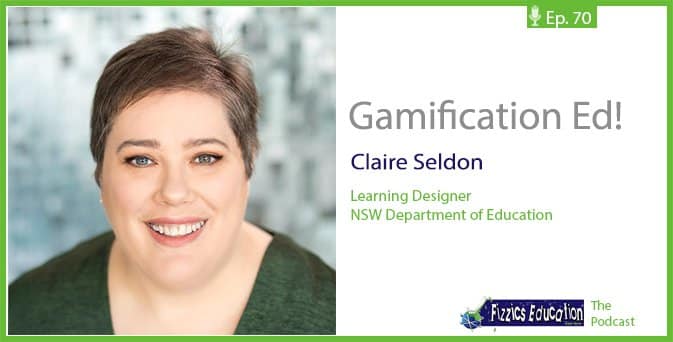
Gamification and education is such a hot topic and Claire Seldon certainly knows a bunch about it! Claire works as a learning designer for the NSW Department of Education and as such has seen the positive impact gamification has had on everyday classroom experiences. Listen to find out her thoughts, tips & ideas on what makes a well-designed gaming lesson!
How do we move beyond “points and badges” to create truly immersive learning experiences? In this episode, we talk with Claire Seldon, a Learning Designer who is transforming the New South Wales curriculum through the power of play. We explore how to leverage her “nerdy gamer experience” to build digital resources that don’t just entertain, but deeply engage students in the complexities of Science and History through discovery and narrative.
About Claire Seldon
Claire Seldon is a former Science, History, and Technology teacher who currently serves as a Learning Designer with the New South Wales Department of Education. With a background in technical IT support and a lifelong passion for tabletop, card, and video games, she creates digital teaching resources that prioritise student agency. Claire draws heavily on Montessori philosophy to design “prepared environments” where students navigate their own learning through discovery and narrative-driven quests.
Expertise: Gamification, Montessori Pedagogy, Digital Resource Design, and Immersive Learning Environments.
Gamification in the New South Wales Department of Education
Claire discusses her work developing high-quality digital resources that align with the New South Wales syllabus, including virtual excursions and interactive history projects. Her approach ensures that game mechanics serve the learning outcomes, focusing on the motivation behind why a student is completing a task.
Key Strategies for Gamified Learning:
Non-Linear Discovery: Designing VR experiences, such as the bushwalk through the Cumberland Plain Woodland at Mount Annan, that allow students to explore panoramas in any order, mapped to a game controller for deeper immersion.
Authentic Narratives: Using real-world context, such as Brad Manera’s drone footage at 1914 aircraft heights for the Western Front project or historical police records for forensics, to create an environment students genuinely care about.
The “Prepared Environment”: Applying Montessori principles to project-based learning, where the teacher designs the “map” and resources—like the Year 11 chemistry forensics game—then steps back to act as a guide while students experiment and iterate.
Top Episode Learnings: Levelling Up Student Engagement
Story and Discovery Over Rewards:
True gamification is found in the hook of a good story and the thrill of discovery. Claire emphasises that students are more engaged by solving a mystery (like a forensic investigation) than by simply earning points or badges.
The Safe Space to Fail:
Games teach resilience because failure is a natural part of the loop. Claire recounts a Year 9 hydroponics project where students had to rebuild their greenhouse twice due to missing parts and a storm, teaching them that making mistakes in a safe school environment is a vital part of learning.
Empowering Students through Beta Testing:
Presenting unit designs as being in a “beta phase” encourages students to provide feedback and take risks. This transparency builds trust and allows students to help refine the learning programme, making them active participants in their education.
Education Tip: The “Side Quest” Method.
Try Claire’s approach by adding “Side Quests” to your next STEM unit. Use elements of chance, such as a dice roll, to determine which format a student uses to demonstrate their understanding (e.g., writing a song, recording a podcast, or creating 360-degree imagery). This provides differentiated learning and stretches students—particularly gifted ones—to explore skills they might not otherwise choose.
[00:00:18]Ben Newsome: Yes, welcome again to yet another Fizzics Ed Podcast. Big week this week, like always, but this one’s particularly special if you love gamification and education. We’re speaking with Claire Seldon, who is a seriously cool teacher who really knows her stuff when it comes to gamification. Now, she is a former science, history and technology teacher and lately has been working as a learning designer with the New South Wales Department of Education. She’s got a fair bit of ICT history and she uses that background to create digital learning teaching resources for students to use in their classroom. And in her own words, she uses her nerdy gamer experience to create and educate all things about gamification. She’s seriously good at it and she has a lot of fun, and you’ll really tell in this interview she’s having a blast doing it, seriously. So, enjoy this interview, I certainly loved speaking with Claire, and I hope you get a bit out of it.
[00:01:13]Claire Seldon: So, I am a former IT second-level tech support who went back to school to become a science high school teacher. I did that for a while in an odd but fabulous Montessori high school, and then I moved to the New South Wales Department of Education, and I’m a learning designer. And I guess you don’t know what that means because when I got the job, I literally didn’t know what it meant either. And I got to work my first day and thinking, “What have I signed up for?” Learning designers create digital teaching resources and professional learning, and I’m really lucky because a lot of my colleagues have to create professional learning for teachers around things that it’s not necessarily in their interest area.
[00:02:02]Claire Seldon: But I mostly focus on digital teaching resources for students, and a lot of the time I get to do things around STEM and science in general, but also maths in the primary area. We try and make sure that anything that we do integrates literacy and numeracy so that it’s as cross-curricular as possible, and a teacher can choose to do that activity because if you’re not ticking off literacy and numeracy outcomes in a primary project-based learning thing, then the teacher just says, “Well, how can I justify doing that?”
[00:02:46]Ben Newsome: Makes sense. And just sort of crossed my mind just then, you’re in IT and you jump to teaching. I guess straight up, why the jump?
[00:02:57]Claire Seldon: Well, I was working in IT in the late nineties, and it was around the Y2K period and it’s better now, but back then there were mostly men. And I got a job working at an internet advertising company, and I worked very hard and I got a raise after three or six months, I’d proved myself. And then they were big, they were growing because this was just before the bubble crash. And they hired a nineteen-year-old who knew nothing, and they hired him at the same salary as me, and they expected me to teach him everything I knew, and then he was part of the boys’ club, and I got asked to clean the monitor by the marketing manager. And I didn’t like that very much.
[00:03:50]Ben Newsome: Why, Claire? Why would you not like that? That’s crazy. I can’t believe… who would have thought? Yeah.
[00:04:00]Claire Seldon: Yeah, so I just was miserable, actually, and I quit and I didn’t do anything for a little while because I jumped around a lot. When I finished school, I actually went to uni to do psychology. I did that for a year and a half and I hated it, and then I got work in IT. I worked for CompuServe, an internet service provider, I worked for Macquarie University doing second-level tech support for the biology department. And I enjoyed that. It was male-dominated, but the university just wasn’t quite as sexist, a lot of the biology professors were women. But when I went out into sort of the industry, it was just a bit… it wasn’t great. And in the end, I decided to go into teaching.
[00:05:02]Ben Newsome: No, I was just thinking it makes a lot of sense, deciding to move into teaching. One thing is that you can kind of change that mindset for people right from the start before they even enter the industry, because eventually these kids are going to be bosses at some point. It seems a logical step.
[00:05:19]Claire Seldon: Yes. Yes. Well, but also, I needed to do a job that mattered. Some aspects of IT were a bit soul-destroying. You could work really, really hard and nothing you did was visible, or nobody cared. Like if you did a good job nobody cared, if you did a bad job everyone yelled at you. Whereas teaching, it so visibly matters. Like at the end of a year, you can look at each student and their progress, maybe some student may have less progress than another, but you can be proud that you helped them achieve that and move forward. And after a few years, I was very fortunate at the school that I was at that we had quite close mentoring relationships with the students because it was such a small cohort. And you know, you see a student in year seven and then they go into year eight, year nine and you’re pushing back and, “No, have some boundaries, have some boundaries,” and then year ten they blossom and you’re like, “Oh, I can see the adult that you’re becoming,” and I loved that. I absolutely adored being allowed to be part of that process. It was wonderful.
[00:06:43]Ben Newsome: Oh, bet. And actually, you got to see that in two different forms of education, Montessori and… was it the standard public school system you went into or was it a different independent school? What was your…
[00:06:54]Claire Seldon: No, it’s a private Montessori school. So I’ve actually never taught in the public system. I work for the government now, but not as a teacher. So yeah, I taught just at that school.
[00:07:10]Ben Newsome: And so roll that forward, you’re now working in government and very much a big fan of education and STEM and everything else. So, I guess for me I’m always trying to get my head around, describe what it’s like on an average week in the middle of the school year. What do you get up to?
[00:07:18]Claire Seldon: Okay, well, so I look after a bunch of different projects. So I’ll give you an example of what I’m working on now. I am finishing a project for Year 10 students on the Western Front. It’s basically we got together with the Australian… not the Australian War Memorial, the Hyde Park War Memorial, and they have a historian, Brad Manera, who’s a genius. And we made a series of videos. He went over to Ypres with the Premier’s… Premier’s Award, PAM, I can’t remember what it stands for. Basically every year students apply to go on an overseas trip to somewhere where Australian veterans have fought and they write a big history essay. It’s a pretty amazing experience.
[00:08:19]Claire Seldon: And because it’s the centenary of World War I, they’ve been going to the Western Front for four years. And so last year Brad Manera went with a videographer and they shot a whole bunch of footage around Ypres and the Western Front. And so I got to turn that footage and archival footage and images into a series of videos. And then I have created a project-based learning sort of unit of work guiding students through that World War I topic in stage five history. And that isn’t particularly gamified or STEM orientated, but what I have tried to do is really closely integrate the use of technology. So there’s a lot of use of Google Earth and Google Maps to try and help the kids situate what they’re learning within the real topography because that was a big thing in World War I over on the Western Front because everything’s so flat. They got some drone footage, they actually got drones to fly at the height that the aircraft flew in World War I, which is disturbingly close to the ground, I might add. And so we turned that into videos and then I wrote lesson plans to go with each video that are sort of form… so a teacher could just do one video and lesson with the kids, or if you did all five, it’s a sequence of work.
[00:08:37]Claire Seldon: And the end is sort of about focusing the students on the veterans in their area. And one of the things that’s quite cool is that we’ve lost a bunch of war memorials. So there’s war memorials, especially to World War I, all over New South Wales that aren’t registered anywhere. So the people in the community know they exist, but the RSL have a database and they’re slowly trying to add things. And so one of the suggested options for a final activity is that the kids actually go and shoot some 360 images or video and submit it up to Google Earth or Google Maps so that their war memorial is on the map.
[00:09:28]Claire Seldon: So that’s one of the projects I’m doing, which is pretty cool.
[00:09:33]Claire Seldon: Another project I’m doing is working with the Royal Botanic Gardens making a virtual reality bushwalk. I’m so excited about this! So this is really STEM and gamification. Basically what I’ve done is we went out to the bush, they’ve got at Mount Annan, they have a tiny bit of remnant, very endangered Cumberland Plain Woodland ecosystem. It contains all these species that don’t exist anywhere else in Australia, let alone the world.
[00:10:07]Claire Seldon: And the idea is that as part of the science syllabus, that students need to explore and compare ecosystems, and one of the things we try and do in the department is create equity for rural and remote students. So the idea is that not every student in New South Wales can go to Mount Annan and see this ecosystem, but if they go through my VR, then they will have that. The VR doesn’t work in Vive or HTC because I tried to make it sort of a bit more of a… like do you know the games Myst or Riven?
[00:10:12]Claire Seldon: It’s kind of like you go on a bit of a wander and I’ve tried to make it as non-linear as possible. So each panorama that you go into has all these little question marks and you don’t know what you’re going to find when you click on it. You might find a plant, you might find an insect, you might find a bird or an animal. You might find a bit of the abiotic features, so there’s a dam and I’ve got a log and talking about the importance of logs as habitat, that sort of thing. We’ve also embedded some videos in it. We recorded sound out there, so when you play it on the big screen, it’s quite immersive and it gives the students the opportunity to discover the way they would if they went on an excursion.
[00:10:59]Claire Seldon: One of the problems I find with a lot of Virtual Reality stuff is that it’s very linear. It’s like you go here and then you do this and then you do that. But in real life, students don’t have to do that. They can make decisions and it’s one of the things about gamification that students find engaging is precisely that when you play a game, you have choices. You always have choices and those choices have consequences. In this, the choices are about what you look at, what order you look at them in, and you don’t know what you’ll find, so there’s a bit of mystery in that. The consequences aren’t negative consequences; the consequence is you find a cool thing and then you learn a bit about it.
[00:11:52]Claire Seldon: Then the next step was that I wanted to work out how to make it a bit more immersive. I found an app that lets me map a video game controller, like a console game PS4 controller, to my laptop. So when I’m running the VR on my laptop, I can actually control and navigate it not by a mouse, but by a video game controller. So when you put it onto the big screen, the person can stand in front of it and it sort of feels like they’re moving through it. It’s pretty awesome. I’m excited for that.
[00:12:30]Ben Newsome: I can hear that! These are some great projects there. Even just thinking about overlaying AR into the World War I stuff, I mean I just imagine you could almost have the drones run almost emulate the sorties that would have been flown over the cliffs and all the rest of the place. But also, whilst they’re flying along, then you could actually put up the imagery of really old scenes that happened at that time and place, depending if there’s any historical photos that actually show that. Just looking at how the topography changed versus its cool and what you’re saying about the Australian Botanic Garden, that is a fantastic site. I’m very, very familiar with it. We actually run holiday science programmes there every year.
[00:13:21]Claire Seldon: Oh wow!
[00:13:23]Ben Newsome: Yeah, absolutely. We’re doing it at the Australian PlantBank. I love the Australian PlantBank, how cool is that place?
[00:13:31]Claire Seldon: It’s a brilliant place and frankly, very well not discovered. Not many people realise that you’ve got this awesome place which is basically like our national seed vault. So think of seeds that have been tucked away so if something goes down in the ecosystem, we can hopefully reboot it using genetic material that’s been conserved. But you’re talking a multi-million dollar installation and it does actually have some exhibits within the foyer and through this and they actually can run visitations and all the rest. It’s just not well known that it’s even there.
[00:14:12]Claire Seldon: No, and I couldn’t recommend it more for teachers to take their students out there. They do all sorts of really cool stuff there. They let me and my photographer actually go into the freezer. That was cool! I would like that to be something I would like to do at some point. We were thinking after I finish this project, there’s so many different things. I’m very spoiled, my boss is very willing to let me get over-excited about ideas. So one of the things I’d like to do is work with the Sydney Botanic Gardens in the CBD to make some kind of AR excursion, so that when the kids arrive, you give them a set of iPads with an app loaded in, maybe Metaverse, I’m not 100% sure because I haven’t really done any work on it.
[00:15:06]Claire Seldon: Then instead of giving them a worksheet and saying “Okay, go and find this plant,” you sort of lead them on a bit of an AR treasure hunt around the gardens. I think that would be so cool. I’d love to do some kind of 360 video look at the journey of a seed from gathering all the way to the freezer. I think students don’t get to see behind the scenes and sometimes it’s like they don’t know what jobs are available and cool things they could do as scientists because stuff gets tucked away in labs or, like you said, cool stuff is happening and nobody knows anything about it. So something like that.
[00:15:53]Ben Newsome: And that’s one of the main roles of science communication, like that’s trying to get it out there. We people like ourselves and the radio hosts can only say so much, but to be honest, I just see the schools as a way of distributing that knowledge face-to-face to the students themselves. That is exactly the point. In getting something like, I mean you said it’s all about equity for the regional and remote students so they can come and visit those sites. That’s awesome. But I also think those kids in the Inner West Sydney or maybe they’re in Northern Melbourne or whatever, they have access to sites but they may actually not have the chance to jump on a bus because frankly, the buses cost too much. They just do. Unless they’ve got particular funding.
[00:16:46]Claire Seldon: It’s true! The buses absolutely kill it. They do.
[00:16:50]Ben Newsome: I mean, that’s one of the things that we do is visiting the schools. I never like the word incursion, but it’s what it says. Going to visit the school means you don’t have to have this cost of a bus. It just… the bus hurts! They absolutely do.
[00:17:01]Claire Seldon: Yes, and it does make a huge difference, doesn’t it? One of the things that my team at the department is associated with is the DART Connections programme, which I find really, really awesome. And Fizzics Ed does stuff with them as well, I believe. You run remote and virtual excursions that way, and that’s the same thing.
[00:17:23]Claire Seldon: When you think about the money and the time and effort and energy that goes into planning a single excursion, it’s a lot of work for the parents sometimes to come up with that extra $40 or $50. Then all the paperwork for the teacher and all sorts of… I mean, people who aren’t teachers who don’t have to fill in all the paperwork, maybe they think, “Oh, you’re being crazy.” It’s like, no! If there are people from organisations listening, a good risk assessment that the teacher can read through and doesn’t have to rewrite is a fine, fine thing if you want people to come to your organisation.
[00:18:19]Claire Seldon: Yeah, no, I agree. But those regional remote things, I mean that’s what virtual excursions, AR and VR can do, is completely give the chance for these kids to 100% experience the stuff that they can’t experience physically in location because, hey, they’re in remote areas.
[00:18:40]Ben Newsome: And the learning is still the same. I mean, yeah, of course, people can come out to those schools and, frankly, yes, we certainly do. But often, unless they’ve got particular funding because they’re in remote areas, or if you band schools together—and that’s a thing, like we often actually sit in the Snowy Mountains where you get schools do a once every two-year camp where they all camp in the school, which I think is just cool by the way—so they all camp overnight and they’ve obviously got all the risk assessments around that because that’s another whole level when kids are sleeping over, anyway—experience with it, they pool their resources.
[00:19:27]Ben Newsome: But this is fun! I mean, Bethesda would actually like… for those who don’t know, Bethesda is a software studio that makes a whole bunch of things like Skyrim and all that sort of stuff. The fact that you’re creating open learning environments, so then in a way, I mean the budgets behind that are way bigger, but that’s sort of what you’re trying to do.
[00:19:48]Claire Seldon: Yes, it is and in fact, Morrowind, still one of the best games I’ve ever played. I so… when I was thinking… I’d done quite a lot of thinking and writing on gamification in the past couple of years. I’ve always been a massive gamer. I’m a board gamer, card gamer. My parents played D&D in the 70s. Like, I’m a second-generation hardcore nerd. I started to think about how do the games that I play and the things that I love about gaming… and you see your kids, it doesn’t matter how unmotivated they are in your class, most of them will have a game that they play. Even if it’s sport or a video game or whatever, and they’ll love it and they’ll know tons about it. Like tons, way more than you want to know.
[00:20:41]Claire Seldon: And so part of what gamification is, is looking at how can you take that passion, that interest and that learning and put it into a school environment. For me, there’s two really key things about gamification: it is discovery and story. If you have a great story to hook your learning on that pulls the kids in, that engages them, that attaches them to the characters, whether they be scientists or even theories—like a theory can be a character—it’s just about the story of that discovery or that idea or the ups and downs that something goes through to be where it is today. That’s much more engaging than dot points.
[00:21:35]Claire Seldon: Similarly with discovery, the minute you say to the kids, “Go and find stuff out, come back and tell me what you think,” as opposed to step one, step two, step three. And that’s not to say that you don’t need to do rote learning or really simple stuff sometimes, you absolutely do. I think everything should be done in balance.
[00:21:51]Claire Seldon: But I don’t think we give… because modern kids, it’s not just in school where they don’t get to make many choices or do things. I don’t know about you, but when I was little, especially in the summer holidays, I’d go out in the morning, say bye to mum, take my roller skates and my swimmers, and I’d see her at the end of the day. And I was 11, 12. I was perfectly safe, just hanging around the neighbourhood. But kids these days, they’re scheduled after school. It’s you do this, and then on holidays you’re on a camp, or your mum wants to know where you are every minute of every day. They just don’t get very much choice or chance to make decisions or change a variable and see what happens. I think gamification is a way that we can bring that choice and agency for students back into the classroom. Same with STEM.
[00:22:45]Ben Newsome: Well, it is. I mean, STEM, yes, STEM‘s an avenue certainly for the makers of the world to explore their world unbelievably so. At the same point, the gamification does the same thing. I mean, we often talk about immersive environments and what does that actually mean? I kind of think in a lot of ways that a really well-constructed open learning environment in games is almost like planning out a novel. And then some, because you know how you often have… you look at the novels and they’ve got characters, and the characters have backstories and what’s going on in the back end and everything else.
[00:23:33]Ben Newsome: In some ways, and I’m going to flick it sort another way, almost like the timelines of a Tarantino film where there’s all this stuff going on and you can explore it. I mean, in a movie or a novel, it’s a linear fashion, turning the page or watching the movie, but in a game environment, it’s different because you can explore it in 3D space. You can either miss stuff completely because you never get to interact with said character or said environment because you never quite get there, or you maybe don’t explore those as quite as deep as you may explore others. But the beauty about it is the student agency. The kids who create the games can get as much detail as they want, but also the kids who play the games after the fact can do what they want. It’s cool!
[00:24:08]Claire Seldon: Definitely! But it doesn’t have to be a game. So I’ll give you an example from Montessori philosophy. So the idea of the Montessori philosophy is that if you prepare the environment correctly, the student will interact with the environment as a learner, and you, the teacher, are a guide. So you’re there, you’re another resource in that space. And it’s very, very clear in a three-to-six, so three-year-old to six-year-old stage one Montessori classroom, where the room is full of stuff, cool things, and each one of those things has a way of interacting with it. And the child gets taught how to interact with those activities or learning objects or whatever it is.
[00:24:55]Claire Seldon: But when they come in in the morning, they can choose out of all the activities they’ve been taught how to use. They just choose one. And then they’ll go and sit down and set it up and have a go, and they could do it 20 times or they can do it once and that’s completely up to them. They choose when they go to the bathroom, they choose when they want to have snack. And when they want to have snack, they go and get a real knife and a real plate and a real piece of fruit and they sit down and they cut it up for themselves. And when they’ve finished, they take it back and they wash it up. And we’re talking three-year-olds.
[00:25:47]Claire Seldon: And that idea of the prepared environment is expanded. So in the high school environment, when you’re doing a project-based learning unit of work, what you have to do is a huge amount of work before the project. You have to, like a game designer, think about all the different things that the students might want to do and how you can prepare for that and how you can have the classroom set up so that there’s things that attract their interest—it might be a poster, it might be a model, the different experiments. And obviously, you also have to meet the syllabus outcomes, so there’s a certain number of prepared explicit lessons that you would give them.
[00:27:03]Claire Seldon: But you also need to be prepared for the fact that the students might go off on a tangent and then you have to work out, “Okay, well how can I deliver the learning that they need to understand that to them?” And it might be a short little one-on-one thing where you just explain something to them, or you might go and find some books and put them in the classroom for them to access on their own. A really cool example of this was when we built… I was doing a unit on hydroponics. And the goal of the project was to set up a greenhouse, fill it with hydroponics and grow some food.
[00:28:05]Claire Seldon: Everything that could go wrong did go wrong. So we wrote to Bunnings and asked them to donate us a greenhouse, which they did. And then we built it and discovered that it was missing a piece, so we had to pull it back down, pack it up, send it off to them, ask them to send us another one, which they did. So we built that and the kids were moaning and groaning and grumbling they had to build it twice, but, you know, they were a lot better the second time. They paid attention to that bit. And then we got it set up, it was all ready to go, and then there was a humongous storm and it blew it down and broke a whole bunch of the wall struts.
[00:29:03]Claire Seldon: So then we had to decide how we were going to deal with this. We couldn’t go back to Bunnings and say, “Hey, can we have another greenhouse?” So we had to come up with a makeshift structure under a veranda. At every step, it was about them making decisions and them testing things. I knew pretty much what we were going to do, so I’d ordered a whole bunch of equipment beforehand, but it wasn’t me telling them, “This is what you have to do.” What I said to them is, “This is the equipment that you have. How are you going to use it?” And it took all year, but at the end of Term 4, we ate a salad out of greens that we’d grown in our hydroponic setup. And it was delicious.
[00:29:56]Ben Newsome: And I wonder how many kids—I’m not too sure when this happened—but I wonder if they’ve gone and built their own one at home. Because the learning doesn’t have to just happen at school; they can repeat and refine and do it at home after the fact, which really means they’re owning it, which is great. But I was actually just listening to that, I mean the greenhouse blowing down when you need it is kind of an issue you might need to fix it, and the kids are going to have to learn resilience and problem solving and all that sort of stuff. I mean, I like it when kids go on a complete tangent. Just speaking with a fantastic teacher recently, Joanne Galita, does a brilliant job with students, has done for many years around the southern area of Sydney.
[00:30:32]Ben Newsome: She was recounting a story whereby she was doing a very simple project with some early years, primary kids, whereby it was all about the weather and so let’s just make a rain gauge. Very obvious thing that’s meant to happen here. Problem is, it only works if it’s raining. If it hasn’t rained for two months, you have an issue. However, the kids thought, “Well what if you just fill it up with water and look at evaporation rates instead?” That becomes a useful thing. Now it’s about relative humidity. You can actually track it in a way. Obviously, you could use a hygrometer because you can get those things, but not so much in a primary school, you’re not always going to have that. But they were able to twist the outcome to suit their needs. Well actually, the outcome was still there, they just did it in a different way.
[00:31:16]Claire Seldon: Yes. Well, as a teacher, you really do need to be flexible for that. You need to be able to say, “Okay, this isn’t going to work.” And sometimes if the kids are bored, I mean I have in the middle of a lesson looked at everyone and gone, “Okay, hands up who’s bored?” Everyone’s hand goes up, my hand goes up. “This isn’t working. An experiment didn’t work, or I had a really cool idea about something and it just hasn’t happened. So then it’s like, okay, well this is what we have to learn. It’s in the syllabus. I pretty much think most of the things in the science syllabus are actually worth learning. How can we figure this out? How can we make this more interesting? Can we go outside? Can we run around? Can we build something? Can we poke something with a stick and see what happens?”
[00:32:15]Claire Seldon: Yeah, and when you ask them, “How could we learn or explore this thing?”, they come up with the most amazing answers. I couldn’t recommend that more. Teachers often struggle, and I know I did, giving control to the students in the classroom, standing back and seeing what they can do. But I think that’s a big part of what makes STEM so awesome, and it’s certainly a big part of gamification. Like if you’ve gamified an activity, and it doesn’t have to be an actual game, it can just be a teaching activity that has elements of story that gives students discovery or competition or whatever. But you need to be able to let go. Because when they play video games, you’re not micromanaging their every move. Or when you play a board game, either it’s every person for themselves or you’re working together for a common good rather than dictating their every action. And I just don’t think that works. They will tune out. They’re much more engaged when they have a say and control and a chance to express themselves.
[00:33:40]Ben Newsome: So to the educators everywhere listening in on this, I’m just thinking here, obviously you’re incredibly passionate about frankly a lot of things, which is awesome. I love hanging out with people like that, it’s very cool. There’ll be some people going, “Right, so cool, I want to go down this gamification route. Let’s give it a bit of a go. And I want to give it a bit of a STEM twist.” It doesn’t have to be STEM, but hey, there’s a STEM podcast effectively, so why not, let’s do STEM. What are the sort of first steps? Let’s say you had some teachers in front of you, you’re doing a learning design chat with them. What do you think is the best way to at least start off planning out a unit of work? So it’s the end of 2018 right now, they’re planning out some work so at some point in early 2019 something happens in their school that is gamified. What are some loose things they should be looking at as they create this thing that might happen?
[00:34:54]Claire Seldon: Well, so I would start by thinking about how you want to gamify it. So do you want to make it a competition? Do you want it to have a story? Do you want the students to go on a bit of a discovery journey? I mean, I hate rewards and competition, that’s just not really my style, but for some students that is. That works for them, it’s engaging and it matters. So from that point of view, do you want them to create something? Most games involve creation and problem solving, so you want to sort of think about what you want the students to get out of that gamified experience. And a lot of these you can deliver through a STEM unit or a project-based learning unit.
[00:35:50]Claire Seldon: There are teachers who gamify their entire classroom, and everything about their classroom is part of a huge sci-fi fantasy game, which I find super awesome, but that’s a lot of work and probably not the best place to start. One of the ways you could do is say, “You know what, the kids hate the maths worksheets we do first thing in the morning. How can we gamify that?” And there are very simple ways you could do something where you create a story around them. So somehow finishing a certain number of sheets correctly in a certain amount of time has an impact on the story. I actually did a presentation on this at the MANSW conference this year. I wasn’t very happy with it, it didn’t quite go as I’d hoped, but the idea of using a story… the problems that the students are doing are related in some way to the story, or the way that they move the story forward.
[00:36:50]Claire Seldon: You could do something like take an activity that’s quite cerebral and try and find a way of making it hands-on or having the students move around. I’ve done some really cool stuff with particle theory, which students often find quite difficult to understand, and I just got them to run around the hall and play a silly game of tip tag, but it was about what the temperature was like. And depending on what the temperature was like depended on how fast or slow they could move, because particle theory.
[00:37:26]Claire Seldon: But if you want to do problem solving or discovery, then you need to think bigger. You need to be doing a project-based… So I’ll give you an example. Year 11 chemistry, when I was a prac teacher I taught Year 11 chemistry, and they were doing the forensics unit as their option. I got to introduce it to them, so what I did was I took the Lindy Chamberlain murder, and I made it into a mini role-playing game. So I got a map, and this is a group of kids, I don’t think any of them had ever played a role-playing game before, so it had to be quite simple.
[00:38:00]Claire Seldon: But I got a map, I got a whole bunch of the different evidence, and then I gave them a mini toolkit of the different forensic tools that they had access to at the time. And then I said to them, “Okay, as a class, you are the forensic examiners and you’ve just arrived at this campsite.” And I showed them the map and I said, “So these are the people you can talk to.” And it took them a little while, but then a couple of the braver ones figured it out and they were like, “Okay, well we want to interview the mother and find out what she has to say.” And I got a lot of the words from the police records and stuff so I could be quite true to the story.
[00:38:45]Claire Seldon: So then they played a game, but they were also thinking how does a forensic scientist work? They were exploring a real crime scene and all the real evidence that was there at the time, and then they had to think about, well, what tests could we do, what do we think will happen. In a very general way because this was an introduction to the topic. And then afterwards I talked to them about everything that had gone wrong and how she’d gone to jail even though it’s clear from the actual evidence that a dingo ate the baby.
[00:39:28]Ben Newsome: I just think it’s interesting because… I love how we just got onto this story just as the sirens go past your home.
[00:39:36]Claire Seldon: Yeah. Well, the police did a pretty dodgy job in that case. But that was part of… when you look at the syllabus for that option, a bunch of it was looking at how forensic equipment has changed over time and how we’ve gotten better at doing it, and also there are a bunch of ethical issues around that because, for example, the science behind it isn’t always as sound as we’d like to think it is. So that one story was a really great way of getting the kids clued in to all the aspects of that topic. And I could have just told them the story, but it was so much more exciting and fun to have them game it out essentially.
[00:40:40]Ben Newsome: That’s right. If I had to boil it down apart from creating the steps in the game, it’s really around context, isn’t it? No context, no one cares about your game. Have context, now they care.
[00:41:30]Claire Seldon: Yes. And you were talking before about writing a novel, and I guess that’s the thing. When you’re writing a gamified unit of work or even just a tiny little lesson, you need to be thinking, “Why will the kids care about this?” And often it’s about the story. And either the story is really shallow and brief, and the idea is that the kids will create it over time, they will build it, which can be awesome, but that wouldn’t work for every group. Otherwise, you need to know what’s happening. Like you said with the video games, there may be stuff going on in the background that the kids never interact with, but you need to know it’s there as the creator.
[00:42:06]Claire Seldon: But I suspect that might put some teachers off because they think, “Oh, I’m not creative,” which I don’t believe; I think everyone can be creative. But when you’re trying to gamify an activity, you can start small. It’s just about thinking about the motivation. So why is the kid doing this thing? And preferably not for rewards or visible achievement, although those are legitimate ways of gamifying something, but preferably to understand something or dig into something or make choices.
[00:42:37]Claire Seldon: I know I’ve said this a few times, but teenagers in particular, they need practice making choices. And school, although it’s high stakes for them emotionally, in terms of making dumb choices and not suffering really long-term consequences and learning from them and hopefully not growing up and doing really stupid things, school is actually a relatively safe place to make dumb choices, and we need to give them that opportunity. It’s more work for us, but it’s better for them in the long run.
[00:43:06]Claire Seldon: Or even just adding a bit of chance to something. I know teachers sometimes use choice boards or something where the students have a number of different ways they can practice a skill or demonstrate their understanding. But you can also use chance, so you give them a whole list of different options and then they roll a dice and they have to do what the dice rolls. And that can be really great, especially stretching your gifted students who may know what they’re good at. If they’ve got choice, they will often choose the thing that they’re good at to keep looking good, and chance forces them to stretch their wings a bit.
[00:43:45]Claire Seldon: But again, it should be in a low stakes thing where they’re not going to have a meltdown because it turns out they’ve got to write a song or something. That would be my… I’m so unmusical, the idea of having to demonstrate my understanding of the periodic table by writing a song… but it would stretch them.
[00:44:04]Ben Newsome: I actually like the idea of it being effectively a scaffold for them to learn and then branch out from. It makes sense. And it comes down to, as educators, how much risk aversion we have, or the exact opposite to that, I suppose. And eventually, like everything, it all comes down to time. So my headspace is, as always with any project, start small and put layers on it like an onion, just keep it growing out.
[00:44:33]Claire Seldon: Absolutely. And hopefully not like an onion where it makes you cry, but you’ll get there.
[00:44:39]Ben Newsome: Definitely not! But at the same point, I mean, I’ve run into a bucketload of teachers who have gone down the gamifying route, and it has worked for their classes. And I’m talking from year three through to grade ten, all types of students in all different locations. And they happily describe where things have worked and where they haven’t, and it’s just about having a go in the first place, and it’s fantastic. Love it.
[00:45:05]Claire Seldon: So one of the great things about gaming and gamification in general is that most kids play games and they’re familiar with the idea of beta testing. So the thing that I always tell teachers is you say to the kids, “This is in beta,” which means it’s not perfect and there are bugs, and I need your help to make it better. And then the kids automatically know that it’s not a polished, finished product, and they feel a sense of excitement because they get to feed back to you, “Hey, this didn’t work,” or “This was really cool,” or “Here’s a good idea for making it better.” And then you as a teacher, you don’t need to be perfect because it’s in beta, and it’ll be better next time.
[00:45:52]Ben Newsome: That’s right, and it’s still in an environment where we’re not selling ranches, we’re not impacting on their own as they grow as students, but that’s our job in the first place, so it’s okay. As long as it doesn’t chew up too much of your time. And maybe over time you might become one of those hyper, over the top teachers who’ve done this completely and totally flipped their classroom around. It all depends on your style eventually and what you want to get out of it, which is fantastic.
[00:46:21]Ben Newsome: Hey Claire, how do people get in touch with you? Because obviously you’ve got a lot of stuff to do with this and I know that you’ve got a website filled with things with the title Teaching With Game. How do they find you? How do they do that sort of stuff?
[00:46:34]Claire Seldon: Well, the best way probably to find me is to find me on Twitter. My Twitter handle is @claireseldon_ed and there’s a link to my website from there. But I do have, in case I know not everyone loves Twitter, a short URL which is goo.gl/sJxUF4. I don’t sell anything on the website, there’s no ads, I don’t make any money at all from it, I don’t have a book. I just found cool stuff and I do update it. If you want to dip your toe in the water but not go crazy, there’s advice on how to turn any worksheet into a simple gamified activity, and I actually gamified the process. So there are some random generators, so you can randomly generate a way of gamifying and a tool like dice or balls or whatever, and then you apply that to your worksheet and just give it a go. It’s very, very simple. There’s a form you can email me from the website. I love giving people advice. I love having people ask my opinion and yeah, I’m just generally really, really keen on people doing cool stuff.
[00:47:46]Ben Newsome: Definitely hit up Claire, and also when you’re going onto Twitter, just make sure it’s spelt C L A I R E. We have an ex-staff member who was C L A R E.
[00:47:58]Claire Seldon: Oh yes, no, I have an I and I have an E. Some people spell it with an I and no E. So C L A I R E S E L D O N _ E D.
[00:48:15]Ben Newsome: Excellent. Hey, by the way, I do the S for Sam thing too with Newsome. I feel like I’m buying a vowel or a consonant from Wheel of Fortune sometimes. But people hear F if you don’t.
[00:48:27]Claire Seldon: Absolutely. I get Claire Felden a whole bunch.
[00:48:31]Ben Newsome: Those people are old enough to remember Australian politics a decade or two ago, it’s getting on… there was a politician called Hewson, and I got a lot of Hewson at that time. I remember John Hewson. That’s the one. Dear oh dear. So, and that’s a different game, which I don’t think I ever, ever want to get involved in at all. But happy to work along in the education front for sure.
[00:48:54]Ben Newsome: Look, thank you very much Claire for your time. It’s been fascinating to have a chat with you, and I love hanging out with you on Twitter doing stuff and the primary STEM chat and all those sorts of things.
[00:49:06]Claire Seldon: Yes, I highly recommend Primary STEM Chat, it’s amazing and you don’t need to be a primary school teacher. I’m not. I’m not even in the classroom, but it’s just a fabulous group of people from all over the world increasingly, mostly Australian to begin with, just sharing stuff that they’ve done that went well but also stuff that didn’t go well. You learn as much from people’s mistakes, I think.
[00:49:23]Ben Newsome: Absolutely, and actually a couple of episodes back, go listen to Rachel Lehr who is the founder of the thing, just talking about what she does over in Western Australia. She does a very good job. She is an awesome, awesome lady, so cool. Couldn’t follow her more on Twitter, she shares the coolest stuff.
[00:49:43]Ben Newsome: Well, thank you very much, I should let you be. I know that you’ve got games to create and people to design learning outcomes and all that sort of stuff, and you’re having fun doing it. That’s the biggest thing out of all of it is that it should be fun and your students benefit the most. Have a fantastic day.
[00:50:00]Claire Seldon: Thanks very much, Ben.
[00:52:04]Announcer: You’re listening to the Fizzics Ed Podcast. Why don’t you book us for a science show or workshop in your school? We love seeing students get excited about science, and you will too. Go to fizzicseducation.com.au and click on schools for more info.
[00:52:21]Ben Newsome: Well there we go, we were just speaking with Claire Seldon who you can really tell is a fantastic educator. Seriously, it would have been awesome being in her class, I’ve got to admit. But she is having a blast and learning a lot about how to do learning design and spreading that knowledge right across the New South Wales Department of Education and beyond through her many works, with Twitter chats and speaking at all sorts of different conferences and things. She’s very, very good at gamification and learning design, seriously.
[00:53:00]Ben Newsome: So, if you want to check out more, jump on Twitter, why not, and go find @claireseldon_ed. So that’s spelt C L A I R E S E L D O N _ E D. You’ll find everything she’s been up to lately, plus you’ll get a link to quite a great blog about gamification. It’s called Teaching With Game. It’s a bit of a long URL, so just go to her Twitter profile and click on the shortened link she’s got there and you can find out all about what she’s been doing and how she’s been helping other educators.
[00:53:20]Ben Newsome: So, that’s enough from me. I hope you’ve had a bit of fun this episode and I look forward to catching up another time. All the best. You’ve been speaking with me, Ben Newsome from Fizzics Education. And given you’re listening to the Fizzics Ed Podcast, have a great one.
[00:54:00]Announcer: This podcast is part of the Australian Educators Online Network. AEON.net.au.
Frequently Asked Questions
How can teachers start gamifying their lessons without complex technology? Start small by adding elements of chance, such as a “choice board” where students roll dice to determine their task, or by wrapping a standard worksheet in a narrative where answers unlock parts of a story to move the plot forward.
What role does “story” play in science education? Story provides the context that makes students care. Instead of dry dot points, framing a unit around a discovery journey or a historical mystery—such as a forensic investigation—creates emotional engagement and a reason for students to dig deeper.
How does Virtual Reality help with educational equity in Australia? It allows students in regional or remote areas, or those in schools where the high cost of bus hire is a barrier, to explore specialised sites like the Australian PlantBank or the Western Front without the logistical burden of travel.
Why is student agency important in gamified learning? In games, choices have consequences. Giving students the agency to choose their learning path or how they demonstrate understanding mirrors the Montessori “prepared environment,” which fosters independence and intrinsic motivation.
What is the “Beta” approach to teaching? It is the practice of telling students that a new unit or resource is in a “testing phase.” This invites them to be co-creators who provide feedback on what works and what doesn’t, lowering the barrier for teacher innovation and building student trust.
Discussion points summarised from the Gamification in the classroom with AI assistance, verified and edited by Ben Newsome CF
Extra thought ideas to consider
Agency and the ‘Prepared Environment’
Discuss how the Montessori concept of a “prepared environment” can be scaled to secondary STEM. If the classroom is designed as a “map” filled with accessible resources and tools, how does the teacher’s role successfully shift from a lecturer to a “guide” or “game master”?
The Value of ‘Bugs’ and Failure in Learning
In software, bugs are errors; in the classroom, they are opportunities. When Claire’s hydroponics greenhouse collapsed, the students learned more about engineering and resilience than a successful build would have allowed. How can we intentionally design “safe failures” into our school programmes to build student resilience?
Recognised by
22 years, award-winning work, 1 purpose
Recognition from business, education and industry bodies across Australia.
Australian Small Business Champion
Multiple years
CILC Pinnacle Award and Hall of Fame inductee
Center for Interactive Learning and Collaboration
Western Sydney Awards for Business Excellence
Winner
Top 100 Coolest Company
Listed
Local Business Awards
Winner
We value your privacy
We use cookies to improve your experience. Essential cookies are always active. You can choose which optional cookies to allow.We use cookies. Optional ones stay off unless you allow them.Privacy policy