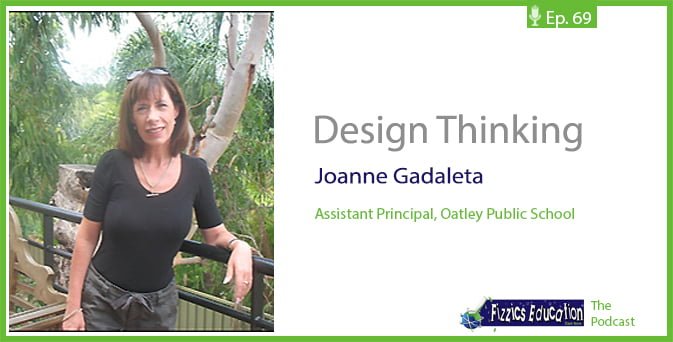
Design thinking & scientific literacy come hand in hand when it comes to making STEM shine in the classroom. Joanne Gadaleta has a huge amount of experience when it comes to helping students understand how to think clearly when it comes to problem-solving & ideation and as such has seen primary students across Sydney grow as a result!
How do we prepare primary students for a future that hasn’t been designed yet? In this episode, we speak with Joanne Gadaleta about the critical importance of Design Thinking and STEM in the early years. We explore her journey from IBM to school leadership at Oatley Public School, and her mission to ensure every student develops a thorough understanding of scientific principles and the 4Cs—communication, collaboration, creativity, and critical thinking—long before they reach high school.
About Joanne Gadaleta
During her career, Joanne Gadaleta has worked for IBM in the corporate sector, established a ‘Community of Schools’ gifted and talented programme, and taught across both opportunity classes and mainstream settings. Currently, she is an Assistant Principal and Instructional Leader at Oatley Public School. Her passion is ensuring primary students are exposed to high-quality STEM learning so they can develop a love of inquiry and a thorough understanding of scientific processes and design thinking.
Joanne discusses how her background in corporate training and specialist teaching informs her approach as an instructional leader. She advocates for a facilitator-led classroom where students take ownership of their learning through authentic projects like the Cardboard Challenge and space-themed design thinking units.
Core Focus Areas:
Facilitator vs. Sage: Joanne emphasises moving away from being the “expert in all knowledge” to becoming a facilitator of learning, guiding students through inquiry-based discovery.
The 4Cs: A successful STEM programme isn’t just about the content; it’s about building communication, collaboration, creativity, and critical thinking skills that are transferable to any future career.
STEM for the Early Years: From Kindergarten boat-building challenges to Stage 2 alien design, Joanne proves that complex scientific methods can be taught to young children through play-based action research and simplified language.
Top Episode Learnings: Designing for Success
The “Unexpected” Opportunity:
Joanne highlights that when an experiment goes wrong, it is often where the best learning happens. Teachers should embrace these “unexpected” moments—or even create them—to help students develop problem-solving and troubleshooting skills.
Authentic Engagement:
By using real-world inspirations like Caine’s Arcade and Michio Kaku’s Physics of the Impossible, teachers can make STEM feel relevant. Involving parents and the community in showcases provides an authentic audience that elevates student performance.
Professional Networks are Key:
New and experienced teachers alike should tap into Professional Learning Networks (PLNs). Joanne recommends using Twitter hashtags like #AussieEd and #PrimarySTEMChat, as well as Yammer, to collaborate with colleagues globally.
Education Tip: Scientific Language through Inquiry.
Don’t be afraid to teach high-level scientific processes to young children. Instead of forcing heavy terminology like “independent variable” immediately, start with inquiry-based questions like, “What is the one thing we are going to change?” Once students understand the concept of a fair test through hands-on learning, the formal language can be layered on with greater meaning.
[00:00:12] Ben Newsome: Welcome again to another Fizzics Ed Podcast. It is another big week here because we are speaking with Joanne Gadaleta. I can tell you right from the intro, she has a true passion for getting kids to love science and get a real thorough understanding about how the science process actually works. She really does.
[00:00:34] Ben Newsome: Now, she used to teach in mainstream classes and opportunity classes and she is currently the Assistant Principal at Oatley Public School. But she did establish a community of schools through Southern Sydney with a gifted and talented programme and ran that for many years and for great effect. The kids love her for it, her peers love her for it, and she does a brilliant job.
[00:01:01] Ben Newsome: So, I hope you get a bit out of this. I certainly did. It was really kind of fun just talking with effectively a mate of mine over the years as I have grown as a teacher. Joanne has helped grow other teachers into their full capacity in science as well. So, I hope you get a bit out of it. I know I did. Let’s get on into it.
[00:01:23] Joanne Gadaleta: Thank you so much, Ben. It’s great to be talking to you.
[00:01:28] Ben Newsome: Look, I am really stoked that you had some time in amongst your day to duck into a room and have a chat with me for a little while because it’s not exactly a quiet time of year for you.
[00:01:42] Joanne Gadaleta: I think if you ask any teacher what this time of year was like, they’d say pretty much crazy. But I think STEM and science are of vital importance in our primary classrooms, so happy to help.
[00:01:56] Ben Newsome: No, thank you so much. For those people who are wondering, yeah, this is being recorded nearly at the end of November 2018 and I know that your school, Oatley Public School, has been going through a whole bunch of stuff in preparation for planning ahead and everything else, and you’re in the thick of that. Just to let everyone know, what do you get up to? What’s your role?
[00:02:21] Joanne Gadaleta: Okay, so my role this year is an off-class Assistant Principal, basically working as an instructional leader to coach and mentor teachers in writing and science. So, I get to go into lots of classrooms.
[00:02:38] Ben Newsome: Yeah, I bet. Full up and front, I’ve known Jo for years. We often talk about the time we run into each other, that we’ve known each other for many, many years. But I met you before you were doing that sort of work. What got you into primary teaching way back when?
[00:02:58] Joanne Gadaleta: Oh, I did primary teaching after I finished high school. And then I actually worked in corporate. I worked for a computer company called IBM for a number of years. Always had my teaching degree. I guess teaching adults wasn’t much different to teaching children. But when I had my own children, I decided that I really wanted to come back and work in the school setting. So, that’s what I did. And I guess my experience has been different to most teachers in that my first real job in teaching was setting up a community of schools in the Sutherland Shire to teach kids that were gifted and talented, achieving, underachieving.
[00:03:39] Joanne Gadaleta: And I had the really good job of designing the programme, teaching the programme, and instead of working in primary school classrooms, I got to work in cool places like science labs in high schools. So, that’s when I met you. Because I found that STEM was the best way to engage these kids and I needed help. And you came in.
[00:04:35] Ben Newsome: And those kids were properly active. I remember we were really talking active. You’d get something into their hands and they would just go at it tooth and nail.
[00:04:47] Joanne Gadaleta: Absolutely.
[00:04:49] Ben Newsome: Absolutely. But the point that came with that was because these kids were so active, you’d better have an active lesson.
[00:04:57] Joanne Gadaleta: Absolutely. I remember being asked in a job interview when I became an opportunity class or gifted and talented class teacher later, what would my classroom look like if the principals were to walk in? And I remember laughing because I thought it wouldn’t be what you expect. It wouldn’t be quiet and it would be messy. But what I could guarantee is that the kids were actually learning and engaged in their learning.
[00:05:24] Ben Newsome: Absolutely right. I mean, as long as the kids are holding things and talking about the thing they’re meant to be learning, if they’re loud, if they’re making a mess or cleaning it up, it’s a good thing.
[00:05:33] Joanne Gadaleta: That’s it. Absolutely.
[00:05:38] Ben Newsome: And I’m just thinking that what you were doing back then, it extended beyond STEM too. I mean, I remember you talking about history projects and all sorts of stuff. You had a ball.
[00:05:45] Joanne Gadaleta: I did have a ball. We linked it into everything. I got to design cool workshops, because that’s what we called them, and they could last for a week or two. So, two days or one-day workshops in everything from doing science, we called it chemistry in the kitchen, where we baked things but looked at the chemical processes. I got to inflate huge airbags to look at air pressure and how molecules react in the real world. We got to do things like rocketry where we built our own rockets, but also really cool things like archaeology. So, that was great.
[00:06:26] Ben Newsome: And it wasn’t just sort of pen and paper stuff. I mean, we’re talking kids creating, emulating what real life was, wasn’t it?
[00:06:36] Joanne Gadaleta: Gosh, no. If I’d have done pen and paper, I would have lost them there and the programme wouldn’t have been so successful. This was all about real-world, hands-on learning every day, all day that they came to me.
[00:06:51] Ben Newsome: And this is the thing. You wind forward to now. I mean, you’re helping other teachers with English and science delivery. What is it that grabs you about STEM? What is it that goes, “you know what, this is just an absolute that we should be teaching with kids”?
[00:07:05] Joanne Gadaleta: Okay. For me, it was really understanding where education was heading and that we needed to change and keep pace with the way the world was changing. And I learned that I was no longer, I don’t know, you know that old saying, “sage on the stage” or “expert in all knowledge”, and I became a facilitator of learning and guiding kids to learn through inquiry.
[00:07:50] Joanne Gadaleta: So, it really ignited a passion that if the kids were going to get the knowledge and skills to be able to be successful in a global and digital world, then we needed to do something differently and we needed to prepare the kids for them. So, I really believe that the way we taught had to change and I think STEM is an absolutely great way that we can engage students and provide them with lifelong skills.
[00:08:10] Joanne Gadaleta: Oh, sorry. I’m going to jump in there. I forgot to say the skills that I’m primarily hoping they get out of STEM is not just science skills or math skills, but I really want them to be able to communicate, collaborate, be creative and demonstrate critical thinking.
[00:08:29] Ben Newsome: And problem solving and working as a team and all that stuff. In reality, how the world works. I mean, we’ve got work experience kids in our company right now and just had a visit from their supervising teacher asking about how they’re going and having a group discussion like no more than 10 minutes before we started this recording. And one of the comments that the teacher said is that what we love is that they’re not just here to learn IT skills, because they’re doing their ITD component for Year 11, but they’re seeing themselves in amongst what it is to be in amongst an outreach operation. What is it like? They’re valuing that.
[00:09:09] Joanne Gadaleta: Absolutely. And look, it is uncomfortable for some people and including me at first, and it’s scary because you don’t really know what you’re going to end up with and the classroom, you’re really giving it over to the students to lead their own learning.
[00:09:27] Ben Newsome: Mind you, though, when kids take ownership of their learning, I mean, that’s when the real interesting things start.
[00:09:35] Joanne Gadaleta: Absolutely, and it’s often not what I planned. So I’ve had to learn to be flexible.
[00:09:41] Ben Newsome: I’m actually just thinking about, I’m going to not so much call you on that, but actually ask you.
[00:13:23] Joanne Gadaleta: Absolutely. And I was really big in teaching them the design thinking process and the scientific processes. So they’d had some pre-learning. I can’t say we jumped into that activity. They already had those thinking skills put in, you know, pretty well under wraps. And one of the ways earlier that year we started off, I thought how can I get these kids enthused? And we were doing force and motion and I took them to the playground, like an external to the school playground, and we rode all the equipment and we started looking at push and pull. And from there, you could build on all those skills and just their imagination went wild.
[00:14:04] Ben Newsome: And that’s the beauty about this whole STEM thing, the acronym that won’t go away. And mind you, it’s got value, but the ability to create projects that are meaningful for kids over a long period is a great thing, and especially if kids take ownership of that in the first place, it’s just unreal. No doubt, you’ve been doing this for a while and you’ve seen all sorts of things happen in the classroom in different ways. What are some of the best STEM-type activities that you’ve seen in different primary classroom settings?
[00:14:35] Joanne Gadaleta: Okay. Probably the one that we implemented last year, which was based on the Cardboard Challenge. I’m not sure if you’ve heard about Cardboard Challenge, it’s a bit of a worldwide phenomena.
[00:14:51] Joanne Gadaleta: And the kids were saying to the teachers in my team, “Homework’s boring.” So it was fourth term, we’re tired, homework’s boring. And we went, “What are we going to do?” So we came up with a solution in every one of the classrooms and the teacher said, “Well, what if we do something like the Cardboard Challenge?” And we went back and we showed all the kids the Caine’s Arcade video, and that inspired them. When they saw that a child that was a little bit nerdy, spent a lot of time on his own, could achieve what he achieved, they all felt that they could because the kid was like them.
[00:15:35] Joanne Gadaleta: From that, we said, “Righto, we’re going to make this a homework challenge.” But there’s a catch. It’s not just build and bring it in. We want to go through the design process with you and each week they were expected to report something back to their peers for homework. Whether it was a sketch of their prototype, whether it was how they were going to decorate it, how they were going to install certain features. In that way, the kids started to use that STEM ideation process where the rest of the group were giving the kids feedback on where to go next or how I can fix it, what could you do. And homework became fun.
[00:16:16] Joanne Gadaleta: We followed that up at the end of the year with holding, in the last week of term, the kids brought all their arcade games in and on the last day of school we invited all our parents in. So the parents went into the classrooms and the kids talked about what they’d done and why, and the parents got to play the games and the parents gave the kids feedback. So it was real-life learning and it was authentic. That was exciting.
[00:16:45] Ben Newsome: That’s awesome. If you’ve never, seriously, challenge anyone listening, go check out Cardboard Challenge. Type it into your favourite search engine, you’ll find it. It’s by imagination.org and I tell you what, it’s just brilliant. I’ve seen it in different schools around the place and every kid beams about it and just wants to show you more about what they’ve made.
[00:17:06] Joanne Gadaleta: Absolutely. Instead of homework being a chore for the teachers as well as the kids, it became a real learning process and that was fantastic. So much so that this year, I’ve got the same group of teachers that I lead and we were studying space. Everybody’s always built the little models of the solar system, all that sort of stuff. We decided to ramp it up a bit and said, “Okay, we want you to design an alien.”
[00:17:35] Joanne Gadaleta: There was specific criteria but they had to become an expert in the planet and they had to build an alien that could live on their planet. We didn’t care if the alien was ugly, small, what it looked like, but it gave the kids a pathway to become experts. From that, they also had to do a passport to their planet. They had to calculate the age of the alien in Earth years on their planet and we went, “You know what, real-world learning, parents involved last year, that was great.”
[00:18:10] Joanne Gadaleta: So for Education Week this year, we actually opened all our classrooms to our parents and the kids had a forum to present the aliens. The parents moved from room to room, from their own kids to other people’s kids, and the kids showed them what they’d done and what they’d learned. I think the design and make process of that showed that kids not achieving in written work on pen and paper tests had another mechanism for showing their understanding. It was great.
[00:18:42] Ben Newsome: Absolutely. It actually reminds me of one of my favourite books. It’s like, which is my next favourite? But the one I’ve just picked up again because I found it on the bookshelf last week is by, I can never say his name properly, I’ll probably get it wrong, but Michio Kaku, who’s a physicist and quite a celebrated one. One of his books is Physics of the Impossible.
[00:19:10] Ben Newsome: It’s fun because all of a sudden it’s a series of chapters based on stuff that just does not exist yet. When you’re talking about the kids designing an alien, it reminds me very clearly of that. He just poses the question: why don’t we have aliens? So we talked about, not yet, maybe they exist, maybe they don’t, and what would be the biology of these aliens? What are the physics of them? Would they be huge? Would they not be? It means that you can apply real-world hardline science concepts onto a strange contraption in your mind to work out are these things real or not. It’s fun.
[00:19:43] Joanne Gadaleta: Absolutely. I know I’ve rabbited on about stage two or years three and four, but this year we’ve been able to engage all the teachers in STEM. In infants, they’ve been doing a play-based study. They’ve done an action research on play in Kindergarten and Year One students. What they’ve done through that is they’ve actually videotaped the kids at play, taught them the specific skills of how to work in a group, how to get on with other people, how to think critically to make boats. We’ve videoed it and used it as evidence of their progress in STEM education. So it can be done with little kids.
[00:20:25] Ben Newsome: Absolutely. I’ve even seen it done down into preschool as well. It all comes down to eventually the language that you use. You don’t dumb down the science. That’s not the case. You just use words that they currently will understand that still explain the concept well. Work with them with their abilities, their fine motor skills and their ability to plan or not plan in the case of the young kids. Being able to film what those kids are doing in the really early years of school, that’s valuable.
[00:21:03] Joanne Gadaleta: Absolutely. What we do is we don’t use the word “independent variable”, for instance. We’ll say, “What’s one thing you could change and what would the difference be?” They get that. It means the same thing and they get it. So they’re actually learning real science methods and I think that’s super exciting.
[00:21:24] Ben Newsome: I get it. It’s a vibrant school. You’ve got lots of cool stuff going on, which means you’re having a lot of fun stuff. But I must kind of wonder, what’s the funniest thing you’ve seen happen in a science lesson?
[00:21:39] Joanne Gadaleta: Funniest? There’s too many. Usually when an experiment goes wrong.
[00:21:51] Joanne Gadaleta: It happens every day in our school. We’re doing a boat building challenge that links to our integrated unit on life in Australia in 1788. And we had you guys in to do our professional learning in the middle of the year, and from that, we got feedback from teachers in other year groups on how to make this task better: build a boat. Some of the things that have happened during the boat building have been very unexpected. For instance, even different classrooms have built different types of boats. I think the teacher got it wrong, but the end result is pretty cool.
[00:22:33] Ben Newsome: I suppose you learn about centre of gravity real fast.
[00:22:37] Joanne Gadaleta: We did. We’re looking at how much weight can their boats take, so yeah. Or the kids that come in with a glue gun, which is probably a little bit unsafe in a primary school for kids to be wielding glue guns. But you know, it’s a learning experience.
[00:22:54] Ben Newsome: Well true. I mean, that’s the thing when I asked about what’s the funniest thing, it almost alludes to what’s gone pear-shaped. The reality is, is it really pear-shaped or is it just learning in another guise? Things go wrong. In fact, I know a number of educators all over the place that deliberately sabotage their experiments so the kids can pick up what went wrong.
[00:23:19] Joanne Gadaleta: That’s when the best learning happens.
[00:23:22] Ben Newsome: They actually know it. They know full well this experiment’s never going to happen. And they want the kids to tweak at some moment to go, “hang on, Miss or Sir, there’s not a chance this is going to happen”, and this is why this is the case. I mean, let’s be honest, kids love proving adults wrong. Why not give them the opportunity?
[00:23:39] Joanne Gadaleta: I think that’s a great idea. I feel that I know myself as a teacher and other teachers I’ve worked with, we’ve sort of been very rigid in how we want things to work and we want it to go right, and STEM doesn’t sometimes, a lot of the time. And you really have to be adaptable and flexible and go, “Okay, so what have we learned?”
[00:24:01] Joanne Gadaleta: What are we going to do differently next time to make sure that we are a bit more successful in what we set out to do? And that’s the kids talking with us, not just the teachers thinking about that, because they are so imaginative that I think we need to build on that capacity at an early age because they’re going to be our leaders of tomorrow.
[00:24:23] Ben Newsome: Yeah, straight up. I mean, it is a new age where information is at the click of a Google button really. So helping kids actually navigate that world and make meaning out of it is in a lot of ways really the new context of what education is about. It’s not like as you said right at the start, the “sage on the stage” really is pretty much gone in a corner somewhere because it just doesn’t work anymore. And so helping them understand, yeah, our role has changed.
[00:24:55] Joanne Gadaleta: And if you try to do that, your kids will prove you wrong because they’ve got access to so much information through technology that, not that it matters, but you don’t want to set yourself up like that as an educator. You want to learn together. And I think it’s more about the process than the content in education these days. We do need content, but it’s what we do with it. I think that’s really important.
[00:25:25] Joanne Gadaleta: I mean, teachers are using it in their classrooms every day to have a collaborative classroom, and I think that’s the way to go if we want to make our kids successful in the future. So, it’s a very exciting time to be an educator.
[00:25:44] Ben Newsome: I agree. The thing is, it’s awesome now, but it’s always been a highly valued profession. It really has, and a lot of fun to be involved in. What do you think about over what you’ve done over the years? What are some of the coolest things you’ve got to do with the school, or with students, with the community, with parents? What’s some of the coolest things that you’ve been able to do as a primary educator?
[00:26:12] Joanne Gadaleta: I think way back when I was doing the enrichment programme, we actually did real research through the Environmental Education Centres. One example of that was to go and work with Liverpool Council to actually look at plant diversity in the environment. And the kids learned how to measure turbidity in water, we learned how to test the pH—and I’m talking Year Five and Six kids.
[00:26:45] Joanne Gadaleta: So the fact that they weren’t just doing it because that was what we wanted them to do, but the fact that what they were doing was valued by the community and then put up on the council website. So I think it’s actually just not learning for the sake of learning, but showing them that their work matters.
[00:27:09] Ben Newsome: That would be really cool too because the kids would have learned about their local environment around the area, which means that outside the school setting they might be able to point out the things they’ve learned just as they walk down the street.
[00:27:21] Joanne Gadaleta: Yeah, and they become much more vocal when they see something that they don’t like in their local environment because they feel that they’ve got a voice. So that’s pretty exciting too.
[00:27:35] Ben Newsome: That’s awesome. Now, I’m just thinking—imagine if you had a bunch of about-to-graduate teachers. They’re pre-service teachers, just about to enter the big wide world of the education system, and they were asking about science and STEM and all this sort of thing. What would be some advice that you’d give them that would be really worth them keeping on board as they enter the schools next year?
[00:28:02] Joanne Gadaleta: Well, I’m hoping that teaching graduates nowadays have a lot more science in their teaching degree than I got, because mine was literacy and numeracy and that was about it. So what I would say to graduates is, it doesn’t have to be complicated. It doesn’t have to be stressful and it doesn’t mean technology and coding. It’s all about getting and training the kids to think in a scientific way. So just have a go. Ask for help. Other teachers, colleagues across schools, even the people that you’ve trained with. There’s a lot of people out there in the online world. And all the online forums, Ben, you’ve used them, you’ve directed me to some when I needed help. Everyone is so collegial and happy to help you on your journey in STEM. So listen to podcasts like yours, watch videos, and participate with online forums and you will have the most exciting time of your lives as teachers.
[00:29:08] Ben Newsome: Absolutely. And those online forums are so valuable. I mean, PLNs, professional learning networks that are out there are rich and they’re deep and they’re diverse. They’re everywhere. And if you’re listening and wondering, “where on earth would I start?” head to Twitter. It’s probably a good start. I mean, there’s a bunch of them around, but head to Twitter, type in #Edu and then #PLN. I mean, I know of a couple across my mind, #AussieEd’s one, #PrimarySTEMChat’s another. There’s a bunch of them out there and you’ll find like-minded people solving the same challenge that you’re solving. It’s a lot easier to solve them together.
[00:29:47] Joanne Gadaleta: Absolutely. The other place you can look is if you are a teacher and you go onto your department portal, type in Yammer. There’s always people on Yammer and I post questions on there all the time when I need help. So, please use that and even if you’re experienced educators, Yammer‘s a place to go to. So, I would encourage them to just jump in, Ben. Jump in.
[00:30:16] Ben Newsome: Speaking of jumping in, your year’s nearly complete, but of course, you’ve got planning for next year and beyond and everything else. Anything you’ve got in the pipeline for your school?
[00:30:28] Joanne Gadaleta: Well, we certainly want to continue the way we’ve approached STEM this year from K to 6. So we’ll be doing that a lot more and embedding it into all of our programmes. But one of the things that we’ve noticed is we want to make differences in our mathematics part of STEM. And we’re hoping that I’ll be able to fulfil the role of an instructional leader again and have a look at real-world engaging mathematics. So, I’m pretty excited about the work of Dr Catherine Attard from the University of Western Sydney in engaging maths. So we’re hoping to embed that across our school. So I’m looking forward to it.
[00:31:11] Ben Newsome: That’ll be awesome. Sounds like we should put in a date next year and you can tell us all about it.
[00:31:17] Joanne Gadaleta: Happy to, happy to. I’ll let you know all the successes and all the things that we didn’t expect. I don’t like to call them disasters or things gone wrong, I just think unexpected.
[00:31:28] Ben Newsome: I agree. It’s like that whole, “I thought I was going to go from A to B and it’s going to be a straight line,” but no, it’s going to be curly and have waterfalls and have pitfalls and all the boundaries, but you eventually get to B anyway.
[00:31:41] Joanne Gadaleta: Absolutely, and at the end of the day you ask, “what did the kids learn from this?”
[00:31:46] Ben Newsome: That’s right. And if they end up at another destination, that’s still valid and very worthwhile anyway. Hey, thank you very much, Jo, for jumping on the podcast. I know you’re flat out and thank you for your time, especially this time of year.
[00:31:59] Joanne Gadaleta: Pleasure, and I hope I don’t sound too exhausted and stumbling over my words at this time of year, but I think all teachers will be able to identify with that.
[00:32:08] Ben Newsome: No, I believe you enunciated quite well.
[00:32:11] Joanne Gadaleta: Thank you so much.
[00:32:14] Ben Newsome: No, you’re ideal. Well, thank you very much, enjoy your afternoon and I might catch you another time.
[00:32:18] Joanne Gadaleta: Great, thanks. Great to speak to you, Ben.
[00:32:38] Ben Newsome: Well there we go. We were hearing from Joanne Gadaleta from Oatley Public School and she really exudes a passion for STEM education. You can really tell this. And I tell you what, it would have been really cool to be one of her primary students learning all this stuff.
[00:32:53] Ben Newsome: And I hope you got a bit out of what you could be doing in your own classroom or wherever you happen to be teaching around the place, whether in a museum, a zoo, or wherever. I’m sure there’s something there that you can be doing. And you know what I like? The simplicity. It just comes down to understanding how to teach scientific literacy, that thinking, that design process to students. And it’s from that real basis that kids can grow as learners and, hopefully, scientists or engineers or technologists or wherever they may grow into in the future.
[00:33:23] Ben Newsome: Hey, you might remember an episode, oh, last episode where we spoke with Dr Karl. And we posed a question as part of a competition to win a copy of his new book, Vital Science. And we, well, let’s go back to that and let’s just hear what that question was.
[00:33:37] Dr Karl: So you get a little shoot, a little seedling, and it weighs nothing. It’s tiny. And you chuck it in the ground and you add a bit of water to it and it just sits there in the ground and it keeps on getting bigger and bigger and after five years it’s 100 kilograms. If you were to dry it out and get rid of the water and the sap, you have 100 kilograms of this dry tree.
[00:34:01] Dr Karl: Here’s the question: Where did those atoms that make up that tree, where did they come from?
[00:34:10] Ben Newsome: So what do you reckon? Is it the air, the water, the soil? Where does the vast bulk of the atoms actually come from that make up the tree? Let’s find out.
[00:34:18] Dr Karl: And so what you’re looking at with a tree, with regard to its dry weight—forget the sap and the water—is basically carbohydrates. In other words, carbon and hydrate. Carbon stands for carbon, hydrate is H2O. So you’ve got a bunch of five or six carbon atoms usually in a circle with some oxygen and hydrogen hanging off them.
[00:34:43] Dr Karl: The carbon atoms come out of the atmosphere from carbon dioxide. The oxygen atoms, they also come out of the atmosphere from carbon dioxide. And the hydrogen atoms, well, they come out of the water, either on the leaves when it rains, but usually out of the soil. Now, the hydrogen atoms have an atomic weight of one. They don’t weigh much.
[00:35:11] Dr Karl: So overwhelmingly, the majority of the weight of the atoms that make up your 100-kilogram tree, they come out of the air. So you can get yourself a pot—and this experiment was done in the 1600s—you can get yourself a pot and put say 100 kilograms of soil in it and put a tiny little shoot and add water for five years, and then you’ve got yourself a tree.
[00:35:31] Dr Karl: And the tree, when you pull it out and dry it, blow me down, it weighs 100 kilograms and the dirt is pretty close to 100 kilograms. You might have had a bit of stuff fall in from the sky, you might have had a bit lost. It’s close to 100. So where did it come from? From the air. That’s right. Trees are made from air. Oh my god, that’s so mind-blowing.
[00:35:55] Ben Newsome: Well there we go. It’s the air. Who would have thought? It’s the carbon atoms straight out of the carbon dioxide in the air. And that’s what’s so cool about learning how chemistry and biology links together. The carbon dioxide in photosynthesis, it’s gotta come from somewhere and the carbon goes somewhere. It gets stored as cellulose within those tree fibres themselves.
[00:36:17] Ben Newsome: Very, very cool. And I hope you got that answer and if you didn’t, there’s no worries. Look up science trivia on our website. We actually have a new section which is filled with science trivia and we’re going to add to this over and over and over through the years and it’ll help out not only quizzing yourself, but also quizzing your students. Kind of a bit of fun. But anyway, just jump on the Fizzics website, you will find that.
[00:36:41] Ben Newsome: But anyway, that comes to the end of yet another episode of the Fizzics Ed Podcast. I hope you got a bit out of it. I had a bit of fun with this and I hope to catch you next week. All the best.
[00:37:11] Announcer: This podcast is part of the Australian Educators Online Network. AEON.net.au.
Frequently Asked Questions
How did Joanne transition from a corporate role to primary education?
After working at IBM for several years, Joanne returned to her teaching roots after having children. She found that teaching adults in the corporate sector was not significantly different from teaching children, as both require effective communication and engagement. Her first major role back in schools involved establishing a community of schools programme in the Sutherland Shire for gifted and talented students.
What are the “4Cs” Joanne emphasises in STEM education?
Joanne believes STEM is the ideal vehicle to teach communication, collaboration, creativity, and critical thinking. While scientific and mathematical skills are important, these four core competencies prepare students for success in a global, digital workforce where they must solve complex, undefined problems.
How can teachers introduce scientific methods to very young students?
Joanne suggests using accessible language rather than complex terminology. For example, instead of using the term “independent variable,” teachers can ask students, “What is one thing we could change, and what would the difference be?” This allows students as young as Kindergarten to engage with scientific processes through play and inquiry.
What was the “Cardboard Challenge” mentioned in the episode?
Inspired by the Caine’s Arcade video, Joanne’s team transformed boring homework into a design thinking project. Students spent weeks reporting on prototypes, sketches, and features of their own cardboard arcade games. The project culminated in an authentic showcase where parents visited the school to play the games and provide feedback.
What advice does Joanne have for new graduates entering the teaching profession?
She advises keeping it simple and recognises that STEM does not always require high-tech equipment or coding. Joanne encourages new teachers to join professional learning networks on platforms like Twitter (using hashtags like #AussieEd or #PrimarySTEMChat) and the department portal’s Yammer to find support and share ideas.
Discussion points summarised from the Design thinking with Joanne Gadaleta with AI assistance, verified and edited by Ben Newsome CF
Extra thought ideas to consider
The Power of an Authentic Audience
In both the Cardboard Challenge and the Space Alien projects, Joanne moved the final assessment away from a desk and into a public forum with parents. Consider how student motivation and the quality of work change when students know their final product will be critiqued and enjoyed by a real-world audience rather than just their teacher.
Redefining Classroom “Failure” as “Unexpected” Results
Joanne prefers the term “unexpected” over “disaster” when experiments go wrong. Discuss the value of teachers deliberately sabotaging an experiment to force students to troubleshoot and “tweak” the variables. How does this shift the classroom culture from a search for the “right answer” to a genuine scientific inquiry?
STEM as a Literacy and Numeracy Vehicle
Joanne integrated literacy through “alien passports” and numeracy by calculating ages in Earth years. How can primary teachers better use STEM projects to meet curriculum requirements in other areas, ensuring that science is not seen as an “extra” but as the core of a multidisciplinary programme?
Recognised by
22 years, award-winning work, 1 purpose
Recognition from business, education and industry bodies across Australia.
Australian Small Business Champion
Multiple years
CILC Pinnacle Award and Hall of Fame inductee
Center for Interactive Learning and Collaboration
Western Sydney Awards for Business Excellence
Winner
Top 100 Coolest Company
Listed
Local Business Awards
Winner
We value your privacy
We use cookies to improve your experience. Essential cookies are always active. You can choose which optional cookies to allow.We use cookies. Optional ones stay off unless you allow them.Privacy policy