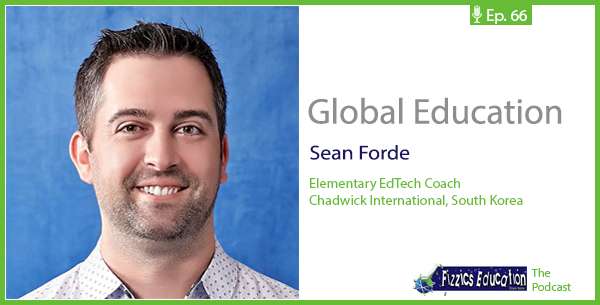
Meet Sean Forde, a passionate educator who has been heavily involved in global collaboration lessons with students. From Flipgrid through to interactive video conferencing, Sean has always been about giving the best avenues for his students to learn!
How do you connect a classroom in South Korea with students in Italy, Alaska, and Arizona? In this episode, we talk with Sean Forde about the power of asynchronous global collaboration. We dive into how simple tools like Flipgrid can break down time-zone barriers, allowing students to co-author books, perform in global theatre, and solve geographic mysteries with peers from across the planet.
About Sean Forde
Sean Forde is an experienced international educator and the Elementary EdTech Coach at Chadwick International in Songdo, South Korea. Sean’s career spans a variety of unique environments, including serving as a K-5 STEAM teacher at the American School of Milan and teaching Yup’ik Eskimo students in the remote village of Russian Mission, Alaska. He is a specialist in Instructional Technology and is renowned for creating massive, multi-country digital projects that foster empathy and global citizenship. Sean is a pioneer in using video-discussion platforms to bridge cultural gaps and is a frequent contributor to the global EdTech community.
Sean discusses specific frameworks he uses to turn local classrooms into global learning hubs:
1. World Read Alouds (WRA)
Digital Co-Authorship: Classes around the world use Flipgrid to record different pages of a story. Using Book Creator for the final product, students build a truly international library.
Geography & Maths Integration: The project adds a STEAM layer by requiring students to research the physical locations and calculate the distances in kilometres or miles between the contributors of each page.
Asynchronous Acting: In partnership with NightZookeeper.com, Sean coordinates a global script broken into scenes. Every two weeks, a new scene is released with printable masks.
Green Screen Tech: Students record their scenes on green screens, allowing Sean to composite them into a unified background regardless of where in the world the video originated, creating a global play.
3. Morning Meeting Mystery Grids (M3G)
The Time Zone Solution: To solve the problem of mismatched schedules, Mystery Grids allow a guest to record a brief intro on Flipgrid. Students then respond with yes/no questions throughout the week to deduce the guest’s location.
Deductive Reasoning: This builds critical thinking as students formulate strategic questions to narrow down the global map based on the guest’s video responses.
Top Episode Learnings: Connecting the World
The Power of Asynchronous Video:
Sean explains that we no longer need to be online at the same time to collaborate. Tools like Flipgrid allow for thoughtful, recorded responses that give students more time to process their language and ideas without the pressure of a live call.
Integrated STEAM Across Borders:
By combining geography and maths (distance calculations) with literacy projects, Sean demonstrates how the Arts and Sciences are naturally intertwined in global projects.
Student Agency and Choice:
Fostering student agency by allowing learners to choose how they demonstrate their understanding—be it through a website, an experiment, or a video—increases engagement and caters to diverse learning styles.
Education Tip: The ‘5 Question’ Mystery.
Try Sean’s ‘Mystery Grid’ logic in your classroom. Hide a ‘Mystery Object’ or ‘Mystery Scientist’ behind a screen. Allow students only five yes/no questions per day to figure out what it is. As Sean demonstrates, this teaches students to prioritise high-value questions and use deductive reasoning—a core skill in both scientific inquiry and global communication.
[00:01:06]Ben Newsome: Yes, welcome again to another Fizzics Ed Podcast. It’s a big week yet again this week. We are speaking with my good friend Sean Forde, who very much is all about global education. He’s an elementary teacher who doesn’t just teach at one school; he’s been to many, many schools right across the globe. Currently, he’s teaching at the Chadwick International School in Songdo, South Korea, but he’s also spent time as a K to 5 STEAM teacher at the American School of Milan in Italy and as an elementary teacher in both Russian Mission, Alaska and Casa Grande, Arizona.
[00:01:34]Ben Newsome: Seriously, Sean very much respects technology and its ability to connect kids together and learners to experts right around the globe. And that’s exactly what we’re going to talk about in this particular podcast. I’ll tell you what, Sean Forde is very much not just about the STEAM side of things; he very much is connecting learners for learners to be able to understand each other and to do cool things. One of the things I really respect about some of these things he’s been doing is some of his work with Flipgrid and World Read Alouds, as well as the Night Zookeeper’s Global Readers Theatre, which I tell you what, he will tell you far more about that rather than listening to me.
[00:02:08]Ben Newsome: So tell you what, sit back, buckle up, grab a coffee, a tea, a glass of wine, or whatever your beverage of choice, and listen on in because Sean very much has a bit to say about global education. And I hope you enjoy the chat.
[00:02:20]Announcer: This is the Fizzics Ed Podcast. We’re all about science, ed tech and more. To see 100 fun free experiments you can do with your class, go to fizzicseducation.com.au. That’s physics spelled F I Z Z I C S and click 100 free experiments.
[00:02:38]Sean Forde: Over the last few years, I am from the US, Minnesota specifically, and I’ve bounced around a bit. Started my career off in Arizona, and that wasn’t all too magical, so I decided to switch it up and go to a remote village of 320 in Russian Mission, Alaska. And that’s where I really got into the whole EdTech, global, thinking out of the box type of education.
[00:03:04]Sean Forde: And then jumped into the international world and came to Songdo, South Korea at Chadwick International. Did three years as second grade, asked my girlfriend to marry me, so that forced me to take a teaching sabbatical of pasta and wine and switching teaching genre to a STEAM/STEM teacher for a year. And my waistline was getting too big, so we decided to come back to Songdo, South Korea and Chadwick International, where I am now the elementary EdTech coach.
[00:03:44]Ben Newsome: I must say though that anyone who likes their kimchi could still increase their waistline, admittedly.
[00:03:50]Sean Forde: Yeah. Yeah, there’s always, there’s always ways that you can find to do that.
[00:03:57]Ben Newsome: True. Oh dear. But I totally get it. So you were teaching out in the southwest, and then hey, let’s change it up. Let’s head out to Alaska, and from there horizons got broadened. Hey, what was it like teaching out in a small place in Alaska? I mean, obviously being remote means you had to sort of think on your feet a bit, I suppose, to be able to get things going a bit. I mean, how did you find it?
[00:04:24]Sean Forde: I mean, it was definitely a change. I mean, going from your cookie-cutter lower 48 in the US school with 24, 28 kids to teaching multi-age first, second grade of mostly native kids, you definitely see a whole different aspect of behavioural and just students in general and just cultural. So you definitely have to put a different hat and lens on your teaching and classroom management; otherwise, it’s going to be a total train wreck.
[00:04:56]Sean Forde: Within the first five, 10 minutes of the day, you knew how your day was going to go, if you were going to even teach anything. So you had to make it hands-on, you had to make it different than what you are used to seeing in the textbooks or going against the standards. And with being 400 miles northwest of Anchorage, that’s where we got connected to CILC, which is a virtual field trip organisation. And these kids don’t have roads. We have to fly to places.
[00:05:31]Sean Forde: So the real eye-opener was I had a kid that came back from Anchorage and he’s like, “Oh Mr. Forde, I saw Taco Bell.” I was like, “Oh, what’d you eat?” Like, “I didn’t, I just saw the sign.” So that was just a real like, you take even Taco Bell for granted, but this kid was so elated and excited that all he did was just see the sign. And then cue the Ace of Base song for that segment.
[00:05:59]Ben Newsome: But you know what? I mean, I’ve had similar experiences. I have taught out in remote Australia, and a number of teachers can recount where some of those kids have never seen the ocean, ever, because they’re in the middle of the desert. It’s a semi-arid area. And just the idea of, I mean, I remember, I’m a country kid. So I remember seeing my first big city, and it’s an eye-opener when you’re only used to seeing a few thousand people and then it steps up. Big change.
[00:06:28]Ben Newsome: And I have connected with some schools in Alaska where they have to fly things in. And some of the things you take for granted, I mean, like when we run our science presentations into Alaska or any place, we’ll say, “Here is a PDF with some simple things you can get from your local shops.” And the teacher would write back to me going, “Oh, about those simple things? We can’t get them for three weeks.”
[00:06:49]Sean Forde: Oh yeah. It was crazy. I mean, you would be teaching and each class had like a teaching intern or aide. And all of a sudden, just out of the blue, people would just vanish. It was like a horror film. But then you find out that the store got bread or eggs and they just scurried away to try to get their hands on bread and eggs or fruit.
[00:07:13]Ben Newsome: Wow. I mean, that’s quite a challenge. So you were dealing with kids from around town, or were they brought, did they catch buses in or anything? Like, how, I mean, it’s a remote area, but I’m trying to get my head around where they were coming from. Were they from properties, or…?
[00:07:33]Sean Forde: Just Russian Mission, Alaska. So besides the teacher kids, they were all Yup’ik, Yup’ik Eskimos. So they’ve lived there their whole life. Maybe have gone into Anchorage, come back. So a lot of subsistence living. And there was only one store, we got a post office, a clinic, and a dirt airport. That’s about it.
[00:08:02]Ben Newsome: Wow. What an experience, considering your background coming out of the lower 48, and then moving across to Korea. It’s a bit of a change again. How did you find going into Korea? I mean, I suppose in some ways it was yet another cultural shift again. How was that? I mean, sort of, what prompted the, “Let’s jump out of the States and go global,” so to speak?
[00:08:31]Sean Forde: So when I was going to school at St. Cloud State in Minnesota, there was an organisation, International Student Volunteers. And at the time as a student, I couldn’t afford it. And finally get up to Alaska where I am making good money compared to the lower 48. And I was at that time getting my Master’s programme in EdTech and design. So I’m like, I’m technically a student for three more credits.
[00:09:00]Sean Forde: So then I signed up to volunteer in Africa and went, and I was definitely the grandpa of the group, but it definitely opened up my eyes to what was out there. And that’s what wanted me to go into international gigs. So I flew over to Boston for a job fair and was looking strictly for Africa and wound up in Asia.
[00:09:25]Sean Forde: Yeah, eventually. Eventually. But I mean, the big shocker is like, I go from remote village where I’m living in like a 1970s trailer that I’m pretty sure if it blew too hard that it might fall and crush me, to moving to Songdo City, which is one of the world’s first smart cities that’s built off of reclaimed land, and in a smart apartment, one-to-one iPads. So it’s a huge shock to have even just paved roads, restaurants, beer again. Like, it was another instance where my waistline increased dramatically just from having paved roads and normal food and drinks.
[00:10:10]Ben Newsome: So that’s quite a contrast. I mean, so in Alaska you were connecting with CILC, so Center for Interactive Learning and Collaboration, doing some video conferencing to enrich kids about what’s going on in the world. How were they, did they have much tech in that room compared to what you’ve found in Korea?
[00:10:29]Sean Forde: In Alaska, you definitely, I mean, we had 10 times more tech in the remote village in Alaska than we did in Casa Grande, Arizona. And it was definitely nice being someone that was interested in tech, but then they made it nice coming in here to also get your hands on even more.
[00:10:51]Sean Forde: But the thing that I found really interesting is that even though you’re in a low, severe poverty area like bush Alaska, and their experiences and what they haven’t seen, and then you come to the extreme wealthy of a private international school, and you see that they’re pretty similar besides just their checkbooks.
[00:11:13]Sean Forde: Like you have kids that definitely travel, but then they stay in the hotel, so they haven’t seen a lot of the world just like the kids of Russian Mission haven’t. So even though they’re two polar opposites on the spectrum, they definitely live a similar life of needing to break down the walls to be able to see what is out there besides where they live or how they live.
[00:11:37]Ben Newsome: And this is sort of, like wind it forward in some ways, I mean, I’ve run into you for a few years through ISTE, through the International Society for Technology in Education, and you doing stuff through CILC and bits and pieces. And one of the things I love about what you do is really getting students out and understanding the world. And one of the things that you do is that little, ah, sometimes your brain just sort of goes into a bit of a point where you can’t remember the name of the thing, but you know the little figurine that we get to print out and we get to send around the world? What’s that guy again? Flat Stanley!
[00:12:11]Sean Forde: Yeah, Flat Stanley.
[00:12:12]Ben Newsome: There I got it. Flat Stanley. If people haven’t heard of what Flat Stanley’s about, this is just cool. Sean, pitch why Flat Stanley is so good for kids to understand about the globe.
[00:12:25]Sean Forde: So with Flat Stanley, obviously he’s been, Stan the man has been around for quite some time. The chapter book by Jeff Brown, I think is pushing 60 years old. I don’t know. But I was so used to like, even in when I was in elementary, you’d get a Stanley, you’d mail it in snail mail. And then eventually, at the end of the year, you get a notebook and actual physical pictures, if people remember what those are. And I was like, this is, I don’t like to wait.
[00:12:59]Sean Forde: So at the beginning of the school years, I give each student in my class a paper Flat Stanley. They colour it, they make it their own. I laminate it, scan it so it’s PDF, and then that way you can email it out with a class letter. That way it’s instantly to someone. They can print it off. They can use the PDF on their phone. If Stanley decides to go swimming in the ocean, he can rejuvenate himself from your local printer.
[00:13:30]Sean Forde: And then if you get it and you’re like, “Ah, I just don’t have the time,” then you can easily forward it on to 40 other people. So just switching it up to this different version and platform allowed me through three straight years to hit all seven continents, even with drastic help from Holly Kercheval from Fizzics herself, got Stan the man to Antarctica, I believe, three straight years. But you just shot in the dark via Facebook, Twitter, MySpace, whatever. You never know what will catch and where it will go.
[00:14:09]Ben Newsome: It’s such a cool way to show the six degrees of separation and a demonstration of EdTech in its simplicity. We are connected with these social apps and we can reach people and they can do things, which is really, really useful.
[00:14:23]Ben Newsome: And then sort of thinking about this further, I mean, lately I know you’ve been working a lot in Flipgrid with World Read Alouds and various bits and pieces. I mean, tell us a bit about that.
[00:14:35]Sean Forde: So, as you have listened to this podcast for a bit, you’ve noticed my voice is pretty monotone. So doing read alouds for my second graders, A, I don’t really like to hear my voice, and B, I would guess they would want someone or differentiated people reading.
[00:14:55]Sean Forde: So I thought it’d be a fun way and a unique way to take a children’s book, break it down page by page backwards within Flipgrid, and then invite people from around the world to record themselves from their location reading a page.
[00:15:12]Sean Forde: So once it was all said and done, I then downloaded those videos and embedded them into an app called Book Creator. So then children can now see the story visually with the words, but also being read from a page from each person in a different country. And it’s been huge because then it also relates to social studies. You can relate it to math with kids researching what’s the distance in miles or kilometres between pages. And it possibly even opens up the door for other connections down the road.
[00:15:47]Sean Forde: And a plug, with Flipgrid’s new mixtapes, it makes it a whole lot easier with organising videos into the correct order.
[00:15:57]Ben Newsome: Yeah, I could imagine. If you get the pages jumbled up, it can be a bit of a pain because I suppose if you had a huge volume of work to go through, you’d have to listen to every minute reading, trying to work out what’s the order to put it in.
[00:16:10]Ben Newsome: And I want to point out with how that Flipgrid works, those people haven’t seen it, it kind of looks like Pinterest in some ways. It’s like a whole bunch of squares where you have people within those squares whoever recorded stuff based on the topic that you want to do. And in this case, it’s this idea of creating a virtual book but read by different people, which is awesome.
[00:16:30]Ben Newsome: And I often think it’d be very interesting from a flipped learning point of view to have, just whether you’re teaching STEAM or whatever it is, getting kids to say what they think about a particular topic or what they’ve learned or what they wish to learn. I mean, you can really use this platform in lots of ways. And because of that, you’ve seen Flipgrid just explode in the teaching scene. I mean, what other things have you seen with that technology or similar that’s helping learners really get together and just learn stuff?
[00:17:05]Sean Forde: Well, I mean, just the diversity of Flipgrid itself. I mean, like you said, if you’re going to do a presentation, you can easily do a pre-Flipgrid so then you have a vision of what the students learn, so then you can cater it more to them. Pre-assessments, projects.
[00:17:25]Sean Forde: I’ve just started doing morning meeting Mystery Skypes. So it’s not a live Mystery Skype, but each morning we listen to an introduction from someone around the world. They come up with five yes/no questions, record their video to them. And when that person is ready, they record their answers back. So it kind of breaks down the issue with time zones. And you can do Mystery Skypes throughout a week during your morning meetings.
[00:17:52]Sean Forde: So there’s one version. Working closely with Night Zookeeper, which is a game-based writing platform and will be actually doing a cartoon series with Sky TV in February. But we’re doing a Global Readers Theatre where they provided masks, the script. So every two weeks a new scene is available and students can practice the scene, print off the masks, and record it on a green screen. So then in the end, come January, we’ll be able to put that whole play together. And it won’t matter if you’re in Missouri, Australia, Italy. We’ll put in the backgrounds and it’ll look like it’s just one play from kids around the world.
[00:18:39]Ben Newsome: That is just so cool. I’m loving it. Look, the thing is though, obviously half the problem with tech is the interface and then explaining said interface to the learner to be able to use it. How have you found your students in picking up the tools, so to speak, to be able to run with it, so that you’re not hands-on directly with each of those 20 or 30 kids in your room?
[00:19:03]Sean Forde: I mean, that’s been the nice thing. Like especially with probably two of the biggest platforms in EdTech, especially in elementary, is Seesaw and Flipgrid. And they just make the user face so simple. Like whether it’s doing a Seesaw activity, it’s pretty cut and dry with just how simplistic the buttons are. Maybe you do just an example, but these kids these days are so touchy and used to technology that as long as you just show it, make it fun and make it different, they will take it and shoot it to the moon.
[00:19:35]Sean Forde: And same with Flipgrid. It’s pretty cut and dry simple. And then they can add their little stickers to their selfie, so it makes it even more fun. So I mean, these companies are definitely getting the right lens of how to shoot out their projects to not only make it easier for the students, but for the teachers as well.
[00:19:55]Ben Newsome: No, absolutely. Now, the thing is, tech is only just one part of this acronym that we all talk about, STEM, STEAM, or whatever permutation that you want to call it these days. I mean, you’ve had to be the STEM teacher in your school. So what sort of things do you know that you’ve thrown together, have run with the students, and it’s, “You know what, this has just worked.” This particular project, whether it’s project-based learning or a particular science, quick in and out experiment. What sort of things have you done where you’ve gone, “You know what, I wish other people would do the same thing with their learners”?
[00:20:32]Sean Forde: Well, I mean, one big one like with here at Chadwick, we’re a PYP school and it’s just inquiry-based. And we’ve got a makerspace, and it’s just getting, like, yes, I was the STEAM teacher and yes, there’s a makerspace, but hearing those and knowing it’s like a designated location, it’s getting other teachers comfortable and knowledgeable that just because you’re not in the makerspace or you’re not at STEAM class, it doesn’t mean that design and STEAM and STEM aren’t happening in your class.
[00:21:10]Sean Forde: Differentiating and letting the student take the wheel to have them show their learning how they want to opens up the avenues for all kids. Like I was extremely shy growing up. So my guess would be if I had to do a paper or a speech, a five-minute would be a two-and-a-half-minute. Where if a kid wants to make a website, make a website. If a kid wants to do a science experiment to explain what’s happening in the world, make that.
[00:21:39]Sean Forde: Don’t put such strict parameters on it. Have obviously an end goal, but allow these kids to test, and then go back to the drawing board, allow them to fail. And even as a teacher, even as teachers in a STEAM/STEM lens, like yeah, you’re usually supposed to test out science experiments before you do it, after you watch them on YouTube. And I’m guilty of not doing it. But I think it’s also good for students to see, not every time because then you just look like a failure, but it’s good for students to see that experiments don’t work all the time. Projects of building and designing and engineering don’t work right away.
[00:22:23]Sean Forde: The stuff you see on YouTube or see in books, it’s edited. They’ve tried a whole bunch. Like you have to fail to make things work. And getting that whole mindset across the board is huge.
[00:22:36]Ben Newsome: Absolutely. I mean, I’ve often said to my students, it’s not an Xbox, you don’t just press play. And by the way, someone had to code that thing. Ever tried coding? It takes ages to get the thing right. Really it really does. No, and that’s it. I suppose it’s all about creating that openness to failure and then the agency to go do something about it, to go learn as you go along.
[00:23:00]Ben Newsome: I guess half the trouble is trying to shove it into an already crowded curriculum. And of course, with your work, ’cause you’ve gone to different curriculums, it means that trying to fit it in based on various requirements may or may not be challenging depending on the environment that you’re at. I mean, how much time do you get given within your requirements from a week-to-week basis to be able to give kids just the chance to freely explore their topic? Or do you find it’s a bit more prescriptive?
[00:23:30]Sean Forde: I mean like in Italy it was a lot more like American-based standards, like very cut and dry. So I mean they still had project time or genius hour, so they were able to explore and build on different things like that. Whereas in a PYP mindset or an inquiry-based mindset, obviously there is somewhat more of a lens to be able to play around and build and hands-on.
[00:24:02]Sean Forde: But then you’re also trying to inquire about your literacy and your numeracy, get to all your specials classes, integrate makerspace, library. So every school has their definite pluses and benefits of being able to get hands-on, but then there are a lot of specials, so it does take away from contact hours.
[00:24:26]Sean Forde: But I think just getting the mindset of, even though you think, “Oh I don’t have the time for this, I’ve got to stick to this format.” Like yeah, sure, stick to that format. But if you eventually do get comfortable with thinking in this way, you’re still getting the same point across, still getting the same things accomplished, but you’re hitting to different kids.
[00:24:50]Sean Forde: Like one unit might be a huge hit for one kid and they want to take it to the moon, but they’re limited because you’re limiting what you’re presenting for the kid. You don’t know what will click for an interest. So you don’t want to limit that by just doing what you’re used to or keep the horse blinders on, as I say. Just want to give little appetisers and they’ll eat it and run with it when they’re comfortable.
[00:25:20]Ben Newsome: So with these sort of connections that you are really facilitating for kids, and they are, they’re global, it’s not just next door. I mean, sometimes it might be a connection with a particular museum or zoo around a particular topic area, but I’m guessing you have a number of school-to-school connections every now and then.
[00:25:38]Ben Newsome: Do the kids get the chance just to outright learn about their own cultures outside of what the topic you’re trying to study? Have you had, do you find that the kids effectively have a virtual, almost like a virtual pen pal that can be created? How has it gone with ongoing relationships, is I guess what I’m asking?
[00:25:57]Sean Forde: I mean, it is easier to do when you’re in a PYP curriculum, ’cause a lot of the units of inquiry can relate to other countries, other cultures. So it is very easy from at least our side to be able to connect. But then finding another school where the curriculum does cater to the flexibility to be able to have communications or do projects together, I would say is probably the most difficult.
[00:26:30]Sean Forde: Like a big one right now, we have a sister school or our main campus I guess is in Palos Verdes, California, Chadwick School. So we’re looking to really build the collaboration with them. But with time zones, it will most likely be streamed through Flipgrid.
[00:26:47]Sean Forde: But we’re looking at doing joint exhibition projects for fifth grade at the end. Even though they aren’t PYP, like if you find a good school and a good at least point person that’s eager to get the other side excited, that’s the main, huge part. Like you’ll find people that are like, “Yeah, let’s connect.” But then they jump in before they’re really fully comfortable to connect.
[00:27:15]Sean Forde: So you’ll try to connect and it’ll fizzle, it’ll fizzle, one will click. So I mean you’ve got to put out feelers. It’s like fishing, I guess.
[00:27:26]Ben Newsome: True. Actually, I was just sort of thinking that you could create mini versions of, you know, Joan Roache who set up Ripples Make Waves, where it’s a 24-hour event around World Water Day. And people all around the globe on every single hour there were lessons being run by students about what they’ve done about conservation of water and cleanliness of water and all that water sustainability stuff. And it happened around the world as the earth turned over that day.
[00:27:55]Ben Newsome: I suppose working with your school in Chadwick and the one in Korea, you could almost create little versions around any given United Nations day or any focus day that your schools would like to look at. And I suppose there’s a chance that if you have the opportunity, you could almost do this even simply in amongst your own classrooms. Like one classroom just talk to the next classroom, even if they’re literally next door. At least the kids are modelling and learning about how it is to communicate a topic virtually, which is effectively a 21st-century skill.
[00:28:28]Sean Forde: Yeah. Yeah, definitely. And even if it is class-to-class or across countries. One thing that I found just that really helps build the camera presence, their interest to inquire more about it, is doing various Mystery Skypes. So you work just in the classroom getting them comfortable with yes/no questions, getting the different jobs set up.
[00:28:58]Sean Forde: And then you might Skype to just an individual adult, then you don’t have to worry about the squirreliness impacting another class on the other side of the camera. But then they can inquire to that person once they find out where they are that relates strictly to their unit or a special day or a holiday. And you let that adult know and it can cater to whatever you want your kids to engage in.
[00:29:26]Sean Forde: And vice versa, you do a Mystery Skype with an actual class and it could stem into a year-long pen pal system. We had a fifth-grade class that did a Mystery Skype with a school in Australia, and now they’re looking to connect throughout the year on various units and they’ve shared their calendars of what they’re studying. And hopefully it keeps going and catches on even more. But you never know what will click and where things will go.
[00:29:52]Ben Newsome: Absolutely. I mean, I was just thinking of a hero teacher of ours, Anne Mirtschin, who’s out of rural and regional Victoria. Some people might know her through Twitter as @merca. She is really passionate when it comes to virtual classrooms and Skype and Mystery Skype, and she’s been well known to get up in the middle of the night to do yes or no questions with people trying to work out where is she? And she seriously is in rural Victoria. And getting kids to try and work out where she is, let alone just saying, “I’m Australian.”
[00:30:25]Ben Newsome: She has a blast with it. I know the entire group with the Global Connections community are right into this global thing. And actually, if you’re listening in and want to get into global a bit more, ISTE, iste.org, has a PLN called funnily enough Global, which can help you out. At least point you in the right direction for some people who have done it before and can help you tread that path.
[00:30:54]Ben Newsome: And I suppose just Sean, like, if you had people, you’re in front of a bunch of people who are pre-service teachers, they’re about to start their world in education. What sort of advice would you give them about how to best impact their kids?
[00:31:13]Sean Forde: I mean, mine I just put my mindset in like, yes you have a book with examples and stuff, but how can you change those examples to relate to the kids now? Like, yes it’s a problem about puppies and kitties. Maybe switch it to Pokemon or things that they can relate to or bring things in to be hands-on.
[00:31:41]Sean Forde: Or just because you’re a teacher and you’re professional, it doesn’t mean you have to be mature. I’m 33 years old and I’m still very immature as far as cartoons and reading children’s books and things like that. So just still wanting to be a kid and not worrying about growing up definitely helps your ability to still find unique ways to break down the walls, connect projects, different things because you want your job to be fun, just like you want it to be fun for your students.
[00:32:19]Ben Newsome: Love it. That makes a lot of sense. I must say though, there’s a lot of people who are doing a fantastic job with that. I mean, I’ve met some amazingly funny, quirky, very cool teachers who, it’s irrelevant about their age. It really is. And I completely agree, I totally understand that. And that obviously means that the kids will then feed off that enthusiasm and off they go.
[00:32:45]Ben Newsome: Hey Sean, thank you very much for joining us on this podcast. I know you’ve got stuff going on all over the place. This programme coming up early next year on TV is going to sound quite cool. So how could people find out about that and also how could people get in touch with you?
[00:33:07]Sean Forde: So yeah, it’ll be really cool because the actual script we’re using will be the pilot episode. So definitely a really cool, once we hopefully get it all put together, that the kids can see their work right next to the professional work. But yeah, with that one you can definitely check that out at flipgrid.com/nzk.
[00:33:36]Sean Forde: And then if you want to see what those World Read Aloud stories look like, you can find the finished ones at worldreadalouds.com. And then me at Sean, S E A N, number four, letter D, on the Twitter.
[00:33:55]Ben Newsome: On the Twitter and tweet away as we all do. Hey, thanks very much. I know that you’re doing a fantastic job, and obviously the collaborative opportunities kids have are basically amazing. And also just hats off for seriously just getting out there and going and checking places out. Like that’s just awesome.
[00:34:17]Ben Newsome: And I believe I’m going to be one of them that, some people listening in would go, “Wow, I have some hints of jealousy of the places you’ve been able to go to.” But the reality is that we all have these opportunities. And it’s what you make of them that counts, and you certainly have done that, which is awesome. So I’ll leave you be, but have a fantastic afternoon. Actually you’re not quite in afternoon yet, are you?
[00:34:42]Sean Forde: No, no, no. Still early. Might even go back to sleep, who knows? It’s the day off.
[00:34:52]Sean Forde: Well, thank you very much for having me, Ben. And I look forward to working with you obviously coming up with hopeful projects here.
[00:34:59]Ben Newsome: Mate, it’ll be great. Catch you soon.
[00:35:01]Announcer: You’re listening to the Fizzics Ed Podcast. Why don’t you book us for a science show or workshop in your school? We love seeing students get excited about science, and you will too. Go to fizzicseducation.com.au and click on schools for more info.
[00:35:19]Ben Newsome: Well, there you go. We just heard from Sean Forde, who is very much a superstar when it comes to global education. Yes, he is a STEAM teacher, but he very much cares about any type of education that gets kids connected with other kids all over the globe. Reach out to him. He’s visible on Twitter for sure, and he will help you out.
[00:35:36]Ben Newsome: And speaking of helping out, we would love to help you out. If you’re wondering about doing some TPL sessions, getting a PLN together and doing some STEM stuff, that’s very much what Fizzics Education has been doing for the last quite a while now, and we will happily help you out as we go forward.
[00:35:51]Ben Newsome: So reach out to us. Drop me a line or just reach out to us through our website. You’ll find us, I’m sure you’ll be able to get us. And we will help you too. But look, have a fantastic week. I hope you got a bit out of this chat; I certainly did. And I look forward to chatting again all about education and STEAM and all the things that we can be doing with it. All the best. Bye for now.
[00:36:41]Announcer: This podcast is part of the Australian Educators Online Network. aeon.net.au.
Frequently Asked Questions
How can teachers overcome time zone barriers when collaborating globally? Sean emphasises the use of asynchronous tools like Flipgrid. While live ‘Mystery Skypes’ are popular, they are often impossible due to drastic time differences between countries like Australia, South Korea, and the US. By using video discussion platforms, students can record questions and responses at times that suit their local schedule, allowing the collaboration to continue without requiring anyone to be online at the same time.
What is the digital version of the ‘Flat Stanley’ project? Instead of using traditional snail mail, which can be slow and unreliable, Sean has students create a paper Flat Stanley that is coloured, laminated, and scanned into a PDF. This digital version is emailed to contacts globally, who can print it or display it on a phone to take photos. This allows for instant participation and the ability to reach all seven continents much faster than physical mail.
How does the ‘World Read Alouds’ project integrate different subjects? The project is a form of integrated STEAM. While it begins with literacy (reading a children’s book page-by-page on Flipgrid), it extends into maths and social studies. Students calculate the distances in kilometres or miles between the different global contributors and research the geographic locations of the participants, turning a reading exercise into a data-mapping project.
What is ‘Global Readers Theatre’ and how does it use green screen technology? In collaboration with Night Zookeeper, Sean coordinates a global script broken into scenes. Every two weeks, students around the world record a specific scene using printable masks and a green screen. These various clips are then composited into a single unified play, making it look as though students from different countries are performing together on the same stage.
Why is ‘student agency’ important in EdTech and STEAM projects? Sean believes in ‘giving students the wheel’. By removing strict parameters on how students show their learning—whether it is through building a website, conducting a science experiment, or making a video—teachers open up avenues for all types of learners. This approach allows students to test ideas, fail safely, and go back to the drawing board, which is a core component of the engineering and scientific mindset.
Discussion points summarised from the Global education with Sean Forde with AI assistance, verified and edited by Ben Newsome CF
Extra thought ideas to consider
The ‘Checkbook’ vs. ‘Experience’ Divide
Sean noted that despite the vast difference in wealth between a remote village in Alaska and an elite international school in South Korea, the students often had similar gaps in their global experience. Consider how technology can be used to provide ‘virtual travel’ that breaks down walls for all students, regardless of their socio-economic background.
Asynchronous vs. Synchronous Learning
While live video calls offer immediate interaction, asynchronous video (recorded responses) allows students more time to process information, practice their language skills, and provide more thoughtful contributions. Reflect on which learning goals in your classroom might actually be better served by a slower, recorded dialogue rather than a live conversation.
Normalising Failure in the Classroom
Sean mentions that scientific experiments and engineering projects rarely work the first time, yet students often see edited, perfect versions on YouTube. Discuss the importance of teachers intentionally showing ‘failed’ attempts or unpolished work to model the persistence required in STEAM fields.
Recognised by
22 years, award-winning work, 1 purpose
Recognition from business, education and industry bodies across Australia.
Australian Small Business Champion
Multiple years
CILC Pinnacle Award and Hall of Fame inductee
Center for Interactive Learning and Collaboration
Western Sydney Awards for Business Excellence
Winner
Top 100 Coolest Company
Listed
Local Business Awards
Winner
We value your privacy
We use cookies to improve your experience. Essential cookies are always active. You can choose which optional cookies to allow.We use cookies. Optional ones stay off unless you allow them.Privacy policy