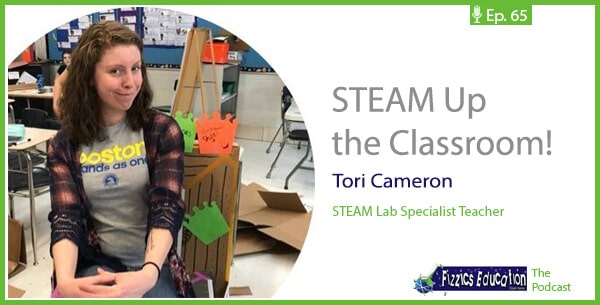
Join Tori Cameron, host of the STEAM Up the Classroom Podcast, as she describes her journey in creating a STEAM lab at her school in Massachusetts, USA. We discuss the importance of low and high tech when it comes to maker spaces, how to source materials, ideas for engaging the wider community and much more!
Is a library just for books, or can it be a hub for innovation? In this episode, we speak with Tori Cameron about her journey from classroom teacher to heading up a brand new STEAM lab. We explore how she transformed an unused library into a 2,000-square-foot makerspace, balancing high-tech tools like 3D printers with low-tech engineering to foster student agency and community buy-in.
About Tori Cameron
Tori Cameron is a passionate educator and the host of the STEAM Up the Classroom podcast. With a background in classroom teaching and a former role as a Director of STEM for a non-profit organisation, she now serves as a STEAM specialist teacher. Tori manages a comprehensive school-wide programme for over 750 students, focusing on cross-curricular integration and making STEAM accessible through both high-tech robotics and low-tech engineering projects. Her work emphasises the importance of giving students a voice in their own learning journey.
Roles: STEAM Specialist Teacher, Podcast Host, and STEM Curriculum Designer.
STEAM Up the Classroom Podcast
STEAM Up the Classroom is a podcast dedicated to sharing practical ideas and inspiring stories from the world of science, technology, engineering, arts, and maths. Tori interviews educators, experts, and even the students themselves to provide a well-rounded perspective on modern education.
The STEAM Lab Framework:
Cross-Curricular Integration: STEAM concepts are woven into literacy, social studies, and history to show students that engineering is relevant across all disciplines.
Flexible Learning Environments: Utilising flexible seating and mobile furniture to allow the space to adapt to the specific needs of a project, whether it is gardening or coding.
Student Media Production: Empowering kids to become creators by using tools like green screens and audio recording equipment to produce their own podcasts and TV segments.
Community Engagement: Building a “playground” for the whole community by involving parents and industry professionals through guest speaking and open-house events.
Top Episode Learnings: Building an Innovation Hub
The Power of the Narrative Hook:
Engineering challenges are more impactful when tied to a story. Using historical events or fiction books provides a meaningful context that helps students connect with physics and mathematics.
Student Agency and Voice:
True learning happens when students have a say in how they learn. Interviewing students about their classroom experiences and allowing them to create their own media fosters deep engagement and ownership.
Community Asset Building:
A successful makerspace isn’t just about the tools; it is about the network. Involving parents and local industry creates a support system that provides expertise, funding, and real-world relevance to the school programme.
Education Tip: The “Problem-Solver” Reframe.
Instead of asking your students what they want to “be” when they grow up, ask them what problem they want to solve or what they want to create. This shifts their mindset from passive career consumption to active agency, encouraging them to develop the skills needed for jobs that haven’t even been invented yet.
More Information & Resources
STEAM Up the Classroom Website (steamuptheclassroom.com)
[00:01:09]Ben Newsome: Yes, welcome again to another Fizzics Ed Podcast. Big week this week, we get to speak with Tori Cameron, who is an incredibly passionate educator. I tell you what, she loves her STEAM stuff so much that she’s setting up the STEAM lab in her school. All the classes right across the school get to come and play with her in terms of tech, in terms of low-tech, in terms of all different ways to get STEAM pumping in their school.
[00:01:37]Ben Newsome: Tori really loves it so much that she also heads up the STEAM Up the Classroom podcast. So very, very passionate when it comes to making and all that type of thing, and also very practical when it comes to elementary and middle school education. It’s a bit of a longer episode, so let’s get right into this. I hope you enjoy it, and I tell you what, I enjoyed talking with Tori too.
[00:01:55]Announcer: This is the Fizzics Ed Podcast. We’re all about science, ed tech and more. To see 100 fun free experiments you can do with your class, go to fizzicseducation.com.au. That’s physics spelled F I Z Z I C S and click 100 free experiments.
[00:02:14]Tori Cameron: Thanks, thanks for having me. I’m very excited.
[00:02:17]Ben Newsome: I am very excited to have a chat with you. In fact, we just had a chat with you.
[00:02:21]Tori Cameron: I know! It’s kind of funny to be like, “Oh hey!” when we’ve been talking for over an hour.
[00:02:27]Ben Newsome: Yeah we have, because full disclosure, Tori runs an awesome podcast called STEAM Up the Classroom. We’ve been chatting on Twitter a lot through Primary STEM Chat, which Rachel Lehr, who is a past guest on the Fizzics Ed Podcast, runs.
[00:02:43]Tori Cameron: And a future guest on mine!
[00:02:46]Ben Newsome: Oh gosh, it’s like we’re all talking to each other. But I mean, Tori’s been doing some fantastic work when it comes to science, technology, engineering, art, and mathematics. I really wanted to have a chat with Tori about why and how. So Tori, tell us a bit about yourself.
[00:03:05]Tori Cameron: Sure. So I actually am in a brand new role at the same school that I’ve been at, but a brand new role this year. Last year my principal had approached me in the middle of the year with an idea that he wanted to start a makerspace. He had just been wondering if I had any ideas or anything like that. From there it spiralled into… the library wasn’t being used and it hadn’t been used for many, many years. So he wanted to put the makerspace in the library so that the library could be basically revitalised and to have kids learning in there again and doing all sorts of things.
[00:04:00]Tori Cameron: So I helped come up with some ideas on what to do with that space and then from there, it actually grew into a position. So never did I think that this would happen so quickly or happen in general. So I’ve come into a new role and we call it the STEAM lab. Basically, I am a specialist teacher, so I get to see every single kid in the school, and it’s roughly 750 kids. We just started, the school year just started a few weeks ago, so it’s been a huge change going from a classroom teacher where I have about 40 kids because I’ll have two different groups of kids, to all of the kids in the whole school.
[00:04:50]Tori Cameron: It’s been really amazing and we’ve been starting it up with all new technology and new lessons and everything, and it’s been a brand new experience for me. Prior to that, I was a classroom teacher and I also worked for a little while as a Director of STEM education for a non-profit organisation. I made different curriculum for their STEM programmes that they had run through after-school programming and they had pre-schools and daycare centres. So I worked with little, little kids too, and then they also had some family events and stuff like that. So yeah, it’s been pretty cool to see how everything has kind of tied together.
[00:05:46]Tori Cameron: And then yeah, you mentioned earlier that I have a podcast, so last year I kind of just started it on a whim. Last summer, I had presented for Education Closet’s Arts, STEAM and Integration Conference. That’s online, so anyone in the whole world can actually see it and they can either see it live or they can see it at a later time. It’s so cool, definitely one of the coolest conferences that I’ve ever been a part of. So I actually presented at that and I just got the bug with talking to people. I started using Twitter to talk to other teachers, and I loved the conference because I talked to so many teachers and so many educators during that conference that I wanted to continue the conversations.
[00:06:38]Tori Cameron: So I had actually spent that summer, which was a summer after my son was born, so he’s a little newborn, and I spent the summer walking around with him in my neighbourhood and pushing him in the stroller and listening to podcasts. So I eventually kind of decided, well, I kind of want to try this and see how it goes. If I’m the only one that ever listens to my own podcast then I think I’ll be okay with it because I’ll be happy to learn something new from whoever is my guest, but it’s grown from there. It’s pretty cool now that I’ve been able to reach so many different people, but also have so many people reach out to me and either ask to be on the podcast or tell me something that they learned from it. That’s all I could ever want. It’s pretty cool. So that’s a little bit about me.
[00:07:12]Ben Newsome: Bit about you! So you have a lot on and by the way, that is fantastic that your school’s really deep diving in on a makerspace. I mean that’s exactly what I really want to talk about. I mean hearing about exactly what’s happening in your school with the STEAM lab is just awesome. But hey, well done with STEAM Up the Classroom. By the way, totally type “STEAM Up the Classroom” into your favourite podcast catcher and you totally will be able to hear about not just from your standard, “Hey, let’s just talk teacher to teacher about how we do STEAM,” which by the way has a lot of importance, but also your recent episode was with students themselves, which was cool.
[00:08:06]Tori Cameron: Yeah, yeah! That one was really cool. I had just mentioned to the kids a few times that I had a podcast and they knew how much I loved doing STEM because I did it all throughout the year. At the end of the year I was like, “Well, would anyone actually want to come on it and tell me about what you guys think?” I had so many different kids that were interested in it and it actually was made into a little TV show for the town TV channel too. It was just such a blast. I think learning from them… I learned from them just so much about myself and what they want in a teacher and what they want to be able to… like ways that they want to be able to learn.
[00:08:53]Tori Cameron: It was a huge learning experience and I’m so grateful to hear all of their feedback and I think honestly I would encourage any teacher to interview their kids, interview their students, and to get ideas from them. Because I mean, who doesn’t want to have a say in how they learn, right? Kids obviously want to have a say.
[00:09:12]Ben Newsome: Absolutely. I mean, your past guests, you’ve got a lot of information when it comes to makerspaces, to doing tech in the classroom and it’s clearly there. But that was one that I went, “You know what, that’s just cool.” And I must say, it’s probably something that we should do on this podcast because often we speak with the experts that do the particular thing and it’s very interesting to hear what they’ve got to say and highly valid. However, hearing the consumer, in this case the student themselves, say “This is how we see how it should be in the classroom” has got so much rich opportunity. It really does. And I love the fact that that was your recent episode. I thought that was really cool.
[00:09:51]Tori Cameron: Yeah, I ended the school year with that one, which was really cool. I got to think about it all summer and knowing that I was moving into this role, it was definitely a great way to end the year and to keep thinking throughout the summer. I definitely am going to do it again. I’ve actually had a few kids that know about it, they’re like, “Are you going to do another episode like that? I want to come on.” I hope that in the STEAM lab, that I actually will be able to have the kids record themselves and start their own little podcasts. We have a green screen in there, so start their own little TV shows.
[00:10:27]Tori Cameron: I’ve been talking with the people that do community access media in town and they’re interested in putting the kids up on the TV channels if they create their own little episodes and stuff like that. So hopefully it snowballs and it grows into the kids being able to explore that different type of media, which would be really cool.
[00:10:49]Ben Newsome: And the thing is, is okay, imagine the student, imagine you’re one of these students doing this. Imagine the agency that you’re creating for them. Because often the time the “I will do what my teacher says” type thing, but now they get to create and showcase their learning. And hang on, what that could mean is decades from now, two decades from now, I kind of wonder what that actually sparks in their mind. Because often it’s “I must consume said thing, so I had to do said test so I get to move on to the next grade level” or to university or whatever it is.
[00:11:27]Ben Newsome: The thing is, is that having people to actually say, “Here’s what I genuinely know, here’s what I believe and here’s what I love,” etc. on audio or visual, whatever it is they do, means that I just like the fact that you give them a voice. And maybe you might be triggering something for later down their lives.
[00:11:45]Tori Cameron: Yeah, I mean that’s the hope. I hope to expose them to a whole bunch of different ways of learning and just ways or new ideas. I like to tell the kids, I like to say, because you know that generic, “What do you want to be when you grow up?” I like to say, “What job do you want to create?” or “What problem do you want to solve?” Your job might not even exist yet. What you do, who knows what’s going to happen and what you can possibly do. They always kind of look at me like, “What do you mean my job doesn’t exist yet?”
[00:12:22]Tori Cameron: And then I’ll say things like, “Guys, Snapchat didn’t exist a few years ago, and now look at it. It’s huge. The people that created Snapchat, oh they are raking it in.” And they’re like, “Wait wait wait wait wait, Snapchat didn’t exist at one point in time?” And I was like, “Yeah, someone created their own career and their own job because they created that app.” I just use that as an example because all the kids are obsessed with Snapchat and it always just kind of blows their minds. So I hope as a teacher that I can provide them opportunities that help them to just see different career paths or to see different education paths that they can take.
[00:13:06]Ben Newsome: I love that question, “What problem could you solve?” I suppose you could do it the other way is “What would you like to create?” That kind of becomes very personal, and when you have something very personal, you’ll often care about it more, funnily enough. So you might actually have some more drive to solve said problem. Or “What would you like to create?” means all of a sudden they’ve got to think more expansively and think, “What would I like to create?”
[00:13:30]Ben Newsome: Often people think that they have a… because of their… for whatever options, whatever’s happened in their lives and where they’re geographical location and their economic status and everything else, perhaps they may have some pre-defined targets that, “I did this because my parents did this,” or whatever it is that’s going on. The thing is, as soon as you ask those two questions, all of a sudden maybe that might trigger the idea of they can have a genuine belief in themselves to do something that’s unexpected and is good for them. That’s awesome.
[00:14:05]Ben Newsome: Hey, I really want to think about and hear about more about the STEAM lab because there’s a lot of schools… I mean I’ve been speaking with heaps of teachers, especially in these learning events we’ve been doing with teachers, the hearing about the setting up of makerspaces. It’s a big thing now and it’s getting going. You’re doing it, and you’re right in the thick of the genuine establishment of it. So how… okay before we go into what it looks like now, how did it look in the initial planning stages? Was it a quick scramble, “Hey guys, we’re going for it, we’re going to make it happen,” or was it more methodical? Like how did the initial thing start?
[00:14:43]Tori Cameron: Hmm. Well, when my principal originally approached me, he had thought of just having it in one small space in the unused library. It would have been basically like a corner of the space. Then I’m… I don’t know if this is… I think he pretty much… I’m pretty sure he visited a few different spaces, he spoke to different principals in the area that had created spaces and from there, he realised that he wanted to have it be a much larger space.
[00:15:27]Tori Cameron: Since the library really wasn’t being used for… we didn’t have a librarian or anything like that. He wanted to renovate the space to have it so that the kids could be in there a whole bunch more because really no classes were going in there. I mean a few times here and there teachers would go in and grab some books, I grabbed some books a few times, but there was no constant learning that was going in there. So we went basically from a few maybe like, oh I don’t even know, a few hundred square feet maybe to 2000, which is crazy! And it blows my mind, I know.
[00:16:11]Tori Cameron: There’s still plenty of books that are in the library and we’ve been going through, especially like science books and trying to make sure that the books that are in there are up to date and making sure that we have resources for the kids like that. But also bringing in brand new resources for the kids. So we have low-tech that’s in there, that’s the typical like cardboard, kind of craft materials, hot glue guns, that kind of thing, some tools that we have, sewing machine, that kind of thing.
[00:16:49]Tori Cameron: And then also a whole bunch of high-tech. So we got iPads to go with different apps and the green screen that we have. What else? We have a 3D printer and Ozobots and Makey Makey kits. What else? Oh, we also have like the iconic Lego tables. We have all sorts of like K’NEX and things like that.
[00:17:25]Tori Cameron: And also some plants that are growing in there, to hopefully some edible ones, like I have an avocado plant and a mango plant and we’re going to have all sorts of herbs and things that are growing in there so the kids can learn about that in like the farming aspect, which is kind of cool. What else? There’s so much going on! And just flexible seating so the kids can move around the furniture based on what they’re doing. We have really cool stools for them so they can really move around their seats and be able to stand up at tables. Like the tables can go up or they can go down, so they can stand, they can sit, and they can use all the space.
[00:18:11]Tori Cameron: It’s not finished yet. The space hasn’t been completely renovated or all the stuff hasn’t come in the mail yet because things have just been taking a long time. Because of the start of the school year, a lot of things are either on backorder or something like that. So it’s not totally picture-perfect ready yet, but the faces that the kids make when they walk in and they’re just in awe and just so excited to be in this new lab, it’s so awesome to be on the other side of it and to feel just as excited and to be providing all of these opportunities for the kids that I honestly could only dream about months ago.
[00:18:59]Tori Cameron: And now it’s here and just how excited that they are. They go home telling their parents and I’ll see them out, like at the grocery store, and they’ll tell me how excited that their kids are to be able to be in this space. It’s so worth it, and I wish I could just shout out to the masses, to every administrator all over the world, and say, “This is so worth it for the kids.” The kids want to build, they want to be able to create, they want to try out new technology and to become mini experts in being able to use little robots and things like that. It’s just so worth it to be able to provide this for the kids. It’s been really cool, and I’m looking forward to this year and to all the years following, to be able to grow the programme and to hopefully host events for families and parents.
[00:19:56]Tori Cameron: It’s funny because we had open house the other night and I had parents coming in, and a few of them were so giddy and excited about the new lab. They were so excited for their kids, but then they were also like, “Oh man, I kind of want to play with stuff and I want to be able to explore what they’re exploring.” And I was like, “Oh, don’t worry, I am planning on having those opportunities for you guys because as a parent, I totally would want to be doing the same thing.” So it was kind of fun on that end too, to have the community support as well.
[00:20:28]Ben Newsome: You’re getting to create your own playground, aren’t you?
[00:20:31]Tori Cameron: I know, I know. It’s a dream, honestly. I can’t even believe it. It’s so amazing. I never, ever would have thought that this opportunity would ever arise, and it has and I wake up every morning just so grateful. I loved that school to begin with, but now I love it even more and I didn’t even know that was possible. I leave every day from work thinking, “Wow, I am so lucky.” And when I get excited in the morning that I get to go to work, I mean, that’s not the case everywhere and that’s not the case for everyone, and I’m so incredibly grateful for this opportunity.
[00:21:18]Ben Newsome: What I love about this is the buy-in you’re getting from the parents. Obviously the kids are going to love it. “Hey, I get to play with robots, I get to do cool stuff with plants and whatever else is going on in your room.” They’re totally going to be into that and it’s almost predictable that they’re going to want to do that. Which kid doesn’t want to fiddle and create? But getting the parents on board is fantastic because in those parents will be not just, “Hey, here’s some support” from an emotional point of view, but they will have their own networks who can support this makerspace. And that’s what I’m seeing in these other makerspaces. They really become very individualised based on the cohorts of kids who happen to hang around, because the parents themselves are going to want to help out.
[00:22:03]Ben Newsome: Gee, you’ve got a really big opportunity here, especially considering you’re starting it from the ground up. Where could you imagine this would end up looking like, two years from now or three years from now? I’m not going to say 10 years, like a whole while away.
[00:22:26]Tori Cameron: Ideally, in my head I have big plans and my principal and administrators, they are so pro-big plans too. Obviously since they’re the ones that are backing this. I think that’s definitely such a huge support to be able to have that. Two years from now, I would really want to have events frequently where I can bring in the community and I would love to be working with businesses and local groups that would come in and shine with what they know and be able to reach the students that way. I love having visitors in my room.
[00:23:19]Tori Cameron: Last year I was notorious for having guest visitors all the time, especially when we were learning about the human body systems. I had guest speakers coming in because I had so many different parents and people that I knew that were in the medical field. I invited everyone I know to come in because they’re professionals. Obviously they are going to know an incredible amount of information, much more than I would ever know because they went to school for it and that’s what they’re doing every day of their lives.
[00:23:55]Tori Cameron: So I love having guest visitors. I would love to have many people come in and be able to work with the kids. I’ve had several people already offer and reach out to say that they would love to start working with the kids. It just depends on… really I kind of want to get my feet wet and figure things out and then I want to have some people coming in definitely. I did this past summer camps and I’m starting up a STEM club for the second year in a row and I would love to continue doing that.
[00:24:38]Tori Cameron: But I would also really love to see the lab be a big resource for the educators that are in the district and especially in my school. I really want them to view it as something that they can come to me and say, “Hey, coming up, we are going to start learning about the solar system. What can we do together where we can use the STEAM lab and also what they’re going to be learning in my homeroom class and combine forces?”
[00:25:12]Tori Cameron: I would love to be able to support the teachers that way, but also not just the science teachers, I would really love to support all of the different subjects too and really show that STEAM is not just science and math, but it also can be used in social studies and it can be used in ELA and we can combine forces to do really cool things. This year I have my plan for the year laid out and I’m hoping to have some cross-curricular activities with the kids so they can start seeing that STEAM isn’t just science and math, but it’s also social studies, it’s also reading and literacy.
[00:26:03]Tori Cameron: I feel like that was a really long answer, but basically I just want it to keep building and to be a really great resource for the community and the kids. Kind of like what you were saying on my podcast, saying yes to as many things as you possibly can, I would love to be able to do the same because I just want to give the kids the world, like every teacher wants to do. Living in the community that I’m working with, I want to be able to give the community the world too and provide as much as I possibly can. If I don’t know the answer, finding people that do know the answer.
[00:26:43]Ben Newsome: Yeah, it’s so cool. I love the fact that you’re looking forward to creating some events in your makerspace because your STEAM lab 100% is going to work with the kids. I totally can see that. I can see how you can link it to curriculum with the Common Core and everything else. Creating these additional events means you get this vibrancy in the school that, whilst schools are vibrant in their own case, having this thing as a focal point for STEAM itself means that it elevates itself.
[00:27:15]Ben Newsome: Often the events that happen in schools that bring the public in can be around drama and arts, and I get that, but it would be kind of nice to bring in things around science because it’s not often seen as an event as such. Bringing industry professionals in to talk with your students is unreal. Anyone listening, if you feel that maybe you might be in an area where you might want particular experts and you may not have them in your location or for some reason they can’t get to your school, there is a platform called Nepris. Have you heard of Nepris?
[00:27:44]Tori Cameron: No.
[00:27:44]Ben Newsome:Nepris is kind of cool. Nepris says connecting industry to classrooms. What it actually does is it does it virtually, so think Skype and the like. So the idea is you’ve got validated people who have been working with children checks and made sure that they’ve got something relevant to say to students, but thousands of people. They could be doctors, lawyers, plumbers, engineers, people working in food or whatever it is they do. They have actually signed up to be “Hey, I want to share what I do to students.”
[00:28:18]Tori Cameron: That’s so cool. That’s kind of similar to Skype a Scientist, but it’s not just scientists.
[00:28:24]Ben Newsome: Effectively yeah. And because it’s so broad, I can’t remember what the numbers were. I was speaking to the CEO a couple years ago, so I can’t remember, it was like at the time it was four or 5,000 different people available. It might be 10,000 now. I’d have to go check. Look up nepris.com. Obviously it’s really cool when you can get people face-to-face in your room. I totally get that. But there might be times when you might be doing a particular topic and you think, “You know what? I’ve got my brain focusing on plants, I don’t know, maybe it’s the morning.” But maybe you might want to connect with a botanist working in the field. Just that opportunity is there and I love it and it makes it rich and rewarding for the kids, which is cool.
[00:29:12]Ben Newsome: So right, so you’re creating this STEAM lab. You’ve got mail on its way. But obviously it’s actually up and functional. You’re a couple of weeks into the school year and you’ve got lessons to run. How long do the kids get to spend in your room?
[00:29:25]Tori Cameron: Yeah, so that’s also been a huge adjustment for me, becoming a specialist teacher and not seeing the same kids every day. So I have the kids for one block and I actually see one class from every grade level for five days in a row, and then it switches to a new class for five days in a row. And we cycle through the school year like that. So I actually see the kids… I think it’s five cycles throughout the year, so it only ends up being around 25 classes give or take. There’s also some other extra things, we have PLC where I’ll see the kids extra, so it’s more than 25, but it’s not a huge amount, which is kind of crazy because one, I have to see all the kids in the whole school, obviously. But it’s kind of crazy to me because I wish I could just see them all the time and every day. I wish every kid could be in the lab every single day.
[00:30:37]Ben Newsome: I was actually just thinking listening to that, because I can totally see the logistics. You’ve got this awesome space that everyone wants to play in, which means you have to timetable it out. One of the things that happens in a lot of museums is outreach boxes, usually called “Museum in a Box” or something like that, and they get sent out to schools and libraries and they get to use these things for a couple of weeks and they get sent back. Wouldn’t it be cool or a little bit interesting if you could get some students as a project to create a box that gets sent around the school?
[00:31:08]Tori Cameron: That would be really cool.
[00:31:10]Ben Newsome: But the fact that you’ve got this timetable constraint and that was going to happen no matter what. You’ve got no choice. But being able to almost outreach some of your stuff to then get booked in by teachers. For example you’re using Ozobots and things, you obviously want it in your room, but there might be some things there that you know are going to be down for this term, they’re not going to get used, there’s no planning in the curriculum yet for you to use it, but I wonder whether that’d be useful.
[00:31:44]Tori Cameron: I think that’s an amazing idea. Alright there you go, you’ve got some homework!
[00:31:49]Ben Newsome: I kind of feel because you hear about these schools setting up makerspaces and they’re always contested. They’ve always got this issue for access. Could be a way around it.
[00:32:02]Tori Cameron: Yeah, it could be. It’s interesting.
[00:32:06]Ben Newsome: In the meantime though, you’ve got this great space being set up. What sort of projects are brewing for this semester?
[00:32:13]Tori Cameron: Yeah, I mean, I actually don’t… semesters don’t really apply to me too much because of the way the schedule is, so I actually am because of the cycles, which is also kind of crazy. It’s an interesting adjustment. Basically what I did is I looked at the school year and I looked at how many times I was going to see each group of kids and I planned out… pencil planned, I haven’t written all the lessons obviously yet, but I planned out how I wanted the school year to look. In speaking with my principal, he really wants to provide opportunities for the kids so that all the kids can have the same opportunities from every grade level.
[00:33:07]Tori Cameron: Everyone in sixth grade will be doing every project, they’ll all have opportunities to use all the different things that are in the lab that are sixth-grade specific, and the same for the third graders and things like that. So I planned out basically when they were going to be using the different technology or the different parts of the lab, and I planned that out. Then from there I’ve been planning, alright, so if they’re going to use the Ozobots this cycle, what am I going to do for lessons? I’ve been looking into all of the curriculum that Ozobots provide and reading up on all of that and the same with all the different other technology.
[00:33:59]Tori Cameron: As much as I love all the technology that has come in the mail, and I’ve heard all about it—for the past several months I’ve been putting out tweets like, “Hey, does anyone have any advice or does anyone have any ideas on things that I should look into for a makerspace?”—I haven’t actually used some of the stuff that’s coming in. So it’s a huge learning curve for me too. I know later we’ll talk about when have you failed, but it’s a huge learning curve. I’m anticipating that it’s going to be a huge learning curve for me, so it’s going to be a huge learning curve for the kids, which is so cool really that we’re kind of learning together.
[00:34:46]Tori Cameron: I’ve been planning out the school year like that and really making sure that I get to all the different major things. Every single kid that has come into the STEAM lab, the first question they say is, “When can we use the 3D printer?” I want to be able to allow all the kids to be able to see the 3D printer in action and in some capacity. I don’t know if every single kid is going to be able to 3D print something because that’s a whole lot of 3D printing and we haven’t turned on the 3D printer yet because it needs to be on the network and everything like that. I have no idea how fast it prints. I don’t know if we have enough for 800 printed projects. So little things like that that I need to figure out.
[00:35:28]Tori Cameron: Right now at the beginning of the school year, I have eight cycles… I see seven different groups of kids from each grade level. Every five days is a new group. At the beginning of the year I have been doing some low-tech things while everything’s been coming in the mail. I actually have started out the school year with kind of getting-to-know-you making. The kids have been building with cardboard, which is really cool, and they get so excited about it. Some of them are like, “Wait a minute, we’re in this brand new lab and we’re going to build with cardboard?” I’m like, “Yeah guys, wait till you get your hands on the cardboard.” It’s true. As soon as they get to start building and using it, they’re like, “Oh, this is awesome.” The first kids in the classroom the next day say, “When can I start building?”
[00:36:34]Tori Cameron: So they’re actually building superhero elements that highlight their superpower. Because the assistant principal at the back-to-school presentation she had with all the kids wanted everyone to think about what their superpower is and what characteristics they’re most proud of about themselves. It was kind of crazy that she had that be her theme, because I had been bouncing around that idea all summer. I actually got a lot of inspo from the TV show Making It. I don’t know if you guys have it in the US? It’s with Amy Poehler and Nick Offerman. It’s just six episodes, but they actually have a season two coming out. It is so impactful for me as an educator but also just a lover of maker ed.
[00:37:29]Tori Cameron: They have all sorts of different people on that show making various things and they’re all experts in some sort of field, whether they’re experts in making felts, crafts, or woodworking. They had a different challenge they had to do every week. I got some inspo from that TV show because they started out with a getting-to-know-you craft or making from their first episode. I was like, “Oh, I should absolutely do a getting-to-know-you one.” That’s kind of where I got the superhero idea because I love superheroes and then it just fit perfectly into what the school was promoting.
[00:38:19]Tori Cameron: So they’re actually creating all sorts of different superhero elements and I told them that it can be anything that their heart desires, as long as it’s school-appropriate. They can make utility belts, capes, masks, hats, shoes, really whatever it is that they want to make that they think their superhero needs, and it has to highlight whatever characteristic they’re trying to show.
[00:38:46]Tori Cameron: For example, I had one of the kids say that she was really proud of her athletic skills and in particular running, so she created shoes that highlighted her superpower because they had flames on the side. I had another student whose superpower was sewing, so she created a sewing machine out of cardboard that she would carry around. I had another kid create glasses because his superpower was reading, so he created really cool-looking glasses.
[00:39:18]Tori Cameron: It’s been really cool seeing what they come up with, but it’s also kind of interesting because a lot of the kids will come up and say, “Hey, can I make glasses? Or can my superpower be that I’m a good artist?” I tell them, “You guys don’t have to ask me, you can decide what you’re going to make. You can decide what superpower you want to highlight.” It’s one of those things I’ve been telling the kids at the beginning of the year. I say, “You guys are going to have a lot of say in what you get to do in this lab. You get to have a say in what you’re creating and how you’re going to create it.” It’s been cute to see their expressions and how they react to that because it’s not always the case being able to have a say in how you learn or what you’re learning. To be able to provide that for the kids in the lab is really cool. But it’s also a huge learning curve for them too.
[00:40:49]Ben Newsome: Absolutely. I was just thinking about the challenge aspect of this. Obviously having the ability for them to do stuff around what they’re interested in is awesome, and also the idea of them being able to creatively solve a problem using engineering and mathematics skills and scientific background. The challenge aspect is interesting because you’re reaching out to different teachers to see what they’re doing in their makerspaces. I kind of wonder whether there’s an opportunity to create a local challenge amongst some local schools who also have makerspaces, to build towards a goal.
[00:41:32]Ben Newsome: Whilst you were saying that, it made me think about the F1 in Schools programme. It’s a huge, huge programme. You’re seriously thinking like 17,000 schools or so in 40-odd nations around the world have kids aged nine and up trying to create their world’s fastest miniaturised F1 car.
[00:41:50]Tori Cameron: Oh interesting, I’ve never heard of this.
[00:41:52]Ben Newsome: Yeah, it’s insane. If you want to check it out, it’s f1inschools.com. It’s a huge thing. It’s a non-profit, but the idea being is that kids from age nine and up use CAD and all the rest to create a miniature air-powered balsa wood F1 car. They race them along a track. They basically have global competitions. Kids compete against each other and they get to the world championships of this F1 in Schools thing. It’s an amazing thing.
[00:42:26]Ben Newsome: I thought that’s a great thing to get involved in, but at the same point, there’s no reason why you couldn’t do this at a local level in your district. The curriculum advisors could create a challenge that suits all these particular schools. Kids, you’ve been creating some stuff, you’ve been exploring your own opportunities. Hey, we’ve got an opportunity to work together on this and we want our school to win.
[00:42:50]Tori Cameron: Yeah, that could be a bit of fun.
[00:42:53]Tori Cameron: Even on a smaller scale from that, I see the kids five days in each cycle. But then I have the added lessons that are during the PLC time, basically their homeroom teachers have meetings or PD that they have to do weekly, so I’ll see the kids during that time. I have a little more flexibility during that time. That’s where I hope to have different challenges for the kids where they come in and I present them with a problem. “Guys, here’s the problem and you guys have to figure out a solution to it.” I hope to do it a little bit along the lines of what time of year it is, or if there’s any special events or holidays or things like that coming along.
[00:43:38]Tori Cameron: I also have plans for each grade level to do their own design challenge with a different theme. Last year when I was teaching sixth grade, we did the Cardboard Challenge, which is through Caine’s Arcade. Have you heard of it?
[00:44:05]Tori Cameron: Oh my gosh, you gotta look it up. Caine’s Arcade started from a kid named Caine out in LA, Los Angeles, where he spent the whole summer creating an arcade out of cardboard boxes in his dad’s used car parts shop. He didn’t have anyone all summer to play his arcade games because mostly people were buying the used car parts off of the dad’s online shop and not coming into the shop. But then randomly a filmmaker came in and saw this elaborate arcade, and the filmmaker was like, “Hey, can I make a video about this and how cool your arcade is?”
[00:44:47]Tori Cameron: From there it grew, and they ended up doing a flash mob for Caine, and thousands of people came to play it, and it was all over the news all over the world, and everyone was talking about this arcade. All over the world, kids started making arcade games out of cardboard boxes. So they decided, why not have a Cardboard Challenge that people can participate in every year, and everyone can submit pictures and everything like that. We did that for the first time last year in sixth grade, and that was huge. The news came and took pictures, and the kids talked about it all year, the parents came in and played the games, and it was so much fun. It was definitely one of the highlights of my year.
[00:45:43]Tori Cameron: So we’re doing it again this year with the sixth grade. I thought, well, the kids had such a blast with it. What if we have some kind of design challenge for each grade? The sixth grade will do the arcades, and that can be their special thing that they get to look forward to. Then what if we have a different design challenge for fifth grade and a different one for fourth grade and third grade? It can be hyped up, so the kids are getting all excited for it, and then they can do the challenge, and the parents can come in and explore whatever it was that they made.
[00:46:20]Tori Cameron: I’ve been working with some of the teachers and asking them, “What are some major topics that you guys learn about throughout the year? Obviously there’s the curriculum standards that I’m looking at, but I really want to know what do the kids love? What gets them excited? What major themes do you teach throughout the year that you would recommend for a project in my room?” Fourth grade, they said electricity is a big one, so I’m hoping to make a design challenge around electricity. Fifth grade, they learn about colonial America, so when the settlers came to America, so I’m hoping to do something about that.
[00:47:03]Tori Cameron: It’s been really exciting. All the technology is obviously super exciting and super new, but it’s also really exciting to still get ideas for the low-tech too. I think all the hype around it that I’m definitely going to try and stir up will hopefully get the kids extremely excited to be able to do that stuff too and not just be running in to play with the Ozobots or running into the lab to try and play with the green screen and stuff like that. They’ll be also super hyped to do the low-tech fun stuff too.
[00:47:46]Ben Newsome: So cool. I mean, that arcade concept, I can see how kids would just love to play in that. That makes total sense.
[00:47:53]Tori Cameron: Oh my god, it was a blast. I highly recommend it honestly, even if you have kids or not. If your kids are at… I don’t know how old your kids are.
[00:48:06]Ben Newsome: I’ve got two mini me’s. One is six years old, one is nine years old.
[00:48:09]Tori Cameron: Oh perfect. They would totally be into Caine’s Arcade and the Cardboard Challenge. It’s like the perfect age, especially the nine-year-old. To create arcade games out of cardboard because then they’ll be able to play what they made and you guys can play it too and get the whole family involved. Oh yeah, it’s a huge blast. You should do that as one of your parties.
[00:48:38]Ben Newsome: Yeah, it sounds like a lot of fun.
[00:48:40]Tori Cameron: It is, it’s so much fun. And that’s really what the concept of the Cardboard Challenge is, to just get kids building and proud of what they’re making and excited and wanting to show people, “Hey, I made this, and I came up with it completely on my own.” You’ll be surprised what the kids make. I had kids creating ski ball, which was crazy cool. They made different whack-a-mole where someone would crawl inside the box to put the different things up, and you would be whacking them on the top. Target darts and stuff like that. It blows my mind what they come up with too. Because you just tell them, “You guys are doing arcade games. What are you going to think of?” And then they think of games that I wouldn’t even imagine to think of.
[00:49:44]Ben Newsome: That’s so cool. Yes, now I’ve got some homework to go look at this more deeply, this is really cool. Make an awesome holiday programme. I could totally see that would work as well. That is fantastic. Hey, in amongst all this, you’re not short of ideas, I can totally hear that. There will have been some challenges and some obstacles in terms of setting this thing up. Tell us a bit about those.
[00:50:14]Tori Cameron: Yeah, I mean, probably the major obstacle right now for me is that things just have taken a while to come in the mail. I had big plans for Cycle 1 with all the kids where I wanted to use a few different pieces of the tech, but it just simply hasn’t… they just didn’t come in on time. My first group of kids that I had, they were like, “What do you mean things aren’t in the mail yet? Does that mean all the other kids in the school are going to be able to use this stuff and we aren’t because we’re first?” Kids were all nervous and upset and that’s when I decided, “Alright, so the plans that I created I need to just push off and I need to create new plans because I want to just not worry about whether things are going to come in the mail on time.”
[00:51:07]Tori Cameron: That’s where I had decided that we’re going to start with the low-tech and we’re going to do the superhero stuff and get the kids hyped up that way. That’s been a huge obstacle too because I didn’t expect to have to change my plans the first week of school, that I had spent so much time planning all summer. Which has been fine. I’m pretty flexible in that sense where I’ve never been afraid to say to the kids, “Guys, this isn’t working or this is not going to happen today. Let’s figure out what we can do or let’s fix whatever it is that’s not going right.”
[00:51:50]Tori Cameron: That’s so easy for me to do it with a group of kids. It’s definitely not as easy to do it with adults and to admit, “Oh jeez guys, this isn’t working.” But when I’m with the kids, I just feel like I’m in my element, so I don’t mind showing them when I’ve failed at something, and I encourage them to be okay with their failures too. “Guys, we can just fix it. We can figure out what the problem is and solve it.”
[00:52:15]Tori Cameron: So it’s definitely been a learning curve for me too to be able to think about like, “Alright, so I know how I am as an educator, but I can’t expect everyone else to just be totally on board with all of this. Like to be totally on board with projects and things coming back into the classrooms or just different ways of teaching and stuff like that.” So it’s been a learning curve for me to be able to not only work with all of the different types of kids that are now coming through my door instead of my core group of homeroom kids that I was used to in years past, but also to work with every single other educator too.
[00:53:07]Tori Cameron: It’s great. I love that I get to be able to see everyone in the school and not just the couple of people that I usually would see last year because of simply the layout. Now I get to go everywhere and see everyone, which is really awesome, but it’s also like I’ve got to tell myself like, “Alright, you have to remember Tori that not everyone appreciates a mess the way you do.”
[00:53:30]Ben Newsome: Ah tell you what, that is the truth. That is true. Mind you, there is always a learning in students to clean up after your mess, so therefore the message is clear. That I get. Obviously having a curveball like “Oh my stuff is not here for my lesson” would be a curveball, it’s a real one. You have to be flexible and adaptable and all those things that people hear about in the brochure of being a teacher, you have to embody on day one.
[00:54:02]Ben Newsome:STEAM lab‘s clearly humming. I can see that as you go through the various cycles of the school, it’s going to just grow and grow and grow and it’s fantastic. Undoubtedly there’d be people listening in just going “Well where do I start?” What would be some advice, if you had some elementary or middle school teachers or whoever was in front of you, and they’re going “You know what? I think I’ve got buy-in from my school or district to get this thing done. What would be your advice for the first steps? What would you suggest?”
Recognised by
22 years, award-winning work, 1 purpose
Recognition from business, education and industry bodies across Australia.
Australian Small Business Champion
Multiple years
CILC Pinnacle Award and Hall of Fame inductee
Center for Interactive Learning and Collaboration
Western Sydney Awards for Business Excellence
Winner
Top 100 Coolest Company
Listed
Local Business Awards
Winner
We value your privacy
We use cookies to improve your experience. Essential cookies are always active. You can choose which optional cookies to allow.We use cookies. Optional ones stay off unless you allow them.Privacy policy