Challenging students Australia-wide to expand their creativity!
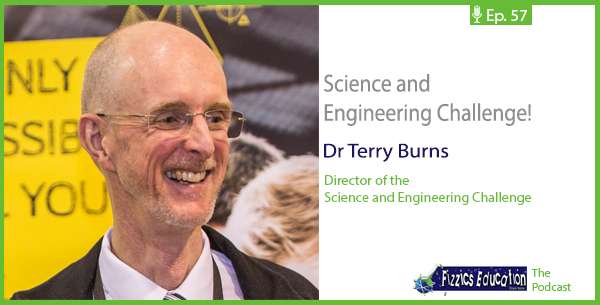
Listen to Dr Terry Burns as he describes why science & engineering challenges help students prepare to work collaboratively and creatively in real-world environments.
In this episode, we explore the evolution of science outreach with Dr Terry Burns, Director of the Science and Engineering Challenge (SEC). With over 550,000 students reached across Australia, the programme has become a national pillar for STEM engagement. We discuss how modelling real-world constraints, such as limited resources and the need for diverse team collaboration, helps students recognise that science and engineering are not just about formulas, but about creative problem-solving and empowering results.
About Dr Terry Burns
Dr Terry Burns is the Director of the Science and Engineering Challenge at the University of Newcastle. He holds a unique academic background as both a qualified engineer and the first person to complete a PhD in Science Communication at the university. Since co-founding the SMART programme in 1998, Terry has dedicated his career to bridging the gap between technical fields and the public. He leads a national team that delivers immersive STEM experiences across Australia, including rural and remote communities, ensuring that the next generation of scientists and engineers is both qualified and inspired.
Expertise: Science Communication, Engineering Education, Team Dynamics, and STEM Outreach Strategy.
The Science and Engineering Challenge (SEC)
The Science and Engineering Challenge is a nationwide STEM outreach programme managed by the University of Newcastle. Operating as a not-for-profit organisation, it partners with universities, Rotary clubs, and local communities to inspire students through competitive, hands-on activities.
Strategic Mission & Impact:
The Engagement Pathway: The programme maintains a continuous presence in students’ lives, from the SMART programme in primary school to Discovery Days and the Year 9/10 Challenge, building a long-term STEM identity.
Modelling the Real World: Challenges are designed without unique solutions, forcing students to navigate limited resources, time constraints, and the necessity of teamwork—mimicking professional engineering environments.
Proven Workforce Influence: Approximately 20% of engineering students at Newcastle and up to 50% in Tasmania identify the challenge as a key factor in their decision to enrol in tertiary STEM degrees.
Inclusion and Reach: The programme specifically targets rural, remote, and indigenous communities, maintaining a strong focus on gender balance and broad engagement across all student demographics.
Top Episode Learnings: Engineering Inspiration
Collaboration Over Individual Merit:
Terry notes that academic high-achievers often struggle in the challenge if they work as individuals. Real success comes from diverse teams—combining “arty,” practical, and detail-oriented students who can communicate and cooperate effectively.
Redefining Failure and Expertise:
In the SEC, destructive testing (like the bridge finale) is used to empower students. Learning from mistakes is core to the programme, with Terry defining an expert as someone who has made many mistakes in a narrow field, making progress through iterative learning.
Empowerment Through Results:
The programme focuses on the “engagement moment.” When students see a structure they built carry a load, they experience immediate success, which serves as a powerful motivator to pursue enabling sciences like physics and advanced mathematics.
Education Tip: Modelling the Real-World Contract.
To engage students in structural testing or physics, adopt Terry’s “real-world” constraint: the lightest structure wins. By introducing resource scarcity and cost-effectiveness (mimicking industry contracts), students stop viewing mathematics as a classroom chore and start seeing it as an essential tool for optimisation and competitive success.
[00:00:25]Ben Newsome: It’s with that frame of mind that Terry Burns and the team at the Science and Engineering Challenge have set about running a variety of STEM competitions for schools right across Australia. This is not a small programme. Over 550,000 students have been involved so far, and I tell you what, that number is set to grow further.
[00:01:00]Ben Newsome: Yes, welcome again to another Fizzics Ed Podcast. It’s a really big week this week because we get to speak with Dr Terry Burns, who comes out of the University of Newcastle and is the Director of the Science and Engineering Challenge. He’s a really passionate science communicator. He’s been doing this since 1998, and I tell you what, he really loves his science outreach.
[00:01:22]Ben Newsome: He does it right across Australia with a bunch of people at SEC, the Science and Engineering Challenge. Lots of bits going on with this particular interview. We get to go right into maker spaces and what students can be doing and getting their heads ready for the real world, and that’s certainly an important part of education. I must say, it would be a lot of fun getting involved in their challenges. It’s not just about robotics; it’s all sorts of stuff.
[00:01:45]Ben Newsome: Just a bit of a heads-up. Unfortunately, we had to change my microphone when I did this recording because I actually had to do this one from my car in the middle of our public holiday weekend. It did actually connect pretty well, but I must say it sounds a little bit at times like we’re talking in a bathtub, which is a bit of a heads-up from me about that particular microphone. It also means there’s a slight buzz after us fixing the recording slightly. I must apologise for that, but it is still worth listening through that buzz because Dr Terry Burns really has a lot to say and I really hope you might be able to implement it from where you’re teaching too.
[00:02:18]Terry Burns: So at the moment, I’m Director of the Science and Engineering Challenge programme. It runs out of the University of Newcastle up here in Newcastle, New South Wales. I’ve been in that position now since early 2011. It’s evolved. Actually, let me start even before that. The Science and Engineering Challenge programme started in the year 2000, and a couple of years before that, in 1998, a programme called SMART—Science, Maths and Real Technology—kicked off, and I’ve been involved in all of those.
[00:02:53]Terry Burns: In 2011, I was fortunate enough to become the Director of the Science and Engineering Challenge, and I guess we went on the next stage of development of the programme. The Science and Engineering Challenge now encompasses quite a few science communication outreach endeavours. It’s a national programme. It’s got about half a dozen or ten staff, depending on how you count them, and it’s all over Australia. We’re exploring an event in New Zealand this year. In the past, we’ve done an event in Singapore. We’ve had some interest from Fiji and from China. We’re just playing it steady at the moment, but depending on what happens in the next twelve months or so, it could be getting substantially bigger.
[00:03:39]Ben Newsome: Wow. So it’s been around for many, many years and under different guises, but it sounds like you’re on the verge of something that’s potentially likely to explode, so to speak.
[00:03:52]Terry Burns: I don’t know about that. People talk about evolution or revolution. Ours has been evolution. I started the SMART programme back in 1998 with a colleague of mine, John O’Connor, who’s been around in the science communication scene for a long time. He’s a professional physicist and just a really good communicator. We started the SMART programme back then because John was getting more invitations than he could possibly handle to speak at schools and do science shows. So I helped him out.
[00:04:23]Terry Burns: I was working in physics with him at that time, and it became obvious that one or two people couldn’t actually achieve much, but if we had a small team, we could do a lot more. So we started to conscript undergraduate students—to involve undergraduate students. We initially paid them a little bit, and then after a while, we were able to work out a place for them in the university pay system and offer them quite good pay to present science shows and workshops on behalf of the University of Newcastle. I guess the SMART programme was born.
[00:04:57]Terry Burns: Why SMART? Well, we wanted basically any acronym that spelled “SMART” because we feel like we’re being smart. And of course, STEM didn’t exist then. So that was, I guess, our first bumbling attempt at trying to identify what STEM was: Science, Maths and Real Technology, as in applied technology.
[00:05:17]Ben Newsome: I was about to go down that path because the fact that it has “Real Technology” in it… I mean, SMART is well-known in Australia these days because it’s been around for quite a while. But the “RT” in this is interesting because, of course, technology changes every single year, if not every month, which means you’d have a bit to keep up with, I’d imagine.
[00:05:36]Terry Burns: Yeah, well, initially we were doing the classic liquid nitrogen shows, and I guess we still do that. But we’ve explored the science of movies, and we’ve explored the Olympic Games when they were on—the science behind the Olympic Games—and lots of other very topical things, as well as tying our theme for the year into the school curriculum and to the focus for National Science Week. And again, we want to be real technology, we want to be up-to-date, so our shows change each year.
[00:06:07]Ben Newsome: So prior to 1998, you’re working as a physicist at the University of Newcastle. What were you actually studying—not just studying, researching and creating?
[00:06:16]Terry Burns: No, no, I was working in the technical field. John is a professor, John O’Connor’s a professor, and I was helping him out in a technical field. I was studying at that time, and my first professional qualification is as an engineer, not as a scientist. Sorry. And then in midlife, I had this strange feeling my brain was dying and I needed to do some postgraduate study. So I ended up doing a full-time PhD. I was the first student to do a PhD in science communication at the University of Newcastle.
[00:06:49]Terry Burns: Because of that, I travelled down to ANU pretty much every week to pick up on some of their coursework and other resources down there. Sue Stocklmayer, who many people will know, was my co-supervisor and a great mentor as well. So over three or four years, I did my PhD then. After the PhD, I found myself in the right position to be offered a job with the Science and Engineering Challenge, which had just received federal government funding to expand and they needed staff.
[00:07:23]Terry Burns: The programme continued to expand. My predecessor, Bob Nelson, eventually retired, and I applied for the Director’s job, and the rest is history.
[00:07:31]Ben Newsome: And now it’s national. Hats off to you with that, well done.
[00:07:39]Terry Burns: Yeah, well, it was national within Bob’s time as Director. What happened was that the funding fell away at the national level, and we had to sort of rediscover ourselves. We’re now a not-for-profit organisation, entity, within the University of Newcastle. We don’t receive any large pot of money from any one organisation or government agency. We work for fee-for-service and for grants and for projects. So it’s a tight budget, but we do a lot with the money that we’ve got. I’m not telling you about it—that’s how you work, I guess, and many others.
[00:08:24]Ben Newsome: Yes, it is. I mean, I believe the entire industry is a smell of an oily rag, or actually an oily rag at a distance perhaps. But we all get there, and you’re totally right when you say at the start, it is very much for the love that we have a ball doing it. I’m just trying to get a picture of what happens on a week-to-week basis. An average week for your ten or so staff running around the country, what sort of things currently encompass the Science and Engineering Challenge?
[00:08:53]Terry Burns: Okay, well, it’s grown. I’ve been speaking about these two programmes, the SMART programme and the Science and Engineering Challenge. They’re now incorporated into one along with another couple of programmes. So the SMART programme still is itinerant; it’s still science show and workshop-based. We’ve added into that mix teacher professional development and resources and training, and also we do holiday clubs through the SMART programme. It’s mostly focused on preschool to probably junior high school, about Year 7.
[00:09:26]Terry Burns: We then have a programme that runs on campus called “Build Me a Future”. “Build Me a Future” is for Year 7 and 8 students, and that’s a combined sort of mini challenge event and a campus experience. So far, that’s only been run at the University of Newcastle. We’re hoping to roll it out to our Ourimbah campus very soon and to other universities around Australia once we sort of get the model exactly right, and it’s pretty close. Very, very happy with it this year.
[00:09:57]Ben Newsome: That sounds kind of like a maker day sort of thing?
[00:10:02]Terry Burns: Well, no, the Challenge—Science and Engineering Challenge days, the challenge days which I was just about to speak about for Year 9 and Year 10—they’re a national competition. We have students come to a central venue from eight different schools, competing on eight different activities. They’re awarded points for how well they go on those activities, and there’s a winner from the day, the school with the largest cumulative number of points.
[00:10:26]Terry Burns: Maker spaces are a lot less structured and more exploratory. Ours are not educational in terms of being a structured process where you start here and follow the method and get this result. Ours is in the middle there, in that science communication space, and I’m very proud of that fact. We give them a whole lot of materials and we give them an objective, and they come up with a solution to that problem. So they build bridges, or they wire up virtual cities, or they make model hovercraft and fly them around, or airships and fly them around, or network up towns on a layout board. Lots of different activities that involve the principles of science and engineering.
[00:11:13]Ben Newsome: I was just thinking briefly, with those different activities, obviously there’s a little bit of a scaffold of “hey, you need to achieve this particular task.” I’m just sort of wondering, is some of these activities year-to-year driven by the schools or the students themselves?
[00:11:32]Terry Burns: So the way that we come up with new activities varies. Sometimes it will be linked to the International Year of, for example, Astronomy, so we had a radio telescope activity come up. Other times it will be driven by a sponsorship. So we have a network activity which was called “Electra City”, and that was largely funded by Ausgrid when they were interested in that space. Sometimes it’s just a fun thing to do, like everyone wants to fly a hovercraft, so we came up with a hovercraft activity, and yes, everyone loves to do it.
[00:12:06]Ben Newsome: Is that with a leaf blower?
[00:12:11]Terry Burns: No, no, it’s a small hovercraft. We use a high flow rate computer cooling fan for the lift fan, and we use some model aeroplane propellers and some little electric motors for thrust, and a skirt made out of a garbage bag on a meat tray as the chassis. So it’s quite fun. Yeah.
[00:12:31]Ben Newsome: Okay, so you look across the years of doing this sort of thing, which of the activities have you gone, “you know what, this activity just sings”? It’s clearly grabbing the students’ attention where you’d be hard-pressed to rip them out of the room to get them on a bus to get back because they just don’t want to stop. Just wondering which ones are the ones that absolutely worked?
[00:12:52]Terry Burns: Well, it varies. I think the hovercraft activity is extraordinarily popular. We’ve got an electricity activity that I was talking about before; it just has wires and a board. It sounds pretty sort of flat and plain, but kids really get into it and you have to drag them away from it. At the end of the day, we do a bridge test. So they’ve spent almost four hours constructing a bridge out of bits of paper and cardboard and balsa and masking tape and drawing pins and paperclips.
[00:13:24]Terry Burns: Nothing that you’d see in the engineering world. So they’ve got this flimsy bridge. We put it in a bridge test apparatus and then run some trolleys across it with increasing weights on it. Now, it’s probably fair to say that the kids have spent about three hours on this and it’s been interesting, they’ve had a good time, but once we get it in front of 250 students at the end of the day and we start trying to destroy it, people get pretty crazy.
[00:13:48]Terry Burns: They stand on the seats and yell and cheer and clap and get really involved, and you know, that’s our finale for the day for a challenge day, and also for a discovery day which is a similar sort of programme but for primary school students.
[00:14:02]Ben Newsome: I love destructive testing. Every time it’s ever run, you watch it happen and every single time, it’s not just the students. You watch the teachers’ eyes suddenly—it’s almost like we forget we’re adults just for a moment.
[00:14:19]Terry Burns: There’s also that wonderful experience when you look across the room. I’ll be in front of the 250 people on the microphone, and I’m looking across at their bridge and seeing the kids who have constructed this bridge in the background. And we’ll run a couple of trolley loads of ingots across it and just the surprise and delight on their face. “We built something that actually works!”
[00:14:41]Terry Burns: And that’s one of the successes of our programme, empowering kids to say, “Look, you had a good day here, it was fun, you enjoyed it, and actually you had success. You might not have won the activity, but you achieved a result, and it was a good result.” And that empowers kids to get involved in STEM.
[00:14:58]Ben Newsome: So considering that, I mean you’d have schools coming back year after year with these particular programmes. I’d imagine you’d probably also have repeat offenders, so to speak, of students who come year after year as well, do you?
[00:15:10]Terry Burns: Well, we do. We try and just have the programmes available for one or two years. The SMARTprogramme is exceptional; it will come back every year or multiple times a year, whenever there’s a need, and do different things. But the Challenge and the Discovery Days look very much the same for twelve months, and then in the next twelve months, we add a couple of new activities and change it up. So students would only come once or maybe twice to each of those programmes.
[00:15:42]Terry Burns: The idea is that we capture them across the programmes at several times during their schooling. So we might catch them in Year 3 in the SMARTprogramme, catch them in Year 5 or 6 in the Discovery Days, catch them in Year 7 or 8 in the Build Me a Future days, and catch them of course in Year 9 or 10 in the Science and Engineering Challenge days. So we’ve got that continuity, and we would hope that then the next step for them would be to come to university or a TAFE and do some tertiary studies in STEM fields and then pop out the end as someone who’s trained and ready to work in a STEM career.
[00:16:15]Ben Newsome: I was speaking with Tom Gordon out of Uni Sydney who heads up Kickstart just a couple of weeks ago about some of the stuff. And it kind of made me wonder, it’d be really interesting to track kids’ progress between different programmes in terms of they do Year 3, then Year 5, then Year 7. It’d be interesting to know just the cumulative impact of, rather than just being the discrete lessons that we run and the ones that we report on with the outcomes and everything else, it’d be so interesting just to follow a kid’s journey and where they end up. I mean when I say where they end up, I’m talking at the tertiary level. I just wonder what is the result of all of these science communication activities as a whole for a particular learner?
[00:16:58]Terry Burns: Okay, so we’ve actually poked around a little bit with research. The problem is that we’re dealing with minors, with kids who are anywhere between 4 and 16 years old. So having a research study with that age group is rather complicated. But there’s some anonymous stats that we can do that are useful. Anecdotally, we get lots of kids who participated in the SMARTprogramme at a quite early age pop up in our Discovery Day or Challengeprogrammes. We just know that because we talk to them and they say, “Oh yeah, we had a great time at” or “I remember when they did this”.
[00:17:36]Terry Burns: We also ask the students who participated in a Challenge Day, that’s Year 9 or Year 10, twelve months after they participated, “Did the Science and Engineering Challenge day that they attended influence their decision to do senior high school maths or science?” And we’re finding that there’s a significant proportion of those kids who attended twelve months ago who are now enrolled in the enabling sciences. I can give you the exact numbers if you like later, but it’s a significant proportion. That’s an anonymous survey that the teachers administer on our behalf, so that’s doable.
[00:18:24]Terry Burns: What we then find is I work at a university and I guess originally the SMARTprogramme and the Challengeprogramme were around to attract students. We don’t apologise for that. It’s grown bigger than that now. It’s a legitimate—it always was legitimate—science communication programme. But we have greater aims. We work with about 28 of the other universities around Australia. Some of those use it as a recruitment tool and that’s fine. Some of them, like us I think, are just in the game because we want to make the pool of qualified and inspired students larger.
[00:19:12]Terry Burns: Rather than squabble over a small and diminishing pool of students. So it’s good to cooperate with other educational bodies to try and get kids to do those right senior high school subjects and then make the step into university. We find that at the University of Newcastle approximately one in five of the students who come here and do a science or an engineering degree say that the Science and Engineering Challenge was a significant influence on that decision.
[00:19:53]Terry Burns: I was working in Tasmania last week actually, and they were saying down there that approximately 50% of the first-year students that enrol in their engineering degrees have been to the Science and Engineering Challenge, and about 50% of them say that the experience was influential in getting them to do an engineering degree. I’ve got colleagues in Queensland who state slightly higher figures as well. So it’s a little bit hard to tie up because of the challenges of the age of the kids as I said, but we’ve got some really good indicators that we’re going in the right direction.
[00:20:08]Terry Burns: The only thing we can’t really measure is how many kids pop out at the end into employment. But there’s plenty of anecdotal evidence of people who are volunteers at our particularly our Challenge Day events where they come up and say, “Oh, I did this at high school.” And that’s nice. We’re trying to accumulate a database of those people. We’re probably only into hundreds now, but you know there’s thousands and thousands of them out there, we just are unable to identify them easily.
[00:20:37]Ben Newsome: It’s an interesting one with even just looking at our own team. We’ve got staff who’ve been through the National Youth Science Forum, and even amongst them, a couple of them have been through the Science and Engineering Challenge. It’s just interesting how these small snippets of time impact their entire career. It’s just unreal.
[00:20:57]Terry Burns: So we exist, I’d like to think, for that engagement moment to get kids interested maybe for the first time. We take a very broad and diverse number of kids from right round Australia. We’re very proud that we go to rural and remote locations and see indigenous kids. We see roughly equal numbers of boys and girls. We think that’s what we need to do to get a broad engagement in STEM. And we’re quite happy, in fact we’re proud to point kids who become interested in STEM at other programmes like yours or the ones out of other universities or museums or out of not-for-profits that just can build on this.
[00:21:42]Terry Burns: I think, at least in my mind, the best thing we can do is firstly get them interested and then get them involved in a whole lot of stuff. They’ll find one of those activities that resonates with them and they’ll go on and they’ll build on that and that will help their STEM interest to grow and that will turn into a career eventually. That’s why the Challenge exists, to get kids into STEM careers.
[00:22:02]Ben Newsome: And one of the force multipliers that’s really helping the actual movement that we want to have happen is helping teachers to do exactly that. That’s definitely part of what you’re moving into with teacher professional learning. Maybe just describe a bit about the sort of things that the teachers get to do in these ones that you’re running.
[00:22:21]Terry Burns: Okay, so there are two levels of engagement. The first thing is when a teacher brings a group of students to a Discovery Day or a Challenge Day, we give them a day off. We say, “You don’t have to do anything other than look after your kids.” What they’ll do is they’ll go round and they’ll change their model of teaching from the instructor who stands up the front who knows everything to the, I won’t say friend, but more a friend model where they move between the groups of their students and encourage them and maybe ask good questions.
[00:22:58]Terry Burns: Not even leading questions, just exploring open-ended questions so that they can help their kids to achieve success in the activities they’re working on. We’ll also talk to the teachers quite often and say, “Look, here are the resources on our website. If you want to download the links and extension activities, you can do these back in your classroom.” So we’re looking at both changing the way that science and engineering—or STEM—is taught in the classroom and also providing some resources for them to do it.
[00:23:27]Terry Burns: Parallel to that, we have professional development courses that we can offer where one of the Challenge staff will go out to a school and do a professional development session with the teachers. It’s generally been focused on robotics recently because there’s a big interest in that space and there’s quite a few schools who have robots and are not quite sure how to use them or how to use them to the full extent. So we’re able to provide a lot of training in that area and that’s been immensely popular as well.
[00:23:56]Ben Newsome: Which robots? Because there are a few around these days. There’s the mBots, there are Spheros, there are LEGO robotics, there are all these different ones around. What tends to be out there? It’s a lot of platforms.
[00:24:08]Terry Burns: We’ve got a couple of platforms. The EV3s were actually… we’ve had quite a few of those given to us by Google and we’re very happy to promote those because they’re so widely popular. We’ve got a new robot that we’re looking at called Edison which is Australian designed, that’s very simple and very robust. We use Spheros as well, and we’ve got a couple of high-tech robots that have been developed by the university that we use for demonstration purposes as well, something more like you’d see in RoboCup in the days gone by.
[00:24:43]Ben Newsome: Good fun! Actually, one of these days I’ll go to one of those events where you actually get to see the robots battle it out.
[00:24:49]Terry Burns: Yeah, they’re a lot of good fun. Mind you though, in some of the things that are coming out, especially out of Boston these days, they’re blowing people’s minds. For those people listening in, if you haven’t checked out what Boston Dynamics does with some of their robots, it’s somewhat crazily freaky in terms of their ability.
[00:25:09]Terry Burns: They’ve been doing it for a long time too, cutting edge.
[00:25:12]Ben Newsome: Oh absolutely, truly. You think about all the coding to get those accelerometers to work, to be able to get a robot to flip or get those dog-looking robots—I guess they’re dogs—to go downstairs and all over. It takes a lot of effort to get this done.
[00:25:25]Terry Burns: Yeah, clever organisation and very creative. I can remember seeing some of those videos must be ten years ago. They’ve been pushing the boundaries for a long, long time.
[00:25:36]Ben Newsome: Absolutely. Very fun place to work. Start your robotics early because I think a lot of people want in on their door to get involved. But it kind of makes me wonder with all this discussion, especially around STEM, how do you imagine if there was a magic wand waved and everyone had five years to pull things together to be able to fulfil what the magic wand was, what do you reckon a really immersive STEM innovative space in a school could look like? If everyone had the perfect budget and all the resources and all the time to be able to develop those resources and implement them, what could you imagine schools looking like if a wand was waved?
[00:26:18]Terry Burns: Well, good question. I’m not an educational person, I’m a science communicator, so I’m a little bit outside the school. From that point of view, what I’d like to see, if we talk about outcomes rather than the inner workings, outcomes I’d like to see are teachers who are STEM aware and STEM capable. I’d like to see cross-disciplinary subject areas, and I’m very proud of the few initiatives I’ve heard in New South Wales and Victoria that are moving in that direction. There’s probably other ones, but they’re the ones I’ve heard of.
[00:27:01]Terry Burns: I’d like to see some clever tech, although not too much of it. Some 3D printers and some robots, some CAD computers, and people using them across disciplinary areas so that the blurring of arts and science becomes less of a line in the sand. And I’d like to see opportunities for industry to get involved in schools and schools to get involved in industry so that both teachers and students could experience what it’s like in the real world with real problems.
[00:27:35]Terry Burns: The reason that the Science and Engineering Challenge is so successful, I claim, is because we’re trying to model the real world. We’re not actually in the real world, but we’re trying to model it. All the things that we give to kids to do represent a problem that could be out there in the real world. There’s no unique one solution. You have to work in teams, you have to be creative, you have to work with limited resources. These are all real factors that are good for students to be exposed to. I think even at school wouldn’t be too soon.
[00:28:06]Ben Newsome: Oh absolutely. And with the limited resources thing, I know everyone loves the egg drop challenge. Just be aware of course with the noxious vapours of eggs you probably should use water balloons instead these days. But the old challenge of getting some simple craft materials around the egg or water balloon so it can handle the fall. I love with especially high school students going, “Yeah, we’re going to limit your time, not only will we give you a pack of resources where I’m not going to give you any more even if you break it, but the winner, if we end up getting a tie for who gets the highest height, we’re going to weigh your pretend spacecraft and whoever’s got the lightest wins.”
[00:28:42]Terry Burns: Yeah. And again, that’s mimicking the real world. Generally, light means less stuff, less stuff means less cost, and less cost is generally going to get the contract.
[00:28:51]Ben Newsome: Well that’s absolutely right. Ask SpaceX and Boeing right now! But you’ve been doing this for many, many years as a science communicator, working with liquid nitrogen and all the stuff, but also doing all the STEM challenges in all these different ways and managing teams these days. You’ve had some awesome wins but, of course, every educator who’s ever been out to enough places will have had exactly the opposite happen where things just not quite gone as planned. Is there any time that you could think back and go, “Oh wow, that happened”? The reason why I always ask this is I’m very interested about, in some ways, failure, because I think from failure is where we learn the most.
[00:29:48]Terry Burns: No, we never have any failures. We’re absolutely perfect, ask anyone. No, seriously though, that’s what’s got to happen from the outside. So we are in the fortunate position of doing what we do over and over and over again. So each time we do it, we’ll learn something. I’ve got a really good team here and I’d like to think that these guys aren’t afraid of making mistakes and we’re reasonably accepting of making mistakes. What we need to do is make those mistakes quickly and in private so by the time we get it in front of a real audience it’s safe and reliable.
[00:30:29]Terry Burns: And that’s generally the case. We make lots of mistakes. The definition of expert in our office is someone who’s made a lot of mistakes in a very narrow field, and that really helps us to make progress. I think if you spoke to most of our partners, clients, people who work with us, they’d say, “Oh yeah, they never make a mistake, they’re really good,” and that’s not true, but that’s how it looks.
[00:30:51]Ben Newsome: It’s the old duck swimming, hey?
[00:30:54]Terry Burns: Yes, yeah. No, but it is true. Obviously being able to replicate a lesson in various places means that over time you are going to really know pinch points for students’ understanding and how to manipulate certain materials in a certain amount of time, what materials works, what doesn’t, all that sort of thing.
[00:31:13]Ben Newsome: It’s one of those things that any teacher who’s brought on—a pre-service teacher—you always see there’s a lot of enthusiasm, but with enthusiasm will come mistakes. It’s how we grow them that really matters, very true.
[00:31:25]Terry Burns: Best thing you can do is to do something once, or to do it the first time. Best thing you can do is to do it multiple times and each time do it a little bit better and to learn from what you’ve done in the past.
[00:31:35]Ben Newsome: And that’s one of the luxuries, I suppose, that your organisation and ours actually has, is that we can actually do exactly that, which means after a while you get kind of good at it, which is kind of handy. But at the same point, there’ll be some people who are listening in who would love to get involved with what Science and Engineering Challenge does, whether they’re in a school. I guess if you had to give them some advice on preparing their students to get involved in these activities, what would you suggest?
[00:31:52]Terry Burns: Pick kids who can work together. All of our activities are based on teams, and we’ve had schools come across in the past to compete and they’ve picked their best science class or their best maths class and been surprised they haven’t won. Or they’ve picked their all-boys or their all-girls and surprised that they haven’t won. If there is any solution for success at a Science and Engineering Challenge competition, it’s pick kids who can work together.
[00:32:26]Terry Burns: Get someone who’s a bit arty, get someone who’s very practical, get someone who’s very focused on detail, get someone who’s very hand-waving and a broad big-picture person. Put them together and give them a bit of practice at working together, and then when they get to do a Science and Engineering Challenge activity, they’ll do really well. There’s no correlation between what grade at school they’re in or what subjects they’re doing. It’s just kids who are bright, and the thing that will achieve success is if they can work together as a good team.
[00:32:56]Ben Newsome: I love that. Collaboration gets thrown around—sometimes people say it’s a buzzword. It’s not! In any way. The real world actually works this way. We know this, so why make it different in the classroom? And I know that everyone listening in knows exactly that that makes a lot of sense. Personally, I’ve seen exactly the same thing happen where, especially funny just off the top of my head, even specifically robotics.
[00:33:26]Ben Newsome: I’ve often found that you’ll have that classic A+ student who’ll just nail it regardless, but the ones who really get it are people who are perceived as the middle of the range kids. The reality is they’re used to working problems and having to fail and try, and fail and try, until they sort it out. And sometimes you’ll see the kids in between the two who are pretty much sort of used to coasting a little bit, that when they’re actually put a real challenge in front of them, it’s kind of a little bit about grit sometimes, and then working with others to solve the problem.
[00:34:02]Terry Burns: Yeah. We’ve had some selective schools in the past who have known to be high achievers do very badly, simply because each of their team members is working as an individual and not cooperating and working with the other members of their teams. Four individuals will never achieve the same level of success as one good team of four.
[00:34:26]Ben Newsome: Absolutely. I mean, it makes me wonder whether the parallels between sports teams and STEM teams are probably quite similar.
[00:34:36]Terry Burns: Oh yeah, absolutely. And people have talked to me regularly about the influences of our activities on boys and girls and whether boys do any better or girls do any better. The answer is maybe girls might do a little bit better because they’re good at working in teams. But in reality, if you’ve got a good team of boys and girls, they’ll do really well. It’s just a fact as far as I’m concerned that if you’ve got gender balance across your team, whether it’s at work in my office or whether it’s at one of the Science and Engineering Challenge events in a team from a school, where you’ve got boys and girls working together, they’ll do better.
[00:35:21]Terry Burns: It’s just a fact. I’m not prepared to discuss this idea that boys are better than girls or girls are better than boys. Just put them together, give them the tools they need, let them work together and they’ll nail it.
[00:35:28]Ben Newsome: Just diversity of interest, abilities and just the way they talk amongst themselves. It’s pretty simple really when you think about it. Well, thanks very much Terry for popping on. I know that you’ve got a well-deserved weekend coming up, but you’re hard at it next week. Where are you heading off to next week?
[00:35:48]Terry Burns: So last week I was in Tasmania, and next week I’ll be in Victoria. A couple of weeks’ time I’ll be in South Australia. We’ve got a team in Queensland at the moment and another team over in Western Australia heading up to Northern Territory. So yeah, this is our busy time of year.
[00:36:08]Ben Newsome: Sounds to me like you need sponsorship from an airline. So if any airline representative is listening, this is the time to jump on here!
[00:36:15]Terry Burns: That would be great! That would be fantastic.
[00:36:18]Ben Newsome: Yeah, I mean, you’ve got to run around to lots of places, but that means you get to see a lot of Australia and sounds like potentially New Zealand and Singapore and somewhere else if things go well.
[00:36:27]Terry Burns: Yeah, very excited. Not definite yet, but looks like we’re going to New Zealand and that will be our first step overseas with this new model of delivery. If it works well, then there’s opportunities to go other places overseas.
[00:36:44]Ben Newsome: Fantastic. Well, I love to hear how far it’s grown since ’98 all the way through to now in 2018. I suppose throw another 20 years on, who knows what’s happening next. But much appreciated Terry and have a fantastic afternoon.
[00:36:58]Terry Burns: Thanks Ben.
[00:37:00]Announcer: This is the Fizzics Ed Podcast. We’re all about science, ed tech and more. To see 100 fun free experiments you can do with your class, go to fizzicseducation.com.au. That’s physics spelled F I Z Z I C S and click 100 free experiments.
[00:37:31]Ben Newsome: Well there we go, we were speaking with Dr Terry Burns and I hope you got a bit out of that considering a bit of the buzz and the hum in that microphone. It actually was a little bit rhythmic, almost a harmonic going on in behind the scenes, and it actually reminds me of the Yanny and Laurel thing that went right across the globe, and which by the way we did talk about in detail on the Fizzics Twist podcast. And by the way, if you haven’t heard about that, Fizzics Twist is this week in science and technology by the Fizzics team. Our team Duncan and Quill and a lot of the others jump in and talk about different science news and things that have been happening through the week, and that Laurel and Yanny thing they talked about only a couple of weeks ago sort of reminds me what was going on with that microphone with Terry.
[00:38:13]Ben Newsome: But ignoring the audio issues, I hope you got a lot out of it, and I certainly did too. It makes me think the more competitions that we actually get to run with students, where kids get to meet other students who are interested around STEM, that’s a really good thing. Thinking about what collaboration is all about in their own teams, it’s something that needs to be modelled over and over and over again. I know it’s a little bit more effort to set up these project-based learning opportunities, but the outcomes for the students are unreal.
[00:38:41]Ben Newsome: Anyway, we have more interviews coming up, no doubt about that. I hope you enjoyed this particular episode and all the best, I’ll catch you next time.
What is the Science and Engineering Challenge (SEC)?
The Science and Engineering Challenge is a national STEM outreach programme in Australia, managed by the University of Newcastle. It involves a series of competitive activities designed to engage students in Year 9 and 10 with the principles of science and engineering through hands-on, problem-solving tasks.
What kind of activities are included in the challenge?
Activities vary and are often updated annually. Examples include building load-bearing bridges from simple materials like balsa wood and masking tape, wiring up “virtual cities” in electricity challenges, and designing and testing model hovercraft or airships. The tasks are designed to model real-world engineering problems with no single “correct” solution.
Does the programme actually influence students’ career choices?
According to Dr Terry Burns, approximately one in five science and engineering students at the University of Newcastle cite the challenge as a significant influence on their study choice. In Tasmania, research indicated that roughly 50% of first-year engineering students had participated in the programme during high school.
How can schools prepare their students for the challenge?
The best preparation is selecting diverse teams that can collaborate effectively. Dr Burns suggests forming teams with a mix of “arty” thinkers, practical builders, and detail-oriented students. Because the activities require creativity and teamwork rather than just textbook knowledge, students who practice working together as a cohesive group often perform the best.
Are there similar programmes for younger students?
Yes, the team also runs the SMART programme (Science, Maths and Real Technology) for preschool to Year 7, Discovery Days for primary school students, and the “Build Me a Future” programme for students in Years 7 and 8, ensuring a continuous pathway of engagement throughout schooling.
Discussion points summarised from the The Science and Engineering Challenge with AI assistance, verified and edited by Ben Newsome CF
Extra thought ideas to consider
The Value of Destructive Testing in Education
The “finale” of the challenge often involves testing structures like bridges to the point of failure. This dramatic display of physics is not just engaging; it teaches students that failure is a data point in engineering. Discussing why a structure failed provides more learning opportunities than a structure that simply “passed” without being pushed to its limit.
Team Composition over Individual Intelligence
Dr Burns noted that selective schools or top-tier science classes sometimes struggle because students work as individuals rather than as a team. This highlights a critical gap in many traditional educational models: the “soft skill” of collaboration is often more vital for real-world engineering success than individual GPA.
Modelling Real-World Constraints
By giving students limited resources (like a specific number of paperclips or pins) and weighing structures to break ties, the challenge mimics the economic realities of engineering. It introduces students to the concept of “optimisation”—balancing strength, weight, and cost—which is the fundamental driver of innovation in industries like aerospace and construction.
Recognised by
22 years, award-winning work, 1 purpose
Recognition from business, education and industry bodies across Australia.
Australian Small Business Champion
Multiple years
CILC Pinnacle Award and Hall of Fame inductee
Center for Interactive Learning and Collaboration
Western Sydney Awards for Business Excellence
Winner
Top 100 Coolest Company
Listed
Local Business Awards
Winner
We value your privacy
We use cookies to improve your experience. Essential cookies are always active. You can choose which optional cookies to allow.We use cookies. Optional ones stay off unless you allow them.Privacy policy