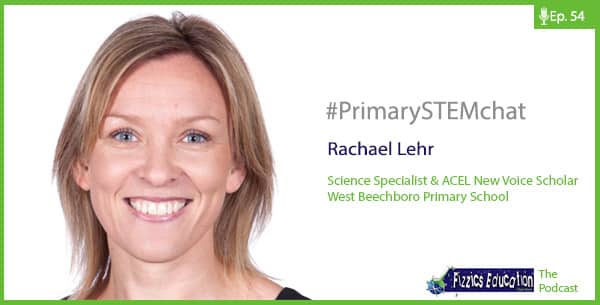
#PrimarySTEMChat comprises a group of highly motivated primary science educators who chat every Thursday night on Twitter about all things primary STEM! Science and digital technology specialist Rachael Lehr drops by to talk about what she knows works in a primary science classroom and the importance of open-ended investigations for growing minds.
How do you move beyond the STEM acronym to create a culture of integrated problem-solving? In this episode, we sit down with Rachael Lehr to discuss her role as a Science and Digital Technology Specialist at West Beechboro Primary School. We explore why STEM isn’t just about coding or robots, but a way of equipping students with the resilience and critical thinking skills needed for life.
About Rachael Lehr
Rachael Lehr is a Science and Digital Technology Specialist at West Beechboro Primary School in Western Australia. Since 2011, she has championed hands-on science and the authentic integration of technology. Rachael is a co-founder of #PrimarySTEMChat, a global Twitter community for primary educators, and runs an innovative Girls STEM Club that focuses on long-term design thinking. She is passionate about moving technology beyond “app-play” to give students a voice in documenting and sharing their scientific discoveries.
Integrated Problem-Solving:
STEM should not be siloed into a one-hour-a-week session. Rachael advocates for embedding STEM principles across the curriculum, including HASS and Health, focusing on the “how” of learning and problem-solving rather than treating the acronym as a standalone subject.
Authentic Tech Documentation:
Technology should serve as a digital portfolio for scientific inquiry. By using tools like iPads and Seesaw, students learn to document their experiments, take photos, and record videos to display their knowledge, rather than just learning how to use an app for the sake of the tech itself.
Building Resilience through Design:
Modern students often want to finish projects quickly. Rachael emphasises the importance of the Design Process—planning, building, analysing, and rebuilding—to teach students how to persist when tasks become difficult or when a design fails.
Education Tip: Building the “STEM Identity” for Girls.
When running a girls-only STEM club, move beyond “girly” science hooks like food or beauty. Instead, focus on Long-Term Project Skills and connect students with real-world mentors. By introducing them to professionals like female pilots and engineers, you help them develop a STEM identity that is based on capability and community connection rather than stereotypical interests.
Associated Resources
#PrimarySTEMChat on Twitter
Join Rachael and other global educators every Thursday night to discuss contemporary issues, share resources, and develop your STEM teaching practice.
[00:01:04]Ben Newsome: Yes, welcome again to another Fizzics Ed Podcast. This week we’re speaking with Rachael Lehr, who is a science specialist out of West Beechboro Primary School, a school in Western Australia that is completely nailing STEM delivery for primary students. From teaching science with a hands-on STEM focus, to creating a girls STEM club after school, integrating digital tech into science, all sorts of stuff is happening out in that school. And more importantly, Rachael is sharing that knowledge through #PrimarySTEMChat, this Thursday evening delivery through Twitter where you can definitely join in. It’s kind of like a PLN for the STEM friendly in the elementary space. So, without further ado, let’s just jump on into this interview. We’ve got a lot to learn.
[00:01:42]Rachael Lehr: Yeah, so for those of you that don’t know me, I’m Rachael Lehr. I’m a primary science and digital tech specialist teacher. So that’s a role I’ve been doing since 2011 now, and with a short little break of classroom teaching in the middle. But yeah, I’m very passionate about science teaching and STEM, and using digital tech authentically in my class. So they’re my real things that I focus on. And for those of you that haven’t joined Twitter yet, which you should, I’m also a co-host of #PrimarySTEMChat. So that’s a weekly chat that we have on Thursday evenings and talking all things STEM. So they’re some of the things I’m doing.
[00:02:20]Ben Newsome: How did you fall into that?
[00:02:23]Rachael Lehr: Yeah, good question. It was actually another Twitter educator who’s passionate about STEM contacted me and said that she felt, I’m assuming you’re talking about STEM chat, by the way, she felt that there was just sort of a gap in that primary STEM arena. And there were a lot of educators that felt like they didn’t know their way forward with STEM in a primary setting. So we just chatted it over and how we thought that would look. And we agreed that it was really a gap and that it was something that we needed help in ourselves, and we were sure other people were in the same spot, they wanted guidance. So it’s been a really great initiative. I’m quite proud of the way it’s moved forward and it’s building momentum and there’s great educators not just in Australia, but around the world that are joining. And I learn so much every week. So that’s been something I’ve been really proud of, the fact that we’ve created something that’s useful and as a professional learning tool in STEM.
[00:03:24]Ben Newsome: And I tell you what, the topics are really quite broad really. I mean it’s STEM, but all sorts of stuff. Just looking back over the past, you had gamification in STEM, you’re going remembering M in STEM, I mean that’s probably a good idea seeing it’s part of the acronym. Doing competitions in STEM learning, all this sort of stuff is highly important in classroom. And I imagine that you’ve got people all over the globe joining in at this point now.
[00:03:51]Rachael Lehr: Oh, and definitely. And we try to vary the topics quite a bit so that we are targeting all the different letters in the acronym for a start. So we’ve done the science, we’ve done the tech, the engineering and the maths. But even just topical things, like you’ll see this week’s chat is going to be about some of the media attention that’s been coming around STEM, both positive and negative of late. So the topics tend to be what do people want to know right now? And we’re trying to get our community involved in what they want to learn about, and also getting lots of guest hosts coming in. So yeah, it’s been really great that we’re actually trying to target the learning to what people want.
[00:04:33]Ben Newsome: With STEM, I mean, what letter tends to be the one that everyone seems to love to talk about the most? I mean, obviously everyone’s got their own preferences and their backgrounds and all that sort of thing. But what do you tend to see bubble up a lot in your community, maybe there’s more around tech or around engineering? What’s the one that everyone seems to love to do more?
[00:04:55]Rachael Lehr: Well, I’ve got probably a bias in that I am a science specialist teacher. So what I see is very science-focused. But I actually think that a lot of people think that STEM is an add-on to science teaching. And that you then teach science with technology and you bring in the engineering principles and the mathematics into science. That is a general feeling that I get that STEM is marketed towards science teachers in a lot of ways. I feel like that the maths gets left behind a lot, and we’ve had chats about this because we’re already focusing on numeracy heavily in our curriculum and in our classrooms. So embedding that into STEM learning, I feel it gets left behind. Some other people think that the STEM is about the digital tech and we know that digital tech isn’t STEM. So I feel like it depends on who you talk to. But for me and where I’m at in my space, I feel like that STEM is seen as I’m a science teacher but I’m a STEM teacher, people are calling themselves now.
[00:06:00]Rachael Lehr: Now I wouldn’t call myself a STEM teacher. I’m a science teacher and I build in STEM principles and STEM skills perhaps into my science teaching. Now I don’t know if I answered your question.
[00:06:13]Ben Newsome: No, you sort of have, yeah exactly. Because this is the thing, it does seem quite confusing across the education body as a whole. I mean, some of the narrative that you hear on Twitter through to the formal documents you’d see in a syllabus or something. It does seem quite varied or even in our own world when we do informal visits to schools, just hearing what people are doing in STEM. And you’re right, totally, sometimes people will say, “Hey, we’re doing all this coding stuff, we’re totally nailing STEM.” And other people will say, “Hey, check out our thing that we just built from an engineering point of view.” And it does seem a bit, not quite, I don’t know if the word’s fractured, but there’s certainly some roads to be made further, I suppose I guess the best way to describe it.
[00:06:53]Rachael Lehr: I totally agree with you because I think that people aren’t very clear about what STEM is. I mean we know what the acronym stands for and we understand those four areas. But even when you look at our curriculum, if you go into SCSA which is in WA or the Australian curriculum, they say, “Look, this is where STEM is in the curriculum.” And then they actually target the specific areas like here’s our sciencecurriculum, here’s the technologies curriculum and here’s the mathscurriculum. Well that’s just showing where those individual areas sit. But it’s not showing how we have STEM embedded into our curriculum at all. Engineering gets a little left behind, it’s only vaguely mentioned in the technologies curriculum. So I mean even in our curriculum that we have to teach from in Australia, I mean STEM isn’t an integrated across areas curriculum. STEM isn’t a subject. So no wonder people are confused.
[00:07:49]Ben Newsome: No wonder. And actually, we were only talking, who was it? Trying to remember who I was speaking with a little while ago. Don’t you hate that when you can’t remember a name? But where there are some high schools that are actually genuinely creating their own little STEM subject just off to the side going, “Look, we’re just going to try and integrate this.” And they’re doing it across the departments, so they’re working with the people on the manual arts side of things through to the people in science and in the IT department trying to have teachers come in and do it. But then again, that’s a big change on the school timetable.
[00:08:19]Rachael Lehr: And definitely, and that’s the narrative around the high schools is that, you know, the challenge of breaking down those silos and working in that way when they are very content-focused and needing to cover content in terms of ATAR and different things. So there’s a big challenge there. But in the primary setting it is a lot more, well it’s easier for a classroom teacher to embed a STEM-type project into learning where they’re pulling in all the other subject areas. But in my scenario as a science specialist teacher, it is harder because I do need to focus on the science as the primary thing. That’s what I’m reporting against. So I’m having to try to bring STEM concepts into my science teaching. So we are guided by what we have to report on, which I mean that’s not necessarily a good or a bad thing, but it’s what it is. So if you’re a maths teacher, you have to report on maths and so on.
[00:09:14]Ben Newsome: Yeah, so and this is often the case you hear that people feel a little bit stretched occasionally. But at the same point you do the best you can.
[00:09:25]Rachael Lehr: And I guess that’s the whole idea of STEM when you think about STEM not being a subject area in itself. And that’s why I do get confused when we’re saying we have STEM teachers because you do have to be teaching some curriculum and reporting on some curriculum. But I just forgot what I was going to say. No idea.
[00:09:47]Ben Newsome: That’s okay. I was actually just thinking right, it’s obviously speaking from your own experience, I mean, you’re at West Beechboro Primary School. I keep on saying public school because you have to bear with me, I’m in New South Wales so I’m gonna say public school without even thinking. But I mean obviously you’re doing the science coordination effectively and helping out within the primary school itself. But it’s clearly brought you into lots of different areas. I mean, is it the digital tech lead teacher and you’re doing coding and Minecraft and all sorts of stuff and created a girls STEM club as well. You do sound a bit busy.
[00:10:16]Rachael Lehr: Yes, busy is an understatement. But yeah, so that’s a role I’ve kind of fallen into with the digital tech. That we needed someone to head that up in the school and I’d been involved in an iPad project about 5 years ago. So I just fell into it. But I am really passionate about it in the sense of digital tech being embedded in our learning. I don’t want to see our students having one hour a week of learning digital tech. I mean, as you know, we are a digital society and I want to see the kids using digital tech for displaying what they know in other subject areas. So I’ve been passionately advocating for that within our school.
[00:10:57]Rachael Lehr: So in our science classroom here, we only use digital tech to display learning. We’re not handwriting. And I’m not taking away from the value of handwriting, but I just want the students to have the opportunity to authentically learn to use digital tech. We use robots, we use the iPads, we have Seesaw, which is a digital portfolio. So I’m getting the kids to use digital tech tools to display their science learning. So we’re not learning how to use digital tech to learn how to use digital tech. We’re learning how to use digital tech to give us a voice, to take the students’ learning beyond the classroom, to connect and lots of other things. So I’m really excited about that aspect of my role as well. You said coding and Minecraft, they are a couple of standalone things that I do do. So whilst I say we try to embed it, I do have lunchtime clubs where some of those that have a heavier interest in those aspects of digital tech, so the coding, they just get to come and code on something that they really want to do. So whether they’re creating a game or something, and in Minecraft I give them challenges. So they are standalone, they’re voluntary, and the kids come on mass at lunchtime to do those things. I can’t keep up with them, there’s so many kids interested.
[00:12:05]Ben Newsome: Well over the years, I mean I know in our own teaching, we have seen a shift, a change in the ability of kids to operate with digital tech, definitely. Have you found it in your school? Are they finding it easier? Are the kids getting younger and younger to be able to do the same topic that might have been for older kids, or are they finding any challenges? What are you seeing with your own students?
[00:12:24]Rachael Lehr: I think we make an assumption as adults who didn’t grow up with tech that our kids are gonna come into us being digitally literate, that’s a tongue twister saying that. And they are digitally literate in certain aspects of, you know, maybe playing games and stuff, but they actually do need to be taught how to use the digital tools authentically and purposefully, not just for playing. But that said, they do come already with a skill set I find that allows them just to pick them up so quickly. And I think it’s our teachers’ own fear, and I speak for myself too, that holds back the students in really showing what they can do with the digital tools.
[00:13:08]Rachael Lehr: So I was very excited, I had an iPad in the early childhood classroom PD last week, so I really went down to our youngest classes and asked, “Can I come down and show you what we can do with the tech tools?” So I spent a lot of Friday down with our pre-primary students. And I can just see that the opportunities that you give them early, they’re just going to fly with it. And I’m not talking about them just using apps. I’m talking about them taking photos and videos and showing what they are learning, and that’s the real goal. So yes, they do need to learn it, but they pick it up really quickly. And I guess in summary it’s us as teachers who need to lose the fear of, you know, that something might go wrong or they might not do something right, because the kids are really confident and ready for it.
[00:13:55]Ben Newsome: They are certainly so. And actually something that I’ve actually noticed over the years is they’re certainly improving their ability as digital natives, though that depends on the student, right? If they haven’t got the iPad, they’re not going to be digital natives because they haven’t got the equipment at home. But the, I have noticed, though mainly more in metropolitan schools, less so in regional, that the ability to use simple hand tools has potentially decreased. I mean obviously this is subjective, I mean, but I’m kind of thinking like for example this programme we run around Meccano, and this was a brilliance 10 years ago. Now it’s not. It’s not at all now.
[00:14:35]Rachael Lehr: It’s really scary. And when I, because we use just digital tech to display learning, we’re not handwriting. And I’m not taking away from the value of handwriting, but I just want the students to have the opportunity to authentically learn to use digital tech. But in addition to that, with a heavy STEM focus on my science learning, which means we’re getting out equipment and we’re creating and we’re building solutions and that kind of stuff. You see people or kids with scissors and knives and hot glue guns and all these pieces of equipment and they really can’t function very well with them. Tying a knot to make a parachute for example, I had Year 4 students, there were three students in the class who could tie a knot. So we are getting kids who are really good at using their thumbs to swipe but they can’t do simple things like tie a string into a knot.
[00:15:26]Rachael Lehr: So it is a big issue I think and it’s going to get worse if we don’t focus on building those skills early on. And even kids at home, young kids at home are being sat in front of screens instead of doing maybe crafty things like perhaps we used to do. I might be showing my age but I didn’t have any screens at home growing up. So we did crafty things and climbed trees and, you know, we were very active and so we built those kind of skills, fine motor skills that we needed.
[00:15:55]Ben Newsome: Yeah, and I actually remember my mum actually saying to me when my little daughter was about to go to school, she goes, “You might be a teacher but just making sure that you remember, I’m less worried about her ABCs, I’m more worried about whether she can hold a pair of scissors and tie a shoelace.” And I suppose just those simple fine motor skills do make a difference if you’ve got to run a STEM project. I mean you’ve only got a finite amount of time before you’ve got to move on to the next topic in a primary school. If the kids can’t handle the equipment, it’s hard enough for them to be creative from that end.
[00:16:25]Rachael Lehr: I know. And so you have to be quite clever in the sense that when you find the three students who can tie a knot, then you create a knot tying station and all the kids go to them. You’re right, we don’t have time in like you’ve alluded to a very busy curriculum and people being under the pump in that way before. And we’re really pushing it out as it is just to get that kind of STEM project done and them to build their model or whatever it is. And so we don’t have time to sit and spend an hour learning how to tie a knot or to cut with scissors. So it actually is quite an issue.
[00:17:00]Rachael Lehr: But you said Meccano and I’ve got a huge love for Lego. So I’ve got in my classroom a Lego wall and a Lego table. So I got Lego boards and glued them over a big table. And just the interest in Lego for our students who have had no access to Lego at home. My girls STEM club that you referred to before, we had a day of doing some building with Lego and they had not used Lego many of them, which is super interesting.
[00:17:30]Ben Newsome: Wow. What year were they in when they haven’t used Lego?
[00:17:33]Rachael Lehr: Year 5 and 6 girls, so for our STEM club, we were building onto the little Edison robots as part of a project. And they said, “Oh I’ve never used Lego before.” And I’m like, “How?” I grew up just loving Lego, we had all those road boards and I’d fill the whole lounge room with a community that you’d build and again, as I said, we didn’t have screens so that’s what I did. But I’m a huge fan of Lego.
[00:18:01]Ben Newsome: Oh huge. And it’s not just about just hey snap some blocks together. I mean there’s planning involved as well as I mean once they learn how to put the blocks together, there’s advanced skills in maybe gear ratios. I mean I know when I used to teach in high school, that’s exactly what we did to talk about gear ratios and torque and whatnot. We would get different gears and have tractor pull races or fastest car and all that type of thing. It is a really good way of learning how simple machines connect together to form something that’s quite compound and complex.
[00:18:28]Rachael Lehr: Yeah, definitely. So I’m just trying to offer these different opportunities to our students who may not necessarily get them at home. And I mean we’ve got a very multicultural community here and so students are coming from very varied backgrounds and you don’t necessarily understand what the priorities are for those families in those cultures. So I mean maybe Lego just wasn’t even a thing for them. So you know, we don’t know what our students are being exposed to at home or what their families prioritise. So I just try to offer as many opportunities for them to build those skills here as I can.
[00:19:04]Rachael Lehr: Now you mentioned my girls STEM club, did you want me to talk about STEM club or?
[00:19:07]Ben Newsome: Yeah, let’s hear about it. Go for it.
[00:19:10]Rachael Lehr: So that’s a thing that’s in the fourth year now for me here. And it started off as a girls science club. So I was very excited and I had two groups each week after school for an hour and a half of girls coming and we did science. And it was very hands-on science, chemistry, and we did science of beauty and we did food science and it was very, you know, it was all lovely and exciting. But I started to realise that girls don’t need to be hooked into those aspects of science. They already really enjoy them.
[00:19:42]Rachael Lehr: So reflecting on all my learning and being involved in STEM chat and writing STEMprogrammes and stuff, I actually felt like that what our girls need is not the science of beauty or the science of food because they’re already passionate about blowing things up in chemistry and all that. They need to learn to develop those STEM skills that we talk about, like the collaboration and the critical thinking, communication and creativity in things that aren’t just one-off sessions where you do it and then you walk away and you come back the next week and you do another thing.
[00:20:18]Rachael Lehr: So the focus for me with the girls is creating some projects where they’re working long term at things, they have to stick at things when they’re hard, because I find that’s something that our students are not necessarily very good at. They want to do things quickly, they want to build the thing and then they want to move on. So for them to slow down and work through those processes of let’s have an idea, let’s think about a problem, and let’s design something, and let’s build something, and then let’s look at did that work, and then analyse it and rebuild, and go through all those steps. They don’t really love it.
[00:20:56]Rachael Lehr: So I’ve actually said to them, “You know, I’m here to help you build the skills that will help you get a job or be successful in a job.” And also the other thing about with girls and we know the stats about girls not going into STEM. I’ve actually said to this group of girls, “I’m not suggesting you have to go into a STEM field or that you need to be an engineer or, you know, you need to do computer programming. It’s more about exposing them to those ideas of developing skills that will help them be successful in whatever they want to do.” Like I said, “You know, I didn’t want to be an engineer, I didn’t want to do computer programming.”
[00:21:29]Rachael Lehr: So I’ve really just trying to tap into their passions and help them see that STEM in a sense is more about skills they need for life than you need to be an engineer, if that makes sense.
[00:21:42]Ben Newsome: No, definitely does. I’m just trying to picture, what sort of projects are they been working on this year?
[00:21:46]Rachael Lehr: It’s very early days because we took a few weeks to start. So I’ve actually done, at the beginning of the term, we actually just did more about who are you and what are you passionate about. So we really talked about how STEM is about problem solving, but I wanted them to have authentic problems. So at this point in time it was just, what are the things you care about? What’s the thing that would make you get up, you know, excited about the day? So and then they made little characters. I don’t know if you’re familiar with Little Mister Men and the Little Miss characters?
[00:22:20]Rachael Lehr: So they designed their own Little Miss, who was in relation to the fact that they’ve got a Little Miss Inventor now that they’ve released finally, a sort of a less stereotypical version of the Little Miss. And so we talked about this Little Miss Inventor and then who would they be. And so that was, you know, the first few weeks was really just trying to find out what their interests are and what they want to be, which was great to see. And so then from there, I’ve actually been trying to tap into the community locally through Twitter and other places to connect them with women that are doing the things that they’re really keen to do.
[00:22:56]Rachael Lehr: So for example, one girl really wants to be a pilot. So I’ve connected with the Women’s Pilots Association here in Perth and we’re going to be able to go out to the airport and she’s going to be able to come and talk to the girls. You know, so that’s, I try to connect them with people that are doing the thing that they’re really interested in. And whilst we’ve been doing that, then we’ve moved on into kind of small STEM projects where the focus is on them working through that design process. So they’re not at the moment solving any really big problems. It’s more about let’s learn to work together, let’s learn to do a design and then create and then analyse and then present what we’ve done to others.
[00:23:42]Rachael Lehr: So at this point in time we’re just building some of those skills. But my goal with them is to move them forward into some sorts of competitions where we’re getting involved with the wider community. So for example RoboGals at the University of WA has a competition coming up. Last year I involved them in something called Game Changer. So they create something and then they take it along and they present it and it’s judged on a whole range of principles. So there’s a couple of things like that and then there’s the Tech Girls are Superheroes, which is an app building competition. So the goal is to move them, build the skills and the confidence in working in a group and doing those kind of design things and then move them into some bigger competitions where they’re doing something that’s outside of our school.
[00:24:28]Ben Newsome: Sounds like you’re doing a bunch. It’s great.
[00:24:32]Rachael Lehr: Well yeah, it is busy. I’m trying to get the girls sorted to go to the university following the Saturday following Easter because there’s a science and engineering fair, that’s the start of that RoboGals thing. So it’s about me just trying to show them the possibilities and what’s out there. But yeah, it is busy. But I enjoy it.
[00:24:54]Ben Newsome: Yeah, I bet, I can hear it. It’s coming right through. I can totally hear it. And actually just makes me wonder, are there inter-schools in your local area that you work with as well?
[00:25:05]Rachael Lehr: I have been working with our high school. They are a senior campus for Year 11 and 12. I haven’t teamed up with them sort of formally, but they would come over and work with the girls in club and bring equipment over and work with us in that way. So that’s something that I’m trying to build some more connections, even just with community.
[00:25:31]Rachael Lehr: And really it’s for self, well, it’s really because I need some money. So I really want to connect with local organisations who would like to help us out in that regard. I was really lucky in the past I got some funding from the ANZ bank.
[00:25:50]Rachael Lehr: And it just allowed me to be able to take the girls places and give them opportunities that you couldn’t otherwise. So money is always a thing. And I don’t want to ask the girls to pay to be part of this. This is an opportunity I want them to be able to have despite whether they have money for lunch or not. I mean even if you ask them for two dollars, it can be off putting enough if you don’t have lunch for the day. So that’s yeah, I am going to try to look into that a bit more.
[00:26:18]Rachael Lehr: But yeah, definitely with the high school. Not so much with any primary schools in the area, but I’m often having teachers from local schools in WA come and visit me to see what we’re doing here with science and digital tech.
[00:26:34]Ben Newsome: And you’re clearly connecting with them with #PrimarySTEMChat anyway, which is a very good thing and it’s obviously growing too, which is fantastic. It makes me kind of wonder too, I guess if you had that magic wand that we all seem to wish we had, but some people sometimes actually have, but if you had that magic wand, you had to wave it and have it really work for your school. I mean, what would you love to see happen if you had that ability just to wave and say this would be a perfect representation of how STEM should be taught?
[00:27:03]Rachael Lehr: Well, I don’t think I do it well in the sense that STEM shouldn’t be in the science classroom one hour a week. And so I’m working within constraints of timetabling and my role as I mentioned before as a science specialist, I need to teach science.
[00:27:22]Rachael Lehr: So I would love to see our school community get involved in projects where the classroom teachers are doing STEM and we’re doing authentic projects that maybe are problem solving within our school community and that all of the kids from K to 6 are involved and the parents are involved. And so I mean I do read of some schools where they are doing these kind of projects. So there’s something that I could look at.
[00:27:47]Rachael Lehr: But like you mentioned before, I feel like there’s pressure on our classroom teachers too, to cover a lot and with new things coming into our curriculum this year with having to do languages and having to do technologies and having to do all of the other things you’re already doing. I feel like I don’t want to put pressure on the teachers, but I would like to in a perfect world see that the STEM isn’t a one hour a week thing. It’s just it’s something that our school does. It’s in our HASS lessons, it’s in our health lessons. And I think it comes down to that the STEM is actually the wrong name for it. That’s a whole another few hour topic.
[00:28:28]Ben Newsome: Yeah, well that is too. I mean you speak with certain circles, they then put an A in it or an R in it or whatever it is, it’s all different people, different ideas.
[00:28:37]Rachael Lehr: And I don’t even think it’s about what letters are in it either. So we can have the STEMSTEAM debate and that often and #PrimarySTEMChat we’ve been there, we’ll be coming back there again. But I actually think when we have this learning called something that’s an acronym of things brought together, it doesn’t actually show what it should look like.
[00:28:58]Rachael Lehr: And I think people just, like we spoke about it a bit earlier, just see it as that science, tech, engineering and maths. I don’t have time for that because we’re doing HASS and we’re doing a project on the first fleet. But if it was something else, I don’t know, we haven’t come up with a word for it yet. But if it was a way of learning that was integrated and problem solving. Like is it project based learning? Is it, you know, so you can bandy all these terms about. But I feel like just calling it STEM is the reason why it’s not done maybe as well as I would like to see it done.
[00:29:34]Ben Newsome: Nah, you literally took the words out of my mouth. It seems to circle around problem solving and creating something to solve a particular problem in a given time frame and materials and expertise that’s in that room. Irrespective of what the actual problem is, that seems to be what it actually is. Maybe we just call it problem solving, which is probably not a good way considering that it’s all about preparing kids for the future to do exactly that in their industries and occupations, and even in their home life. I mean that’s the whole point, right?
[00:30:00]Rachael Lehr: Oh, exactly. And I mean I’ve actually said to my students at times, you know, “You’re not going to go away and remember anything I taught you about science. But if I have equipped you with the skills to work in a group and to problem solve or think critically, then I feel like I’ve done my job.
[00:30:17]Rachael Lehr: I mean you’re not going to remember that there’s five animal groups or maybe they will. But, you know, those kind of content based stuff that I deliver and that you hang this STEM type learning on are googleable, they can go and look that up later. But I want them to leave my classroom with skills that will help them do whatever they want to do in life, even if it’s not in the traditional STEM subjects.”
[00:30:41]Rachael Lehr: So yeah, I mean we like I said, we bandy this about a lot in STEM chat and in conversations in life and at PD sessions I do. And I don’t know that I have an answer, but I do feel like that we do need to repackage it if we want to do it well.
[00:30:57]Ben Newsome: And actually just I guess there’d be people listening to this who are coming to grips with implementing a new programme like what you’re getting into at your school. I mean what sort of advice would you have for those people as they just start out on that particular road?
[00:31:12]Rachael Lehr: I guess like anything, start small. Because I think sometimes we just have such big ideas and aspirations for how it’s going to look. And so whilst like I said even here I haven’t got where I want to be yet, but it’s about starting small and just tinkering away and being patient.
[00:31:30]Rachael Lehr: Like if you are being if you’re some sort of STEM leader or digital tech leader or science leader, I don’t know what kind of roles people would be where you’re trying to implement this across a whole school, I think it’s about being patient and letting the other teachers see successes you’re having and in a sense come to you.
[00:31:49]Rachael Lehr: I think the more we push things onto others and say, “You must do this or thou shalt,” then you get that kickback and the flat, “I don’t have time for that.” But by being patient and just slowly leading by example, I’m finding that the teachers are slowly getting on board.
[00:32:05]Rachael Lehr: Now that goes against everything in my nature to be patient and I just want everyone to do it now. But it pays dividends. And the other thing is that it’s messy. And you won’t always know the thing that you need. You know, that the students will sometimes know more than you, particularly with tech.
[00:32:23]Rachael Lehr: I think just embracing the mess and that not every lesson will go to plan. I feel like there’s a perfectionist in me that wants to nail every lesson as the perfect lesson. And you come away kind of kicking yourself and that didn’t work. But this kind of learning isn’t, you know, follow the bouncing ball and in a straight line. You go off on tangents.
[00:32:45]Rachael Lehr: And so I think just be prepared or willing just to follow the students’ lead a little bit and to be messy and noisy and maybe not the same sort of traditional teaching and learning that you would have been used to.
[00:33:01]Ben Newsome: It is. And it’s very much something you hear about in the startup culture and beyond, which is simply fail well, fail fast, fail often, but get back up each time.
[00:33:10]Rachael Lehr: Yeah. And that’s so true. But yeah, it is hard for some, and teachers have I think teachers have very high expectations of themselves. Like they just, you know, they’re here with the best intentions wanting to make a difference. And when you have a lesson that doesn’t go to plan or things don’t seem to be going well or the kids don’t want to persist at the project that you started or they have nothing they’re passionate about, don’t give up. It’s there, it just sometimes takes time.
[00:33:38]Ben Newsome: And we’ve all been there before. In fact, that’s something we concentrated quite a lot earlier on in the episodes with this podcast was actually just the epic failures we’ve had in our classrooms because we’ve all had them. And just wondering, is there any particular story you can recount off the top of your head? I mean just putting you on the line here right now, but just out of interest, is there a particular thing where you look back now going, “You know what, I probably should have been able to pick that this was not going to go well.”
[00:34:08]Rachael Lehr: I guess it’s not really an epic failure, but it’s been a very recent change of direction because I guess we’ve sort of put the cart before the horse. And this is more about digital tech than STEM. But, we’ve been doing coding with the senior classes and they’ve been working on projects.
[00:34:28]Rachael Lehr: But when you’re on an online environment where we’re sharing things on Seesaw, so it’s an online community, we were getting some inappropriate comments and inappropriate use of the tech. And so I’ve actually had to go, “Whoa, hang on, like we’re doing all this stuff and I’m getting them to develop all these digital skills and use all this tech. But we’ve never actually stopped and talked about how should we be digital citizens? What makes us a good digital citizen?”
[00:35:00]Rachael Lehr: So I’ve sort of just done that as small parts of the learning. So I’ve had to go, “Well no, we’re not coding this week, we’re actually spending time looking at our iPad rules and protocols and saying what did I miss?” And so I’ve actually had to pull it right back.
[00:35:16]Rachael Lehr: And go, so they sat with me on Friday and we went through and they decided, you know, “You haven’t covered this or you haven’t covered that.” And they were involved in that. So I guess sometimes I feel like we push forward with the learning that we want to take place, but we haven’t given the kids the skills they need to work safely in that environment, whether that’s with STEM learning or digital tech or anything.
[00:35:41]Rachael Lehr: So I guess that was just a reflection for me that I went about it the wrong way and I’ve had to change that. So I’ve had that with digital tech tools as well where I’ve tried something like Padlet and different things online and been so excited about the potential for use that I haven’t given the students perhaps not so much the rules but the protocols for use and then you get issues and then you have to deal with issues that should never have been there because you’ve rushed in. I rush in because I’m excited!
[00:36:08]Ben Newsome: Yeah, we think we’re all guilty of that. And actually every different jurisdiction state, nation would have their own standards around the use of ICT for sure. But if you’re wondering, I know there’s one which handles from a global point of view, just head on to iste.org, International Society for Technology in Education. You’ll find the standards for learners, teachers and everything else around sort of how to help shape that conversation for students.
[00:36:44]Ben Newsome: Because that is a big one too because I can totally know what you’re talking about because I’ve done the same thing. You get really excited about delivering this really cool app you’ve found or whatever and then the kids go about well, frankly being kids.
[00:36:56]Rachael Lehr: And I mean you don’t blame them, you’ve just given them so much power. Like you can sit there on Padlet and you can do a poop emoji and everyone can see it instantly. Why wouldn’t you? You know, but that’s my fault in not having those kind of conversations before. So like I said, I rush into things so excitedly because I’m like this is so cool, you guys have to see how cool this is. And they’re just interested in doing things that kids would do.
[00:37:21]Ben Newsome: That’s right. But then they learn very quickly that they can’t do that.
[00:37:24]Rachael Lehr: Oh, and that’s fine, yes. And so I’ve actually often had to say to them, “Look I was wrong, I should have done this first.” You know, and I’m getting much better at saying, “Oh, that didn’t work, did it? Let’s stop.” And so I think being willing to do that in front of the kids and to say it was my mistake, you know, I should have done this better, is quite powerful too for them to see that you’re acknowledging that it was you.
[00:37:51]Ben Newsome: Yeah, that’s actually a position of strength that all leaders actually aspire to emulate to be honest. Because if we sort of sage on stage, I mean, eventually you don’t come across as real or fallible and therefore whenever you say something that actually is really true and does work, it actually comes across with more power in the first place.
[00:38:07]Rachael Lehr: Oh definitely.
[00:38:08]Ben Newsome: Well, thank you very much Rachael for popping on the podcast. I know, you’re very busy, especially considering it’s a Monday, you’ve got to plan out your week. What have you got happening this week?
[00:38:17]Rachael Lehr: I’ve got girls STEM club this afternoon so I’m just getting ready for that. And I’m presenting our digital tech curriculum to our staff on Wednesday for the first time. So, planning around that as well. And just regular sorts of learning, plus it’s Easter. So…
[00:38:34]Ben Newsome: It is, it is Easter! Yes, it’s coming.
[00:38:36]Rachael Lehr: Yes, it certainly is.
[00:38:38]Ben Newsome: Nah, you’re totally right. Yeah, someone actually reminded me of that yesterday going, “Oh yeah, that’s right.” Too busy worried about what’s happening this week, let alone next weekend. You’re right. Very much the case.
[00:38:48]Rachael Lehr: Yeah, so. And last week was a very scattered week with Harmony Day and different things going on, you know incursions. So it was a disrupted week. So sometimes I just look forward to getting the kids in the classroom and doing the things we do. So hopefully this week other than, you know, Friday being out will just be a regular week in the classroom.
[00:39:07]Ben Newsome: Nah, and it sounds like, really, it does sound like West Beechboro is doing a fantastic job, for science, tech, engineering, maths for sure. And look, listeners, if you want to get in touch, obviously I’m no doubt you most likely would love to. Rachael, how do we get in touch with you?
[00:39:21]Rachael Lehr: Well, you should be following along on Twitter at @rachaellehr and that’s R A C H A E L L E H R. And I also have a secondary Twitter account which is just my classroom one which is WBPS Science Rocks. It actually doesn’t have the two S’s in there. Do I need to spell that? Probably do.
[00:39:46]Ben Newsome: We’ll pop it all in the show notes too.
[00:39:48]Rachael Lehr: You can put a link up. Yeah, so that’s one where I’m just posting all the stuff happening in class. And my other Twitter account is where you’ll find #PrimarySTEMChat, so follow along on that on Thursday nights. Yeah, so that’s the main ways to get in touch with me. I’m usually, if you send me a message via Twitter, I’ll usually respond. So not too, I usually get back pretty quickly if I can. So.
[00:40:11]Ben Newsome: Yeah, no worries. No doubt we’ll catch you on Thursday night. And I know you’ve got a vibrant chat on its way considering what’s coming up with what the minister brought up about STEM. And we look we know education’s a bit of a contentious field, always has been, always will be. But I think that the fact that, you know, you’re doing the best for your students and helping others do the same is really what matters. So thank you very much Rachael and look, we’ll catch you next time soon no doubt.
[00:40:36]Rachael Lehr: Thank you Ben. I really appreciate the time.
[00:40:39]Announcer: This is the Fizzics Ed Podcast. We’re excited about science. Grab a copy of our new book, Be Amazing: How to Teach Science the Way Primary Kids Love, from our website. Just search Be Amazing book. It’s available in hard copy and ebook. Go to fizzicseducation.com.au. That’s physics spelled F I Z Z I C S.
[00:41:00]Ben Newsome: Well, there you go. That was Rachael Lehr, who very much would be an awesome teacher for any student. Doesn’t matter whether it’s primary or not, but imagine being in her primary classes. I mean, as a science specialist, she’s very much putting all the variables and bits and pieces in there. But she’s got the T and the E and the M also going with STEM as well, which is fantastic. And tell you what, her work with the PLN, the Professional Learning Network through Twitter on #PrimarySTEMChat is amazing.
[00:41:30]Ben Newsome: And one of the things about this whole STEM movement is it really comes down to problem solving. And it’s not just about us being the sage on stage saying, “All right kids, solve this problem,” and then the kids come back with they’ve solved the problem and you do this over and over again. Kids can be documenting their own learning and learning from each other. And that’s exactly what Brett Salakas talked about on one of our previous podcasts.
[00:41:48]Brett Salakas: They can film it and the last two years that I’ve taught that, the kids like capturing the rocket launch off the bamboo skewer in slow motion. And then collating their experiments and collating their knowledge and making like a mini documentary. So they’re able to sort of voice over, narrate their own learning. They’ve got this beautiful digital resource that is a reflection of their learning. It’s like a journal I suppose of their learning. But they’ve got their own footage.
[00:42:24]Brett Salakas: So they’re not just downloading stuff off YouTube, which we all love to do. And you know, they’re not just consuming content, but they’re actually creating their own content. So it’s tangible, they’re getting in, they’re making their experiments, but then they’re actually building their own sort of content as well in the process. And for me, that’s magic.
[00:42:58]Ben Newsome: Yes, you can definitely tell that Brett Salakas is one of those passionate educators who really wants to get the most out of his students, get them engaged in their own learning rather than him just being the sage on stage, without a doubt. You can check out some of his work through Twitter where he heads up and co-founded the group called AussieEd, which meets up on a Sunday evening Australian Eastern Standard Time. And that particular grab was from the episode back in episode 7 of the Fizzics Ed Podcast.
[00:43:26]Ben Newsome: Long time ago now, but I know that it’s well worth your time. That particular episode was actually recorded at 11 o’clock on a Saturday night because it was the only time the man actually had the time to jump on the chat. It was a busy, busy time for him and me, but it was a good time nonetheless. Anyway, I hope you’re making your classrooms engaging, your museum sites engaging or wherever you happen to be working. I hope you’re having fun with it too. You’ve been listening to me, Ben Newsome, for Fizzics Education. And this is the Fizzics Ed Podcast. I’ll catch you next week.
[00:44:17]Announcer: This podcast is part of the Australian Educators Online Network. AEON.net.au.
Frequently Asked Questions
What is #PrimarySTEMChat and how can educators join?
#PrimarySTEMChat is a weekly professional learning network (PLN) conducted on Twitter every Thursday evening. Co-hosted by Rachael Lehr, it provides a platform for primary educators to discuss STEM implementation, share resources, and troubleshoot challenges. Educators can participate by following the hashtag #PrimarySTEMChat during the live session or connecting with Rachael via @rachaellehr.
Is digital technology the same as STEM?
Rachael Lehr emphasises that digital technology is a tool within STEM, not STEM itself. In her science classroom, tech like iPads, robots, and Seesaw are used authentically to display and communicate science learning rather than being taught as isolated skills. STEM is an integrated way of learning that focuses on problem-solving across all subject areas, such as HASS and health, rather than being a separate subject on the timetable.
How can teachers manage the “perfectionism” barrier in STEM?
Rachael encourages teachers to “embrace the mess.” STEM learning is rarely linear, and lessons often go off on tangents. Being willing to follow the students’ lead and admitting to students when a teacher-led approach hasn’t worked can empower learners and create a more authentic, collaborative environment.
What is the purpose of the girls STEM club at West Beechboro?
The club aims to develop long-term project skills, resilience, and collaboration. Rachael moved beyond stereotypical “girl-friendly” science topics (like the science of beauty) to focus on high-level design thinking and connecting students with professional women in diverse STEM fields, such as pilots and engineers, to show the possibilities beyond the classroom.
Why are fine motor skills becoming a concern in STEM classrooms?
As students spend more time swiping on screens, traditional skills like tying knots, using scissors, or handling hand tools are decreasing. Rachael noted that in some Year 4 classes, only a few students could tie a knot. This impacts STEM education because students need these hands-on skills to effectively build models and prototypes during design challenges.
Discussion points summarised from the #PrimarySTEMChat with Rachael Lehr with AI assistance, verified and edited by Ben Newsome CF
Extra thought ideas to consider
STEM as a Way of Learning, Not a Subject
Consider whether the acronym “STEM” actually hinders implementation by making it seem like a separate subject. Focus instead on the integrated process of problem-solving within existing subjects like HASS or Health, where students apply scientific and mathematical principles to real-world scenarios.
The Digital Citizenship Prerequisite
Before introducing collaborative digital tools like Seesaw or Padlet, it is critical to establish clear protocols for digital citizenship. Rushing into the “cool” tech without teaching students how to interact safely and appropriately online can lead to issues that distract from the learning objectives.
Leveraging Peer Experts
In a crowded curriculum where there is little time to teach basic manual skills (like tying knots or cutting), identify student experts who can lead “skill stations.” This not only saves instructional time but also builds leadership and collaborative skills within the student cohort.
Recognised by
22 years, award-winning work, 1 purpose
Recognition from business, education and industry bodies across Australia.
Australian Small Business Champion
Multiple years
CILC Pinnacle Award and Hall of Fame inductee
Center for Interactive Learning and Collaboration
Western Sydney Awards for Business Excellence
Winner
Top 100 Coolest Company
Listed
Local Business Awards
Winner
We value your privacy
We use cookies to improve your experience. Essential cookies are always active. You can choose which optional cookies to allow.We use cookies. Optional ones stay off unless you allow them.Privacy policy