



Science Show Demonstrations
- Air vortices – Shooting compressed air rings over the class – discussion on pressure
- Bernoulli balls – Float balls in mid-air, relating curved surfaces to wing design
- Coloured shadows – Colour addition vs colour subtraction
- Fire ball – Learn about the fire triangle in this highly visual demonstration
- Flying toilet paper – Demonstration on how the Coanda effect helps planes to fly
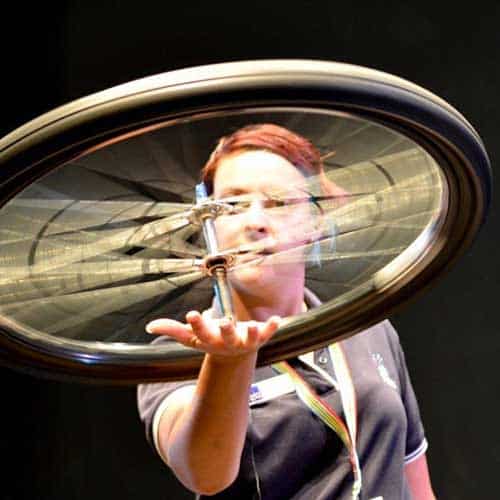
- Giant gyroscope – A student uses a giant gyroscope to spin on a rotating platform
- Gigantic bubbles – Have a look at surface tension in a different way
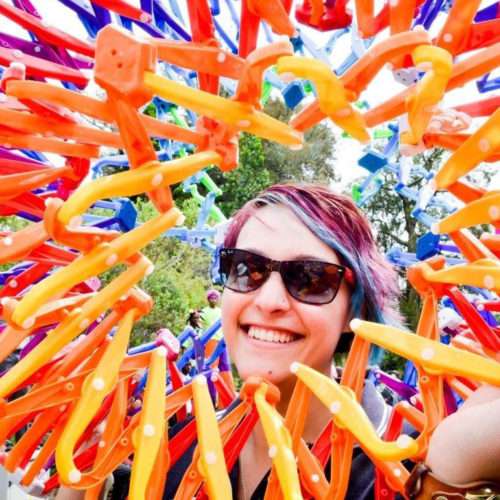
- Mega hoberman sphere – An expanding sphere (1ft to 4ft). Gravity, forces, friction & big bang.
- Nail chair – How can you sit on a nail chair and be OK? Dispelling magic myths…
- Newton colour wheel – Colour addition experiment for the entire audience.
- Rubens Tube – A ‘flame equalizer’, how does it work?
- Skateboard shuffle – Pulling and pushing forces are analysed in this visual demonstration (age dependent)
- Slinky Shake – A visual representation of sound waves
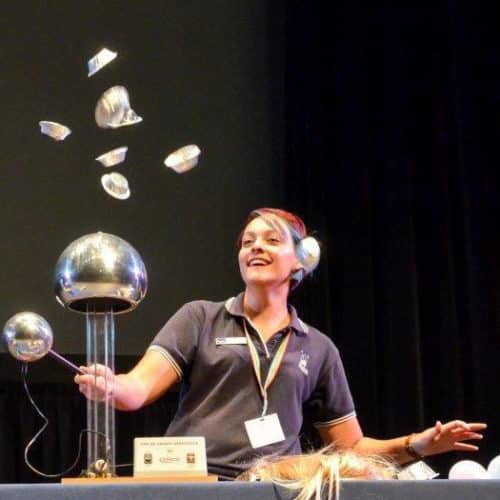
- Van de Graf hair rise – Opposite charges attract, like charges repel… related to a ‘Fun fly stick’ toy
Science show content
What Students Experience: The Ultimate Science Journey
As our flagship “sampler” performance, Big Science Big Fun is designed to demonstrate the sheer breadth of the physical and chemical world. By bridging multiple disciplines in one high-impact session, we provide students with a panoramic view of how science explains everything from the air we breathe to the energy that powers our lives.
1. Forces, Flight & Motion
We explore the physics of movement. From levitating beach balls and the Bernoulli principle to giant gyroscopes and the mechanics of flight, students see how forces shape our world.
2. Exploring Energy
Students witness the hair-raising power of static electricity and energy transfer. Using the Van de Graaff generator, we make abstract energy concepts visible and memorable.
3. Light, Sound & Chemistry
The journey rounds out with optics and acoustics. Students explore coloured shadows, flame equalisers, and energetic fireballs, connecting light and sound energy to chemical reactions.
What an amazing day of Big Science! Our students were absolutely enthralled by the experiments and demonstrations. A fantastic way to bring the curriculum to life.
Thank you Fizzics Education! Our kids are still talking about the giant fog rings and the hair-raising electricity. Engaging, educational, and high energy!
An out-of-this-world experience for our students. The variety of science concepts covered in Big Science Big Fun kept every year level engaged.
Our Commitment to Quality Science Education
A Trusted School Partner for hundreds of Australian schools.
Supporting teachers and students since 2004 with reliable, syllabus-aligned visits.
Since 2004, we have provided stable, high-quality STEM support.
Our programs are refined through constant dialogue with teachers.
Led by science specialists who understand classroom dynamics.

Australian Curriculum Mapping
Australian National Curriculum Mapping for all our science incursions
Australian ACARA Content Outcomes:
Science F-10 Version 9.0
Foundation
- describe how objects move and how factors including their size, shape or material influence their movement AC9SFU02
- recognise that objects can be composed of different materials and describe the observable properties of those materials AC9SFU03
- explore the ways people make and use observations and questions to learn about the natural world AC9SFH01
- pose questions and make predictions based on experiences AC9SFI01
Year 1
- describe pushes and pulls in terms of strength and direction and predict the effect of these forces on objects’ motion and shape AC9S1U03
Year 2
- explore different actions to make sounds and how to make a variety of sounds, and recognise that sound energy causes objects to vibrate AC9S2U02
- recognise that materials can be changed physically without changing their material composition and explore the effect of different actions on materials including bending, twisting, stretching and breaking into smaller pieces AC9S2U03
Year 1 & 2
- describe how people use science in their daily lives, including using patterns to make scientific predictions AC9S1H01, AC9S2H01
- pose questions to explore observed simple patterns and relationships and make predictions based on experiences AC9S1I01, AC9S2I01
- compare observations with predictions and others’ observations, consider if investigations are fair and identify further questions with guidance AC9S1I05, AC9S2I05
Year 3
- identify sources of heat energy and examine how temperature changes when heat energy is transferred from one object to another AC9S3U03
- investigate the observable properties of solids and liquids and how adding or removing heat energy leads to a change of state AC9S3U04
Year 4
- identify how forces can be exerted by one object on another and investigate the effect of frictional, gravitational and magnetic forces on the motion of objects AC9S4U03
- examine the properties of natural and made materials including fibres, metals, glass and plastics and consider how these properties influence their use AC9S4U04
Year 3 & 4
- examine how people use data to develop scientific explanations AC9S3H01, AC9S4H01
- consider how people use scientific explanations to meet a need or solve a problem AC9S3H02, AC9S4H02
- pose questions to explore observed patterns and relationships and make predictions based on observations AC9S3I01, AC9S4I01
- compare findings with those of others, consider if investigations were fair, identify questions for further investigation and draw conclusions AC9S3I05, AC9S4I05
Year 5
- identify sources of light, recognise that light travels in a straight path and describe how shadows are formed and light can be reflected and refracted AC9S5U03
- explain observable properties of solids, liquids and gases by modelling the motion and arrangement of particles AC9S5U04
Year 6
- compare reversible changes, including dissolving and changes of state, and irreversible changes, including cooking and rusting that produce new substances AC9S6U04
Year 5 & 6
- investigate how scientific knowledge is used by individuals and communities to identify problems, consider responses and make decisions AC9S5H02, AC9S6H02
- pose investigable questions to identify patterns and test relationships and make reasoned predictions AC9S5I01, AC9S6I01
- compare methods and findings with those of others, recognise possible sources of error, pose questions for further investigation and select evidence to draw reasoned conclusions AC9S5I05, AC9S6I05
Australian National Curriculum Mapping for all our science workshops & shows

NSW K-10 Science Syllabus Mapping
NSW K – 10 Science Syllabus mapping for all our incursions
NSW Science Syllabus Content
A student:
- STe-5PW-ST observes the way objects move and relates changes in motion to push and pull forces
- ST1-8PW-S describes common forms of energy and explores some characteristics of sound energy
- ST1-9PW-ST investigates how forces and energy are used in products
- ST2-6MW-S describes how adding or removing heat causes a change of state
- ST2-8PW-ST describes the characteristics and effects of common forms of energy, such as light and heat
- ST2-9PW-ST describes how contact and non-contact forces affect an object’s motion
- ST3-6MW-S explains the effect of heat on the properties and behaviour of materials
- ST3-7MW-T explains how the properties of materials determines their use for a range of purposes
- ST3-8PW-ST explains how energy is transformed from one form to another
- ST3-9PW-ST investigates the effects of increasing or decreasing the strength of a specific contact or non-contact force
NSW Science and Technology K–6 Syllabus (Implementation from 2027)
For explanatory points & implementation advice for each dot point, please visit the NESA Science and Technology K–6 Curriculum site
Early Stage 1
STE-SCI-01 identifies and describes characteristics of living things, properties of materials, and movement
- Recognise that properties of materials can be observed using the senses
- Observe and manipulate materials to describe their properties using Tier 2 vocabulary
- Pose questions about materials and describe how they are used in everyday objects
STE-PQU-01 poses questions based on observations to collect data
Stage 1
ST1-SCI-01 measures and describes changes in living things, materials, movement, Earth and the sky
- Recognise that a force is a push or a pull that can make things either start moving, stop moving, change speed, direction or shape
- Pose questions and test the effects of forces on an object’s movement
- Recognise that light and sound can travel through air, water and some solids and are affected by those materials
- Recognise that sound is created and carried by vibrations
- Test how different materials and actions affect the volume and pitch of sound
ST1-PQU-01 poses questions based on observations and information to investigate cause and effect
Stage 2
ST2-SCI-01 uses information to investigate the solar system and the effects of energy on living, physical and geological systems
- Recognise that matter is anything that has mass, takes up space and consists of very small particles
- Observe examples of matter that exist as a solid, which has a defined shape and volume; a liquid, which has a definite volume but not a definite shape; and a gas, which has neither a definite shape nor a definite volume
- Observe and describe water changing from solid to liquid to gas and back again, using Tier 2 and Tier 3 vocabulary
- Describe how adding and removing heat energy affects the movement and arrangement of particles when matter is changing state
- Recognise that heat energy can be transferred from warmer to cooler objects by conduction, convection and radiation
- Pose questions and conduct fair tests to compare how different materials absorb or reflect heat energy
- Describe how the properties of materials and transfer of heat energy impact everyday life
ST2-PQU-01 poses questions to create fair tests that investigate the effects of energy on living things and physical systems
Stage 3
ST3-PQU-01 poses questions to identify variables and conducts fair tests to gather data
- Recognise that in a fair test, an independent variable is changed, a dependent variable is measured, and controlled variables remain the same
NSW K – 10 Science Syllabus mapping for all our incursions
Print a PDF detailing NSW K-6 mapping

VIC Science Syllabus Content
VIC Curriculum F–10 Version 2.0
For explanatory points & implementation advice for each dot point, please visit the VIC Curriculum F-10 site.
Foundation to Level 2
- objects can be made of one or more different materials; these materials have observable properties. VC2S2U04
- materials can be combined in a variety of ways for particular purposes; the properties of objects and mixtures can differ from the properties of the materials from which they are made. VC2S2U05
- materials can be changed physically by different actions without changing their material composition, including by bending, twisting, stretching, crushing, squashing and breaking into smaller pieces. VC2S2U06
- the way objects move depends on a variety of factors including their size, shape and material. VC2S2U10
- pushes and pulls are forces that can change an object’s movement or shape and can be represented in terms of strength and direction. VC2S2U11
- experiences can be used as a basis for posing questions to explore observed patterns and relationships, and to make predictions. VC2S2I01
- observations, findings and ideas can be shared with others by using everyday and some scientific vocabulary. VC2S2I06
Levels 3 and 4
- solids, liquids and gases have observable properties; adding or removing heat energy leads to a change of state between solids, liquids and gases. VC2S4U04
- the properties of natural and made materials, including fibres, metals, glass and plastics, influence their use and re-use. VC2S4U05
- heat energy can be generated from different sources; temperature changes may happen when heat is transferred from one object to another. VC2S4U09
- forces, including frictional, gravitational, electrostatic and magnetic, can be exerted by one object on another through direct contact or from a distance and affect the motion (speed and direction) of objects. VC2S4U10
- scientific investigations to answer questions or test predictions can be planned and conducted using provided scaffolds, including identifying the attributes of fair tests, and considering the safe use of materials and equipment. VC2S4I02
Levels 5 & 6
- light can be produced from many sources; light travels in a straight path, can form shadows, and can be absorbed, transmitted, reflected or refracted by objects. VC2S6U08
- the observable properties of matter (solids, liquids and gases) can be explained by modelling the motion and arrangement of their particles; mixtures (including solutions) can be formed by combining 2 or more different substances. VC2S6U03
- changes to substances may be reversible, in which case the substance may be recovered, or irreversible, in which case new substances are formed; for most substances a change of state or dissolving in water is reversible, while irreversible changes include cooking and rusting. VC2S6U04
- repeatable scientific investigations to answer questions can be planned and conducted, including, as appropriate, deciding the variables to be changed, measured and controlled in fair tests, considering potential risks, planning for the safe and ethical use of equipment and materials, and obtaining permissions for investigations conducted on Country and Place or in protected areas. VC2S6I02
VIC F – 6 Science Syllabus mapping
Print a PDF detailing VIC P-6 mapping
Show Requirements
🔬 The Stage Setup
👨🎓 Capacity: Max 240 students per show.
🏫 Target: Designed for Years K to 6.
🪑 Chairs: Not required for this session.
⚡ Utilities: 2 power sockets + 2 tables.
⏰ Duration: 60 mins (+45 min set/pack).
⚠️ Safety & Audience Fit
Fire Alarms: Ability to isolate/turn off alarms is required for Rubens tube or fireball demonstrations.
Primary Focus: For younger audiences, the content concentrates more on light, movement, and sound.
* Experiments may vary depending on the average age of the audience and location constraints.
Go Further!
Complete Units of Work to Support Your Teaching
Support your classroom with 270+ syllabus-linked lessons, high-quality videos, and marking rubrics.
Save time and engage students in STEM with high-quality videos, printable experiments, quizzes, and full marking rubrics.






