

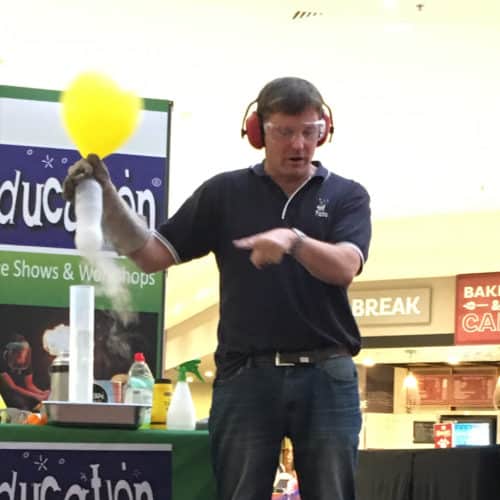

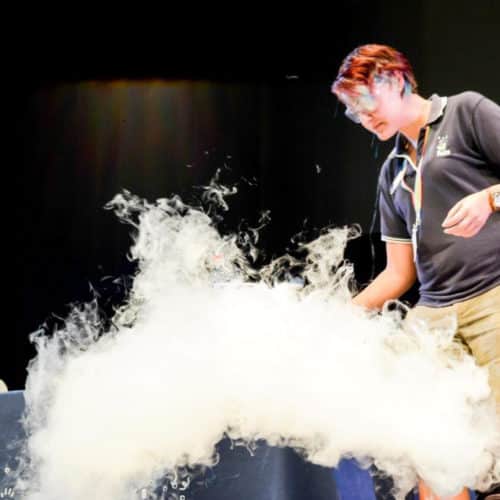
Science Show Demonstrations
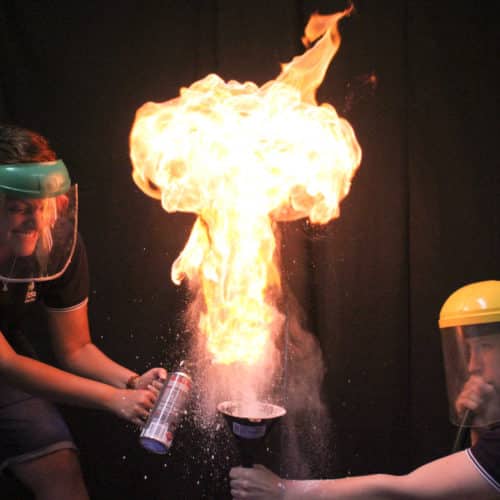
- Fire ball – Learn about the fire triangle in this highly visual demonstration.
- Hydrogen BANG! – Discover just why the Hindenburg exploded…
- Rocket launcher – Learn how to launch several types of rockets… its all about high & low pressure
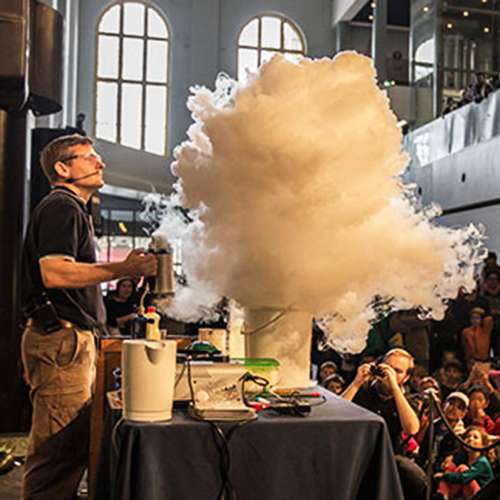
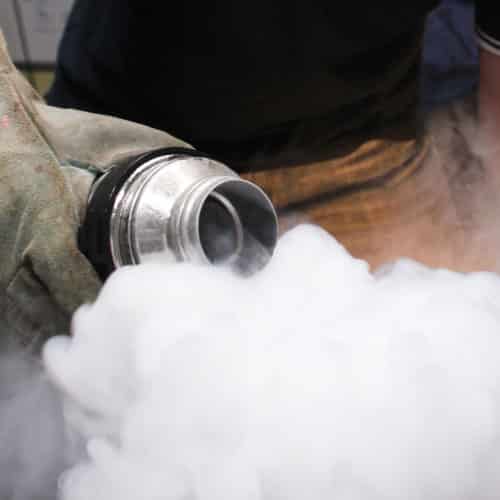
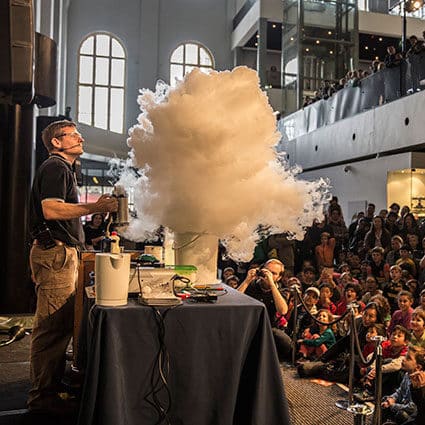
- Don’t trap it! – Giving liquid Nitrogen nowhere to go will result in a VERY fast expansion…
- Expand-a-foam – What happens to shaving cream in a bell jar?
- Balloon dog pop – Explosive decompression really lets you down… especially in space.
- Elephants toothpaste – The classic foamy reaction that releases a lot energy!
- Whoosh bottle – A rudimentary engine on stage .
- Hot water dump – Liquid nitrogen into boiling water… which one wins?
- Bicarb balloons – A great experiments students can safely repeat
- Lift me up – A simple way to demonstrate how an air jack works
- Bernoulli bag – Can you fill a 7 ft bag in one breath?
Science show content
What Students Experience
The Tick Tick BOOM! incursion is structured as a progressive scientific investigation. Rather than a series of disconnected demonstrations, students follow a logical sequence that builds a deep conceptual understanding of matter and energy.
1. Foundations of Pressure
Students explore the relationship between temperature, volume, and pressure. By comapring dramatic implosions versus explosions, they identify the invisible forces that govern gas behaviour and particle theory.
2. Rapid Gas Expansion
We investigate the physics of gas expansion. Students compare controlled energy release with the rapid build-up of potential energy when expansion is restricted, demonstrating the mechanics of work and force.
3. Energetic Transformations
The finale explores kinetic energy within vessels. This stage focuses on the laws of conservation of energy and the real-world physics behind controlled chemical and physical reactions.
The Scientific Mindset: Safety & Logic
Throughout the performance, we reinforce a Safety-First Framework. Students learn that scientists study energetic reactions to understand energy transfer and design safer environments. We clearly differentiate between chemical and physical reactions, providing relatable, everyday examples that ground high-energy phenomena in classroom-ready logic.
Our Commitment to Quality Science Education
A Trusted School Partner for hundreds of Australian schools.
At Fizzics Education, we know science is naturally captivating. Our 20-year history is built on delivering reliable, syllabus-aligned visits that engage students and meet the practical requirements of the modern classroom.
Consistency & Care
Supporting Australian schools and teachers since 2004.
Real Feedback
Guided by unedited reviews from educators and principals.
Qualified Presenters
Facilitated by experienced science educators focused on student outcomes.

Australian Curriculum Mapping
Australian National Curriculum Mapping for all our science incursions
Australian ACARA Content Outcomes:
Science F-10 Version 9.0
Foundation
- describe how objects move and how factors including their size, shape or material influence their movement AC9SFU02
- recognise that objects can be composed of different materials and describe the observable properties of those materials AC9SFU03
- explore the ways people make and use observations and questions to learn about the natural world AC9SFH01
- pose questions and make predictions based on experiences AC9SFI01
Year 1
- describe pushes and pulls in terms of strength and direction and predict the effect of these forces on objects’ motion and shape AC9S1U03
Year 2
- recognise that materials can be changed physically without changing their material composition and explore the effect of different actions on materials including bending, twisting, stretching and breaking into smaller pieces AC9S2U03
Year 1 & 2
- describe how people use science in their daily lives, including using patterns to make scientific predictions AC9S1H01, AC9S2H01
- pose questions to explore observed simple patterns and relationships and make predictions based on experiences AC9S1I01, AC9S2I01
- compare observations with predictions and others’ observations, consider if investigations are fair and identify further questions with guidance AC9S1I05, AC9S2I05
Year 3
- identify sources of heat energy and examine how temperature changes when heat energy is transferred from one object to another AC9S3U03
- investigate the observable properties of solids and liquids and how adding or removing heat energy leads to a change of state AC9S3U04
Year 4
- identify how forces can be exerted by one object on another and investigate the effect of frictional, gravitational and magnetic forces on the motion of objects AC9S4U03
- examine the properties of natural and made materials including fibres, metals, glass and plastics and consider how these properties influence their use AC9S4U04
Year 3 & 4
- examine how people use data to develop scientific explanations AC9S3H01, AC9S4H01
- consider how people use scientific explanations to meet a need or solve a problem AC9S3H02, AC9S4H02
- pose questions to explore observed patterns and relationships and make predictions based on observations AC9S3I01, AC9S4I01
- compare findings with those of others, consider if investigations were fair, identify questions for further investigation and draw conclusions AC9S3I05, AC9S4I05
Year 5
- explain observable properties of solids, liquids and gases by modelling the motion and arrangement of particles AC9S5U04
Year 6
- compare reversible changes, including dissolving and changes of state, and irreversible changes, including cooking and rusting that produce new substances AC9S6U04
Year 5 & 6
- investigate how scientific knowledge is used by individuals and communities to identify problems, consider responses and make decisions AC9S5H02, AC9S6H02
- pose investigable questions to identify patterns and test relationships and make reasoned predictions AC9S5I01, AC9S6I01
- compare methods and findings with those of others, recognise possible sources of error, pose questions for further investigation and select evidence to draw reasoned conclusions AC9S5I05, AC9S6I05
Australian National Curriculum Mapping for all our science workshops & shows

NSW K-10 Science Syllabus Mapping
NSW K – 10 Science Syllabus mapping for all our science incursions
NSW Science Syllabus Content
A student:
- ST2-6MW-S describes how adding or removing heat causes a change of state
- ST2-8PW-ST describes the characteristics and effects of common forms of energy, such as light and heat
- ST2-9PW-ST describes how contact and non-contact forces affect an object’s motion
- ST3-6MW-S explains the effect of heat on the properties and behaviour of materials
- ST3-8PW-ST explains how energy is transformed from one form to another
- ST3-9PW-ST investigates the effects of increasing or decreasing the strength of a specific contact or non-contact force
NSW Science and Technology K–6 Syllabus (Implementation from 2027)
For explanatory points & implementation advice for each dot point, please visit the NESA Science and Technology K–6 Curriculum site
Early Stage 1
STE-SCI-01 identifies and describes characteristics of living things, properties of materials, and movement
- Recognise that properties of materials can be observed using the senses
- Observe and manipulate materials to describe their properties using Tier 2 vocabulary
- Pose questions about materials and describe how they are used in everyday objects
STE-PQU-01 poses questions based on observations to collect data
Stage 1
ST1-SCI-01 measures and describes changes in living things, materials, movement, Earth and the sky
- Recognise that a force is a push or a pull that can make things either start moving, stop moving, change speed, direction or shape
- Pose questions and test the effects of forces on an object’s movement
ST1-PQU-01 poses questions based on observations and information to investigate cause and effect
Stage 2
ST2-SCI-01 uses information to investigate the solar system and the effects of energy on living, physical and geological systems
- Recognise that matter is anything that has mass, takes up space and consists of very small particles
- Observe examples of matter that exist as a solid, which has a defined shape and volume; a liquid, which has a definite volume but not a definite shape; and a gas, which has neither a definite shape nor a definite volume
- Observe and describe water changing from solid to liquid to gas and back again, using Tier 2 and Tier 3 vocabulary
- Describe how adding and removing heat energy affects the movement and arrangement of particles when matter is changing state
- Recognise that heat energy can be transferred from warmer to cooler objects by conduction, convection and radiation
- Pose questions and conduct fair tests to compare how different materials absorb or reflect heat energy
- Describe how the properties of materials and transfer of heat energy impact everyday life
ST2-PQU-01 poses questions to create fair tests that investigate the effects of energy on living things and physical systems
Stage 3
ST3-PQU-01 poses questions to identify variables and conducts fair tests to gather data
- Recognise that in a fair test, an independent variable is changed, a dependent variable is measured, and controlled variables remain the same
NSW K – 10 Science Syllabus mapping for all our incursions
Print a PDF detailing NSW K-6 mapping

VIC Science Syllabus Content
VIC Curriculum F–10 Version 2.0
For explanatory points & implementation advice for each dot point, please visit the VIC Curriculum F-10 site.
Foundation to Level 2
- objects can be made of one or more different materials; these materials have observable properties. VC2S2U04
- materials can be combined in a variety of ways for particular purposes; the properties of objects and mixtures can differ from the properties of the materials from which they are made. VC2S2U05
- materials can be changed physically by different actions without changing their material composition, including by bending, twisting, stretching, crushing, squashing and breaking into smaller pieces. VC2S2U06
- the way objects move depends on a variety of factors including their size, shape and material. VC2S2U10
- pushes and pulls are forces that can change an object’s movement or shape and can be represented in terms of strength and direction. VC2S2U11
- experiences can be used as a basis for posing questions to explore observed patterns and relationships, and to make predictions. VC2S2I01
- observations, findings and ideas can be shared with others by using everyday and some scientific vocabulary. VC2S2I06
Levels 3 and 4
- solids, liquids and gases have observable properties; adding or removing heat energy leads to a change of state between solids, liquids and gases. VC2S4U04
- the properties of natural and made materials, including fibres, metals, glass and plastics, influence their use and re-use. VC2S4U05
- heat energy can be generated from different sources; temperature changes may happen when heat is transferred from one object to another. VC2S4U09
- forces, including frictional, gravitational, electrostatic and magnetic, can be exerted by one object on another through direct contact or from a distance and affect the motion (speed and direction) of objects. VC2S4U10
- scientific investigations to answer questions or test predictions can be planned and conducted using provided scaffolds, including identifying the attributes of fair tests, and considering the safe use of materials and equipment. VC2S4I02
Levels 5 & 6
- the observable properties of matter (solids, liquids and gases) can be explained by modelling the motion and arrangement of their particles; mixtures (including solutions) can be formed by combining 2 or more different substances. VC2S6U03
- changes to substances may be reversible, in which case the substance may be recovered, or irreversible, in which case new substances are formed; for most substances a change of state or dissolving in water is reversible, while irreversible changes include cooking and rusting. VC2S6U04
- repeatable scientific investigations to answer questions can be planned and conducted, including, as appropriate, deciding the variables to be changed, measured and controlled in fair tests, considering potential risks, planning for the safe and ethical use of equipment and materials, and obtaining permissions for investigations conducted on Country and Place or in protected areas. VC2S6I02
VIC F – 6 Science Syllabus mapping
Print a PDF detailing VIC P-6 mapping
Incursion Requirements
🔬 The Setup
👨🎓 Capacity: Up to 240 students per session.
🏫 Target: Suitable for K to Year 6.
🪑 Furniture: 2 tables at front (No student chairs).
⚡ Utilities: 1 standard electrical power socket.
⏰ Duration: 60 mins (+45 min set up/pack up).
⚠️ Essential Safety
Fire Alarms: Ability to isolate fire alarms is a mandatory requirement for this performance.
Go Further!
Complete Units of Work to Support Your Teaching
Support your classroom with 270+ syllabus-linked lessons, high-quality videos, and marking rubrics.
Support your classroom teaching with 270+ syllabus-linked lessons, high-quality videos, printable experiments, and comprehensive marking rubrics designed for K-6 teachers.






