
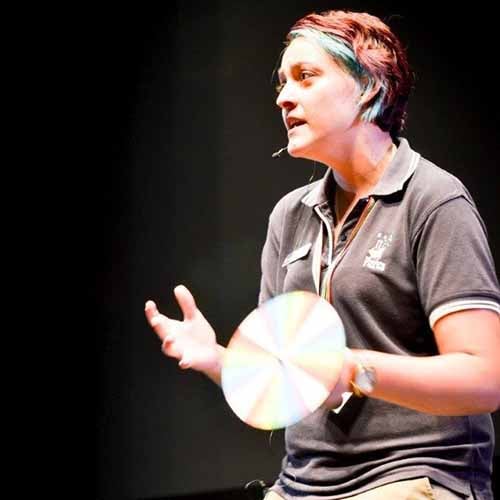

Interpret Real Articles… Explain What Is Occurring
Science journal articles are filled with amazing discoveries… but sometimes can be filled with jargon.
In this session, we challenge students to communicate the science from real science articles through a designed model from random materials.
- Learn the key points in the article.
- Design a model of the concepts using simple materials
- Give a 90-second talk to your class on what the article is about!
Prepare to fail forwards as we try science communication on the fly… and have some fun in the process!
Interpret & model real science
Science communication is more than just sharing facts; it is about making complex discoveries accessible, relatable, and engaging. Inspired by the legacy of Professor Julius Sumner-Miller, who championed the use of simple materials to demonstrate profound concepts, this workshop empowers students to move beyond textbooks and become active science communicators. By engaging directly with real-world science journal articles, students are challenged to bridge the gap between technical jargon and public understanding. This process requires a deep level of scientific literacy: students must first analyse complex data and findings to identify the core message of the research. They then translate this abstract information into a tangible form, creating a working model out of simple, everyday materials. This hands-on “discovery learning” approach mirrors the work of professional science communicators, requiring students to ensure their experiments are replicable, safe, and effective at conveying a concept. Ultimately, the workshop culminates in students explaining the “why” behind the science. Your students must articulate:- What is the concept?
- Why is the concept important?
- How does the model show this?
- What is the impact of the concept?

Australian Curriculum Mapping
Australian National Curriculum Mapping for all our science incursions
Australian ACARA Content Outcomes:
Science F-10 Version 9.0
Year 9 & 10
- explain how scientific knowledge is validated and refined, including the role of publication and peer review AC9S9H01 AC9S10H01
- Investigate how advances in technologies enable advances in science, and how science has contributed to developments in technologies and engineering AC9S9H02 AC9S10H02
- develop investigable questions, reasoned predictions and hypotheses to test relationships and develop explanatory models AC9S9I01 AC9S10I01
- analyse and connect a variety of data and information to identify and explain patterns, trends, relationships and anomalies AC9S9I05 AC9S10I05
- construct arguments based on analysis of a variety of evidence to support conclusions or evaluate claims, and consider any ethical issues and cultural protocols associated with accessing, using or citing secondary data or information AC9S9I07 AC9S10I07
Year 11 & 12
- Science is a global enterprise that relies on clear communication, international conventions, peer review and reproducibility (ACSBL008)
- Development of complex models and/or theories often requires a wide range of evidence from multiple individuals and across disciplines (ACSBL009)
- Advances in science understanding in one field can influence other areas of science, technology and engineering (ACSBL010)
- The use of scientific knowledge is influenced by social, economic, cultural and ethical considerations (ACSBL011)
- Scientific knowledge can enable scientists to offer valid explanations and make reliable predictions (ACSBL013)
- Scientific knowledge can be used to develop and evaluate projected economic, social and environmental impacts and to design action for sustainability (ACSBL014)
- ICT and other technologies have dramatically increased the size, accuracy and geographic and temporal scope of data sets with which scientists work (ACSBL068)
- Models and theories are contested and refined or replaced when new evidence challenges them, or when a new model or theory has greater explanatory power (ACSBL069)
- The acceptance of scientific knowledge can be influenced by the social, economic and cultural context in which it is considered (ACSBL070)
- People can use scientific knowledge to inform the monitoring, assessment and evaluation of risk (ACSBL071)
- Science can be limited in its ability to provide definitive answers to public debate; there may be insufficient reliable data available, or interpretation of the data may be open to question (ACSBL072)
- International collaboration is often required when investing in large-scale science projects or addressing issues for the Asia-Pacific region (ACSBL073)
- Scientific knowledge can be used to develop and evaluate projected economic, social and environmental impacts and to design action for sustainability (ACSBL074)

NSW K-10 Science Syllabus Mapping
NSW Science 7–10 Syllabus (2023)
Stage 5
- analyses data from investigations to identify trends, patterns and relationships, and draws conclusions SC5-WS-06- Describe patterns and trends, including inconsistencies in data and information – Describe relationships between variables – Assess the validity and reliability of first-hand data – Use graphed data from investigations to extrapolate or interpolate information to make predictions – Use knowledge of scientific concepts to draw conclusions that are consistent with evidence – Synthesise data and information to develop evidence-based arguments – Evaluate conclusions and evidence, including identifying sources of uncertainty and possible alternative explanations – Analyse the validity of information from secondary sources
- communicates scientific arguments with evidence, using scientific language and terminology in a range of communication forms SC5-WS-08- Present scientific arguments using evidence, correct scientific language and terminology, as appropriate to audience and purpose – Create written texts to communicate scientific investigations, explain scientific theories and principles, structure a scientific argument, and evaluate findings in light of scientific knowledge – Recognise that scientific texts develop arguments by encouraging the reader to adopt a specific perspective and positioning them to accept the authority of a text
Biology 11–12 Syllabus (2025)
- analyses and evaluates primary and secondary data and information BI-11WS-05
- communicates scientific arguments using evidence, scientific language and terminology for a specific audience BI-11WS-07
Chemistry 11–12 Syllabus (2025)
- interprets data and information CW-LSWS-05
- communicates information using scientific language and terminology CW-LSWS-07
Earth and Environmental Science 11–12 Syllabus (2025)
- analyses and evaluates primary and secondary data and information EES-11WS-05
- communicates scientific arguments using evidence, scientific language and terminology for a specific audience EES-11WS-07
Physics 11–12 Syllabus (2025)
- analyses and evaluates primary and secondary data and information PY-11WS-05
- communicates scientific arguments using evidence, scientific language and terminology for a specific audience PY-11WS-07

VIC Science Syllabus Content
VIC Curriculum F–10 Version 2.0
For explanatory points & implementation advice for each dot point, please visit the VIC Curriculum F-10 site.Levels 9 & 10
- scientific knowledge is contestable and is validated and refined over time through expanding scientific methods, replication, publication, peer review and consensus VC2S10H01
- advances in technologies have enabled advances in science, while science has contributed to developments in technologies and engineering VC2S10H02
- the use of scientific knowledge to address socio-scientific issues and shape a more sustainable future for humans and the environment may have diverse projected outcomes that affect the extent to which scientific knowledge and practices are adopted more broadly by society VC2S10H03
- scientific knowledge may be interpreted in different ways by individuals and groups in society; the values and needs of society can influence the focus of scientific research VC2S10H04
- data and information can be organised, processed and summarised by selecting and constructing representations including tables, graphs, descriptive statistics, models, symbols, formulas and mathematical relationships VC2S10I04
- information and processed data can be analysed and compared to identify and explain qualitative and quantitative patterns, trends, relationships and anomalies VC2S10I05
- communicating and justifying scientific ideas, findings and arguments for diverse audiences involves the selection of appropriate presentation formats, content, scientific vocabulary, conventions, models and other representations, and may include the use of digital tools VC2S10I08
VCE Key Science Skills (Units 1–4)
Analyse and evaluate data, methods and scientific models- Analyse and explain how models and theories are used to organise and understand observed phenomena and concepts, and identify the limitations of selected models and theories
- Critically evaluate and interpret a range of scientific and media texts, including journal articles, mass media communications and opinions in the public domain, by considering the quality of available evidence
- Distinguish between opinion, anecdote and evidence, and scientific and non-scientific ideas
- Communicate to specific audiences and for specific purposes using appropriate scientific genres, and clear, coherent and concise expression
- Discuss relevant scientific information, ideas, concepts, theories and models and the connections between them
- Use appropriate terminology and representations, including standard scientific symbols, units and abbreviations, and mathematical and graphic representations






