


STEM workshop content
What Students Experience: The Engineering Challenge
This workshop transforms the classroom into an engineering lab. We move from the history of Rube Goldberg’s whimsical designs into a high-stakes, hands-on mission where failure is just a step toward a better solution.
1. Inspiration & Logic
We begin with an engaging discussion and video showcase of complex Rube Goldberg machines. Students analyse how simple triggers lead to massive chain reactions, setting the stage for their own design thinking process.
2. The Build Challenge
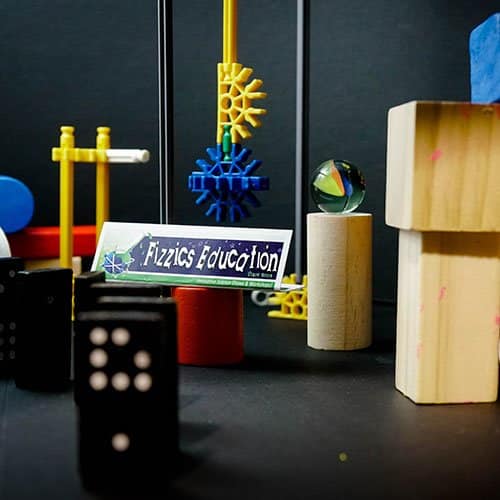
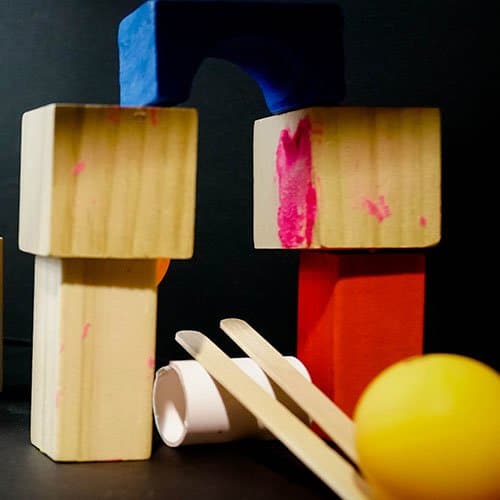
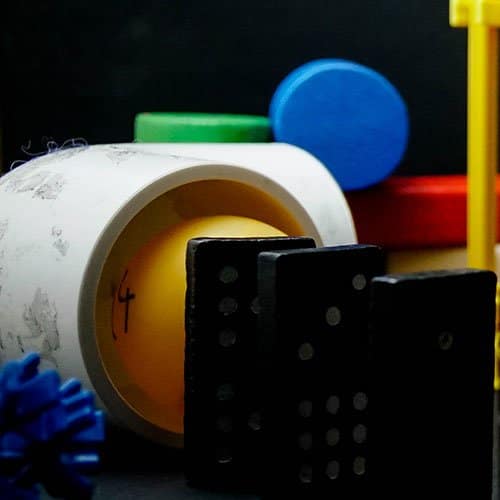
Armed with everyday materials and unexpected items, teams must build a contraption that harnesses potential and kinetic energy. The goal? Creating a precise sequence of events that successfully rings a desk bell.
3. Defining STEM
We wrap up by connecting the fun back to the real world. Students discuss what STEM actually is: the powerful combination of materials, scientific knowledge, and collaboration to solve a given problem.
Real World Engineering: Macquarie University
Our Commitment to Quality Science Education
A Trusted School Partner for hundreds of Australian schools
At Fizzics Education, we know science is naturally captivating. Our 20-year history is built on delivering reliable, syllabus-aligned visits that engage students and meet the practical requirements of the Australian classroom.
Supporting Australian schools and teachers since 2004.
Guided by unedited reviews from educators and principals.
Facilitated by experienced science specialists focused on student learning.

Australian Curriculum Mapping
Australian National Curriculum Mapping for all our science incursions
Australian ACARA Content Outcomes:
Science F-10 Version 9.0
Year 7
- investigate and represent balanced and unbalanced forces, including gravitational force, acting on objects, and relate changes in an object’s motion to its mass and the magnitude and direction of forces acting on it AC9S7U04
Year 7 & 8
- develop investigable questions, reasoned predictions and hypotheses to explore scientific models, identify patterns and test relationships AC9S7I01 AC9S8I01
- analyse data and information to describe patterns, trends and relationships and identify anomalies AC9S7I05 AC9S8I05
- construct evidence-based arguments to support conclusions or evaluate claims and consider any ethical issues and cultural protocols associated with using or citing secondary data or information AC9S7I07 AC9S8I07
Year 9 & 10
- develop investigable questions, reasoned predictions and hypotheses to test relationships and develop explanatory models AC9S9I01 AC9S10I01
- analyse and connect a variety of data and information to identify and explain patterns, trends, relationships and anomalies AC9S9I05 AC9S10I05
- construct arguments based on analysis of a variety of evidence to support conclusions or evaluate claims, and consider any ethical issues and cultural protocols associated with accessing, using or citing secondary data or information AC9S9I07 AC9S10I07
Australian National Curriculum Mapping for all our science workshops & shows

NSW K-10 Science Syllabus Mapping
NSW Science 7–10 Syllabus (2023)
Stage 4
A student:
- identifies questions and makes predictions to guide scientific investigations SC4-WS-02
– Identify questions and problems that can be investigated scientifically
– Make predictions based on scientific knowledge and observations - describes the effects of forces in everyday contexts SC4-FOR-01
– Explain forces as either direct (contact) or indirect (non-contact)
– Conduct a practical investigation on the effects of a range of direct and indirect forces
– Investigate examples of forces and magnetism in familiar contexts
Stage 5
- asks questions or makes predictions using observations SCLS-WS-02
– Ask questions about familiar objects and events based on observations
– Make predictions based on observations - evaluates current and alternative energy use based on ethical and sustainability considerations SC5-EGY-01
– Explain efficiency in relation to energy transfers
– Explain how to improve energy efficiency in energy transfers and transformations
NSW K – 10 Science Syllabus mapping for all our NSW incursions

VIC Science Syllabus Content
VIC Curriculum F–10 Version 2.0
For explanatory points & implementation advice for each dot point, please visit the VIC Curriculum F-10 site.
Levels 7 and 8
- balanced and unbalanced forces acting on objects, including gravitational force, may be investigated and represented using force diagrams; changes in an object’s motion can be related to its mass and the magnitude and direction of the forces acting on it. VC2S8U14
- energy exists in different forms, including thermal, chemical, gravitational and elastic, and may be classified as kinetic or potential; energy transfers (conduction, convection and radiation) and transformations occur in simple systems and can be analysed in terms of energy efficiency. VC2S8U15
- investigable questions, reasoned predictions and hypotheses can be developed in guiding investigations to identify patterns, test relationships and analyse and evaluate scientific models. VC2S8I01
- scientific methods, conclusions and claims can be analysed to identify assumptions, possible sources of error, conflicting evidence and unanswered questions. VC2S8I06
- evidence-based arguments can be constructed to support conclusions or evaluate claims, including consideration of ethical issues and protocols associated with using or citing secondary data or information. VC2S8I07
Levels 9 & 10
- investigable questions, reasoned predictions and hypotheses can be used in guiding investigations to test and develop explanatory models and relationships. VC2S10I01
- the validity and reproducibility of investigation methods and the validity of conclusions and claims can be evaluated, including by identifying assumptions, conflicting evidence, biases that may influence observations and conclusions, sources of error and areas of uncertainty. VC2S10I06
- arguments based on a variety of evidence can be constructed to support conclusions or evaluate claims, including consideration of any ethical issues and cultural protocols associated with accessing, using or citing secondary data or information. VC2S10I07
Session Requirements
👥 Capacity & Timing
👨🎓 Attendance: Maximum of 30 students per class.
🏫 Target: Appropriate for Years 7 to 10.
⏰ Duration: 60 or 90 minutes.
🛠️ Set/Pack: 45 mins setup and 45 mins pack up.
📍 Space & Layout Needs
🏗️ Furniture: 7 tables arranged around the room.
🖼️ Wall Space: Access to clear wall space is required.
🪑 Seating: Chairs are not required.
Customised Learning & Safety
Materials used may be varied to suit conditions and the audience. Please chat with our presenter for any specific focus areas.
Extend the Experience
Pair this workshop with one of our school favourites for up to 240 students:






