



Science of the Deep Blue!
Dive into the science of the sea as we explore the physical factors that determine life underwater and along our coastlines.
- Learn about what drives ocean acidification and its effect on coral.
- How do heat and salt drive our ocean currents?
- How does pressure change underwater and what does this mean for marine life as well as scuba divers?
- Why do light wavelengths & intensity change as you go deeper and what does this mean for organisms?
- How do whales and dolphins use echolocation to locate prey?
- Which technologies are being used in current ocean research?
- … and more!
This show & workshop has been specially designed for National Science Week 2020 ‘Deep Blue: innovations for the future of our oceans.’
Also available as a video conference to any school around the globe!
Online Class Version
We’ve run live interactive distance programs since 2010 and are highly experienced in making online classes engaging for students on a variety of web conferencing platforms.
- All of the activities listed below will be covered during the conference.
- Upon booking, you will receive a PDF outlining the materials that you can have on hand to make the workshop more interactive. It’s not a problem if you can’t source all of the materials, as we’ll have these on hand for the workshop
- Full child protections are in place
- We usually connect to classes & homes via Zoom, however if you wish to use a different software we can work with you on getting the connection live.
If you connect with us via Zoom
- Full system requirements for Zoom here
- Each student should test their Zoom connection here.
- Once the date & time is arranged we will send you simple connection instructions (one click & you’re in!)
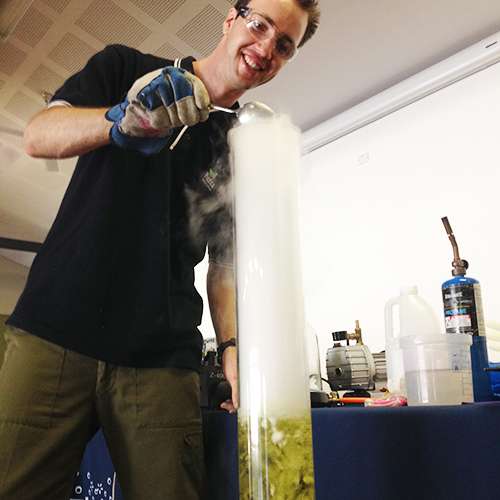
Science Show Demonstrations
- Light attenuation – What happens to light wavelengths as we go deeper?
- Under pressure – How does pressure change as you descend into the ocean?
- Colourful currents – How do heat and salinity affect ocean currents?
- Echolocation – We look at how whales & dolphins hunt prey
- It glows! – How is luminescence used by some organisms underwater?
- Science of SCUBA – Divers avoid decompression sickness… how & why?
- Ocean acidification – Corals can’t handle big changes in pH. How is this a problem now?
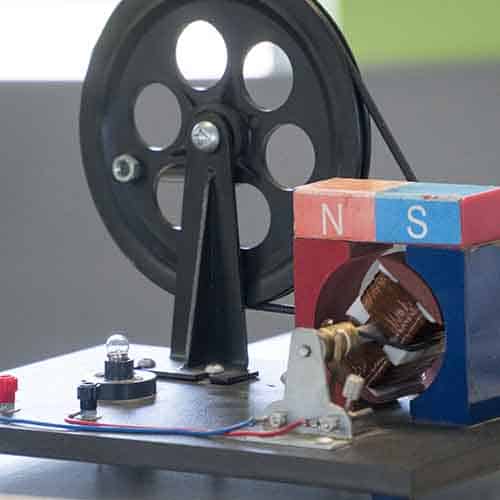
- Hydropower – We can harness the energy of the waves!
- Weird sealife – We look at the diversity of life underwater
- Whale snot sampling – Seriously, this is a thing! Using drones in current research
- Fresh vs salt water – How much freshwater is there really in the world?
- Cleaning our oceans – How are scientists & engineers combating pollution in our oceans?

Australian Curriculum Mapping
Australian ACARA Content Outcomes:
| Code | What students learn |
|---|---|
| ACSSU117 | PW1 Change to an object’s motion is caused by unbalanced forces acting on the object |
PW2 The action of forces that act at a distance may be observed and related to everyday situations.
| Code | What students learn |
|---|---|
| ACSSU155 | PW3 Energy appears in different forms including movement (kinetic energy), heat and potential energy, and causes change within systems |
| ACSSU182 | Energy transfer through different mediums can be explained using wave and particle models |
| ACSSU229 | The motion of objects can be described and predicted using the laws of physics |
| ACSSU190 | Energy conservation in a system can be explained by describing energy transfers and transformations |
| ACSSU112 | Interactions between organisms, including the effects of human activities can be represented by food chains and food webs |
| ACSSU150 | Multi-cellular organisms contain systems of organs carrying out specialised functions that enable them to survive and reproduce |
Ecosystems consist of communities of interdependent organisms and abiotic components of the environment; matter and energy flow through these systems ACSSU176
Australian National Curriculum Mapping for all our science workshops & shows

NSW K-10 Science Syllabus Mapping
NSW K – 10 Science Syllabus mapping for all our incursions
NSW Science Syllabus Content:
A student:
| Code | What students learn |
|---|---|
| SC4-10PW | develops knowledge of the Physical World, Earth and Space, Living World and Chemical World, and understanding about the nature, development, use and influence of science |
appreciates the importance of science in their lives and the role of scientific inquiry in increasing understanding of the world around them SC4-1VA & SC5-1VA
| Code | What students learn |
|---|---|
| SC4-14LW | relates the structure and function of living things to their classification, survival and reproduction |
| SC4-10PW | describes the action of unbalanced forces in everyday situations |
| SC5-14LW | analyses interactions between components and processes within biological systems |
| SC5-10PW | applies models, theories and laws to explain situations involving energy, force and motion |
NSW Science 7–10 Syllabus
(Implementation from 2026)
For explanatory points & implementation advice for each dot point, please visit the Science 7 -10 Curriculum site
A student:
- identifies questions and makes predictions to guide scientific investigations SC4-WS-02
- describes the effects of forces in everyday contexts SC4-FOR-01
- explains how the properties of substances enable separation in a range of techniques SC4-SOL-01
- describes the role, structure and function of a range of living systems and their components SC4-LIV-01
- explains how data is used by scientists to model and predict scientific phenomena SC4-DA1-01
- develops questions and hypotheses for scientific investigation SC5-WS-02
- evaluates current and alternative energy use based on ethical and sustainability considerations SC5-EGY-01
- analyses the impact of human activity on the natural world SC5-ENV-01
- describes the features and applications of different forms of waves SC5-WAM-01
- describes a range of reaction types SC5-RXN-01
NSW K – 10 Science Syllabus mapping for all our incursions
Victorian F – 10 Science Curriculum
| Code | What students learn |
|---|---|
| VCSSU101 | Water is an important resource that cycles through the environment |
| VCSSU103 | Change to an object’s motion is caused by unbalanced forces acting on the object; Earth’s gravity pulls objects towards the centre of Earth |
| VCSSU105 | Light can form images using the reflective feature of curved mirrors and the refractive feature of lenses, and can disperse to produce a spectrum which is part of a larger spectrum of radiation |
| VCSSU121 | Ecosystems consist of communities of interdependent organisms and abiotic components of the environment; matter and energy flow through these systems |
| VCSSU128 | Global systems, including the carbon cycle, rely on interactions involving the atmosphere, biosphere, hydrosphere and lithosphere |
Requirements
- Appropriate for Years 7 to 10 with a maximum of 240 students per science show
- Access to 2 electrical power sockets and 2 tables
- Chairs are not required
- Duration 60 minutes, set up time 45 minutes and pack up time 45 minutes
- Ability to darken the room for some of the demonstrations






