



Science Show Demonstrations
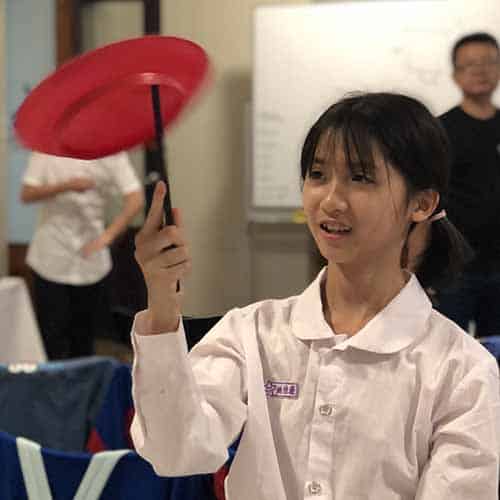
- Spin spin spin – Once the disks spin they hold their angle due to rotational inertia
- Mega hoberman spin – As collapsing spheres spin they speed up…why?
- Space station twirl – Learn how gyroscopes are used on International Space Station
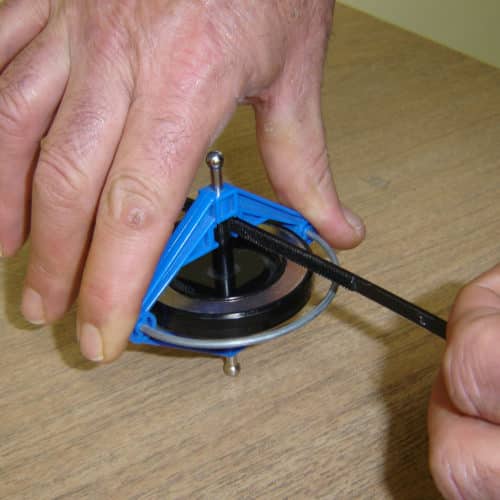
- Gyrating gyros – Create balance in the gyroscopes with a bit of speed
- Skateboard shuffle – Investigate push and pull forces plus the impact of friction
- Pendulum swing – Does the weight or length of string affect the speed?
- Rocket launch – Release pressure to make it fly!
- Euler’s disc – A lack of friction allows movement to go for a long time
- Magnetic levitators – Levitate the magnets and watch them spin with very low friction
- Table cloth pull – An inertia demonstration used in magic tricks
- Dropper poppers – Store and release energy with a spring!
- Vortex fog rings – Transfer force with air vortices
- Gyro rings – Pull the rings up against gravity as they spin
- Tornado tubes – Make a tornadoes in a bottle.
- Inertia beads – Self-siphoning beads… how do they work?
- Balancing bottle – It’s all about the centre of balance!
- Book pull apart – The more friction, the harder it is to separate the pages
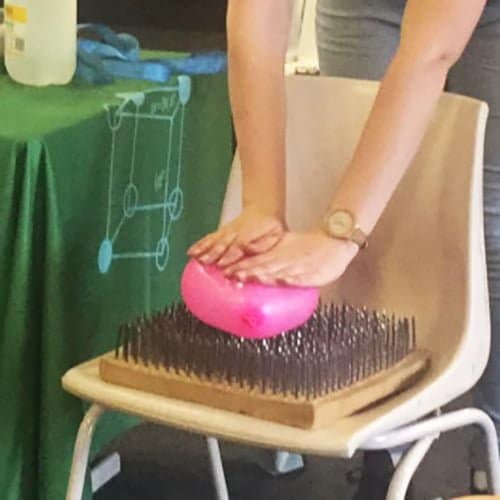
- Nail chair – Its all about spreading out the pressure!
Science workshop content
What Students Experience: The Physics Lab
In this high-velocity workshop, students explore the fundamental laws that govern how everything in our universe moves. From the microscopic friction between surfaces to the massive forces required for space travel, we make Newtonian physics tangible, visual, and unforgettable.
1. Newton’s Fundamentals
We kick off with spectacular demonstrations of Newton’s 3 Laws of Motion. Illustrated through high-impact examples—from the pressure distribution of a chair of nails to the balanced forces of a levitating bottle—we ground abstract laws in physical reality.
2. Kinematics Exploration
Students rotate through specialized stations to test how laws of motion apply across states of matter. They investigate rotational dynamics with gyroscopes, analyze frictional coefficients, and map non-contact magnetic force fields.
3. Applied Mechanics
The session concludes with the conservation of momentum and the physics of the tablecloth pull. We launch vortex rings to visualize force transfer through fluids and discuss the mechanics of spacecraft maneuvering in a vacuum.
Physics in Action: High School Feedback
⬅️ Swipe to see real classroom moments ➡️
Our Commitment to Quality Science Education
A Trusted School Partner for 20 Years
Fizzics Education delivers reliable, syllabus-aligned visits that engage secondary students and meet the practical requirements of the Australian classroom.

Australian Curriculum Mapping
Australian National Curriculum Mapping for all our science incursions
Australian ACARA Content Outcomes:
Science F-10 Version 9.0
Year 7
- investigate and represent balanced and unbalanced forces, including gravitational force, acting on objects, and relate changes in an object’s motion to its mass and the magnitude and direction of forces acting on it AC9S7U04
Year 7 & 8
- develop investigable questions, reasoned predictions and hypotheses to explore scientific models, identify patterns and test relationships AC9S7I01 AC9S8I01
- analyse data and information to describe patterns, trends and relationships and identify anomalies AC9S7I05 AC9S8I05
- construct evidence-based arguments to support conclusions or evaluate claims and consider any ethical issues and cultural protocols associated with using or citing secondary data or information AC9S7I07 AC9S8I07
Year 9 & 10
- develop investigable questions, reasoned predictions and hypotheses to test relationships and develop explanatory models AC9S9I01 AC9S10I01
- analyse and connect a variety of data and information to identify and explain patterns, trends, relationships and anomalies AC9S9I05 AC9S10I05
- construct arguments based on analysis of a variety of evidence to support conclusions or evaluate claims, and consider any ethical issues and cultural protocols associated with accessing, using or citing secondary data or information AC9S9I07 AC9S10I07
Australian National Curriculum Mapping for all our science workshops & shows

NSW K-10 Science Syllabus Mapping
NSW Science 7–10 Syllabus (2023)
Stage 4
A student:
- identifies questions and makes predictions to guide scientific investigations SC4-WS-02
– Identify questions and problems that can be investigated scientifically
– Make predictions based on scientific knowledge and observations - describes the effects of forces in everyday contexts SC4-FOR-01
– Explain forces as either direct (contact) or indirect (non-contact)
– Conduct a practical investigation on the effects of a range of direct and indirect forces
– Analyse force diagrams to make predictions
– Examine the relationship between force and energy
– Describe how magnets attract or repel each other based on their polarity
– Conduct a practical investigation to test the effect of distance on the action of a magnet
– Observe and map the magnetic fields of magnets
– Conduct a practical investigation to construct electromagnets and compare their strength
– Investigate examples of forces and magnetism in familiar contexts
Stage 5
- asks questions or makes predictions using observations SCLS-WS-02
– Ask questions about familiar objects and events based on observations
– Make predictions based on observations
NSW K – 10 Science Syllabus mapping for all our NSW incursions

VIC Science Syllabus Content
VIC Curriculum F–10 Version 2.0
For explanatory points & implementation advice for each dot point, please visit the VIC Curriculum F-10 site.
Levels 7 and 8
- balanced and unbalanced forces acting on objects, including gravitational force, may be investigated and represented using force diagrams; changes in an object’s motion can be related to its mass and the magnitude and direction of the forces acting on it. VC2S8U14
- investigable questions, reasoned predictions and hypotheses can be developed in guiding investigations to identify patterns, test relationships and analyse and evaluate scientific models. VC2S8I01
- scientific methods, conclusions and claims can be analysed to identify assumptions, possible sources of error, conflicting evidence and unanswered questions. VC2S8I06
- evidence-based arguments can be constructed to support conclusions or evaluate claims, including consideration of ethical issues and protocols associated with using or citing secondary data or information. VC2S8I07
Levels 9 & 10
- Newton’s laws of motion can be used to quantitatively analyse the relationship between force, mass and acceleration of objects. VC2S10U17
- investigable questions, reasoned predictions and hypotheses can be used in guiding investigations to test and develop explanatory models and relationships. VC2S10I01
- the validity and reproducibility of investigation methods and the validity of conclusions and claims can be evaluated, including by identifying assumptions, conflicting evidence, biases that may influence observations and conclusions, sources of error and areas of uncertainty. VC2S10I06
- arguments based on a variety of evidence can be constructed to support conclusions or evaluate claims, including consideration of any ethical issues and cultural protocols associated with accessing, using or citing secondary data or information. VC2S10I07
Session Requirements
👥 Capacity & Timing
👨🎓 Attendance: Max 32 students per class.
🏫 Target: Appropriate for Years 7 to 10.
⏰ Duration: 60 or 90-minute options.
🛠️ Set/Pack: 45 mins setup + 45 mins pack down.
📍 Venue Requirements
🏗️ Tables: 2 tables arranged around the room.
🔌 Power: Access to 1 electrical power socket.
🪑 Seating: Chairs are not required for students.
Tailored Programming & Safety:
Materials may be varied to suit conditions. We will tailor the workshop to suit both your school and current requirements. Contact us here.
Extend the Experience
Pair this workshop with a larger stage show for groups of up to 240 students:






