



Science Show Activities
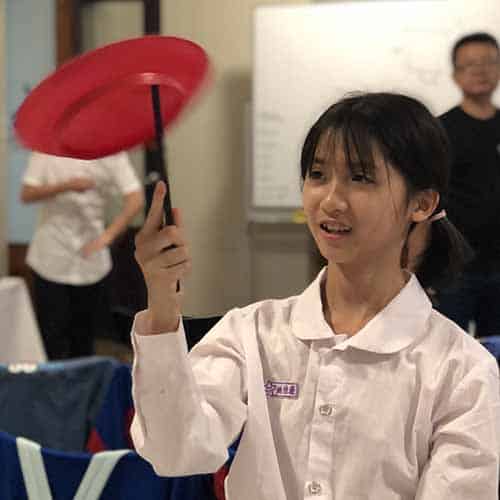
- Spin spin spin – Once the disks spin they hold their angle due to inertia
- Rocket carts – For every action there’s an equal & opposite action
- Mega hoberman spin – As collapsing spheres spin they speed up…why?
- Space station twirl – Learn how gyroscopes are used on International Space Station
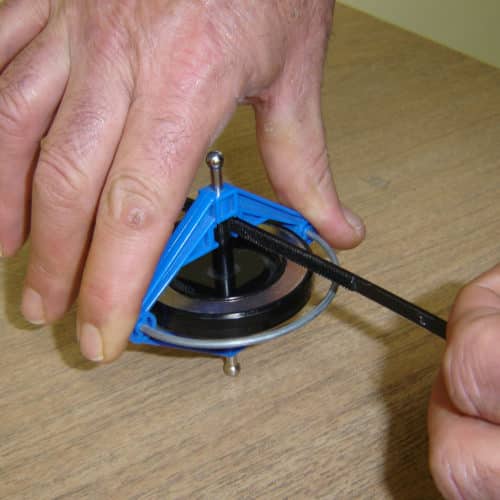
- Gyrating gyros – Create balance in the gyroscopes with a bit of speed
- Skateboard shuffle – Investigate push and pull forces
- Rocket launch – Release pressure to make it fly!
- Euler’s disc – A lack of friction allows movement to go for a long time
- Magnetic levitators – Levitate the magnets and watch them spin with very low friction
- Table cloth pull – An inertia demonstration used in magic tricks
- Magnet mayhem – Investigate the interaction of a variety of magnets
- Dropper poppers – Store and release energy with a spring!
- Vortex fog rings – Transfer force with air vortices
- Gyro rings – Pull the rings up against gravity as they spin
- Tornado tubes – Make a tornadoes in a bottle.
- Inertia beads – Self-siphoning beads… how do they work?
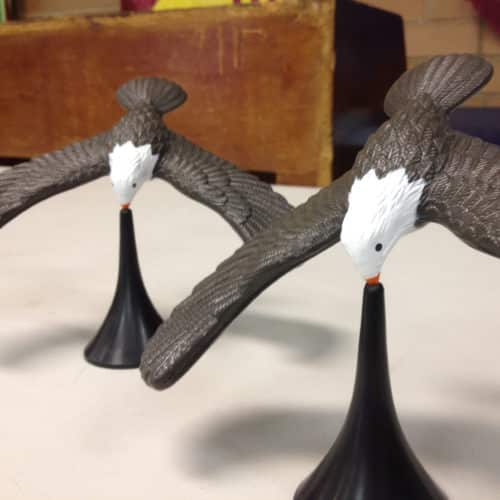
- Balancing bottle – It’s all about the centre of balance!
- Book pull apart – The more friction, the harder it is to separate the pages
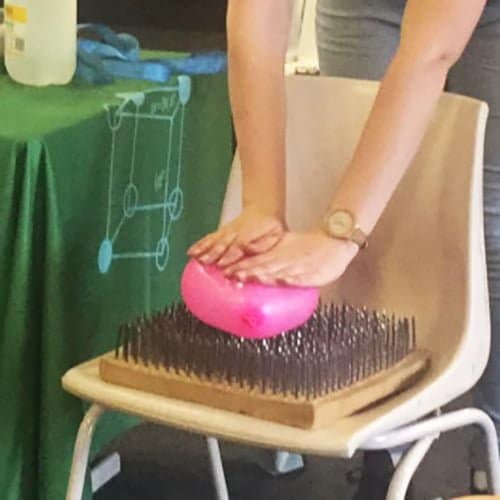
- Nail chair – Its all about spreading out the pressure!
Science workshop content
What Students Experience: The Physics Lab
In this high-velocity workshop, students explore the fundamental laws that govern how everything in our universe moves. From the microscopic friction between surfaces to the massive forces required for space travel, we make Newtonian physics tangible, visual, and unforgettable.
1. Newton’s Fundamentals
We kick off with spectacular demonstrations of Newton’s 3 Laws of Motion, illustrated through everything from sitting on a chair of nails to the physics of a balancing bottle.
2. Hands-On Exploration
Students rotate through specialised stations to test how laws of motion apply across solids, liquids, and gases. They investigate rotational “spinning” forces, static and frictional forces, and the nature of non-contact magnetic forces.
3. Advanced Mechanics
The session concludes by reinforcing the concepts, including the classic tablecloth pull and the mechanics of spacecraft manoeuvring in a vacuum. We even launch vortex rings to show how force transfers through the air.
Real Classroom Feedback
The girls had a fantastic day investigating the laws of motion! The hands-on stations really helped them understand inertia and friction through real-world examples.
An incredible session! Seeing the laws of motion demonstrated with such high-impact equipment made a huge difference to our students’ understanding of physics.
⬅️ Swipe to see more examples ➡️
Our Commitment to Quality Science Education
A Trusted School Partner for 20 Years
Fizzics Education delivers reliable, syllabus-aligned visits that engage students and meet the practical requirements of the Australian classroom.

Australian Curriculum Mapping
Australian National Curriculum Mapping for all our science incursions
Australian ACARA Content Outcomes:
Science F-10 Version 9.0
Foundation
- describe how objects move and how factors including their size, shape or material influence their movement AC9SFU02
- explore the ways people make and use observations and questions to learn about the natural world AC9SFH01
- pose questions and make predictions based on experiences AC9SFI01
Year 1
- describe pushes and pulls in terms of strength and direction and predict the effect of these forces on objects’ motion and shape AC9S1U03
Year 2
- recognise that materials can be changed physically without changing their material composition including by bending, twisting, stretching and breaking AC9S2U03
Year 1 & 2
- describe how people use science in their daily lives, including using patterns to make scientific predictions AC9S1H01, AC9S2H01
- pose questions to explore observed simple patterns and relationships AC9S1I01, AC9S2I01
- compare observations with predictions and others’ observations AC9S1I05, AC9S2I05
Year 4
- identify how forces can be exerted by one object on another and investigate the effect of frictional, gravitational and magnetic forces AC9S4U03
Year 3 & 4
- examine how people use data to develop scientific explanations AC9S3H01, AC9S4H01
- consider how people use scientific explanations to meet a need or solve a problem AC9S3H02, AC9S4H02
- pose questions to explore patterns and draw conclusions AC9S3I05, AC9S4I05
Year 5 & 6
- investigate how scientific knowledge is used by individuals and communities to make decisions AC9S5H02, AC9S6H02
- pose investigable questions to identify patterns and test relationships AC9S5I01, AC9S6I01
Design and Technologies F-10 Version 9.0
Years 3 & 4
- describe how forces and the properties of materials affect function in a product or system AC9TDE4K02
Australian National Curriculum Mapping for all our science workshops & shows

NSW K-10 Science Syllabus Mapping
NSW K – 10 Science Syllabus mapping
NSW Science Syllabus Content
A student:
- STe-5PW-ST observes the way objects move and relates changes in motion to push and pull forces
- ST1-9PW-ST investigates how forces and energy are used in products
- ST2-9PW-ST describes how contact and non-contact forces affect an object’s motion
- ST3-9PW-ST investigates the effects of increasing or decreasing the strength of a specific contact or non-contact force
NSW Science and Technology K–6 Syllabus (Implementation from 2027)
For implementation advice, visit the NESA Science and Technology site.
Early Stage 1
STE-SCI-01 describes characteristics of living things, properties of materials, and movement
- Recognise that properties of materials can be observed using the senses
- Pose questions about materials and describe how they are used in everyday objects
- Bend, twist, crush and stretch objects to test material properties
Stage 1
ST1-SCI-01 measures and describes changes in living things, materials, movement, Earth and the sky
- Recognise that a force is a push or pull that changes movement, speed, direction or shape
- Pose questions and test the effects of forces on an object’s movement
- Test how frictional forces affect moving objects
- Test how the force of magnetism affects objects

VIC Science Syllabus Content
Science
Foundation to Level 2
- The way objects move depends on factors including size, shape and material. VC2S2U10
- Pushes and pulls are forces that can change an object’s movement or shape. VC2S2U11
Levels 3 & 4
- Forces, including frictional and magnetic, affect the speed and direction of objects. VC2S4U10
- Scientific investigations can be planned using fair test scaffolds. VC2S4I02
Design and Technologies
- Levels 3-4: Describe how forces affect function in a product or system. VC2TDE4C01
- Levels 3-4: Describe how the properties of materials affect function. VC2TDE4C04
Session Requirements
👥 Capacity & Timing
👨🎓 Attendance: Max 32 students per class.
🏫 Target: Appropriate for Years K to 6.
⏰ Duration: 60 or 90-minute options.
🛠️ Set/Pack: 45 mins setup + 45 mins pack down.
📍 Venue Requirements
🏗️ Tables: 2 tables arranged around the room for rotation stations.
🔌 Power: Access to 1 electrical power socket.
🪑 Seating: Chairs are not required for students.
Go Further!
Complete Units of Work to Support Your Teaching
Support your classroom with 270+ syllabus-linked lessons, high-quality videos, and marking rubrics.
Save planning time with high-quality videos, printable experiments, vocabulary lists, and marking rubrics designed to engage students in STEM.
Extend the Experience
Pair this workshop with a larger stage show for groups of up to 240 students:






