
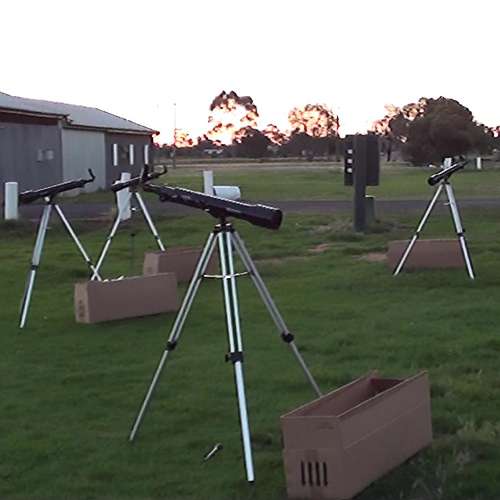


Your students become astronomers with this evening telescope workshop.
Students will discover;
- How to find the south celestial pole
- Constellations of the zodiac and how to identify them
- The Milky Way and Magellanic clouds
- Planetary orbits and ring features
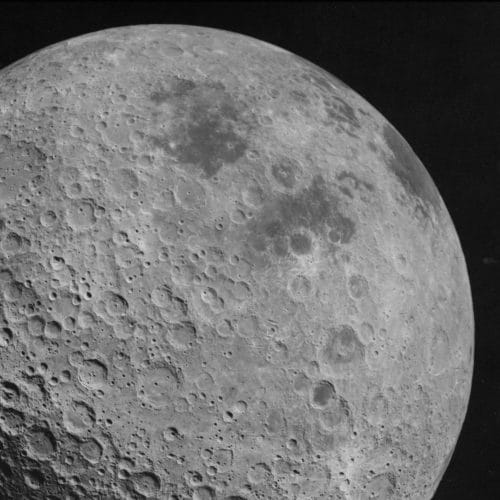
- Surface features of the moon
- Learn about the dynamic nature of astronomy
Working in pairs or threes, students use one of 7 telescopes to observe the night sky as well as have the opportunity to use a motor driven telescope with GPS capabilities.
 Rated Excellent on Trustpilot – read our reviews
Contact us

Australian Curriculum Mapping
Australian National Curriculum Mapping for all our science incursions
Australian ACARA Content Outcomes:
Science F-10 Version 9.0
Year 7
- model cyclic changes in the relative positions of the Earth, sun and moon and explain how these cycles cause eclipses and influence predictable phenomena on Earth, including seasons and tides AC9S7U03
Year 7 & 8
- explain how new evidence or different perspectives can lead to changes in scientific knowledge
AC9S7H01 AC9S8H01 - examine how proposed scientific responses to contemporary issues may impact on society and explore ethical, environmental, social and economic considerations AC9S7H03 AC9S8H03
- develop investigable questions, reasoned predictions and hypotheses to explore scientific models, identify patterns and test relationships AC9S7I01 AC9S8I01
- analyse data and information to describe patterns, trends and relationships and identify anomalies AC9S7I05 AC9S8I05
- construct evidence-based arguments to support conclusions or evaluate claims and consider any ethical issues and cultural protocols associated with using or citing secondary data or information AC9S7I07 AC9S8I07
Year 10
- describe how the big bang theory models the origin and evolution of the universe and analyse the supporting evidence for the theory AC9S10U03
Year 9 & 10
- explain how scientific knowledge is validated and refined, including the role of publication and peer review
AC9S9H01 AC9S10H01 - Investigate how advances in technologies enable advances in science, and how science has contributed to developments in technologies and engineering AC9S9H02 AC9S10H02
- develop investigable questions, reasoned predictions and hypotheses to test relationships and develop explanatory models AC9S9I01 AC9S10I01
- analyse and connect a variety of data and information to identify and explain patterns, trends, relationships and anomalies AC9S9I05 AC9S10I05
- construct arguments based on analysis of a variety of evidence to support conclusions or evaluate claims, and consider any ethical issues and cultural protocols associated with accessing, using or citing secondary data or information AC9S9I07 AC9S10I07
Australian National Curriculum Mapping for all our science workshops & shows

NSW K-10 Science Syllabus Mapping
NSW Science 7–10 Syllabus (2023)
Stage 4
A student:
- identifies questions and makes predictions to guide scientific investigations SC4-WS-02
– Identify questions and problems that can be investigated scientifically
– Make predictions based on scientific knowledge and observations - explains how observations are used by scientists to increase knowledge and understanding of the Universe SC4-OTU-01
– Compare historical and current solar system models to show how models are modified or rejected due to new scientific evidence
– Explain that predictable and observable phenomena on the Earth are caused by the relative positions of the Sun, the Earth and the Moon
– Use physical models or virtual simulations to explain the cyclic patterns of lunar phases and eclipses of the Sun and Moon
– Investigate how a recent advancement in science has increased knowledge of the world and the Universe - describes the effects of forces in everyday contexts SC4-FOR-01
– Explain forces as either direct (contact) or indirect (non-contact)
– Conduct a practical investigation on the effects of a range of direct and indirect forces
– Investigate examples of forces and magnetism in familiar contexts
Stage 5
- asks questions or makes predictions using observations SCLS-WS-02
– Ask questions about familiar objects and events based on observations
– Make predictions based on observations - describes the features and applications of different forms of waves SC5-WAM-01
– Explain how the electromagnetic spectrum is used to learn about stars
NSW K – 10 Science Syllabus mapping for all our NSW incursions

VIC Science Syllabus Content
VIC Curriculum F–10 Version 2.0
For explanatory points & implementation advice for each dot point, please visit the VIC Curriculum F-10 site.
Levels 7 and 8
- cyclic changes in the relative positions of Earth, the Sun and the Moon can be modelled to show how these cycles cause eclipses and influence predictable phenomena on Earth, including seasons and tides. VC2S8U12
- investigable questions, reasoned predictions and hypotheses can be developed in guiding investigations to identify patterns, test relationships and analyse and evaluate scientific models. VC2S8I01
Levels 9 & 10
- space exploration seeks to expand knowledge of the origins and structure of the universe and to resolve the challenges of humans travelling and living away from Earth’s surface. VC2S10U12
- the universe contains features including galaxies, stars, solar systems and black holes; the big bang theory models the origin and evolution of the universe and is supported by evidence. VC2S10U13
- investigable questions, reasoned predictions and hypotheses can be used in guiding investigations to test and develop explanatory models and relationships. VC2S10I01
Requirements
- Appropriate for Years 7 and 10 with a maximum of 21 students per class.
- Access to 1 electrical power socket would be handy.
- Duration is variable and organised with our office.
- Set up time 45 minutes and pack up time 45 minutes.
- Parents should be encouraged to help supervise where possible.
- This experience is best run in winter and is usually offered as part of an overnight science visit.
- Before booking, check this Moonrise calculator to see the time at which the moon will be above the horizon (this is essential as much of the workshop focuses on the Moon).






