Transcript
[00:00:00]
Announcer: You’re listening to the Fizzics Ed Podcast. For hundreds of ideas, free experiments and more, go to fizzicseducation.com.au. And now, here’s your host, Ben Newsome.
[00:00:19]
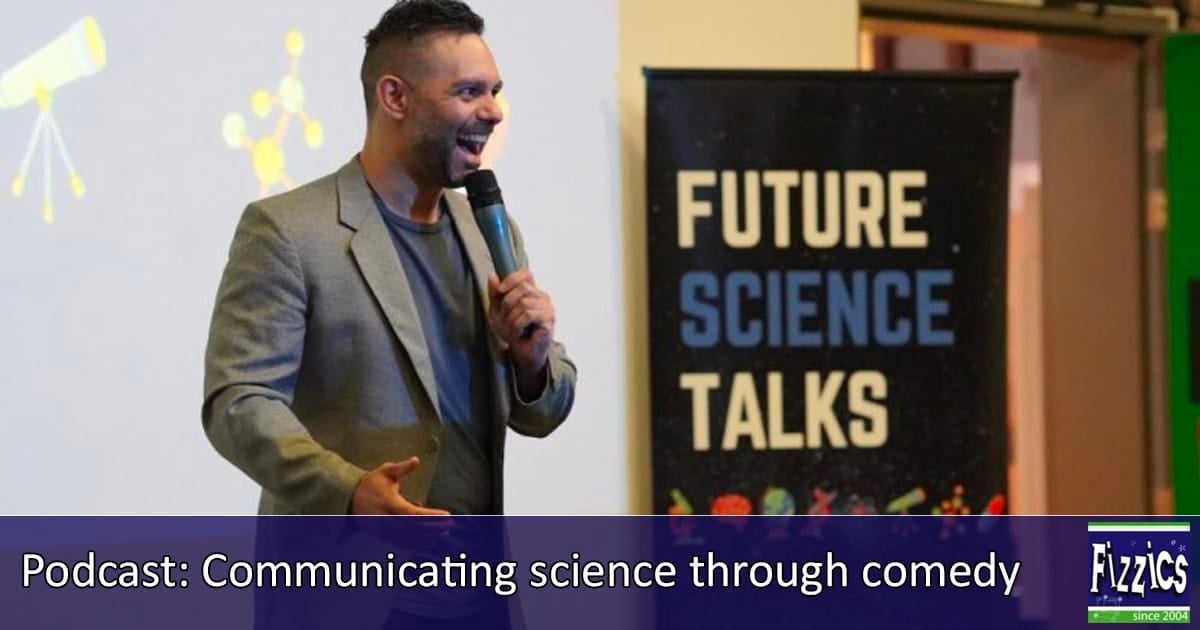
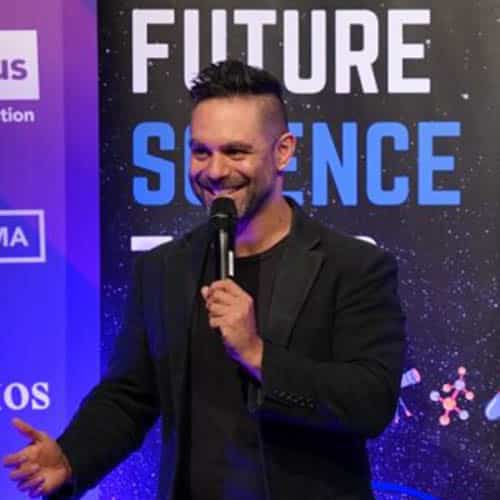
Ben Newsome: G’day and welcome again for another Fizzics Ed Podcast. Glad to have you again for another chat around science and STEM and all that sort of thing. Today, we’re talking comedy. Yes, we are. We’re definitely talking comedy as we chat with David Crisante: who is the director for Future Science Talks where he has this awesome programme that involves five workshops, which eventually culminates in a 10-minute talk that is 80% science and 20% humour at the Factory Theatre and the Manning Bar and a variety of different locations and comedy festivals right around Australia. What an awesome opportunity for those people who are in research to showcase what they do up on stage. Guess what? It helps you polish your communication skills too.
[00:00:59]
Ben Newsome: So, David has got a lot to share about what it’s like when you actually do your presentations in a humour environment and why it’s so important to be able to communicate in this way, especially as you think about how you might need to communicate your research in more formal settings. Let’s hear what he’s got to say.
[00:01:18]
Announcer: This is the Fizzics Ed Podcast. We’re all about science, ed tech and more. To see 100 fun free experiments you can do with your class, go to fizzicseducation.com.au. That’s fizzics spelt F I Z Z I C S and click 100 free experiments.
[00:01:36]
David Crisante: Yeah, we’ve got a national programme where we go around Australia. We find scientists living in each city and a few different towns, and we train them on how to speak about their science but add humour to it. The goal is for them to give presentations that are 80% science and 20% humour. They’re pretty short, you know, eight to ten minutes for all their presentations. But what it means is they learn how to infuse a bit of humour into what they do, which is great for our talks, but it also means that when they give other talks or meet the general public or speak with a major donor or a funding body, they know how to hook in their audience through some advanced storytelling techniques.
[00:02:26]
Ben Newsome: How did this come about? Because this is a really good idea. I mean, there’s plenty of training opportunities for scientists to present their wares so to speak, but running it on a stage with a bit of comedy is another thing altogether. Where did this come from?
[00:02:39]
David Crisante: It came from, I’ve sort of had two parallel lives. So I started my career as a journalist and then was in diplomacy and political speechwriting for five years in Canberra, where I worked with senior politicians including Foreign Minister Julie Bishop. And then I changed and worked as head of media and comms at science and health organisations.
[00:03:06]
David Crisante: And what happened was I saw that, in particular with those science and health organisations, we would put the same good storyteller who was a great scientist, we would put them in front of people to tell that story, even if the people didn’t want to hear about that particular science. We just knew that they were a good storyteller and that would lure our stakeholders, the general public, major donors, that would lure them into our tent, and then we could sort of change and sell them different types of science where we were not confident that the scientists in that space were necessarily good communicators or storytellers.
[00:03:45]
David Crisante: And that just struck me as a bit strange. We weren’t giving opportunities to others and by virtue of not giving opportunities to them, then they couldn’t be good enough for us to give opportunities to them. So it was a bit of a negative feedback loop, whereas with the ones that we were giving opportunities to, there was a positive feedback loop because they were getting more and more experience and more and more skilled, but that meant that we had to rely on them more and more.
[00:04:10]
David Crisante: And in parallel to this life that I’ve had—quite serious communications, politics, international crises—I have been in the arts. So I was in theatre when I was younger, teaching theatre to children in Italy and Japan. In Canberra, I was co-managing a dance studio, and the last few years I’ve been running comedy shows and public speaking training and getting people on stage.
[00:04:35]
David Crisante: A lot of people get into comedy not because they want to be a comedian, but because they want to learn some of those skills. And what we’ve done is we’ve combined those two elements, the serious and the fun, so that the people in the programme, it is a very serious talk that they’re giving where they’re really conveying some complex information to the audience, but at the same time using performance techniques about storytelling, about generating a reaction from your audience and combining that so they’re much more effective.
[00:05:06]
David Crisante: And we could do that in a theoretical way of just doing workshops, but instead what we’ve done is we’ve combined this programme with major festivals around Australia. So if there’s a major comedy festival around Australia, we’ll have a presence there, we’ll train up some local scientists and we’ll get them in that festival. And all of the shows kind of sell out. People really like it. It’s really exciting, it’s really nice, and it’s nice to see both the audience get really excited but also the scientists really change throughout the process. It’s almost like you can see them getting bigger on stage when they get that positive feedback from the audience where the audience is laughing and having fun.
[00:05:42]
Ben Newsome: This is really daunting because I mean if you ask most people what their greatest fears are and if they’re really going to be genuinely honest, I mean some will say yeah, fear of heights or spiders or something, but it seems to be rather prevalent that talking in public’s a thing. It’s very difficult. And then you add comedy that hey, I’ve got to actually be entertaining as well. That is quite an experience, especially for a scientist who may well be quite happy away from the public. How do you go about finding these scientists who might want to get up on stage?
[00:06:14]
David Crisante: Look, that’s probably the hardest element to the programme is actually getting information out there to the science communities or networks that there’s this opportunity.
[00:06:31]
David Crisante: The challenge with a career in science, and I’m talking in particular academia, is your ability to progress in your career is based on your ability to communicate what you do. They go to conferences all throughout the year, they write academic papers, they’re constantly mingling with each other. And if they’re not able to communicate what they’re finding, both to each other as well as to the organisations that can give them funding, then they’re going to be stymied.
[00:06:59]
David Crisante: So we’re actually working with a group of people who might not feel like they are natural communicators, but ironically it’s one of the few professions where they have to communicate on a very regular basis in a very public manner in a way that, for example, an accountant wouldn’t. So it’s a really interesting career path because I think there’s a natural tension for a lot of the individuals and personalities that go into science.
[00:07:30]
David Crisante: Where we come in is we acknowledge all of that. I’ve worked with scientists for a long time. We’re very explicit; we don’t want to breed a generation of scientists who can do stand-up comedy. We want to ensure that these people in our programme have more tools in their communication toolkit so that they’re more adaptable for various scenarios.
[00:07:56]
David Crisante: And what we’ve found is we started the programme about a year ago with a pilot group of 10 people, largely PhD students. And we’ve found that they, over the past year, have put their hand up for a lot more activities. Their approach has been different at conferences and opportunities have come their way.
[00:08:15]
David Crisante: And that’s the whole idea, to develop more of those positive loops where people are self-nominating as well as being nominated by others because people around them can see that they have either these skills or they’re willing to give it a go. And by giving things a go, you’re going to develop those skills. Scientists are very smart people. We just tap into their intellect and give them a pathway and they flourish. We don’t write anything for them. We just give them the ups and downs, lefts and rights and the guidance and they’re pretty amazing.
[00:08:48]
Ben Newsome: Absolutely, and I love how the focus is on storytelling. I mean, I’ve been privileged enough to be involved as a judge at some of those 3-minute theses and those sort of things and the ones that really stand out distilled their message for the audience at hand. And that is a real bit of a killer thing to be able to do because I mean it’s one thing to talk to your peers, but I mean some of these scientists may well be running some fantastic research in an area that the media might love, and suddenly if you’re being put on a breakfast show for a couple of minutes before they do a cross to something else, to be able to get a message across in a way that’s going to hopefully grab the attention of the million-plus people who might be watching you, that’s a skill and could be daunting, but this is really a great incubation process for them to be able to do that.
[00:09:34]
David Crisante: Yeah, so my job was to prep those people that were going into that morning programme being on the ABC or whatever it was to talk about what they did. And there were some things that I learned which were really interesting. A lot of interviews would finish and the people being interviewed would confide in me and say that they weren’t asked the right question. Or the journalist didn’t really get it or the journalist took them down a path that they were uncomfortable with.
[00:10:00]
David Crisante: And this programme, this science comedy programme is aimed at bypassing that. So a lot of the training that I would give people when they had to speak to the media would be, before you really get into it, just say at the very beginning what you want to talk about. No matter what the first question is, just make sure you get it out there because actually when you speak to somebody, if you can pique their interest and curiosity, they will be more informed by what you’re saying rather than their preconceived ideas.
[00:10:30]
David Crisante: But if you don’t try to connect with them, you’re inviting them to use their preconceived ideas and you’ll have a dialogue with them on their terms. So if you’re speaking with somebody and through storytelling techniques you’re able to get into the mind of the people that you’re speaking with, you’re going to have a lot more impact.
[00:10:51]
David Crisante: We have a formula and methodology for these talks. They’re 10 minutes in length. And in the first two minutes, every single speaker needs to explain who they are, what they’re doing, why they’re doing it, and what are some of the things that people usually think about them when they have any of that information.
[00:11:11]
David Crisante: For example, if you’ve got an accent, rather than letting the audience’s mind wander, if you can own your accent and explain your personal story, they will feel much more connection to you. Equally if you bring up a topic, a scientific topic that maybe they think they know something about, if you don’t address their preconceived thoughts about what it is, for example, ‘I do quantum computing and when I tell people this they often ask XYZ.’ If you don’t mention that, then people might be internally asking those questions while they’re listening to anything that you say.
[00:11:49]
David Crisante: So what we do is with that element, with that introduction, we can be very, very playful. And what that means is we’re not actually making humour in light of the science. In fact, we’re using humour to draw people in, to get them to like us, to get them to see who we are, so that they understand that we also see the world through their perspective as well. And then they’re really interested in this quite complex topic without feeling that they’re being spoken down to. And that’s key.
[00:12:16]
Ben Newsome: Absolutely, and considering that you’ve had quite a few people go through this process, what are some of the standout messages, some of the standout stories that grab your attention? Because in essence, effectively the ones that grabbed your attention, therefore they were good storytellers. I’d love to know what was out there.
[00:12:33]
David Crisante: Yeah, it’s really interesting because I would say the subject is way less interesting than the person delivering the subject. So we’ve had some very, very fascinating talks that I think haven’t necessarily cut through because of a variety of reasons to do with the speaker, you know, maybe there’s a bit of shyness, whatever it is. And we’ve equally had talks that seem pretty boring, and the audience is having the best time.
[00:13:04]
David Crisante: So one of our very first pilots that we did in the Sydney Comedy Festival in 2023, there was a PhD student, he was looking at cockroaches. And we use this example through our training material when we’re training others on a talk that they can give and why it’s effective. Because at the beginning, this researcher, his name’s Toby, he addresses all the things that we think about cockroaches. He tells us how horrible they are as housemates.
[00:13:35]
David Crisante: But he’s not there to talk about those cockroaches. He’s there to talk about an Australian native cockroach that’s found in a cave. It’s translucent and it looks more like an ant than anything else, and it runs around similarly to an ant. And he talks about his endeavours to go and find them and discover them and, you know, his goal is to work out where they fit in terms of evolution.
[00:14:00]
David Crisante: And the audience is just loving it because he tackles what they talk about at first, you know, all of our aversion to cockroaches, and then he starts showing these beautiful photos of native cockroaches all around the world. And you can hear the audience cooing and aahing. And one thing that he does is he sort of has this character where he gets almost like a bit too into cockroaches. And therefore it’s quite fun because we don’t necessarily have to agree with him, but we can see where he’s coming from.
[00:14:30]
David Crisante: And the key takeaway message from the talk is not all cockroaches are bad. And it’s so clear and it’s so obvious. And with all of our talks, you know, one of the challenges that we have is when we are training the scientists, we often throughout the programme need to say, ‘Okay, but what is your talk in one sentence?’ And that’s a real challenge for them to articulate that.
[00:14:52]
David Crisante: By the end of the programme, they can definitely do it. But if they can’t do it, then how can the audience know what the takeaway message is? How can the audience know what it is in a sentence? And the reality is we consume a lot of material every day. We don’t really remember things in great detail a week later, six months later, a year later.
[00:15:11]
David Crisante: But I would say a lot of people would remember Toby, the guy who was just a little bit too into cockroaches, but as a result, we know that not all cockroaches are bad. It was just such a simple, easy, nice key message that was non-threatening to us, and it invited us to see the world from his perspective, which is really nice.
[00:15:31]
Ben Newsome: That’s fantastic. I mean especially when you think about the single one-liners because the number of times I’ve been in conferences and the various mingling opportunities and things, you may only have a couple of things to say because that’s all the time you may actually have. Being memorable is key in amongst that.
[00:15:47]
Ben Newsome: I mean I think back to my world. I mean I do a variety of different projects, but if I had to really be simple and one simple sentence that at least grabbed some sort of curiosity saying, ‘What, you said that?’ I just say, ‘I blow stuff up for a living.’ And they look at you in this weird way, and then I’m able to talk a little bit further.
[00:16:01]
Ben Newsome: But at least a really very simple sentence, it’s not like, ‘Oh I do XYZ and it’s rather beige.’ Blowing stuff up for a living is an unusual thing to say, and it grabs people’s attention. No, I don’t—and I know there’s a lot of educators listening in, that’s not just our role, as you very well know—but it does grab attention.
[00:16:20]
Ben Newsome: And I mean we’re trying to grab attention to people in a 10-minute talk. I mean I like how you say in the first two, three minutes, who are you, what do you do, why are you doing it? Effectively what we’re really saying is why should we come on this journey with you? Why should we care? And if you show why you care, why you’re doing the research, why you did the PhD for four years in some underground cave or whatever it is that you do, it’s something that’s going to—there’s a motivation and people need to hear it. And I love how you’re doing that.
[00:16:49]
David Crisante: One of the real challenges with public speaking and why we don’t like giving it is the reality is as adults we’re less forgiving than children. Children just agree with each other, they don’t question each other, and they’re very, very fair and open. Adults, they immediately think when you approach them, ‘Who are you and why should I listen to you?’ And it doesn’t matter whether you’re a CEO, a scientist, a public speaker, it doesn’t matter what you’re doing, as long as you’re talking to people, that’s what they’re going to be thinking.
[00:17:21]
David Crisante: And as a result we can be quite defensive. And we can try to justify why people should listen to us, or sort of feel that judgment from them and react to it. And what we try to train people in the programme is rather than fighting it, just acknowledge that they’re going to do it and answer those questions. Because like a film, once you’ve got a few questions answered, you know, if you know that you’re watching a drama and people are fighting on stage, you know why there’s conflict because it’s a drama. Equally if there’s a comedy and something silly happens, you know why that’s happening because it’s a comedy.
[00:17:58]
David Crisante: So it’s about putting the audience at ease by answering the questions before they’ve really had time to ask them. And what I liked about the way in which you characterised, like, ‘I blow stuff up for a living,’ is when we do speechwriting, we encourage the people in our programme to imagine two people speaking, with one person giving a lot more information and one person responding.
[00:18:23]
David Crisante: So if it’s ‘I blow stuff up for a living,’ the response would be, ‘Oh really, why do you do that?’ And then you have your answer. And then the response might be, ‘Oh that’s interesting.’ And then you have a bit more information, and then you have a quick response. And what we do is we remove the second person.
[00:18:38]
David Crisante: And that’s how we develop a speech or a method of communicating with an audience that takes into account how they’re probably thinking or reacting, so that we can be just in front of them, which means then they’re listening rather than thinking. Because as soon as they’re thinking, you know, we sort of lose the ability to connect with people.
[00:18:58]
David Crisante: And we want them, if we’ve spent all this time and effort developing our presentation, then we want them to be listening rather than being curious about us, but not about our expertise. We want them to be curious about what we have to say, not about how we look, how we’re standing, what our face is doing, etc. And using comedy is quite disarming for that.
[00:19:19]
Ben Newsome: G’day, it’s Ben here. I hope you’re enjoying this particular chat and guess what, there’s so much more you can do with your science teaching. Head on over to fizzicseducation.com.au. There are comprehensive teaching units that you can get your hands on. If you click on the top you will find there are a whole bunch of scope and sequences, cross-curricular teaching ideas, hundreds of printable experiments and activities, videos, risk assessments, marking rubrics, you name it, it’s all there and it’s all linked to the curriculum and it’s something that you can implement right now. Head on over to fizzicseducation.com.au and check out what’s on offer.
[00:19:56]
Ben Newsome: Oh for sure. And there’ll be some scientists listening into this because it goes all over the place, this particular chat, who might like to be involved, but for some way, shape or form may not be able to be involved this year or next year or whatever. I mean, if they were able to sit down even just for five minutes with you just to hear some ideas around, righto, so I’ve heard the chat for the last 15, 20 minutes, I get it, but I need some takeaways now because I’ve got this obscure thing I’m doing with algae or whatever it is, how would you coach them in this initial part to be able to hone a bit about what they’re talking about, just a little, to take them a little bit further, not necessarily all the way onto stage, but at least just to hone a little bit of their ability to communicate?
[00:20:36]
David Crisante: Yeah, so there’s two elements that really are fundamental. One is what are we saying, and the other is how are we saying it. So with what we’re saying, one of the biggest struggles, believe it or not, it’s not the comedy. The comedy the scientists are really good at. We don’t teach them the jokes, we give them a few techniques and they run riot. And we do work with them over, you know, several workshops about how to develop the comedy, but what’s really interesting is they’re actually really, really good at it.
[00:21:07]
David Crisante: What they do struggle with is a concept using an inverse pyramid method of communicating, where we talk about the big picture at the beginning with regards to what we are doing, and then we get into more detail about why we’re doing it or what it is that we’re doing.
[00:21:27]
David Crisante: I see a lot of pyramid-style communication methods where we get a little bit of information and then finally right at the end we get to, ‘So this is what I’m doing,’ or ‘This is how I’m spending my day.’ You know, ‘This is the… therefore at the end of the day after you’ve had all this information audience, I’m doing this.’
[00:21:46]
David Crisante: And I understand why scientists do that, because they’re being defensive and they’re justifying what they’re actually doing. But in particular if you’re speaking outside of scientific circles, or outside of your immediate circle, you need to do the opposite. Because when people are listening to information, unless they understand what they’re listening to, it’s hard for them to grasp each little bit of information and work out how that’s related to the bigger picture.
[00:22:13]
David Crisante: And if we provide a reveal right at the end, when we’re listening to information, it’s not like reading where we can go back to the top and quickly re-read the top. If we’re listening, then we’ve got to in our mind try to re-evaluate or reframe all the information that we’ve heard previously if we were thinking it was going to be on a different pathway.
[00:22:32]
David Crisante: It’s a bit like having a reveal at the end of a movie. That might work for a movie, but it doesn’t work for a scientific talk, and in particular it doesn’t work if you’re going to hear a series of them, or you’re going to leave your audience very fatigued. So that’s one that I would immediately recommend to change, is get out there and tell people what you’re doing and then provide all the background information.
[00:22:52]
David Crisante: And the second one is the biggest one, the biggest takeaway by far about how we say it, is say it with a smile. It makes such a difference to your body language, your vocal range, how you connect with an audience. We train people in the programme on their body language, but before they get up on stage the thing that I say to everybody is big energy in your first 20 seconds, slow down and big, big smile.
[00:23:17]
David Crisante: Because it makes such a difference with an audience hearing information from somebody who’s smiling. You feel like they like you. If you hear information from somebody with a serious face, they might have a serious face because they’re concentrating or because they want to get it right or whatever it is, but as the audience, you feel that they don’t like you. And therefore you shut down and shut off and there’s a really unfortunate series of effects that can happen when you’re watching somebody and you’re trying to decide who are they and why should I listen to them, and they’re not smiling to you.
[00:23:45]
David Crisante: So they’re the two key takeaways that I would change. But what is exciting is we are a national programme, so if people are interested, you know, there’s definitely ways that we can connect with them. And we’re going to more and more conferences around Australia and delivering some of this training in person.
[00:24:02]
David Crisante: So, although they are the two key takeaways, we’ll put some blogs on our website with all this information. We think that this is relatively easy to connect this information with people in science, and I think for us there’s a degree of demystifying science communication. I’m not convinced that it is as difficult as some people make it out to be, and all scientists are communicators because they have to do it anyways. It’s simply just a matter of being encouraged to do it in a way that aligns with their personality, where they’re at, and just general good practice.
[00:24:38]
Ben Newsome: Oh, I love it, absolutely. And even just the judicious use of imagery, that it’s compelling, especially as you described, I mean looking at a cockroach as there, our Blattodea species. Looking at these things that are unusual and translucent and a little bit odd for the audience. There’s not graphs, there’s not heavy dense text. That is highly likely a massive chunk of what you do as far as getting them off trying to read from their own slide that they wrote themselves and actually showing something that’s memorable and people can walk away going, ‘Okay, I get what this person does.’ That is key, it’s awesome.
[00:25:06]
Ben Newsome: So righto, so you’ve got effectively a travelling training camp effectively going all over Australia. So there’d be people who’d love to be involved, either with an organisation or themselves personally. How would they find the website and get in touch?
[00:25:21]
David Crisante: Cool. So the website is futuresciencetalks.com.au. It has grown a lot. So we are sort of building the bike as we’re trying to ride it, and we are excited by all the enthusiasm around Australia. We just started with a niche idea, and you know, how do we get a science talk but get a bit of humour into it?
[00:25:46]
David Crisante: And like, I’m shocked that in six months it’s gone all over Australia. We’re yet to do WA and Tasmania, but everywhere else, which is super exciting.
[00:25:56]
David Crisante: With the website, what we hope to do is put online modules that people can access. That will probably be happening in the next few months, in case the science comedy programme is not where they are. The key with our programme is we want to finish it with a show. We feel that there is such learnings for people when they actually do it with an audience.
[00:26:19]
David Crisante: Afterwards, there’s a lot of conversations with the people in the programme saying, ‘Oh I get it now. I see why you were saying these things and how it actually played out, and now I get it. And now that I’ve done it, I can use it again and again and be more confident when I use these tools.’
[00:26:36]
David Crisante: So if people go to the website, there’s an EOI form for the science comedy programme. We’re hoping to do a roadshow around New South Wales including regional areas where they have universities or campuses. So even if you’re not in a capital city, if you go to the EOI form and you put in your information, as soon as we open up a programme in your area, we’ll be in touch with you first.
[00:27:01]
David Crisante: For us, the most important thing is not whether you’re a good communicator, not whether you’ve got a lot of public experience behind you. You know, public speaking experience. You know, it doesn’t matter if you’ve got a lot of profile. For us, the most important thing is enthusiasm. And by enthusiasm I don’t necessarily mean jumping off the walls with energy. I mean just being interested in trying something new, trusting in us a little bit, because I know it’s really hard for people, I know it’s scary, but we will take care of you, and we’ll give you the guidance, and it’s about trusting yourselves and being open to a new element of who you are and what you’re capable of.
[00:27:40]
David Crisante: The reality is we’re funny with our good friends, and we’re funny with our family. So we know how to do it. And this is why we don’t write the jokes for the scientists, because we simply get that behaviour that’s really good and effective in their private lives, and we move it to a more professional setting and guide them through the mechanisms to do that in a way that works, rather than sort of floundering and feeling your way through it.
[00:28:04]
David Crisante: So definitely jump on our website. If you also Google Science Comedy, we are the top-hitting Google for now, who knows, that might change. But yeah, we’ll have a lot of resources in there, and please contact me. I’m David Crisante, you can find me on LinkedIn, you can find me a bunch of different ways, and I’m really keen to connect. For me, one of the biggest challenges is connecting with scientists and connecting with research groups. So anything that I can do to sort of, you know, just improve the contacts that I have and understanding of what scientists require in this space, the easier it is for us to connect with them, to build it, to support them.
[00:28:43]
Ben Newsome: Fantastic. And for those teachers listening out there, there is no reason why we can’t run something like that within your school grounds, even if you’re not involved with Future Science Talks. Have a think about it with your drama faculty, have a chat with your English teachers, somehow just mesh something together. And those people overseas, it’d be well worth reaching out to Future Science Talks as well, because there’s always those opportunities to maybe grow it internationally as well. Look, love your work, David, this is really awesome, and hopefully I can get along to one of the gigs, it’d be really fun to watch.
[00:29:12]
David Crisante: Sounds great, Ben. Thank you.
[00:29:14]
Announcer: We hope you’ve been enjoying the Fizzics Ed Podcast. We love making science make sense. Why don’t you book us for a science show or workshop in your school? If you’re outside of Australia, you can connect with us via a virtual excursion. See our website for more.
[00:29:31]
Ben Newsome: Well, I hope you enjoyed that chat with David Crisante. I certainly did, and as a science communicator, I love what he’s doing when it comes to informing others about communicating complex ideas to audiences of all abilities and backgrounds. Love your work. And also, if you’re a researcher or if you happen to know other researchers in science or beyond, please tap them on the shoulder, because David is looking for people to speak on his stages.
[00:30:01]
Ben Newsome: He’s organising around the country, so get in touch with David. Again, go to the website futuresciencetalks.com.au, find out all about it, find out where all the different venues are, the times, the dates, the locations, what’s going on with these Future Science Talks, and consider perhaps putting your hand up to chat as well. I hope you enjoyed this chat, I certainly did, and as usual, there are more episodes coming up on the Fizzics Ed Podcast. So you’ve been listening to me, Ben Newsome. This is the Fizzics Ed Podcast, and I hope to catch you another time.
[00:30:25]
Announcer: You’ve been listening to another Fizzics Ed Podcast. We’re excited about science. Subscribe to us on iTunes to download the next episode as soon as it’s released. And don’t forget, for hundreds of ideas, free experiments, our new Be Amazing book and more, go to fizzicseducation.com.au. That’s physics spelled F I Z Z I C S.
[00:30:53]
Announcer: This podcast is part of the Australian Educators Online Network. AEON.net.au.
Frequently Asked Questions
What is the Future Science Talks programme?
Future Science Talks is a national Australian initiative that provides scientists with a series of five workshops to help them integrate humour into their research presentations. The programme culminates in an eight to ten-minute talk at major comedy festivals, where the content is balanced at approximately 80% science and 20% humour.
Why is humour considered a valuable tool for scientific communication?
Humour serves as an effective “hook” to engage the audience’s curiosity and build rapport. By making complex data more accessible and relatable, researchers can better connect with the general public, major donors, and funding bodies, ensuring their message is both understood and remembered.
How does the programme support the career progression of researchers?
In the scientific community, particularly in academia, advancement is often tied to the ability to communicate findings. Participants in the programme, such as PhD students, develop a diverse “communication toolkit” that allows them to self-nominate for more public speaking opportunities, media appearances, and conferences, thereby increasing their professional visibility.
What are David Crisante’s key tips for scientists when speaking to the media?
David advises that scientists should take control of the narrative early on. He suggests that within the first two minutes, a speaker should clearly explain who they are, what they are doing, and why it matters. This proactive approach helps to address any preconceived ideas the interviewer or audience may have about the scientific topic.
What is the significance of the first 20 seconds of a presentation?
According to the programme’s methodology, the first 20 seconds are crucial for establishing a connection. David emphasises starting with high energy, maintaining a slow pace, and offering a big smile. These non-verbal cues improve the audience’s receptivity and help the speaker project confidence and warmth.
Extra thought ideas to consider
The Role of Storytelling in Funding and Advocacy
Scientific research often relies on the support of stakeholders who may not have a technical background. By shifting from a data-heavy approach to a narrative-driven one, researchers can bridge the gap between complex scientific enquiry and the emotional impact that often drives funding decisions and public advocacy.
Demystifying the “Expert” Persona
Using humour and self-deprecating performance techniques can humanise scientists, breaking down the perceived barriers between experts and the community. When a scientist can laugh at the challenges of their work, it fosters a deeper level of trust and encourages the public to engage with science as a shared conversation rather than a one-way lecture.
Incubating Communication Skills in Safe Spaces
The success of combining comedy with science suggests that “safe” performance environments—like a comedy club—provide an excellent incubation space for developing high-stakes communication skills. For educators and institutions, this highlights the value of gamification and the arts in STEM training to build resilience and adaptability in future researchers.
Discussion points summarised by AI from the FizzicsEd Podcast, verified and edited by Ben Newsome CF