Transcript
[00:00:00]
Announcer: You’re listening to the Fizzics Ed Podcast. For hundreds of ideas, free experiments and more, go to fizzicseducation.com.au. And now, here’s your host, Ben Newsome.
[00:00:20]
Ben Newsome: Welcome again for another Fizzics Ed Podcast. Glad to have you again for another chat around STEM, no matter where you are around this world of ours. That’s what we do here. Today, we’re talking with a fantastic place in Melbourne called the Science Gallery Melbourne, which is part of the Global Science Gallery Network, which was pioneered by Trinity College in Dublin.
[00:00:40]
Ben Newsome: This is an amazing opportunity for you to look at how you can collide art and science together and how that really plays a vital role for us to shift our understanding about science and produce a bit of discourse around art, innovation, and so much more. Today, we’re hanging out with two amazing people. We’re hanging out with Vhairi Mackintosh, who is the learning and outreach manager for the Science Gallery Melbourne, and we’re hanging out with Jesse Chambers, who is the learning delivery manager for the Science Gallery Melbourne as well. Two amazing people who love their STEM and art combined. So let’s find out just what they’ve been getting up to.
[00:01:11]
Announcer: Fizzics Ed Podcast. We’re all about science, ed tech and more. To see 100 fun free experiments you can do with your class, go to fizzicseducation.com.au. That’s physics spelt F I Z Z I C S and click 100 free experiments.
[00:01:18]
Ben Newsome: Vhairi, Jesse, welcome to the Fizzics Ed Podcast. It is fantastic to have you on board. How did you actually find your way into the Science Gallery?
[00:01:28]
Vhairi Mackintosh: Thanks, Ben. It’s great to be here. Back in 2018, which feels like a lifetime ago, I was finishing my PhD at Melbourne Uni and I got an invite along to something called Science Gallery. I’d never heard of it before because at that point, Science Gallery Melbourne, there was no building, it was running in pop-up mode. I went along and discovered this incredible place where it really is about the collision of art and science and bringing lots of different people together to solve problems and think about the challenges that we face as local and global communities.
[00:02:18]
Vhairi Mackintosh: So I got involved as a mediator. Mediators are our on the gallery floor science communicators, and they are explainers, but also listeners. They’re connectors between the works within an exhibition and the general public that come into the exhibitions. I just had the best time exploring really broad ideas about a whole variety of things. I’m an earth scientist by trade, so I was very used to learning about earth sciences and talking about earth sciences, and then I was thrown into discussing gene editing and speculative futures. It was an amazing role. I then went away and worked for something called the Tech Schools here in Victoria and then came back in 2021 while our learning team, who work with schools that Jesse and I are part of, was forming as we were opening the new building. So yeah, I’ve been involved for quite a while.
[00:03:11]
Ben Newsome: That’s fantastic. Jesse, how did you fall into this?
[00:03:15]
Jesse Chambers: I’m a teacher by background, so I was teaching in Victoria, but I’m really interested in the intersection between formal and informal learning. So I went and did further studies in science communication and then saw this position come up at Science Gallery for a STEAM educator and jumped at the opportunity because it seemed like a really interdisciplinary place for learning that brings together lots of different subject areas.
[00:03:43]
Ben Newsome: Speaking of interdisciplinary, that’s exactly what Science Gallery is all about. So if I’m a visitor, if I walk into the space, what do I get to see, Vhairi?
[00:03:54]
Vhairi Mackintosh: What do you get to see? Good question. You walk in, it is a huge space split into two main gallery areas, the Western and Eastern gallery. The Western gallery will always have a huge installation. At the moment, it’s called Chroma, and a lot of school students that come in call it the big snake. It’s this incredible installation that will move in response. It’s got many screens. It’s just beautiful, very mesmerising. I’m not sure exactly how big it is, but it’s huge.
[00:04:00]
Vhairi Mackintosh: And then if you head into the right is where we have our main programming where we’ll have two exhibitions a year. At the moment, it’s an exhibition called Not Natural, which is a really excellent exhibition exploring the friction between artificial and natural systems, the ideas around gene editing, synthetic biology, species de-extinction, chimeras. Just because we can, should we? Lots of bioethical considerations. It’s a really exciting exhibition. So we run two a year, and that’s what you’ll mainly see in that Eastern space.
[00:04:41]
Vhairi Mackintosh: You’ll see mediators on the gallery floor. So we’re a little bit different to more traditional galleries where you might have gallery attendants telling you to be respectful of the works. Some of them we still have to be respectful and not touch, but a lot of them you’re encouraged as a visitor to touch, interact, participate.
[00:04:58]
Vhairi Mackintosh: We have a wonderful exhibition called Chickenosaurus, which is looking at the speculative idea of chimeras. Could we have a chicken dinosaur? Would it be like Jurassic Park again if we started to edit and splice and change up genes of animals?
[00:05:15]
Vhairi Mackintosh: And so this one you can do your own drawing of your speculative chimera and then you scan it into software that adds it to this digital world of animated chimeras that audience members have participated and contributed to the work. So that gives you a bit of a feel for some of the works in the space.
[00:05:31]
Ben Newsome: This is fun because, I mean, the name Science Gallery kind of says it, yeah, it is a blend of art and science. A really good friend of mine, Ted Tagami, artist trained, he said, “Look, art should make you question and think. Whether you like something or you hate something, either way you’re thinking about it,” and that is good art, and this is good science communication. And Jesse, this must be a playground for you.
[00:05:53]
Jesse Chambers: Oh, I have the most amazing classroom in the world, I think, in the form of the gallery upstairs. We’re able to combine so many different learning areas. And I think it gives weight behind including the ‘A’ in STEAM, giving students the interpretive skills that allow them to really unpack what the other letters in that acronym mean. And so we run a whole range of learning programmes. We had last year 8,000 onsite students come and visit us at Science Gallery and another 8,000 engaged with us online. We’re still the new kids on the block relatively speaking when it comes to learning experiences in Melbourne, but we have these really unique partnerships with schools as well.
[00:06:37]
Jesse Chambers: In 2021, we received funding from the Victorian Government to set up the STEM Centre for Excellence, which is a partnership that we have between Science Gallery, the University, and the Victorian Government to provide free programming for 25 partner schools. And so we offer learning experiences at Science Gallery. Some of those programmes we’re able to offer to schools for free through this partnership, these 25 partner schools which have been selected by the Department of Education, but we also offer for 200 plus other schools learning experiences as well.
[00:07:08]
Jesse Chambers: I suppose the unique thing about these deep partnerships that we form with schools means that they’re coming to Science Gallery regularly and we’re actually an embedded part of their curriculum back at school. So to give you an example, we have one school, the Victorian College for the Deaf, who comes and visits us every four weeks. So as part of their lesson cycle, they have a series of lessons in week one, week two, and week three where they’re learning about content back at school, and then they come and apply that with us at Science Gallery and get stuck into a really hands-on interdisciplinary workshop. And that continues throughout the whole year. So it’s not a one-off trip to an excursion provider, which may have a limited impact compared to coming regularly.
[00:07:57]
Ben Newsome: Yeah, that’s fantastic. As a former teacher, I know the possibilities that enriched learning can have. And half the problem is it is difficult to get a partner who has that capacity to support that. So wow, that’s fantastic. Now, one of the things I do know about, we’re hanging out actually in a space forum with a few different members across Australia who do some space stuff. You’ve got an interesting way of blending science into space. I’d love to hear a bit more about it because there’ll be people here who were not in said meeting. So I’d love to know a bit more, how are you guys going about teaching, for example, space and in this case parliament and a few other things?
[00:08:37]
Jesse Chambers: So I suppose it comes back to the fact that we start with the capabilities as our launchpad for creating programmes. Those intercultural understanding, ethical understanding, personal and social capabilities, and we try and find engaging ways that we can bring those areas to life because they’re applicable to so many different disciplines. And so we’re in talks with the good people at the Australian Space Discovery Centre over in Adelaide, and we’re at the same time having chats with the community engagement team at the Parliament of Victoria. And we thought, well, this is a perfect opportunity for us to blend two different learning areas together and also give students an opportunity to collaborate with one another, because the space sector is such a collaborative sector that requires working with so many different industries that it was a perfect stimulus for getting students to think about the possibilities of space.
[00:09:35]
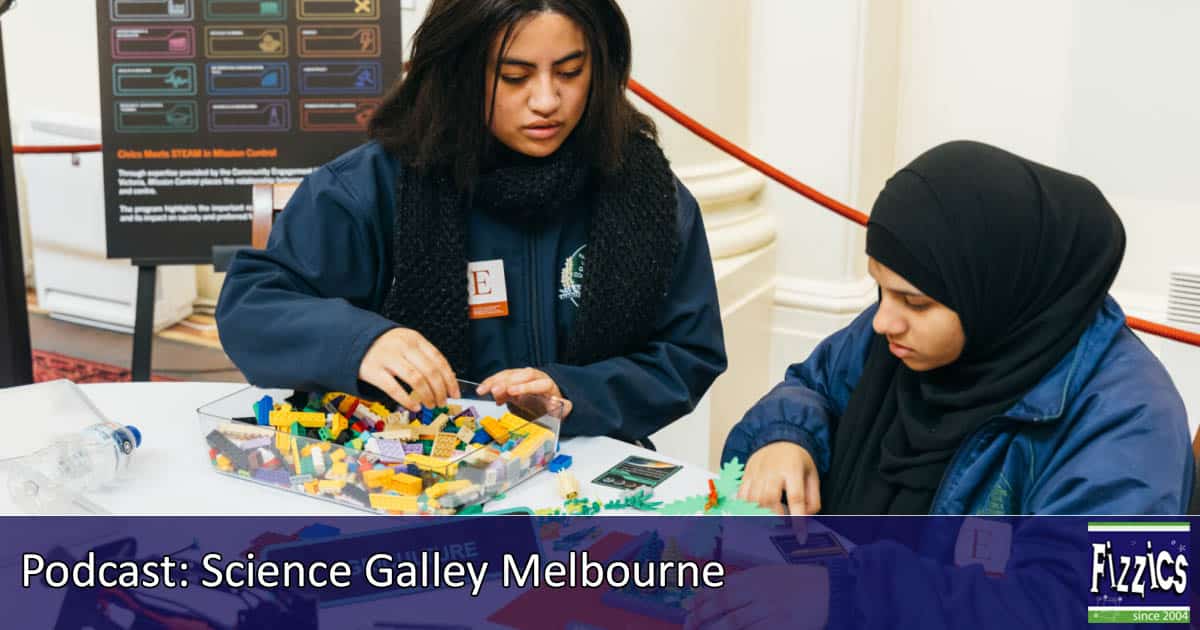
Jesse Chambers: And so what we did was we created a programme called Mission Control. And that just happened to line up with our previous exhibition, Dark Matters, which was in collaboration with CERN from Switzerland, the Large Hadron Collider, which was just so exciting. We started the day with students in the gallery learning about particle physics and really big questions. And then we would bring them into our workshop space and they would actually act as members of parliament. And they would have to think about which industries they would take on a hypothetical mission to Mars.
[00:10:11]
Jesse Chambers: Which I know a lot of schools have done, it’s been interesting to look at existing programmes which have explored Mars, which have really focused on what are the capabilities that we need to live on Mars. Whereas we wanted to focus on, well, what are the sorts of industries that we’re going to take along on this mission, and how are we going to work together with them? And what’s the role of parliament in doing that?
[00:10:45]
Jesse Chambers: Because for a lot of young people, I think they understand that parliament exists, they understand that it’s a place to make decisions, but there’s sometimes a disconnect between what’s their role in helping that decision-making process. And it’s an area of the curriculum which I think doesn’t get a lot of airtime and deserves a lot of airtime.
[00:11:00]
Jesse Chambers: And so we wanted to give students the chance to really see the relevance that parliament had for making decisions. And so in that part of the programme, they’re given a mock committee inquiry report. And that committee inquiry report says, “Hey, we think these 12 industries should go.” So things like law and policy, things like education, things like entertainment and recreation. But like most things, we have limited resources, and therefore the students can only take 10 out of those possible 12 industries. So after they’ve gone through a little bit of debate with one another, thought about the merits of bringing them or not bringing them, they then work in those industry groups that they’ve chosen.
[00:11:43]
Jesse Chambers: They have these small RoboMaster robots and share information with one another by sending these little information cards, which are also available on the Science Gallery’s website if you want to run this in your classroom yourself. And they send them between each other’s groups to share information from one industry that might be relevant for completing the design challenge that we set for them if they were working in a different group. So really leaning into that collaborative aspect of the programme and those personal and social capabilities that are inherent in the workshop.
[00:12:17]
Jesse Chambers: It’s been really well received by students, which has been great. They love the opportunity to debate. And one of the things that I’ve found really interesting is which industries we’re noticing that they’re voting off. Because we wanted to find out a little bit of data through running the programme itself about which industries students weren’t taking along. And it’s things like entertainment and recreation, or the arts, which I thought was really interesting. You know, and then we have the discussion with them about, well, you’re going to end up on this planet and you’re going to be really bored. Or law and policy, they’re going to live on a lawless society on the planet that they set up this operation on.
[00:12:54]
Jesse Chambers: Or education even. And we open up the discussion with them about, well, if you vote education off, how are you going to teach and train all of the other jobs and skills that are going to be required for running this operation on another planet? It’s a really exciting programme and we’ve been well supported by both the Parliament of Victoria and the Australian Space Agency, who’ve provided expertise, they’ve provided resources and in-kind support for helping us to get this programme together.
[00:13:33]
Jesse Chambers: And one of the great outcomes of it is that the Discovery Centre in Adelaide is now going to run the programme with the Parliament of South Australia too. So students will actually go and participate in this module about parliament at the Parliament of South Australia, then walk down to the Discovery Centre and complete the design challenge at the Discovery Centre. So not only is it a really interdisciplinary programme, but it’s one that’s brought together a whole bunch of partners and their expertise in different ways.
[00:14:03]
Ben Newsome: What I love about this is that it very much emulates exactly what happens in real life. I mean, I even think way back to grade 10 when they took us through CHOGM, this Commonwealth Heads of Government Meeting, kids get to emulate that, which is kind of neat. And it is, it’s really competitive to work out which industries survive and which don’t.
[00:14:31]
Ben Newsome: I mean, I was actually thinking about, as you said, arts and entertainment gets on the chopping block, and yet I know that there are places like Raytracer and Nominal Systems that do digital twin technologies where they can actually completely simulate in a VR environment missions that actually have to happen. And these are people who are straight up game designers, and they’re working with the space industry.
[00:14:56]
Ben Newsome: And very important, I remember being on a webinar with the Australian Virtual Astronaut Challenge with Azimuth Advisory who does space law for a living. I mean, straight up, in space law, once you get 400 kilometres above our sea level, we’re in space, it’s not the Wild West. There are rules around orbits and all the stuff has to work. As I think about this, Vhairi, as the students come in, is this the outcomes that you would expect that would have happened, or was it a bit of a surprise? What did you think?
[00:15:26]
Vhairi Mackintosh: Yeah, I think it has been really interesting seeing what students are connected with with the programme and our programmes more broadly. I think, like Jesse said, we’re kind of surprised with sometimes how much they get behind the debating or who they choose. Like I do have to say we did run a lot of early programmes, we got a lot of Taylor Swifts heading to Mars for entertainment. So some students were for entertainment, some weren’t.
[00:15:52]
Vhairi Mackintosh: But yeah, it’s been really interesting seeing students connect with maybe material that they’re not as familiar with and really get behind it. And I think the way that we structure our programmes is that we kind of allow agency within the output. So the students get to choose what they create, how they present it, how they communicate it back to us. Like Jesse said, we have a big focus on the Victorian capabilities. So communication, creative thinking, and critical thinking are really key throughout all of our programmes.
[00:16:18]
Vhairi Mackintosh: And I guess something that we haven’t mentioned which I think is really powerful and we do see what students are connecting with is that we employ university students and recent graduates who are studying STEM or STEAM. We call them learning experience facilitators and they co-design and co-deliver the programmes with us. So really we are, even within our design, collaborating with external collaborators, but we also bring in within our internal team lots of diverse experience. So they could be studying a whole heap of different things.
[00:16:46]
Vhairi Mackintosh: And then the school students also get to connect with these university students who are just a little bit ahead of them in their journey in life. So it’s really special getting to see them have conversations with an engineering student about an engineering challenge as they’re doing it as part of their Mission Control programme or someone who’s studying environmental sustainability and they’re in our Sustainable Communities programme. So getting to actually connect with real people who are studying and wanting to go on these journeys and pathways is something that’s really special.
[00:17:16]
Vhairi Mackintosh: And that’s actually something we created a programme around because we’re the only Australian node of Science Gallery, there’s actually eight of us around the globe. We started in Dublin in Ireland back in 2008 and now there’s eight of us dotted around the globe. But we are the only Australian node, so we really wanted to think about how do we connect with national schools audiences. And one way we’ve done that is through the STEAM Careers online forums, where we really wanted to showcase to school-aged learners diverse pathways that they might not be as familiar with at school. We realised that you don’t necessarily know the different pathways, and so we really wanted to empower young people with the knowledge that would allow them to choose any potential pathway.
[00:17:58]
Vhairi Mackintosh: And so we have, like you were just mentioning a second ago, Ben, we had a video game designer on there. We’ve had someone who started out as a musician, a trumpet player who then went to work for NASA as an engineer. We’ve had lots of people who have taken lots of wiggly journeys and something I think that’s really nice that comes out of those conversations either in person with our learning experience facilitators or through connecting with the forums is that for young people it’s okay if you don’t know what you want to do yet. Lots of us still don’t know what we want to do yet and we’re quite a bit past school by now.
[00:18:29]
Vhairi Mackintosh: And so yeah, this is just different ways we’re connecting. And so that’s a completely online programme that means we’ve had schools from all over Australia connecting in. We’ve actually had international schools connecting in as well, and it’s a really great way to see some of what we’re doing at the gallery and experience that interdisciplinary thinking and ways of bringing lots of people to the table and that you can have many careers and many journeys along the way.
[00:18:54]
Ben Newsome: G’day, it’s Ben here. I hope you’re enjoying this particular chat, and guess what? There’s so much more you can do with your science teaching. Head on over to fizzicseducation.com.au. There are complete and comprehensive teaching units that you can get your hands on. If you click on the top, you will find there are a whole bunch of scope and sequences, cross-curricular teaching ideas, hundreds of printable experiments and activities, videos, risk assessments, marking rubrics, you name it, it’s all there, and it’s all linked to the curriculum, and it’s something that you can implement right now. Head on over to fizzicseducation.com.au and check out what’s on offer.
[00:19:31]
Ben Newsome: That’s fantastic. And the beauty with the Science Gallery, and as it’s also being the only node in Australia too, can I just ask, do you get to work with the other nodes?
[00:19:41]
Vhairi Mackintosh: Yes, so that’s something we’re actually looking at building in more and more. So for the STEAM Careers online forum, we’ve teamed up with the Science Gallery in Bengaluru in India. The theme of those forums is connected to our exhibition at the time. And so at the moment the next upcoming forum which is on the 13th of May will be on loosely careers related to the biotech industry. Science Gallery Bengaluru have a current exhibition, Carbon, which actually looks at a lot of overlapping themes. So actually one of the panellists will be from a Bengaluru startup, NoPo, who will be on the forum. And it’s a way we’ve connected school students in Australia and India. So they can be chatting online in the forum. There’s a Q&A and a forum in discussion.
[00:20:25]
Vhairi Mackintosh: So they can be discussing live as well. That’s something we’re looking to build and build, particularly with our colleagues in Science Gallery Bengaluru because time difference is a bit easier if we want to do live engagements as opposed to in Dublin and London, where it’s a little bit trickier to get students online live at the same time. And so yeah, we’ll actually be looking at ways we can expand that this year, which will be really exciting. So as well as those capabilities curriculum, we’ll be looking at that intercultural learning and sharing and figuring out how we can connect students in different places across the globe.
[00:20:55]
Ben Newsome: Which is awesome because it also gets connected into other institutions. Yes, I got to speak with the people at CERN. If you’re listening in about CERN, check out the CERN Beamline for Schools competition where grade 11, 12 students can actually compete to go to CERN. It’s somewhere in the back catalogue of this podcast somewhere. Just look up CERN and Fizzics and you’ll find it. But yeah, there’s a lot of that stuff around, for sure.
[00:21:18]
Ben Newsome: And which means there’s more stuff coming up. And so I’m just wondering, I mean, by its nature, the way this sort of podcast is, people listen to it all over the world, and inevitably they can’t get to those nodes. Not always, sadly. And of course, we have the online capacity to work with it. But there might be some people who want to create their own interdisciplinary experiences based on the resources that you guys have created. I’m just thinking about those cards, Jesse, that you guys have created that can allow them to really work with the work you’ve been doing. How could they go about reproducing a really high-fidelity experience for the kids if they couldn’t come into the gallery?
[00:21:53]
Jesse Chambers: Yeah, so if you were to go on our website, the Science Gallery learning page has a link to the Mission Control programme resources, which are all downloadable and available to you to run in your own classroom. And so we’re mindful of the fact that not every school is going to have access to RoboMaster robots to allow them to exchange information. The programme’s been written in a way that it can be adapted depending on the resources that you have at school.
[00:22:20]
Jesse Chambers: So if you don’t have access to resources, then the students can exchange those cards, which can be printed off, by walking around to different tables, for example, and exchanging that information that way. Like I said earlier, we start from this place of launching from the capabilities and then bringing in different learning areas. So you could feasibly apply this same model of kind of like the heads of government model that you talked about, Ben, or this parliament model, or this mock UN model where students are debating with one another about an ethical issue.
[00:22:58]
Jesse Chambers: And it might not be related to space, but it could be related to another ethical issue. I know at the moment we’ve created a programme which is all about bioethics, and that’s linked into the exhibition that we’ve currently got on, Not Natural. But providing opportunities for students to have those really meaty discussions as a springboard for then trying to solve a problem seems to be a really neat model that gets them invested in creating a solution for a problem that they need to solve.
[00:23:26]
Jesse Chambers: And so if you’re running this in your own classroom, it can be as simple as having some really open-ended question starters that get students thinking that might not have a really clear yes or no answer. Something that I think students find really difficult when they come to Science Gallery, and it’s a good thing, is that a lot of the questions our learning experience facilitators will ask are not those clear yes or no answered questions, those closed questions.
[00:23:56]
Jesse Chambers: And for a lot of students, it can create a sense of, “Oh, but what is the answer to that question?” And I think that that’s one of the beautiful things about Science Gallery is that we ask those meaty questions and it’s something that teachers can do in their own classroom as well when they’re asking something about like an ethical dilemma of who do we bring on this mission to Mars and why should we bring them or not bring them?
[00:24:21]
Jesse Chambers: In terms of the design challenge component of this programme, which you’ll read online, you can create a design solution using a whole range of different mediums. We created the programme with almost a universal design for learning lens over the top of it, where students can output their design solution in a range of different ways.
[00:24:50]
Jesse Chambers: We use Lego at Science Gallery because it just provides a really neat and tidy way of students creating something which they can then display at the end. So each of the students get given a Lego baseplate. That’s for that particular industry. And then at the end of the programme, they all bring their baseplates together and we can see this Martian landscape of industries. And it’s a really cool visual way of showing the collaborative work that’s gone on in that class.
[00:25:13]
Jesse Chambers: But that’s not to say teachers couldn’t use good old butcher’s paper and markers or something that is readily accessible. We don’t want the programme to be so prescriptive in a way that it becomes a barrier to running it.
[00:25:27]
Ben Newsome: I agree. And hey, break out the clay even, do whatever you want, just get creative. And I suppose that’s the ability of art. As long as we give them a bit of constraints, that produces creativity, which is the whole point. Which I definitely love. So there’ll be people here listening in who would love to know, righto, we talked about the website. Well, where do I go? So where do they have to go?
[00:25:48]
Vhairi Mackintosh: Yes, so if you go to melbourne.sciencegallery.com, you’ll then be able to navigate to the learning tab and find schools. And then there’s a whole heap of resources on there, like Jesse said. So if you want to come visit us on site, you’ll see STEAM learning excursions and you can book into a whole heap. We’ve got drone flying and the Mission Control one we’ve spoke about. There’s Sustainable Communities where you learn about the three pillars of sustainability through a game show. Or you can come and see one of the exhibitions and do a linked workshop like the bioethics one that Jesse was chatting about.
[00:26:20]
Vhairi Mackintosh: You’ll then also see the STEAM Careers online forums. If you want to either sign up for one coming up or we also have all the past forums on there. So we’ve run ones around emerging tech, sustainability, mental health, social change, and future careers, where we’ve also had a representative from the Australian Space Agency chat about their pathway and journey. A whole heap of diverse careers featured on there. Or you’ll be able to find the Mission Control resources as well if you want to have a go at running them in your own time. So that’s melbourne.sciencegallery.com and then navigate to the learning page.
[00:26:52]
Ben Newsome: Awesome. And as usual, these are links that we put on the show notes and you can click to your heart’s content and go find out more. So thank you so much, Vhairi and Jesse, for hanging out with me. I want to go down to Melbourne now.
[00:27:03]
Vhairi Mackintosh: Come and visit us, Ben. Always welcome, Ben. Come and visit.
[00:27:05]
Ben Newsome: I do love a blend. It’s always nice to not just deal with a linear subject. I love the branching ideas and this is very much a place where this happens. So look, thank you so much for your time and I hope to catch you again soon.
[00:27:17]
Vhairi Mackintosh: Thanks, Ben. Have a good day. Bye.
[00:27:21]
Announcer: We hope you’ve been enjoying the Fizzics Ed Podcast. We love making science make sense. Why don’t you book us for a science show or workshop in your school? If you’re outside of Australia, you can connect with us via a virtual excursion. See our website for more.
[00:27:38]
Ben Newsome: Well, I hope you enjoyed that chat with Vhairi Mackintosh and Jesse Chambers from the Science Gallery Melbourne. This is a really good opportunity to think about just how you might teach your students about how politics works, about how decisions are made, and through a STEM lens. What an amazing opportunity for students to get their head around just how the real world works. Love your work, Jesse and Vhairi. This is very, very cool. So you might want to go check out their website. Just go type into any of your favourite search engines: Science Gallery Melbourne. And that’ll get you right through to it.
[00:28:15]
Ben Newsome: And as I mentioned before, we always put these links into the show notes and there’s a number of YouTube videos and things you can check out there too. And you can find out just how you can get involved. So I hope you enjoyed this chat. I certainly do. And I did love that they have got many things coming up with exhibitions in the gallery. So yes, we were talking about chimeras and so forth, but there’s going to be more by the time you listen to this podcast, no doubt. So go check out what they’re getting up to. So this is the end of this particular episode, but as usual, there are more coming up on the Fizzics Ed Podcast. This is me, Ben Newsome from Fizzics Education. This is the Fizzics Ed Podcast and I hope to catch you another time.
[00:28:47]
Announcer: You’ve been listening to another Fizzics Ed Podcast. We’re excited about science. Subscribe to us on iTunes to download the next episode as soon as it’s released. And don’t forget, for hundreds of ideas, free experiments, our new Be Amazing book and more, go to fizzicseducation.com.au. That’s physics spelled F I Z Z I C S.
[00:29:15]
Announcer: This podcast is part of the Australian Educators Online Network. aeon.net.au.
Frequently Asked Questions
What is Science Gallery Melbourne?
Science Gallery Melbourne is a gallery space dedicated to the collision of art and science. It is part of the Global Science Gallery Network, which was pioneered by Trinity College Dublin. The gallery aims to engage young people aged 15–25 by exploring complex global challenges through interdisciplinary exhibitions and interactive installations.
Who are the mediators mentioned in the podcast?
Mediators are the science communicators on the gallery floor. Unlike traditional gallery attendants, their role is to be both explainers and listeners. they act as connectors between the art installations and the public, facilitating dialogue and helping visitors participate in the exhibits.
What themes are explored in the Not Natural exhibition?
The Not Natural exhibition explores the friction between natural and artificial systems. It covers topics such as synthetic biology, gene editing, species de-extinction, and bioethics, asking whether we should perform certain scientific advancements just because we have the capability.
How does the gallery include the “A” in STEAM?
The gallery uses art as an interpretive tool to help students unpack scientific concepts. By integrating art, students develop the interpretive skills necessary to understand the ethical, social, and cultural contexts of STEM, moving beyond just the technical data.
What is the Mission Control digital resource?
Mission Control is a digital resource pack that facilitates a hypothetical mission to Mars. It involves a simulated parliamentary inquiry where students take on the roles of various stakeholders to make decisions about resource allocation and the societal impact of space science.
Extra thought ideas to consider
Speculative Biology and Bioethics
The Chickenosaurus exhibit highlights how art can be used to provoke discussion about gene editing and synthetic biology. Educators can use these speculative concepts to encourage students to ask not just if we can achieve a scientific feat, but whether we should, considering the long-term ethical implications for the environment and biodiversity.
Civics in the Science Classroom
By simulating a parliamentary inquiry for a mission to Mars, Science Gallery Melbourne demonstrates that science does not happen in a vacuum. It requires funding, legislation, and public support. Integrating civics into STEM education helps students recognise that as future citizens, they have a voice in how scientific research is prioritised and governed.
Discussion points summarised by AI from the FizzicsEd Podcast, verified and edited by Ben Newsome CF