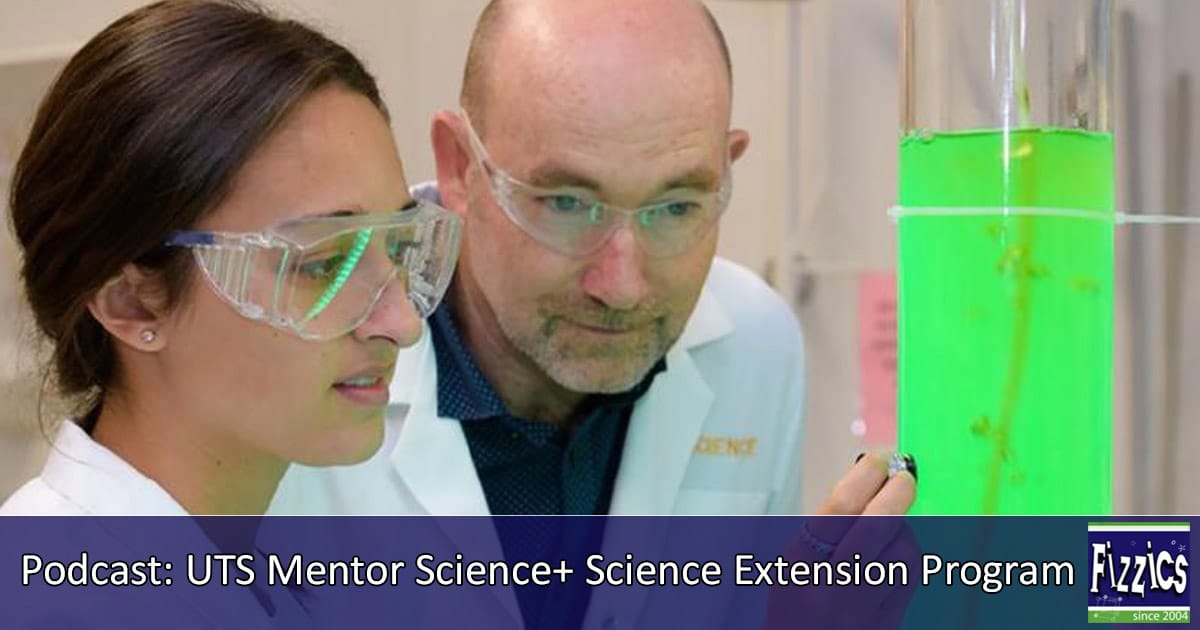
Podcast: UTS Mentor Science+ Science Extension Program
Science Extension enables students to pursue their passion for science. The NSW HSC subject requires students to engage with complex concepts and theories and to critically evaluate new ideas, discoveries and contemporary scientific research. We speak with Dr Lisa Cabral from the University of Technology Sydney to learn the opportunities for both students and mentors with the UTS Mentor Science+ Science Extension program
About the UTS Mentor Science+ Science Extension Programme
The Science Extension course challenges HSC students to examine a sophisticated scientific research question influenced by one or more scientific disciplines. Uniquely for this subject, students produce a detailed research report that reflects the high standards required for publication in a peer-reviewed scientific journal.
This course lays a vital foundation for students pursuing tertiary study in STEM-based courses and prepares them to engage with emerging industries. To support this, UTS works closely with schools to pair students with academic mentors, allowing them to utilise university-grade infrastructure and analyse data within a professional research environment. This programme ensures that the transition from secondary to higher education is optimised for the next generation of Australian scientists.
Mentorship Focuses on Process: The primary role of a mentor in Science Extension is to guide students through the scientific process and methodology, rather than just acting as a subject matter expert.
Bridging the Accessibility Gap: Initiatives like the UTS Mentor Science+ programme are crucial social justice efforts that allow students in under-resourced schools to access high-level scientific enquiry.
Science Careers are Diverse: A foundation in science can lead to a varied career path, from medical research in oncology and virology to leadership roles in STEM education.
Dr Lisa Cabral is an accomplished researcher and educator with an extensive background in both medicine and science pedagogy. Lisa earned her PhD from UNSW, focusing on the human immunodeficiency virus (HIV), and later completed a Graduate Diploma of Education. Her career includes extensive experience in vascular biology, cancer research, and mentoring Honours and PhD students.
Lisa has a strong history of fostering partnerships within the scientific community, including her work with CSIRO’s Scientists in Schools initiative. She is a key figure in the Science Teachers Association of NSW (STANSW), serving as a presenter, convenor, and current editor of the journal Science Education News.
Currently, Lisa leads the teaching activities within the Faculty of Science HSC Mentor Science+ Science Extension programme at UTS. Her role is centred on organising collaborative relationships between the university and NSW high schools, helping students recognise the rigour and excitement of authentic scientific enquiry.
[00:00:15]Ben Newsome: Welcome again for another Fizzics Ed Podcast. Glad to have you no matter where you are around this world of ours as we are talking science. We are talking about Science Extension, which is an amazing opportunity students have to get into real science connected with real research. Today we’re hanging out with Dr Lisa Cabral, who is the lead teacher for science for the University of Technology Sydney. We talk about Science Extension, exactly what it is and, more importantly, what the benefits are and how you might get your students into this. Let’s get right into it.
[00:01:07]Dr Lisa Cabral: I’ve been involved in medical research for most of my life, but also heavily involved in education all along the way. Through my medical research, just to give people a little bit of background on different things that I’ve worked on, because I have worked in many different areas, and I guess that’s what’s really exciting about science as well. For those young people out there who are thinking of science as a career, it is a really awesome thing to do.
[00:01:46]Dr Lisa Cabral: I started off very young. I finished school and went straight into the workforce as a laboratory technician and I studied a Bachelor of Science part-time. I was very lucky in that I went into an exciting laboratory working on cancer at the time.
[00:02:15]Dr Lisa Cabral: I got to look at the effect of carcinogens, which are nasty chemicals that unfortunately can cause cancer. We were looking at these potential carcinogens on liver cells in rats. That was pretty exciting for me back at the tender age of 17 to be working in a dynamic, exciting lab like that.
[00:02:38]Dr Lisa Cabral: I then moved on and worked in a laboratory in the physiology department, working on alveolar type 2 cells in the lung. We were looking at them because at the time it was thought this could be really important for studying cot death, which we don’t hear much about today. Back when I was young, cot death was the big thing that everyone talked about.
[00:03:09]Dr Lisa Cabral: I then moved on to vascular biology, looking at a very special cell called endothelial cells, which line blood vessels. We were looking to see how important they were in tumour growth.
[00:03:35]Dr Lisa Cabral: I then did my PhD looking at the human immunodeficiency virus (HIV), and we were looking at ways that we could stop the virus from binding to its target cells, which are your T-cells involved in your immune function. From there, I went and worked as a senior post-doc working on really nasty, aggressive cancers like glioblastomas in the brain and also pancreatic cancer.
[00:04:07]Dr Lisa Cabral: I always mentored students along the way. I was always involved in mentoring Honours and PhD students, which was lots of fun, and I got involved in CSIRO’s Scientists in Schools programme. I guess that’s where I really decided that education was the way I wanted to go and went on into education. Very exciting.
[00:04:40]Ben Newsome: I always find it fascinating how people find their way into education, and you were educating from way back as you think about it for sure. Gosh, you fell into biomedical science very early. What drove you into it? There was a reason why you stepped into the lab at that 17-year-old age.
[00:05:04]Dr Lisa Cabral: It’s funny Ben, because lots of people always ask that question, and for me, I don’t really know. I loved learning; lifelong learning for me is amazing, so I think I’ve always loved learning everything. I guess I did everything. Even back then, shorthand and typing were subjects in my day, so I even did subjects like that.
[00:05:30]Dr Lisa Cabral: At the end of the day, because I could do science, I chose those subjects. At that stage, I really didn’t know if I wanted to be a chef, an architect, a scientist; I wanted to do so many things. Because I could do science subjects, I chose them and I loved it.
[00:05:53]Ben Newsome: I know there’d be some people listening in thinking, you know what, that’s me too. That is 100% the case. I know we’re about to move on and talk about the subject Science Extension, and that’s one of the hardest things, coming up with what you actually want to do for your research project. I think it’s the same thing through life, if you’re passionate about life in general, then it sometimes is a struggle to decide what you actually want to do.
[00:06:18]Ben Newsome: So tell us a bit more about the Science Extension programme because you’re now very much involved with that. How’s that going?
[00:06:25]Dr Lisa Cabral: Absolutely. It’s going really well. I just started working at UTS this year because we have a brand new programme called Mentor Science + Science Extension. The main objective is that it is a big social justice initiative for us. We realise there are still a lot of schools and students out there who can’t access Science Extension as a subject because their schools sometimes just don’t have the capacity to offer it.
[00:06:55]Dr Lisa Cabral: That’s one of our main things, to offer the subject to those students. We also offer mentors to students within schools who do offer Science Extension. We offer scientists and higher degree research students to mentor students through the Science Extension course.
[00:07:25]Ben Newsome: Fantastic. How many schools are currently involved in this?
[00:07:30]Dr Lisa Cabral: We currently have 16 schools involved and over 80 students at the moment, so it’s going really well. One of the main challenges for everyone with Science Extension is that it would be fabulous if every single student were able to have a mentor to help them.
[00:08:00]Dr Lisa Cabral: In our programme, that’s what we’ve guaranteed. If you choose Science Extension with us, we guarantee a mentor, but we always need more. If anyone’s watching out there from other organisations, maybe you’re a retired scientist, we’d love to have you on board as well.
[00:08:25]Ben Newsome: For sure. When it comes to mentorship, there would be people listening who could 100% help you out. Often the question that comes up is, what does that involve? How much time are we looking at for mentoring? Mentoring takes a lot of different shapes.
[00:08:45]Dr Lisa Cabral: Yes, absolutely. With us, from the time that the students get started with the mentoring, which is pretty much now, we just started our mentor-student partnerships last week, which was amazing. We had a whole lot of students come to UTS, meet up with their mentors in this massive room; there was a real buzz, heaps of discussion going on, so it was absolutely amazing.
[00:09:15]Dr Lisa Cabral: The mentoring starts then and it goes through till the time students have to submit their reports. What we’ve found in the past is that generally students need a lot more support and guidance at the beginning and then again at the end.
[00:09:40]Dr Lisa Cabral: We do ask for around 10 hours of mentor’s time with the student from the start to the finish. That can be via Zoom, via emails, and obviously face-to-face when possible. That’s pretty much how we work.
[00:09:55]Ben Newsome: With the mentoring, do they have to be explicitly involved in the project itself, or can they be off to one side in a different organisation giving guidance and hints?
[00:10:05]Dr Lisa Cabral: Both Ben. It’s great if we can have mentors that have expertise in the area that the students have chosen a project on. Some of our students choose things that are quite unique; we had someone this year looking at TikTok, for example. I couldn’t find anybody who was doing research on TikTok from my networking.
[00:10:35]Dr Lisa Cabral: The role of the mentor really is to support and guide the student. Obviously, anyone who has been a scientist knows the scientific process. That’s the really important role of a mentor, to be able to guide students through that scientific process, not so much be an expert in their area.
[00:10:55]Ben Newsome: I’m curious, you would have seen some fantastically interesting projects come across your desk at the time to submit. It’s almost unfair, you can’t pick a favourite, but at the same time, there are things that grab your attention. What have you seen researched by these students?
[00:11:05]Dr Lisa Cabral: Like you said, it is just so vast, it’s crazy. We did have a student one year who was interested in a model kind of project. I think this student was also studying Investigating Science at the time, but they were just really curious about wombat poo.
[00:23:30]Ben Newsome:Dr Lisa Cabral, thank you so much for your time and for sharing your knowledge on the podcast today.
[00:23:36]Dr Lisa Cabral: Thank you, Ben, it’s been an absolute pleasure.
[00:23:40]Announcer: You’ve been listening to the Fizzics Ed Podcast. For more science, education, and free resources, visit fizzicseducation.com.au. Catch you next time!
Frequently Asked Questions
What is the UTS Mentor Science+ programme?
The UTS Mentor Science+ programme is a social justice initiative designed to support students who want to study Science Extension but may not have access to the subject at their school. It provides these students with the opportunity to undertake the course while also pairing them with academic mentors and higher degree research students to guide them through their scientific research.
Who can become a mentor for Science Extension students?
Mentors can be scientists, higher degree research students, or even retired professionals from various scientific fields. The primary requirement is a deep understanding of the scientific process, as their role is to guide students through the rigours of research, data collection, and reporting.
What is the time commitment required for a Science Extension mentor?
Typically, a mentor is expected to provide around 10 hours of support to a student from the beginning of their project until the final report is submitted. This time is usually weighted towards the start and the end of the project and can be conducted via Zoom, email, or face-to-face meetings.
Does a mentor need to be an expert in the student’s specific research topic?
Not necessarily. While expertise in a specific area is helpful, the mentor’s most important role is to support and guide the student through the scientific process. For example, if a student is researching a niche area like social media trends, a mentor with a general scientific background can still provide essential guidance on methodology and analysis.
How does Science Extension prepare students for future careers?
Science Extension allows students to engage with real-world research and authentic scientific enquiry. By working with mentors and sometimes utilising university-grade infrastructure, students develop the critical thinking, statistical analysis, and communication skills necessary for tertiary study and careers in STEM and emerging industries.
Extra thought ideas to consider
The Importance of Process over Subject Expertise
As Dr Lisa Cabral highlights, a mentor’s value often lies more in their understanding of the scientific method than in their specific knowledge of a student’s chosen topic. This suggests that teaching students *how* to think like a scientist—focusing on methodology, ethics, and data integrity—is more critical for long-term success than just mastering the facts of a single subject.
Democratising High-Level Science Education
The UTS Mentor Science+ programme serves as a model for how universities can bridge the gap for students in schools with limited resources. By providing external access to Science Extension, institutions can ensure that a student’s postcode or school size does not limit their ability to engage in high-level scientific research and pursue STEM pathways.
The Non-Linear Path of a Science Career
Dr Lisa Cabral‘s journey from a 17-year-old laboratory technician to a PhD researcher in HIV and eventually an educator demonstrates the versatility of a science degree. This provides a valuable lesson for students: a career in science is rarely a straight line and can lead to unexpected and diverse opportunities across research, industry, and education.
Discussion points summarised by AI from the FizzicsEd Podcast, verified and edited by Ben Newsome CF
Recognised by
22 years, award-winning work, 1 purpose
Recognition from business, education and industry bodies across Australia.
Australian Small Business Champion
Multiple years
CILC Pinnacle Award and Hall of Fame inductee
Center for Interactive Learning and Collaboration
Western Sydney Awards for Business Excellence
Winner
Top 100 Coolest Company
Listed
Local Business Awards
Winner
We value your privacy
We use cookies to improve your experience. Essential cookies are always active. You can choose which optional cookies to allow.We use cookies. Optional ones stay off unless you allow them.Privacy policy