Transcript
[00:00:00] Announcer: You’re listening to the Fizzics Ed Podcast. For hundreds of ideas, free experiments and more, go to fizzicseducation.com.au. And now, here’s your host, Ben Newsome.
[00:00:19] Ben Newsome: Welcome again for another Fizzics Ed Podcast. It’s another season, and we’re talking STEM yet again. Today, we’re hanging out with a very interesting person. We’re hanging out with Nikki McCarthy Hicks, who is the manager of Inside Industry. Now, imagine taking your students to a real steelworks, a fully-fledged steel manufacturing plant. That’s exactly what Inside Industry does. They work with BlueScope Steel, and they’ve been working with them for a very, very long time. Huge history, but here’s the thing: there is a bucket load of STEM going on in a steelworks. Think about robotics, think about the chemistry involved in making steel, and all that sort of thing. Taking your students into an actual foundry where the really hot stuff is flowing around the place, it’s an astounding place to check out. Today, we’re going to find out just what Inside Industry does with Nikki and how you might be able to get involved. Let’s get into it.
[00:01:18] Announcer: This is the Fizzics Ed Podcast. For all about science, Ed Tech, and more, to see 100 fun free experiments you can do with your class, go to fizzicseducation.com.au. That’s physics spelled F I Z Z I C S, and click 100 Free Experiments.
[00:01:34] Nikki McCarthy Hicks: Hello, thanks for having me.
[00:01:38] Ben Newsome: I’m really excited. You’re not that far away from where I am. I’m in Sydney, you’re down in the Illawarra, and some people don’t know what even the Illawarra is because some people listen to this all over the world. How about you just describe where you are, what you do, and why? Tell us about you.
[00:01:56] Nikki McCarthy Hicks: I can’t believe people don’t know where we are. It’s a beautiful part of the world. We’re nestled between the mountains and the sea, so it’s quite gorgeous and a very beautiful temperament weather-wise. We’re quite lucky all year round. I am the manager of Inside Industry, which is the visitor centre at BlueScope. It’s on the Wollongong side of the steelworks, the Port Kembla steelworks, so we’re quite close to Wollongong city. We do tours of the steelworks and other industry opportunities within the Illawarra. We take the general public, community groups, and school students in to have a look.
[00:02:36] Ben Newsome: Which, when you think about it, is a rather unique experience, because not everyone has a steelworks around the corner. That is an extraordinary experience. How on earth did you fall into this?
[00:02:46] Nikki McCarthy Hicks: I’m quite confident it’s probably the only working industrial site you can visit that close in the world. I’ve actually come from the fitness industry personally, so I believe the steelworks have actually been doing this for about 30-odd years.
[00:03:11] Nikki McCarthy Hicks: I know when I was in school, I did a tour inside the steelworks, so they’ve been doing it for a really long time. I’ve been involved for 18 months, so it’s new and exciting to me, but I think it’s exciting to most people that have been up close. It doesn’t lose its shine, that’s for sure.
[00:03:36] Ben Newsome: Especially when there’s enough shine, that’s for sure, because we’re talking about molten steel. That’d be some heat in that too. This is a STEM podcast; we talk science education and whatnot. Having students visit a working heavy industry, that is firstly a fairly unique thing to be able to do. There’s a lot of science and engineering involved in this. What do these kids get to learn?
[00:03:56] Nikki McCarthy Hicks: Depending on what they actually need, we do get a really huge variety. Some people are coming in here to supplement certain parts of their curriculum that they’re studying, and others are coming in because it is about what can I do with my engineering or STEM subjects later on. What are the career opportunities? Our standard steel tour is all about steelmaking.
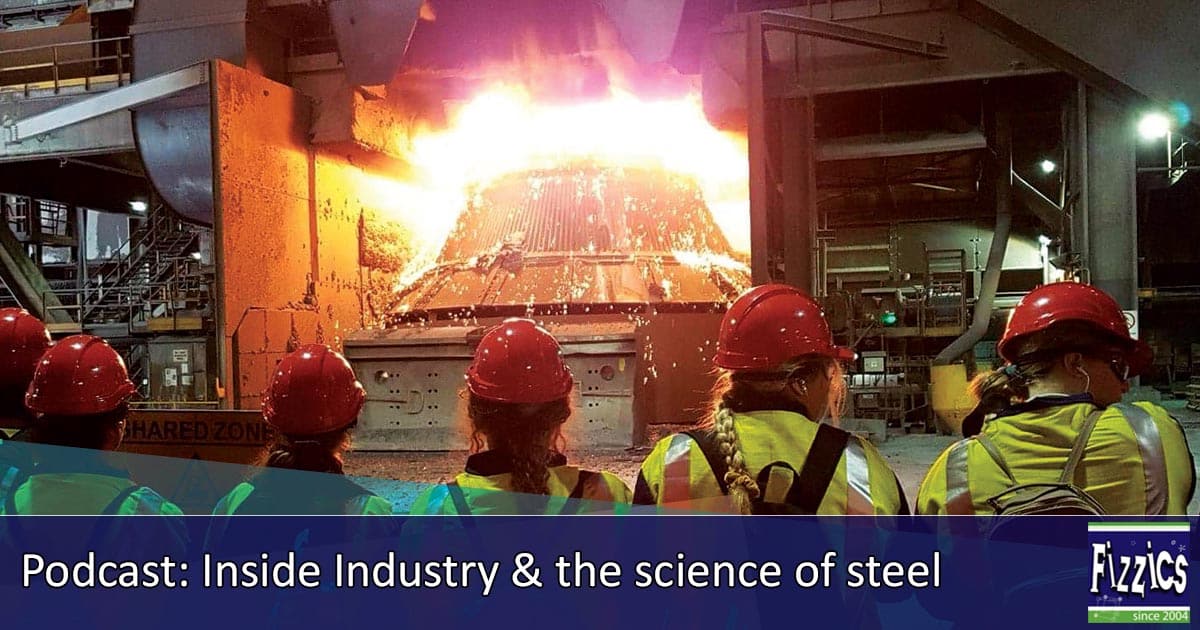
[00:04:20] Nikki McCarthy Hicks: We take you for a drive around the site, talk a little bit about the history and the process, and then we get into the BOS, which is the Basic Oxygen Steelmaking with the big vessel where we drop in the steel and the molten iron. You go over to the slab caster to see that rolled out as a big slab of fiery hot slab, and then we go over to the Hot Strip Mill to see it all rolled down.
[00:04:50] Nikki McCarthy Hicks: In those processes, you’ll see massive machines, you’ll see people with trades at work, engineers at work, and on the end of it, you’ll also see robots that roll it up and mark it and send it off in big rolled coils of steel. We can actually bespoke that a little bit. If you’re bringing kids that are really interested in working in materials engineering or electrical engineering, there are other parts of the steelworks that are welcome visits with students. They also can help us out with cadets and apprentices that might want to have a chat with the kids and answer any questions or tell them about the process.
[00:05:22] Ben Newsome: Which is a fantastic opportunity because you go on a lot of field trips and you kind of get to see whatever the things are that you get to see, then you come home knowing something. But to be able to be involved, that’s another level, which is fantastic. From BlueScope’s point of view, having career pathways is really central to it, and also frankly, explaining what happens in the big building.
[00:05:45] Nikki McCarthy Hicks: Absolutely. One fabulous example, we recently had some students that had a really specific interest in the tech side of it. We went to the BOS, and one of the cadets there has worked specifically on a video programme, a virtual VR-type thing.
[00:06:05] Nikki McCarthy Hicks: They’ve done the processes, the how-to, the learning for new staff. You put on these goggles and you’re actually in the workplace and you can see and read and do all at the same time. It’s amazing, and it was a cadet that developed it. She showed that technology to these students and answered some questions and talked about the whole programme. It was a really fabulous experience for the students.
[00:06:42] Ben Newsome: I like this because if I went to a 13, 14, 15-year-old kid and say, “What do you think happens in a steelworks?” they’ll say, “Probably make steel.” I’d say, “What else do you know?” I suppose as you quiz these kids, even just average perception, steel’s been around for many years; it’s been a rather useful thing to make for humans for a very long time, and people may not realise that there’s innovation and there’s tech and it keeps evolving. Steel is a high-energy-use product, it absolutely is, which inevitably means that the people who are running the steel mill want to be able to make it as efficiently as possible, because it not only helps the bottom line, there’s also the climate change thing and everything else. There really is an opportunity to say, “Hey, it may be a century-old industry, but it is actually evolving.”
[00:07:37] Nikki McCarthy Hicks: Absolutely, and you see that every day down here. There’s a whole sustainability department that work on improving processes to help reduce carbon emissions, to help make it a greener process, and there’s a number of projects in place that are part of that. The sustainability team have been around for 50 years now, and it’s just grown and grown, so it’s a really major part of the steelworks infrastructure.
[00:08:08] Nikki McCarthy Hicks: Talking to anyone in there—I’m not sure if you’ve met Simon Tooke, Ben, but he manages the plate mills at BlueScope in Port Kembla, and he’s incredibly passionate about careers in engineering and opportunity. He did a speech recently with the students and talked to them about a lot of the tech side of it and the different roles and responsibilities that are involved in working at the steelworks.
[00:08:40] Nikki McCarthy Hicks: What he was talking about was producing steel and all the different things that go into what slows down production, what increases production, and the different roles around measuring that and reporting on that. We were over at the BOS with Ruby O’Driscoll, who’s one of the supervisors over there. It’s not my area of expertise, so I can’t give you the detail that Ruby or Simon could, but it was actually a really interesting conversation and it’s information that you probably don’t really think about when you’re thinking about production on that scale.
[00:09:18] Ben Newsome: You’ve actually reminded me, it’s like a thought bubble from a long time ago. My late father-in-law used to make conveyor systems for very large logistics companies, and we’re talking serious multimillion-dollar conveyor systems. They’re big when you go into these places, and he recounted stories of speaking with various managers who want to implement said systems. They want to increase the line speed, so just imagine faster conveyor belts mean faster product going out the door. He said, “That’s true, you’re going to get faster product within the building, but look over there.” What he’d point to is the person taking the things off the belt and into a truck. He’d say, “You can make this run at light speed if you want, but your constriction is the human loading the truck.” Funnily enough, they then started working on machines that would do that. The idea being that your efficiency gain wasn’t where the manager thought it was. There’s a whole another area again.
[00:10:28] Nikki McCarthy Hicks: Absolutely, and we do get a lot of business study students coming in to learn about that side of it. I guess it depends whereabouts you sit in the scope of things, but the steelworks in the Illawarra is huge, it’s a massive part of our infrastructure, employing well over 3,500 as well as supporting another 10,000 through the ongoing processes. Having an international port next door, it actually is really a big part of who we are.
[00:11:05] Ben Newsome: I’m really good friends with a national environmental manager for another very large materials company who happens to send some of their product so that you guys can make the steel, and then gets the byproduct that comes out of the process that they then reuse in their concrete manufacture. It’s very interesting how all these things interweave, which students can see on paper or read on a website, but there’s another thing actually going and seeing it for real.
[00:11:32] Nikki McCarthy Hicks: Yeah, absolutely. I’ve never seen a student disappointed when they come in. We’ve had primary school students, high school students, university students. At every level, there is something to wow them. It’s the big machinery inside there, the heat of it, the process of it, the engineering and automation of it as well. Even safety is quite huge. You’re quite surprised when you go in and it’s really impressive how close you can get and how safe you are at the same time.
[00:12:08] Ben Newsome: Absolutely. A place like that, you don’t want downtime and you want to look after your workers absolutely. This is a genuine manufacturing environment, so you’ve got to have those controls. I think a visit to a place like this, and I agree, I’d love to see if there’s another thing globally, because there probably isn’t. Sometimes, when you watch some of these science or STEM outreach programmes, it’s so heavily focused on the science or the engineering, and misses the holistic view. I feel that that narrative of learning whatever is the current innovation that they’re doing in the steel manufacture is fine, but then learning actually how does the business operate? I think it’s really good.
[00:12:54] Nikki McCarthy Hicks: We’ve also got innovation labs, which is one of the departments at the steelworks and they’ve got a whole weather lab over there. They’re testing the coatings of metal and how the metal is made, and some of it’s all top secret information. But it’s really interesting. And it’s a great place that they do have a lot of cadets over there as well.
[00:13:19] Ben Newsome: Oh, for sure. People may not initially think of chemical engineering being a straight-up pathway directly into a very large company that’s moving coated products all over the country and beyond.
[00:13:36] Nikki McCarthy Hicks: Absolutely. Changing the subject just slightly, but while you’re talking about careers and pathways, one of the great things about having a cadetship with the steelworks is you can do that straight out of school and go to uni, and they pay for that. They pay for your study and you’re earning an income straight away. It can be quite different to independently going to university and then having to do placement and different things. If you’re doing medicine, you’ve got to do placement for five plus weeks full-time and generally you’re away from home, you can’t earn an income. This is an amazing opportunity to work relatively locally, close to home, earn an amazing income, study at the same time. They really are an employer that should be on your list.
[00:14:26] Ben Newsome: It’s amazing. There’d be locals listening into this for sure. There’s people in Sydney and people maybe even in the Illawarra. I guess the question comes to me straight away is, how do you find the catchment, so to speak? Do you find is it mainly local schools? Do you find people coming down from Sydney? Do you find people coming even further? Where do they tend to come from?
[00:14:46] Nikki McCarthy Hicks: We get quite a lot local because they obviously know about it. We also have a lot coming from Southern Highlands and Macarthur area. Sydney, we’re starting to get a few come down. We had Pymble Ladies’ College in last week. So we do get quite a few from there.
[00:15:10] Nikki McCarthy Hicks: But we also get some regional schools. We’ve had the Catholic school from Bega come up. We’ve had a group in from Orange and they come in and do a few things, it’ll be a bigger day trip. The Engineering Summer School, they come down every year and bring students from a broad cross-section of schools, so possibly from around the state, I suspect. They do a particular summer school programme and then they’ve got a whole bunch of places they visit.
[00:15:34] Ben Newsome: Which makes a lot of sense. If you’re not in Australia, and all Australian schools know about this thing. A lot of schools in Australia go to Canberra. It’s just the thing that happens in this state, and this state happens to be quite large, so you’ve got a lot of schools going there. It’s the odyssey. For three days, they go and see all the Canberra sites and there’s all these different things. So if you’re in the States listening to this, imagine sending your schools to Washington DC. Because there’s lots of things in Washington DC, it’s almost comparable in some ways, having been to both places. I can see the same thing being here. Some people might be listening to this going, “Going to a steel place would be awesome, but what else?” But there are a lot of things around the Illawarra area that you could do. It’s just a matter of not going down the predictable path and taking students somewhere a little bit more unique.
[00:16:22] Nikki McCarthy Hicks: I think it depends on what you’re trying to achieve. With the Engineering Summer School, they do half a day at the university and half a day with us. They do a programme over there that is engineering-based as well and then the kids swap. So we do a morning and an afternoon. The group that came from Bega, they were actually coming back from Sydney. They had an end-of-year excursion that had a number of things going on. Big few days for them, but they got here very tired, but they left excited. They definitely were woken up when they went inside.
[00:17:05] Ben Newsome: Oh, that’s fantastic. I’m just curious, there’d be people listening in from all sorts of walks of life, and at least in the formal education space, some of them run different subjects. What do you see tend to come across your door? In the parlance of this state, is it more science, is it TAS, or is it down the business side? Is it mainly high school, have you got some primaries coming? What do you find?
[00:17:30] Nikki McCarthy Hicks: High school is probably the most common. It’s often the career-based trips, so it might be a careers adviser that’s organised it and bring a whole bunch of year 9 or 10 or 11 and 12 students because we obviously offer apprenticeships as well. Having said that, from subject, STEM is probably the main target, or STEAM as it’s more appropriately known now.
[00:18:00] Nikki McCarthy Hicks: We do have kids coming in that are doing business studies, geography. Lots of people want to come in and find out more about the sustainability processes: what are we doing for the environment, all of those kinds of things. They often ahead of time will ask those questions, and we’re more than open to that. Send us an email, what is it that you’re looking to get from your visit?
[00:18:20] Nikki McCarthy Hicks: Our tour guides, which I haven’t actually touched on, they’re super knowledgeable. They’ve all got a lived experience, so they can answer most questions. But we can also link up with department managers, so if you’re after something really specific, most of the people at BlueScope are more than happy to give up 20 minutes of their time and have a chat to students.
[00:18:43] Ben Newsome: Which grabs my thought around the broader… I know people who listen here from museums, zoos, aquariums, they’re in university, they’re in all sorts of different places. For some of them might be looking for an enrichment experience they’ve not done before. This is really, really cool. I like it. It’s great.
[00:19:01] Nikki McCarthy Hicks: Like I said, I come from the fitness industry and had very minimal exposure to industry. And it’s fascinating. It’s so much to learn, and as a local in particular, we should know more about it than most of us probably do. It is a lot more sustainable and moving to a more environmentally friendly model all the time, which is also something important that we should all be aware of.
[00:19:28] Ben Newsome: Oh my gosh, and that’s where you think about the green hydrogen, offshore wind, and all those sorts of things. That’s a real thing because we want the electrons, but hopefully if we can get them without putting carbon up there, it’s kind of a thing.
[00:19:40] Nikki McCarthy Hicks: Exactly. That’s exactly right.
[00:19:43] Ben Newsome: Oh, this is fantastic. I guess there’d be some people who would be going, “Righto, I’m at least very curious.” Where would they need to go to find out all this information?
[00:19:52] Nikki McCarthy Hicks: You can find most of the information on our website, which is insideindustry.org.au. You can send me an email, pick up the phone, and all of that information is on that website. We’re also on Instagram and Facebook and LinkedIn as Inside Industry. Pretty easy to find, I think. If you Google “steelmaking in Wollongong”, we’d probably come up. I hope we come up.
[00:20:16] Ben Newsome: There’s something wrong if you don’t.
[00:20:18] Nikki McCarthy Hicks: Just start with Inside Industry, let’s keep it safe.
[00:20:21] Ben Newsome: Yeah, exactly right. Easy as. We will put those links in the show notes as usual as well. I always like to ask people a bit of advice. If you had a careers adviser in front of you, a whole bunch of careers advisers, and they’re trying to at least tell their students what goes on in steel manufacture that might excite their students who may not be easily excited, what would you suggest would be some things to say, “You know what, it’s really worth going on a trip like this because of X, Y, and Z”?
[00:20:54] Nikki McCarthy Hicks: Because of what you will see. You just won’t get to see that without literally coming inside the gates. The BOS is the showstopper. Everyone loves it. It’s like fireworks. You see the scrap metal get tipped in huge containers, and then they tip in the molten iron and it just explodes. You see that up close, you hear it up close, it’s amazing.
[00:21:26] Ben Newsome: There you go. It’s awesome. You can say to the kids, “Hey, you want to watch something explode? They do this for a living.” But yeah, that’s right. I love the narrative in there that you did say, and it is scrap steel, which means you can talk about sustainability and the circular economy too.
[00:21:42] Nikki McCarthy Hicks: Absolutely. It is infinitely recyclable steel.
[00:21:47] Ben Newsome: Yeah, that’s amazing. Look, Nikki, thank you so much for jumping on the podcast. As we wind up this year, I know that people listening to this, it’s into 2024, but thank you for hanging out with me.
[00:21:57] Nikki McCarthy Hicks: No problem. Thanks so much for having me. I really appreciate the opportunity. Hopefully I see lots of students coming in to check us out.
[00:22:05] Ben Newsome: I reckon that’ll happen. Thanks so much.
[00:22:07] Nikki McCarthy Hicks: Thanks, Ben.
[00:22:10] Announcer: We hope you’ve been enjoying the Fizzics Ed Podcast. We love making science make sense. Why don’t you book us for a science show or workshop in your school? If you’re outside of Australia, you can connect with us via a virtual excursion. See our website for more.
[00:22:25] Ben Newsome: Well, there we go. We just spoke with Nikki McCarthy Hicks. I hope you enjoyed that chat, and maybe there might be a chance to bring your students to BlueScope. What an amazing experience, seeing real steel being made in action. If you want to find out more, go to insideindustry.org.au and find out just how you might be able to get involved. That is yet another Fizzics Education podcast, the Fizzics Ed Podcast has been running for many years, and there are many chats coming up throughout this season. You’ve been listening to me, Ben Newsome from Fizzics Education, and this is the Fizzics Ed Podcast and I hope to catch you another time.
[00:22:58] Announcer: You’ve been listening to another Fizzics Ed Podcast. We’re excited about science. Subscribe to us on iTunes to download the next episode as soon as it’s released. And don’t forget, for hundreds of ideas, free experiments, our new Be Amazing book and more, go to fizzicseducation.com.au. That’s physics spelled F I Z Z I C S.
[00:23:25] Announcer: This podcast is part of the Australian Educators Online Network. AEON.net.au.
Frequently Asked Questions
What can students expect to see on an Inside Industry tour of the steelworks?
Students gain rare access to the Port Kembla Steelworks. The tour typically includes visiting the Basic Oxygen Steelmaking (BOS) plant to see molten iron being converted into steel, the slab caster to observe large steel slabs, and the Hot Strip Mill, where those slabs are rolled into thin coils of steel using massive, high-speed machinery.
How does the tour align with the STEM curriculum?
The experience covers multiple STEM disciplines. It showcases industrial chemistry through the steelmaking process, physical science through the rolling and cooling of metal, and engineering and robotics through the automated systems and machines that manage the production line.
Are there specific career pathways discussed during the visit?
Yes. Nikki McCarthy Hicks highlights that BlueScope offers engineering cadetships and trade apprenticeships. These programmes allow students to work and earn an income while the company pays for their university study or trade qualification, providing a direct transition from school to a professional career.
What role does sustainability play in modern steel manufacturing?
Sustainability is a major focus, with dedicated departments working on carbon reduction and greener manufacturing processes. Students learn about the circular economy, as steel is infinitely recyclable and the plant uses large amounts of scrap metal as part of its production cycle.
Is the experience suitable for primary school students?
While the tour is very popular with high school careers and science classes, it is also suitable for primary school and university groups. The content is tailored to the age level, ensuring that the scale and excitement of the machinery are engaging for younger learners while providing technical depth for older students.
Extra thought ideas to consider
The Integration of Robotics in Hazardous Environments
Consider how automation and robotics have transformed safety in heavy industry. By utilising robots to mark, roll, and transport extremely hot materials, industry reduces human exposure to high-risk environments while increasing the precision and speed of production.
Industry as a Living Laboratory
Heavy industrial sites like the Port Kembla Steelworks serve as real-world laboratories for testing innovation. From developing new protective coatings for steel to experimenting with green hydrogen, students can see how theoretical science is applied to solve global challenges like climate change and material longevity.
Discussion points summarised by AI from the FizzicsEd Podcast, verified and edited by Ben Newsome CF