Transcript
[00:00:00] Announcer: You’re listening to the Fizzics Ed Podcast. For hundreds of ideas, free experiments and more, go to fizzicseducation.com.au. And now, here’s your host, Ben Newsome.
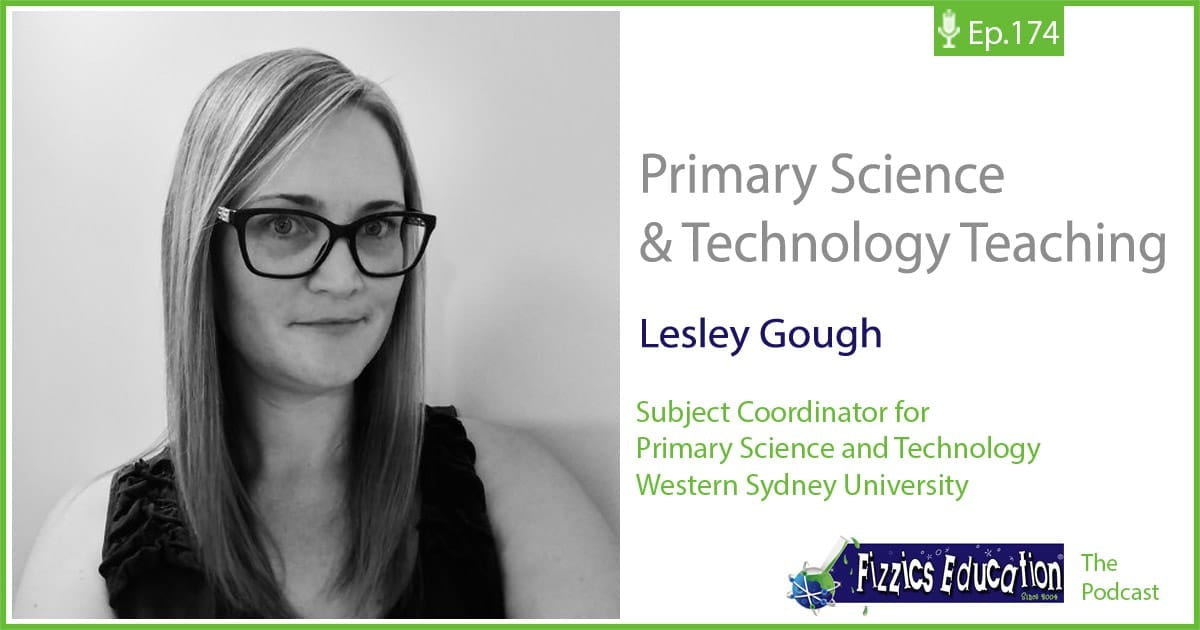
[00:00:18] Ben Newsome: Welcome again for another Fizzics Ed Podcast. Glad to have you no matter where you are around this world of ours. We’re talking science, we’re talking STEM as usual. Today we’re hanging out with Lesley Gough, who is a teacher, a scientist, and researcher. She’s involved with Western Sydney University as a subject coordinator for primary science and technology for both the Master of Teaching and the Bachelor of Education programmes. She has a bucketload of experience when it comes to getting students involved in science and getting them to understand the scientific method at that age group. Lots to share. Let’s get right into it.
[00:00:59] Announcer: This is the Fizzics Ed Podcast. For all about science, EdTech and more. To see 100 fun free experiments you can do with your class, go to fizzicseducation.com.au. That’s physics spelled F I Z Z I C S and click “100 Free Experiments”.
[00:01:14] Lesley Gough: Yes, really well thanks. Just a very hectic schedule at the moment. Assignments are coming in thick and fast, so spending a lot of time marking.
[00:01:23] Ben Newsome: Oh gosh, given your role, I can imagine so. Why are you doing assignments at this point in time?
[00:01:34] Lesley Gough: I’m currently working at Western Sydney University as a sessional academic. I’m employed every semester to teach our pre-service teachers in Australia. I’m working on the Master of Teaching programme, and the Bachelor of Education programmes. I am the subject coordinator for primary science and technology on both of those programmes. I’m basically teaching the teachers how to teach science, which is really exciting.
[00:02:09] Ben Newsome: Which brings up the point, how did you get into this role?
[00:02:13] Lesley Gough: That’s a long history. I started out as an environmental scientist. Science has always been a passion of mine and I’m sure we’ll touch on why later. I retrained as a primary school teacher due to the global financial crisis. At the time I was a contaminated land consultant, so I used to dig holes in the really dirty dirt, which was amazing fun. But once that housing market crash happened, no one really wanted to redevelop the really dirty stuff anymore.
[00:02:50] Lesley Gough: I thought now’s a good time to check out my other passion of teaching. I retrained and right from the beginning as a primary teacher, I noticed that the passion wasn’t there for science amongst my colleagues. It seemed to be a burden and one of those things they’d just leave to the end. They’d get their English and maths done, they’d read lots of stories, they’d have drama, and science was that thing, “We haven’t done any science. Let’s put some in.”
[00:03:25] Lesley Gough: From early days there, I took the mantle of science lead. Right my first year of teaching, I led the stage through a science programme linked to the curriculum. We were a small school, just two classes of year three children or equivalent because this was in Scotland where I trained to be a teacher. So equivalent year two. We did this amazing science programme, we built this senses garden. It was amazing hands-on science all integrated through the curriculum. I joined the science group in the local authority area and helped lead some projects there and then came back to Australia where I noticed the same phenomenon. No one wanted to teach science.
[00:04:15] Lesley Gough: My first role back in Australia was as a governess on a cattle station. I quickly moved into distance education. Science was again left on the back burner, so I redeveloped the whole programme from K to 12 and really got science at the forefront with some excellent colleagues in STEM education. Then I found myself in New South Wales where I found the same phenomenon for the third time, that no one liked science. I ended up as a science specialist down here, ended up at Western Sydney University doing my Master of STEM Education and just got talking with some of the academics, got involved in research in STEM and found myself teaching at the university on the programmes there. Driven by my passion for science and lately my passion for science is for everyone and we need to really get it at the front rather than that thing we do at the end because we have to.
[00:05:16] Ben Newsome: Oh my gosh, that’s quite a ride, from Scotland to a cattle station. But throughout you hear this a lot with a lot of people who’ve been on this podcast, you 100% exude passion for it and I’d hope it would rub off on the various teachers that you’re working with. One thing that’s cropped up throughout that history is that consistent thing you noticed about teachers regarding science. What do you think is driving this?
[00:05:52] Lesley Gough: There’s a wide variety of research about why primary school teachers don’t have that passion for science. In fact, one of the assignments on the Master of Teaching unit is about primary teacher attitudes towards science and how the unit has affected yours. The attitudes basically stem from not having a secure background in science themselves. Whether they’ve had poor experience of the chalk and talk experiences at school where it’s “copy this from the board”. I remember a bit of that myself. “Copy this definition from the board, that’s our science lesson, we’re just going to write three or four definitions.”
[00:06:35] Lesley Gough: And some of my pre-service teachers not seeing the relevance of it in their lives. Certainly even when I was working in distance education, teaching the children on cattle stations remotely via satellite link and phone, comments like “science isn’t for us, we’re just farmers.”
[00:07:05] Ben Newsome: Interesting.
[00:07:07] Lesley Gough: Really interesting conversations like that. I’ve come back at it like, science is for everyone. Let’s find a common ground here. So a conversation with a Year 10 student for example: “Oh no, we don’t do science, we’re just farmers.” I knew he was responsible for cutting some of the grass in the paddocks at his place. I said, “I know you’re out on the ride-on but you also had the whipper snipper out, tell me how you mixed the fuel for that? Because I’m really confused.” He just launched into this excellent explanation of how ratios work with his two-stroke. I said, “You’ve just told me ratios and that’s our chemistry topic for this week in science.”
[00:07:46] Ben Newsome: It’s amazing. Thinking right now, we’ve got a lot of graziers in our family and a number of them are tertiary qualified and some are not, but both groups of farmers within our family all think the same way. Just one happens to have the letters. The reality is that they are land managers. They are soil scientists. They have to be, because if they want their land to be productive, they want it to be thriving and looking after pastures in a particular way, there is a bucketload of science. Turns out there’s an entire degree on agricultural science.
[00:08:26] Lesley Gough: That’s right. When you really dig into what they do and you talk to them about what they’ve done to increase the productivity of their land, they’ve used the scientific process to do that. They’ve trialled things, found out if it works, and then continued doing something that does work.
[00:08:41] Ben Newsome: Absolutely. Gone are the days of shoving a bunch of cattle into a space and hoping for the best, reducing the head of cattle by guesswork. I have watched the work done in analysing the soil productivity, the crops involved, their nutritional value, they are straight-up scientists on the land. I’m happy you mentioned that area because it’s true.
[00:09:11] Lesley Gough: Again with my pre-service teachers, we did a tutorial called Kitchen Chemistry. We call it Kitchen Chemistry in primary school because we’re using things readily available in our kitchen. The low reaction chemicals. Not the big explody chemicals, but the ones you can use safely with students.
[00:09:40] Lesley Gough: I was trying to tap into what they knew about kitchen chemistry, so we talked about cooking experiments gone wrong. We touched on macarons and how they never work out. I had a student that had been experimenting with trying to get these macarons, and I said, “You’re using the word experimenting, how can you tell me that you’re not using science in your kitchen?”
[00:10:05] Lesley Gough: We just really dug into that. I’m bringing them round to my way of thinking that we’re constantly using science in our lives. We don’t go through a day without using science. Even tapping away on our iPhones, there’s science involved in that process to get those to us. That’s the pre-service teacher attitude: “I don’t do science, I’m not interested in science” or “science is boring.”
[00:10:31] Ben Newsome: As they get exposed to kitchen chemistry, hats off to anyone who is doing more than bicarb and vinegar. That is a very worthwhile thing but there’s plenty more you can do. As they go through this, do you see an attitudinal shift within the degree or do they need to be implicitly in front of students learning that the students engage better? What do you see happen in the lecture halls versus on the school grounds?
[00:11:01] Lesley Gough: What’s really interesting with the way I’m teaching is I do a mixture between I’m an academic telling you about the research, and I’m now a Year 6 teacher and we’re going to do an experiment. I do those hands-on experiments with the students and it’s amazing. Just the attitude shift even with my adults, my pre-service teachers, these people have definitely got their 12 years of education behind them.
[00:11:41] Lesley Gough: They still have those wow moments that we get with the children in the classroom. That’s what’s keeping me at uni because I do miss the kids in the schools and the wow moments, but I’m getting it with these people who just say simple things like, “I just did not know that before.” It is amazing to watch them.
[00:11:58] Ben Newsome: This is the power of academics who work in tertiary institutions. You’ve got 200 teachers coming under you each year, but they then go on to do a long career, which means you’re effectively impacting tens of thousands of students through this, which could be daunting if you think about it.
[00:12:19] Lesley Gough: It’s a bit scary. The first time I was ever up in front of a bunch of students, I was teaching a different subject on maths, and there were 30 people sitting in front of me taking notes and I was thinking, “Wow, this is quite daunting and confronting.” But now, I’m quite used to it, I’ve been doing it for a few years.
[00:13:01] Lesley Gough: Carrying that forward, the things I’m saying and the things I’m doing in these practical lessons with my students, they are potentially impacting those students. We do know that the PISA that does the science tests shows Australia’s dropping in their science understanding. I’m hoping that if I can impact 200 students a semester, they’re potentially impacting thousands of students going forward. That’s quite an exciting thought.
[00:13:32] Ben Newsome: It is. It makes me think about how do we construct a pre-service science curriculum for primary teachers that actually works. There’s actually a lot to unpack in that simple question.
[00:13:46] Lesley Gough: I’m hoping to go into doing my PhD next year and that’s exactly where I’m looking. What can we do? I haven’t quite finalised my question, but it’s along those lines of how can we make this successful so that we are increasing that scientific literacy? I’m not even looking for educating the future round of scientists or inventors. What I’m looking at is how can we ensure that our population going forward is scientifically literate?
[00:14:32] Ben Newsome: Yeah, I want them to understand what they’re reading on the internet. That would be useful. Just thinking, on the radio there was a professor talking about phonics. Early language, the ability to read.
[00:15:23] Ben Newsome: Rather important globally. She actually wasn’t pulling any punches. She said it’s a complete lottery to parents, which would be scary for teachers listening in. She said the research is showing that certain schools would do phonics, others would do other areas, all well-meaning teachers wanting to do an awesome job. But from a research standpoint, it’s a straight-up lottery.
[00:15:53] Ben Newsome: From a science curriculum perspective, it would be nice to have a rinse and repeat situation. If we were discussing a burger business, there’s a famous place with yellow arches that gets 18-year-olds to smash out the same burger in Zambia to Zetland. It’s on spec, on time, guaranteed. Whereas with science educators, we want the ability to bring in personal experience and the capacity to affect students with your own knowledge, and yet by definition that makes it a lottery.
[00:16:19] Lesley Gough: Absolutely, and it depends on the students in your cohort. I’ve done my time as a science specialist in a few different schools. Teaching stage one in New South Wales, seven classes. Each lesson was different. It was the same plan, the same resources, but the conversations were different, the children’s interests were different, the class dynamics were different.
[00:17:04] Lesley Gough: And the results were different across the board. As a teacher you’ve got to have the pedagogical content knowledge, you’ve got to know your students and how they learn. You’ve got to be able to modify what you’re doing towards different students. You’ve got to have this really good sense of how to formatively assess each individual student. Is that student going to tell me or write it, or am I going to observe them doing something? Even your assessment practices change between students.
[00:18:14] Lesley Gough: There is an argument for having specialists against having a generalist in primary school. I don’t know what the answer is. Is the answer to have a science specialist in primary school? Some schools definitely do, and the science outcomes there are incredible. One teacher can really focus on those outcomes, teach the same lesson across many classes and hone their ability.
[00:18:24] Lesley Gough: But then the other teachers are missing out on that whole child experience, because in primary school we teach the whole child. We don’t just teach their ability to do science. When I’m teaching science, there’s literacy in there, there’s numeracy. There’s even some geography and history. Depends where the children take me. Where are we going on this adventure today? We could end up reflecting on the history of the science rather than the practical aspects.
[00:19:01] Lesley Gough: By going with the students’ interests, research tells us they remember it better. It’s a great way to go. But without my science degree, how would I go about being a science specialist? My pre-service teachers mostly do not have a science degree, so they don’t have that background. I just don’t know what the answer is to that one, Ben.
[00:19:21] Ben Newsome: I think what you’re doing is touching on the art of teaching itself.
[00:19:25] Lesley Gough: Yes, there’s definitely art in all of what we do. I definitely teach science better than I teach any of the other subjects, but I do have an ability to teach the other subjects. Except music, I’m terrible at that one.
[00:19:40] Ben Newsome: It’s got some mathematical things. I cannot play a chord to save my life, however, I understand the physics of how the sound waves actually work.
[00:19:56] Ben Newsome: In fact they relate. The practice of it though, can’t hold a tune and can’t tap out a beat. This is the beauty that we’re not all human Swiss army knives. We all have different abilities. But I do like the idea of raising the minimum bar of what people understand about science, raising the minimum bar of our students and their perceptions of science. You briefly touched on formative assessment which is something I like.
[00:20:15] Ben Newsome: Formative and summative. It’s one thing to sit the test, but if they didn’t know they were on the wrong path, how would they ever get past that test in the first place? Formative matters. How do you know if different students are on a success path or not?
[00:20:45] Lesley Gough: It’s different for everyone. That’s a difficult question. When I’m trying to get across the ideas of formative assessments with my pre-service teachers, it’s not something you can just read in a book. You can’t read an academic paper about formative assessment and suddenly know how to do it. It’s through experience that you develop your ability to formatively assess students.
[00:21:18] Lesley Gough: I’m constantly doing it in my tutorials with my pre-service teachers and giving them feedback, saying, “You’ve just brought up a great point.” Giving students feedback that they are on the right path is really important. Not necessarily saying “that’s wrong, start again,” but asking a question to get them to think about whether they are on the right path themselves. I think that takes a lot of skill.
[00:22:04] Lesley Gough: It isn’t something in your first year of teaching you’re going to master. In my 15th year of teaching I don’t hit it every time. I don’t come out of every lesson knowing exactly what the students can do. I definitely still come out of lessons thinking “that did not go to plan. What can I do?”
[00:22:25] Ben Newsome: That’s actually really important. Firstly don’t rest on your laurels, but I like the idea of assessing as you walk out that door to the staff room going “did that actually work?” Asking the question and being honest with yourself is a powerful thing.
[00:22:42] Lesley Gough: I think that was the steepest learning curve becoming a teacher, learning to really deeply self-reflect. Self-reflection doesn’t come naturally to most people.
[00:23:08] Lesley Gough: What I really like to do that’s exciting is model being incorrect. I’ve taught this to some of my pre-service teachers and had some really good feedback this semester. One of them said the biggest piece of feedback was “it was all going wrong in my lesson and I just took a deep breath and thought what would Lesley do?” I asked, “What did you come up with?”
[00:23:58] Lesley Gough: The pre-service teacher said, “make a learning experience about my mistake.” She asked the children “what did I do wrong here?” and got them to critique her work. That is amazing, because now the children have a lot of trust in you. They feel free to fail. Taking responsible risks. I can fail and it’s not a big deal because my teacher’s not right all the time either. That was probably my favourite moment in this academic journey.
[00:24:51] Lesley Gough: There is research to back that up. If children feel safe to make mistakes they have a potential to gain knowledge and learn through their mistakes.
[00:25:11] Announcer: G’day, it’s Ben here. I hope you’re enjoying this particular chat. And guess what? There’s so much more you can do with your science teaching. Head on over to fizzicseducation.com.au. There are complete and comprehensive teaching units that you can get your hands on. If you click on the top, you will find there are a whole bunch of scope and sequences, cross-curricular teaching ideas, hundreds of printable experiments and activities, videos, risk assessments, marking rubrics, you name it. It’s all there and it’s all linked to the curriculum, and it’s something you can implement right now. Head on over to fizzicseducation.com.au and check out what’s on offer.
[00:25:47] Ben Newsome: Absolutely. I think about the genuine privilege we get as outreach people to see kids from preschool up into high school. By about Grade 2 or 3 they start to realise that “sometimes I can’t make a mistake in this class. I used to be able to, but now they care.” We actually beat the creativity out of them over time.
[00:26:28] Lesley Gough: That’s something I’m often saying, Ben. I model being wrong. Which works in my favour often because I don’t always spell everything right.
[00:26:43] Ben Newsome: Oh there’s words. Like parallel. Every time I look at it and go “double L or double R?”
[00:26:56] Lesley Gough: Children really feeling confident to call me out for being wrong as well. That’s when I know I’ve developed that relationship with my students. I’m never going to tell a student not to tell me. If I’m wrong, tell me. It’s the ultimate trust between teacher and student. I always tell my students to question me as long as they’re happy to listen to my justification or me admitting I was completely wrong.
[00:27:34] Ben Newsome: For sure. A hallmark of someone who’s really relaxed and thoroughly knows their content is it’s no longer a script. They are just playing. You see some of the best teachers just ask more questions than anything else. It’s not the sage on the stage chalkboard time.
[00:28:13] Ben Newsome: I’m curious. If you had to do a go-to experiment this evening, and you had a bunch of Grade 4s in front of you. What’s your go-to experiment that beyond nine times out of ten just works, doesn’t need fancy materials and helps teach a concept?
[00:28:51] Lesley Gough: Whoa, that’s putting me on the spot. Actually I did an experiment from a very good website called Fizzics Education.
[00:29:02] Ben Newsome: Oh gosh. This sounds like this was set up and staged. It was not, by the way.
[00:29:08] Lesley Gough: This sounds completely set up. What I do is when I’m modelling to my pre-service teachers, I show them where I get all my resources from. In primary school we’re not inventing scientific concepts, we’re doing experiments that have already been done.
[00:29:45] Lesley Gough: Your website’s amazing because since we ran into each other at the conference a couple of months ago, I realised you’ve got all those free experiments and I haven’t been utilising them. For last week’s prac for kitchen chemistry we did the effect of the temperature of water on the growth of yeast.
[00:29:55] Ben Newsome: Oh gosh, good one.
[00:29:56] Lesley Gough: Really easy experiment. As a teacher you’re often gathering resources from home. If you’ve got yeast and sugar, you can do this experiment. You don’t need anything fancy, just empty plastic bottles, yeast and sugar. Thermometer is optional. It always works as long as the yeast is in date.
[00:30:24] Ben Newsome: I was about to suggest that. That’s a variable.
[00:30:27] Lesley Gough: It can be changed to be as complex or simple as you like. You can just get hot water and cold water and do a fair test. Or make it fancy and have thermometers and test tubes. You always get a result from that and it’s a great example of how to plan a fair test in science.
[00:31:05] Ben Newsome: Fantastic. The beauty about that experiment is you can go onto tangents of why is it a bell curve? Cold not so good, hot you kill everything, it’s like a Goldilocks situation where the balloon inflates best in the middle.
[00:31:26] Lesley Gough: We didn’t quite get into that, but it just opened up the first foray into doing a fair test for some of my students. I brought to them that all you need is curiosity, which leads to a question and the ability to do a fair test and then you’ve got a science experiment.
[00:31:50] Ben Newsome: 100%. If someone’s going to do an experiment properly where it’s valid, you control absolutely everything and just change a something. If you measure that something and the change, you’re doing science. It doesn’t matter if it’s a null result. That boils down a multiple year degree into a simple sentence.
[00:32:28] Lesley Gough: That brings me to my favourite word to teach my little scientists: anomaly. I love teaching them the word anomaly because no result is a result in science. I preface my teaching with: I used to love being a scientist because it was the only career where you can get paid loads of money to be wrong, as long as you write a sentence “I was wrong” at the end. You’ve just proved your hypothesis wrong which is a result in itself.
[00:33:19] Ben Newsome: Oh for sure.
[00:33:25] Lesley Gough: Sometimes your result is different to someone else’s. That’s where we bring in the word anomaly. I find that the really little learners love the long words and can retain them and use them in context.
[00:34:12] Ben Newsome: It’s like trying to get a kid to say anemone… I can’t even say it.
[00:34:59] Lesley Gough: Anomaly is a fantastic word for explaining things when your result is not the same as everyone else’s. But you kept everything the same, we have an anomaly. You can be wrong in science. I love how in the science lab, children don’t feel under pressure to get the right answer. As long as they get an answer and they can explain why.
[00:35:28] Ben Newsome: What if we just teach our students to celebrate either it does make an effect or it does not make an effect? They’re both results. If we learn to celebrate both versions of said result, the kids will be happy about doing the process.
[00:35:40] Lesley Gough: We talked about the water eventually over time coming to the same temperature, so that cold water is eventually going to have a result if we left it long enough. Our pracs are only two hours long, but I explained to them to go home and leave their samples out for 12 hours and they might get the same net effect overall.
[00:36:03] Ben Newsome: And listen for that misconception with the hot water because some kids think if the hot water comes down to tepid water it’s going to do the same thing as the cold water, but they killed the yeast.
[00:36:24] Lesley Gough: That’s exactly right. It’s ensuring they’ve got the language to explain those things and understanding that yeast is a living organism, which again was news to some of my students in the past.
[00:36:55] Ben Newsome: I think that’s time well spent. Before we build out these units of work I would like more time spent on what are known misconceptions of students globally on this subject. Once you know them, at least you know the top 10 that will turn up.
[00:37:32] Lesley Gough: There is some great research on children’s science and the ideas and beliefs that kids come with. But you can get similar results by asking your non-teacher, non-science friends. If I ask them a question, it’s often the same answer the children in my class are going to give.
[00:37:55] Ben Newsome: I’m going to throw this out to everyone, you can try this. Imagine throwing a ping-pong ball on top of some water so it’s going to float. Turn a clear cup upside down over the top of the ping-pong ball and quiz the group: where will the ball go if you push the cup down on the floating ball? Will it stay on top, go to the middle, or the bottom of the water? I have asked that simple question across post-graduate students right down to kindergarten kids…
[00:38:23] Lesley Gough: We did this at the conference too, Ben. I remember this.
[00:38:26] Ben Newsome: I did too. And you split the group almost in three and it happens all the time. The answer is the ball goes to the bottom of the jug, but the ball is still floating on top of the water no matter where you push the glass because air takes up space and displaces the water out of the glass. A lot of people think the clear glass will cut through the clear water, therefore the ball will stay at the very top. I threw this to a bunch of adults at the Science Teachers Association conference and we did split the group.
[00:39:18] Lesley Gough: Yeah, absolutely. That’s where my pre-service teachers are coming from with their ideas. I spend time talking to them about their misconceptions prior to doing experiments so they can realise that these beliefs they had are not quite right. We know that’s the way to affect conceptual change, that students need that hands-on experience. We can’t just tell them the moon is not a source of light. We need to prove it somehow. Anything to do with space that you can’t actually hold in your hands is very difficult to do.
[00:40:05] Ben Newsome: Spatial things are very difficult. And it’s hard for lots of people. Spatial reasoning is a real skill.
[00:40:12] Lesley Gough: Yeah, absolutely. Let’s start with curiosity. Let’s start with a question and being a bit curious about the world. It came as a surprise to me that not everyone’s curious. I’m wondering, how do we turn some of our adults back to those five-year-olds that said “but why?” all the time. I’d love to see more adults saying “but why?”
[00:40:41] Lesley Gough: But not petulant, they have a genuine curiosity about the world. They’re asking “but why?” because they genuinely want to find out about the world. And you said is it about Year 3, 4 they start losing that?
[00:41:13] Ben Newsome: Yeah, there are inflection points we see. We see the inflection point moving from primary school into the middle school era, Grade 6 through Grade 7. There is a genuine “uh” that happens. Excited kids moving into a real science lab and then it changes. We’re dealing with human psychology.
[00:41:47] Ben Newsome: But over time we will succeed and I know what you’re doing is certainly helping. Imagine if someone had to be your replacement as an academic working with those 200 students per semester. What would be a couple of things that you would impart upon them before you leave? What words of wisdom could you give?
[00:42:20] Lesley Gough: Here’s what I know is those hands-on learning experiences work for adults as well as children. The 5Es that we talk about in science: Engage, Explore, Explain, Elaborate, and Evaluate. Still so powerful and valuable. I use the 5Es with adults, so I suppose hands-on. Get hands-on with science and the students will learn and want to teach it. And ask questions. Ask lots of questions because if the students aren’t going to ask me questions, I’m asking the students questions. That’s just what being a scientist is. We ask questions and we investigate them.
[00:43:02] Ben Newsome: Yeah, I love it.
[00:43:04] Lesley Gough: I’m glad. I think we’re on the same page, Ben. We need to band together all of us keen scientist people and hope to instil some enthusiasm in others.
[00:43:14] Ben Newsome: Oh for sure. That’s going to happen over time without a doubt. Lesley, this has been fantastic having a chat with you. There’ll be some people who would love to reach out to you. How might they do that?
[00:43:49] Lesley Gough: If you head to the Western Sydney University website and look up our staff profiles you’ll be able to find all my contact details there. Other than that I’m on LinkedIn. My full name is Lesley Gough. Happy for people to reach out to me. Particularly early childhood to primary educators looking to do some fantastic science in their schools. Happy to support programmes to spark that curiosity in our pre-service teachers and our children.
[00:44:03] Ben Newsome: Oh fantastic. Well thank you very much, as usual we’ll put those links in the show notes. Have a fantastic evening and thank you very much for taking the time to have a chat with me.
[00:44:06] Announcer: We hope you’ve been enjoying the Fizzics Ed Podcast. We love making science make sense. Why don’t you book us for a science show or workshop in your school? If you’re outside of Australia, you can connect with us via a virtual excursion. See our website for more.
[00:44:23] Ben Newsome: So hope you enjoyed that chat with Lesley Gough. I certainly did and it’s really encouraging that we can get primary students into science at a very young age and this flows right through into high school and into tertiary education as well. These kids are amazing if we give them their chance. So let’s do so. So by the way you can reach out to Lesley on LinkedIn and as usual we put the links in the show notes. And as usual you can always find more on the back catalogue of the Fizzics Ed Podcast. There’s quite a lot of chats when it comes to science teaching and as usual there’s more coming up. So you’ve been listening to me, Ben Newsome at Fizzics Education. This is the Fizzics Ed Podcast and hope to catch you another time.
[00:45:00] Announcer: You’ve been listening to another Fizzics Ed Podcast. We’re excited about science. Subscribe to us on iTunes to download the next episode as soon as it’s released. And don’t forget, for hundreds of ideas, free experiments, our new Be Amazing book and more, go to fizzicseducation.com.au. That’s physics spelled F I Z Z I C S.
[00:45:28] Announcer: This podcast is part of the Australian Educators Online Network. AEON.net.au.
Frequently Asked Questions
Why do many primary school teachers feel hesitant about teaching science?
Many primary teachers lack a secure background in science or have had negative “chalk and talk” experiences during their own schooling. Consequently, science is often viewed as a burden or a secondary priority compared to English and mathematics. Improving teacher confidence through hands-on experiences is key to changing this attitude.
What is the benefit of “modelling mistakes” in the classroom?
When a teacher admits they are wrong or makes a mistake, it builds a culture of trust and “responsible risk-taking.” Students feel safer to fail and experiment without the pressure of always having the “right” answer, which is a fundamental aspect of the scientific process.
How can “Kitchen Chemistry” be used to teach the scientific method?
Using everyday materials like yeast, sugar, and water allows students to conduct fair tests with variables they understand. For example, testing how different water temperatures affect yeast growth helps students learn about data collection, anomalies, and the requirements of living organisms using safe, accessible items.
What is the “5Es” framework mentioned in the podcast?
The 5Es (Engage, Explore, Explain, Elaborate, and Evaluate) is an instructional model that promotes active learning. It encourages students to explore concepts hands-on before formal explanations are provided, making the learning process more memorable and impactful for both children and adults.
Should primary schools use science specialists or generalist teachers?
There is an ongoing debate regarding this. Specialists can provide high-level expertise and focused outcomes, but generalist teachers are often better positioned to integrate science with literacy, numeracy, and the “whole child” experience. Both approaches have merits depending on the school’s resources and pedagogical goals.
Extra thought ideas to consider
The Importance of Scientific Literacy for Everyone
Scientific literacy isn’t just about training future scientists; it’s about ensuring the general population can critically evaluate information, understand how things work (from agricultural ratios to kitchen chemistry), and apply logical enquiry to their daily lives.
Identifying and Addressing Misconceptions
Students often come to class with deeply held beliefs that aren’t scientifically accurate. Identifying these misconceptions through formative assessment and providing hands-on proof to the contrary is essential for achieving genuine conceptual change.
Discussion points summarised by AI from the FizzicsEd Podcast, verified and edited by Ben Newsome CF