Transcript
[00:00:00] Announcer: You’re listening to the Fizzics Ed Podcast. For hundreds of ideas, free experiments and more, go to fizzicseducation.com.au. And now, here’s your host, Ben Newsome.
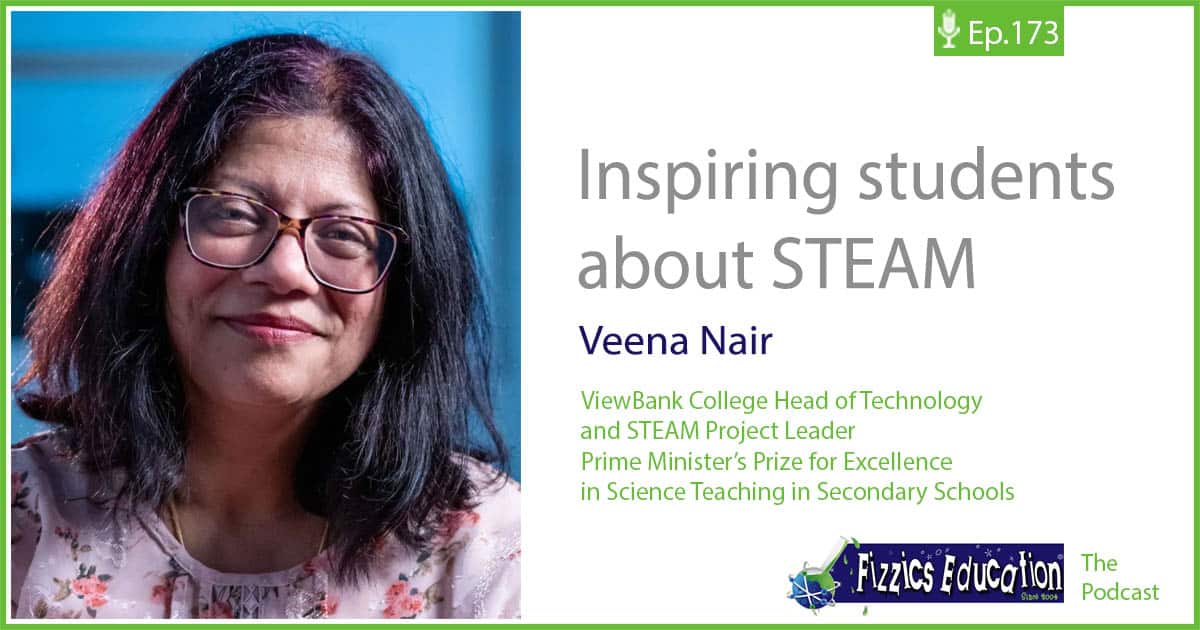
[00:00:18] Ben Newsome: Yes, welcome again to another Fizzics Ed Podcast. Glad to have you again for another chat around STEM and science and all that sort of thing. That’s what we do here. And no matter where you are around this world of ours, well, I hope you enjoy this chat with Veena Nair, who very much knows her way around science teaching. So much so that in 2022, she got the Prime Minister’s Prize for Excellence in Science Teaching. She is a Head of Technology and STEAM Teacher of the Year for DATTA Australia and many other accolades. She really knows her science teaching and loves spreading it. So that’s what this is all about, really thinking about how we can work with our students to get them to be critical thinkers and so much more. So I hope you enjoy this chat. Let’s get right into it.
[00:00:57] Announcer: This is the Fizzics Ed Podcast. We’re all about science, ed tech and more. To see 100 fun free experiments you can do with your class, go to fizzicseducation.com.au. That’s physics spelled F I Z Z I C S and click 100 free experiments.
[00:01:16] Veena Nair: So I am initially from India. Came to Australia in 2004 and have been teaching, have taught in about three countries across four curriculums. And have been passionate in STEM from childhood and have run organisations, organised my own organisation in India in implementing coding in underprivileged schools. I have been always interested in technology and the intersection of education and technology. I continue to work with a lot of underprivileged schools in India as well currently. And very big on sustainability and industry and academic partnerships with schools. I think that about sums it up.
[00:02:21] Ben Newsome: And that’s a lot to sum up in a short amount of time. Well done. But I was just thinking, you mentioned childhood and that’s often the trigger that gets people into different paths in their lives. What made you think STEM, this is for me, this is what I love, this is what I want to do? Where did this come from?
[00:02:41] Veena Nair: I was very lucky to have my father to guide me and develop that love for STEM. He was a physics professor, and he just played and taught me physics very, very unconventionally. We used to open all kinds of gadgets at home. Not every time we could put them back together. But we learnt and he taught me that it’s okay to go and experiment and look at things in a different way and try and give it a go. And that is what got me into STEM.
[00:03:29] Ben Newsome: It’s funny how it just takes, in this case it wasn’t a chance encounter, it was your family, but it’s often that mentor, that spark that really produces what we see now. You’ve worked with underprivileged schools, you’ve worked across several curriculums, and you’re still doing this to this day. How was it like, so you’re doing this work in India with underprivileged students in STEM. How were you going about that?
[00:03:56] Veena Nair: So I visit India every year to meet my family and one of my colleagues from my previous organisations, she introduced me to these schools in Mumbai where they are from very, very low socio-economic. I can give an example. There are schools in Mumbai with no toilets, about a thousand kids. And so I started talking to them and initially started conducting workshops for principals there to talk to them about design thinking, about creativity and how to develop that in their context. And trust me, it was a far more learning experience for me than it was for them. Because how do you do that? We are so conditioned to think that we need these many resources to do all of these things. But they had none. And then where do you go from there? And so you had to immediately start innovating and become creative in that space and see what they had. But what they had was enormous passion and wanting to do something different. And that is where it worked.
[00:05:24] Ben Newsome: Wow. So I’ve had the genuine privilege to be able to chat with some people who have done some work in India and in Africa in underprivileged areas. And you’re right, there’s an incredible amount of capacity within those students, but as you said, the resources are incredibly low. But then again, scarcity can make a huge difference when it comes to creating something. I think it was Leonardo da Vinci that mentioned something about that, creativity comes from being confined in a box or something like that. There’s no way that’s the right quote, but that’s the way I took away from it. Is that often it’s the rules that confine you that force you to think more. In this case, the complete lack of resources, you mentioned even a lack of simple sanitation. That’s a big deal. So what sort of things were you innovating around, ideating around with the teachers and the students in Mumbai?
[00:06:19] Veena Nair: Oh, we ran workshops where we had simple sticks, traditional toys sometimes, slingshots, creating those kind of things. Using unfortunately but useful, found everywhere these days, plastic bottles that can be recycled and used. So creating miniature greenhouses, for example, using bottles. What we worked on was how to, so slingshots have been used for thousands of years. But what is the physics behind it? You need to make that explicit and then that triggers something else and that understanding and knowledge is what you bring to that. So you go from what they are traditionally used to, the students, and then you say, “Okay, how does this work?” Because that is the question that’s not asked often.
[00:07:28] Veena Nair: And when you start doing that, you open a whole lot of knowledge libraries in their minds. Simple things, even cooking, for example, they use different, so you can talk about chemical reactions in that, how is that happening? Making simple solar cookers, those kind of things. There’s so much knowledge. You can do literally with anything that you touch, you can talk science about it.
[00:08:03] Ben Newsome: Oh, absolutely. I remember actually watching a TED Talk a little while ago, it’s quite an old one, I wish I could remember who spoke, but he did describe doing STEM out of trash. It was deliberate. It was exactly what was done and I think it was done in India. And the little devices he was showing were really cool. And obviously we sort out the hygiene side of things and that’s true, but these are discarded objects, waste, and they’re still materials that have value. I bet you as people are listening right now, think of your teacher cupboard, the teacher drawer with all the stuff. And we’re kind of like bowerbirds where people just keep on collecting things and collecting things and collecting things because I might just use it one day. And that’s true, but there’s so much stuff that’s just out there, you just need to know how to apply it.
[00:08:54] Veena Nair: Simple pins, absolutely right. What you could find in a teacher drawer. Pins, tacks, maybe a tape, sticks, anything, straws. We keep it saying that we will need it one day, you’re absolutely right. And it could go to anything.
[00:09:16] Ben Newsome: Oh, for sure. My team here laugh at my collecting mindset. There’s so many things here that, “Oh no, no, I know where it is and I’ve had it for eight years and I finally use it,” and I go, “See, that’s why I collect the thing, because I knew what I wanted to do with it one day.”
[00:09:34] Veena Nair: Yeah, I think when we sit down and really think about, “Okay, now I’ve got this project and I want to make something out of this,” that is when we focus and apply our creative brains to it. But if we don’t do that, then it just sits in that drawer and it’s never used. So we encourage them to come up and think about what they could do with what their resources were, and they were amazing, the teachers who came up with these great ideas. We gave them absolutely nothing. Things like balloons that cost nothing.
[00:10:16] Ben Newsome: Yeah, it’s awesome. So you go across there once a year, which therefore implies that you’re here a lot. So what’s your main role that you do here in Australia?
[00:10:27] Veena Nair: I am the STEM leader or STEAM leader at Viewbank College, and I’m also the sustainability leader at Viewbank College. I teach technology predominantly these days. I am trained as an electronics person. My undergrad was in electronics and maths. And my focus these days is teaching VCE Systems Engineering.
[00:11:03] Ben Newsome: How’s it go, what age groups are you tending to work with?
[00:11:07] Veena Nair: I work with predominantly secondary students. So usually Year 9 onwards is what I teach these days. I’ve taught from all year levels in my past, right from primary. I’ve taught in primary, I’ve taught in secondary, I’ve taught at tertiary, so across the whole thing.
[00:11:29] Ben Newsome: So curious, when you’re doing electronics projects, there’s a lot of different, for want of a better term, circuit boards and bits and bobs, different robotics kits and all these things exist. The shiny toys, they’re all there. But irrespective of those platforms, what makes a good STEM project? Like what makes one sing as opposed to one that might be labelled STEM and it’s not really STEM at all?
[00:11:57] Veena Nair: What a great question, Ben. People think that if they tick boxes in science or maths or technology as individual subjects that that is STEM or STEAM. But it is really the integration of all of these that makes a great STEAM project. And the most important and impactful one. Because we don’t work in silos in real life. We apply everything together and use that. So when we only say, “Okay, we are doing science and hence we are doing STEM or STEAM,” I don’t think that’s fair. I think it is really when you bring the beauty of each of these subjects into a very holistic, integrated manner, students just love it.
[00:13:00] Ben Newsome: I have a feeling that the best outputs happen when there’s a lot of grey. What I mean by this is, you know how we can have a predetermined outcome, and that’s kind of nice to be goal-oriented to solve a certain problem, and that’s a lot of these STEM projects. But sometimes it can be fun to say, “Look…” For example, right now we’re working on a project with some schools in Western Sydney and these kids are competing to put something into space next year. And that’s a serious thing.
[00:13:35] Ben Newsome: And you kind of think about it, you’ve got over 100 students, they’re all competing to be the students who got to put this thing into space. And they come out with all sorts of ideas. And they’ve got some confines. Only a certain size that this box can be, and it can only be a certain weight and all the certain rules around it.
[00:13:51] Ben Newsome: But after that, it is completely up to them what they want in that volume. We could not care what they might come up with as long as it meets the rules that makes NASA allow to fly this thing. And it’s interesting watching kids handle that versus not. Some kids love a prescriptive, “Here is my procedure, I’m going to learn how to bake a cake and now here’s my chocolate cake at the end.” I’ve used that analogy a few times on the podcast, sorry if you listen to it. But it’s true, often it’s the recipe. And those kids do fine until they’re given a blank slate. And what’s wild about “I don’t know what you’re going to create, I don’t know what your output’s going to be, just the rules are it’s got to fit in the box.” After that it doesn’t matter. Gee, we’ve had some amazing ideas come across from students that were completely unexpected. And I think that’s a lot of fun.
[00:14:42] Veena Nair: Again, a really important student agency and giving that freedom to explore. That’s the best way to empower anyone, including our students. Children of any age or learners of any age have enormous creativity in them. And we often stifle that by having this, as you say, a prescribed way of doing things. But if you just let it and say, “Okay, this is a project, come up with some ideas,” and as you said, put some constraints around it, what works. Because that also is an important learning thing that you just can’t go and do, you have to consider these constraints and things that can make your project better.
[00:15:40] Veena Nair: So yeah, I have seen exactly what you mentioned. All my classes run like that. We have an open project, students. And most often what we don’t realise is in this process when we open it to the students, the biggest challenge sometimes is finding that problem or the opportunity or the need that they can work on. To look at something and say, “How can I innovate? What can I take this further? How?” Finding that itself is a very huge creative process.
[00:16:24] Ben Newsome: Massively so. And you can find, you get those student leaders who bubble up, who in some ways were unexpected. We often expect the certain leaders of the kids to lead the students, and yet suddenly in a creative STEAM mindset, suddenly kids who may not have quote-unquote “shone” in different disciplines, suddenly they come to the fore and turns out they’re very likely to be leaders in the future.
[00:16:56] Veena Nair: Absolutely. And they develop so much confidence in that process. Because so far, maybe they’re not the typical students, as you said, who are not shining in a typical classroom with assessments and tests and all of those things. But give them this open slate and they they just thrive. And in the process, develop this huge confidence about themselves. And I found that really, really works well with girls specifically. Girls and non-binary kids and all of, like, I’m not just being, but it is very interesting to see the confidence that builds up with students. And I think that’s very important.
[00:17:44] Ben Newsome: I think you’re right on. This is 100% cumulative. It is. I mean, if you get a win, you’ve created a thing, you didn’t think you could do it, and now you’ve created a thing and it works! The thing works! Guess what, in the next challenge you’re going to be more likely to be engaged because you did it once before, you’re possibly going to be able to achieve it again.
[00:18:04] Ben Newsome: I think there’s also this other side thing that happens with these projects, which is sort of talked about, but I wish there was a bit more focus on it in some ways. Yeah, we’re doing the academic output, that is true, we are teachers after all. But there’s this other side, there’s the behavioural side, there’s the potential changes might happen with their links to community.
[00:18:27] Ben Newsome: If you’re having these kids create a thing to solve a problem in their real space, in whether it’s in their school or their community, whatever, suddenly kids are actually aware of the issues around the area. Maybe they might even be more engaged and potentially even more caretaking of the space because, I mean, if you fix, I don’t know, just say you create a stormwater catchment system or whatever it is, you’re probably going to care about throwing rubbish out the car. You’re not going to probably do it so much anymore. Like, silly things like that. It’s going to make a difference over time.
[00:18:56] Veena Nair: I think we have such a great opportunity through these projects in STEAM to make our students real change-makers and take ownership of this world as future leaders, future citizens, and contribute in that space and take that ownership that this is my responsibility, this is, you know, that collective. The other point that you touched is so important, and that is one big area where I work is also connections to community, connections to industry, connections to academia.
[00:19:44] Veena Nair: Again, as you mentioned earlier, teachers, we all work in our own classrooms, and our schools work in their own spaces. There is very little that happens with engaging with community in a real sense. Maybe there might be an incursion or something, but not in the truest sense where, you know, you have real partnerships with industry where they come in regularly, share ideas, exchange ideas and all of that. That happens very rarely. And that is something that we need to do way more often.
[00:20:23] Ben Newsome: For sure. I think about a teacher, I think Carl Euston came on the podcast a little while ago. He was describing his Grade 5 students, off the top of my head I think it was Grade 5, where they were linking with a retirement community. And this is during the building of a large rail system in Northwestern Sydney. And what they were doing is they were collecting stories of what the area was like 50 years ago and then overlaying it over the top of the various, what’s happening now in the district.
[00:21:05] Ben Newsome: And those conversations were then used by the local council, because, you know, they were effectively collecting data. But also, these kids now actually have some elderly citizens who can then be mentors in their own right. And they were running, they were actually showing the student work was showing, they were showing VR, I believe, to these senior citizens about, “Here’s what they’ve been creating in their own schools.” And it’s just that Carl’s taking the students out of the school confines to link with community in such a way like that.
[00:21:43] Veena Nair: It’s such a great story there. Absolutely great story and I wish we could do more of those. And somehow I think primary schools seem to be doing this better than secondary schools. I really hope that we can model secondary schools a little bit more like primary schools, where they’re open to going out, doing things, and engaging with community much more than what we at the moment currently do. We are so bogged down with test scores and assessments and exams at the end of Year 12 and everything seems to be directed in that direction. And I think it would be wonderful if we could do more of what primary schools are able to do.
[00:22:36] Ben Newsome: It’s so difficult. I think about what happens within a high school. That timetable won’t go away. It just won’t. The different subjects at different times and some of these, some of these have some really random start and finish times. That’s my own bugbear. Why are we starting this at 11:23? Like who designed that timetable? That’s a different side thing. But anyway, you’ve got this timetable so rigid. And I’ve got this funny feeling, and I’d love to know what your thoughts are, it’s not like there’s a lack of wanting to do it, it’s the structures we put in front of ourselves that are impeding the progress that we want to make happen in the first place.
[00:23:16] Veena Nair: Absolutely right. And the timetable, the rigidity of the timetable is really, really something that I don’t know how we can get past. But what we have trialled at our school since last year is join two subjects together, or three subjects together. Art, design and tech, and science in Year 7. And it is all project-based. And students learn skills, they explore skills. We have connected with our local tech school, the Banyule Nillumbik Tech School.
[00:23:59] Veena Nair: And students go there for a day to just get some skills, design skills, 3D printing, just for a couple of days actually, two days. And one of the projects that they work on is the Protein Database project. So they choose a protein. So they do some research, they understand what proteins are. They develop an idea in teams of how they want to project or portray that protein. It could be an art piece, it could be a mix of art and tech, it could be anything really, in any material that they want.
[00:24:49] Veena Nair: So it could be a painting, it could be an installation, it could be anything. And they use 3D printing, they or they can use 3D printing, sewing, I mean, as I said, anything that they really want to. And in the process, learn a lot more about proteins and how they are part of our bodies, not only our bodies but animals and plants and everywhere else, and learn to use tools and technology and art in the process. So we have tried to navigate through that process a little bit.
[00:25:37] Ben Newsome: That’s quite an undertaking. You say it so casually, “Oh, yeah, we just amalgamated three subjects together, no problem, and off we’re going to do this.” There’s a lot of effort in that, and a lot of getting people on board, almost like an intra-marketing thing, so to speak, within the organisation to be able to do this. That would have taken some time. Well done. And so, I’d love to know, advice, if you had some people listening in on this who would love to even embark on said project, what would be some steps to take to ensure its possible success?
[00:26:16] Veena Nair: I think the first thing that we did, and that’s probably the advice we would give, is connect with a really passionate scientist who actually brought this project to us. And then developed a really, skill up of our own teachers. Explain why we are doing what we want to do, how it can help students. And when we started, we trialled it with one class first, with a senior class, so it was a little bit easier. Saw the results, was very encouraged by those results because those projects were then exhibited in UK, in a European exhibition.
[00:27:08] Ben Newsome: So those things, those small touchpoints of achievement really helped in, as you said, intra-marketing. Yes, so to speak, I know I kind of didn’t want to say it, but it is, you’ve got to get people on board in your organisation before something’s going to happen.
[00:27:30] Veena Nair: Absolutely. And it’s still in progress. It’s not that everything goes smoothly because teachers, all of us want, we play to our strengths, and that’s natural. And getting us out of the comfort zone is a bigger challenge than students. Because students come with this white canvas, they’re ready to take on anything, at least at Year 7. And so really sometimes it is us as adults that need to learn from them as to how to take on these risks.
[00:28:07] Veena Nair: And letting go sometimes in a classroom, saying that, “Yes, this is your space and I’ll be there to guide you and support you rather than explicitly be there and you listen to me and I…” You know, that kind of thing. So that shift is the most difficult one most times. And it comes with practice and it comes with support and encouragement to our teachers that it’s okay to fail. I think that is the most important thing that we need to teach all of us, that it’s okay to fail.
[00:28:45] Ben Newsome: And you know what, the world won’t end if you’re in Grade 7 and you did fail said design, art, STEAM project thing with proteins, etc. Did it really matter in Grade 7? Did it really, really matter? That learning, that failure is the learning.
[00:29:05] Veena Nair: Absolutely. And that is the thing that I, when you were talking about the space programme, it’s not about the competition or who goes, comes first. But look at the learning journey that has happened. And that is the biggest achievement in this process. You will never forget that experience. But if I ask anyone, “What did you learn in Grade 9 maths in Week 2?” I don’t think anyone can tell.
[00:29:36] Ben Newsome: No, not at all.
[00:29:38] Veena Nair: But they will remember the experience. They will remember what they learnt overall. And that is the lifelong achievement for all of us.
[00:29:52] Ben Newsome: Absolutely. And we’re actually with that competition we’re playing with, this is with the Powerhouse One project we’re working with a few different groups from Magnitude.io, STEM Industry School Partnerships and whatnot with six Western schools. Once the so-called winning design is chosen, guess what? All the six schools then are coming together to work together to improve said project. So there is no real losers, winners, etc. because you all come together and now you’re all working on the same project to make it even better, which is closer to what actually happens.
[00:30:27] Veena Nair: Yeah, absolutely. Absolutely. And it’s so important to take that feedback on, that’s another skill, that, “Okay, this is the best idea here for these reasons, and now let us together work and, you know, it becomes our project rather than your and mine project.”
[00:30:45] Ben Newsome: Exactly. And it’s interesting watching the mindsets of kids who are used to just competing like it’s a 100-metre race.
[00:30:52] Veena Nair: Yes, because that’s what we have been used to, right, all our lives, that it’s you versus me kind of a thing. And we need to move from that and get into more collaborations.
[00:31:03] Ben Newsome: Exactly right. No, I agree. Well this has been really fantastic having a chat with you, Veena. Really good. It’s a good way to energise myself at the end of the week for sure. And so I’m actually curious, what are you doing today with the work that you’re doing and into next week?
[00:31:18] Veena Nair: So today I’ve got my Year 10s and Year 12s and I’ve asked, they have started to work on their projects, some very interesting ideas being done. And I am going to start planning for my week ahead, really.
[00:31:36] Ben Newsome: That sounds like a normal teacher’s world, very much the case. I know that feeling.
[00:31:42] Veena Nair: And I must say, we do run, again the other thing that looking at planning is also a conference that we do every year, every second year. So which is the STEAM Futures Conference, which is again tied to industry and academia coming together with school educators to know what is happening currently in these fields and then what we can take back. So that’s the planning that I need to start doing with my students.
[00:32:14] Ben Newsome: It’s always the case, isn’t it? You’re often thinking six months ahead whilst you’re trying to deal with today. Pretty much the case. I know that feeling. Oh, Veena, this has been fantastic. Hey, there might be some people who would love to know how to get in touch with you to learn more about what you’ve been doing and all that sort of thing. How would they best reach out to you?
[00:32:34] Veena Nair: The best way is to connect me via LinkedIn. I’m very active on LinkedIn. So if you look me up with my name, I’m pretty sure you will find me at Viewbank College or in STEM fields somewhere.
[00:32:53] Ben Newsome: Easy. And as usual, I’ll put those links in the show notes so you’ll always be able to find those. But thank you very much. I hope you have a fantastic morning. I am going to go teach a forces programme to a school in Queensland.
[00:33:07] Veena Nair: That sounds really, really very interesting. I wish I could join you for there, but I’ll be looking out. And thank you so much for this opportunity. It was wonderful talking to you, Ben, and you’re doing such a great work. Keep it up. Thank you so much again.
[00:33:22] Ben Newsome: Oh, thank you so much. Catch you another time.
[00:33:25] Announcer: We hope you’ve been enjoying the Fizzics Ed Podcast. We love making science make sense. Why don’t you book us for a science show or workshop in your school? If you’re outside of Australia, you can connect with us via a virtual excursion. See our website for more.
[00:33:41] Ben Newsome: So I hope you enjoyed that chat with Veena Nair. She very much loves getting kids engaged in critical thinking, in science itself. And that is very much one of the reasons why she did get the Prime Minister’s Prize for Excellence in Science Teaching in 2022. Love her work. So I hope you enjoyed this chat. And as usual, there’s more coming up on this podcast. So you’ve been listening to me, Ben Newsome at Fizzics Education. This is the Fizzics Ed Podcast and I hope to catch you another time.
[00:34:08] Announcer: You’ve been listening to another Fizzics Ed Podcast. We’re excited about science. Subscribe to us on iTunes to download the next episode as soon as it’s released. And don’t forget, for hundreds of ideas, free experiments, our new Be Amazing book and more, go to fizzicseducation.com.au. That’s physics spelled F I Z Z I C S.
[00:34:35] Announcer: This podcast is part of the Australian Educators Online Network. AEON.net.au.
Frequently Asked Questions
What is the key to a successful STEAM project?
According to Veena Nair, a truly impactful STEAM project requires the holistic integration of all subjects rather than treating science, technology, engineering, arts, and maths as silos. When students see the beauty of how these disciplines intersect to solve a real-world problem, they become much more engaged and the learning becomes more meaningful.
How can teachers implement STEM with very few resources?
Scarcity can actually be a catalyst for creativity. By using found objects and recycled materials—such as plastic bottles for greenhouses, balloons, or simple sticks and pins—teachers can make science explicit. Even a traditional slingshot can be used to teach complex physics concepts, showing that you can talk science about almost anything you touch.
Why are community and industry partnerships important for schools?
Partnerships with industry and academia take learning out of the classroom confines. These connections provide students with mentors and real-world context, helping them see themselves as change-makers. It moves education from a theoretical exercise to a practical contribution to society.
How can project-based learning help students who don’t excel in traditional tests?
Open-ended projects with student agency allow learners who may not shine in traditional assessments to find their voice. By removing the “recipe” and providing a blank slate with some constraints, students develop enormous confidence and leadership skills that are often missed in typical classroom settings.
How can high schools overcome the rigidity of the timetable for STEM?
One approach is to amalgamate subjects for specific year levels. For example, combining Art, Design & Technology, and Science into project-based blocks allows students to work on integrated projects (like the Protein Database project) without being interrupted by a traditional period bell every hour.
Extra thought ideas to consider
The Value of Failure in the Learning Journey
In a creative STEM environment, failure should be normalised as a crucial part of the discovery process. While students might remember a specific failure in a Year 7 project, that failure is where the real learning happens. It is important to shift the focus from the final grade to the overall experience and the resilience built along the way.
From Competition to Collective Collaboration
Shifting student mindsets from a “100-metre race” competition to a collaborative effort mimics how modern industry actually works. By having different student groups eventually come together to improve a single chosen design, schools can foster a sense of collective ownership rather than individual winning.
Discussion points summarised by AI from the FizzicsEd Podcast, verified and edited by Ben Newsome CF