Transcript
[00:00:00] Announcer: You’re listening to the Fizzics Ed Podcast. For hundreds of ideas, free experiments and more, go to fizzicseducation.com.au. And now, here’s your host, Ben Newsome.
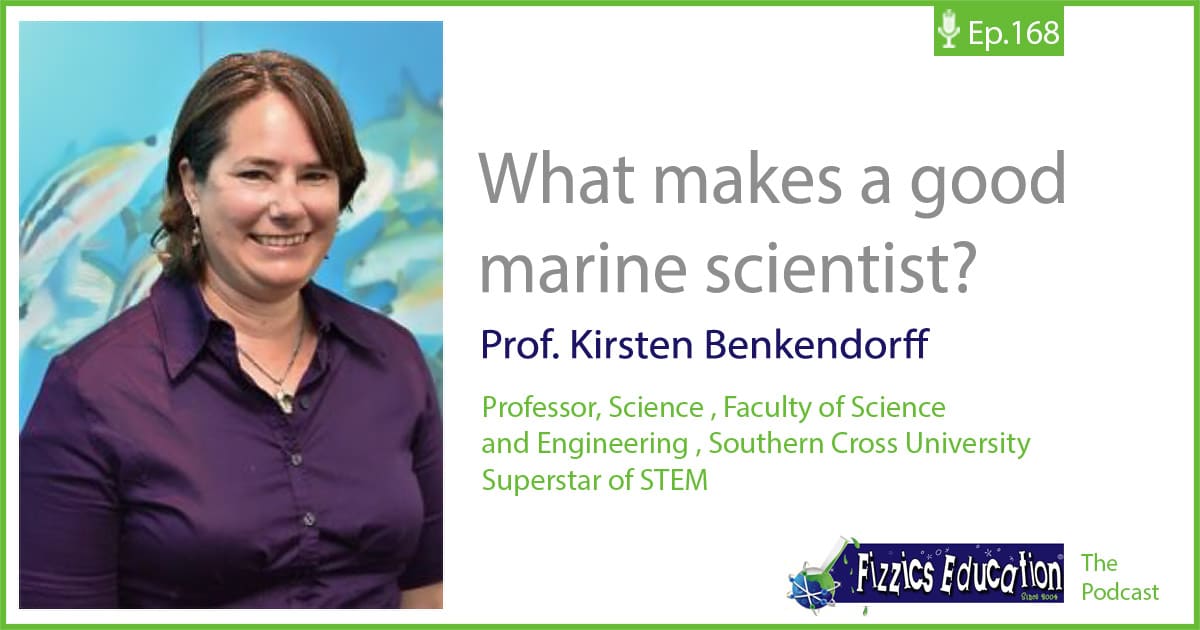
[00:00:18] Ben Newsome: Welcome to another Fizzics Ed Podcast. Glad to have you again for another chat around STEM, and today we’re hanging out with someone who is highly passionate about inspiring students for her passion in marine biodiversity. She is very, very good at helping students really understand how to do evidence-based research, and she is very passionate about making sure that our fisheries and aquaculture industry is sustainable and healthy. We’re hanging out with Professor Kirsten Benkendorff from Southern Cross University, and today we’re going to learn just how she thinks about how science should work and how she works with a whole bunch of different teams to make sure her research really makes best benefit for us and the environment. Let’s find out more.
[00:00:58] Announcer: This is the Fizzics Ed Podcast. We’re all about science, ed tech and more. To see 100 fun free experiments you can do with your class, go to fizzicseducation.com.au. That’s physics spelled F I Z Z I C S and click 100 free experiments.
[00:01:16] Ben Newsome: Hi Kirsten, welcome to the Fizzics Ed Podcast.
[00:01:18] Prof. Kirsten Benkendorff: Thanks for having me.
[00:01:20] Ben Newsome: Thank you for coming along, especially during the peak of flood monitoring. Is it a bit busy for you?
[00:01:27] Prof. Kirsten Benkendorff: Yes, it’s a bit over a year post those significant floods in the Lismore area and we’re really trying to get out on country and collect data to see how these systems are actually recovering.
[00:01:41] Ben Newsome: That’s fascinating. A long time ago I did an undergraduate degree in environmental biology, so I have a little bit of an inkling about where you’re going with this. But I’m curious, that’s not the only thing that you do with marine work. Kirsten, what do you do?
[00:01:55] Prof. Kirsten Benkendorff: What do I do? Good question. At the moment, the post-flood monitoring is really looking at the invertebrates in the sand. We’re looking at little things like worms, bivalves, crustaceans as bio-indicators to test out the health of the system. We’re also looking at contaminants in the sediment, whether there’s heavy metals and other things that might have come down in the flood. So that’s one of the projects that we’re looking at.
[00:02:22] Prof. Kirsten Benkendorff: In addition to that, I’m really interested in looking at generally the health of seafood, how that contributes to human health, and how what we do in our natural environment impacts the health and safety of the seafood that we eat. Just trying to make everyone understand that there’s a strong connection between the land and the sea, and what we do in these catchment areas above where we grow our seafood can actually get into the environment and impact both the safety and health of the seafood there as well. That’s my broad research programme around the health of the environment and the health of our seafood.
[00:02:58] Ben Newsome: What’s interesting is as we have a chat, we’ll timestamp this conversation, it’s 2023 in the middle of the year and a bit over a year since the Lismore floods and you’re looking at that flow-on effects. What’s your guess about how long these effects might last, whether they’re good, bad, or in between?
[00:03:16] Prof. Kirsten Benkendorff: It’s interesting because the extent of the impact depends on not only the flood in that particular catchment, but how healthy the system was before the flood, and the multiple stressors. What else is going on in that particular estuarine system at the time? We’re studying six different estuaries. One of those is in the National Park, the Sandon River. It’s a lovely pristine system, and we did find higher diversity in there and not a lot of evidence of flood impacts straight after the flood compared to the other sites.
[00:03:52] Prof. Kirsten Benkendorff: Upstream, where the marine and freshwater are still mingling, those highest sites upstream tend to have really heavy layers of silt. The first time we sampled some of those sites in Brunswick River and Richmond River, we were sinking up to our chests in mud. It was just like swimming through this fine sediment of mud, and sampling with our corer, we could actually see layers of where the seagrass should have been and the compacted dead seagrasses. We could also see sometimes these red layers, which was where some of that terrestrial soil had come in. You could just see it when you were sampling.
[00:04:36] Prof. Kirsten Benkendorff: As you move down towards the mouth of the estuary, the impacts aren’t as great because the flushing with the ocean happens much more quickly, and so recovery at that end of the estuary seemed to be much faster. The estuaries are starting to resettle, but I think we do still have ongoing persistent impacts in estuaries like the Richmond River where there is a lot of runoff from sugarcane and other industries on land, and of course clearing of that riparian vegetation, which is a big problem.
[00:05:04] Ben Newsome: Well, as I think about talking about Australian mainland at this point. There’s a lot of river systems! There’s a lot of estuaries! And that’s a lot of sampling to do. How do you deal with that?
[00:05:16] Prof. Kirsten Benkendorff: I can’t possibly cover all the estuaries. I’m working on the mid-north coast to the north coast of New South Wales. Even getting up and down those six estuaries is a pretty big effort, particularly when some like the Clarence River are just massive systems. It’s a really big river. The Department of Primary Industries is now looking at expanding this sampling further down the south coast and looking at other aspects of the environment like the fish populations as well.
[00:05:48] Prof. Kirsten Benkendorff: One thing that we realise is that we don’t have good baseline data. That was one thing that surprised me. I couldn’t look at flood impacts because we didn’t have before data in most of these estuaries. In some of them we do have some data, but there’s usually just a few little patches of data from ten years ago, eight years ago, and no consistent sampling or monitoring. It’s tricky when you’re dealing with shifting baselines. You don’t know what’s normal and what is the point of recovery. When can you say it’s recovered if you don’t actually have that preliminary or initial data? There’s a need for more work, and it looks like the Department of Primary Industries Fisheries is definitely going to try and expand that to get more baselines for the future.
[00:06:26] Ben Newsome: That’s going to be quite the project. I was thinking as you were describing this, some people listening in would have definitely heard of Sydney Water Streamwatch. It’s been around for many years and did a lot of stuff in freshwater environments, not so much estuarine and marine. A lot of baseline data gets collected by schools of different age groups. Is this an area that could grow into this with some of the ecosystems that you’re dealing with?
[00:06:49] Prof. Kirsten Benkendorff: Definitely. There is the Streamwatch programme where a lot of people are looking at the macroinvertebrates in streams. With respect to the water quality data, often the data that’s collected is just temperature, pH, salinity, those types of things. It’s not necessarily picking up all the impacts of nutrient runoff, though the changes in pH are actually something that probably can be detected with respect to acid sulphate soils. So definitely something school groups can get involved in. It changes day and night in the estuary as well because you’ve got these respiration and photosynthesis cycles, so it’s good to get night data as well.
[00:07:30] Prof. Kirsten Benkendorff: I think turbidity is something that school kids could definitely collect. That’s where we think about a nice healthy system when we can see nice clear water. If you’ve got too much sediment in the water, it appears quite turbid. That can be measured quite easily with a turbidity tube. It’s pretty cheap to do and I think pretty important to collect data that way.
[00:07:56] Prof. Kirsten Benkendorff: Collecting data on the organisms themselves is interesting. We’ve been out in some mangroves looking at some options with the Gumbaynggirr Rangers out there. Things that live in the sediment are really interesting, but whether you can identify them all back in the lab is a challenge. One thing that we’ve found is a good little indicator are the soldier crabs. You can see all the soldier crab holes and their activity on the top of the surface, but you can also do a core and you can sieve them and the little soldier crabs run around. You could have fun picking out the soldier crabs and actually counting how many you get in a certain area in the sand.
[00:08:36] Ben Newsome: Oh definitely, you’ve actually tweaked a very distant memory of mine. In late final year undergraduate, I spent a week in Jervis Bay and we were doing mark and recapture with red-fingered crabs, and there were two others, the semaphore crab and one other. But I remember doing it and I was stunned about the sheer number of these things!
[00:08:58] Prof. Kirsten Benkendorff: And definitely they can be very dense and they’re turning over the sediment. They’re actually keeping it aerated, they’re keeping the nutrients cycling through the system. And they’re a sign of a good healthy system, because one of the things that we’ve been looking at is this mangrove die-off in Boambee Creek. The sediment is black and quite compacted and smelly and not nice. The soldier crabs just aren’t there, and actually all of the crabs throughout that forest are just not there. So they’re definitely an indicator that there’s something going wrong in that particular forest.
[00:09:37] Prof. Kirsten Benkendorff: It’s good when you’ve got little critters that you can see. Some of those bigger crabs with their sharp claws are not necessarily the ones that the kids are going to want to pick up, the big mud crabs. But little soldier crabs, they’re really gentle and they’re super cute, so definitely encourage looking at them.
[00:09:52] Ben Newsome: Oh, for sure. We had to be really careful in the pneumatophores and frankly, oysters while we were digging around! It was a really good example of students at the tertiary level trying to do our job properly, but let’s be honest, there was bias. If you had a marked crab and you could see it, guess what you were going to try and do? Which is a bit of a conversation. As you design your projects, and these are real research projects that are feeding towards the DPI to think about how they might manage catchments, how do you manage bias so it’s done properly?
[00:10:28] Prof. Kirsten Benkendorff: It is all about standardising the methods. I think it’s actually really important whenever you’re planning a new project, the first thing you’ve got to do is get out into the environment and observe what’s possible and trial some things that might work. When we first started the post-flood monitoring, we thought we might drop a grab off the boat and collect some sediment. Apart from the fact that it wasn’t safe, so there were OH&S issues with the size of our boat and the grab, the grab wasn’t grabbing consistently. It depends on the coarseness of the sand. If you’ve got more shell grit or if you’ve got fine sediment, the fine sediment was just trickling through.
[00:11:04] Prof. Kirsten Benkendorff: But we wanted to sample that fine sediment because that was the flood impact. So we changed to these hand corers which is really low-tech technology. They’re just PVC pipe with a little plug on the top and you drill it into the sand and pull that core up. Simple methods that actually really worked because it’s absolutely reliable. We set the depth that we want to sample at and do four transects and the three depth levels and you standardise that according to the height of the tide and various other things.
[00:11:35] Prof. Kirsten Benkendorff: So it is about trialling things in the first instance, planning. Always those preliminary studies, I think, are really important. Then going with what works and what you know that you can repeat over time or over space or both, if that’s what you’re trying to do. It’s really repeatability I think that matters.
[00:11:53] Ben Newsome: Oh, for sure. I was thinking about some of the work that gets done by high school teachers around the country. We want to be able to emulate what gets done with biological programmes. If you’re listening in, there should be certain buzzwords grabbing your head like transect, bio-indicator and various other things. These things actually happen in the real world! And so as we design this… I guess the challenge is, it’s good that you mentioned WHS, the safety aspect is a reality. And you’re dealing with water. It’s kind of important with that. So when you do this sort of work, how much… when you say baseline data, before you can make a decision that something’s actually occurring in the environment? Are you looking over a year, two years, multi-years before you go, ‘this is specifically, it’s within confidence limits that there is genuinely a problem’?
[00:12:40] Prof. Kirsten Benkendorff: It just depends on the study. But if I take my Woolgoolga Lake study for an example, there we did 10 surveys over a year’s period and we were sampling in different conditions. After rain runoff events and dry events and when the lake was closed to the open and when it was open to the ocean.
[00:13:00] Prof. Kirsten Benkendorff: It was very interesting to find that for example over 80% of the days, the bacterial levels in that lake exceeded Australian guidelines for safe swimming. 100% of the time it exceeded safe guidelines for collecting shellfish. When you’ve got those national guidelines to compare the data to, that’s where looking at nutrient levels, the bacterial levels are quite interesting and again something potentially that could be done with teachers and schools.
[00:13:30] Prof. Kirsten Benkendorff: You can get the plates that you can do the very standardise method for counting faecal coliforms in these water samples. It gives you some idea of what’s going on. It’s always good to have a comparison. There have been studies of course that show that unless you’re actually looking for human pathogens, they could have come from dogs or seabirds or other such things. Again you need to observe what’s going on in the environment. If you’re looking at a stormwater runoff and you’re sampling upstream and downstream of it, it could give you some sort of indication.
[00:14:00] Prof. Kirsten Benkendorff: In terms of how long you need to study, it depends on what you’re trying to find and the level of natural variability. What we’re always trying to determine is what is that baseline, what’s natural. You need to get some sort of indication of whether it varies across the year in different seasons and then see if we can actually detect an impact over and above that.
[00:14:24] Prof. Kirsten Benkendorff: When the big monitoring studies haven’t been done, it’s actually harder to know and you’re usually restricted by what’s feasible. What can you realistically do in this timeframe? We found that three sites in six rivers was actually all we could do in a sampling period logistically and even that’s actually pretty hard work. It’s not just getting out into the field and getting the samples, but when you’ve got those samples you then need to process them.
[00:14:51] Prof. Kirsten Benkendorff: We’re sorting through these samples in the microscope and that takes months. You’ve got to think what’s feasible to do as well, and you’re better off with less good quality data than a bigger data set that’s compromised or you don’t finish. That’s another factor that you’ve got to put in.
[00:15:10] Ben Newsome: Bite off what you can and chew as quickly as you can!
[00:15:13] Prof. Kirsten Benkendorff: Exactly.
[00:15:15] Ben Newsome: It sounds very… it is, it’s multidisciplinary. There’s so many different levels. In just a couple of minutes you moved from microbiology, after talking about hydrology, geology and everything else. It’s difficult. So in the world of tertiary land, do you have to work across multiple faculties to be able to produce a large report? Or is this something that if you work with six rivers it’s done within your own team?
[00:15:43] Prof. Kirsten Benkendorff: This one is done within my own team, but I am multidisciplinary. I started my undergraduate in biology and I did a PhD that was biology and chemistry, although more natural products chemistry. It just happens that the skills I have in natural products chemistry also apply to looking for pesticides and things like that so I have an understanding of that.
[00:16:05] Prof. Kirsten Benkendorff: Over time I’ve come to realise that to really look at environmental health, understanding these other components—nutrients and the sediment type and doing these metal analyses—all of those types of things are quite important. Some of these samples that we collect we contract out to the Environmental Analysis Laboratory, so they’re the experts on the machines that can produce some of those data and then we need to be able to interpret and analyse the data.
[00:16:38] Prof. Kirsten Benkendorff: I’m probably more multidisciplinary than a lot of people just because of the path that I’ve taken and the various interests that I have. But in science we can always collaborate and I think you do get the best work done when you work as a collaborative team where people are really joining their different skill sets for the one purpose. You’ve got the same outcome that you want, but everybody’s contributing their expertise into that and there’s a lot of opportunity to do that in environmental science.
[00:17:05] Ben Newsome: Speaking of the many disciplines, you’ve been very privileged to be able to hang out with some amazing people with Science Technology Australia through the Superstars of STEM programme. What’s that been like?
[00:17:15] Prof. Kirsten Benkendorff: It’s a fantastic programme. I think just in one part to see all of the other fantastic women in science in Australia. They’re really inspiring just to hear what everybody’s doing. Also, I think there’s a good opportunity through those peer groups to share experiences. I’m probably one of the older in the group, so I’ve had this longer academic career, so it’s nice to feed back my experiences and hope that that might help some of the others.
[00:17:45] Prof. Kirsten Benkendorff: We’re just starting a mentoring programme and I’m really excited to start the mentoring. I’m actually hoping that through that not only can I gain personal advice but that I can learn to become a better mentor as well. So, really appreciate the opportunities provided through that group.
[00:18:05] Ben Newsome: Massively so. And there’s a lot of time spent with mentoring for sure. I was wondering as you were saying that, what are some of the challenges of juggling all of the different things that are on your plate and being able to mentor as well at the same time?
[00:18:17] Prof. Kirsten Benkendorff: It is a challenge. I’ve certainly been prioritising mentoring of my HDR students, so Higher Degree Research students. I have 10 PhD students at the moment and I’ve got a couple of undergraduate interns working in my lab as well. I really love that nexus of education and research and where we can teach people to become better researchers, so I put a lot of focus into that.
[00:18:44] Prof. Kirsten Benkendorff: But it is hard to balance all of the things that we’ve got to do in our general day, particularly in teaching terms. I teach invertebrate life as my main unit and I absolutely love it. I’ve always been inspired by invertebrates and being able to inspire other students to love and appreciate invertebrates is really great and learn taxonomy in the process.
[00:19:07] Prof. Kirsten Benkendorff: I do have to make all of my students aware that that’s the time that I really need to be focusing in on the teaching side of things and we juggle things around. But the reality is that the research never stops. You can’t predict when a new paper comes back that just needs some revisions to go back to the journal and you’ve got to keep all of these things progressing simultaneously. Let’s just say I’m lucky that I’m an insomniac.
[00:19:33] Ben Newsome: Yeah, I figure we sleep when we finally rest eventually but I absolutely agree. Actually I was just thinking there’s something I’d like to have a chat about. There’d be people listening here who teach from Grade 1 and there’d be people dealing with Grade 2 through to 12, tertiary and whatnot. But no matter what, we’re all science people who are going to listen to a podcast like this. So, what makes a good scientist?
[00:19:57] Prof. Kirsten Benkendorff: Interesting. I think a good scientist is really somebody who can not only think of the good ideas—ideas are cheap, they’re all over the place. But it’s actually thinking of a way that you can design an experiment to produce new knowledge that is actually sound. There needs to be rigour in that process.
[00:20:23] Prof. Kirsten Benkendorff: Being able to design a rigorous experiment or a rigorous approach towards really supporting a hypothesis or discovering something new. And it is the follow-through. If I think about the characteristics that I appreciate that I’ve got as a scientist: an analytical mind, so actually being able to analyse data, but also very observant. Being able to observe nature inspires a lot of the ideas that I come up with.
[00:20:53] Prof. Kirsten Benkendorff: But then following that through with the rigorous design and interpretation. It takes a fair bit of commitment. I don’t know if that answers the question, but yeah.
[00:21:05] Ben Newsome: No, you have, absolutely. And some of the things that I’ve heard echoed with other people before too. You’re right. Gosh, I have, and some people who know me definitely know, I have a lot of ideas all the time. It doesn’t mean I’m actually going to do them! But they’re out there. But it does, it’s the follow-through and the rigour I agree for sure. So if you had a bunch of teachers or educators in front of you and you were imparting ‘here’s how to go about said process’ to be able to produce at the end of their courses scientists with some rigour, what would be some steps that you’d hope for them to at least encourage within their students?
[00:21:44] Prof. Kirsten Benkendorff: I think the first step is to observe and question. I think that’s actually to encourage people to question. And then to think about the alternatives. You’re thinking that that might be the answer, but what are the alternatives? Because a good experiment is designed when you can actually rule out the alternatives. How are you going to control that information so that you can actually demonstrate that it is this and not that?
[00:22:12] Prof. Kirsten Benkendorff: Thinking about design. I think that science is quite a creative process from that perspective. Teaching them the importance of numbers, not to be scared of the maths. I see it as a really important tool, that data is really important. Being able to manage that data, being able to take care and check. I’m kind of one of those supervisors that likes to see the data sets of my students because I can usually see if there’s an error in the data there, do some preliminary data analysis.
[00:22:45] Prof. Kirsten Benkendorff: I guess one thing that I didn’t mention about being an important scientist is also actually being able to communicate that science. So encouraging students to observe nature, come up with some questions, think about how they want to test that and then being able to share that information with others is really important.
[00:23:11] Prof. Kirsten Benkendorff: They mightn’t have the equipment to do the full experiment, but thinking about those design elements, because as we move through our careers in science we realise that we don’t have all the answers ourselves. There’s a whole world out there of other people that you can collaborate with. Having a firm idea of how you want to achieve something is really important, the first step that can get you the right people and link you up with the right equipment.
[00:23:36] Ben Newsome: Oh, for sure. I’ve been involved in quite a few high school programmes over the years and one of the things that we like to put on the end of it if we have a chance is some form of pitching thing to be able to say, ‘imagine you were getting funding for XYZ’. Often the students will go another shade of pale, thinking about having to actually do this. But I’m sort of like, at some point you want to advocate on behalf of what you’ve just done, because it might actually benefit the community. Here’s an idea, because that’s actually the role, or the environment or whatever it is that you’re doing. You want to keep funding to be able to keep the research going. This really is a skill and it does take some time. I’m glad that you mentioned that because the communication side, it does take time to develop like every other discipline, but it does matter and also it does bring rewards if you can do it.
[00:24:21] Prof. Kirsten Benkendorff: Definitely, and just to put it out there, I was pretty introverted as a kid. I was a pretty shy student and not outspoken. But I had ideas and I really pushed myself through that barrier of being able to stand up and speak out. I think it’s one of those things that you just improve with practice. It’s absolutely confidence building, and sometimes you’ve just got to put yourself in those uncomfortable positions and push through it, and it’s absolutely worth it when you do.
[00:24:55] Ben Newsome: Fantastic, absolutely. Now there’ll be some people here who’d love to know just a bit more about what you’re doing especially with marine ecology because there’s a lot of it going on and they might just be fascinated about what’s been going on with the floods and what you’ve been learning. So, how would they get in touch?
[00:25:11] Prof. Kirsten Benkendorff: I guess I’m at Southern Cross University so that’s probably the easiest way to track me down, at the National Marine Science Centre, which is part of Southern Cross University. Certainly you could find me, my email is my name, [email protected], so that’s certainly one option for tracking me down. But yeah, easiest to contact by email.
[00:25:36] Ben Newsome: Easy. And as normal we’ll put those links in the show notes. I actually have been to the Marine Science Centre years ago when I was wearing a different badge with CSIRO. Long time ago. It’s a very nice spot and if you get a chance to go up the Northern New South Wales it’s worth checking out for sure.
[00:25:52] Prof. Kirsten Benkendorff: Absolutely, so we have a Solitary Islands Aquarium which is open on the weekends and public holidays and certainly school groups can also book tours to come in and see the Solitary Islands system which shows off the East Australian Current and the different subtropical and more temperate systems that we get along the coast here, so it’s pretty nice.
[00:26:13] Ben Newsome: Oh for sure, and it’s nice that you mentioned that, so those people listening overseas, yes we did just say the EAC, reference finding Nemo. It’s a real thing! Actually a good friend of mine was doing work with fisheries and you’d probably know Professor David Booth at UTS… he does a lot of work and is noticing that subtropical fish are turning up down in Sydney which is rather odd because we’re not subtropical really.
[00:26:38] Prof. Kirsten Benkendorff: Yeah and we definitely get Nemo overwintering here on the Solitary Islands now, which we were kind of the southern limit of distribution and they’d come down in warmer climates and not stay all year round, but definitely a lot of evidence that more species are coming down and persisting and breeding here as well. Things are changing, no doubt about it, but we’re a really important little pocket, a stepping stone for some of those more temperate systems.
[00:27:06] Ben Newsome: And done with rigorous research, and the data is real because the data has been collected. It shows what’s happening. Thank you very much for popping on, it’s been a real pleasure.
[00:27:16] Prof. Kirsten Benkendorff: My pleasure, thank you very much for having me.
[00:27:19] Announcer: We hope you’ve been enjoying the Fizzics Ed Podcast. We love making science make sense. Why don’t you book us for a science show or workshop in your school? If you’re outside of Australia, you can connect with us via a virtual excursion. See our website for more.
[00:27:37] Ben Newsome: So, I hope you enjoyed that chat with Professor Kirsten Benkendorff. I certainly did, and guess what? You can collaborate and connect with her. She really wants you to. If you love your marine science and you want to conserve it, protect it, and all that sort of thing, well worth reaching out to her on her email that she gave. As usual, we do put those links in the show notes, please reach out to her. Also go find out about her research portal, there’ll be a link in there too. Her and her team have produced over 150 scientific papers and it’s still ongoing. There’s a lot of work to be done with influencing policies on water quality management, pesticide regulations, and all the work that’s needed for keeping our seafood safe and healthy. So, I hope you enjoyed this chat. I certainly did, and there are more coming up on the Fizzics Ed Podcast. So guess what, you’ve been listening to me, Ben Newsome from Fizzics Education. This is the Fizzics Ed Podcast and I hope to catch you another time.
[00:28:27] Announcer: You’ve been listening to another Fizzics Ed Podcast. We’re excited about science. Subscribe to us on iTunes to download the next episode as soon as it’s released. And don’t forget, for hundreds of ideas, free experiments, our new Be Amazing book and more, go to fizzicseducation.com.au. That’s physics spelled F I Z Z I C S.
[00:28:53] Announcer: This podcast is part of the Australian Educators Online Network. AEON.net.au.
Frequently Asked Questions
Why are invertebrates like worms and crabs used as bio-indicators?
Invertebrates that live in the sediment, such as bivalves and crustaceans, are excellent indicators of ecosystem health because they are relatively stationary and reflect the cumulative impact of their environment. By monitoring their diversity and abundance, scientists can detect changes in water quality or the presence of contaminants like heavy metals.
What is “baseline data” and why is it often missing?
Baseline data represents the “normal” state of an environment before a major event occurs. Kirsten notes that many Australian estuaries lack consistent, long-term monitoring, making it difficult to determine exactly how much damage a flood has caused or when a system has truly recovered to its original state.
How do land-based activities affect our seafood?
There is a direct connection between catchments and the coast. Runoff from agriculture, industry, and urban areas carries sediment, nutrients, and chemicals into estuaries where seafood is grown or caught. This can impact both the health of the marine organisms and the safety of the seafood for human consumption.
What are the benefits of using “low-tech” tools in field research?
While advanced technology has its place, simple tools like PVC pipe hand corers are often more reliable in challenging environments. They allow for highly standardised and repeatable sampling, which is crucial for ensuring data rigour and allowing different teams to compare results accurately over time.
How can schools contribute to marine science monitoring?
Students can participate by measuring water turbidity using simple turbidity tubes or by conducting biodiversity counts of accessible species like soldier crabs. These observations help build local data sets that contribute to a broader understanding of how estuarine systems change across different seasons and conditions.
Extra thought ideas to consider
The Shifting Baseline Syndrome
Consider how our perception of a “healthy” environment changes over generations. If we do not have data from decades ago, we might accept a degraded system as the new normal. How does this impact our long-term conservation and restoration goals?
The Role of Creativity in Experimental Design
Science is often seen as rigid, but designing an experiment that can effectively rule out alternative explanations requires significant creativity. How can we encourage students to think more creatively about the “controls” and variables in their own scientific enquiries?
The Value of Multidisciplinary Science
Kirsten’s work combines biology, chemistry, and hydrology. By breaking down the silos between different science subjects, we can show students how these fields interact in the real world to solve complex environmental problems.
Discussion points summarised from the FizzicsEd Podcast, verified and edited by Ben Newsome CF