Transcript
[00:00:00] Announcer: You’re listening to the Fizzics Ed Podcast. For hundreds of ideas, free experiments and more, go to fizzicseducation.com.au. And now, here’s your host, Ben Newsome.
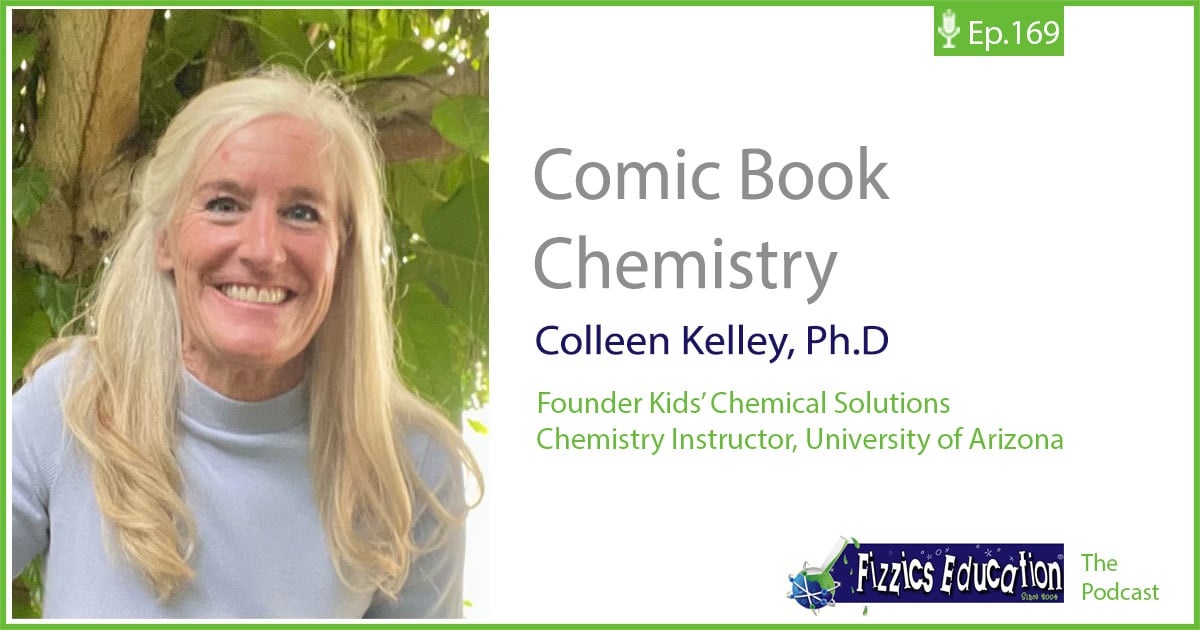
[00:00:19] Ben Newsome: Welcome to another Fizzics Ed Podcast. No matter where you are around this world of ours, we are talking STEM. And today, we’re hanging out with Dr Colleen Kelley, who out of the University of Arizona, has found a great way to captivate students in chemistry—comic books! Yes, she makes comic books that really helps with molecular literacy to students of many different ages. She has a real passion for science communication and science education and she has done a lot of work in this area. Let’s go listen in and find out just how comic books really work for teaching chemistry.
[00:00:52] Announcer: This is the Fizzics Ed Podcast. We’re all about science, ed tech and more. To see 100 fun free experiments you can do with your class, go to fizzicseducation.com.au. That’s physics spelled F I Z Z I C S and click 100 free experiments.
[00:01:13] Ben Newsome: Look, I’m really excited. I am in between schools right now as I run around on the road just post Science Week. And so I’m sitting in the park, hopefully the wind does nice things, but you’re sitting in the evening and connecting with me when you should be having a bit of time off. So thank you for taking the time to have a chat with me.
[00:01:31] Dr Colleen Kelley: My pleasure. I’m always happy to talk about science education for sure.
[00:01:38] Ben Newsome: For sure. Now I’m really curious about some of the work that you do—very much so, actually. I’m just curious before we get right into it, what made you fall into science education in the first place?
[00:01:50] Dr Colleen Kelley: That was not intended. I think maybe most of us were like that. As a child, I was not interested in science per se, but I read a lot of mysteries. And I keep coming back to that because it plays a huge role in what I’ve created. But I read a lot of Agatha Christie. I think I’ve read every single one. I was in a race with my other friend to see how many we could get through in a year. And that problem-solving comes through when you’re reading, so there’s an imagination that’s sparked. There are clues, there’s trying to decipher. So there was a bit of a scientific method in these mystery novels.
[00:02:25] Dr Colleen Kelley: And so when I got to high school, age about 16, I took my first chemistry class and understood that I was solving puzzles and mysteries much along the same way without any really formal understanding of science. I thought it was just something fun to tackle and problems to solve. And I had so much fun doing it that I did all of my friends’ homework too because they just kept handing it to me.
[00:02:56] Dr Colleen Kelley: I was a swimmer, so on the swim team bus to away meets I would be just scribbling everybody’s science homework because they just kept handing it to me and I thought it was like the best fun ever. So when I come at science education, I look at it more like that than I think how a lot of people do. I just kept solving puzzles and mysteries, and in college at university the same.
[00:03:30] Dr Colleen Kelley: And then certainly doing a PhD is investigating something that nobody else in the world has ever solved. And I thought that just blew my mind, Ben, that I was going to do something that nobody else had ever done. I think as a young graduate student that why are they entrusting me to this problem? But they do, and that’s part of the process. So really, for me, it’s about a gigantic mystery and clues and solving it in that way, and that’s how I’ve always framed it in my teaching as well.
[00:04:02] Ben Newsome: That’s fantastic. And I’ve always looked at it a way of how do we make this accessible in some way, shape, or form. A good friend of mine years ago finally made my brain click when it came to chemistry because that’s sort of your background. It’s just electrons doing their thing. Eventually, wherever the electrons go is what’s going to happen in some way. I mean, that’s oversimplifying it, but effectively once that worked for me, I started to understand that this is why we see the colour changes, this is what’s rather going on. This is interesting.
[00:04:36] Dr Colleen Kelley: It’s funny. I teach at the University of Arizona Organic Chemistry, and I tell my students, and I’ve done this for the last 30 years, if you’re stuck on something, it either comes down to the shape of the molecule or the electrons—one of the two. Pick them. Pick one of the two. Just write down “It’s too big or too small,” that’s shape, or “It’s electron-deficient or electron-rich,” that’s electrons. One of those four things write down and you’re going to get some credit on your test, and it’s probably true.
[00:05:06] Ben Newsome: Oh, fantastic. So if you’re listening to this, probably write that down as a good idea.
[00:05:11] Dr Colleen Kelley: I would say that’s my life-preserver advice. If you’re drowning, those are the things that you can grab onto and start swimming.
[00:05:20] Ben Newsome: For sure. When we watch science educators in any way, shape, or form, it often comes down to first principles because the principles matter. We can get all fancy with the high and mighty words, but eventually it’s the first principles that tend to explain the vast majority of things that we see. It’s fantastic. And a lot of it is about making it accessible, and this is why I really wanted to have a chat with you is the… I love this comic book stuff you’re doing. It’s fantastic.
[00:05:43] Dr Colleen Kelley: I do too!
[00:05:46] Ben Newsome: Where did this come from?
[00:05:49] Dr Colleen Kelley: It came from showing up at my first class at the university and loving chemistry so much and standing in front of 300 students thinking they were going to love it just as much as I did—and they didn’t. And they were frustrated and they were brilliant and they were scared and fearful and all these things. So I just started telling stories. And I just needed to look for an on-ramp. And so I came into it through mysteries and stories, so I just started creating my own stories.
[00:06:19] Dr Colleen Kelley: I’d often lift characters from Shrek or Winnie the Pooh or whatever I could figure out, so a lot of times I would use fictional animated characters because they seemed most inclusive. No one in my class was an ogre, so it seemed like using Shrek was a good example, and I wasn’t going to offend anyone in particular. So I just started telling stories and they were sticking, and students over the years encouraged me to write them down.
[00:06:49] Dr Colleen Kelley: So I did. I started writing a chemistry textbook as a story and again I thought that was going to be an enormous success and sent that to publishers and it fell flat on its face. So I had to figure out that nobody wants a written story. So I just had to keep going and find a medium that would work for what I was doing in the classroom.
[00:07:18] Dr Colleen Kelley: And it came out that a comic book was really the best way to do it because you could see the characters in action, there was a lot of dialogue, you could show molecules in a panel. So the comic book offered the perfect solution to what I was trying to figure out. So that was another puzzle was how do I get my stories out into the world and what format?
[00:07:52] Ben Newsome: So you went into written format first, and I understand it’s always difficult to put something that you’ve created out into the world and it just not quite work the first time, and I love how you iterated. Are you doing the illustrations as well?
[00:08:04] Dr Colleen Kelley: I am not. No, the illustrations are a former student of mine. I have a 23-year-old son, and they were in class together 10 years ago. And she ended up going to art school, and I contacted her when the comic book series needed to be illustrated and she said “Sure, yeah, I’ll do it.” So her name’s McKenzie, and she’s still involved in the project today. She’s an animator, illustrator, not a scientist, but she was in my class and did well in my class, so I knew she’d be able to help.
[00:08:39] Ben Newsome: This is so fantastic. It’s so tempting to want to be the human Swiss Army Knife and can do all the things at all times, and yet in reality, having a team to work with is incredible, because there’s no way that I’d be able to put a comic book out because my drawings resemble stick figures.
[00:09:02] Ben Newsome: But having a narrative base to it really makes sense and having someone to work with is fantastic. So how did you go about putting out your first thing? The reason why I’m asking this is there’d be people listening in that might have pondered this, maybe in a different discipline of science, but haven’t gone down this route feeling like this is an impossible thing to try. And I’m talking with someone who has done this, so I’d love to know what was it like doing your first thing?
[00:09:26] Dr Colleen Kelley: Well, I certainly had my moments over the last five years where I thought it was also impossible. I came up with the story and then did some YouTube investigating on how to write a comic book script. I’m a PhD chemist, I don’t know how to write a comic book. It’s the furthest skill set that I’ve ever thought I would acquire. So I just did some research and there’s a template to do it and I just followed the template.
[00:10:06] Dr Colleen Kelley: And then McKenzie and I worked on the individual characters for art, and then once we had those and the script, I connected with a comic book developer, designer who then really helped to mentor me because he said “Your bubbles are like 6,000 words, they have to be like 10.” And so I had to iterate on the story to fit comic book format even though I thought I had it down. I had no idea that by trade it’s three to six panels per page—a panel’s a square, a box. I didn’t know how many words you could put in a bubble, and what was the ideal length.
[00:10:46] Dr Colleen Kelley: Our comic books are quite long, and we scratched the ideal length because there’s no way we’re going to be able to teach chemistry in 24 pages. So ours are closer to 40 or 50 pages. But we inserted activities and some explanation—like we have Ray’s Rules, Ray’s one of the characters, and Poppy’s Puzzles inserted. So it’s a little bit of an activity book, comic book combo. So we started, we had a prototype out in 2021, “The Case of the Vanishing Van Gogh.” That was our first one that came out, that was about ions and colours, to your point about electrons.
[00:11:29] Dr Colleen Kelley: So I would just encourage people to just start and then, like you said, contact a team and go from there and just take their direction on where to go. I knew what the story was and I knew what learning objectives needed to come from that. I also was adamant that it be funny, or why do it if we’re not going to get a couple chuckles along the way?
[00:11:55] Dr Colleen Kelley: And that the characters represent molecules and elements. We don’t have any humans in our comic books. They’re either green or a big blue ox or a walking red blood cell. They’re all kinds of wacky things, but they’re much like Dr Seuss, they’re kind of Seuss-like.
[00:12:16] Ben Newsome: That’s good fun. So you’re talking with ions and whatnot, and I’m just curious, so you’re working with tertiary students, but I can imagine this being brought into high school and even lower depending on interest, yeah?
[00:12:28] Dr Colleen Kelley: Yeah, Ben, so this project, I initially did it to get my stories out and to use it as a way to facilitate teaching for everybody in a fun way. But what I learned was incredible. I went into a fourth-grade classroom—now keep in mind, at the same time, I’m teaching at the university level. So I’m teaching 20-year-olds organic chemistry who want to be physicians, doctors. And then I’m also leaving university and going to fourth grade and teaching nine-year-olds. So I’ve got a 10-year difference in the group I’m teaching, and I’m teaching them the same thing. So to your point, the comic books were able to communicate these complex concepts in a simple way, in a fun way, in a story that nine-year-olds were able to catch on because really it just requires imagination.
[00:13:08] Dr Colleen Kelley: And through this process what I realised, learning chemistry is like learning to read. And that’s where I started to dive into the science of learning to read. And right about nine years old, kids go from learning to read to reading to learn. That’s really pivotal. They can start then to gather content through reading and learning. So that’s the age I was getting the most efficacy out of the comic books.
[00:13:48] Dr Colleen Kelley: And I realised that if you consider the periodic table the alphabet, right? That’s the alphabet. If you consider then a formula, a word. If you consider an equation, a sentence. And a mechanism, a paragraph. The parallel is uncanny. And so a nine-year-old has learned how to read, and they’ve mastered that hierarchy of letters to words to sentences to paragraphs.
[00:14:28] Dr Colleen Kelley: And so when you start like that at nine years old with chemistry and you start with the symbols for the elements and then they make formulas and then they make equations, they’re already trained—they’ve just been through that process. They have the neuroplasticity, they have the imagination. No one’s telling them that chemistry’s hard at nine years old because no one thinks they’re learning chemistry at nine years old. So there’s not that cultural bias against learning it. I’m certainly not calling it a science or chemistry. They’re just reading comic books and learning cool things. And so when you put that on top of a child’s mind who has just learned how to read, you’d be amazed at they can write and balance chemical equations by the end of the fourth comic book.
[00:15:06] Ben Newsome: G’day, it’s Ben here. I hope you’re enjoying this particular chat, and guess what? There’s so much more you can do with your science teaching. Head on over to fizzicseducation.com.au. There are complete and comprehensive teaching units that you can get your hands on. If you click on the top, you will find there are a whole bunch of scope and sequences, cross-curricular teaching ideas, hundreds of printable experiments and activities, videos, risk assessments, marking rubrics—you name it! It’s all there and it’s all linked to the curriculum and it’s something that you can implement right now. Head on over to fizzicseducation.com.au and check out what’s on offer.
[00:15:44] Ben Newsome: Absolutely. I was just thinking about one of the very classic… everyone and their elephant’s toothpaste, yes, here we go again, we’re going to talk about elephant’s toothpaste again. But the very simple experiment whereby I might throw this in front of a group of Grade 3 students and say, “Here’s hydrogen peroxide, it’s H2O—oh, there’s an extra 2 there, that means there’s an extra thing about this substance that makes it different and has different properties, and we’re going to make it break up.”
[00:16:15] Ben Newsome: And just showing them that on the left there’s H2 and O2, and then there’s a line with an arrow and now it’s H2O and O2, I go, “Can we just count up what’s on one side versus the other?” And kids at this Grade 3, they can count—really simple arithmetic at this point—and they clearly can understand balanced equations very fast, because “Well, we just need two bits of this, and that’s going to produce two bits of this, and now we’re fine.” The point is that when we look at some of the stuff that happens in high school chemistry, let alone tertiary, sometimes it’s held off when it doesn’t necessarily have to be if the medium’s correct.
[00:16:46] Dr Colleen Kelley: I think it’s, at least in the United States, it’s a huge mistake we’re making is holding off chemistry way too long. And so what happens when they get to university is I have termed the coin “molecular literacy,” but conversely I’ve got a classroom of students who are molecularly illiterate because they have not worked with the periodic table long enough, they’ve not spent enough time noodling with formulas and equations.
[00:17:16] Dr Colleen Kelley: And so by the time they’re 15 or 16, again if you go back to reading, it’s really difficult to teach a 16-year-old how to read for the first time and then expect them to go to college and write papers and dissertations two years later. And yet that’s exactly what we’re doing in science, especially chemistry. And we wonder why everyone’s struggling. It is a skill set much like reading that takes several years to master.
[00:17:46] Dr Colleen Kelley: For sure. So the students that I get that are doing well and seem to understand this molecular literacy have inadvertently been exposed to it through a different kind of school or homeschooling or after-school programmes. But a traditional student might get it when they’re 15, they might have chemistry at 16, go to college and then they just get blasted with it.
[00:18:26] Dr Colleen Kelley: And the college professors, we’ve been doing it, we’re completely fluent, right? And so we can’t understand why these brilliant students in every other subject who work super hard and are incredible human beings are struggling. But we just haven’t given them enough time with the literacy part. And I’ll just say one more thing that’s really important to me is in the United States, at the university level, chemistry is 80% literacy. I mean, you spend 80% of your time in a classroom writing and responding to questions in a written format and 20% in the lab.
[00:19:06] Dr Colleen Kelley: So if all they’re doing is making slime, that’s only 20% of their grade, right? There’s still another 80% that we have ignored in our K through 12 system. And so I could have the greatest slime maker in the world come to my class and they’re still going to fail because they’re illiterate but they’re good at making slime. I think we need to rethink all of these hands-on experiments and make sure that we emphasise literacy probably more because when they encounter it at the university it is emphasised more. And my comic books do that. So my comic books allow that to happen whereas before there was no vehicle to introduce these literacy concepts.
[00:19:41] Ben Newsome: This reminds me of a conversation I had with a friend of mine at the University of New South Wales who runs a group now called Ludo. Michael set up this company because as an associate professor in biological sciences he had tertiary students struggling with ecological concepts. And so he figured that he would create computer games based on these concepts. And now down the track at this point in time as we have this chat there’s like 30 games on these various things, and it’s a full-blown company.
[00:20:11] Ben Newsome: And the point of it was that he wanted the students to engage with the concepts in a medium that was familiar to them. And the great news about producing this with comic books is clearly it’s a publication, it’s something that can be distributed widely across every library on the planet, and it doesn’t necessarily need electricity, it doesn’t need a fancy device in any way, shape, or form, and as long as they follow the literacy as you mentioned, they’re going to learn something and make it more meaningful, which is fantastic.
[00:20:44] Dr Colleen Kelley: Yeah, the series is also scaffolded against the learning objectives in a 100 or introductory university course. So Comic Book 1 is Chapter 1 from a university textbook, Comic Book 2 is Chapter 2—I mean, I’m not that creative, you know? But I also knew that I needed to align, I needed to keep the ducks in a row because that’s the way the chemistry is taught.
[00:21:08] Ben Newsome: That’s the way the textbook is like that for a reason, and that’s the scaffold to build off, but it is still creative, however, to take a known paradigm and shift it slightly. They’re going to learn it, which is fantastic. So if there people would be listening in on this who would be thinking, there might be people in universities around the world who listen to this thing, if they were going to create something like this, just say it’s geology—gosh, it could be anything! What would be their first steps that you’d suggest to consider reshaping the way that you might teach the literacy of a given subject, perhaps using comic books as a medium?
[00:21:50] Dr Colleen Kelley: That’s a good question. I would suggest starting with your textbook and looking at that and then finding some kind of mystery within that subject. So if it’s geology maybe it’s about sulphur. I’m a chemist so I’m going to pick an element out, but maybe it’s like sulphur that’s part of petroleum products or something like that that comes along with it. So I would say uncover something very interesting that you would want to tell at your holiday table to everyone there and everyone there would want to listen and not think you’re being very boring.
[00:22:30] Dr Colleen Kelley: So take all the technical jargon out of it and see what stories are there. And then work on characters that represent what you’re trying to teach. So for example, our sulphur atom in our book is this yellow puffball with one eyeball that looks a little bit like a Minion, but it’s a yellow puffball-y substance because sulphur’s a yellow powder. So whatever it is you’re trying to bring to life, try to create a character out of that to be interacting with one another.
[00:23:10] Dr Colleen Kelley: So think of it at the invisible level, because usually the students struggle with what they can’t see, right? That’s why the biology of a cell is not something people are fearful about because they can look under a microscope and they go “Oh yeah, there’s the nucleus, there’s some mitochondria.” But if you can’t see it, that’s where these stories really come into play because you need imagination. So I would just suggest look at your textbook, find out what students struggle with, how can I make that into a story, what would the characters look like, and then just keep writing at it and see what develops. It’s a bit of an odd process.
[00:23:56] Ben Newsome: And I suppose on top of that, start! Give it a go and see what happens.
[00:23:59] Dr Colleen Kelley: Give it a go. Yeah. And I read a lot still and I use a lot of history. One of the things about history is it’s timeless, right? There are great stories in history that are still going to be interesting. If they were interesting 50 years ago, I mean my first story is 100 years old right now. So if it’s still interesting 100 years later, most likely it’ll keep being interesting. So pick some great stories from history and see if there’s any way you can incorporate those.
[00:24:34] Ben Newsome: Fantastic. Now there would also be people who would love to find out more about these books and to maybe get in contact. So how might they do that?
[00:24:43] Dr Colleen Kelley: Sure, yeah. Our website is kidschemicalsolutions.com. And they can go to our website and there’s contact info on the website and everything’s there. Our comic books are not available on Amazon. They’re available through our website, which links then to my publisher.
[00:25:15] Dr Colleen Kelley: And the other thing, Ben, is often we get the question is there a digital version? And I’m standing firm on that—no. For the reasons that you just talked about. There’s enough digital everything, there’s not enough paper books in the world for the kid on the subway to read or the kid who wants to go to a library or someone who just doesn’t have Wi-Fi. So I think when we talk about accessibility, inclusivity, a book that can be found for free in a library is really important to me.
[00:25:50] Ben Newsome: 100%. So any librarians out there, perhaps get in touch, because this would be a valuable addition. Hey, Colleen, thanks so much for hanging out with me.
[00:25:58] Dr Colleen Kelley: Thank you so much! And if anybody has questions, let me know.
[00:26:02] Ben Newsome: Much appreciated. Enjoy your evening. I’m going to enjoy going off to another school and I hope to catch you again soon. Okay, bye Ben.
[00:26:11] Announcer: We hope you’ve been enjoying the Fizzics Ed Podcast. We love making science make sense. Why don’t you book us for a science show or workshop in your school? If you’re outside of Australia, you can connect with us via a virtual excursion. See our website for more.
[00:26:28] Ben Newsome: Well, I hope you enjoyed that chat with Dr Colleen Kelley. I certainly did. And guess what? You can get your hands on these comic books, so head on over to kidschemicalsolutions.com. No matter where you are, she should be able to help you out and you might help your students and perhaps yourself understand a little bit about your own molecular literacy and have a bit of fun reading the comic books as well. What a great medium to learn science and frankly any area. So, I hope you enjoyed this chat, I certainly did. You’ve been listening to me, Ben Newsome, from Fizzics Education. This is the Fizzics Ed Podcast and hope to catch you another time.
[00:27:01] Announcer: You’ve been listening to another Fizzics Ed Podcast. We’re excited about science. Subscribe to us on iTunes to download the next episode as soon as it’s released. And don’t forget, for hundreds of ideas, free experiments, our new Be Amazing book and more, go to fizzicseducation.com.au. That’s physics spelled F I Z Z I C S.
[00:27:28] Announcer: This podcast is part of the Australian Educators Online Network, AEON.net.au.
Frequently Asked Questions
What is molecular literacy?
Molecular literacy is a concept coined by Dr Colleen Kelley that treats chemistry as a language. In this framework, the periodic table is the alphabet, formulas are words, and chemical equations are sentences. By teaching children to ‘read’ chemistry using the same cognitive processes they use for literacy, the subject becomes far more accessible and less intimidating.
Why are comic books an effective medium for teaching chemistry?
Comic books allow students to visualise abstract, ‘invisible’ concepts through characters and narrative. The format uses panels and dialogue to break down complex mechanisms into manageable parts, making it easier for students to imagine how molecules interact. It also provides an engaging ‘on-ramp’ for learners who might be intimidated by traditional textbooks.
At what age can children start learning complex chemistry?
Dr Kelley has found that nine-year-olds (fourth-grade students) are at an ideal developmental stage. At this age, children transition from ‘learning to read’ to ‘reading to learn’. They possess the neuroplasticity and imagination required to balance chemical equations and understand molecular structures before any cultural bias about chemistry being ‘too hard’ sets in.
Do these comic books align with university-level chemistry?
Yes. The comic book series is scaffolded against the learning objectives found in introductory university chemistry courses. For example, the first comic book covers the same concepts found in the first chapter of a standard college textbook, ensuring that the foundational ‘literacy’ remains rigorous while being presented in a fun format.
Why aren’t there digital versions of these chemistry comics?
Dr Kelley has purposely chosen to keep the series as physical books to ensure accessibility and inclusivity. This allows students to engage with the material without needing a device or Wi-Fi, making it easier for libraries to provide the resource for free and for children to read in any environment, such as on a bus or in a park.
Extra thought ideas to consider
The ‘Reading to Learn’ Milestone
Consider the significance of introducing complex STEM concepts at the exact moment a child’s brain is wired to start gathering content through reading. By aligning chemistry with this literacy milestone, we can bypass the struggle many older students face when they encounter ‘molecular illiteracy’ for the first time in high school.
Narrative as a Scientific Tool
The use of mysteries and puzzles in education mirrors the scientific method itself. By framing chemistry as a mystery to be solved rather than a series of facts to be memorised, educators can tap into a child’s natural curiosity and problem-solving instincts, much like the Agatha Christie novels that inspired Dr Kelley.
Discussion points summarised by AI from the FizzicsEd Podcast, verified and edited by Ben Newsome CF