Transcript
[00:00:00] Announcer: You’re listening to the Fizzics Ed Podcast. For hundreds of ideas, free experiments and more, go to fizzicseducation.com.au. And now, here’s your host, Ben Newsome.
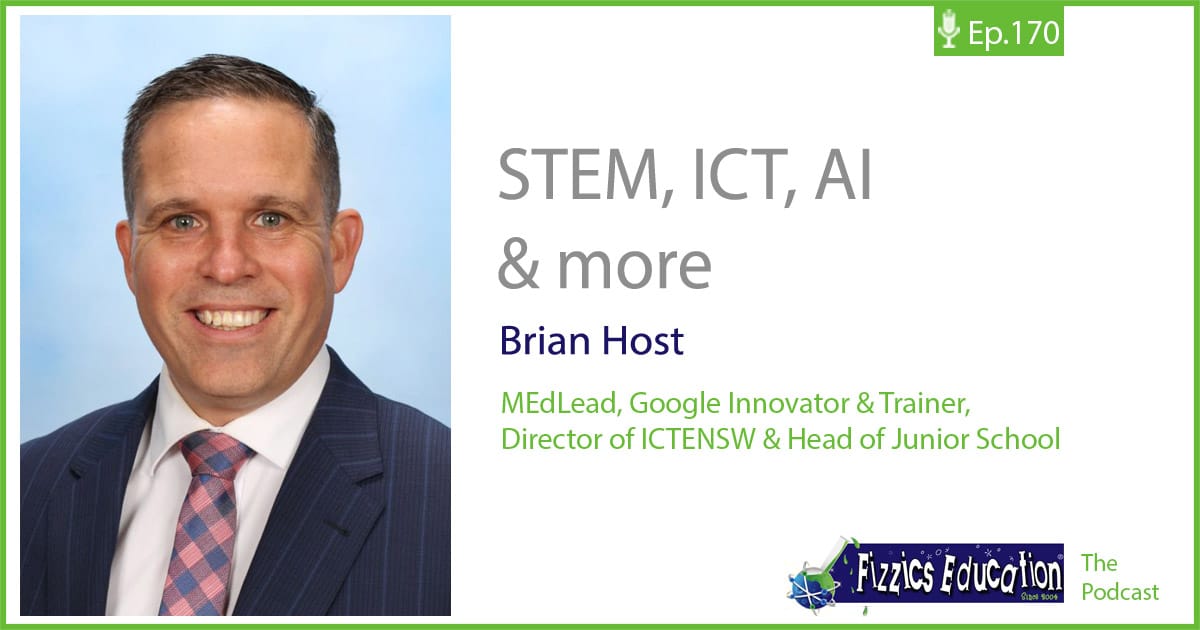
[00:00:17] Ben Newsome: Welcome again for another Fizzics Ed Podcast. Glad to have you, no matter where you are around this world of ours. We’re talking STEM, and today we’re definitely talking about ICT as we hang out with Brian Host, who many of you in New South Wales might know as the director of ICTE New South Wales, very much an important group when it comes to helping teachers right across the state and frankly beyond understand and really disseminate ideas around how to teach ICT and more to students. He is a coordinator of primary and middle school, and he’s about to head into next year as the head of junior school at Shellharbour Anglican College. And today, we talk about AI, ICT, STEM in general, how to really get your students humming with STEM projects, and our thoughts around education itself. It’s a bit of a whirlwind chat as I hang out with Brian, and it’s a really good fun as we chat just past National Science Week. Let’s get into it.
[00:01:11] Ben Newsome: This is the Fizzics Ed Podcast, for all about science, EdTech and more. To see 100 fun free experiments you can do with your class, go to fizzicseducation.com.au. That’s physics spelled F I Z Z I C S, and click 100 free experiments.
[00:01:26] Ben Newsome: Mate, I’m actually quite stoked because we had this chance encounter at the Berry Show at the start of this year, and suddenly we realised we knew people down there and all the rest. So it’s kind of fun actually to catch up in person, funnily enough, outside of Twitter.
[00:01:39] Brian Host: Yeah, absolutely. Social media is great, but it is a much nicer opportunity to do the face-to-face connection.
[00:01:55] Ben Newsome: Oh, for sure. I mean, there’s a few people—some people listening might know the hashtag of #primarySTEMchat where a lot of us types hang around and just talk about things. And there’s only a couple of people I’ve actually ever met in person despite talking with them for years.
[00:02:11] Brian Host: It very much seems to be a way with education. The circles are close, but often, yeah, I know even speaking earlier this week with people in WA, and you might not get to face-to-face meet them, but there’s so many opportunities to learn with people along that journey though.
[00:02:31] Ben Newsome: Oh, for sure. Now, clearly as you’re listening, guys, yes, I know Brian, but you might not. So, Brian, do you want to let us know what it is that you do, why you do it, where you do it, all that sort of thing?
[00:03:01] Brian Host: Certainly. Well, I’m obviously an educator. I’m a primary educator, but I have worked in K to 12 schools. I’m based out of Sydney mainly, however, I do work out of schools in a smaller city slightly south of there called Wollongong. For those international educators, it’s a wonderful place. Lots of great things come out of Wollongong. A lot of Australian educators might stir me up a little bit by that, but it is a great place to live right on the coast here. So, I work for Cedars Christian College down there. I’m the primary coordinator at Cedars, however, I’ve just been appointed as the head of junior school at Shellharbour Anglican College.
[00:03:40] Brian Host: So those heading down south for holidays, that’s the school on the hill as you go past around Shellharbour there. So that is where I’m heading in 2024. Very passionate about STEM education. I’ve been engaging with STEM education for close to 10 years now and really looking at ways to use STEM as an opportunity to enhance learning for students on all levels.
[00:04:20] Brian Host: Obviously, it does have an amazing ability for higher achievement students, but just the regular everyday student, the engagement they have when you bring in the real-world concepts from STEM, it’s incredible.
[00:05:23] Ben Newsome: It’s so much fun doing the problem-solving with them and getting out of their way just a little bit. That can be—and let’s be honest, it’s really hard as an educator to know where they’re going and what pitfalls they’re about to hit and letting them have it in the first place.
[00:05:42] Brian Host: That’s right. So often, and I know one of the greatest things that a lot of my students have learned is it’s okay to fail. It’s okay to make the error because that’s part of the learning journey and they move through that process if the environment is set up in such a way that they know they’re safe. They can make the mistake, they can learn through that failure and actually use it to strengthen their learning.
[00:06:09] Ben Newsome: Now what’s—I mean, across 10 years of doing STEM stuff, I mean, you would have seen a bunch of projects work really well and some less so, but either way, they’re great fun to see. What are some ones that stick out in your mind where you say, “You know what? That really worked and I’m totally going to do that again.”?
[00:06:26] Brian Host: Well, I suppose one of the ones—it was eight years ago when I first won a STEM grant for one of the schools that I was working with, an Innaburra school. It was a STEM grant on Minecraft Education and actually using it in the classroom. It was back in the day that you had to run a localised server. It was an interesting project to work with. And we actually used theories around—our students were learning around transport and we wanted to actually have the students in an environment where they could actually build the transport network that is in that local area.
[00:07:05] Brian Host: So they designed the local area, built the transport network, looked at the features of it. Problem was, at that time, they didn’t have a physics module within Minecraft Education, which made it a little bit challenging to be able to test things and work out whether these would actually operate correctly in real life. However, the students were so inspired by being able to build within that and create the environment around them.
[00:07:35] Brian Host: Fast forward that sort of now eight years, it’s not necessarily that project, but elements of that project I’m continuing to bring into my classes, whether it’s teaching from a technology perspective or teaching from a science perspective because obviously there is the more physics modules have actually been released within Minecraft. So, being able to allow the students within that virtual sandbox to really experiment and problem-solve and break things. And in reality, if they break it in Minecraft, it’s a little bit less significant than breaking it in the real world.
[00:08:12] Ben Newsome: A little less expensive. Yes, absolutely. Actually, I was on a webinar yesterday with some people, it was Fleet Space Technologies, and they put nano-satellites up into space to do geology things and they do a lot of 3D printing. And they were just describing how the layers for entry are so much lower. So whereas like you were describing, you break something, it’s going to cost a fortune, for them, breaking something could cost three months of rebuilding the thing. And the point now where they actually do 3D printing of even the wing nuts that might hold something together, it’s like, “You know what? It’s actually cheaper for us to print it than to go to the shops and go and buy a packet for 10 bucks.” It’s funny. And I guess, especially with your background with ICTE New South Wales—ICT educators—you’ve been doing that and been involved for a while yourself. You would have seen some great things come across teachers’ desks.
[00:08:36] Brian Host: Absolutely. Like things like Kai’s Clan—and I know Kai’s Clan have got multiple different products there—which is a virtual reality, physical robotics product. That’s a really phenomenal example. I know Lumination, from a 3D world, amazing, amazing product. I’d love to actually get over to the Lumination lab. A lot of the work that I do with Google and also with Microsoft, Canva, all of those companies that are out there, there’s elements of—yes, they’re companies, but they’re not companies that are trying to manipulate education.
[00:09:05] Brian Host: They’re actually companies that are trying to support in education and build products which are user-friendly for education with obviously the long-term mindset that this is the world that the students will graduate into. So let’s create products that are going to support them as they leave school and move into a world beyond school.
[00:09:35] Ben Newsome: Yeah, I mean, eventually there is a collaborative aspect to all this stuff. I mean, you could walk into a staff room and people would have different opinions of what it’s like with third-party companies being involved in education. But the reality is that without those materials, those resources, it’s pretty hard to do a lot of stuff. I mean, we can do a lot with paper and scissors and rock and things, but someone had to make the paper. But so if you go down the ICT route, same thing. I guess when you go to the EduTechs, the ISTEs, whatever version, whether it’s the BETT conference or whatever, all this—there’s a lot of shiny things out there. There really are. And I guess that’s half the battle is trying to navigate which version of robot do I need, which version of whatever it is I need. And I feel like there’s that much choice it’s paralysing.
[00:10:22] Brian Host: I would totally agree. Often, educators when they do go to those big conferences, and I’ve been to those conferences, they do get fascinated by what’s next to market, what’s next trend. In reality, though, that doesn’t make a difference in students’ learning. It’s going back to grassroots and actually going: What does the curriculum say? What do I do as the teacher? How am I going to use whatever it is? Technology, it can be a pencil, it can be a robot. Basically, you use whatever technology is the best for the learning at the time.
[00:11:05] Brian Host: There is so much out there. Grok is a really good example. You can actually do most of the coding that you need within the Australian or New South Wales curriculum through a free product that WiseTech sponsors, which is Grok Academy. Yes, they don’t necessarily have all the robots that go with it, but you can purchase from plenty of different companies that are out there, things like Micro:bits, which are small microcomputers that you can do a lot of the coding that you require from the syllabus directly on those, which is not going to break the budget.
[00:11:51] Ben Newsome: No, not at all. They’re borderline—and I hate to say disposable, but gee, it’s close. If you really wanted to make something where if it gets submerged or possibly worse, you’re only going to lose 30 bucks, give or take, plus shipping, whatever it is, whatever they’re currently going for. I mean, of course, it would be ideal if you can keep it for 10 years. But the reality is it’s right. It’s a small little microcomputer and you can do the things, you can strap it on some cardboard and do something with it.
[00:12:23] Brian Host: And if it breaks, that’s a bummer. But ultimately, you’re not buying a new car, sort of thing, or it’s not going to cost you a house.
[00:12:31] Ben Newsome: I mean, yeah, I mean, predominantly a lot of my work is science education, and there are some chemistry demonstrations whereby the reagents involved, that was a $15 demo for less for a minute tops, and that’s it. Or maybe worse, they’re actually way more expensive ones than that. And like, I’ve never actually looked at that, I probably should because I run a business.
[00:13:02] Ben Newsome: But there—and you kind of look at—you don’t want to be wasteful. But so if we’re looking at really how a design thinking process of it works and you get to that iterative point of view, iterative by definition is try it then try it then try it then try it till something works. Well, during the try-it steps, there’s going to be potential hazards where you’re kind of going to break the thing. And at only a small amount of money, a nominal amount, if the kid is learning, “Hey, I now have picked up I probably shouldn’t do that again,” if it’s a low cost for that, it can be good.
[00:13:28] Brian Host: I know one of the projects that Martin Levins did when he was working for the iCARA project, he actually had students create, again, very, very low cost using the Micro:bits, creating watering systems for plants. So had two Micro:bits, one with a moisture sensor in it, one connected to a watering pump. And it was collecting the data again, which we need from the mathematics syllabus. It was collecting all of that, analysing the data.
[00:14:12] Brian Host: The students were using the data to actually code the other Micro:bit to allow the pump to kick in once it got to a certain level. So there’s so many real-world applications to these technologies that would traditionally be known as Internet of Things, even though that’s now moved beyond. But that’s very much in the curriculum, in the syllabus, whether it’s in the lower levels or up in the higher levels. These microcomputers, whether it’s Arduino, Micro:bit, Raspberry Pi, are so valuable. And like you say, they can hit elements of technologies, but they can very much hit science as well as mathematics.
[00:14:48] Ben Newsome: Well, that’s really what the whole STEM thing’s going about. And I swear if you get enough educators in a room and the acronym turns up, inevitably the discussion of, “What is this and do we—do we like it?” and the people who’ve been doing it for a while have sort of moved past it. And I don’t know—do you reckon it’s going to become—I mean, we don’t talk about whether we’re anymore whether we’re going to teach kids mathematics pure. We don’t talk about whether we’re going to, whether—the word “whether” being important—is music important or health and physical education? It feels like at some point in time that the debate of “what is STEM” will sort of simmer down slowly eventually, maybe. And we get to move on.
[00:15:24] Ben Newsome: But the—I guess everyone’s got a different interpretation. For me, I see a lot of this—if you sort of look at the letters, sometimes there is a small S, a large T, a tiny E, and the M is like trailing off to the—I mean, literally as a physical thing. It’d be kind of nice if it is even. But I guess we’re humans and we’re going to lean towards what we like teaching best.
[00:15:47] Brian Host: And it’s going to come to a point that it’s going to be a more transdisciplinary approach, or a multidisciplinary approach where we’re integrating all of those elements at different levels at different times. Whatever the curriculum at the time most requires is going to be the thing that we most teach and focus on. And we draw out from the STEM acronym what the lessons are needed. So it’s not going to be, “Okay, we’re doing pure science.” There will be times. My daughter’s going through senior years of school at the moment, and there’s pure science involved in that area.
[00:16:40] Brian Host: But at the lower levels where it can actually be integrated a lot more, that’s very much what I know within New South Wales the drive is. With all the new syllabus reforms, there’s a whole focus on how do we bring these together, not necessarily teaching everything all together as one, but how do we actually have these subjects complement each other and work together so that students get an understanding which is really strong in all different areas.
[00:17:07] Announcer: G’day, it’s Ben here. I hope you’re enjoying this particular chat, and guess what? There’s so much more you can do with your science teaching. Head on over to fizzicseducation.com.au. There are complete and comprehensive teaching units that you can get your hands on. If you click on the top, you will find there are a whole bunch of scope and sequences, cross-curricular teaching ideas, hundreds of printable experiments and activities, videos, risk assessments, marking rubrics, you name it, it’s all there, and it’s all linked to the curriculum, and it’s something that you can implement right now. Head on over to fizzicseducation.com.au and check out what’s on offer.
[00:17:42] Ben Newsome: Yeah, I mean, I think about these subjects. I mean, you’re right, curriculum is a battleground, forever is. It’d be—if you just sort of think about it from the psychology of a student, I always often wondered and we see this a lot as an outreach group, we get a lot of people wanting people like us to come out towards the end of the year because, frankly, the kids are fried. They’ve had enough. They’re done. They’re shot to pieces.
[00:18:07] Ben Newsome: And it’d be kind of neat that, yeah, if you had these aligned curriculum that sort of worked within each other and they’re transdisciplinary, but we acknowledge that the kid themselves has shut off. And frankly, sometimes, let’s be honest, let’s be honest, anybody listening to this in the car, have you had enough by end of November? Are you ready for the end of the year? So it’d be kind of fun to actually acknowledge that that’s what humans are like towards the end of a given set period of time. And so for a month, we then implement the learnings we’ve had from all the different subjects and we’re going to just do, for want of a better term, a STEM fortnight or a month or whatever it is that fits within our lives because it is engaging.
[00:18:49] Ben Newsome: I mean, right at the top of this conversation, you talk about the engaging factor. I mean, I think about some of these students that are often shut off, but now they get to solve something with stuff with parameters. And off they go. It’d be great to just shove at the back end of the year and go, “Righto guys, you’ve been learning this stuff for nine months, guess what? For the next month you’re going to do something.”
[00:19:10] Brian Host: And definitely, and it’s not necessarily free inquiry. The teacher’s still there engaging with and supporting the students. But it’s taking a lot of the explicit instruction that you’ve learned or taught during the year and allowing the students to then go, “Okay, what next? How do I apply this?” And I think the students would absolutely be in delight. They’d be in that point of absolute awe and enthusiasm.
[00:19:41] Ben Newsome: Yeah, because they get to do it. And I kind of feel like, again, it’s then the psychology side, which is less sort of talked about, but nothing like a carrot to go for. Like it’s the Premack principle, if you think back to beginning teachings, “If you do this, we’ll do this.” I mean, if you had to, but the reality is that it’s nice. The problem often with the STEM thing is that there’s that tension between “I want the kids to explore within given parameters to solve a problem,” but if they don’t have enough scaffold or understanding of what on earth they’re trying to achieve, they can’t do it. But if you spend too much time doing all the scaffolding and knowledge, you don’t give them enough time to build anything, nothing gets done. So there’s this weird tension.
[00:20:21] Brian Host: So it’s almost like I know what I do a lot of is do that back-end exploration, but I also put it at the front end as well. I use a provocation to really—whether it’s handing them the device such as a Micro:bit and go, “During this lesson, I want you just to feel it, look at it, play with it, explore it. What do you think it does?” and actually draw it out from the students and then lead into the actual conversation, whether that’s a book or whether whatever it is, using something as that wow factor to really hook them in…
[00:20:50] Brian Host: …and then have the explicit learning that comes and then the deep inquiry that happens as well. And then ultimately, you do get to that building phase where they—so instead of losing what generally happens is you do have that tapering off, you actually build that consistency of learning and consistency of focus and attention.
[00:21:25] Ben Newsome: Oh, for sure. I mean, I just reflect back as you’re talking. Last year I was able to go to the T3 Alliance teacher training, STEM training programme in Florida. I’m involved in the board that sort of governs it. And I got to see it in the flesh about how they operate and you talk about provocation. Through teachers, we deliberately gave no instruction. Just outright no instruction at all. A bag and it was—they were making brushbots, or toothbrush bots. They just here, make this.
[00:21:55] Ben Newsome: And so some had seen it before and they smashed it out, they did it so quickly. Others weren’t sure, but they watched the teacher’s dynamics, they watched each other and learnt how to make these little brushbots go.
[00:22:24] Ben Newsome: And so they then said to the teachers, “Okay, so we gave you no instruction. So guess what we’re going to give you no instruction about now?” And they gave them a box of, basically, it’s going to be a computer. The whole thing. Not just the Pi device, the whole lot, the screen, everything. And again, deliberately no instruction. Different size bolts, different size everything, “Go, you work it out.” And you can imagine like people’s faces because we’re always used to having instructions, right?
[00:22:50] Ben Newsome: But I was involved in said training, so I put myself through the thing. We all knew we had to build this thing. And all we had to look at was, “Okay, look over there, there’s one that was built before. Sort it out.” That was honestly effectively what was said. And they described after we had finally built these things, because then we learnt how to code these things and do all the stuff that we expect, that if you do the same thing with students enough times, they learn to start thinking for themselves and they learn to not fear a blank page.
[00:23:12] Brian Host: Which very much aligns with Sugata Mitra’s work when he did the “Hole in the Wall” project. The students, or the—they weren’t even students. They were able to learn by themselves if they’re given the resources. It’s not necessarily going to the level of, “Okay, teacher walk out of the room.” Even though he was close to it.
[00:23:35] Brian Host: But we as teachers are there as guides. We’re there as facilitators, we’re there as coaches. That doesn’t mean that we’ve got all the answers. And I’ve got a really good friend, excuse me, her robotics team is the national champions. They’ve been off to World Championships and she’ll freely admit, she understands the basics, but she doesn’t understand that higher level of coding.
[00:24:00] Brian Host: It’s the students that are with her that actually know it and understand it and she’s just facilitating this. And when we as educators get out of the way, it’s amazing what the students can actually come up with to answer these big real-world problems.
[00:24:21] Ben Newsome: You’re reminding me of what I see on Instagram reels or whatever where it’s, “Programmer receive call: How to fix website? Programmer googles.” That’s what happens. It’s that we are not the font of all knowledge. It’s how you source it and distil it and work it out that makes all the difference.
[00:24:42] Brian Host: Absolutely. Yes.
[00:24:45] Ben Newsome: Oh gosh. So I mean, so where do you see the world moving towards in this day and age? I mean, I know there’s a lot of AI stuff. It won’t go away. I mean, where are we shifting?
[00:24:57] Brian Host: I think as educators, it’s—I know one of the big shifts that we’re working on at our school is very much training kids and training them to not be terrified of the future. Actually embracing the future and going, “Yes, there’s things that are new that are out there. They can be used for two different purposes. They can serve a good purpose, they can serve a not-so-good purpose.” How do we ethically teach students how to use things such as AI? So it becomes a supportive, beneficial thing.
[00:25:27] Brian Host: We realise that AI is not creative. It will not create anything new. That’s one of the blessings of us as humans, we actually have that gift of being able to be creative.
[00:25:55] Brian Host: AI only pulls the information that’s currently available to humanity. So, yeah, us as humans have that important area that we still have to create and build further. And that’s a beautiful thing. It is something incredible that we can go, “Actually, we’ve got these super computers, these quantum computers doing these amazing things, but they’re still not as talented as us from a creative perspective.” They might be able to write things, but it’s based on the creativity of us previously. So there’s definitely going to be that shift towards AI. The amount of teachers who are already using AI to formulate things like lesson plans and programmes, that’s already happening.
[00:26:40] Brian Host: Myself, I wouldn’t just trust the AI and just go, “Okay, this is all I’m doing.” I’ve got to actually still have that human input into it because if I’m just using the computer, it’s almost like Skynet and just going, “Okay, let that run the world.” No, that’s not the case. We don’t want that.
[00:27:01] Ben Newsome: No, for sure. I’ll tell you what, I don’t know why this crossed my brain, I’ve never had this before, but I think I’m going to use it again. All right, so in terms of trusting AI, imagine that you went to an AI tattooist and you trusted this tattooist to put a tattoo on your arm that is in a foreign language. Now that’s—you see right there? You feel weird, right?
[00:27:30] Ben Newsome: Because already you know that it could actually go bad with a human, let alone an AI, which actually tells me, fundamentally feels to me that there is a reason to be careful with it and not take it at face value because would you take at face value a piece of ink on your skin? It’s there. It’s there and you’ve got to trust it, right? So why are we trusting the outputs that just come out to you through the various versions of all the different ones that are out there? We can’t just trust them blindly because that’s what—it’s the same.
[00:28:02] Brian Host: Yes. And generally, the output will only be as good as the input that we put into it. And often when we put prompts into it, we don’t necessarily know what we want until we know what we don’t want. And when we’ve got the outcome, we’ve gone, “Actually, that wasn’t what I wanted.” And that’s why we edit the prompts so much. So there is care to be taken with using AI. I’ve used it and I actually think it does save time and it can be beneficial for what we are doing. I know there are plenty of people out there using it, but it’s going in with an ethical mindset and actually going: How do we best use this where we’re not plagiarising, where we’re not using this for harm?
[00:28:51] Brian Host: So that’s—I think that’s going to be a huge narrative around education over the next sort of at least next five years. And I know there’s so many more different AI versions coming and the power of what it can do is only going to—it’ll only increase over the next 5 to 10 years.
[00:29:13] Ben Newsome: I had a really good example of how to use AI, acknowledging that these—this is for tertiary students, so a university saying acknowledging straight up, “Of course they’re using AI. We’re not silly.” So they now use the prompt as the question and they say, “Prove whether the AI bot was right or not.”
[00:29:31] Brian Host: That is such a good way of flipping it.
[00:29:34] Ben Newsome: Just totally flip it outright, go, “Righto, is it right?” I like that.
[00:29:38] Brian Host: It just then forces the students to go and do that research.
[00:29:43] Ben Newsome: They’ve got no choice now! Because they’ll try and prompt that in, it’s going to pop out a prompt that’s rather similar anyway. So they’re kind of gazumping them right from the start. It’s good. And making them think harder, which is the point, right?
[00:29:53] Brian Host: Absolutely. And you’re then teaching them to think about their thinking and actually forcing them to build that really deep knowledge.
[00:30:04] Ben Newsome: Yeah. I love it. I love how game that lecturer was to put it together that way going, “You know what? We’re just going to put it this way in your exams.” I love it. It’s awesome.
[00:30:13] Ben Newsome: It’s really awesome to hang out with you. I know it is on the weekend, you probably have some bits to go. But there’ll be some people listening in who spend on their weekend, they’re zoned in, they’re on their way to school or whatever they’re doing. What would be some advice that you’d be giving to them if you had a chance to sit with them and say, “Look, I’ve been doing this for 10 years, I’m going to be doing this for much longer. Here’s what I’ve learned that works with students and here’s some things that I would avoid.”?
[00:30:38] Brian Host: I suppose for myself, what I would suggest is don’t be scared of trying. I was blessed in my schools that I was given permission to try and actually experiment. That’s not always been the case. I know that there are plenty of teachers who don’t have official approval or official permission. However, that doesn’t mean you can’t necessarily iterate and try things in your classroom which are small scale. Start off small, then prove the case. Build it bigger.
[00:31:11] Brian Host: A lot of what I’ve done is based on research that has been done in-house. It’s a lot of action research that I’ve intentionally documented over time, whether I’ve documented on my blog or LinkedIn or posts or however I’ve done that. I’m now in educational leadership and I’m doing exactly the same thing, just purely for the fact that it allows us to have that real rich understanding of why we believe what we believe and then our practices match that belief.
[00:31:37] Brian Host: So start small, iterate and do action research along the way. It can be terrifying, especially when you finally get it right and you go, “Oh, okay. Now everyone’s looking at me because they want me to take it to the next level.” But that’s a good thing. That is a good thing even though it does have that moment where your heart drops and goes, “Wow, okay. This does really make a difference.”
[00:32:21] Ben Newsome: Yeah, I agree. There’s something to be said for being slightly concerned. That means you’re pushing boundaries within reason, everyone. Let’s not set our classrooms on fire! But apart from that, I mean it’s all within good. Yeah, just exactly, I like it. Iterative in thinking as well as in projects.
[00:32:41] Brian Host: Yep.
[00:32:42] Ben Newsome: Awesome. Hey, there’ll be some people would love to get in touch with you. Where would they need to go?
[00:32:46] Brian Host: Best place to reach out to me is either through Twitter or LinkedIn. I’m on both of those social media platforms and I regularly am writing and using that. I also have my blog that I happy for people to reach out via that method as well. So—
[00:33:08] Ben Newsome: 100%. And as usual, they are in the show notes, so go across there, click on the things and go get in touch with Brian, for sure. And well done as you move into next year with your new position as head of junior school, right?
[00:33:21] Brian Host: Yes, correct. So it’s exciting times for the team down there and I look forward to supporting them as they venture into this new whole realm of—I’ll be the second head of junior school for that school. So it’s a massive new season for them.
[00:33:41] Ben Newsome: Oh fantastic. Look, thank you so much. Enjoy your weekend. I will as well. And I’ll no doubt catch you at some way shape or form through those internet networks that won’t go away.
[00:33:52] Brian Host: All right. Well, thank you. Enjoy your weekend too.
[00:33:55] Announcer: We hope you’ve been enjoying the Fizzics Ed Podcast. We love making science make sense. Why don’t you book us for a science show or workshop in your school? If you’re outside of Australia, you can connect with us via a virtual excursion. See our website for more.
[00:34:13] Ben Newsome: Well, I hope you enjoyed that chat with Brian Host. He has an amazing array and deep understanding about how to teach ICT and STEM in many different ways with many different students. There is so much to learn from him. In fact, I really encourage you to go over to his website. Go to brianhost.blogspot.com. Again, brianhost.blogspot.com, and you can find there is a heap of stuff, everything from leadership through to STEM and much more. It’ll be really, really valuable.
[00:34:41] Ben Newsome: And seriously, check out what he’s been doing. He is a Google Innovator and trainer, he is the director of ICTE New South Wales, and he’s a presenter, a coach, many other things. So I definitely want you to get in touch with him if you can. So I hope you enjoyed this chat. I certainly did. You’ve been hanging out with me, Ben Newsome from Fizzics Education. This is the Fizzics Ed Podcast, and hope to catch you another time.
[00:35:01] Announcer: You’ve been listening to another Fizzics Ed Podcast. We’re excited about science. Subscribe to us on iTunes to download the next episode as soon as it’s released. And don’t forget, for hundreds of ideas, free experiments, our new Be Amazing book and more, go to fizzicseducation.com.au. That’s physics spelled F I Z Z I C S.
[00:35:28] Announcer: This podcast is part of the Australian Educators Online Network. AEON.net.au.
Frequently Asked Questions
How can failure be used as a learning tool in the classroom?
In a STEM environment, failure is treated as a safe part of the learning journey. By allowing students to make errors and iterate on their designs in a low-risk setting, they learn to strengthen their problem-solving skills and understand that mistakes are necessary steps towards a successful outcome.
How can Minecraft Education be used for transport and planning projects?
Students can use Minecraft as a virtual sandbox to design and build local transport networks. This allows them to experiment with infrastructure and transport features in a digital environment where breaking things is less expensive and more manageable than in the real world.
What are some cost-effective ways to teach coding and the Internet of Things (IoT)?
Tools like Micro:bits, Arduinos, and Raspberry Pis are highly valuable for classroom use. They allow students to engage with real-world applications, such as building automated plant-watering systems, without breaking the school budget. Free platforms like Grok Academy also provide excellent curriculum-aligned coding resources.
How should educators approach the rise of Artificial Intelligence (AI)?
Teachers should focus on the ethical use of AI, teaching students that while it can be a supportive tool for formulating ideas, it lacks human creativity. A powerful classroom strategy is the ‘prompt and verify’ method, where students use AI to generate an answer and then must conduct research to prove whether the output was correct.
What does it mean for a teacher to be a ‘facilitator’ in STEM?
Being a facilitator involves ‘getting out of the way’ and allowing students to lead their own enquiry. By providing a provocation (like a new piece of hardware) without immediate instructions, teachers encourage students to explore, collaborate, and source information independently, much like Sugata Mitra’s ‘Hole in the Wall’ project.
Extra thought ideas to consider
The Move Towards Transdisciplinary Learning
Education is shifting away from teaching subjects in isolation. A transdisciplinary approach integrates science, technology, engineering, and maths to solve real-world problems. This helps students understand how these disciplines complement each other and ensures a deeper, more cohesive learning experience.
Combatting End-of-Year Fatigue with Engagement
The end of the school year is often when students and teachers feel most exhausted. Implementing intensive STEM ‘fortnights’ or projects during this time can re-engage students. It allows them to apply the explicit instruction they have learned throughout the year in a hands-on, high-interest practical application.
Discussion points summarised by AI from the FizzicsEd Podcast, verified and edited by Ben Newsome CF