Transcript
[00:00:00] Intro Voice: You’re listening to the Fizzics Ed Podcast. For hundreds of ideas, free experiments and more, go to fizzicseducation.com.au. And now, here’s your host, Ben Newsome.
[00:00:18] Ben Newsome: Yes, welcome again for another Fizzics Ed Podcast. Glad to have you again, no matter where you are around this world of ours. Now, if you happen to be an Australian, you would remember and know about the Australian Science Olympiads. It’s organised by the Australian Science Innovations group, which by the way has been doing this for over 35 years.
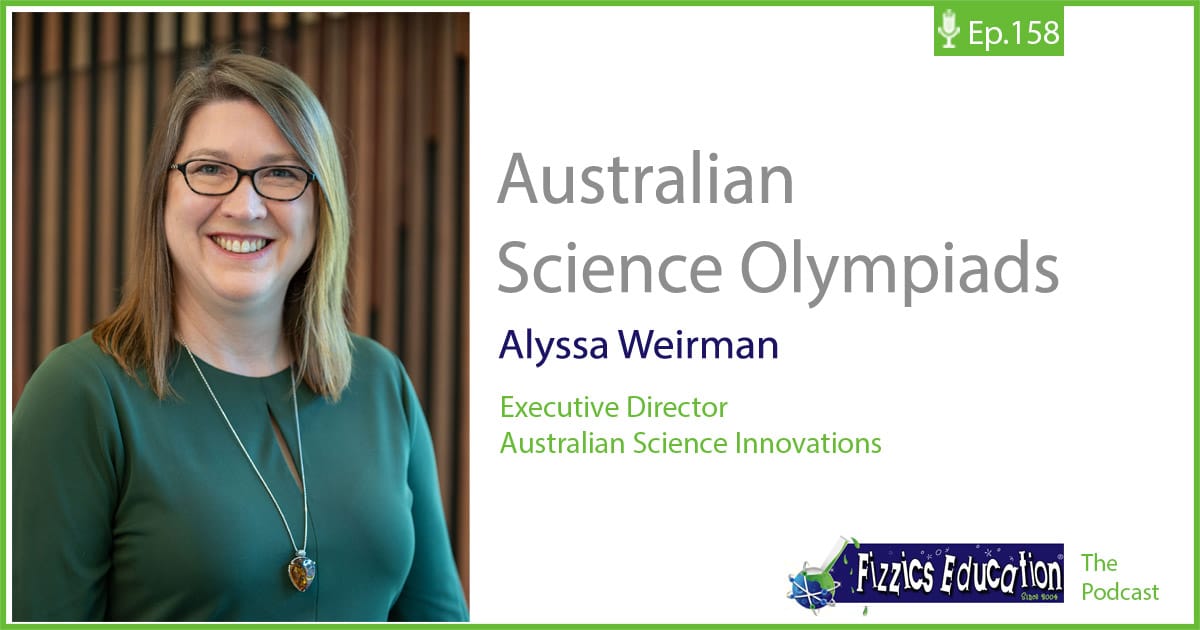
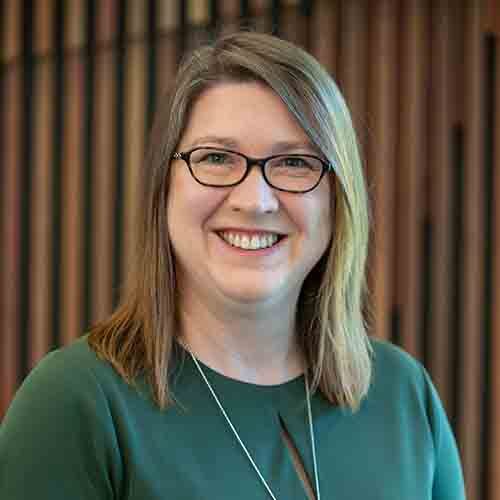
[00:00:45] Ben Newsome: And Alyssa Weirman, the Executive Director of the Australian Science Innovations, has dropped by to have a chat about what they’ve been doing lately. She is also a trained geologist and loves all things science in her role in managing ASI. And by the way, she does because of her background love a bit of rocks, fossils, cliffs, and volcanoes.
[00:01:10] Ben Newsome: But she also brings over a decade of business experience into ASI. So if you like the Australian Science Olympiads—and I certainly do, I did this many many years ago when I went through high school—you might want to know just what they’re getting up to now and how you can get involved.
[00:01:30] Alyssa Weirman: Thanks, Ben. Thanks for having me. I’m really excited to be here.
[00:01:36] Ben Newsome: Oh, really. I was actually thinking about what you’ve been getting up to—not just necessarily yourself, the organisation—I think when I was a kid, I actually was involved in these Olympiads at some point in time.
[00:01:48] Alyssa Weirman: Oh wow, really? It was before my time, so I heard about it later in my career and was like, “Oh, that sounds so cool,” but I never actually got a chance to be involved. But that is so cool that you were actually involved. What was your experience? What are your memories about that?
[00:02:10] Ben Newsome: I was just thinking, oh gosh, it’s going back. I definitely sat the exams, the tests. I didn’t, by the way—and this is actually a spoiler—I didn’t actually become any finalist or anything like that. I was just a kid doing it. But I do remember doing it.
[00:02:25] Alyssa Weirman: Oh, that’s very cool. Yeah, I think I remember doing a maths one. That was definitely around when I was a kid, and I remember getting an HD and being really excited, but I didn’t go anywhere, I didn’t go any further. And I never got another HD with any of the other ones I did, but just one year I got an HD in maths and was like, “Whoa!”
[00:02:44] Ben Newsome: Yeah, and it can actually happen. Oh gosh, we’re going down a rabbit hole. I was actually thinking when I did university, my statistics wasn’t fantastic, but the following unit was an HD because I finally realised what on earth was going on. It took the penny to drop, and there you go. So that’s the nature of the beast, like testing versus what you do in real life. Anyway, look, thank you for joining for this chat. I mean, okay, so you’re from ASI. Some people very much know who we’re talking about, but at the same time some people may not. So please describe what you do and who you work with and all that sort of thing, please.
[00:03:14] Alyssa Weirman: Yeah, yeah. So I’m the Executive Director with the Australian Science Innovations. I facilitate and support this organisation which is all about the Science Olympiads. Australian Science Innovations—we’re going to call it ASI because it’s a very long name—ASI has been around for 35 years doing this, which is pretty amazing for any organisation.
[00:03:45] Alyssa Weirman: And the Science Olympiads, some of you may know, a lot of you may not, it’s all about identifying, training, and supporting students to take part in the international competition. And Australia is actually pretty successful in competing on the international stage in the Science Olympiads. We win a lot of medals—not always gold, but always come away with a good stack of medals. But it’s not just about that, although we all love a medal, it’s also about introducing science to kids.
[00:04:20] Alyssa Weirman: So the Science Olympiads, I might just step through it so that people understand what it is, because I’ve only been with ASI for a year and it took me a while to get my head around actually what the Science Olympiads meant. So I have a very good perspective of a newcomer. But basically, we do an exam every year in July and August in the four disciplines: Earth Science, Biology, Physics, and Chemistry. And we test students on their capacity to answer questions, answer scientific questions.
[00:04:55] Alyssa Weirman: And then from that test, we select 24 of the top students—so that’s just the top who can answer these particular type of questions—and then they come to a Summer School and they get immersed in first-year university of that subject. So they get two weeks of really intense study during their school holidays and become really capable in that particular area of science.
[00:05:25] Alyssa Weirman: And then from that group, we select four to six to compete on the international stage. And they go and travel overseas and compete with other countries like the US, Thailand, Japan, China. And they go to places like Switzerland, where they’re going this year to Switzerland, United Arab Emirates, Japan, and there’s also the physics students going to Mongolia, which is a really interesting logistical problem.
[00:05:50] Alyssa Weirman: So it’s a really great opportunity, but it’s not just about those students who get to do the Summer School and take part in the competition. It’s about giving students an opportunity to identify their own love of science. And I love that intro that you just did of talking about your own experience. I mean, when I got that HD I went, “Hey, I’m actually really good at maths.” And you don’t often have those experiences when you’re at school. You just keep going with the everyday, but those little individual experiences can give you a hint of what your talent may be, what you might be good at.
[00:06:25] Alyssa Weirman: Admittedly, I hated maths and I never pursued it, but from that moment on I knew that I was actually good at maths. So this is what I think is some of the value of the Science Olympiads beyond just winning gold for Australia, which we do on a fairly regular basis. It’s also about giving students that opportunity to understand themselves and their own capability and showing them how good they are at something. And I think that’s really valuable.
[00:07:00] Alyssa Weirman: And one of the programmes that we’ve just started doing in the last two years is the Junior Science Olympiad. And that is a same competition, but it’s for a younger age group from Year 7 to 10. And what we love about this competition is that it has additional components beyond just the exam and the Summer School, which is actually called the Spring School just to confuse you. And so the extra components are the Junior Science Olympiad Training Squad and the Junior Science Olympiad Academy.
[00:07:35] Alyssa Weirman: What we love about the Training Squad is we use that exam, like all the other Olympiads, to identify really talented students, but we find them in remote, regional, and low socioeconomic areas. Those areas that haven’t had the same resources that you and I might have in a metropolitan area. And we use this training squad to lift them up to a level playing field so that they get an opportunity to compete on a level playing field for the Senior Science Olympiads, or the Junior Science Olympiads if they’re still young enough.
[00:08:10] Alyssa Weirman: So we’re really excited about this competition because for us, if we want to win gold, we have to be able to find those talented people no matter where they are and support them and lift them up to be able to take part. And you never know where that’s going to be.
[00:08:35] Alyssa Weirman: This year we’ve got some students who are coming from Cairns, there’s some from Geraldton, and they’re all taking part in the international Olympiads and they’ve been identified through the Junior Science Olympiad Training Squad and given the same opportunities that other kids have had. So it’s really exciting, and the kids are just amazing. They’re just so passionate about science, they’re so engaged and so involved, and we just love being able to support them through this process.
[00:09:00] Ben Newsome: I love how it’s about identification eventually because this is really powerful, because we kind of think about science as an endeavour. I mean, we can look at the different content disciplines—I mean, I could spend a lot of time talking about microbiology and all the rest—and yet the actual discipline of doing the science, the scientific reasoning and all the rest, that might actually be something that is taught even without a spectacular amount of materials. You just need to know how a scientist thinks.
[00:09:30] Alyssa Weirman: Yeah, completely. It’s all about that scientific method of observation, trying to be as unbiased as possible, being aware of your own bias, and making assessments from what you think is going to happen—your hypothesis—to what actually happens in reality, being able to reflect.
[00:09:55] Alyssa Weirman: And I think it’s such a powerful way of thinking about the world because you can apply it to your own actions as well, like psychologists do. You know, self-reflection is an amazing way to not just deal with the scientific method, but to deal with your own personal development. I think it’s such an interesting and powerful way of viewing the world. It’s such a benefit to humanity in so many ways that we still don’t really even understand. But anyway, I’m going off on philosophical tangents, my apologies.
[00:10:25] Ben Newsome: No, don’t apologise. It’s actually important because I mean, honestly, career development is also about developing yourself, it just is, for sure. I was actually thinking about the students when they sit down—so you’ve got this mid-year test that’s effectively a test. I mean, there’s got to be a way of sifting said students—but as they sit down, do they have to have done a bucketload of, I don’t know, “I’ve got to learn a lot about geology,” or whatever it is, or is it really about how they reason through a problem?
[00:10:55] Alyssa Weirman: Yeah, so number two. It’s good to have that knowledge because what we find is that kids, they may have their own particular interest in geology and so they’ve got lots of information they can bring to the question. But a lot of the questions are around comprehension: reading through and using that scientific method to understand the problem and then create the answer that is, you know, the correct one.
[00:11:25] Alyssa Weirman: So there are opportunities—we’ve got this thing called Olympiads Online, which you can get to through our website. And that is a free online training programme so that anyone can go in there and register, do a bit of a test, work out where their strengths are, and then practise questions that are very similar to the Olympiad questions. So that’s a really good way to practise for the actual Olympiad exam.
[00:11:54] Ben Newsome: Massively so. I was actually listening to—this was almost coincidental—I was listening to a radio programme yesterday, cannot remember exactly—I should have been paying attention because actually I was paying attention to the road because that’s what I need to do when I’m driving, however—yes, so whilst I was vaguely paying attention, I did hear this snippet of information. They were talking about the issues with the construction of understanding of someone’s knowledge. They were talking about the issue they’ve had where someone may get measured against a yardstick, but the problem is this particular yardstick they didn’t understand in the first place, they didn’t understand how the question was framed, therefore they couldn’t get an answer out very well.
[00:12:30] Ben Newsome: And surprise, surprise, if you give them a rubric, a scaffold, some way of being able to answer said question in the way that’s expected, suddenly you actually elucidate the knowledge that the kid had in the first place, which is not spectacular when you think about it. I mean, it’s pretty obvious, this is how you do the thing. So being able to have access to those online resources would be incredibly powerful for kids coming up through this year.
[00:12:54] Alyssa Weirman: Yeah, completely. I think it’s a really valuable tool for kids to have a go. There’s practice papers on our website as well. So once you’ve gone onto Olympiads Online and you’ve done all your practising that you can, you can then actually do a practice paper with the questions and go, “Oh, actually, I need to fix up this bit,” and you can really focus on a particular area.
[00:13:18] Alyssa Weirman: So yeah, there’s some great resources there to support kids. Because we want to see everybody who is interested in science—you know, it’s not going to be for everyone, but there are a lot of science nerds out there—we want to see them be able to take part in the competition and have a chance and discover their own aptitude in science. Even if they don’t make the team, it doesn’t really matter. It’s about discovering themselves and their own aptitude.
[00:13:42] Ben Newsome: For sure. And I kind of think about it from a student’s perspective too. This is quite a thing to put on a portfolio to say that they’ve done as they not just go into university but as they leave. They’re being identified and certainly if I was in industry looking for some of the brightest minds, this is actually not a bad place to start.
[00:14:01] Alyssa Weirman: Yeah. We actually, we’re—it’s funny you should say that because we’re starting an alumni programme. We’ve been working on it for a little while. COVID obviously had a bit of an impact because we couldn’t do face-to-face, but we really want to be able to provide opportunities for our alumni—that is the kids who take part in the Olympiad programme, but also the kids who have done really well in the exams who are really engaged—to see what careers and opportunities are out there, to connect them with industry, to show them.
[00:14:35] Alyssa Weirman: Because the problem with science is it’s really hard to know what a scientist does. You know, you’ve got astronaut, a doctor, somebody who works in a lab, but there’s such an amazing array of different careers out there that, you know, it’s kind of a world of possibility. So we want to use this alumni programme that we’re developing to connect kids with the range of opportunities that are out there, the amazing ideas, and all the innovation that happens in Australia, like quantum computing. The Quantum Brilliance is just literally above me right now.
[00:15:09] Ben Newsome: Absolutely, and shout out to Cathy Foley, our Chief Scientist in Australia by the way. So if you don’t know who Cathy Foley is, she very much was involved in quantum tunnelling and a few other things back in the day. But yeah, it’s—it is, it’s powerful. And I suppose as a mindset, it really is “what if?” and once you’ve done the “what if?” question, you then go about your experiment and maybe isolate a variable—probably a good idea—and test it. And that’s really all it is, just that’s the simple method.
[00:15:44] Alyssa Weirman: Yeah, yeah. What I love about science is that simple method can be applied in so many different ways. When you have physics, you’ve got, you know, the quantum mechanics and nuclear physics—I know that’s been in the news a lot with all the subs. You’ve got biology, you’re looking at, you know, individual insects or plants or bacteria. Earth Science is such a different way of approaching the scientific method because you’re looking at rocks and you have to kind of assess the mineral components. There’s so many amazing things that you can uncover in science.
[00:16:20] Ben Newsome: Oh, for sure. And what I actually love about it—and I actually do have this discussion when we do career days—there was one actually this week through a group called Inspiring the Future Australia—they were on a podcast here gosh, a couple of years ago—anyway, talking with Adrian.
[00:16:45] Ben Newsome: Anyway, so as we were talking with the careers, one of the questions that comes up inevitably is to myself because I’m the science guy, it’s like, “I don’t really care about science, should I be studying said science?” I say, “Well actually, you know what, it’s the mindset that you come out of it. You might end up as an SEO person for websites and perhaps doing fair testing against what works better to get people onto your site and frankly sit on the site in some way is valuable and guess what? You’re actually applying the scientific method in a non-science discipline.” So the thinking is what matters.
[00:17:10] Alyssa Weirman: Yeah, totally. It’s so valuable. Even in business, even that application of, you know, trying to identify an efficient system that’s going to make your business processes work more effectively. Scientific method can help you get there. It’s just so applicable to everything.
[00:17:29] Ben Newsome: Yeah, it’s formal thinking.
[00:17:31] Alyssa Weirman: Yeah.
[00:17:32] Ben Newsome: Yeah, yeah. So one of the things that grabbed my eye when I was on your website was the Asian Science Camp.
[00:17:39] Alyssa Weirman: Ah, yes. We haven’t—last year we did the Asian Science Camp. So last year with COVID we had lots of challenges with people actually travelling internationally, of course, and the International Biology Olympiad didn’t take place. So the students actually instead went to the Asian Science Camp, which was held online. But it’s—yeah, it’s a little bit—it’s different to the Olympiads in that it’s—we still use the Olympiad exam to select students who can take part in that competition, but it’s more about giving these students the opportunity to meet other students internationally and just learn about science, develop networks.
[00:18:25] Alyssa Weirman: Because the other aspect of a scientific research career is actually developing international networks. Oh yeah, it’s so important if you’re going into scientific research because that’s the way we exchange knowledge around the globe. So this is—the Asian Science Camp is all about giving students the opportunity to develop those networks, to start to develop those networks, while just learning lots about science and having an awesome time in a nerdy way.
[00:18:58] Ben Newsome: No, it’s so true. I mean, those PLNs—those professional learning networks—are so powerful. I mean, okay, this is an education podcast, I mean teachers will be going, “Yeah, I know what a PLN is,” but the kids may not. Those learning networks are so valuable, and it does not matter what industry you’re in. And hopefully if your network crosses industries, that’s where the really interesting fun happens.
[00:19:17] Alyssa Weirman: Yeah, totally. It’s just like scientific research. If you’re doing multi-disciplinary—so you’ve got say a little bit of biology, a little bit of physics, and a little bit of Earth Science—you can have some amazing stuff coming out of that that’s really interesting. Sort of that really cutting-edge development like a professional learning network that cuts across different networks.
[00:19:40] Ben Newsome: Yeah, it’s really hard to create innovation in a vacuum, unless your innovation is about vacuums, but as a whole it’s kind of hard to do it by yourself. It really, that inspired does require conversations quite often.
[00:19:53] Alyssa Weirman: Yeah, totally.
[00:19:55] Ben Newsome: Yeah, no, that’s awesome. So if you had a bunch of teachers in front of you and they were looking at throwing their kids through this, what would be some advice you’d give them to say, look, get the kids prepared as best they could with the resources they’ve got at hand?
[00:20:09] Alyssa Weirman: So I’d say have a look at our website, which is asi.edu.au, has all the information you need. Check out Olympiads Online, which you can link to from our website, and get all of your kids to sign up to the Olympiads Online website. And so, you know, not everyone’s going to be interested, but there’ll be a whole group of kids who really love science who’ll just go through and do all of the questions and tests and work out where their specialty is. That’s what I would do if I were a teacher and wanting to get my students trained up.
[00:20:53] Alyssa Weirman: Also, if you’re in that Year 7 to 10 teaching area, if you’re teaching that group of students, then seriously look at the Junior Science Olympiad because it’s got—it’s a pathway to other things. With the Training Squad and the Academy, it means that the kids don’t have to get the top, top marks, they just need to show us an aptitude and if that aptitude is a clear indicator that they may be able to develop into something else, then they may have the opportunity to do the training squad. So it’s a great way to really lift up kids who are almost there but they just haven’t had the resources to get them to that next level. That’s what we want to—we want to help them do that.
[00:21:35] Ben Newsome: Yeah, which is eventually lifting science literacy.
[00:21:38] Alyssa Weirman: Yeah, exactly.
[00:21:39] Ben Newsome: Very important.
[00:21:40] Alyssa Weirman: It’s a kind of a passion. Science—everyone should be a scientist, really.
[00:21:47] Ben Newsome: Absolutely, or at least understand the media that’s in front of them.
[00:21:51] Alyssa Weirman: Yeah, exactly.
[00:21:52] Ben Newsome: No, it’s so important. This has really been a great chat and honestly, it’s almost been a memory lane thing for me. I’m having a little think about what I was doing. I actually remember getting my little certificate. I’m going back in time. But look, thank you very much and look, I really hope that this keeps growing. I mean, the Asian Science Camp, I can see how that can actually grow further and go from online to who knows to where it might go from there.
[00:22:20] Alyssa Weirman: Yeah, yep. That would be awesome, I think. We are really keen to see it grow and develop and to reach as many kids as we can. We’d love to do some kind of outreach with some regional schools, but one thing at a time. We’ve got to build slowly so that we can do all of that sort of stuff.
[00:22:38] Ben Newsome: Yeah, takes time. But hey, we’ve got our time on our hands. You’ve been around for 35 years at this point in time. Let’s double it, right?
[00:22:47] Alyssa Weirman: Yeah, totally. Another 50.
[00:22:49] Ben Newsome: Sounds good. Thanks so much for hanging on the podcast.
[00:22:52] Alyssa Weirman: Thank you for having me, Ben.
[00:22:55] Intro Voice: We hope you’ve been enjoying the Fizzics Ed Podcast. We love making science make sense. Why don’t you book us for a science show or workshop in your school? If you’re outside of Australia, you can connect with us via a virtual excursion. See our website for more.
[00:23:12] Ben Newsome: Well, I hope you enjoyed that chat with Alyssa Weirman. How good would it be to be involved with growing the Australian Science Innovations group and the Australian Science Olympiads? This is such a great vehicle for getting high schoolers into STEM as a career path. Now, if you want to know a bit more, go on over to asi.edu.au and you can find out all the details that you need to know about the Science Olympiads.
[00:23:45] Ben Newsome: Now, if you’re overseas and there’s nothing like that in your country at this point, why not challenge someone to set it up? And if not, why not you set this up? Because it’s something that’s been going on for 35 years and will keep on growing and growing and growing, and it makes a genuine impact. So if you’re overseas, maybe you could look at doing this as well. Just a little idea. Anyway, so look, I hope you enjoyed this chat, I certainly did, and as usual, we’ve got more episodes coming up. You’ve been listening to me, Ben Newsome from Fizzics Education, and this is the Fizzics Ed Podcast, and I’ll catch you another time.
[00:24:04] Intro Voice: You’ve been listening to another Fizzics Ed Podcast. We’re excited about science. Subscribe to us on iTunes to download the next episode as soon as it’s released. And don’t forget, for hundreds of ideas, free experiments, our new “Be Amazing” book and more, go to fizzicseducation.com.au. That’s physics spelled F-I-double-Z-I-C-S.
[00:24:32] Outro Voice: This podcast is part of the Australian Educators Online Network. AEON.net.au.
Frequently Asked Questions
What are the Australian Science Olympiads?
The Australian Science Olympiads are a series of national competitions designed to challenge high school students in disciplines including Biology, Chemistry, Physics, and Earth Science. Organised by Australian Science Innovations (ASI), the programme identifies talented students and provides them with intensive training, with the top performers representing Australia at international competitions.
How can students prepare for the Olympiad exams?
Students can access “Olympiads Online,” a free training platform provided by ASI. This resource allows students to register, test their current knowledge, and practise with questions similar to those found in the actual exams. Additionally, past practice papers are available on the ASI website to help students familiarise themselves with the exam format and problem-solving requirements.
What is the Junior Science Olympiad (JSO)?
The Junior Science Olympiad is specifically tailored for students in Years 7 to 10. Unlike the senior programmes, the JSO includes a Training Squad and an Academy designed to support students from regional, rural, and low-socioeconomic backgrounds. This initiative aims to level the playing field by providing resources and training to students who show high aptitude but may lack access to specialised STEM programmes.
What happens if a student is selected for the Summer School?
The top 24 students from the initial exams are invited to an intensive two-week Summer School (or Spring School for juniors). During this period, students are immersed in first-year university-level content for their chosen discipline. It is from this group that the final four to six students are selected to travel overseas and compete on the international stage.
Why should students participate if they don’t plan on a career in science?
Participation in the Olympiads fosters a scientific mindset—a way of thinking characterised by observation, hypothesis testing, and self-reflection. These critical thinking and problem-solving skills are highly transferable to business, psychology, and various other industries, helping students develop a more rigorous approach to understanding the world regardless of their eventual career path.
Extra thought ideas to consider
The Power of International Professional Learning Networks
Beyond the competition, programmes like the Asian Science Camp allow students to build international networks early in their lives. In the world of scientific research, these global connections are essential for the exchange of knowledge and multi-disciplinary innovation. For students, starting these networks in high school provides a significant advantage for future collaborative projects.
Bridging the Educational Divide in Regional Australia
One of the core missions of the Junior Science Olympiad Training Squad is to identify talent in areas that traditionally have fewer resources. By providing specialised support to students in places like Cairns or Geraldton, the programme ensures that academic excellence is not limited by geography, allowing the best minds from all over Australia to compete internationally.
Discussion points summarised from the FizzicsEd Podcast, verified and edited by Ben Newsome CF