Transcript
[00:00:00] Announcer: You’re listening to the Fizzics Ed Podcast. For hundreds of ideas, free experiments and more, go to fizzicseducation.com.au. And now, here’s your host, Ben Newsome.
[00:00:18] Ben Newsome: Welcome to another Fizzics Ed Podcast. Glad to have you no matter where you are around in this world of ours. We are talking STEM, and today we are hanging out with a superstar of STEM named by Science and Technology Australia, one of those that talks about STEM, loves their STEM, and promotes STEM.
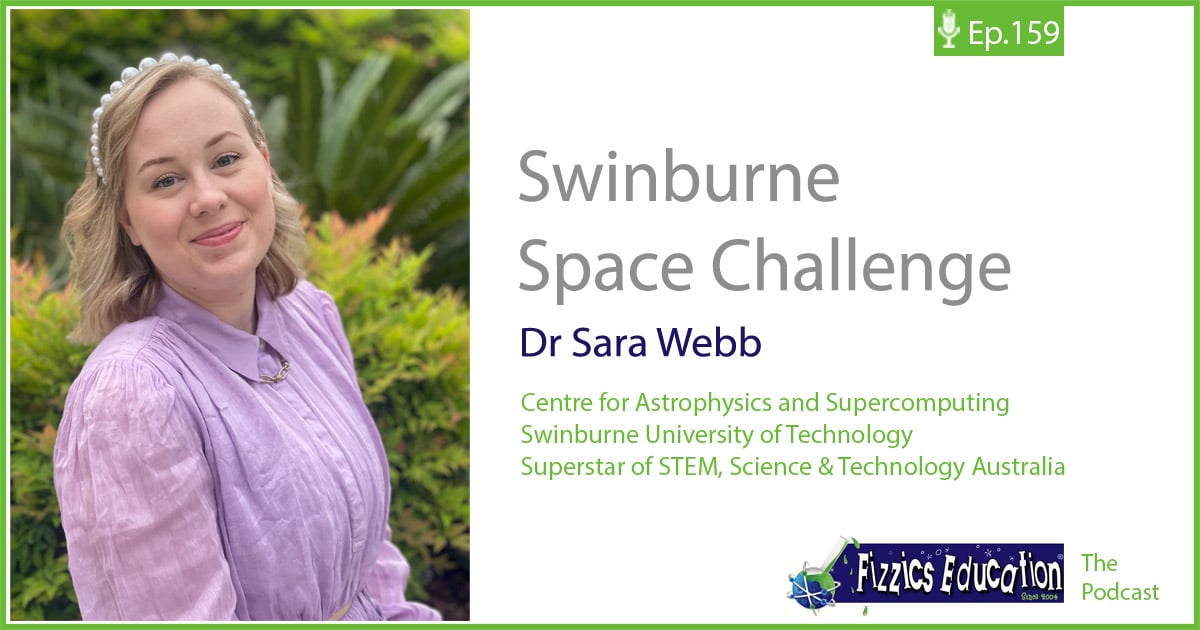
[00:00:35] Ben Newsome: Dr Sara Webb is an astrophysicist out of Swinburne University of Technology where she is very much into astronomy. So much so, she does research into fast radio bursts, gravitational wave events, studying flaring stars, and applying machine learning to all sorts of astronomy.
[00:00:55] Ben Newsome: She also shares the wonders of astronomy and astrophysics through a programme called the Space Challenge, which is run out of Swinburne University of Technology for high school students. She really loves her STEM, and you can hear it come through in this chat. So let’s get right into it.
[00:01:20] Announcer: This is the Fizzics Ed Podcast. For all about science, ed tech and more. To see 100 fun free experiments you can do with your class, go to fizzicseducation.com.au. That’s physics spelled F-I-double-Z-I-C-S, and click 100 free experiments.
[00:01:26] Dr Sara Webb: I’m an astrophysicist, technically, that’s what I did all of my training in. But really, I’m just a big data nerd. I love using data, I love using machine learning in all different ways. I do that across astronomy and outside of astronomy too, which is pretty unique. Not a lot of people tend to vary from where they’re trained, so I’m very excited that I can do that. Aside from that, my big passion is science communication. I’m mission director for our Swinburne Space Youth Innovation Challenge, but I also do a lot of science communication on the side in my own social media things as well, which I just love, it gives me life.
[00:02:04] Ben Newsome: I love how scientists are really being given this platform to really do this. For a while you’re stuck away and almost shunned for doing so, but there’s actually a real point to this, to take it out to the world so people know what’s going on.
[00:02:18] Dr Sara Webb: Yeah. That’s why I’m super grateful to be a superstar of STEM as well, who champion this idea of minority expert voices, because unfortunately in the media we find that there’s not a lot of women, not a lot of gender-diverse people if you break down the stats of who the experts are. Which is not representative for most fields, and I think communication is super important.
[00:02:45] Dr Sara Webb: Like you said, it should be part of your job, because the majority of science is funded with public money. And that’s wonderful. That is the most amazing thing that we live in a society that values science so much we fund it, which is excellent.
[00:03:05] Dr Sara Webb: But I think it also means it’s our responsibility and our duty to explain our science to the public, to everybody, because we’re doing it for the better of society, of humanity in general. How boring would it be if people just kept their science secret and you didn’t get to learn about it? You don’t need to be an expert in something to be interested in something.
[00:03:32] Ben Newsome: Otherwise it becomes the dark arcane arts that no one knows what’s going on. That’s fair enough. That’s definitely a feeling that we get around people these days, and it needs to be out there. I totally agree. You are doing that. I love to learn about the Swinburne Youth Space Innovation Challenge, but also, did you put yoghurt in space?
[00:03:42] Dr Sara Webb: We did. As part of that Swinburne Space Challenge, we have put yoghurt, well, we put the building blocks of yoghurt in space because yoghurt is really simple. It’s just milk, proteins, and then some lactic acid-producing bacteria. You just shake it up and you let the bacteria go to town and you produce yoghurt.
[00:04:06] Dr Sara Webb: So we sent up all sorts of different bacteria, the ones that you normally get in your store-bought yoghurts and a couple of surprise bacteria, and a couple of different milks. Cow’s milk and then also soy milk, and we tried to experiment to see if yoghurt would be made. The good news is, yes, it does, despite microgravity.
[00:04:32] Ben Newsome: Fantastic. Microgravity is a wild beast of a thing. It does things that you do not expect. So the bacteria played nice, that’s a good thing. I’m just curious, where did this project come from?
[00:04:36] Dr Sara Webb: It stemmed from a programme we have called the Shine programme, which is Swinburne and Haileybury schools combined. We’ve been running that for I think this is our sixth or our seventh year now, it’s hard to count through the pandemic. What we do is we work with a group of students to design an experiment for space and send an experiment to space.
[00:05:01] Dr Sara Webb: That was such a great success, it still is a great success, it’s one of my favourite things to do during the year is work hands-on with these students. We realised that not only were they brilliant and coming up with excellent legitimate scientific inquiries that we could do, but they loved learning about it.
[00:05:20] Dr Sara Webb: We wanted to make it as accessible as possible, so we created the Swinburne Space Challenge where for a much lower entry cost, they can still learn all of the basic principles that we teach at an undergraduate level. We teach it as part of our space applications units. They can get a taste of what space is, and then they can start coming up with their own concepts and ideas and start channelling those creative juices.
[00:05:43] Dr Sara Webb: The coolest part is they get to analyse some of the experiments that we send to space as part of our other programmes. They get to not only be creative, but then figure out did our experiments work or not in their own school laboratory.
[00:05:56] Ben Newsome: With real things, with real stuff, with real data. That brings up the point, when you speak with high school students, when they envisage what an astrophysicist is, do they think astronomer peeking through a telescope? Does their conception of what they think you do meet reality?
[00:06:13] Dr Sara Webb: No. I think this is a common theme, especially for astronomy. My conception of what I thought an astronomer did before I became one was completely different to what I actually do. We see all of the beautiful images that come from things like the JWST, stunning images of the universe, and you think an astronomer might just play and work with them all day. We do, but we don’t. A lot of the time it’s with computers, so we’re using computer programming to sift through insane amounts of data to do really complex numerical things with a computer. The computer is our best friend, a supercomputer is our best friend.
[00:06:53] Ben Newsome: I was going to ask you, do you have to buy some time on supercomputers or do you have access to it at all times? They’re not exactly a cheap thing.
[00:07:02] Dr Sara Webb: No, they’re not. I’m very privileged that at Swinburne we have the OzSTAR supercomputer, which is just a machine. It is such an incredible computer. My entire PhD was done using OzSTAR, and I still use it every day. I get to log on and use the computing nodes. Thankfully, my stuff isn’t too intensive. You don’t expect that. High school students don’t expect that when I tell them that I spend most of my days programming and very rarely look at data physically, a lot of it is working with the data.
[00:07:44] Ben Newsome: I remember at uni, stumbling upon this, actually really underlines the point about computing power. Whether we believe it or not, there’s the group that does SETI, and SETI has this thing called SETI@home. I think it’s still trundling along. The idea was that you could download this tiny little bit of software onto your computer, it kind of crowdsources your CPU.
[00:07:56] Dr Sara Webb: It’s like protein folding back in the day.
[00:08:01] Ben Newsome: Yes, exactly! Something had to crunch it, and back then there just weren’t these massively crazy supercomputers. Well, they were super back then for those people, but not for us now. Your phone’s probably more powerful. But it’s wild that data is inherently linked to astronomy.
[00:08:18] Dr Sara Webb: Yeah, and the thing that a lot of people don’t realise, even some astronomers don’t realise, is how similar some of the things we do with our data and how we analyse and interrogate our data is to other datasets. For medical imaging, our images are very, very similar and what we’re looking for is similar.
[00:08:40] Dr Sara Webb: A lot of the time you’re looking for things that are anomalous, so things that don’t quite fit the pattern. It’s like that Playschool thing, “What doesn’t belong?” That’s kind of what we do with our data in very clever ways with machine learning. That is completely transferable to so many different areas of science.
[00:09:00] Dr Sara Webb: The coolest thing is seeing my friends and my colleagues and now myself work with other datasets. I now work with human data, which I didn’t think I’d ever work with human data, but I do. I have friends who work in the medical industry now using all of the things that they would do on astronomy data, but now trying to detect cancers or solve problems. It’s really cool how transferable that data knowledge is. That’s true for any type of data that you do across any type of science, it’s very transferable.
[00:09:27] Ben Newsome: Makes me think about some of the business incubators and things like that that exist, whereby the fastest, coolest, most wonderful things come from multiple disciplines smashed together. When scientists get in a room, there’s just bubble energy. But it’s really curious that this is the effect of just the nature of the beast, that you do the conferences.
[00:09:50] Ben Newsome: I’m far more likely as a science educator to go to a science education conference than to a dentistry conference. Yet, I’m sure that if I randomly turned up… I don’t know why dentistry turned up, maybe they need to brush their teeth more, I don’t know. But I could possibly go to a dentistry conference and learn something I’ve never heard of before and realise it’s applicable actually in my own world. We should do more of that.
[00:10:16] Dr Sara Webb: It’s funny you say dentists. One of the experiments we sent up to space was actual teeth. Teeth are fascinating. In general, the way that our teeth work and the way that the mineralisation happens to protect our teeth and to make the enamel is really cool, and I don’t think dentists get enough credit for how neat their job is.
[00:10:39] Dr Sara Webb: We worked with my partner’s parents, both dentists and both lectured and were professors in dentistry techniques before they retired. So our students got to chat to them to ask questions about why would a tooth decay differently in microgravity. It’s all of this idea of we have saliva in our mouth, and we have gravity, so saliva likes to fall down our teeth, which is very helpful, it covers most of it.
[00:11:05] Dr Sara Webb: Now, if you imagine you’re in space and in microgravity, how weird that would feel because your liquid doesn’t fall, it floats. So your teeth don’t get covered in the same way that they would with your saliva. If you’ve got bacteria on your teeth, then the bacteria can just have a field day, they can be very, very happy, which is not good for our teeth. So we were trying to investigate that. I never thought I would send a human tooth to space, but we did.
[00:11:31] Ben Newsome: It’s so significant though, because we’ve been lucky enough to run into quite a few people doing this sort of work in space through the Australian Virtual Astronaut challenge, which at time-stamping this chat, we’re now three years into it, and most likely we’ll keep on doing it. It’s fascinating the challenges required to do long-term, not just hanging around in low Earth orbit, but frankly, going to the Moon or beyond. That is a genuine deal.
[00:12:12] Dr Sara Webb: It is. We’ve put a lot of neat things in space, all of it with that idea though, that humans aren’t meant for space. Our bodies, they don’t like it because we’re Earth-bound creatures, we have evolved to live happily on the Earth. As soon as you take us away from the Earth, things change, sometimes for the better, sometimes for the worse.
[00:12:35] Dr Sara Webb: It’s kind of scary, but exciting, because we’re going to be sending humans back to the Moon but for longer periods of time, and then eventually humans to Mars. That is super challenging because we don’t know exactly how their bodies are going to react and if it’s worth the long-term health consequences that could be present. We don’t know that yet, and we’re still trying to figure all of that out, which is exciting.
[00:13:03] Ben Newsome: It’s amazing. I think about some of the quotes, I’ve even had kids quote it back at me, “failure’s not an option,” but the reality is that you have no choice but to fail to get this right. There is no way out of this.
[00:13:13] Dr Sara Webb: I love that quote, “failure’s not an option,” because I think people sometimes use it or understand it out of context that you’re just not allowed to fail, you can’t fail. The idea is that you have to fail so many different times to learn enough to not fail when it counts.
[00:13:35] Dr Sara Webb: That’s so true when you look at all of the space programmes, is so many things do go wrong. Sometimes it’s catastrophic and devastating, and sometimes it’s little minor things, but all of them teach you how to be prepared for the next thing. That’s just so incredibly important, especially when you think about the Youth Space Innovation Challenge. We’ve worked with kids as well putting stuff into space through Magnitude.io, and the mindset of, if something slightly went wrong, it was almost like we should go into a puddle of tears. Actually, no, we’ve just learned something.
[00:14:11] Ben Newsome: And it’s just a simple mindset shift.
[00:14:15] Dr Sara Webb: I think sometimes, or at least from what I’ve seen working with some students, is the fear of failure, which I had too when I was a student. I’m still scared to try new things if I think I’m not going to do okay at them. I think a lot of people feel this because you’re scared of failure. But if you just don’t try something, then you’ll never be able to do it, full stop.
[00:14:42] Dr Sara Webb: There’s 100% success of not doing something if you don’t do it. Exactly. It’s that fear of overcoming that little bit of fear. I always tell myself, well, if I haven’t failed at least once, then I probably haven’t learned something. So I go in trying to learn, and I think that helped me shift my thinking.
[00:15:05] Dr Sara Webb: Trying to teach that to our high school students as well, I think sometimes you see their minds literally tick over and be like, “Oh, that makes sense. Okay.” And then they’re more keen to not do something perfectly on the first go, and I think that’s a good thing.
[00:15:30] Ben Newsome: Well, it’s true. As we speak, I’ve got a teen, lovable grade eight child that is just like every other grade eight child worldwide, has their things going on. I think about them, as much as they project bravado and confidence and all the rest, they have the same human frailties and things, and frankly as a teen, even more than anywhere else.
[00:15:55] Ben Newsome: We were talking just prior to pressing record on this thing, just around the challenges that happen, and how even just simple inflection points can happen. A simple word of encouragement suddenly makes a thing happen for a child, or conversely, the exact opposite, an offhand comment produces such damage, but the child out of their bravado doesn’t say a single thing and you don’t know the damage you’ve done.
[00:16:16] Dr Sara Webb: It does happen. I was telling you before the call that I think I’m a physicist out of spite, because I chose physics in Grade 11. I went to school in Queensland, so we chose our senior topics for Grade 11 and 12, which I think is similar down here in Victoria. I hadn’t initially chosen physics, I had chosen something else, I think it was Law actually.
[00:16:40] Dr Sara Webb: I did a term of Law, decided that I really did not like it, and was like, “I’ve always liked maths, I love maths, I’m going to swap to physics and I’m going to swap to the hard maths.” And I did, because my grades were fine enough that the coordinator was happy to put me in.
[00:17:00] Dr Sara Webb: When I got to my physics class, after just one week of trying to catch up an entire term’s worth of work, my physics teacher at the time said, “Look, I just don’t think you’re cut out, maybe you should consider changing before it gets too late.” I was so fired up and upset because I loved physics and I was trying to catch up on an entire term in a week, and I was trying my little butt off.
[00:17:25] Dr Sara Webb: I just did not accept that at all, obviously, I’m a physicist now. So I just worked extra, extra hard, but with this idea of “I will prove you wrong.” Now I realise, well maybe I wouldn’t have been a physicist if I hadn’t have been so determined. But that was a big moment.
[00:17:45] Ben Newsome: Curious, because in a lot of ways that could affect people massively. In your case, it didn’t. I’ve had my own experiences like this, where someone… it’s like putting a red flag in front of a bull for me. Tell me I can’t do it, you watch me. I double-dare you to stop me now. It makes me curious, there might be some educators listening in going, “I’ve used that technique because I knew what it was going to do.”
[00:18:14] Dr Sara Webb: Yeah, someone was like, “Oh, they probably did it because they knew.” And I was like, okay, but you don’t know what that child’s going through. So I think you’ve got to be careful sometimes.
[00:18:28] Ben Newsome: Massively, it’s high stakes! You get it wrong, it’s really wrong.
[00:18:31] Dr Sara Webb: Yeah, exactly. I think sometimes kindness and encouragement can go a long way. Because you can still voice your concerns, be like, “I want to support you, why don’t we chat about it?” But I think for me, I would… yeah.
[00:18:48] Ben Newsome: No, totally. So I’m just curious about… there’s people who listen to this all over the place, and I’m curious, are they able to get involved in the innovation challenge that you run?
[00:18:59] Dr Sara Webb: Yes! Any high school students who are in grades 10, 11 and 12 across Australia are absolutely welcome to come and get involved. So we’ve closed our applications for 2023, but they’ll be opening again later in the year for 2024. You can email [email protected].
[00:19:20] Dr Sara Webb: The best thing is that it’s a team challenge, so between four and six of you and your friends can get involved from a school. You can chat to your teacher, because we’ve got even some whole school classes doing it and just broken up into little teams. It’s Australia-wide now, so we are so excited to have students from all over Australia joining. That’s definitely something to keep in your noggins for later in the year.
[00:19:45] Dr Sara Webb: For any university mentors, we use a lot of our Swinburne students who are in not only Science, but Engineering, we have some Law students who mentor as well. That is so much fun because they get to chat to the high school students about how did they get where they were going to go, did they know they were going to do this?
[00:20:08] Dr Sara Webb: I think that is one of the most valuable things as these weekly chats we have between high school students and university students. Because I felt this when I was in high school, I thought what I chose at university, that was it, that was my career forever. Now I’m like, well, that’s not true at all. You can do whatever you want, literally, the world is your oyster.
[00:20:28] Dr Sara Webb: It’s good for our students to hear some of our mentors, like some of them have worked for 10 years, done all different industry stuff and then gone back, some of them have changed degrees or done research. It’s just so diverse and very cool to see the exchange between them. It’s amazing.
[00:20:48] Ben Newsome: Oh, for sure. I was actually at a careers event this week, I volunteered through a group called Inspiring the Future Australia where I rock up and spend an hour or two with students having those chats as round tables. A lot of them think it’s all linear. You do high school, you do this uni, jump into the course and 50 years later, you’re now a world expert in whatever it is. That’s great if that happens for some, the vast majority of it, it’s hard work mixed with chance encounters. It really is. But that’s important. So I’m just wondering, if you had students in front of you, and they’re in that group, they’re about to kick off in the innovation challenge, what would be some words of advice if they were looking to get into science in general, not just so much physics but anything like that?
[00:21:29] Dr Sara Webb: Anything. One of my biggest pieces of advice is to try everything, and that comes back to that “don’t be afraid to fail.” Because you don’t know what you’re going to like about something until you try a few different things. It’s kind of that idea of you don’t know if you truly like or you don’t like something unless you’ve had outside experiences as well.
[00:21:55] Dr Sara Webb: So try everything, and that could just be watching different YouTube videos on people explaining different concepts and just seeing what makes you excited, or trying at-home kits or all of these different things you can try before you actually get to doing the thing. There’s a lot of free resources out there, which is incredible.
[00:22:32] Ben Newsome: Absolutely. In fact, I was saying exactly that sentence, even almost to the letter, to some students who were trying to work out how they were going to set up some photography business. I said, “Look, your phone is a world’s gateway for all knowledge, and it’s completely free, you’ve just got to know where to look.” That’s so true. It really is.
[00:22:54] Dr Sara Webb: Yeah, exactly. Anything you want to learn. You don’t have to wait until you get to university to dabble. Not at all. There’s free lectures, there’s so many free lectures so you can really get a taste of what will actually be taught if I go to learn something. That’s what I did because I wanted to be an archaeologist before a physicist, dead set, I still kind of want to be an archaeologist if I ever get time.
[00:23:22] Ben Newsome: You could use the data points on some of that mapping they do with satellites to find the stuff, I don’t know, I have no idea, but you’ve got skillsets that could work with it.
[00:23:27] Dr Sara Webb: Exactly, I’m trying to figure out a way in. But I listened to a free lecture that was called Galactic Archaeology. I had no idea that I… I mean, I loved physics, but I had no idea that astrophysics was really a thing. That was just amazing, and so that changed my interest and then I started learning more about astronomy, and I wouldn’t have known that if I hadn’t have listened to that free online lecture back when I was 16 or so.
[00:23:56] Ben Newsome: So I can’t have an astrophysicist on this chat without asking what are you currently looking at or trying to discover and discern out of the crazy cosmos of ours?
[00:24:06] Dr Sara Webb: Oh my goodness, so many things. One of the things that we’re trying to figure out at the moment, and we’re finishing up a paper at the moment on, is what are Fast Radio Bursts? Some of you might have heard of them. They’re mysterious radio bursts, we don’t know what they are. We have ideas, but we haven’t found what we call counterparts to them, so we haven’t seen them in any other frequency aside from radio, which is curious.
[00:24:35] Dr Sara Webb: So we’re looking with optical telescopes and some other telescopes to try to see what’s happening. We’re still confused, still trying to figure it out with data, which is exciting. I think that’s the exciting bit about astronomy is there’s so much we don’t know. In the last 100 years, we’ve gone from zero to 100 of the things we don’t know, and that’s great because there’s just so much more for us to try to understand and discover.
[00:25:01] Ben Newsome: Oh, there is. This is fascinating, I know we could frankly chat for a very long time, I’ve got this funny feeling. But you’ve got Fast Radio Bursts to discover, find out what is going on. I know, it’s crazy, but it’s great. Thank you so much. We’ve got the email and as usual, we’ll put this information in the show notes, that’s definitely the case. But if people needed to Google something now, if they’re driving a car and they want to pull over now because they need to find out stuff, where would they need to head off to, where on the world wide web?
[00:25:29] Ben Newsome: …about yourself and Swinburne and all the things that you’re involved in.
[00:25:34] Dr Sara Webb: So Swinburne, you can just Google Swinburne University, you can Google Swinburne University Astronomy, and all of our magical amazing programmes will pop up. For me personally, you can just Google Dr Sara Webb or Sara Webb Science and I am on all of the social medias. I make videos, explainer videos on topics as well, so people leave the questions that they have that maybe there’s not an answer for, or one that they haven’t found yet, and then I try to figure out the answer or explain why we don’t have an answer, which is my favourite thing to do. All of that is excellent.
[00:26:07] Ben Newsome: I love that, because you do science communication a lot. I love the Q and A, you just never know what’s coming next as the question.
[00:26:16] Dr Sara Webb: My goodness, it’s always aliens and black holes, and they are my two favourite topics in the world.
[00:26:21] Ben Newsome: Oh, they are. Maybe they live inside and we just don’t know it because we can’t get past the event horizon. We just don’t know yet.
[00:26:25] Dr Sara Webb: Who’s just to say?
[00:26:27] Ben Newsome: Who knows? Oh gosh, that is a rabbit hole. Well, thank you very much, Sara, for joining me on this and well done for becoming a superstar of STEM.
[00:26:35] Dr Sara Webb: Thank you very much! Thank you for having me.
[00:26:37] Announcer: We hope you’ve been enjoying the Fizzics Ed Podcast. We love making science make sense. Why don’t you book us for a science show or workshop in your school? If you’re outside of Australia, you can connect with us via a virtual excursion. See our website for more.
[00:26:52] Ben Newsome: Well, I hope you enjoyed that chat with Dr Sara Webb, I certainly did. I love how her work in big data and machine learning not only helps astronomy out but is applicable in other industries. That’s so fascinating. And I love how her work with the Space Challenge programmes can help inspire other high school students.
[00:27:13] Ben Newsome: If you want to know a bit more about the Space Challenge, a couple of different ways: either go to the show notes of this podcast, there’ll be a link there for you to check out, or go to Swinburne University’s website and just type in “Swinburne University Space Challenge” into your favourite search engine and you’ll be able to find the link to a PDF which gives you all the information about this.
[00:27:35] Ben Newsome: As usual, we have a lot of stuff coming up, and I want to say thanks to Science and Technology Australia, who is organising the Superstars of STEM programme. If you want to find more about that, go to scienceandtechnologyaustralia.org.au. So look, that’s the end of this particular podcast. I hope you’ve enjoyed this, but as usual, we have more episodes coming up. You’ve been listening to me, Ben Newsome from Fizzics Education, and this is the Fizzics Ed Podcast. I hope to catch you another time.
[00:27:54] Ben Newsome: You’ve been listening to another Fizzics Ed Podcast. We’re excited about science. Subscribe to us on iTunes to download the next episode as soon as it’s released. And don’t forget, for hundreds of ideas, free experiments, our new “Be Amazing” book and more, go to fizzicseducation.com.au. That’s physics spelled F-I-double-Z-I-C-S.
[00:28:22] Announcer: This podcast is part of the Australian Educators Online Network, AEON.net.au.
[00:28:30] Announcer: A E O N, dot net, dot a u.
Frequently Asked Questions
What is the Swinburne Space Challenge?
The Swinburne Space Challenge is an innovation programme designed for Australian high school students in years 10, 11, and 12. It provides a platform for teams to design their own space-based experiments while learning the principles of space applications and scientific enquiry used at an undergraduate level.
Why was yoghurt sent into space as an experiment?
Students involved in the Swinburne Space Challenge sent milk and lactic acid-producing bacteria to the International Space Station to investigate whether yoghurt could be produced in microgravity. The experiment successfully confirmed that the fermentation process still works in orbit despite the lack of gravity.
How does machine learning assist astrophysicists?
With the massive amount of data generated by telescopes and supercomputers like OzSTAR, machine learning is used to identify anomalies and patterns. This technology helps scientists find rare events, such as Fast Radio Bursts, much more efficiently than traditional manual observation.
What were the findings regarding human teeth in microgravity?
Research showed that in microgravity, saliva does not flow around the mouth and coat teeth as it does on Earth. This lack of a protective coating can allow bacteria to thrive, which poses unique challenges for the dental health of astronauts on long-duration missions to the Moon or Mars.
What advice does Dr Sara Webb have for aspiring scientists?
She encourages students to try everything and not be afraid of failure. Scientific discovery often comes from failing many times to learn what works, and Dr Webb emphasises that career paths in STEM are rarely linear and are often shaped by diverse interests and chance encounters.
Extra thought ideas to consider
Cross-Disciplinary Data Application
The methods used to analyse distant stars are often remarkably similar to those used in medical imaging. Consider how a background in ‘Big Data’ and machine learning can open doors in various industries, from detecting cancers to solving complex problems in the medical sector.
Human Resilience and Space Exploration
Humans are Earth-bound creatures by evolution, and our bodies react in unexpected ways to space. Exploring how basic biological functions change in microgravity—from saliva flow to bone density—is essential if we are to become a truly multi-planetary species.
Discussion points summarised from the FizzicsEd Podcast, verified and edited by Ben Newsome CF