Transcript
[00:00:00] Ben Newsome: You’re listening to the Fizzics Ed Podcast. For hundreds of ideas, free experiments, and more, go to fizzicseducation.com.au. And now, here’s your host, Ben Newsome.
[00:00:17] Ben Newsome: Welcome again to another Fizzics Ed Podcast. Glad to have you again for another chat around STEM. In this particular case, we are hanging out with someone who’s incredibly passionate about building capacity in science communication. So much so that since 2003, Dr Graham Walker has been working in the Asia-Pacific area, Africa, and the Middle East, and has worked with hundreds of people through dynamic partnerships and on the ground.
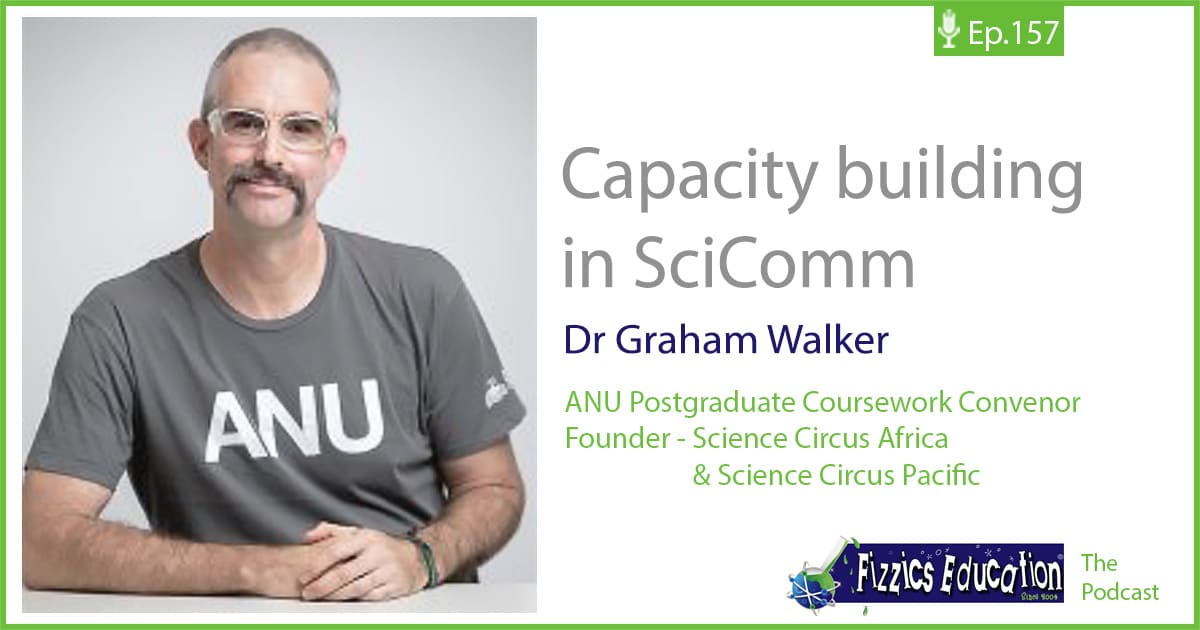
[00:00:45] Ben Newsome: He is at the National Centre for Public Awareness of Science, CPAS, at the Australian National University, where he convenes a bunch of postgraduate coursework and he really loves making science happen. So much so, he founded Science Circus Africa, which has reached over 500 staff and through them 73,000 people in 10 African countries. He’s currently involved in the DFAT-supported programme Science Circus Pacific. He is a massive aficionado of science shows and workshops and has trained all over the world. Today, we are talking with someone who really knows their stuff when it comes to science communication. Let’s get into it.
[00:01:19] Ben Newsome: This is the Fizzics Ed Podcast, for all about science, EdTech and more. To see 100 fun free experiments you can do with your class, go to fizzicseducation.com.au. That’s physics spelled F-I-Z-Z-I-C-S, and click 100 free experiments.
[00:01:39] Dr Graham Walker: Good to be here, Ben. Thanks for having me.
[00:01:46] Ben Newsome: I’ve been thinking just a little while ago, how have we not crossed paths before in some way?
[00:01:52] Dr Graham Walker: Look, I’ve had my eye on you. I know the team at Fizzics do good stuff. I love seeing the pictures on social media. If I’m not mistaken, I think maybe you came to one of my science shows at a library once as well, but it might have been someone else at Woden library.
[00:02:11] Ben Newsome: I might have. I have been to Woden before, but mind you we had other people there too. It gets like that. You just don’t know where you’ve been last.
[00:02:19] Dr Graham Walker: I’ve done a few shows in a few places, but it’s good to have this opportunity to connect properly.
[00:02:27] Ben Newsome: Honestly, just chat science communication, why on earth we actually do it. Gosh, you’ve been doing it all over the world.
[00:02:38] Dr Graham Walker: I’ve been working in science communication for a fair while now in Africa, the Pacific, the Middle East. One of the really important things science communication can do is contribute to wider development issues and address sustainable development goals. In a lot of low and middle-income countries you work in in Africa, whether it’s the science happening in schools or the science happening out in the community, there are lots of opportunities for science to make a difference.
[00:03:08] Dr Graham Walker: It’s also a great adventure working in those different countries and cultures and seeing how different cultures and different countries value science and the different ways they communicate it. It’s really fascinating.
[00:03:27] Ben Newsome: That’s the fun thing about informal learning. I used to be a formal teacher once upon a time, but informal allows you to really play in areas that are unexpected. The ability to cross-cultural partnerships alone, thinking about the work you’ve been doing in Africa and currently in the Pacific, undoubtedly means you’re crossing across a lot of different people from a lot of different persuasions and where they want to head with it. As I think about embedding science in a community, a lot of this is about what they want, not necessarily what we want.
[00:04:04] Dr Graham Walker: Absolutely. That’s a good place to start as a teacher in a classroom or even more so a science communicator, which is what’s relevant to your audience. When I did my doctoral research on science shows, if you want to quantitatively measure a whole lot of different things in a science show, making it relevant to your audience is the thing that inspires them. If you’re trying to change behaviour or shift attitudes, that is the variable doing so much more than everything else.
[00:04:38] Dr Graham Walker: You can be an amazingly enthusiastic presenter, have the big flashy demo, and people might go away smiling from an experience like that, but if you want to actually make a change in those people and communities, it’s got to be relevant.
[00:04:59] Ben Newsome: Not necessarily the flashy demos. I’ve hung out with quite a few people on this podcast talking about honestly just simple water to do some great simple stuff, which will grab your attention if you’re looking carefully enough.
[00:05:13] Dr Graham Walker: Absolutely. This is another cultural thing. Probably a lot of your listeners will have seen the demo where you take a cup, put a card on it, turn it upside down, remove the hand and the plate stays there. There are variations on it. It’s one you see written up in textbooks and you might think it’s old hat. I’ve got photos of kids in villages in Malawi seeing that for the first time and the magic is there. There’s something about that simple stuff.
[00:05:53] Dr Graham Walker: I like to say doing extraordinary science with ordinary stuff is potentially more impactful and more magical. I love a big flashy demo and hovercrafts. Let’s unblur the background in case anyone can see hovercrafts and bits and pieces. Just some classic props right there.
[00:06:21] Ben Newsome: Anyone listening will 100% understand this. Anyone that does science teaching or science communication for a living just has bits and pieces everywhere. Yes, I’ve got a hovercraft at the back as well. What I love about it, like what you did in Malawi, it is simple. They can get a cup of water from anywhere, they can get a piece of paper and they can do it. What I love doing with these audiences is say, “Righto, so you’ve seen it, you’ve seen the trick, here’s the recipe, here’s the procedure, but what can we do to make it better?”
[00:06:48] Ben Newsome: Can we push this to its nth degree? Can we do it with a bucket? What about a barrel? At what point will this not work? Exploring it, that’s the fun part.
[00:07:04] Dr Graham Walker: Absolutely. I’ll be doing a workshop in Malaysia later this year, but I see your demo very much like an onion. Obviously, the science has got to be in the middle. It’s something particularly in informal science learning settings, sometimes we forget that science is the middle word there. The whiz-bang and the theatre, that’s great, but the science has got to be there.
[00:07:34] Dr Graham Walker: That’s the middle of your onion and then you’ve got how you’re going to explain that, thinking about your audience, how you’re going to connect with them, make it relevant. How you’re going to bring those emotions in and use interactivity or theatre or your own enthusiasm to connect. There are so many things we can wrap around a good demo or a good piece of science communication.
[00:07:52] Ben Newsome: For sure. These demonstrations don’t necessarily have to be linear. As you were talking there, I was able to pop out to Parkes, the CSIRO, this awesome observatory that people might know as “The Dish”, this massive 64-metre thing that looks out for pulsars. We were asked to do some science shows during the Elvis Festival, which by the way was frankly fun doing science in front of a whole bunch of Elvises.
[00:08:29] Ben Newsome: We were doing standard demonstrations like liquid nitrogen, but prior to going on to do this thing in front of the dish, I went to learn a bit more about how they constructed the dish. The tolerances, they had to weld this thing at night because the temperature differences between day and night would mess up the welding of this massive parabolic dish.
[00:08:51] Ben Newsome: It got me thinking, now I can actually link a very standard demo of the ball and ring apparatus, shoving it in nitrogen and it doesn’t fit anymore, linking it suddenly to something that’s right in front of them, this massive thing is important. Often we go out, people will say how is this relevant? How is this experiment somehow linked to their lives or is it just an oddity? If you think deeper about it, there are lots of tangents you can go with any of these experiments.
[00:09:19] Dr Graham Walker: Absolutely. The idea of relevance, for any teachers listening or anyone interested in this area, there’s a great paper by Stacy Priniski. What she does is break that idea because often we go, “We’ve got to make this demo relevant” and you’ve made that link. It can be a struggle as a communicator and an educator to think how can I approach that in a really methodical way.
[00:09:57] Dr Graham Walker: Stacy gives this model where they break relevance down and cite a lot of great studies into how we can just link it to everyday life. That might be the most fundamental part of relevance. It’s got to be part of my life for it to be relevant to me. Going up a level and saying what would actually be useful for me? What’s going to help me achieve my goals?
[00:10:28] Dr Graham Walker: Right up to this top level, when the science can link in with something deep in a person’s identity or their culture, the things you hold really dear, the things that make you, you. When you find those connections with the science, then that’s the kind of relevance that stays with you and motivates people. Great paper and I can give you the reference for that, Ben. Real asset for teachers.
[00:10:56] Ben Newsome: That’d be so perfect. I was just thinking about these kids in the audiences, the kids in the workshops that get to participate. Every now and then they can suddenly have this light bulb come on and they can say, “I can apply said knowledge.” I was thinking about this bloke in Africa that really genuinely needed to get a wind farm going to power his village and did it from bits and pieces from the local rubbish tip, the garbage dump, and made it happen.
[00:11:28] Ben Newsome: There’s a reason why he did a TED talk, there’s a reason why there’s a movie, it’s incredibly inspiring, but he was applying it, he made it relevant to his life.
[00:11:42] Dr Graham Walker: There are probably some science communicators, you’re a freelance science communicator, you’d know about operating on a budget and creating magic out of the stuff you’ve got lying around in the shed. If I look at the toys my son wants, they’re all complicated, they’re all out of the box amazing. The toys and frankly some of the science equipment that teachers make in Africa is just amazing. It’s all built from scratch and fantastic STEM principles in there.
[00:12:23] Dr Graham Walker: Even Aboriginal and Torres Strait Islander communities here, you see this great fusion of traditional crafts with STEM and things like that and there’s a lot to learn.
[00:12:35] Ben Newsome: The beauty about the maker movement, which really has gotten a bit of a go, it’s been going on for a bit over 10 years now, it really is applicable outside of frankly education period.
[00:12:55] Ben Newsome: I was chatting with someone a little while ago about using Raspberry Pis to do these various things that we’re teaching with. The bloke said, “I’ve got something like that.” He’s using one of the Pis to measure the mass of his beehives of all things. He said, “What this means is at a certain mass, it means it’s ready to harvest.” How cool is that?
[00:13:39] Dr Graham Walker: I’ve got a friend and she does beekeeping and otherwise you’ve got to get the frame out and get all your gear on and upset the bees. Simplicity. That’s what STEM should be about, taking whatever it is and finding out where it fits in your life. I was very much brought up like that. My grandfather was quite an eccentric example of that and that’s flowed through.
[00:14:07] Ben Newsome: You’re heavily involved with the new people that come through on the science circus training through ANU. How do you find that? They come from all different aspects, from all different walks of life. How do you work with the talent in front of you plus run through a formal programme? What’s it like every year?
[00:14:25] Dr Graham Walker: I’m based at a place called the Centre for the Public Awareness of Science at the Australian National University and we’ve been working with Questacon since Questacon started under a staircase a couple of buildings to the left of me. Questacon, a big national science centre in Australia for people overseas. We’re a university doing science communication.
[00:14:55] Dr Graham Walker: A big thing that I think is really important when you’re learning to do science communication, whether you’re doing a training course for a day, you’re an amateur wanting to teach yourself, or you’re in a formal course like we run, is you go out there and you actually do science communication in authentic settings with authentic audiences. I’m sure people out there can imagine when they’ve given a talk to a bunch of their mates when they’re practising, completely different thing if you go and do it with that audience.
[00:15:28] Dr Graham Walker: The science circus has been going for a long time. This year we are trying a different approach with Questacon where students get a bit of experience touring, but they’re also embedded with other teams at the science centre at Questacon and get some experience in other areas of science communication that happens in science centres, like conceptualising exhibits, doing evaluation and things like that.
[00:15:58] Dr Graham Walker: As far as how it is for me, I love it. A lot of people get to a point in their career where they’ve done lots of exciting stuff themselves and continue to do that, but you get a real buzz and a deeper satisfaction in sharing that with other people and seeing how they then apply those tools or don’t apply or find their own tools and go off and make it theirs.
[00:16:23] Dr Graham Walker: Whether I’m doing that here at the university or doing that with partners in our capacity building projects, it’s a real buzz and it keeps me fresh as a science communicator as well. Every year, I’ve got a few demos that I keep for myself, but most of my IP I happily give away and see other people doing it and that pushes me to keep being inventive myself.
[00:16:45] Ben Newsome: The beauty about it is that it really eventually is just working with people and has communication in the title. We often, especially in the world I work in, it’s all about demonstrations or hands-on experiences the kids can have. But communications can be done through paper, it can be done through various media. I think about the fringe festivals, there’s comedy that can be done, there’s drama, there’s sculpture that can be done.
[00:17:16] Ben Newsome: Even just thinking about the way people write interpretive signage within a museum, it takes a skill so that people of all different persuasions can actually understand what on earth they’re actually trying to describe and still be true to the science. It does take time and it does take putting it out there and getting feedback.
[00:17:31] Dr Graham Walker: Definitely. It’s iterative across all those mediums. You’ve got to, as we’ve been talking about, make it relevant for our audience, connect emotionally, there are all those fundamental things. Particularly in the methods that I use, I do a lot of science shows, that was my gateway experience into science communication. From then you realise, a show’s great, especially if I’ve got a thousand kids in front of me, but what if I only got three kids in front of me?
[00:18:12] Dr Graham Walker: Then I thought, these hands-on methods, things where the audience has a lot more control and a lot more autonomy for what they do. Going back to your stuff around making and tinkering, big pedagogy coming into schools at the moment and it really puts the students in the driver’s seat.
[00:18:40] Dr Graham Walker: I think that kind of thing is really important and those underlying issues when we’re doing science communication, this could be a teacher in a classroom or it could be me doing capacity building, how we essentially respect our audience and give them agency and control.
[00:19:04] Dr Graham Walker: You can’t have a thousand kids in front of you and go “I’m going to do some open-ended learning.” That’s something I think about a lot in my practice as I’ve gone forward as well, about how much I’m trying to control within the science communication and how much of that power I’m handing over.
[00:19:29] Dr Graham Walker: In a teaching situation, you’re handing a lot of that over and checking the risk assessments very carefully. That’s another fundamental thing we have to think about as educators and science communicators, how can we give our students or our audiences agency and how can that be meaningful and how’s that negotiated? Something I’ve been thinking a bit more about recently as I’ve relaxed, my hair’s changed colour. Important ideas in education and science communication.
[00:20:05] Ben Newsome: It all comes down to the outcomes, doesn’t it? There’s the meaningful, how does this link to my life? Through to full-blown career pathways. We’ll do this, then we’ll do this, all the way through to placement within an organisation. They’re all different outcomes. When you look at all the different respective organisations that are out there across the planet, not just in Australia, there’s a lot of well-meaning people reaching millions of people every year.
[00:20:42] Ben Newsome: I’m hoping that as an industry per se that we’re lifting literacy in a different way. As they consume media on the net or they’re watching the latest TikTok science YouTuber, that they can have a thought about is this right? Is this true? Does this affect me? Does it affect my friends, my community and all the rest? Literacy matters and that’s a lot of the ways we’re actually working on this.
[00:21:12] Dr Graham Walker: Absolutely. Something related to that I think about a fair bit in my practice is, you’ve got your science content, your facts about physics or chemistry or climate change, but then you’ve got those processes that go with science and that critical thinking, that curiosity, how am I going to test an idea, that scientific method and all the process things that go with science.
[00:21:42] Dr Graham Walker: They’re sometimes underdone in science communication. We’re very focused on getting the facts across and obviously for teachers where you’ve got a curriculum and I bet money it’s crowded wherever you’re watching. Sometimes those underlying skills and process-oriented parts of science get under-baked.
[00:22:10] Dr Graham Walker: If you look at curriculums around the world, I’m involved in a curriculum design project in the Solomon Islands, just been involved in school gardening projects in Papua New Guinea and Kenya and it does seem within formal education a much greater acknowledgement that those process attributes, capabilities are just as important as the facts that students leave with. I’d argue they’re more important, but they’re also harder to teach in my experience. Good to see priorities in science classrooms broadening, particularly in low and middle-income countries.
[00:22:53] Ben Newsome: It’s absolutely fantastic. I feel like it’d be remiss of me not to ask considering what you do in behind all of the things. This is unfair, it’s like picking your favourite child. You can’t. If you had to choose, let’s pretend next door you’ve got 300 kids walking through the door, you’ve got to quickly grab something in the corridor on the way to the stage because suddenly you’ve got to do a thing. If you were going to go, “I want to show something fun, awesome, and relatable to any public audience”, what would you grab?
[00:23:30] Dr Graham Walker: It’s hard, isn’t it? It’s not very fair. It’d depend a bit on who they were. My go-to actually goes back to your water and that cup and what I call cup and card and then a variation on that where you’ve got the fly screen. Most people probably will have seen that.
[00:23:58] Dr Graham Walker: If I’m going to perform internationally, usually my suitcase is chock-a-block with that show and usually there’s a tiny little gap where I’ll fit in that and I’ve used it in exactly the circumstance you’re describing when another presenter was flustered because their show was so complicated. “I’m not ready to go on.” I go, “Don’t worry, I’ve got two cups.” Keep them busy for the first 10 minutes.
[00:24:28] Dr Graham Walker: That’d definitely be a go-to. I think with 300 kids that’d be a go-to. I’m really in the open-ended tinkering, you can see a little trolley I found discarded somewhere on the campus and bits and pieces. If we had a smaller number of kids or anyone, adults, I think that’s another really good go-to because going back to what we were talking about before, when you hand over that power and creativity to your audience and you’ve got some physical things that they can do with that, if that’s well facilitated, then you potentially spend a day with some stuff you found in the stationery cupboard. Different contexts, different tools.
[00:25:09] Ben Newsome: Definitely agree and especially on the tinkering side. From my experience going in working with different groups of students, same age, it’s highly dependent on what they’ve been exposed to prior. Anyone listening, try this. Just grab some random stuff. Doesn’t matter. It could be sticky tape, wooden sticks, whatever’s hanging around. If you want to talk open-ended, imagine just dumping that on a table and say, “Kids, in 10 minutes, I’d love something to happen with this.” I don’t care what it is, doesn’t matter.
[00:25:45] Ben Newsome: Some will love it and some will look at you aghast, they’ll look at you like you’ve given the world’s worst task ever. There’s no procedure, there’s no how to do the thing. What’s interesting because I’ve done this before, I’ve done it with teachers all the way down to really young ones, is the first time it’s a bit of a struggle. The second time it’s less of a struggle. If you do this thing over and over again, it starts to change your mindset on failure.
[00:26:09] Ben Newsome: It starts to change your mindset on looking at materials differently. You look at a straw and go, “Well, a straw’s sort of flexible. Well, it’s also sort of hard if I use it the right way. It can support stuff, but only in a certain direction.” You look at things differently. I feel like it’d be neat if we could give us, and you talk about a crowded curriculum, but imagine having the ability to have “I don’t care what you do in this hour, just produce a thing somehow.”
[00:26:24] Dr Graham Walker: You hinted at some ways that teachers can use this because for a lot of teachers, they’re worried, “I’ve got to get through the curriculum.” All these things are real pressures and I really feel for teachers as an informal educator. I have great respect for anyone that can make an engaging classroom while ticking all the boxes, doing all the admin.
[00:26:55] Dr Graham Walker: As far as those approaches, often teachers can be hesitant to use them because that idea of what does the lesson look like? Just go out stuff, do something with it. Actually breaking that down into little stages. What you said about identifying the properties of these different materials, I’ve got a bit of paper, it’s strong this way, but it’s weak that way. If it gets wet, it’ll break. Breaking it down into little bite-sized chunks.
[00:27:36] Dr Graham Walker: One of the balances in a setting like that is letting your students have that control and driving their own ideas, but not in a way that makes them feel anxious. The workshops at Questacon, one of the places they start with is “Classify these materials differently,” or write down the properties of these materials, you break it into chunks.
[00:28:15] Dr Graham Walker: Where we’ve taken that in some of the programmes we run here at the ANU is, after you’ve done a few things like that, people have created something fun, then you give them a little scenario or a problem to solve of, make something to feed your pet while you’re not there.
[00:28:39] Dr Graham Walker: Where we’ve taken that is actually, now we can start taking you built those creative problem-solving skills and those prototyping skills. Now think about a problem related to climate change in your local community. Can you invent something there? It’s giving them those process skills and then leading them towards content that can make a difference, but letting them go on that journey.
[00:29:04] Ben Newsome: The good news about that is that it may not necessarily cost thousands of dollars to buy a thing because we’re giving them the skills to do it with just random bits. It’s possible. It’s a mindset change that we’re affecting.
[00:29:18] Dr Graham Walker: Local materials, Ben. I’m a huge advocate, whether you’re an informal educator or a teacher. You need to have the stuff and if you’re a teacher in Tuvalu, you don’t want to have to order fancy science supplies from somewhere in the US or Australia.
[00:29:40] Dr Graham Walker: You can do a lot of that stuff with stuff from the corner store and it’s cheaper, it’s more relevant locally, it’s more accessible, you can get multiple sets so kids can do it. There’s a lot going for those local items.
[00:30:05] Dr Graham Walker: I’ve had some funny experiences because some of the capacity building programmes in Africa, you pack your suitcase full of stuff you’re sure you won’t be able to find and everything else you’re improvising, walking through the supermarket grabbing random stuff. A little anecdote for you here with everyday items. We did a massive trip as part of Science Circus Africa. We drove from Johannesburg through Botswana, Zambia, Malawi, and we’d previously gone to Mauritius before that.
[00:30:44] Dr Graham Walker: We’re at a border crossing, Malawi-Zambia and this guy, big machine gun looking pretty grumpy. He can see our cars full of stuff and there’s a lot of issues with wildlife smuggling, so he’s asking us all these questions and we tell him what we’re doing and he goes “You doing science education? Show me some of it.” My colleague Joe, bless him, had the kidney cards.
[00:31:16] Dr Graham Walker: You’ve got these two kidney-shaped cards and depending on where you hold them, one looks bigger than the other. Try it yourself. They’re actually the same size but it’s a trick of perception in your brain. I’ve got these photos of this big machine-gun-clad border guard and my colleague doing kidney cards out the window at this border stop and we’ve done musical straws at other border stops.
[00:31:36] Dr Graham Walker: It’s more accessible. The other thing about everyday items and why I really encourage science teachers to use them wherever they can rather than fancy equipment, safety is a big exception, it doesn’t paint a picture that STEM is different from the world. If I have to use a beaker rather than a glass, I’m saying this is special science stuff and it’s different to the stuff in your everyday life.
[00:32:06] Dr Graham Walker: Through that physical act of using those everyday items wherever we can, we’re saying these two worlds are the same. When you leave your science classroom, the stuff we’ve learned is just as relevant in your kitchen or fixing your plumbing. A lot of the issues with formal science education is that it can set up different worlds and that’s even more extreme if you come from a cultural background that isn’t embedded in Western STEM, which is regrettably most of STEM that we hear about.
[00:32:37] Ben Newsome: Totally. I even think about programmes where people ask “Should we wear a lab coat?” It’s like “No, we really don’t need it. It actually gets in the way.” We’ve actually made a point of, “Right, we’re going to put it on now because we need it and now we’re getting rid of it because we don’t.” As you say safety’s important. I’m actually thinking now the kids, as you talk about the musical straws, are well aware of things like, in Australia, single-use straws have been banned correctly.
[00:33:07] Ben Newsome: We have been getting slowly a little bit of flak and understandably from the kids. They go “Hey, you can’t use that straw.” We go “Yeah, but it’s being used now to teach you about science and it’ll be gone because it was already made. We already had 10,000 straws in a box at work. We got 10,000 demos worth here and we’re going to use them.” It’s good that the kids actually are keeping up with current events and I suppose as science communicators and teachers we have to do the same.
[00:33:31] Dr Graham Walker: Absolutely. I’ve got colleagues that work on making sure science research is responsible and sustainable and thinks about the bigger picture. The whole reason we have science communication is that historically science and society have not been overlapping circles in the way that you’d want them to be. With the straws, I’m the same as you that I have a large collection of plastic straws, particularly as I’m seen as a dumping ground for other people’s stuff which I embrace by the way.
[00:34:01] Dr Graham Walker: Having a plastic one that’s the reed and then the disposable one that’s the straw. I think as science communicators, we have to walk the talk. It’s a good talking point.
[00:34:12] Ben Newsome: Absolutely. I actually like a bit of friction if we’re running a programme. It gives you something to talk about that’s not necessarily just the demo.
[00:34:18] Dr Graham Walker: That call to action for people to improvise, use what they can find, solve their problems. Had a bunch of kits and things that have been my go-to to retrofit and then you can’t buy them anymore and it forces you to be creative, which is always a good thing.
[00:34:34] Ben Newsome: For sure. There’ll be people listening in of all different walks of life. If you had a variety of different educators in front of you, it doesn’t matter if they’re formal, if they’re informal, if they’re working at a magazine producing copy, in some way they’re engaged in communicating the science. What would be a simplistic but effective important thing to take away from a class from yourself where they had to, a piece of advice for if you’re going to communicate science, here’s something to keep always in the back of your head.
[00:35:09] Dr Graham Walker: I think it’d be going back to that idea of relevance. One of the mantras of any kind of communication is think about your audience first and foremost. Having tools to actually break down how the audience perceives that science and how it’s relevant to them as I was mentioning earlier, I think that’s a real key one. Another one I bang on a lot about is emotional engagement.
[00:35:38] Dr Graham Walker: Not just looking at it like I want people to be excited, but actually thinking there are different emotions that are helpful for different types of science communication. Thinking about science demos and hands-on activities, surprise as an emotion is so critical for keeping people engaged but it’s also the moment that really novel learning happens because surprise is your brain’s way of going, “I don’t know what’s going on there, I don’t have that knowledge.”
[00:36:09] Dr Graham Walker: Surprise is a fabulous feeling, but it’s also a really important moment in learning. When I’m communicating science, it’s probably the engagement and the motivational affective side that is more important for me. Obviously, if you’re a teacher trying to get the curriculum across, you have to be thinking about the content as well and so an emotion like surprise is very potent in a situation like that.
[00:36:35] Ben Newsome: And frankly fun.
[00:36:37] Dr Graham Walker: It is. When I did my doctorate, working out how all these intuitive things you pick up as a science communication practitioner actually operate on a psychological level was like whoa.
[00:36:50] Ben Newsome: Gosh, can you imagine people with an MRI machine around them when they’re doing this? Maybe we should do that as a piece of research, watching a science show.
[00:37:00] Dr Graham Walker: Sometimes fancy tools aren’t the best tools. If someone had an MRI, don’t get me wrong, I’d be happy to do a demo for them. I talked to a bloke who was doing research in zoos and he wired people up to heart monitors. He really did the whole thing. I go, “Do you reckon I should do that for my science show thesis?” He goes, “Nah.”
[00:37:26] Dr Graham Walker: To go back to your question, thinking about not just the facts and the content, but actually getting people excited about it or maybe getting them reflective about it. I’ve been doing a lot of engagement around climate change recently and quite often that’s not surprising in a good way. Acknowledging that science has that emotional dimension is really important.
[00:37:55] Ben Newsome: Absolutely agreed. Look, thank you very much for hanging out with me, especially in a busy commencement of this year. Undoubtedly, there’ll be some people who’d love to get in touch with you. How would they do that?
[00:38:08] Dr Graham Walker: Best way, you can find me on Twitter and Facebook. Twitter’s a good spot and it’s @DrGrahams. If people want to get in touch that way. If you Google “Dr Graham Walker CPAS”, you’ll find all the details about where I work at the Centre for the Public Awareness of Science.
[00:38:33] Dr Graham Walker: If you’re interested in studying science communication, either as an undergraduate as part of a science degree or a postgraduate, and for listeners overseas, the Australian government have got some really tasty scholarships for several African countries, most Pacific and Southeast Asian countries. We’ve got a real diverse cohort here. If you’re keen to take your science communication to the next level, we very much welcome students at all levels here as well.
[00:38:59] Ben Newsome: Fantastic. Thank you so much again and hope to see you in person again at some point as we go back to the very start of this conversation about in that library.
[00:39:15] Dr Graham Walker: Absolutely. I saw you had a team down at the Canberra show. I didn’t get out there myself, but you did. That was good to see. Always happy to have a chat and always open to ideas for collaboration as well. On that note, I am currently developing some resources around climate change. If either you or people on the podcast are interested, I’ll be looking to disperse that IP far and wide and do research on how people actually use that. That could be a potential place to work together this year.
[00:39:50] Ben Newsome: Sounds fantastic. Sounds like a plan.
[00:39:53] Dr Graham Walker: Cool. Have a great day.
[00:39:56] Dr Graham Walker: Awesome. Thanks, Ben. Thanks for having me and see you later, everyone.
[00:40:00] Ben Newsome: We hope you’ve been enjoying the Fizzics Ed Podcast. We love making science make sense. Why don’t you book us for a science show or workshop in your school? If you’re outside of Australia, you can connect with us via a virtual excursion. See our website for more.
[00:40:17] Ben Newsome: I hope you enjoyed that chat with Dr Graham Walker. I certainly did and as a science communicator, it was so fascinating to watch his mind tick when it comes to science education and different ways to present science. He couldn’t help himself but talk about some of his favourite science experiments. Doesn’t surprise me whatsoever. Thank you, Graham, for hanging out, especially coming into this busy time as you kick off yet another postgraduate year.
[00:40:44] Ben Newsome: Considering the work you’re doing with the Science Circus Pacific and Science Circus Africa, you’ve got a lot on your plate. Thank you very much for hanging out with me. And you, the listener, thank you for hanging out with me as well throughout the Fizzics Ed series. There are over 150 episodes of this podcast and there’s more to come as usual. You’ve been listening to me, Ben Newsome from Fizzics Education. This is the Fizzics Ed Podcast and I’m glad to have you along for the ride.
[00:40:59] Ben Newsome: You’ve been listening to another Fizzics Ed Podcast. We’re excited about science. Subscribe to us on iTunes to download the next episode as soon as it’s released. And don’t forget, for hundreds of ideas, free experiments, our new Be Amazing book and more, go to fizzicseducation.com.au. That’s physics spelled F-I-Z-Z-I-C-S.
[00:42:33] Ben Newsome: This podcast is part of the Australian Educators Online Network, AEON.net.au.
Frequently Asked Questions
How can educators make science more relevant to their students?
According to Dr Graham Walker, following the Stacy Priniski model is highly effective. Relevance can be broken into three levels: linking science to everyday life, ensuring the science is useful for achieving personal goals, and connecting it to a person’s deep-seated identity and culture. When science aligns with who a person is, the motivation to learn increases significantly.
Why is “ordinary stuff” often better than specialised lab equipment for teaching?
Using everyday items like cups, cards, and straws breaks down the barrier between the classroom and the real world. If students only see science performed with beakers and flasks, they may perceive it as something “special” that doesn’t apply to their home life. Using local, accessible materials proves that scientific principles are everywhere, from the kitchen to the workshop.
What role does emotion play in science communication?
Emotion is a powerful catalyst for learning. Specifically, the emotion of surprise is critical because it signals to the brain that there is a gap in knowledge. When a student is surprised by a demonstration, their brain becomes primed to receive new information to explain the unexpected event.
What are Science Circus Africa and Science Circus Pacific?
These are capacity-building initiatives founded and supported by Dr Graham Walker and the ANU. They focus on training local staff in low and middle-income countries to deliver high-impact science shows and workshops. These programmes aim to improve STEM literacy and address sustainable development goals by making science education accessible and culturally relevant.
How does tinkering and the maker movement benefit science students?
Open-ended tinkering hands agency and control over to the student. Rather than following a strict linear procedure, students must identify the properties of materials and solve problems creatively. This process helps change their mindset regarding failure and encourages them to view materials through a functional, scientific lens.
Extra thought ideas to consider
Prioritising Process over Facts
While science curricula are often crowded with facts, the underlying processes—curiosity, critical thinking, and the scientific method—are arguably more important for long-term literacy. Consider how your lessons can prioritise these “process attributes” even when the specific content is challenging.
The Ethics of Sustainability in Demonstrations
As science communicators, it is important to “walk the talk.” This includes being mindful of using materials like single-use plastics. Even when using old stock for educational purposes, these moments provide excellent opportunities for “friction” and discussion regarding environmental responsibility and sustainable innovation.
Cross-Cultural STEM Integration
There is immense value in fusing traditional crafts and indigenous knowledge with Western STEM principles. Recognising that different cultures value and communicate science in diverse ways can lead to more inclusive and impactful educational outcomes.
Discussion points summarised from the FizzicsEd Podcast, verified and edited by Ben Newsome CF