Transcript
[00:04:10] Josh Edwards: They do. They really do. And it’s really designed to really accelerate kids right into space. Some of those kids have actually gone through this project and are on a track to genuinely hitting the real deal.
[00:04:21] Josh Edwards: It really is. I mean, the opportunities for children now and the jobs that are ahead of them in these industries are something that we won’t understand right now. They’re still being developed. And the sorts of things that they get to do at Space Camp, whether it’s going in the 1/6th gravity machine to experience what it’s like to bounce around on the surface of the moon, to the underwater SCUBA opportunities that you mentioned, simulations that… the vision is remarkable. And I do encourage people to have a look at endeavorscholarship.org just to see what they get to immerse themselves into.
[00:05:03] Ben Newsome: Yeah, we’re not kidding. And actually, there’s Netflix documentaries around this site. If I remember, they’ve got a Saturn V on its side. It’s huge.
[00:05:11] Josh Edwards: They have. The sorts of things that you can touch and feel and see and really put that sort of STEM learning into perspective, where these are the sorts of opportunities, these are the sorts of things that people need to build and figure out how they’re going to work. And going from the moon to Mars, there are opportunities for kids in STEM to really be challenging themselves and breaking through the next challenge for the world, really.
[00:05:34] Ben Newsome: So when you think about an all-expenses-paid trip, I mean, that’s awesome. But everyone wants to get involved, and there’s only a couple of seats. It’s almost like getting on a rocket. There’s only a couple of seats, you don’t all get to go. So eventually there’s some sort of pass mark, some sort of, “Hey, here’s what you’ve got to do to do the thing.” My question is, what are these pass marks? How do you get involved?
[00:05:57] Josh Edwards: So, what we’re asking students to do is to submit a three-minute video with a one-page summary addressing a future space challenge. So in this scenario, it’s the year 2050, and 35 people are travelling to Saturn’s largest moon, which is Titan.
[00:06:12] Josh Edwards: And they have to address one of the following items that will need to be considered for a trip like this, whether that’s water or food, life support, propulsion, or solar radiation. What we want to see from these students is to be creative. We want to see unique ideas.
[00:06:30] Josh Edwards: We want them to tap into their passion and their inspiration for what challenge they want to address and have a technical basis to see how they can solve it.
[00:06:48] Ben Newsome: And this is the thing, because you can easily be glib, saying, “Hey, I’ve got a new idea for how we’re going to grow food,” or whatever it is. If it’s innovative, it’s got to be new by definition, which means if you’re having a chat with your students, or if you’re one of the students listening in, try to look at what’s already out there. It’s probably not a bad start. And it’s, I mean, I’ve said it in a few different ways, innovation doesn’t have to be ridiculously completely crazy brand new. It can often just be a step to the side that no one’s considered before.
[00:07:18] Josh Edwards: It certainly can. Innovation can come in so many different forms, and with the applications that are rolling in, we can certainly see that. We have applications from all across Australia. The momentum is growing. The energy from students, from teachers to be involved in this, it’s palpable and it’s exciting to be around.
[00:07:34] Ben Newsome: Oh, absolutely. So, I mean, one of the things, so our mutual friend Marnie was just involved in launching the Australian Virtual Astronaut Challenge only last week. We got 260 schools involved. It’s in its third year, and I got to see a lot of the submissions from those students. And this is a very similar situation because your students will be submitting for this and we get some awesome ideas. What got through with the judges, the panel, were the sort of things that were replicable, that could be used well in a variety of different situations. They weren’t trying to create the next new crazy neutron-powered whatever it is starship. They were practical. They were things that were useful to do. And so as I think about looking at water and food and whatnot getting to Titan, because Titan’s a fair way away in our solar system, these are actually real things being faced by the space industry now.
[00:08:11] Josh Edwards: It is. They certainly are. And that’s why we don’t want students to have to figure out all of them. We’ve asked them to pick one, keep the scope limited, but to really hone in on one particular challenge and just apply all of their learning, their knowledge, and their passion to addressing it.
[00:08:31] Ben Newsome: So there is a rather short runway for this particular one. We’re only having a bit of a chat just before submission date. When is the date this is due?
[00:08:42] Josh Edwards: It’s due on the 12th of March. That’s the last day to submit applications, so it’s coming up fast.
[00:08:45] Ben Newsome: But then again, when you think about it, it’s only a couple of minutes worth of a chat to camera, and it’s only a quick page summary of what you want to do. And in some ways, sometimes less is more. We can get quite verbose when we describe things and how we’re going to do them. Sometimes it’s the simplest idea conveyed well with passion that can help.
[00:09:06] Josh Edwards: That’s exactly right. And it’s not all about the particular science or the concept that you’re after. It is about how you present it. That goes a long way in any sort of job that you’ll have in the future. So that’s part of the criteria. We want students to really carefully consider how they put the video together, what points they really emphasise, and how they go about it.
[00:09:31] Ben Newsome: Okay, so that brings up the question. Does this have to be like a Hollywood production thing?
[00:09:34] Josh Edwards: Certainly doesn’t. We’re not looking for special effects, though I have seen some come in and they’ve been pretty spectacular.
[00:09:42] Ben Newsome: Oh, really?
[00:09:43] Josh Edwards: They certainly have. So look, we do want the students to put effort into their application and how they choose to do so, whether it’s a simple piece to camera that’s straight to the point, packed with information and really clearly laid out, that’s wonderful. If they want to put their creativity to how they display their information with PowerPoint slides and whatnot, that’s also welcome. So we want a diverse range of applications. We want to see students tap into their creativity and then apply it.
[00:10:13] Ben Newsome: Oh, absolutely. And so what year are we looking at? What grade level are we looking at here?
[00:10:17] Josh Edwards: So students from age 15 to 18 are eligible to apply. Space Camp in Huntsville run a lot of different programmes for a lot of different age groups. Like you mentioned with the AVIA, there are plenty of other ways for Australian students to be getting involved in space and in STEM, but for this particular programme, it’s age 15 to 18.
[00:10:36] Ben Newsome: Yeah, teachers, I know you want to apply. There are other ways to get in. Maybe you can accompany them as baggage.
[00:10:43] Josh Edwards: There is one teacher going with every group. That’s being run by a separate organisation called AMDA.
[00:10:50] Ben Newsome: Got it, got it. And let’s be honest. I mean, if you don’t happen to make it in this particular round, this Huntsville, Alabama, this site, Space Camp, has been around for many, many years. You can definitely go there regardless. But hey, what an opportunity if you can get there through this.
[00:11:06] Josh Edwards: Exactly. And that’s what we want to see. We want to see students who wouldn’t have dreamed of going to Space Camp in Alabama, but this is their opportunity. It’s right there in front of them and we want them to really try and take it.
[00:11:18] Ben Newsome: Now I’m interested. So this is the Australian side of this particular thing, but this is being organised globally, right?
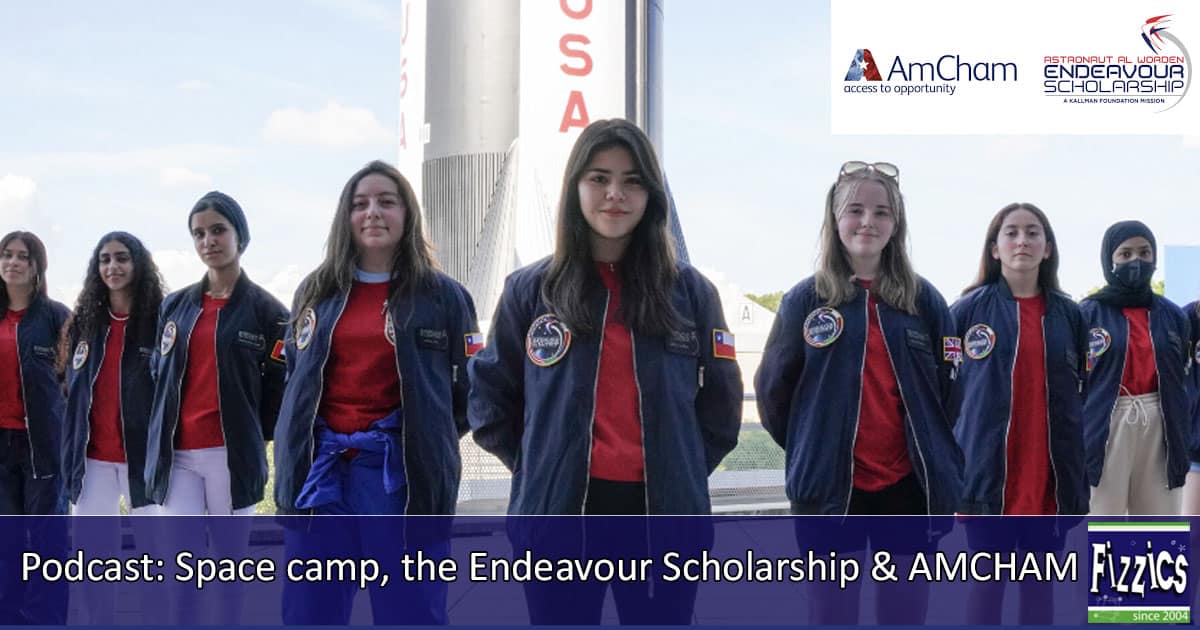
[00:11:23] Josh Edwards: It is. So a terrific organisation called Kallman Worldwide is the main organiser of the Al Worden Endeavour Scholarship Challenge. They’ve run this programme for students in Chile, Singapore, the UAE, the UK, and now in this round, there’ll be Australia, Bahrain, France, and the United States.
[00:11:38] Josh Edwards: So it truly is a global opportunity. And it’s one of the amazing things about space. I mean, you look at the global collaboration on the International Space Station. We can’t do it alone.
[00:11:50] Josh Edwards: And so that’s one of the things that this scholarship fund really looks at emphasising and making sure that students from their first opportunity to get involved in space know that it is a global community that works to achieve these problems.
[00:12:06] Ben Newsome: And now you did mention Al Worden. So for people going, “Who’s Al?” Apollo 15 command module pilot launched this scholarship programme in 2019. So it’s been going for a few years. COVID would have been a bit challenging, I believe.
[00:12:19] Josh Edwards: Yeah, it would have. And, you know, this is the first year that Australia’s been involved. We’re delighted to have COVID behind us so that we can get these kids on the plane and across for this wonderful opportunity. And Al Worden was an amazing advocate for STEM and for global international collaboration and education. Those were his absolute passions. He was an engineer. He wanted to see the opportunities that students who could pursue careers in STEM could go and do. He wanted to see that they could go and become astronauts if they put their mind to it. And these are the sorts of opportunities that are available today.
[00:12:57] Ben Newsome: Now a little heads-up. If you happen to pick up one of these scholarships—because you could be the person who gets it—make sure that you remember and meet as many people as you can, because the reality of these industries is that they’re also network driven. And you just never know where this might take you.
[00:13:15] Josh Edwards: They are. And that’s an amazing recurring theme that comes up at AmCham. We just had a couple of events with Pam Melroy, who’s NASA’s deputy administrator and a former astronaut herself, who helped build the International Space Station.
[00:13:28] Josh Edwards: And we had events in Perth, we had events in Sydney, and soon we’ll have NASA administrator, former Senator Bill Nelson, come and address an AmCham audience in Adelaide alongside Enrico Palermo, the head of the Australian Space Agency.
[00:13:43] Josh Edwards: So these sorts of networking opportunities will go through with you for these students through to the rest of their professional careers. And the amazing opportunities to meet people who are deeply committed, passionate individuals is a really wonderful thing.
[00:14:00] Ben Newsome: 100 per cent. So, right, we’re excited. Where do we have to go?
[00:14:03] Josh Edwards: So if you visit amcham.com.au, all the information will be there. There’ll be links to find more information, informational videos, more information on what the scholarship entails, what Space Camp entails, it’s all there. So amcham.com.au.
[00:14:20] Ben Newsome: And find out a bit more what AmCham does, because it’s curious just what’s out there in the world and in behind the scenes. You guys are doing some amazing stuff.
[00:14:28] Josh Edwards: Yeah. So AmCham was established in 1961 in Australia. So we’ve been here for a fair while now. We have over 500 members ranging from small startup companies who are looking to get their foothold and enter the market all the way through to international companies like Amazon, as we discussed earlier, like Boeing.
[00:14:45] Josh Edwards: Incredible companies doing incredible things. So it’s an amazing network of people in all sorts of industries in the educational sector. We have a lot of universities who are deeply involved in programmes like this as well.
[00:15:00] Josh Edwards: And one of the exciting things that I’m working on is a report series with KPMG. This is a report series looking at the emerging industries that are going to shape the future economies of Australia and the United States called “A Prosperous Future.” And our next edition is on space. So stay tuned on our website, that’ll be released a little bit later this year.
[00:15:20] Ben Newsome: 100 per cent. And Australian audience listening in, there is a genuine push between to 2030 whereby 20,000 jobs are required in the space industry. And what a way to start your career.
[00:15:34] Josh Edwards: They certainly are and there are amazing job opportunities and they’re often in really interesting communities. The NASA launches up in the remote areas of the Northern Territory that happened last year are an amazing indicator of what there is to come for communities. There are spaceports being built in Far North Queensland and in Western Australia. There are amazing opportunities in the space industry and it is certainly going to continue growing.
[00:16:00] Ben Newsome: Hey, a little bit of a heads-up, too, this is the way I think. If you’re listening in, maybe consider if you’re going to submit this idea—I know you’ve only got a couple of weeks as we record this thing and maybe you’re only hearing this a couple of days before the submission date—but maybe have a look at the actual space industry websites themselves, like go to the Australian Space Agency and look at all the different areas the industry covers.
[00:16:21] Ben Newsome: And importantly, maybe have a think about what is needed here. Because perhaps this might be the beginnings of, you know, you’ve got a couple minute pitch to submit for the scholarship. This could actually be something that you could actually dive into because you might not need to get a job in the industry, maybe you might found a company.
[00:16:41] Josh Edwards: Oh, absolutely. And the number of companies that are involved at some stage in the supply chain of the space industry is incredible. So the companies that you might not immediately associate with launching into space are often very involved in space. It’s covering agriculture, it’s covering mining, climate change. All of these issues will have space applications to help solve problems and create new opportunities.
[00:17:09] Ben Newsome: Fantastic. So again, like always, we always put the links in the show notes, so that will be there. And very, very excited. I hope you get ahead if you’re listening in. And if you don’t get there, it’s okay. There will always be another time. This has been running since 2019 and I believe 2024 will happen as well. But this might be your year.
[00:17:25] Josh Edwards: That’s right. I mean, and the chamber will continue supporting kids who want to get involved, who want to see what the next opportunity is that’s out there. And whether it’s in space or in another area that they’re passionate about, there’ll be an event. We run events all across the country in all different industries and sectors. The chamber’s got an incredible network and we want to keep that to growing.
[00:17:49] Ben Newsome: Awesome. Thanks very much for your time, Josh. This was great.
[00:17:52] Josh Edwards: Pleasure to join you, Ben. Catch you soon.
[00:17:56] Ben Newsome: We hope you’ve been enjoying the Fizzics Ed Podcast. We love making science make sense. Why don’t you book us for a science show or workshop in your school? If you’re outside of Australia, you can connect with us via a virtual excursion. See our website for more.
[00:18:13] Ben Newsome: Hey, thanks so much, Josh, for dropping by to tell us about the Al Worden Endeavour Scholarship. This is an amazing opportunity. So teachers, let your students know. If they’re aged between 15 and 18, they can get that full scholarship, so let them know about it. It’s worth applying. And even if they don’t get it through, it still is good to go through the process. So look, I hope you enjoyed this. I hope this is something that you can take action on because this is a real opportunity for your students. So I hope you enjoyed this chat with Josh. I certainly did, and I hope you can join me again on the Fizzics Ed Podcast. You’ve been listening to me, Ben Newsome from Fizzics Education, and I’ll catch you another time.
[00:18:51] Ben Newsome: You’ve been listening to another Fizzics Ed Podcast. We’re excited about science. Subscribe to us on iTunes to download the next episode as soon as it’s released. And don’t forget, for hundreds of ideas, free experiments, our new “Be Amazing” book and more, go to fizzicseducation.com.au. That’s physics spelled F-I-double-Z-I-C-S.
[00:19:18] Ben Newsome: This podcast is part of the Australian Educators Online Network. AEON.net.au.
Frequently Asked Questions
Who is eligible to apply for the Al Worden Endeavour Scholarship?
The scholarship is open to Australian students aged between 15 and 18 who have a passion for STEM and space exploration.
What does the scholarship prize include?
The scholarship provides an all-expenses-paid trip to the United States to attend a week-long programme at Space Camp in Huntsville, Alabama. This includes hands-on astronaut training, SCUBA diving simulations, and experiencing 1/6th gravity machines.
What are the requirements for the application?
Students must submit a three-minute video accompanied by a one-page summary addressing a future space challenge. The scenario involves a mission to Saturn’s moon, Titan, in the year 2050 with 35 people on board.
Which specific challenges can students choose to address in their pitch?
Applicants must focus on one of the following five areas: water, food, life support, propulsion, or solar radiation. The judges are looking for creative, unique ideas with a technical basis.
When is the application deadline?
Applications for this round are due by the 12th of March. Students are encouraged to focus on clear communication and passion, as the quality of the presentation is a key part of the selection criteria.
Extra thought ideas to consider
The Scale of the Space Economy
With a target of creating 20,000 new jobs in the Australian space industry by 2030, space is no longer just about astronauts; it involves agriculture, mining, climate change monitoring, and complex supply chain management.
Innovation through Practicality
Innovation doesn’t always mean inventing a completely new technology. Often, the most effective solutions are practical “steps to the side” that take existing concepts and apply them to new environments, such as the harsh conditions on Titan.
The Importance of Global Collaboration
The International Space Station stands as a testament to what humans can achieve when they work across borders. This scholarship emphasises that solving the next generation of space challenges will require a global community of scientists and engineers working together.
Discussion points summarised from the FizzicsEd Podcast, verified and edited by Ben Newsome CF